
Business voice troubleshooting, maintenance and change support
VoIP PBX Support in Dubai, UAE
When business calls fail, the telephone system is only one part of the path. Extensions, IP phones, switching, voice VLANs, firewall rules, internet connectivity, SIP trunks and provider services can all affect whether a call rings, connects, stays clear and reaches the intended person. FourTeck helps businesses examine that complete path, define the real support requirement and plan corrective work without assuming the cause before the environment has been checked.
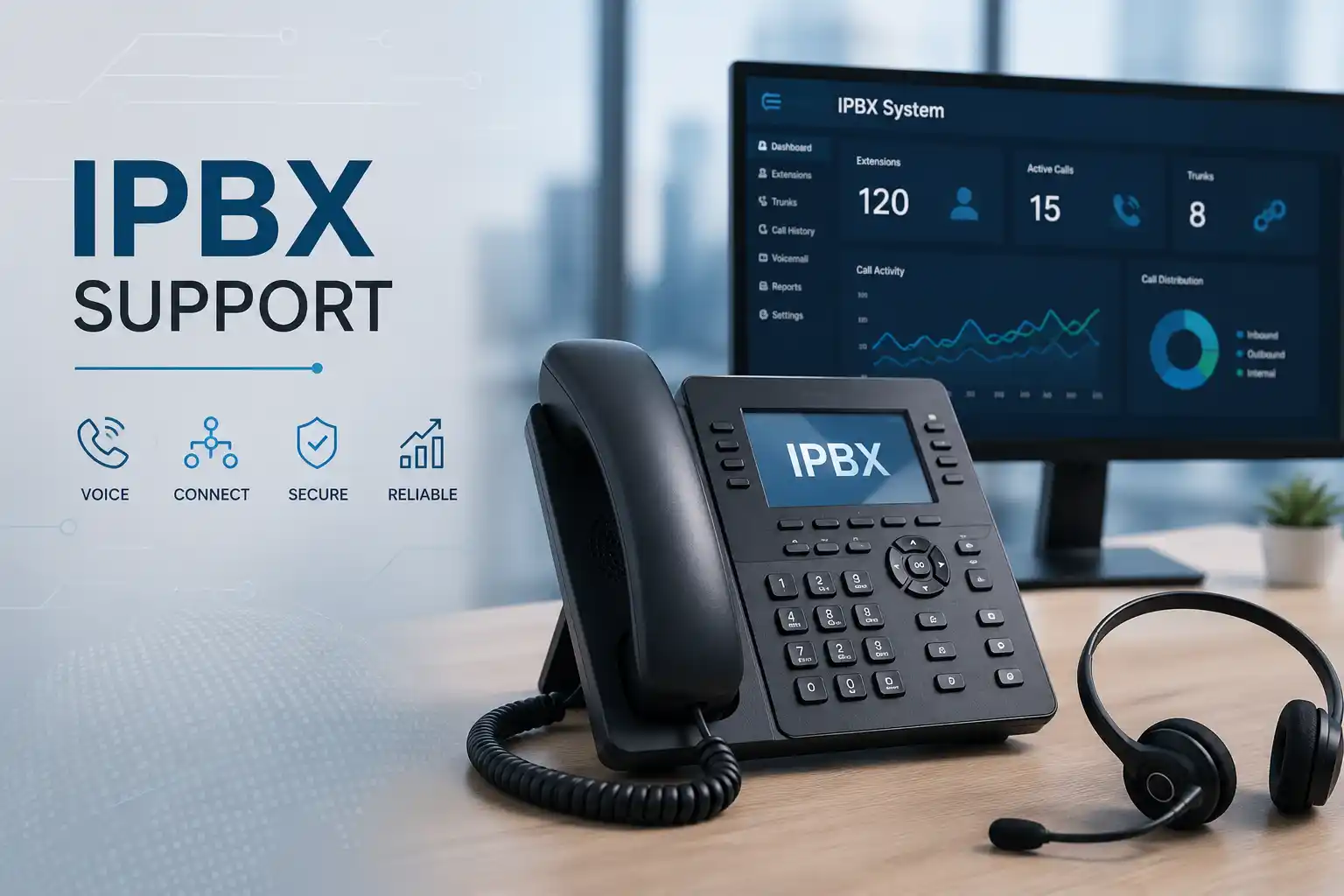
What does VoIP PBX support mean for a business?
VoIP PBX support is the technical assessment, troubleshooting, configuration, maintenance and change assistance used to keep an organisation’s IP-based telephone environment working as intended. It is mainly used when calls fail, call quality is poor, extensions do not register, routing is incorrect, staff need user or extension changes, or an existing PBX needs clearer documentation and maintenance. Businesses should consider support when communication problems affect customers, reception, sales, service teams, remote users or branch operations. Before work is confirmed, prepare the PBX platform details if known, affected extensions, example call times or numbers, recent changes, SIP or telecom provider information, network details, available administrative access and the business outcome required. The exact scope remains access, configuration, vendor and environment dependent.
What the service can cover
Depending on the confirmed scope, FourTeck may assist with PBX health checks, extension registration, ring groups, queues, auto-attendant menus, office-hours rules, voicemail, forwarding, outbound permissions, caller identification, call recording settings, SIP trunk coordination, IP phone connectivity, network and firewall dependencies, configuration backup, migration planning, testing, documentation and administrator handover.
Not every item is included automatically. A telephone fault can cross several technical and provider boundaries, so the first task is to define which systems and parties are involved.
Who may need this support
The service can suit companies with an existing IP PBX, hosted or on-premises voice system, SIP trunks, office IP phones or branch calling arrangements. Typical users include reception teams, sales departments, customer-service groups, managers, shared workspaces, remote employees and multi-site organisations that depend on predictable call handling.
It can also help an organisation that has inherited an undocumented telephone setup, is preparing for an office move, needs new extensions, has recurring call complaints or wants to review whether a current system can support a planned change.
Common VoIP PBX problems that justify a structured assessment
A telephone complaint often arrives as a simple statement: callers cannot hear us, one phone is offline, the main number is not ringing, transfers fail, external calls drop, or the reception queue behaves differently from yesterday. These symptoms are useful evidence, but none of them proves a single cause. The same experience can result from a handset, cable, switch port, IP addressing issue, voice VLAN, PBX registration state, routing rule, firewall behaviour, internet performance, SIP trunk condition or carrier-side event. Structured support begins by narrowing the pattern rather than changing several systems at once.
No inbound calls
Incoming calls may fail before reaching the PBX, arrive at the PBX but follow an incorrect route, or reach an extension that is unavailable. Provider status, DID mapping, trunk registration, time conditions, inbound routes, queue status and extension availability may all require review.
Outbound calls fail
The issue may relate to dial patterns, permissions, account balance or provider conditions, trunk state, number formatting, authentication, routing or firewall connectivity. One extension failing is a different diagnostic signal from every user failing.
One-way or missing audio
Signalling can succeed while the audio path fails. Network address translation, firewall handling, remote endpoints, routing, codec negotiation, provider paths and local network conditions can be relevant. Changes should be evidence-led rather than based on a generic rule.
Poor or unstable call quality
Delay, packet loss, jitter, congestion, weak wireless links, overloaded uplinks, unstable internet service or provider conditions may affect speech. The PBX may be operating normally while another part of the path is degraded.
Phones lose registration
Registration problems can involve power, cabling, switch configuration, DHCP, DNS, VLANs, provisioning, credentials, PBX reachability, network changes or remote connectivity. The pattern and timing of the disconnection matter.
Call flow is wrong
Reception routing, queues, ring groups, prompts, office hours, overflow rules, voicemail and forwarding can become confusing after repeated changes. A written map of the intended customer journey is often the best starting point before further configuration.
Why unresolved voice problems can affect more than the phone system
Business telephony connects customers, suppliers, reception, sales, support staff, management and remote teams. A recurring call fault can therefore create operational effects that are larger than the number of affected handsets. Missed inbound calls can delay enquiries and service requests. Poor audio can force staff to repeat calls or switch to personal communication methods. Incorrect routing can send customers to the wrong team or to voicemail when staff are available. A failed branch link can isolate a remote office from shared extension dialling. An undocumented PBX can make a small user change risky because nobody is certain which routing rule depends on it.
The objective of support is not simply to make one test call succeed. A useful outcome is a clearer understanding of the affected path, approved corrective action, validation of important call scenarios and records that make future changes easier to manage. Some faults will still depend on an internet provider, SIP carrier, hosted platform, manufacturer, building cabling or customer-controlled network device. Identifying that dependency accurately is part of the service rather than a failure of the assessment.
Possible VoIP PBX support scope
The final scope should be agreed after the environment, symptoms and business priority are understood. Depending on the confirmed requirement, assistance may include the following activities. The list is intentionally broad because one customer may need a single routing correction while another may need a multi-system assessment involving phones, network equipment, a firewall and a telecom provider.
Inbound routes, department destinations, ring groups, queues, prompts, overflow behaviour, office hours, voicemail and forwarding logic.
New or changed extensions, display names, permissions, registration status, user moves and approved role-based settings.
Trunk state, authentication information supplied securely, provider-side routing evidence, number mapping and escalation details where the carrier must act.
Pattern review, network path checks, packet-loss or congestion evidence, switch and uplink considerations, internet behaviour and provider dependency.
Power, cable, switch port, addressing, VLAN, provisioning, registration, feature keys, headset or handset issues and replacement compatibility considerations.
Available backups, export options, change notes and rollback planning before modifications that could affect multiple users or routes.
Inventory of numbers, extensions, trunks, prompts, call flows, devices, integrations and dependencies before an upgrade or platform change.
Records of relevant settings, extension lists, provider dependencies, test results, completed work and recommended next actions within the agreed scope.
Service-fit matrix: what the symptom may tell us
| Observed situation | Possible technical areas | Recommended next step |
|---|---|---|
| One phone cannot register | Phone power, cable, switch port, VLAN, addressing, provisioning or extension credentials | Compare the affected device with a working phone and preserve existing settings before broad changes. |
| All external calls fail | SIP trunk, provider service, internet, firewall, routing or PBX outbound rules | Establish whether internal extension calling still works, then check trunk and provider evidence. |
| Calls connect but audio is one-way | Media path, NAT, firewall, routing, remote endpoint or provider behaviour | Capture exact call examples and test the signalling and audio paths separately. |
| Reception routing changed unexpectedly | Time conditions, inbound routes, queues, ring groups, forwarding or recent configuration changes | Document the intended call flow and compare it with the current configuration before editing routes. |
| Quality is poor at busy times | Bandwidth, congestion, switch uplinks, packet loss, Wi-Fi, internet service or provider path | Correlate the complaint with time, location, connection method and network load. |
| Office move or expansion planned | Extension plan, switch PoE capacity, cabling, VLANs, firewall, numbers, trunks and user requirements | Inventory the current environment and confirm the new site’s voice and network prerequisites before moving devices. |
Service information for planning a support request
| Service topic | VoIP PBX support, troubleshooting, maintenance and controlled configuration assistance. |
|---|---|
| Main purpose | Identify the affected communication layer, restore or improve approved call functions where possible, and document practical next steps. |
| Typical systems involved | PBX platform, IP phones, switches, PoE, voice VLANs, router or firewall, internet connection, SIP trunks, remote phones and provider services. |
| Remote support suitability | Often suitable for configuration review, logs, routing, account administration and provider coordination when secure authorised access is available. |
| On-site suitability | Useful when phones, cabling, switch ports, PoE, racks, physical equipment or site-specific network conditions require inspection. |
| Customer access required | Access dependent. Administrative or provider access may be needed through an approved secure method after authorisation is confirmed. |
| Testing and validation | Scope dependent. Typical tests can include internal, inbound, outbound, transfer, queue, voicemail, office-hours and remote-user scenarios where applicable. |
| Vendor coordination | May involve the SIP carrier, internet provider, hosted service, hardware vendor or other third party when evidence points outside the customer’s direct environment. |
| Service location | Dubai and UAE coordination, subject to scope, location, scheduling, access and approved quotation. |
| Quotation requirement | Final commercial terms depend on the confirmed work, affected environment, remote or on-site requirement, dependencies and any project tasks. |
Remote VoIP PBX support or an on-site visit?
When remote assistance may be practical
Remote support can be efficient when the PBX is reachable securely, an authorised user or administrator can assist, the internet connection is working and the issue is mainly related to configuration, extensions, call flow, logs, SIP account state or provider communication. It may allow the engineer to compare settings, review registration status, inspect routing, collect diagnostic evidence and perform approved changes without waiting for physical access to the site.
Remote access does not remove the need for authorisation, backups or change control. It also cannot replace hands-on testing when the problem appears to involve a faulty cable, switch port, PoE power, handset, rack equipment or physical site condition.
When on-site support may be more appropriate
An on-site visit may be recommended when several phones are affected by local infrastructure, the PBX or gateway cannot be reached remotely, cabling must be tested, switch ports or PoE need hands-on inspection, a rack change is planned, phones must be moved or provisioned physically, or the issue depends on the exact condition of equipment at the premises. A site visit can also help when an undocumented system needs an inventory before an upgrade or relocation.
Attendance timing depends on location, engineer availability, building access, site conditions, required equipment and the confirmed scope. Contact FourTeck to confirm the suitable support method rather than assuming that every fault requires a visit.
How a VoIP PBX diagnosis can be approached
A useful troubleshooting process moves from business impact to evidence, then from broad system boundaries toward the specific layer that appears responsible. It should avoid random resets or unrelated configuration changes that can erase useful evidence and create new faults.
Identify whether the issue affects one user, one department, one call direction, one branch or the whole business. Record what still works.
Note example times, numbers, extensions, symptoms and whether the issue is consistent or intermittent. This helps correlate logs and provider records.
Check for network, firewall, internet, PBX, provider, cabling, firmware, user or office changes near the time the problem began.
Establish authorised administrative access and available configuration backups before making changes that could affect service.
Review phone status, switch connectivity, addressing, VLANs, PBX registration, trunk state, firewall path, internet behaviour and provider dependency as relevant.
Distinguish local configuration from a network or provider issue and explain which evidence supports the next action.
Make only agreed changes, preserving rollback options where appropriate and coordinating any third-party action.
Repeat meaningful call scenarios, confirm the user experience and record completed changes, remaining dependencies and recommendations.
Planning configuration changes without creating a second problem
PBX configuration can affect many users at once. A change to an outbound rule can prevent a department from calling. A modified inbound route can send customers to the wrong destination. A firewall adjustment intended to correct audio can expose more services than required if it is applied without understanding the traffic path. For that reason, configuration support should begin with a written business objective, an understanding of the current arrangement and a realistic rollback option where the platform permits it.
The change plan may include a configuration backup or export, a record of the original values, confirmation of authorised access, a maintenance window if the change could interrupt calls, and a short validation script that reflects the customer’s real call flow. For example, a reception change may need an external inbound call, an internal transfer, an unanswered overflow path, a voicemail test and an after-hours test. The correct validation sequence depends on the system and requested change.
Licensing, hosted-platform restrictions, provider settings, proprietary provisioning, unsupported firmware or older hardware can limit what can be changed. FourTeck can help identify these dependencies, but a third party may need to approve or implement part of the work.
Testing, validation and handover after PBX work
A support task should end with evidence that the agreed scenarios have been tested, not only with a statement that a setting was changed. The validation plan should match the original problem and business use. If the issue involved inbound sales calls, the test should include the sales number and its actual routing. If one branch experienced poor audio, test that branch and the relevant path. If new users were added, verify registration, outbound permissions, inbound direct numbers where applicable, voicemail and transfer behaviour expected for their roles.
Where the PBX interacts with a SIP provider, firewall or internet connection, some validation may require coordination across several parties. A successful test at one moment also does not guarantee that an intermittent provider or network fault has disappeared permanently. If the complaint occurs only during high utilisation, monitoring or additional evidence may be required.
Handover can include the actions completed, affected settings, extension or call-flow records, backup location if part of scope, third-party cases raised, remaining risks and recommendations. Clear notes reduce dependence on memory when a similar problem returns or when another engineer later needs to make a change.
Capability focus: faster fault isolation through call-path thinking
VoIP is a chain of dependencies. A desk phone needs power, a live network connection, an address, a path to the PBX and valid registration. The PBX needs the correct extension and routing logic. External calls may additionally depend on a SIP trunk, internet connection, firewall policy, NAT behaviour, DNS, upstream routing and the carrier network. Remote users add further variables such as their local internet service, VPN or session security and the method supported by the PBX platform.
The value of call-path thinking is that it gives the support process an order. If internal calls work but external calls do not, the investigation can focus beyond basic extension registration. If one desk fails while nearby phones work, attention can move toward the local phone, cable, switch port or extension profile. If every phone loses audio at the same time but signalling remains available, the investigation can focus on shared media-path dependencies rather than replacing handsets.
This method does not guarantee an immediate cause, particularly with intermittent faults, but it reduces unnecessary changes and creates clearer evidence for any provider or vendor escalation that follows.
Capability focus: clearer call-flow documentation for reception and departments
Many PBX problems are not technical failures in the traditional sense. The system may be working exactly as configured, but the configuration no longer matches the business. Staff changes, new departments, revised office hours, multiple receptionists, remote working, seasonal coverage and new direct numbers can gradually turn an understandable call flow into a set of overlapping exceptions.
A practical support engagement can therefore include mapping the desired customer journey before making changes. Which number does the customer dial? Which team should ring first? How many seconds should pass before another destination is tried, subject to the platform’s capability? What should happen when staff are busy? Does the call reach a queue, another branch, reception or voicemail? What changes after business hours? Who owns recorded prompts? Which users are allowed to redirect calls? These are business decisions that should guide the technical configuration.
Documenting the intended flow creates a useful reference for testing and future changes. It also helps management distinguish a configuration request from a fault, which can make support conversations more precise and reduce the risk of solving one department’s request by disrupting another department’s calls.
Capability focus: preparing an existing PBX for maintenance, relocation or upgrade
Older telephone systems can continue to serve a business for years, but they often accumulate undocumented extensions, obsolete user accounts, unknown administrator dependencies, old prompts, provider details held by one person and call rules whose purpose is no longer obvious. A relocation or upgrade exposes these gaps because the business suddenly needs to know which numbers, devices, routes and integrations must survive the change.
Preparation can start with an inventory of the PBX platform, version where relevant, extensions, phone models, SIP trunks, direct numbers, ring groups, queues, auto attendants, voicemail, recording requirements, remote users, branch connections, gateways and integrations. Available configuration backups and provider account information should be identified. The network should also be reviewed because a new office may use different switches, VLANs, firewall rules, internet services and cabling.
The objective is not to promise that every legacy function will move unchanged. Compatibility, licensing, provider portability, supported firmware, handset provisioning and third-party integrations can affect the final design. FourTeck can help document the current state and define the questions that should be resolved before a maintenance window or migration is approved.
Dependencies, access and customer responsibilities
VoIP PBX support often requires cooperation across the customer’s IT and telecom environment. FourTeck may need an authorised contact who can describe the business impact, approve changes and provide access to the relevant systems. Administrative credentials should not be posted publicly or sent casually. Credentials should be shared only through an approved secure method after identity and authorisation are confirmed.
Useful information can include the PBX platform, affected extensions, SIP provider, internet provider, public numbers, network diagram, firewall model, switch layout, voice VLAN information, current backups, support contracts, licenses, previous vendor notes and recent change records. Some hosted services restrict administrative functions to the service provider, while some on-premises systems may depend on vendor-specific software, expired maintenance or unsupported hardware. These limits can affect the available options.
The customer may also need to provide a suitable maintenance window, building or rack access, an on-site contact, authority to coordinate with providers and representatives who can perform user acceptance tests. If replacement parts, licenses, telecom changes or third-party engineering are required, those elements may need a separate quotation or provider approval.
Risk, limitations and exclusions to understand before work begins
Diagnosis depends on available evidence, access and the ability to reproduce or observe the reported problem. An intermittent voice fault may require logs, repeated examples or monitoring before the source becomes clear. A carrier or internet provider may need to investigate its own network, and FourTeck cannot guarantee the actions or timing of an independent third party.
Configuration changes can interrupt calls, so broad changes should be avoided without authorisation, a suitable maintenance window and a recovery path where practical. Hardware faults may require parts or replacement outside the support labour scope. Unsupported PBX versions, discontinued phones, obsolete gateways or expired licenses can limit configuration and security options. A successful test confirms the tested scenario at that time; it does not remove the need for ongoing maintenance, capacity planning or provider monitoring.
Migration or major upgrade work requires its own discovery and change plan. Zero downtime should not be assumed, and legacy phones, trunks, integrations or recordings may not transfer without modification. Final timing, inclusions, exclusions and commercial terms depend on the approved quotation or service agreement.
Business environments where PBX support may be useful
Different organisations use telephony in different ways, which changes what a support engineer must prioritise. A professional office may rely on direct extensions, receptionist transfer and meeting-room phones. A retail location may need a main number that reliably reaches the floor or back office. A clinic may need departments to receive calls predictably while staff move between rooms. A warehouse may need durable endpoints, paging or branch calling across a noisy operational environment. A hospitality site may depend on reception and internal extension routing. A multi-branch business may need consistent dial plans, central reception, shared queues or secure remote extensions.
For remote and hybrid teams, internet quality and endpoint security become more important because the call path leaves the controlled office network. For growing organisations, onboarding and offboarding matter: extensions, names, permissions, voicemail, queues and direct numbers should be updated when people join, move roles or leave. For project offices, temporary connectivity and a defined shutdown or relocation process may be more important than long-term expansion.
FourTeck can adapt the assessment to the actual call workflow rather than applying one generic checklist. The required support scope remains dependent on the platform, user count, locations, provider arrangement and approved business objective.
Operational, security and maintenance considerations for business voice
A PBX should be treated as business infrastructure rather than an appliance that is ignored until a failure. Administration access should be limited to authorised people and changed when responsibilities change. Remote access methods should follow the platform’s supported design and the organisation’s security requirements. Old users, unused extensions, stale provider accounts and shared administrator credentials can make the environment harder to manage and increase avoidable risk. Firmware or software maintenance should be planned with compatibility and rollback in mind rather than applied blindly to a production telephone system.
Backups are important, but their usefulness depends on what they contain, where they are stored and whether they match the system version and recovery method. The PBX documentation should identify critical numbers, trunks, extensions, queues, call flows and the network dependencies that matter during an outage. If voice shares network switches with computers, wireless access points and cameras, capacity and PoE limits should be understood. If the company relies heavily on external calls, internet and SIP-provider continuity should be part of the wider business continuity discussion.
Maintenance can therefore include periodic configuration review, backup checks, user and extension housekeeping, call-flow confirmation, provider details, software lifecycle review and network dependency checks. Actual inclusions and frequency depend on the agreed maintenance scope.
Before you contact FourTeck about a VoIP PBX issue
Preparing concise information can shorten the discovery stage and help decide whether remote support or an on-site visit is more appropriate. You do not need every technical detail before making contact, but the following items are useful where available.
- The Dubai or UAE service location and an authorised contact person.
- A clear description of the business impact, not only the technical symptom.
- Which users, extensions, departments, numbers or branches are affected.
- Whether internal calls, inbound calls and outbound calls work differently.
- Two or three recent example call times and numbers where appropriate.
- The PBX platform, hosting arrangement and version if known.
- The SIP trunk or telecom provider and account contact details, without posting passwords.
- Relevant IP phone, gateway, switch, router or firewall details if known.
- Any network, ISP, firewall, PBX or office changes made before the issue started.
- Whether secure administrative access can be arranged after authorisation.
- Whether a recent PBX configuration backup or export exists.
- The normal working hours and an acceptable maintenance window for disruptive changes.
- Building, rack or site-access restrictions that may affect an on-site visit.
- Any provider case number or previous technician notes related to the fault.
- The desired result, such as restored calls, corrected routing, new users, better documentation or migration planning.
Service evaluation checklist for quotation and engagement scope
Before a quotation is finalised, the parties should have a shared understanding of what the engagement is expected to cover. The following points help separate a short support task from a wider project or maintenance requirement.
- Exact service objective and the business priority attached to it.
- Number of users, phones, extensions and affected sites within scope.
- Current PBX platform, hosting model, carrier arrangement and network dependencies.
- Remote-only, on-site or combined support requirement.
- Administrative, provider and physical access available to the assigned engineer.
- Whether corrective configuration, new extensions, call-flow changes or migration planning are required.
- Whether telecom-provider or internet-provider coordination is part of the requested work.
- Testing scenarios expected before the work is accepted.
- Documentation, extension lists, call-flow records or administrator handover required.
- Maintenance window, user communication and any business restrictions on downtime.
- Parts, licenses, subscriptions or third-party charges that are outside or separate from support labour.
- Whether ongoing maintenance or only a one-time assessment is being requested.
How FourTeck can assist with the next step
FourTeck can begin by clarifying the reported issue and determining which parts of the business voice environment may be involved. The assessment can connect user experience with PBX configuration, phone status, network behaviour, firewall or internet dependencies and telecom-provider information. When enough evidence is available, FourTeck can explain whether the next action is likely to be remote troubleshooting, an on-site inspection, an approved configuration change, provider escalation, replacement assessment, migration planning or a more detailed project scope.
For planned work, FourTeck can help document extensions, numbers, trunks, users, call flows and network prerequisites before a relocation, expansion or upgrade. For recurring support, the discussion can include backups, maintenance responsibilities, administrator access, change records and provider contacts. Testing and handover can be included where they form part of the approved scope.
The purpose of the quotation stage is to remove ambiguity. The customer should understand what FourTeck is expected to assess or change, which third parties may be involved, what access is required, whether a maintenance window is needed and what deliverables are expected. Contact FourTeck IT Services to provide the issue details and request a scope discussion.
Dubai and UAE service coordination
VoIP PBX support in Dubai may be delivered remotely, on site or through a combination of both, depending on the issue, authorised access and physical work required. A configuration or call-routing problem may be assessed remotely when the PBX and related systems are reachable securely. A site visit may be recommended for cabling, phones, switch ports, PoE, rack equipment, gateways or network conditions that cannot be checked from a remote session.
Service timing depends on engineer availability, customer access, the confirmed work scope, site conditions, provider participation and any required parts or licenses. Installation, configuration, migration and maintenance tasks should be stated clearly in the quotation rather than assumed. Customers can review the wider FourTeck IT services available for connected business systems or use the support contact page to discuss a specific telephone issue.
Coordinating PBX support across Dubai, Abu Dhabi, Sharjah and Ajman
Businesses with users or branches in Dubai, Abu Dhabi, Sharjah and Ajman may need one support conversation to separate central PBX issues from local-site problems. A central call-routing change can affect several locations, while a single branch may have its own switch, cabling, firewall, internet circuit or phone-registration issue. The support plan should therefore identify which functions are shared and which are site specific before engineers or providers begin changing settings.
Remote troubleshooting can be useful for central configuration, logs, SIP status, routing and user administration. Planned on-site visits may be more suitable for physical equipment, local cabling, switch or PoE checks, branch gateways, phone moves or a site inventory. Installation, migration and maintenance projects can combine discovery, remote preparation and scheduled physical work according to the approved scope.
Scheduling and travel depend on location, building access, engineer availability, site conditions, equipment readiness and third-party coordination. FourTeck does not assume permanent coverage or immediate attendance in every location. The service plan is confirmed after the customer explains the affected sites, business priority, technical environment and required outcome.
Related FourTeck IT services that can affect voice reliability
Switching, VLAN, cabling, addressing and connectivity checks can be relevant when phones lose registration or call quality is unstable.
Firewall and VPN support
Voice signalling, media paths and remote users may depend on firewall routing, NAT, VPN or access policies that require controlled review.
IP phone support
Handset power, provisioning, registration, feature keys and user moves are part of the endpoint side of a PBX environment.
Business IT support
Voice issues may intersect with internet connectivity, users, networks, servers and other workplace systems that need a wider technical view.
Why businesses contact FourTeck for PBX-related assistance
A business communication problem can sit between several suppliers. The phone vendor may say the network is responsible. The internet provider may say the circuit is healthy. The SIP provider may ask for call examples. Internal staff may know that the issue began after a change but not which setting matters. FourTeck’s role can be to create one technical view of the customer environment, collect useful evidence and coordinate the next action without making unsupported assumptions about the cause.
The same approach is useful for planned changes. Rather than beginning with a device list, the discussion can start with the call outcome: which numbers must work, how reception should route calls, which users need direct numbers, how branches communicate, what happens after hours and what must be documented at handover. That business context helps define the PBX, network and provider tasks that belong in the quotation.
FourTeck can also connect PBX work with broader network, firewall, internet and user-support requirements where those dependencies are part of the issue. For company background and the service approach, visit the FourTeck IT Services information page.
Questions businesses often ask before requesting VoIP PBX support
The questions below cover the decisions customers commonly need to make before engaging a support provider. The correct answer can depend on the PBX platform, hosting model, network design, telecom carrier, access available and whether the issue is a fault, a change request or a wider project.
Can a VoIP PBX problem be checked remotely?
Often, yes, provided the customer has working internet connectivity, secure authorised access can be arranged and the problem does not require physical inspection. Remote troubleshooting may be suitable for extension registration, call routing, queues, voicemail, office-hours rules, trunk status, logs, provider details and some firewall or network checks. It is especially useful when the PBX is hosted or when an administrator can provide controlled access to an on-premises system. Remote work is less suitable when the PBX is unreachable, phones have no power, cabling is suspected, switch ports must be tested or local equipment needs replacement. The first conversation should establish what still works, which users are affected and whether the site can provide an authorised contact. From there, FourTeck can recommend a remote assessment or propose an on-site scope if physical evidence is essential.
Why do callers hear one-way audio even though the call connects?
A connected call shows that signalling completed, but the voice media may travel through a different path. One-way audio can therefore involve firewall or NAT handling, routing, remote endpoint conditions, internet paths, provider settings or the way the PBX advertises media information. It should not automatically be treated as a phone fault or solved by opening broad firewall access. Useful evidence includes whether the problem affects inbound, outbound, internal or remote calls; whether it happens with every number or only certain destinations; and whether it started after a network, firewall, provider or PBX change. A controlled assessment can compare successful and failed call paths, review relevant logs and identify which party owns the next action. Because media-path problems can cross customer and provider boundaries, resolution may depend on cooperation with the SIP carrier or hosted service.
What should we do when the main number rings the wrong department?
Start by writing down the intended call journey before anyone edits the PBX. Identify the public number, the first destination, the expected ringing period, overflow destination, busy behaviour, office-hours behaviour, after-hours destination and voicemail requirements. If there are different routes for sales, accounts, support or branches, record them separately. The current PBX may use inbound routes, ring groups, queues, time conditions, digital receptionist menus or forwarding rules to create that behaviour. One small change can therefore have several downstream effects. FourTeck can compare the desired flow with the present configuration and define the specific change scope. Testing should then include real external calls during the relevant time condition. If the public number is routed by the carrier before it reaches the PBX, provider coordination may also be necessary.
Is poor VoIP quality always an internet problem?
No. Internet quality is important for many external and hosted voice systems, but speech quality also depends on the local network, switch uplinks, congestion, packet loss, wireless links, firewall processing, remote-user connections, provider paths and the endpoints themselves. A useful diagnosis begins with the pattern. If only one desk has problems, a local phone, cable or switch port deserves attention. If every user experiences distortion at a certain time, shared network load or an upstream service may be more relevant. If internal calls are clear but external calls are poor, the boundary between the PBX and the carrier becomes important. The support process should compare affected and unaffected scenarios rather than relying on a single speed test. Depending on the evidence, additional network monitoring, provider tests or Quality of Service review may be appropriate.
When is an on-site PBX visit usually needed?
An on-site visit is usually more useful when hands-on evidence matters. Examples include phones that receive no PoE power, suspected damaged cabling, switch-port faults, rack or gateway issues, an on-premises PBX that cannot be reached remotely, office moves, phone relocation, physical inventory work or a site where several local systems interact in an undocumented way. It can also be appropriate when remote tests point to a physical layer that cannot be verified by the customer’s staff. An on-site visit should still have a defined objective; attendance alone does not guarantee that a carrier-side or software-side issue can be resolved at the premises. The quotation or work order should identify the systems to inspect, site access requirements, authorised contact, expected tests and any known third-party dependencies.
Should we repair the current PBX or plan an upgrade?
The decision depends on whether the current system still meets the business requirement and remains supportable. A system may justify continued maintenance when it is stable, compatible with required phones and trunks, appropriately secured, documented and supported by its vendor or service provider. Upgrade planning becomes more relevant when hardware is failing repeatedly, software is no longer supported, licenses prevent required functions, administrator access is uncertain, replacement parts are difficult to obtain, provider compatibility is changing or the business needs features and capacity the present system cannot deliver. FourTeck can help inventory the existing environment and separate immediate faults from lifecycle concerns. An upgrade should not be recommended solely because a system is old; the risks, dependencies, user impact, migration effort and business outcome should be considered together.
What information helps diagnose an intermittent call problem?
Intermittent problems are easier to investigate when users record specific examples rather than general statements. Ask affected staff to note the approximate time, calling and called numbers, extension, call direction, location, whether the call connected, what each side heard and whether another call made immediately afterward worked. If the issue affects a branch or remote user, record the connection method and whether other internet services were normal. Preserve relevant logs when possible and avoid rebooting multiple devices before evidence is captured unless service restoration requires it and the change is authorised. Recent firewall, ISP, PBX, phone, switch or office changes are also useful context. With enough examples, the support process can look for patterns across logs, network events and provider records.
Can we add new extensions without changing the rest of the system?
Sometimes, but the impact should be checked before the change. A new extension may need a license, available number range, handset or softphone compatibility, network connection, PoE capacity, voice VLAN access, provisioning, outbound permissions, voicemail, queue membership, direct number and security settings. In a small environment, these dependencies may be simple. In a larger office, extension templates and user roles may be used to standardise settings. If the PBX is hosted, the service provider may control licensing or provisioning. If a new user requires a direct public number, the carrier may need to allocate or route it. The change should therefore begin with the user’s role and expected calling functions rather than only with an extension number.
What should we confirm before moving the PBX or phones to a new office?
Confirm the current inventory and the new site’s prerequisites before moving equipment. The inventory can include the PBX or hosted service, phones, extensions, public numbers, SIP trunks, gateways, queues, reception flow, remote users, prompts and any analogue devices or integrations. At the new site, check internet service, firewall readiness, switch capacity, PoE budget, voice VLAN design, structured cabling, rack power, number portability requirements and provider lead times. A move should also include a cutover plan, user communication, fallback considerations and an agreed validation script. A working phone at the new desk is not enough if the main number, reception routing, transfers, voicemail and outbound presentation have not been tested. The final schedule remains dependent on site readiness and third-party services.
What should be included in a PBX support quotation?
A useful quotation should make the scope understandable to both technical and business stakeholders. It should identify the service objective, affected site or sites, systems within scope, whether work is remote or on site, access assumptions, planned diagnostic or configuration tasks, testing expectations, documentation or handover requirements and known exclusions. If provider coordination, licenses, hardware replacement, migration, cabling or network changes may be required, the quotation should state whether those elements are included, estimated separately or dependent on further assessment. It should also identify any maintenance-window requirement or customer responsibilities that could affect delivery. FourTeck can prepare the quotation after the environment and required outcome are sufficiently defined; pricing and scheduling should not be inferred from the page before that assessment.
When should we consider ongoing PBX maintenance instead of one-time support?
One-time support may be appropriate for a specific, isolated fault or change when the environment is otherwise documented and stable. Ongoing maintenance becomes more useful when the PBX supports many users or sites, changes happen frequently, call routing is business critical, provider dependencies are complex, software lifecycle needs attention, backups need review or the company wants a documented process for user changes and recurring incidents. A maintenance plan can define which systems, users and sites are covered, what preventive tasks are expected, how changes are requested, how provider escalation is handled and which work remains chargeable or project based. Actual inclusions, review frequency, response arrangements and on-site activities depend on the agreed service plan and should not be assumed to be unlimited.
Frequently asked questions about VoIP PBX support in Dubai
What does FourTeck check first?
The first step is to understand the business impact and identify whether the problem affects one phone, one user group, one call direction, one site or the wider environment. That pattern helps define which technical layers should be checked next.
Can FourTeck support SIP trunk issues?
Support can include reviewing trunk status, PBX-side settings, call examples and network dependencies, then coordinating technical evidence with the carrier where provider action is required. Final access and scope depend on the service arrangement.
Can call routing and queues be changed?
Yes, subject to platform capability, authorised access and the approved scope. The desired business call flow should be documented before changes so inbound routes, queues, ring groups, office hours and overflow behaviour can be tested properly.
Do you need our PBX password?
Administrative access may be required for some tasks, but passwords should not be posted publicly. Credentials should be shared only through an approved secure method after identity, authorisation and the support scope are confirmed.
Can network problems affect VoIP?
Yes. Phones and PBX services can depend on switching, PoE, addressing, VLANs, DNS, routing, firewalls, internet connectivity and provider paths. That is why voice troubleshooting often includes selected network checks.
Can you support office moves?
FourTeck can assist with discovery, extension and number inventory, new-site voice prerequisites, configuration planning, user moves and testing where included in the approved project scope. Provider lead times and site readiness can affect scheduling.
Will remote support fix every PBX fault?
No. Remote support is suitable for many configuration and diagnostic tasks, but physical faults, cabling, switch ports, PoE, rack equipment or inaccessible systems may require on-site work.
Is a configuration backup important?
Yes, where the platform supports it. A known backup or export can improve rollback and recovery options before a significant change. Its usefulness still depends on version, contents, storage and recovery method.
Can FourTeck document an existing PBX?
Documentation can be part of the scope and may cover relevant extensions, public numbers, trunks, queues, routing, provider dependencies, network relationships and completed changes, subject to available access and system information.
How is the final service scope confirmed?
The scope is confirmed after the issue, environment, access, locations, third-party dependencies, requested outcome and remote or on-site requirement are understood. Commercial terms follow the approved quotation or service agreement.
Discuss your VoIP PBX issue with FourTeck
Share the affected users or numbers, what is working, what is failing, when the problem began, recent changes and any available PBX or provider information. FourTeck can use that information to define whether the next step should be remote assessment, on-site inspection, configuration work, provider coordination, maintenance planning or a separate migration or upgrade quotation.
If the request involves a planned change, include the desired call flow, number of users, locations, maintenance-window constraints and expected testing or documentation. The exact scope and scheduling depend on access, the current environment and third-party requirements.
For a wider view of FourTeck’s connected business technology services, visit the FourTeck IT Services home page. Service descriptions are general guidance; final technical actions, inclusions and commercial terms depend on the confirmed customer environment and approved scope.