
Recorder fault diagnosis · storage checks · CCTV continuity
NVR Repair Dubai in Dubai, UAE
When a network video recorder stops saving footage, loses cameras, restarts unexpectedly, reports disk errors or becomes unavailable to authorised users, the visible symptom does not always identify the real cause. NVR repair should therefore begin with evidence, access and a structured check of the recorder, storage, network and connected cameras before corrective work is approved.
FourTeck assists businesses in Dubai with NVR assessment, troubleshooting, repair planning, recorder configuration, storage investigation, connectivity checks and related CCTV support. Final scope depends on the current environment, equipment condition, access, compatibility, urgency and whether parts or replacement hardware are required.
What helps us assess the fault
Share the recorder brand and model, number of cameras affected, the exact warning or behaviour, when the problem started, whether recording is still occurring, recent network or power changes, and whether authorised administrator access is available.
Do not send passwords through a public enquiry. Credentials should only be exchanged through an approved secure method after identity and authorisation are confirmed.
Missing footage, stopped recording or playback errors.
Disk warnings, capacity issues and abnormal drive behaviour.
Offline channels, intermittent streams or registration problems.
Local viewing, user permissions or remote connectivity problems.
Direct answer: what does NVR repair cover?
NVR repair is the assessment and corrective support used when a network video recorder cannot reliably receive, store, play back or provide authorised access to CCTV video. It may involve the recorder hardware, storage drives, operating condition, configuration, camera registration, IP network, PoE infrastructure, power, time settings or user access rather than one isolated component. Businesses should consider support when recordings are missing, cameras repeatedly disconnect, the recorder does not boot normally, storage reports errors, playback fails or remote viewing has stopped working. Before work is confirmed, prepare the recorder model, camera count, symptoms, error messages, start time of the fault, recent changes, storage history, network details and authorised access. Remote diagnosis may be practical for settings and connectivity; physical faults normally require on-site assessment.
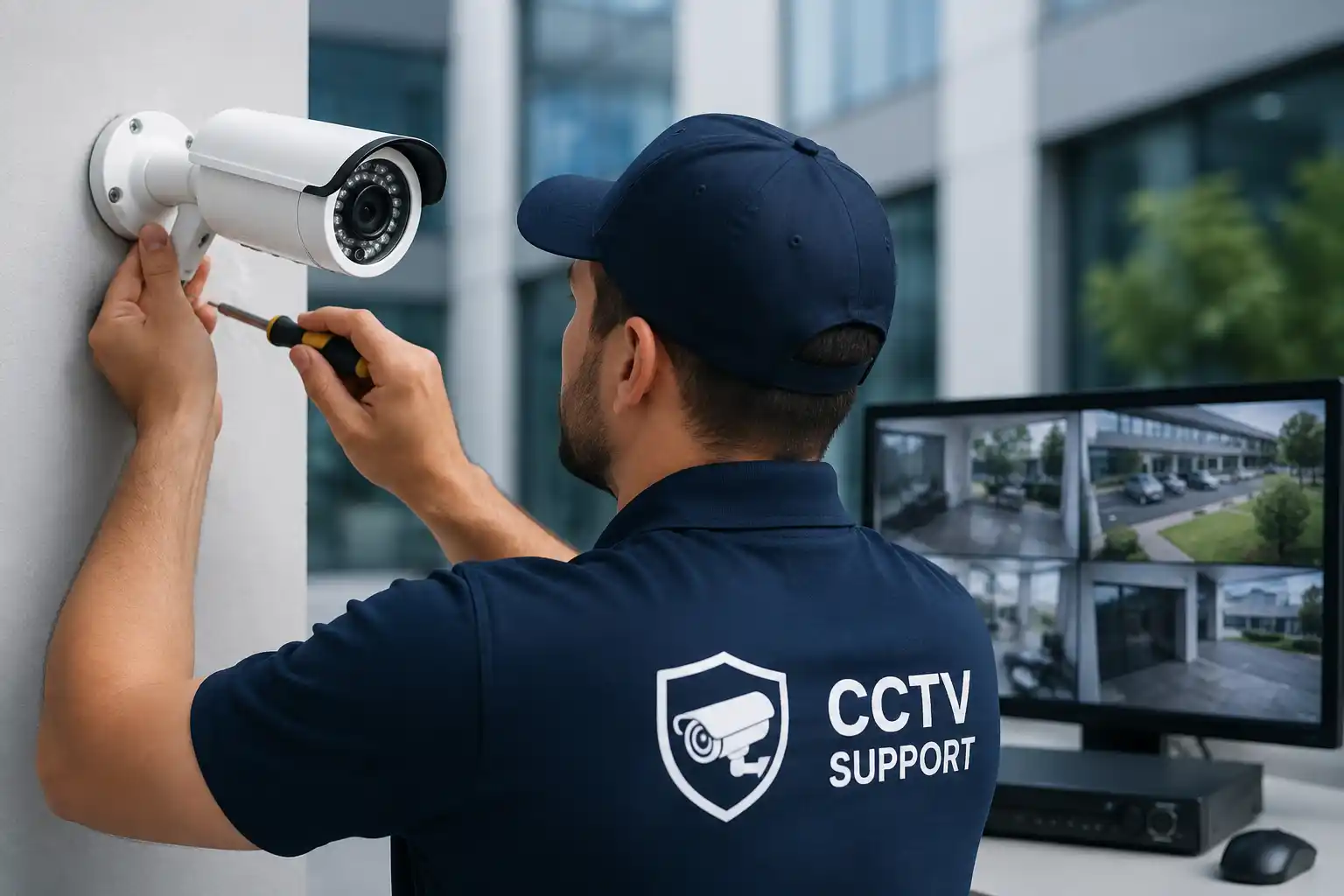
What an NVR does in a business CCTV system
A network video recorder, commonly shortened to NVR, is normally responsible for receiving video streams from IP cameras and writing those streams to local storage. Depending on the system design, it may also provide live viewing, playback, user accounts, camera management, event handling, export functions, time synchronisation and network services related to surveillance. That makes the recorder a central point in the evidence chain. If it is unhealthy, a business may still see some live video while historical recordings are incomplete, or cameras may remain powered but no longer be registered correctly with the recorder.
The recorder is not independent from the rest of the infrastructure. It relies on stable power, healthy storage, correct network addressing, reachable cameras, adequate switch capacity, compatible video streams and authorised configuration. A camera that appears offline on the NVR may have lost PoE power, cabling, network reachability or credentials rather than having a recorder fault. A storage warning may be caused by a failed disk, a disconnected drive, a file-system issue, an unsupported replacement drive or an abnormal shutdown. A remote viewing problem may be caused by firewall, ISP, mobile application, DNS, cloud relay or account settings while local recording continues normally.
For that reason, a useful repair process starts by separating symptoms. FourTeck reviews what still works, what has failed, whether the fault affects one camera or the complete recorder, whether the issue is continuous or intermittent, and whether there were recent changes. This reduces unnecessary replacement decisions and helps define whether the appropriate next step is configuration correction, storage work, network troubleshooting, physical repair, replacement assessment or coordination with the recorder manufacturer or another provider.
Common NVR problems businesses report
Recording has stopped or is incomplete
The system may show live cameras but fail to retain expected video. Possible areas include hard-drive condition, recording schedules, storage allocation, stream configuration, time settings, disk capacity or recorder software. Evidence should be checked before any drive is formatted or replaced.
Cameras appear offline
One or many channels can disappear because of camera power, cabling, PoE, addressing, credentials, switch faults, network changes or recorder registration. The same symptom can come from different technical layers, so isolation is more useful than guessing.
The NVR restarts or will not boot normally
Repeated restarts, freezes, abnormal fan behaviour, no display output or boot loops can involve power, storage, temperature, internal hardware or software condition. Physical testing and a controlled diagnostic sequence may be required.
Playback or export is unreliable
Users may be unable to find footage, jump to the correct time, export evidence or play video smoothly. This can involve storage health, timestamps, codecs, permissions, client software, browser support or an overloaded recorder.
Remote viewing no longer works
A mobile or remote client can fail while local access continues. Troubleshooting may involve the internet connection, firewall policy, DNS, vendor relay service, user credentials, certificates, ports or application configuration, depending on the design.
Disk alarms or storage warnings appear
Warnings about missing, abnormal or full disks need careful assessment. The aim is to understand current recording status and evidence risk before changes are made. Replacement parts and data availability are scope and condition dependent.
Why an unresolved NVR fault matters operationally
An NVR issue is not only a device inconvenience. Its business impact depends on what the surveillance system is expected to support. A retail operator may need recordings to review a transaction or incident. A warehouse may depend on recorded video to investigate loading activity. A property manager may need reliable camera history for access areas. An office may use CCTV to confirm events around entrances, reception or shared areas. When the recorder is unstable, the organisation may discover the problem only after footage is requested.
The impact can also be administrative. Staff may spend time repeatedly restarting equipment, checking cameras manually, trying different applications or contacting several vendors without a clear owner for the full environment. If the fault involves network changes, power or storage rather than the NVR itself, replacing the recorder without diagnosing dependencies can leave the original problem unresolved. If time settings are incorrect, recordings may exist but be difficult to locate accurately. If storage is degraded, the apparent retention period may not match what users expect.
FourTeck approaches the issue by first establishing what evidence is still being recorded, what parts of the environment are reachable and which technical layer needs attention. This keeps corrective work tied to the real fault and gives the business a clearer view of immediate risk, repair options, replacement considerations and maintenance needs.
Possible NVR repair and support scope
Depending on the confirmed scope, assistance may include initial consultation, remote diagnosis, on-site recorder inspection, basic power and connection checks, storage review, camera registration checks, network reachability testing, configuration review, account and permission review, recording schedule validation, time and date checks, playback testing, export testing, firmware or software review where appropriate, authorised configuration correction, replacement assessment, vendor coordination, documentation and preventive recommendations. Not every task is required for every fault.
Where physical hardware is involved, repair feasibility depends on the recorder design, age, condition, parts availability and whether a component is field-replaceable. A failing drive may require replacement with a suitable storage device. A damaged power supply, main board, interface, fan or connector may need parts or manufacturer-level repair that is separate from troubleshooting labour. If the unit is unsupported or uneconomical to repair, the practical recommendation may be replacement rather than continued component repair.
Where software or configuration is involved, FourTeck may review recording settings, channel configuration, user access, time synchronisation, network interfaces and relevant logs. Changes should be authorised and, where possible, existing configuration or evidence should be preserved before intrusive actions. The final quotation should clearly identify diagnosis, labour, replacement parts, configuration work, new equipment, data-handling limitations and any third-party responsibilities rather than treating every recorder issue as one fixed repair package.
NVR service-fit matrix
| Observed issue | Possible technical areas | Recommended next step |
|---|---|---|
| No cameras visible on the NVR | Recorder network, switch, PoE, camera addressing, credentials, cabling, camera power | Confirm whether cameras are powered and reachable, then test the path between cameras and recorder. |
| Live video works but old footage is missing | Disk health, recording schedule, retention, stream profile, storage configuration, time | Review storage status and recording configuration before formatting or replacing disks. |
| Recorder reboots repeatedly | Power, disk fault, temperature, hardware condition, software condition | Arrange controlled physical assessment and preserve relevant settings where feasible. |
| Only remote viewing has failed | Internet, firewall, DNS, remote service, application, permissions, certificate or port settings | Check local recorder health first, then trace the authorised remote-access path. |
| Disk error or abnormal storage warning | Drive condition, SATA or interface path, capacity, compatibility, power, recorder storage controller | Assess current recording status and evidence needs before drive action. |
NVR repair service information
| Service topic | NVR repair, recorder troubleshooting and related CCTV recording support. |
|---|---|
| Main purpose | Identify why an NVR is not recording, displaying, storing, playing back or providing authorised access as expected, then define suitable corrective action. |
| Typical systems involved | NVR, IP cameras, hard drives, monitors, PoE switches, cabling, LAN, firewall, internet, mobile or desktop viewing clients and power infrastructure. |
| Remote support suitability | Suitable for some configuration, log, account and connectivity checks when secure access and a working connection are available. Scope dependent. |
| On-site support suitability | Appropriate when storage, power, cabling, ports, hardware, local display, recorder condition or physical replacement must be inspected. |
| Customer information required | Location, recorder model, camera count, symptoms, warnings, recent changes, current recording status, network condition and authorised access availability. |
| Testing and validation | May include live view, recording, playback, timestamp, storage, channel reachability, user access and remote connection tests according to scope. |
| Parts and replacement | Condition, model and availability dependent. Hardware supply or manufacturer repair should be confirmed separately where required. |
| Service location | Dubai and UAE support coordination, with remote or planned on-site work based on the issue and approved quotation. |
| Quotation requirement | The final commercial scope depends on assessment, access, parts, site conditions and corrective work required. |
Remote NVR support versus on-site assessment
When remote support may be useful
Remote troubleshooting can help when the recorder is powered, online and reachable through an authorised method. It may allow a technician to review channel status, recording configuration, disk warnings, network settings, user permissions, timestamps, playback behaviour and relevant logs. A user or administrator at the site may still need to confirm physical indicators, check whether cameras are powered or describe what is shown on the local monitor.
Remote work is not a substitute for physical testing when the recorder will not boot, drives are making abnormal noises, cabling is damaged, the local network is down or hardware replacement is required. Secure access must be approved by the customer.
When an on-site visit is usually more appropriate
On-site assessment is generally more useful when the issue involves storage drives, power adapters or power supplies, fans, rack conditions, connectors, local displays, cabling, PoE switches, physical camera links or a recorder that cannot be reached remotely. It is also appropriate when several CCTV components need to be tested together or when replacement equipment must be installed and validated.
Scheduling depends on the location, site access, engineer availability, urgency, parts, building restrictions and the confirmed work scope. FourTeck can help determine the most suitable starting method after reviewing the reported symptoms.
How the NVR diagnostic process usually begins
- Confirm the business impact. Establish whether recording has stopped, whether live viewing is available, whether an incident review is waiting and which users or sites are affected.
- Identify the recorder and connected environment. Record the NVR model, approximate age where known, camera count, storage layout, network path, monitor connection and relevant switching equipment.
- Collect symptoms and evidence. Note alarms, screenshots, event times, disk messages, offline channels, restart patterns, unusual sounds and the last time the system was known to work normally.
- Review recent changes. Power interruptions, network changes, password changes, camera replacement, disk replacement, firmware actions, firewall changes or office work can provide useful context without proving the cause.
- Protect access and evidence. Before intrusive work, confirm authorised access, the value of existing footage and whether configuration or recording data should be preserved where technically possible.
- Test the relevant layers. Depending on the symptom, this may include power, boot condition, storage, network reachability, camera streams, recording schedules, time, permissions, playback and remote access.
- Isolate the likely fault domain. The aim is to distinguish recorder hardware from storage, network, camera, account or third-party service issues before recommending a corrective path.
- Agree the corrective action. Configuration changes, drive replacement, hardware repair, equipment replacement or vendor escalation should be approved according to the findings and quotation.
- Validate the result. Testing should reflect the original symptom and include the functions that matter to the business, such as recording, playback and camera availability.
- Record the next steps. Remaining risks, maintenance recommendations, replaced parts, credentials ownership and configuration notes should be documented according to scope.
Repair planning, safe changes and corrective work
Once the likely fault area is identified, the next step is not automatically to reset or replace the recorder. The correct action depends on what evidence must be protected, what backups or exported configuration are available, whether the system is still partially recording and how dependent the site is on continued surveillance. A recorder that contains footage relevant to an ongoing incident should be handled differently from a newly installed unit with no important history. A disk that is reporting errors should not be reformatted casually if the customer may need existing data.
Configuration changes should be controlled. Where practical, current settings may be recorded or backed up before changes. If a network address, gateway, user permission, recording schedule or camera credential is modified, the expected effect should be clear and the result should be tested. Firmware or software actions should be treated cautiously because compatibility, release path, power stability and vendor-specific requirements can matter. FourTeck does not assume that every recorder issue is resolved by an update.
Hardware corrective work may involve drive replacement, power components, cables, network ports or the recorder itself. Parts must be suitable for the equipment and expected recording workload. Replacement decisions should consider camera compatibility, channel count, stream requirements, storage capacity, retention goals, network interfaces, user access and future expansion. If a new recorder is introduced, the work can include camera registration, storage setup, recording validation, timestamp checks and user handover according to the approved scope.
Testing an NVR after repair or configuration
A recorder should not be considered healthy only because the login page opens or the local monitor displays live cameras. Testing needs to match the original complaint and the system’s intended use. If the problem was missing recordings, the validation should confirm that new footage is actually being written and can be played back across the required channels. If the issue involved time, the displayed timestamps and recorded event times should be checked. If a disk was replaced, the recorder should recognise the drive correctly and recording should continue without new storage alarms.
If camera channels were offline, tests may include verifying stable camera registration over an appropriate observation period, not just one successful connection. If remote access was the complaint, authorised users may need to confirm access from the approved external path while local recording remains unaffected. If a recorder had been rebooting, temperature, power and storage behaviour may need additional observation before the system can be considered stable.
Handover can include a summary of the fault found, work performed, parts replaced, configuration changes, unresolved limitations and maintenance recommendations. Where customer administrators manage the system, FourTeck can explain the relevant status indicators, storage warnings and escalation triggers without exposing credentials publicly. A successful repair restores the tested function, but it does not remove the need for future maintenance, disk-health monitoring, access control and periodic recording verification.
Capability focus 1: faster fault isolation across the surveillance path
A useful NVR repair service looks beyond the front panel of the recorder. Video travels through a chain: the camera must have power, the camera must transmit a valid stream, the network must carry it, the recorder must authenticate and receive it, storage must accept it, and users must have the correct access to view or retrieve it. A failure at any point can create a similar symptom on screen. For example, an offline channel can be caused by a failed camera, a damaged cable, an exhausted PoE budget, a duplicate IP address, a changed camera password or an NVR registration issue.
FourTeck’s diagnostic approach is to establish which links in that chain are working. This helps reduce unnecessary replacement and gives the customer a clearer explanation of whether the fault is local to the recorder or part of a wider CCTV or network issue. The approach is especially useful in business sites where the surveillance system has grown over time and multiple contractors have changed cameras, switches, internet services or recorder settings. Accurate fault isolation depends on access and available evidence; it is not a guarantee that every symptom can be reproduced immediately.
Capability focus 2: protecting recording continuity and storage visibility
Storage is one of the most important and most frequently misunderstood parts of an NVR. A recorder can look normal while a disk is degrading, a recording schedule is incomplete or retention is shorter than expected. Conversely, a full disk is not necessarily a fault if the system is designed to overwrite the oldest footage. The meaningful question is whether the recorder is storing the required channels at the expected quality and whether playback is available for the period the business needs.
During support, storage status can be reviewed alongside disk alerts, recording schedules, channel bit rates, available capacity and observed retention. If a drive is failing, replacement may be recommended, but existing footage availability cannot be guaranteed. Some recorder formats are proprietary, some systems write across multiple disks, and physical disk condition may limit recovery options. If historical footage is business-critical, that requirement should be stated before changes are made.
For ongoing operations, FourTeck can also recommend routine checks so administrators know how to confirm that cameras are recording, how to recognise storage alarms and when to request maintenance. The objective is not to promise a fixed number of retention days without assessing the actual camera count, resolution, frame rate, compression, recording mode and storage capacity. Instead, the system should be checked against the customer’s real retention goal and site conditions.
Capability focus 3: clearer access, playback and evidence retrieval
A recording system is only useful when authorised users can find and review the footage they need. Access problems may appear after staff changes, password changes, mobile application updates, firewall changes, internet changes or recorder replacement. Playback can also become confusing when time settings differ between cameras, recorder and client devices. The goal of support is to restore the required authorised workflow while keeping access controlled.
FourTeck can review user permissions, local access, remote access paths, time settings and playback behaviour according to the system design. Where the recorder supports different user roles, access should be limited to appropriate staff rather than relying on shared administrator credentials. Remote viewing should be configured in a way that reflects the customer’s security requirements and the capabilities of the equipment. If vendor cloud relay or application services are part of the solution, their availability and account requirements remain vendor dependent.
Evidence export can also be tested after repair when it is within scope. This may include verifying that the selected period can be located, that files can be exported using supported methods and that authorised users understand the basic retrieval process. FourTeck can document the steps relevant to the environment, while any legal or compliance requirements for evidence handling remain the customer’s responsibility unless separately agreed.
Dependencies, access and customer inputs
The speed and depth of NVR diagnosis depend heavily on what information and access are available. A clear problem statement helps: for example, “cameras 5 to 8 stopped recording after a switch change” is more useful than “CCTV not working.” The service location, recorder make and model, number of channels in use, storage configuration, network arrangement, recent work and current display status should be provided where known. Photographs of error messages or hardware labels may help during initial triage, provided they do not expose private information.
Administrative access may be required for configuration review. The customer should identify who is authorised to approve changes and who owns the recorder, camera and remote-viewing credentials. Passwords should not be placed in a public contact form or published documentation. Where secure credential exchange is needed, it should occur through an approved method after identity and authorisation are confirmed.
Third-party dependencies can include internet service providers, managed firewall providers, building network teams, CCTV manufacturers, cloud relay services, mobile app platforms, storage suppliers and previous installers. If the recorder is part of a managed building system, local access rules or vendor warranties may restrict what can be changed. Site access, rack keys, security escorts, work permits, maintenance windows and parking or loading rules can also affect on-site work in Dubai.
Before replacement or major configuration work, FourTeck may need to confirm camera compatibility, stream formats, channel capacity, storage requirements, existing cabling and remote-access expectations. The final service scope remains environment dependent and should be confirmed in the quotation.
Repair limitations and important risk guidance
NVR repair has practical limits. Diagnosis depends on the condition of the equipment, the evidence available, authorised access and whether the fault can be reproduced. A failed storage drive can make historical footage unavailable, and data recovery cannot be guaranteed. A recorder with severe board damage, power damage or unsupported hardware may require specialist manufacturer repair or replacement. Parts availability varies by brand, model and age.
Configuration changes can also carry operational risk. Resetting a recorder, changing storage settings, upgrading firmware, modifying network parameters or replacing a drive can affect access or recordings. Such actions should only be taken after the business impact, backup options and approval are understood. Unsupported or legacy cameras may not work with a replacement recorder without adjustment or replacement. Remote-access features can depend on internet, firewall and vendor services outside FourTeck’s control.
On-site work depends on location, building access, scheduling, engineer availability, equipment access and confirmed scope. Hardware supply, replacement cameras, new storage drives, network remediation, cabling and third-party fees may be separate from diagnostic labour unless explicitly included. A successful functional test confirms the tested condition at that time; it does not guarantee that no future fault will occur. Final commercial terms are defined by the approved quotation or service agreement.
Business environments where NVR support may be useful
NVR faults affect different businesses in different ways. In a retail shop, the priority may be reliable footage for entrances, tills or stock areas and quick playback when an incident needs review. In a warehouse or logistics environment, the recorder may support loading bays, gates and internal aisles, making camera uptime and retention especially important. An office may have fewer cameras but still rely on recording around reception, entrances, server rooms or common areas. Hospitality and restaurant sites can have multiple zones where time accuracy and continuous recording matter to operational review.
Clinics and educational environments may require careful consideration of authorised viewing and privacy policies. Property-management sites can include multiple camera networks, remote gatehouses, lifts, parking areas and common spaces, increasing the importance of clear documentation and stable network links. Multi-branch organisations may use separate recorders at each site or centralised viewing, meaning a remote access problem can affect management visibility even when local recording continues.
The correct support approach depends on site design. A small office NVR connected directly to a few PoE cameras is different from a larger installation using managed switches, VLANs, multiple storage disks and remote viewing across several locations. FourTeck can help identify the dependencies relevant to each environment and define whether the requirement is a repair, a configuration correction, storage replacement, network work, an upgrade project or preventive maintenance.
Operational, security and maintenance considerations after repair
After a fault is corrected, a small amount of operational discipline can reduce the chance that recording problems remain unnoticed. Businesses should know who is responsible for checking recorder status, how storage alarms are reported, how often sample playback is verified and who owns administrator access. The NVR should have accurate time, and important camera channels should be reviewed periodically to confirm that the expected view is still being captured. Changes to switches, IP addressing or internet services should be coordinated with the surveillance environment rather than made in isolation.
Security is also part of maintainability. Default credentials should not remain in use, administrator accounts should be limited to authorised staff and remote viewing should follow an approved access design. Exposing a recorder directly to the internet without understanding the security implications can increase risk. Where the recorder supports updates, release notes, compatibility and change risk should be considered before applying them. Security improvement reduces risk but cannot guarantee complete protection.
Maintenance may include checking recorder health, disk status, camera reachability, recording schedules, time synchronisation, ventilation, physical cleanliness, UPS or power conditions, network stability and remote-viewing access. Frequency should be based on the agreed support plan and the importance of the surveillance system. FourTeck can help document the current environment and recommend a practical maintenance approach, but actual recurring tasks, visit frequency and included work must be confirmed in the service agreement.
Before You Contact FourTeck about an NVR fault
Providing a concise set of facts can make the first assessment more productive. Prepare what is available; you do not need to open equipment or make risky changes.
- The Dubai or UAE service location and site contact.
- NVR brand, model and approximate installation age if known.
- Number of cameras configured and number currently affected.
- The exact symptom, alarm, error text or unusual behaviour.
- When the issue began and whether it is constant or intermittent.
- Whether live view, recording, playback and remote viewing still work.
- Any recent power outage, network change, password change or equipment work.
- Storage or disk warnings shown by the recorder.
- Whether historical footage is urgently required for an incident review.
- Current network and internet status at the site.
- Whether authorised administrator access is available.
- Whether a previous installer, vendor or maintenance provider is involved.
- Any site access rules, rack keys, escorts or maintenance-window restrictions.
- Preferred starting method: remote assessment or planned on-site visit.
- Business priority and the outcome you need restored.
Checklist for defining the service quotation
How FourTeck can assist with NVR repair in Dubai
FourTeck can begin by clarifying the reported problem and deciding whether remote triage or an on-site assessment is the most useful first step. The aim is to identify whether the fault sits in the recorder, storage, camera path, network, power, access configuration or a third-party service. This connected view is important because the NVR is part of a wider surveillance system rather than a standalone appliance.
Depending on the findings and approved quotation, FourTeck may assist with recorder checks, storage investigation, camera connectivity, network settings, authorised configuration, playback and recording validation, user access, remote-viewing troubleshooting, hardware replacement assessment and coordination with CCTV or network vendors. Where replacement is more practical than component repair, the required camera compatibility, channel count, storage target and migration steps can be reviewed before change.
After work, the service can include functional testing and a practical explanation of what was changed, what remains dependent on third parties and what maintenance actions are recommended. Customers can also review broader support options through the FourTeck IT Services website or learn about the service approach on the FourTeck company information page.
A quotation should be based on the actual recorder condition, site environment, access, required parts and work requested. Contact FourTeck to confirm the service scope and scheduling options before relying on an assumed repair path.
Dubai and UAE service coordination
For a Dubai NVR fault, the best starting point depends on what still works. If the recorder is online and secure access is available, remote diagnosis may help establish whether the problem is related to settings, camera registration, storage alarms or network reachability before a site visit is planned. If the NVR is offline, does not boot, has physical disk alarms, is located in a restricted rack or requires hands-on testing, on-site work is more appropriate.
Service coordination should consider building access, parking or loading procedures, rack access, security approval, maintenance windows and the availability of a knowledgeable site contact. In managed offices or towers, building network teams may need to be involved if the camera VLAN, switch infrastructure or internet connection is outside the customer’s direct control. Replacement hardware or storage parts can also affect scheduling and should be confirmed before work is promised.
FourTeck can coordinate remote or on-site assistance based on the issue, location, urgency, access and approved quotation. Installation, configuration, storage replacement, migration and maintenance tasks should be clearly included in the agreed scope. Service timing depends on engineer availability, customer access, site conditions, required parts and any third-party provider involved.
Coverage coordination across Dubai, Abu Dhabi, Sharjah and Ajman
Businesses with CCTV sites in Dubai, Abu Dhabi, Sharjah and Ajman may have different recorder models, network providers, access procedures and operational priorities at each location. FourTeck can help coordinate remote troubleshooting, planned on-site assessment, recorder replacement, storage work, configuration review or maintenance where the service scope is confirmed. A multi-site issue should first be separated into local faults and shared dependencies. For example, if remote viewing fails for several branches at the same time, the cause may be a common application, firewall policy or provider issue rather than simultaneous recorder hardware failure.
Scheduling and travel depend on the site, engineer availability, building access, equipment availability and approved work. A branch with a dead recorder may need physical attendance, while another branch with a configuration issue may be reviewed remotely. FourTeck does not assume permanent engineer presence in every emirate or a fixed attendance time. The practical service plan is built around the confirmed fault, business impact, authorised access and any third-party or parts dependency.
Related FourTeck IT and surveillance services
CCTV service and maintenance
Useful when the recorder issue is part of a wider surveillance problem involving cameras, storage, viewing or preventive checks.
IP camera support
Relevant when cameras are offline, unstable, incorrectly addressed or failing to register with the NVR.
Available as part of a confirmed support scope.
Network support
Useful when recorder and camera communication depends on switches, VLANs, IP addressing, routing or unstable connectivity.
Assessment determines the network work required.
Business IT support
Suitable when CCTV faults overlap with internet, firewall, user devices, storage or broader site infrastructure.
Scope can be coordinated across connected systems.
Why businesses contact FourTeck for recorder troubleshooting
Businesses often need a technician who can consider the recorder and the network around it rather than sending the issue back and forth between separate vendors. FourTeck can assess the CCTV path from camera to switch to recorder to storage and authorised viewing, helping identify where the reported failure actually sits. This is particularly useful when the original installer is no longer available, the environment has changed over time or the business does not have current documentation.
The service is built around clear initial assessment, safe change planning, remote and on-site coordination, testing and practical next steps. The objective is to explain whether the current NVR can be repaired, whether the fault is elsewhere in the system, what replacement or configuration work may be required and what should be documented after the change. Where another provider controls part of the path, FourTeck can help gather technical evidence for escalation rather than making unsupported assumptions.
FourTeck does not rely on fixed repair claims because recorder condition, compatibility, evidence needs and parts vary significantly. Customers receive a scope based on the observed problem and the work required. For broader service information, visit the IT services overview, and when ready to provide the site and fault details, use the FourTeck contact page.
Questions Dubai customers commonly ask before requesting NVR repair
The following questions address the practical decisions businesses often make before requesting support. They are intended to help you decide what information to gather, whether remote or on-site assessment is likely to be useful and what should be confirmed in the quotation.
Can an NVR be repaired if it has stopped recording but still shows live cameras?
Often the issue can be assessed, but the exact repair depends on why recording stopped. Live video confirms that at least some camera-to-recorder communication is working, yet storage, recording schedules, stream settings, time configuration or drive condition may still be faulty. The safest first step is to check the recorder’s storage state and recording configuration without formatting drives. If the business needs footage from before the fault was noticed, tell the technician before any storage action. The final solution may be a configuration correction, drive replacement, recorder repair or another change after assessment.
Why does my NVR say the hard disk is abnormal or missing?
An abnormal or missing disk message can come from a failed drive, a loose or failed connection, power problems, an unsupported replacement drive, the recorder’s storage controller or file-system condition. The warning alone does not show which cause applies. If recording is business-critical, avoid repeated resets or formatting until the current disk state is assessed. FourTeck can review what the recorder detects, whether new footage is being written and whether physical drive inspection or replacement is required. Historical footage recovery is condition dependent and cannot be guaranteed.
Why are cameras offline on the recorder even though they still have power?
Power does not prove that a camera is reachable or authenticated. An IP camera can be powered yet unavailable because of cabling, switch configuration, VLAN changes, duplicate addressing, wrong gateway settings, changed credentials, damaged network ports or stream compatibility. The NVR itself may also have an incorrect network address or registration setting. A structured test should check reachability from the relevant network segment and confirm camera credentials and recorder registration before hardware is replaced.
Can FourTeck check an NVR remotely in Dubai?
Remote assessment may be suitable when the recorder is online, secure remote access is authorised and the fault relates to configuration, channels, logs, permissions, playback or network settings. It can be a good first step for narrowing the problem before deciding whether a visit is necessary. Remote support is less useful when the NVR will not power on, restarts constantly, has physical disk or fan problems, is isolated from the network or needs cabling and hardware testing. A site contact may still be required to confirm local indicators.
When should I request an on-site NVR technician instead of remote support?
On-site support is usually more appropriate when the recorder is physically inaccessible online, has boot problems, disk alarms, power issues, unusual noise, damaged connectors or needs a replacement drive or unit. It is also useful when camera outages may involve PoE switches, cables or local network ports. If several CCTV components are affected, physical inspection can help establish whether one shared power or switching issue is responsible. Site timing depends on access, location, engineer availability, parts and the approved scope.
Should we repair the existing NVR or replace it?
The decision depends on age, fault type, parts availability, camera compatibility, channel capacity, storage needs, reliability history and the cost of corrective work. A healthy recorder with a failed drive may only need storage replacement and testing. An older unit with recurring hardware faults, unsupported software or insufficient channel capacity may be better treated as an upgrade project. Replacement planning should confirm whether existing cameras can register correctly, whether the network design is suitable and how much storage is required. FourTeck can provide an assessment rather than recommending replacement solely because a fault exists.
What if we cannot find recordings from a particular day?
First confirm that the recorder time is correct and whether the camera channel was recording during the requested period. Missing footage can result from schedule settings, disk failure, overwritten retention, camera disconnection, time mismatch or storage interruption. It is useful to note the exact date, approximate time and camera required. If the incident is important, avoid unnecessary recorder resets, disk formatting or replacement before the system is checked. The existence or recovery of historical footage cannot be promised because it depends on what was actually recorded and the physical condition of storage.
Why does remote CCTV viewing fail while the local monitor still works?
That pattern often points to the external access path rather than the recording function. The cause may involve the internet connection, firewall or router policy, DNS, public IP changes, certificates, user permissions, mobile app configuration or a vendor relay service. Because the local monitor works, the technician can first confirm that the recorder is healthy and recording normally, then trace the external path. If the remote service belongs to a third-party vendor, service availability and account requirements remain vendor dependent.
What information should we prepare before asking for an NVR repair quotation?
Prepare the site location, recorder make and model, camera count, current symptoms, exact warnings, when the problem started, whether live view and recording still work, disk status, recent power or network changes and the availability of authorised administrator access. Also state whether historical footage is urgently required and whether the site has access restrictions. These details help FourTeck determine whether remote assessment is sensible, what physical work may be needed and whether parts or replacement hardware should be considered in the quotation.
Can a network change cause an NVR to lose cameras?
Yes. Changes to IP addressing, subnet design, VLANs, switch ports, DHCP, gateways or firewall rules can interrupt communication between cameras and the recorder. A camera may continue to record internally or remain powered while the NVR no longer reaches it. Before changing camera or recorder settings repeatedly, identify what network work occurred and whether the original addresses are still valid. FourTeck can review the camera-to-recorder path and coordinate with the network provider when the affected equipment is managed by another party.
Can an NVR repair improve how long recordings are retained?
Repairing a storage fault can restore expected recording capacity, but retention depends on several variables: number of cameras, resolution, frame rate, compression, recording mode, motion settings, stream bit rate and total usable storage. A technician should not promise a fixed retention period without reviewing those factors. If the business needs a specific retention target, that target should be stated during assessment so storage capacity and recording settings can be reviewed. Additional drives or a different recorder may be needed depending on the equipment and target.
Does replacing a hard drive automatically fix an NVR storage problem?
No. A new drive can correct a failed-disk problem when the rest of the recorder is healthy, but similar warnings can be caused by the storage interface, power, incompatibility or recorder hardware. The replacement drive must also be appropriate for the recorder and expected recording workload. After replacement, the system should be checked for proper recognition, recording, playback and new alarms. Existing footage on the old drive may not be accessible, so the customer should clarify evidence requirements before replacement.
What should we test after NVR repair is completed?
Testing should confirm the functions that matter to your operation. At minimum, relevant camera channels should display, new video should record, recent footage should play back and the recorder should show the correct time. Where applicable, disk status, remote viewing, user permissions, export and channel stability should also be checked. The technician should compare the result with the original symptom and record any remaining limitation. If a third-party internet or vendor service is still unstable, that dependency should be stated rather than treating the recorder repair as a complete resolution.
Is one-time repair enough, or should an NVR be maintained regularly?
A one-time repair can correct the immediate problem, but surveillance systems benefit from periodic health checks because storage, fans, power, cameras, network links and remote access can degrade over time. Maintenance can include reviewing disk condition, recording status, time accuracy, channel reachability, ventilation, remote access and configuration documentation. The frequency should reflect the importance of the system and the agreed service plan. Maintenance does not guarantee that hardware will never fail, but it can make faults more visible before a business needs footage unexpectedly.
What if the original CCTV installer is no longer available?
Support can still be assessed, but access and documentation become more important. Identify who owns the system, whether administrator credentials are available, what recorder and camera models are installed and whether any vendor portal or cloud account is involved. FourTeck can review the current environment and determine what can be supported safely. Password recovery, factory reset or account transfer may depend on the manufacturer and proof of authorisation. A lack of documentation may add discovery work, so the quotation should reflect the actual condition of the environment.
How do I know whether the problem is the NVR, the cameras or the network?
Look at the pattern rather than one symptom. If one camera is offline while all others record normally, the fault is more likely to be local to that camera path. If every camera drops together after a switch or network change, shared infrastructure becomes more relevant. If live view works but recording does not, storage or recording configuration deserves attention. These patterns are clues, not final diagnosis. A technician should test the relevant layers before concluding which component has failed.
What is the next step if we need NVR repair in Dubai?
Send FourTeck the site location, recorder details, number of affected cameras, symptoms, warnings, start time of the problem, recent changes and whether recording or playback still works. State if historical footage is urgently required and whether authorised remote access is available. FourTeck can then recommend whether remote triage or an on-site assessment is the more practical starting point. The repair, parts, configuration and testing scope can be quoted after the environment and fault are understood.
Frequently asked questions about NVR repair and support
Do you repair every NVR brand?
Support feasibility depends on the model, fault type, access, available documentation and parts. Contact FourTeck with the recorder details so the scope can be assessed before work is confirmed.
Can an NVR be checked without removing it from site?
Yes, many diagnostics can begin in place. Physical removal is only considered when necessary and appropriate for the equipment, repair path and evidence requirements.
Will replacing the NVR keep all existing cameras?
Not always. Compatibility, stream support, credentials, network design and channel capacity must be checked before replacement. Legacy cameras may require additional work or replacement.
Can you recover deleted or overwritten recordings?
Data recovery cannot be guaranteed. Availability depends on what was recorded, whether it was overwritten, the storage format and physical disk condition. State evidence requirements before storage work begins.
Do NVR hard drives need special consideration?
Yes. The drive must be compatible with the recorder and suitable for the intended workload. Capacity, interface, recorder limits and recording demands should be checked before replacement.
Can a power issue damage the recorder or recordings?
Power instability can contribute to recorder restarts, storage problems or hardware failure. The actual cause should be assessed, and UPS or power protection may be reviewed where relevant.
Do you configure remote viewing after repair?
Remote access can be included when technically suitable and approved. It may depend on firewall, internet, vendor services, user accounts and the security design of the site.
Can you work with the building or network provider?
Vendor coordination may be included when another party controls switching, internet, firewall or building access. Responsibilities and third-party charges should be confirmed in scope.
How long does NVR repair take?
There is no reliable fixed duration before assessment. Timing depends on fault complexity, access, parts, recorder condition, vendor dependencies and whether replacement or additional site work is needed.
What happens if the NVR cannot be economically repaired?
FourTeck can outline replacement considerations such as camera compatibility, channel requirements, storage, network settings, user access and testing so the business can evaluate the next step.
Request an NVR assessment or repair quotation
If your NVR has stopped recording, shows disk errors, loses cameras, cannot play back footage or has become inaccessible, share the site, recorder model, camera count and symptoms with FourTeck. We can review whether remote diagnosis or an on-site visit is the most appropriate next step and define the work needed before repair, replacement or configuration changes are approved.
Service timing, parts, site attendance and final commercial scope depend on assessment, access, equipment condition and availability. Historical footage recovery and future fault prevention cannot be guaranteed.