
IP PBX Services in Dubai, UAE
Business calling depends on more than the PBX alone. Extensions, IP phones, SIP trunks, switches, voice VLANs, internet quality, firewall rules and provider services all contribute to whether a call reaches the right person and stays clear. FourTeck helps organisations assess, troubleshoot, configure, install, maintain and plan changes to IP PBX environments with the wider communication path in view.
Support can begin with a single call-flow problem or a broader telephone-system project. The final scope is confirmed from the existing platform, user count, sites, access, carrier dependencies, required features and the business result the customer wants to achieve.
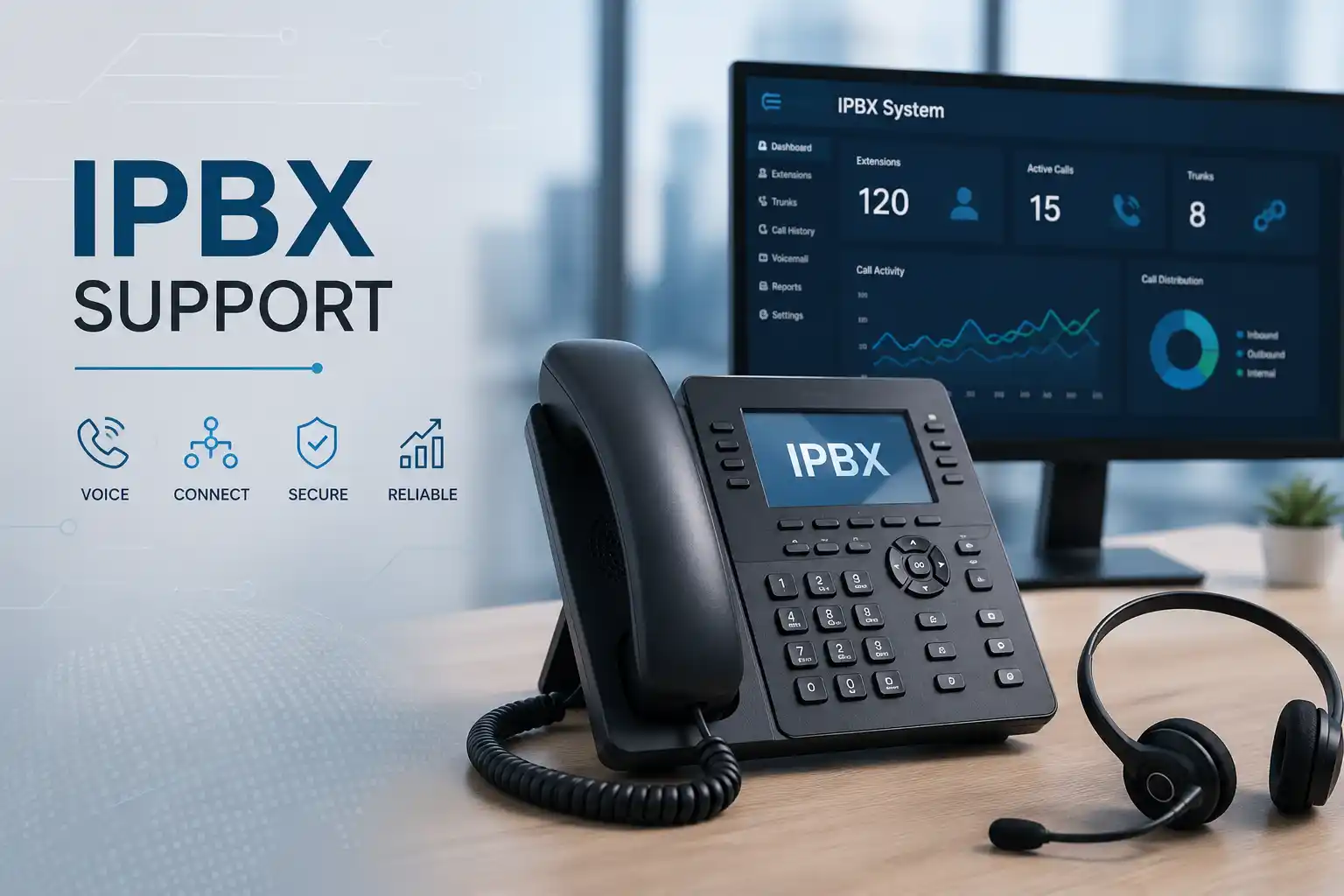
Calls, trunks, phones, network and firewall checked as connected layers.
Routing and configuration work planned around business call requirements.
Support method depends on access, symptoms and physical work required.
Licensing, carriers, hardware and migration work are confirmed before quotation.
What does an IP PBX service actually cover?
An IP PBX service supports the business telephone platform that manages extensions, incoming and outgoing call routes, receptionist handling, ring groups, queues, voicemail, schedules and connections to voice providers. It is mainly used to restore faults, make authorised configuration changes, prepare new installations, improve an existing call flow, support office moves or branches, and plan upgrades or migrations. Businesses should consider the service when calling problems affect staff or customers, when the telephone setup is undocumented, or when a change could affect several users. Before work is confirmed, the customer should be ready to explain the required calling behaviour, affected users and sites, current PBX or provider details, recent changes, available administrator access and any maintenance-window restrictions. The exact scope remains dependent on the platform, licences, network, firewall, carrier and physical environment.
What IP PBX Services May Include
IP PBX work can range from a focused configuration request to a multi-site communication project. Depending on the confirmed scope, FourTeck may assist with extension provisioning, phone registration, inbound and outbound routing, ring groups, queues, auto-attendant menus, office-hour schedules, voicemail, forwarding, caller identification, call permissions, recording settings, SIP trunk coordination, remote-user considerations, system backups, migration preparation and post-change testing. The objective is not to change every available setting. It is to understand the business requirement, identify the technical dependencies, make only approved changes and verify that important call paths still behave as intended.
A telephone environment also touches the network. IP phones may depend on Power over Ethernet, DHCP options, DNS, time services, switch configuration, voice VLANs, firewall policies, routing and a stable internet connection. A caller reporting one-way audio may not have a PBX configuration problem at all; the issue could relate to network address translation, firewall handling, provider routing or packet loss. Likewise, a phone that will not register may be affected by its local network port, credentials, provisioning method, reachability or platform-side status. Good service therefore considers the complete path rather than assuming the most visible device is the cause.
Who may need this service?
The service may suit professional offices, reception-led businesses, clinics, schools, retail operations, warehouses, hospitality sites, property-management teams, logistics operations, project offices and organisations with more than one branch. It is particularly relevant where telephone numbers, extensions and call routing are important to customer contact or internal coordination. A small office may need help setting up a clear reception and voicemail path, while a larger organisation may need queues, department rules, branch connectivity, user permissions, reporting or staged migration planning.
When should the PBX be reviewed?
A review is useful when calls drop, audio is poor, external calls fail, some extensions will not register, reception handling is inconsistent, users cannot reach voicemail, call queues behave unexpectedly, office-hour rules no longer match operations, a new department is being added, an office is moving, a carrier is changing, or the current system has little documentation. It is also sensible before a major network or firewall change because voice services can be affected by routing, NAT, VLAN, QoS and internet behaviour.
Common Symptoms and What They Can Point Toward
The same telephone symptom can come from more than one technical layer, so diagnosis should begin with evidence rather than assumption. A dropped call could reflect internet loss, provider behaviour, firewall session handling, network congestion or PBX resource issues. Delayed ringing could involve forwarding logic, queue timing, device registration or provider delivery. Poor voice quality can be influenced by packet loss, jitter, local switching, Wi-Fi use, oversubscribed links or endpoint condition. Failed outbound calls may involve dial patterns, permissions, trunk status, carrier restrictions or number formatting. The purpose of assessment is to narrow these possibilities safely.
| Observed issue | Possible technical areas | Useful next step |
|---|---|---|
| One-way or no audio | Firewall, NAT, media path, provider, routing, network loss | Collect affected numbers and times, then test the signalling and media path. |
| Phones show unregistered | Credentials, provisioning, VLAN, DHCP, cabling, switch port, PBX reachability | Confirm whether one phone, one area or all extensions are affected. |
| Incoming calls miss reception | Inbound route, ring group, queue, schedule, failover, provider delivery | Write the intended call flow and compare it with the active configuration. |
| Calls are choppy or delayed | Packet loss, jitter, congestion, Wi-Fi, WAN quality, switch behaviour | Compare wired and wireless paths and review network conditions during the fault. |
| Outbound calls fail for some users | Permissions, dial rules, trunk selection, number format, carrier policy | Record successful and failed examples without changing broad rules prematurely. |
Why Unresolved PBX Problems Can Affect the Wider Business
Telephone faults can create operational friction beyond the IT team. Reception may miss customer enquiries, sales staff may be unable to return calls, service teams may lose queue visibility, remote workers may not receive expected calls, and management may not know whether the issue is internal or provider related. When routing has grown through repeated small changes, employees can also become dependent on workarounds such as personal mobiles or manual call transfers. That may hide the root problem while making the communication process harder to support.
Documentation is another business concern. If extensions, numbers, trunks, schedules and administrative access are known only to one person or old vendor, even a simple move can become risky. A structured service engagement can help build a clearer record of what exists, how calls are intended to flow, which providers are involved, what settings are critical and what should be backed up before future changes. This does not guarantee that every future fault will be avoided, but it reduces uncertainty and gives the next support action a better starting point.
Service Scope: What Assistance May Be Considered
Troubleshooting
Call failure analysis, phone registration checks, routing review, trunk status, voicemail issues, queue behaviour, one-way audio investigation, call-quality review, log collection and provider coordination. The exact diagnostic steps depend on platform access and reproducible evidence.
Configuration
Extensions, ring groups, queues, office hours, auto attendants, forwarding, outbound permissions, caller identification, voicemail and other authorised call-flow settings. Existing configuration should be reviewed and backed up where appropriate before significant changes.
Installation
Deployment planning, user and extension mapping, IP phone provisioning, switch and PoE checks, network integration, SIP trunk coordination, test calls, documentation and handover. Physical work, licensing and equipment are quoted according to the confirmed environment.
Migration and upgrade
Current-state inventory, number and extension mapping, dependency review, backup, compatibility checks, staged planning, carrier coordination, user communication, cutover testing, fallback considerations and post-change verification. Zero downtime cannot be assumed before scope and provider constraints are known.
Maintenance
Configuration review, backup status, user and extension records, platform health observations, call-flow checks, provider details, network dependencies and maintenance recommendations. Recurring inclusions depend on the approved service plan or contract.
Documentation and handover
Extension lists, call-flow notes, provider references, network dependencies, administrator handover, change records and next-step recommendations. Sensitive credentials should be shared only through an approved secure method after authorisation is confirmed.
Service-Fit Matrix for Common Business Situations
| Business situation | Relevant assistance | What must be confirmed |
|---|---|---|
| Reception calls ring the wrong users | Inbound route, queue, ring group, schedule and overflow review | Desired call path, working hours, fallback destination and authorised access |
| New staff or departments are being added | Extension creation, phone provisioning, permissions and directory updates | Available licences, phone capacity, numbering plan and network readiness |
| Business is moving to a new office | Inventory, network checks, phone relocation, trunk coordination and cutover planning | New-site cabling, internet, firewall, provider timing, physical access and downtime tolerance |
| Current PBX is ageing or poorly documented | Assessment, backup, extension map, call-flow documentation and migration options | Platform support status, data access, licences, integrations, provider details and business priorities |
| Calls are unreliable at one branch | Branch network, internet, firewall, registration and routing investigation | Whether the fault follows a site, provider, phone type, time pattern or specific call direction |
IP PBX Service Information
| Service topic | Business IP PBX support, troubleshooting, configuration, installation, maintenance and migration assistance. |
|---|---|
| Main purpose | Keep business call handling understandable, supportable and aligned with required user and customer call flows. |
| Typical systems involved | IP PBX platform, IP phones, SIP trunks, switches, PoE, voice VLANs, firewall, router, internet connection, remote users and provider services. |
| Remote support suitability | Often suitable for authorised configuration review, logs, routing, user changes and provider coordination when secure access and connectivity are available. |
| On-site suitability | Appropriate when phones, cabling, switch ports, racks, power, network paths or physical installation must be inspected or changed. |
| Access required | Environment dependent. Authorised PBX, network, firewall or provider access may be needed according to the problem. |
| Testing and validation | May include extension registration, internal calls, inbound calls, outbound calls, transfer, queue, voicemail, office-hours and failover checks according to approved scope. |
| Vendor coordination | Carrier, ISP, SIP provider, software vendor or hardware supplier action may be required where the dependency sits outside the customer environment. |
| Service location | Dubai and UAE service coordination, subject to issue type, site access, scheduling and confirmed scope. |
| Quotation requirement | Final commercial scope depends on systems involved, work required, licences, hardware, provider dependencies, number of sites and service method. |
Remote Support or On-Site Visit: Which Is More Appropriate?
Remote assistance
Remote support may be appropriate when the internet connection is working, secure access is authorised and the issue relates mainly to PBX settings, logs, extensions, call routes, voicemail, queues, user permissions or provider coordination. It can also be useful as the first diagnostic step because the engineer can review what is happening before deciding whether physical work is required. A customer contact or administrator may need to place test calls, confirm handset behaviour or describe what users see.
Remote work should not be treated as a guarantee of resolution. If the problem involves a failed phone, cabling, PoE, switch hardware, local power or a network path that cannot be validated remotely, the next step may need to be on-site.
On-site assistance
An on-site visit may be recommended when physical phones need provisioning or replacement, ports and patching must be checked, racks require inspection, cabling is uncertain, voice VLANs need local verification, several users are affected at one location, or the system cannot be reached securely from outside. New office installation and relocation work commonly include local coordination because equipment, power, cabling and user positions must be matched to the final plan.
Attendance timing depends on location, engineer availability, building access, equipment requirements and the approved quotation. A short remote assessment before the visit can help identify what information, tools or replacement options should be prepared.
How an IP PBX Assessment and Diagnostic Process May Work
Confirm whether the issue affects reception, one user, one department, one branch, inbound calls, outbound calls or the whole telephone service. Business impact helps set priorities without guessing the technical cause.
Record examples, times, numbers involved, handset messages, provider notifications, recent changes and whether the issue is constant or intermittent. Useful evidence should be gathered before broad resets or unplanned changes remove it.
Confirm authorised administrative access, current backups, support contacts and whether changes require a maintenance window. Credentials should be handled through an approved secure method rather than published or shared openly.
Check the PBX, extension status, trunks, routing, network reachability, firewall path, internet condition and provider status as relevant. The test sequence should follow the evidence rather than changing unrelated settings.
Separate confirmed observations from likely causes and external dependencies. If the provider, ISP, hardware supplier or software vendor must act, the required information can be prepared for escalation.
Apply approved corrective work, repeat relevant call tests and record useful configuration or support notes. Remaining risks, unsupported elements or recommended follow-up work should be made clear.
Planning Installation or Configuration Changes
A new IP PBX installation or substantial configuration change should begin with the required business call behaviour. The technical platform matters, but the practical questions come first: Which numbers reach the business? Who answers them? What happens when the first group does not answer? Are there different rules during lunch, evenings, weekends or holidays? Which users need direct numbers, voicemail, call forwarding, mobile applications or remote extensions? Are calls recorded, and if so, what operational and policy requirements apply? Which departments need outbound permissions or international calling? These decisions become the map for the configuration.
The existing environment should then be reviewed. Switches must have enough suitable ports and PoE capacity if phones receive power from the network. Cabling and patching should be identifiable. Voice VLAN design, DHCP, DNS, time synchronisation, firewall rules and internet connectivity may need review. SIP trunk or telecom provider details must be coordinated, especially where numbers are moving. If the change replaces an old system, current extension lists, numbers, prompts, queues, forwarding rules and office-hours behaviour should be captured before they are lost.
Before implementation, the approved scope should identify licensing, hardware, carrier tasks, remote-user requirements, integrations, backup and rollback considerations. Significant changes should be scheduled for a suitable maintenance window when practical. The exact sequence depends on the chosen platform and the customer’s environment, so the work should not be presented as a one-click deployment.
Migration and Upgrade Planning for Existing Telephone Systems
A PBX migration is a business communication change, not just a software replacement. The current system may contain years of extension numbering, direct numbers, reception logic, queue behaviour, voicemail, prompts, call permissions and carrier settings. Some of these may still be useful; others may reflect old departments or workarounds that no longer match the organisation. Migration planning is an opportunity to document the current state and decide deliberately what should be carried forward.
A practical migration review can include the existing PBX version, user and extension inventory, phone compatibility, SIP trunks, number ownership, branch links, remote users, network requirements, firewall dependencies, call recording, reporting needs, integrations, backup availability and administrator access. Any platform-specific licences or subscriptions should be checked separately. Where the existing hardware or software is unsupported, options may be constrained by what data or configuration can still be exported.
The project plan should identify a test method, cutover responsibilities, provider timing, user communication and fallback considerations. A pilot group or staged change may be appropriate when business continuity requirements make a single cutover undesirable. After migration, validation should cover important inbound numbers, outbound destinations, transfer, queues, voicemail, office-hours logic, caller identification and remote users as applicable. Zero downtime cannot be promised in advance because carrier actions, number changes, internet conditions and third-party systems may affect the transition.
Testing, Validation and Handover After PBX Work
A configuration change is not complete simply because a setting was saved. Validation should confirm the real business outcome. For a new reception route, test an inbound call and watch how it moves through the expected destinations. For a queue, confirm member availability, timing, overflow and voicemail behaviour. For a new extension, verify registration, internal calling, outbound permissions and inbound reachability where applicable. For office-hours changes, check both open and closed scenarios rather than assuming a schedule will behave correctly.
Where network or firewall work is involved, call quality should be observed after the change and the relevant path should be checked for stability. If a SIP provider was part of the incident, successful test calls should be documented with enough detail to confirm the issue is no longer present under the tested conditions. A successful test is evidence for that moment and configuration; it does not remove the need for ongoing monitoring, maintenance or provider support.
Handover can include an updated extension list, description of the main call flows, administrator notes, backup location, provider contacts, user guidance and outstanding recommendations. For reception or departmental users, simple instructions for hold, transfer, voicemail, queue login or approved shortcuts can reduce avoidable support calls. Documentation should be proportionate to the environment but clear enough that the next authorised administrator is not starting from zero.
Capability 1: Clearer Call-Flow Control
Many business telephone problems are not hardware failures. They are mismatches between how the organisation expects calls to move and how the PBX is actually configured. A documented call-flow design gives reception, sales, support and management a common reference. It can show which number enters which route, which users ring first, how long the system waits, where calls overflow and what happens outside office hours.
This clarity makes future changes safer because the engineer can see the intended business outcome before editing settings. The limitation is that call-flow design still depends on the capabilities of the current platform, available licences, provider behaviour and any integrations. If a requirement is not supported by the existing environment, FourTeck can explain the dependency and help define practical options rather than silently forcing a workaround.
Capability 2: Better Voice-Network Coordination
IP telephony shares the same physical and logical infrastructure used by other business systems, yet voice reacts quickly to packet loss, congestion, unstable links and poor wireless conditions. A PBX support engagement can therefore include checks of switching, PoE, VLANs, firewall policies, routing and internet behaviour when they are relevant to the fault.
The goal is not to apply generic network tuning. It is to identify whether the voice path is receiving the connectivity it requires without disrupting other services. Changes such as VLAN updates, QoS policies or firewall rules should be based on the actual design and approved business traffic. Older switches, unmanaged devices, unknown cabling or provider limitations may restrict what can be improved without further work.
Capability 3: More Maintainable Telephony
A maintainable PBX environment has more than working extensions. It has useful records of numbers, users, trunks, call routes, provider contacts, backups and important dependencies. That documentation becomes valuable during staff changes, office moves, outages, upgrades and vendor handovers. It also helps management see whether repeated issues come from the same ageing component or unclear process.
Maintenance recommendations should be based on what is actually present. Some systems may need only a cleaner extension list and configuration backup; others may need platform updates, network changes, replacement planning or a migration roadmap. Ongoing support inclusions, visit frequency and preventive tasks depend on the agreed service plan. Unlimited support or fixed response commitments should not be assumed unless specifically included in a contract.
Dependencies, Access and Customer Inputs
IP PBX support often requires coordination across several systems and organisations. The PBX platform may be maintained by the customer, a previous integrator or a cloud service provider. Telephone numbers and SIP trunks may sit with a telecom or voice carrier. IP phones depend on switches, power and local addressing. Remote extensions depend on internet and security design. Call recording may depend on storage, licensing and policy. Because these parts are connected, the fastest path to a useful assessment is usually to identify who controls each layer and what authorised access is available.
Customers may be asked for the site location, user count, current PBX platform, affected extensions, examples of failed numbers, approximate time the issue started, whether it affects inbound or outbound calls, recent changes, internet-provider information, SIP-provider details, network diagram if available, firewall contact, switch information, licence or subscription details, backup status, preferred service method and a local contact who can place test calls. For a project, floor plans, department lists, required direct numbers, remote-user needs and target call flows can also be useful.
Administrative credentials should not be published in a public form or page. They should be shared only through an approved secure method after the customer’s identity and authorisation are confirmed. If access is unavailable, the first stage may need to focus on documentation recovery, vendor coordination or identifying who can authorise the required system changes.
Risks, Limitations and Exclusions to Confirm
Diagnosis depends on evidence and authorised access. An intermittent voice problem may require observation over time, provider logs or repeated call examples before a reliable cause can be isolated. Some faults require action from a SIP provider, internet service provider, cloud platform, telecom carrier, manufacturer or software vendor. FourTeck can help gather information and coordinate the technical case, but third-party actions remain dependent on that provider’s systems and processes.
Hardware failure can require parts or replacement outside the labour scope. Unsupported phones or legacy PBX software may limit upgrade and security options. Configuration changes can interrupt active calls or related services, so significant work may require a suitable maintenance window, backup and rollback plan. Migration results depend on source configuration quality, number-porting or trunk arrangements, compatibility, licences, access and user acceptance. A successful test does not guarantee that a future provider outage or network failure cannot occur.
On-site work depends on building access, rack or ceiling access where relevant, location, scheduling, engineer availability and the approved quotation. Final commercial terms should identify which systems, users, sites, tasks, equipment and third-party work are included. Anything not confirmed should be treated as scope dependent rather than assumed.
Business Environments Where IP PBX Support Can Be Useful
Professional offices
Reception, management, finance, sales and service teams may need clear extension ownership, transfer rules, voicemail and direct-number routing. Office moves and staffing changes make documentation particularly useful.
Retail and showrooms
Customer-facing numbers may need to ring across counters, offices or departments without leaving callers unanswered. Internet and network reliability can be important where the same site also depends on cloud applications and payment systems.
Warehouses and logistics
Large sites can require desk phones, remote offices, security desks and branch communication. Cabling distance, switch placement, network design and provider connectivity can shape the practical deployment.
Clinics and service operations
Reception and appointment calls may need predictable queue or overflow behaviour. Any recording, privacy or retention requirement should be defined by the organisation and checked against its policies and applicable obligations.
Hospitality and property sites
Front desks, maintenance teams, management and distributed work areas may need extensions that remain understandable as staff and spaces change. Physical network conditions can influence phone availability across the site.
Multi-branch organisations
Branches may share a platform or use separate systems with linked routing. Internet quality, VPN or firewall design, number presentation, branch failover and central administration should be reviewed as part of the wider service.
Operational, Security and Maintenance Considerations
A business PBX is an administrative system with access to communication settings, user accounts, trunks and potentially recordings or call data. Administrator access should therefore be controlled, documented and limited to authorised people. Shared administrator credentials make it harder to know who changed what and can complicate staff handover. Remote administration should be provided through appropriate security controls for the platform and network rather than through unnecessary public exposure.
Change history is equally useful. When a call route, firewall policy or provider setting is altered, the business should be able to connect that change with later symptoms. Backups are important before significant configuration work, but a backup is useful only if it can be located and is suitable for the platform in question. Older systems may have limited backup or restore options, so migration planning should not assume perfect portability of settings.
Maintenance can also review unused extensions, old users, abandoned forwarding rules, outdated prompts, obsolete department queues, unsupported phones, licence use, provider contacts and network dependencies. These checks can reduce confusion and make future troubleshooting faster. Actual maintenance frequency and included tasks depend on the service plan, business risk and the stability of the environment. Preventive review can reduce avoidable incidents, but it cannot remove all outages or third-party failures.
Before You Contact FourTeck
Providing a clear starting picture can make the first assessment more productive. You do not need to know every technical answer, but the following information is useful when available.
- The Dubai or UAE service location and whether the requirement covers one or multiple sites.
- A main contact person who understands the business impact and can approve testing.
- The number of users or extensions affected and whether reception is impacted.
- The current PBX platform, version or provider name if known.
- Examples of failed calls, including whether they were inbound, outbound or internal.
- Approximate start time, frequency and whether the problem is constant or intermittent.
- Any recent network, firewall, internet, office, provider or PBX changes.
- The SIP trunk, telecom carrier or internet provider involved, where relevant.
- Whether authorised PBX, firewall, switch or provider portal access can be arranged.
- The current backup status or whether a configuration backup is known to exist.
- Any remote users, branches, mobile applications or special call routes that must be preserved.
- The intended business outcome, such as restoring calls, changing reception routing or preparing a migration.
- Any maintenance-window, building-access or security restrictions.
- Whether remote diagnosis is acceptable or physical on-site work is already known to be required.
Checklist for Defining the Service or Quotation Scope
- Confirm the exact telephone-service objective.
- Confirm number of users, extensions and sites.
- Identify PBX, phone, trunk and provider environment.
- Confirm required administrator and network access.
- Decide whether remote, on-site or mixed support is expected.
- List approved configuration, installation or migration tasks.
- Identify hardware, licence or subscription dependencies.
- Define test cases for important inbound and outbound call paths.
- Confirm documentation and administrator handover requirements.
- Identify vendor, ISP, carrier or fit-out coordination needs.
- Agree any maintenance window or service-impact restrictions.
- Record explicit exclusions so optional work is not assumed.
The final quotation should reflect the confirmed environment and required work. A checklist helps prevent a small request from quietly expanding into an unplanned migration, network rebuild or hardware replacement project.
How FourTeck Can Help and How the Quotation Process Starts
FourTeck’s role is to translate a telephone problem or project requirement into a clear technical scope. For a fault, that can begin by identifying the affected call direction, users, sites and recent changes, then checking the relevant PBX, provider and network layers. For a configuration request, the first task is to write down the intended business outcome so changes can be compared with the existing call flow. For an installation, relocation or migration, discovery expands to user counts, numbers, departments, trunks, remote workers, network readiness, firewall dependencies, licences, equipment and cutover requirements.
Where third parties are involved, FourTeck can help organise the technical information needed for coordination. That may include a SIP provider, telecom carrier, internet provider, software vendor, hardware supplier, building contractor or internal IT contact. The goal is to reduce ambiguity about which layer is responsible for the next action. FourTeck can also help test and document approved work so the business has a record of what changed and what remains outstanding.
A quotation can then be prepared around confirmed tasks rather than an assumed generic package. The number of users and sites, availability of secure access, physical installation requirements, licences, equipment, provider dependencies, travel, scheduling and documentation needs can all affect the scope. Contact FourTeck to confirm what can be assessed remotely, whether an on-site visit is recommended and which items should be included before work begins.
IP PBX Service Coordination in Dubai and the UAE
For a Dubai office, the service plan may combine remote troubleshooting with a planned on-site visit where phones, switches, cabling, racks or local testing require physical access. For businesses elsewhere in the UAE, the same principle applies: the method depends on the issue, location, urgency, site access, engineer availability, equipment needs and approved quotation. A remote review can sometimes identify whether the problem is configuration related or whether the visit needs to include network, firewall or physical telephone work.
Installation, migration and relocation projects require more planning than a single configuration change. Building access, fit-out timing, internet activation, carrier work, phone delivery, switch readiness and user availability can all affect the sequence. Customers should confirm any restricted access hours, security procedures, parking or loading requirements, rack-room access and local contacts before a visit is scheduled. Service timing cannot be guaranteed until these dependencies and the work scope are known.
Dubai, Abu Dhabi, Sharjah and Ajman Coverage
Businesses in Dubai, Abu Dhabi, Sharjah and Ajman can contact FourTeck to discuss IP PBX troubleshooting, planned configuration, installation, maintenance, migration or project support. Remote assessment may be suitable for software and configuration issues where secure access is available, while physical phone installation, cabling, rack work, switch checks or local fault testing may require an on-site visit. Scheduling and the final service plan depend on location, travel, building access, site conditions, equipment availability, third-party provider actions and the confirmed quotation. Multi-site organisations should also identify whether branches share one PBX, use separate systems or depend on common SIP trunks, firewall policies or central internet connectivity because that relationship can change the diagnostic and migration approach.
Related FourTeck IT Services
IP telephony often intersects with other office technology. The following verified FourTeck resources can help customers frame a broader requirement without turning the telephone project into an unrelated product purchase.
Review connected support for networks, firewalls, servers, user devices, Wi-Fi and telephony.IT support in Dubai and the UAE
See FourTeck’s wider service approach for connected business systems.About FourTeck IT Services
Understand the broader business-technology support orientation behind service engagements.Contact and support requests
Share the site, symptoms, current environment and required outcome for assessment.
Why Businesses Contact FourTeck for PBX Assistance
Businesses often need help because telephone problems cross vendor boundaries. A PBX administrator may say the platform is healthy while the telecom provider points to the customer network, and the network team may see no obvious outage. FourTeck can approach the problem from the connected business environment: users, phones, PBX, switches, firewall, internet and provider paths. That does not mean every layer will need changes. It means the diagnostic process can follow evidence across the path until the next responsible action is clearer.
FourTeck can also help businesses move from undocumented settings toward a supportable operating model. Clear extension records, call-flow notes, backup information, provider contacts and change history can make staff changes and future troubleshooting easier. For projects, the same discipline supports safer installation, migration and handover because the business requirement is defined before implementation. Recommendations are kept practical and scope dependent, with third-party limitations, access requirements and optional work identified rather than hidden inside broad claims.
Questions Businesses Ask Before Requesting IP PBX Services
Customers rarely search for telephone support because they want to study a PBX in isolation. They usually have a practical question: Why are our calls dropping? Can the receptionist route be changed? Can new extensions be added without replacing the whole system? Is the phone problem actually caused by the network? Can our current numbers move to a new office? Should we repair the existing platform or plan a migration? The answers depend on the current environment, but the following decision guidance can help a business prepare a more useful support request.
Can an IP PBX problem be checked remotely?
Many configuration and diagnostic tasks can begin remotely when the business has a working internet connection, authorised administrative access and a user who can help with test calls. Remote work may cover extension status, trunk state, call routes, office-hours rules, voicemail, queues, logs and some network or firewall information. It can also help determine whether the issue appears limited to one user or affects a wider call path. Physical faults are different. If the phone has no power, a switch port is failing, cabling is uncertain or a rack needs inspection, an on-site visit may be the appropriate next step. A remote first look can still be useful because it may identify what should be tested physically.
Why do calls work internally but fail externally?
Internal extensions can keep working even when the connection to the outside telephone provider has a problem. External calling depends on the SIP trunk or carrier service, outbound rules, inbound routes, number formatting, firewall handling, internet connectivity and provider reachability. The useful question is whether the failure affects inbound calls, outbound calls or both, and whether all external destinations fail in the same way. A few recent examples with numbers and times can help separate a routing issue from a provider or connectivity problem. Broad configuration changes should be avoided until the pattern is understood.
What should we do if only one phone is not working?
A single-phone issue is often easier to isolate because the rest of the environment provides a working comparison. Check whether the phone has power, obtains the expected network connection and shows a registration or account error. The fault may involve the handset, network cable, switch port, VLAN, provisioning, extension credentials or PBX-side status. Swapping components without a record can make diagnosis confusing, especially if the phone receives a different address or configuration after a move. When requesting support, provide the extension number, phone location, displayed error and whether another phone works on the same area of the network.
What if every phone in the office stops making calls?
A widespread failure suggests a shared dependency and should be treated differently from one faulty handset. Shared dependencies can include the PBX itself, a core switch, internet service, firewall, SIP trunk, power or a network change. The first objective is to determine whether phones are still registered, whether internal extension calls work and whether internet or other office systems are also affected. This evidence helps narrow the layer before anyone restarts unrelated equipment. If the PBX or provider is inaccessible, escalation may be required. On-site assistance may be needed when the shared dependency is physical or cannot be reached remotely.
Can call quality problems be caused by the office network?
Yes, but poor quality should not automatically be blamed on the network. Voice can be affected by packet loss, jitter, congestion, unstable Wi-Fi, faulty cabling, switch problems, internet conditions, provider routing or endpoint behaviour. The useful evidence is when and where the problem occurs. If only remote users are affected, the home or branch connection may be relevant. If calls degrade at busy office times, bandwidth or internal network load may deserve attention. If only calls to one destination or provider behave badly, the fault may sit farther upstream. Testing should compare the voice path under real conditions rather than relying on one speed test alone.
Do we need a new PBX just because our current system has recurring faults?
Not necessarily. Recurring problems can come from poor documentation, network faults, provider issues, outdated firmware, failing hardware, incorrect call routes, unsupported software or a design that no longer matches the business. An assessment should identify whether the current platform is still supportable and whether the cost and risk of repeated repair justify an upgrade. Replacement becomes more compelling when the system cannot meet required workflows, lacks vendor support, has serious compatibility limits, depends on unavailable parts or makes secure administration difficult. The decision should compare repair, stabilisation and migration options rather than treating replacement as an automatic answer.
How do we prepare for an office move without losing our business numbers?
Begin by identifying every business number, SIP trunk or carrier account, extension, reception route and service that must continue. Confirm whether numbers stay with the same provider, whether the provider requires a location or service change, and when the new internet connection will be ready. The new office also needs suitable network cabling, switches, PoE capacity, firewall configuration and phone positions. A move plan should assign responsibility for provider work, phone relocation, PBX access, testing and fallback communication. Number continuity depends on carrier arrangements, so provider confirmation should be obtained rather than assumed.
Can a PBX support remote or branch users?
Many modern IP PBX environments can support remote or branch calling, but the exact method depends on the platform, licences, security model, phones or applications and network design. Remote users add dependencies that office-only users may not have: home or branch internet quality, firewalls, VPNs or secure platform access, device provisioning and support for changing locations. Before enabling remote calling, the business should define who needs it, which numbers they will use, what happens if the remote connection is unavailable and how access will be controlled. Unsupported shortcuts that expose administrative or voice services directly to the internet should be avoided.
What information helps diagnose one-way audio?
One-way audio means the call connects but one side cannot hear the other. Useful evidence includes whether the problem affects inbound, outbound, internal or remote calls; which numbers are involved; whether it happens on every extension; and whether the issue began after a firewall, router, provider or internet change. Because signalling and audio media can follow different technical paths, the PBX may show a connected call even when media traffic is being blocked or routed incorrectly. The investigation may involve PBX settings, NAT, firewall policy, network routing, provider configuration and endpoint behaviour. It should not be solved by randomly opening broad firewall access.
Should we use call queues or ring groups?
The right choice depends on how the team handles calls. A simple ring group can be useful when several users should ring together or in a defined order and the business does not need more advanced queue behaviour. A queue can be more appropriate when callers may wait for available agents, when login or status behaviour matters, or when routing needs more control. Platform capabilities vary, and licences may influence what is available. Before configuration, define the customer experience: how long should callers wait, what should they hear, what happens when nobody answers, and where should calls go outside working hours?
What can affect the cost or scope of an IP PBX service?
The main factors include whether the requirement is troubleshooting or a planned project, the number of users and sites, the current platform, administrative access, phone models, network condition, firewall dependencies, SIP provider involvement, licence needs, equipment replacement, cabling work, remote users, migration complexity, test requirements and documentation. A request to “fix the phones” may be small if one routing rule is wrong, or broader if a core switch is failing and the PBX is undocumented. A useful quotation therefore needs enough discovery to identify the likely layers and explicit exclusions.
Can we add new employees without redesigning the whole system?
Often yes, when the current PBX has available capacity, licences and a workable numbering plan. The new user may need an extension, phone or application, voicemail, outbound permissions, directory visibility, queue membership and an appropriate caller ID. The network must also have a suitable port and power if a desk phone is being added. If growth has created inconsistent numbering or an overloaded queue structure, the change may be a good time to improve documentation rather than simply creating another extension with no plan.
When is on-site telephone support usually worth requesting?
On-site assistance is useful when the work is physical, widespread or dependent on local observation. Examples include installing multiple phones, tracing unknown cabling, checking PoE, identifying switch ports, reorganising a rack, testing a new office, troubleshooting phones that cannot be reached remotely or coordinating a move with users and facilities staff. For a purely administrative change, remote support may be more efficient. For mixed problems, remote discovery followed by a targeted visit can reduce uncertainty and help the engineer arrive with a clearer test plan.
What should we ask for after a PBX change?
Ask for confirmation of what was changed, which test cases were completed, any unresolved dependency and any documentation that should be updated. For significant work, an extension list, call-flow summary, backup note, provider reference and administrator handover can be valuable. Users may also need short guidance if the change affects transfer, voicemail, queue login or other daily actions. Documentation should not include openly exposed passwords. Access information should be handled securely and according to the organisation’s control process.
How do we decide between one-time support and ongoing maintenance?
One-time support suits a defined fault, change, installation or assessment with a clear endpoint. Ongoing maintenance may make sense when the business has many users, multiple sites, frequent staff changes, recurring incidents, an important reception or queue function, or a wider IT environment that benefits from periodic review and documentation. A maintenance plan can include agreed preventive tasks and a process for changes, but inclusions should be written clearly. It should not be assumed to provide unlimited labour, parts, licences or guaranteed response unless those items are specifically part of the contract.
What is the best next step if we are not sure whether the fault is the PBX, internet or provider?
Describe the symptom in business terms first. Explain who is affected, whether calls fail inbound or outbound, whether internal extension calling still works, when the problem began and whether the internet or other systems show problems at the same time. Avoid making major configuration changes until the pattern is understood. FourTeck can use that information to decide which layer should be checked first and whether remote or on-site assessment is appropriate. If another provider needs to act, the support process can help document the evidence needed for escalation.
Frequently Asked Questions
What does IP PBX support include?
Depending on the confirmed scope, support may include extensions, phone registration, inbound and outbound routing, queues, ring groups, office hours, voicemail, SIP trunks, provider coordination, call-quality investigation, backups, documentation and migration planning.
Can you troubleshoot dropped calls?
Dropped calls can be investigated across the PBX, network, firewall, internet and provider path. Useful evidence includes affected numbers, times, sites and whether the fault is repeatable. A specific cause should not be assumed before testing.
Can PBX configuration be changed remotely?
Often yes when secure access is authorised and physical testing is not required. Significant changes should still consider backups, business impact, maintenance windows and rollback. Some tasks will require an on-site visit.
Do you install IP phones as part of PBX work?
Phone installation and provisioning may be included when agreed. The scope can depend on phone compatibility, network ports, PoE capacity, cabling, extension details and the chosen PBX platform.
Can FourTeck help with SIP trunks?
FourTeck can assist with technical review and coordination where SIP trunks are part of the environment. Provider-side activation, number ownership, restrictions and service availability remain dependent on the carrier or SIP provider.
Can you migrate an old telephone system?
Migration assistance can include inventory, extension and number mapping, backup, dependency review, network readiness, carrier coordination, test planning, cutover support and documentation. Compatibility and downtime remain scope dependent.
What access should we prepare?
Authorised PBX access is often useful, and network, firewall or provider access may also be required according to the fault. Do not send passwords publicly; use an approved secure exchange after authorisation is confirmed.
Will changing the PBX interrupt calls?
Some changes can affect active or new calls, so the risk should be reviewed before work begins. Major configuration, upgrades or migration may need a planned maintenance window and a rollback approach.
Do you provide IP PBX support outside Dubai?
Requirements in Abu Dhabi, Sharjah, Ajman and other UAE locations can be reviewed. Remote or on-site service depends on the issue, access, location, scheduling, equipment and approved quotation.
How is the final service scope confirmed?
The scope is based on the current platform, users, sites, reported issue or required outcome, authorised access, network and provider dependencies, physical work, licences, equipment, testing and documentation requirements.
Discuss Your IP PBX Requirement with FourTeck
If your business is dealing with failed calls, poor audio, unregistered phones, unclear reception routing, a planned office move, new extensions, an ageing PBX or a migration project, start with the business impact and the current environment. Share the service location, affected users, PBX or provider details if known, recent changes, examples of the problem and the result you want. FourTeck can review whether the next step should be remote diagnosis, on-site assessment, configuration work, project planning or a quotation that includes provider and network dependencies.
The final service plan depends on authorised access, site conditions, platform compatibility, licences, equipment, network readiness, carrier responsibilities, scheduling and the approved work scope. Clear discovery at the start helps keep the engagement practical and reduces the risk of unexpected changes later.