
Business telephony planning for connected branches
IP PBX Multi-Site Configuration in Dubai, UAE
A multi-site IP PBX should make branch communication easier without hiding important dependencies. FourTeck helps businesses review extension plans, call routes, SIP connectivity, office hours, network readiness, security controls and site-specific requirements before configuration changes are approved.
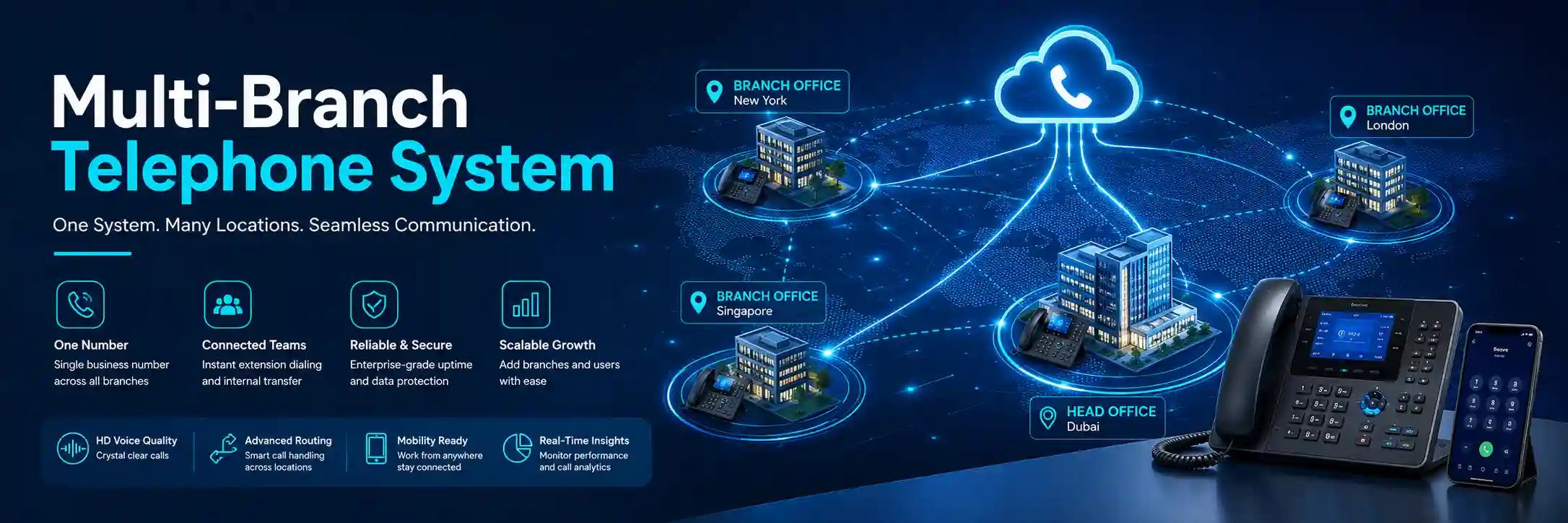
Planning considers branches, head office, remote users and how each location depends on the voice platform.
Incoming, outgoing and inter-office calls are mapped to the business workflow before technical changes begin.
Voice quality and registration can depend on internet links, LAN design, QoS, VLANs, firewalls and provider paths.
The final implementation, testing plan and schedule depend on the existing environment, access and approved quotation.
What does multi-site IP PBX configuration mean?
Multi-site IP PBX configuration is the planning and setup required to let business telephone users at different locations communicate through a coordinated voice environment. It is mainly used to organise extension dialling, branch-to-branch calling, reception handling, incoming numbers, outbound permissions, queues, voicemail, office hours and approved remote-user access across more than one site. Businesses opening branches, standardising separate phone systems or improving an existing distributed telephone setup may consider this service. Before work is confirmed, the customer should identify the sites involved, user and phone counts, current PBX platform, SIP or telecom provider, important call flows, network ownership, available administrator access and any maintenance-window restrictions. The exact scope is configuration, network, carrier and access dependent.
What a Multi-Site IP PBX Service May Cover
A multi-site telephone project starts with the business call journey rather than a list of PBX settings. A company may want employees in Dubai headquarters to dial a three- or four-digit extension for a colleague in another branch, a reception team to answer calls for several offices, sales calls to reach the right queue regardless of location, or after-hours calls to follow different rules at each site. These requirements need to be written clearly before configuration is changed because the same technical feature can create very different operational results.
Depending on the confirmed scope, assistance may include reviewing the existing IP PBX, documenting extensions and direct numbers, defining extension ranges by location or department, checking phone registration methods, planning branch-to-branch routing, reviewing SIP trunks, coordinating number routing with a voice provider, configuring ring groups or queues, aligning office-hour schedules, checking voicemail behaviour, reviewing caller identification rules and confirming outbound permissions. Where remote users or mobile clients are part of the environment, the assessment may also cover authentication, secure reachability, public DNS, certificates, firewall policy or an approved session-border mechanism where the selected platform requires one.
The LAN and WAN are part of the voice service path. Switches, PoE capacity, structured cabling, VLANs, DHCP options, addressing, routing, internet links and firewalls may influence whether phones register and whether audio is stable. A PBX configuration can appear correct while a network problem causes one-way audio, delayed ringing, registration failures or poor call quality. For this reason, FourTeck can review the technical path that supports the phones instead of treating every symptom as a PBX-only problem.
A project can also include testing and handover. Test cases may cover internal calls within each site, calls between sites, incoming numbers, outgoing calls, transfer behaviour, queue or ring-group logic, voicemail, office-hour rules and agreed fallback routes. The final list depends on the functions actually used by the customer. Documentation may record extension ranges, site identifiers, trunk ownership, key call routes, administrative dependencies and follow-up recommendations so later changes do not depend on memory alone.
Who may need this service?
The service may suit a business opening a second or third office, a company with independent PBX systems that wants a clearer operating model, an organisation moving to a central or hosted voice platform, or a multi-branch team that already shares one PBX but has inconsistent routing and extension rules.
It can also be relevant when reception staff answer for several sites, remote employees need approved business extensions, different branches have separate office hours, or administrators are spending too much time resolving user changes because the extension and routing plan is poorly documented.
What should be known before configuration begins?
The most useful starting information is the current topology: which PBX serves which users, where the PBX is hosted, how each site reaches it, what SIP trunks or numbers are in use, which phones and applications connect, and which call flows matter to daily operations.
Access should be authorised and backups should be considered before change work. A customer should also identify maintenance restrictions, business-critical departments, emergency or regulatory call requirements that must be verified with the relevant provider, and any third-party systems that depend on telephony.
Common Planning Triggers and Operational Problems
Multi-site PBX work is often requested because a business has changed faster than its telephone configuration. A new branch may have been added using separate numbering, employees may be transferring calls through external numbers instead of internal extensions, office-hour rules may differ between locations, or reception teams may be unclear about which site owns a particular incoming number. These are not only convenience issues; they can create missed calls, inconsistent customer handling and support confusion.
Branch-to-branch calls are awkward
Staff may be calling public numbers to reach colleagues because internal extension ranges are duplicated, undocumented or not routed between systems. The correct fix depends on whether the sites share one PBX, use separate PBXs or connect through a provider or inter-system trunk.
Incoming calls reach the wrong team
Numbers can be mapped to the wrong destination, old rules can remain after a move, or office-hour logic can send calls somewhere unexpected. Diagnosis should trace the call from the carrier or SIP trunk through the PBX route to the final extension, queue or voicemail destination.
Voice quality differs by location
One branch may report robotic audio, delay or dropped calls while other locations work normally. That pattern can point to branch internet, LAN congestion, cabling, switching, firewall handling or provider conditions rather than a universal PBX fault.
Moves and user changes take too long
When phone models, extension ranges, provisioning methods and site settings are inconsistent, every transfer or new employee becomes a one-off task. A standard plan can make future administration clearer, although the correct method remains platform dependent.
Business Impact When Multi-Site Telephony Is Poorly Coordinated
Telephone systems still support reception, sales, customer service, logistics, facility coordination and many internal workflows. When a multi-site configuration is unclear, staff may not know where a call should be transferred, branch calls may unnecessarily use external routes, after-hours messages can reach the wrong mailbox, and users may lose confidence in queues or forwarding. The result can be delayed customer response and repeated administrative effort even if the PBX itself remains online.
Operational risk also increases when a change is made without understanding dependencies. Editing a trunk, route or firewall rule can affect many users at once. Replacing a site router can disturb phone registration. Changing an extension range can conflict with another branch. Introducing a new SIP provider may alter number presentation, codec choices or routing behaviour. A planned configuration service reduces guesswork by documenting the current state, mapping required outcomes and validating agreed call scenarios after changes.
Good multi-site design does not eliminate every outage or provider issue. It does, however, make ownership and troubleshooting clearer. Administrators can see which component belongs to the PBX, the local network, the internet connection, the firewall, the voice carrier or the endpoint. That clarity is especially useful during expansion, staff moves and vendor escalation because technical evidence can be collected from the right part of the service path.
Possible Service Scope
The final scope depends on the confirmed environment and quotation. The following areas show the type of assistance that may be relevant rather than a promise that every item is included.
Current-state review
PBX location, platform, versions where available, extensions, phones, trunks, branch connectivity, routing, office hours, voicemail and important integrations can be documented before change planning.
Extension and numbering plan
Departments, branches and future growth can be considered when assigning extension ranges so internal dialling remains understandable and duplicate numbering is avoided where the platform requires uniqueness.
Call-flow configuration
Incoming routes, ring groups, queues, IVR menus, reception destinations, time conditions, voicemail, forwarding and agreed failover behaviour may be configured after the business flow is approved.
SIP and provider coordination
Where number routing, trunk registration or carrier-side settings are involved, FourTeck can help collect evidence and coordinate technical information with the relevant telecom or SIP provider.
Network readiness
Switching, PoE, voice VLANs, routing, QoS approach, firewall policy, DNS, DHCP, WAN paths and internet performance can be reviewed where they influence phone registration or call quality.
Testing and handover
Agreed call scenarios can be tested by site, and the customer can receive updated extension, route and dependency information based on the work included in the approved scope.
Centralised, Distributed and Hybrid Multi-Site Designs
There is no single correct architecture for every organisation. Some businesses operate one central or hosted PBX that serves phones and applications in every branch. Others keep a PBX at each location and connect the systems for inter-office dialling. A hybrid environment may retain legacy equipment at one site while newer branches use a different platform. The configuration approach should follow the actual business, network and support requirements rather than forcing all locations into an architecture that has not been assessed.
Centralised or hosted voice platform
A central platform can simplify user administration and make extension numbering more consistent because one management plane serves many locations. The trade-off is that branch phones depend on reliable connectivity to the PBX or hosting environment. Internet quality, firewall rules, DNS, certificates, NAT behaviour, session-border requirements and provider paths can therefore become critical. Branch continuity expectations should be discussed before deciding how much functionality must remain available during a WAN interruption.
Separate PBX systems linked together
Independent PBXs can preserve local control or support legacy systems, but inter-site routing must be planned carefully. Extension ranges should avoid ambiguous matches, routes should define which dial patterns cross to another PBX, and security controls should limit unnecessary exposure. Call transfer between systems, caller identification, voicemail behaviour and feature compatibility can differ by platform, so testing should focus on the functions the business actually needs.
Hybrid and migration-stage environments
During an upgrade, a business may temporarily operate old and new systems together. A controlled coexistence plan can include temporary trunks, translated extension ranges, staged user moves, provider coordination and clear rollback points. Compatibility with phones, gateways, analogue devices, recording systems or door intercoms should be assessed rather than assumed. A hybrid design can be useful as a transition method, but it should not become an undocumented permanent dependency.
Service-Fit Matrix
| Business situation | Relevant assistance | What must be confirmed |
|---|---|---|
| A new branch is opening and should use the existing business telephone system. | Extension planning, branch connectivity review, phone provisioning approach, call routing and test plan. | PBX capacity, licences where applicable, phone compatibility, network readiness, provider requirements and site access. |
| Two locations use separate PBXs and staff want internal extension dialling. | Numbering review, inter-system route design, trunk or secure connection planning and call-flow testing. | Platform compatibility, route capability, security method, overlapping extensions and desired transfer behaviour. |
| Call quality is poor only at one branch. | Branch LAN, WAN, firewall, QoS, packet-loss and phone-path assessment alongside PBX checks. | When the issue occurs, affected users, internet condition, recent network changes and available test access. |
| Reception answers calls for several sites and routing is inconsistent. | Incoming-number mapping, queue or ring-group review, office-hour logic, overflow and voicemail planning. | Desired business call flow, number ownership, reception staffing model and after-hours requirements. |
| The business is migrating from several local systems to one platform. | Inventory, dependency mapping, staged migration, provider coordination, testing, rollback planning and handover. | Source-system access, number portability or trunk process, device compatibility, downtime limits and backup readiness. |
Multi-Site PBX Service Information
| Main purpose | Coordinate extensions, call routes and telephony operations across multiple business locations. |
|---|---|
| Suitable for | Branches, multi-office companies, central reception teams, distributed departments and businesses planning PBX consolidation or expansion. |
| Typical systems involved | IP PBX, IP phones, softphone or mobile clients, SIP trunks, switches, routers, firewalls, internet links, VLANs, PoE, DNS and DHCP services. |
| Assessment method | Remote review, configuration evidence, call testing and on-site inspection where physical network or device checks are required. |
| Remote support suitability | Suitable for authorised configuration review, logs, routing, account administration and many test activities when secure access is available. |
| On-site support suitability | May be required for phones, cabling, PoE, switches, rack work, branch internet handoff, physical inspection or issues that cannot be reproduced remotely. |
| Customer information required | Site list, user counts, extension plan, PBX details, providers, phone models, call-flow requirements, recent changes, network ownership and access availability. |
| Testing and validation | Scope dependent; may cover internal, inter-site, inbound, outbound, transfer, queue, voicemail, office-hour and remote-user scenarios. |
| Vendor coordination | May involve SIP carriers, internet providers, PBX vendors, hosting providers or third-party application suppliers. |
| Scheduling | Depends on approved scope, customer access, engineer availability, maintenance windows, provider actions and any required equipment. |
| Commercial scope | Subject to assessment and approved quotation; replacement hardware, licences, carrier fees or third-party services are not assumed to be included. |
Remote Configuration Support Versus On-Site Branch Work
When remote assistance may be practical
Remote work can be suitable when the PBX administration interface is securely reachable, an authorised contact can approve changes, the branch network is working, and physical inspection is not necessary. Typical remote activities may include reviewing extension settings, documenting call routes, examining available logs, checking SIP status, creating or modifying users, adjusting approved routing rules and performing coordinated test calls with staff at each site.
Remote support does not remove the need for safe change control. Configuration backups, access permissions, maintenance windows and rollback options should still be considered. If the problem cannot be isolated remotely, an on-site visit may be recommended.
When an on-site visit may be needed
On-site assistance may be appropriate when phones fail at the physical network layer, cabling or PoE must be tested, a switch or firewall needs local access, a rack or patching issue is suspected, branch bandwidth or packet loss must be observed from the site, or equipment installation is part of the work. Local staff availability and building access can also influence whether remote support is sufficient.
An on-site visit should have a defined purpose. FourTeck can use the assessment to identify what needs physical verification and what can continue remotely, helping avoid unnecessary site work while still addressing issues that cannot be confirmed through software access alone.
Assessment and Discovery Process
A controlled project separates discovery from implementation. This is important because an apparently simple request such as “connect our new branch” can involve numbering, carrier routing, firewalls, phone provisioning, WAN design and business continuity. A practical assessment may follow these stages.
- Clarify the business objective. The first question is what users should be able to do after the project. Examples include internal extension dialling between sites, centralised reception, common office-hour rules, independent branch numbers, shared queues or a staged move to a new PBX platform.
- List the locations and affected users. The assessment identifies head office, branches, remote staff, reception positions, departments, shared phones and any locations that require different operating rules.
- Inventory the current telephony environment. The PBX or PBXs, extension ranges, SIP trunks, direct numbers, desk phones, gateways, soft clients and relevant licences or subscriptions are recorded where available. Unsupported or undocumented systems may require additional discovery.
- Map the current call flows. Incoming numbers should be traced to reception, queues, ring groups, departments, voicemail and after-hours destinations. Outbound rules, caller identification and branch-specific restrictions are reviewed where relevant.
- Review network and internet dependencies. Each site may be checked for addressing, switching, PoE, VLAN use, routing, firewall policy, DNS, DHCP, WAN connectivity and other conditions that affect phones and audio. The depth of this review depends on the reported requirement.
- Confirm access, authorisation and backups. Administrator access should be authorised. Existing configurations should be backed up where the platform permits and where backup is relevant to the planned changes. Credentials should only be shared through an approved secure method after identity and authorisation are confirmed.
- Identify third-party dependencies. SIP carriers, internet providers, hosted PBX operators, DNS providers, firewall administrators or specialist application vendors may need to participate. Provider lead times and change procedures can affect the project schedule.
- Define the change plan. The approved design should state which routes, extensions, sites, devices and network settings are changing, what will be tested, who must be available and what rollback approach is practical if a critical test fails.
- Agree a maintenance window when required. Some changes can be made with limited user impact; others can interrupt active calls, registration or number routing. The window should reflect the expected risk and the business operating schedule rather than a generic assumption.
- Record findings and next actions. If the assessment shows that the request depends on equipment replacement, carrier work, licensing or a larger network change, those dependencies can be separated from the immediate PBX configuration scope and included in a clear next-step proposal.
Planning and Implementing Approved Changes
Implementation should follow the agreed business call map. The objective is not to make the largest number of configuration changes; it is to change only what is required to achieve the approved result while keeping existing services understandable and recoverable.
Build or clean up the extension plan
A multi-site extension plan should leave enough structure for future users without making everyday dialling difficult. Some companies reserve number ranges by branch, while others group by department. The best approach depends on the platform, current numbers and growth expectations. Existing short codes, feature codes and emergency or service numbers should be considered so new ranges do not create accidental conflicts. When separate PBXs are linked, dial patterns should be explicit enough to avoid routing loops or ambiguous destinations.
Configure branch and reception call flows
Incoming numbers can be mapped to local teams, a central receptionist, queues or automated menus according to the customer’s approved workflow. Each site may need different office hours, holidays, overflow paths or voicemail. These settings should be documented in business language as well as technical terms. For example, a rule should explain that an unanswered branch call moves to central reception after a defined handling stage rather than simply listing a PBX route object that may be unclear to non-technical staff.
Prepare network and security changes
Voice configuration may depend on firewall policies, VLAN assignments, QoS markings, routing, DNS or NAT. These changes should be planned with the network owner and limited to the connectivity actually required. Broadly exposing PBX administration or signalling services to the internet is not an appropriate shortcut. Where a platform uses an SBC, VPN, secure tunnel or vendor-specific remote connectivity method, the supported architecture should be followed and the access path documented.
Provision or reassign endpoints
Phones and applications may need updated accounts, provisioning addresses, firmware compatibility, certificates, VLAN settings or user credentials. Large rollouts benefit from a device inventory that links phone model, user, extension and site. Not every existing phone will necessarily be compatible with a new platform or provisioning method, so reuse should be confirmed rather than assumed.
Coordinate carrier-side actions
Some changes cannot be completed entirely from the PBX. Moving direct numbers, changing SIP trunk routing, presenting new caller identification or adjusting registration details may require action from the telecom or SIP provider. Provider schedules and approval processes are outside the PBX configuration itself. FourTeck can help prepare the technical details and test after the carrier confirms its side of the work.
Testing, Validation and Handover
Testing should represent real business use, not only a successful phone registration. A registered device can still have incorrect routing, missing audio, unsuitable caller identification or an after-hours rule that sends customers to the wrong destination. The test plan therefore needs to follow the services included in the approved scope.
Typical checks may include extension calls within each office, calls between branches, transfers from reception to another site, inbound calls to direct and main numbers, outbound calls under permitted routes, queue membership, ring-group behaviour, voicemail access, office-hour transitions, mobile or soft-client calling and agreed failover scenarios. Audio should be assessed in both directions, and problems should be isolated to the endpoint, LAN, WAN, firewall, PBX or provider where possible.
Handover can include an updated extension list, key incoming-number routes, branch identifiers, provider references, PBX ownership, backup location and notes on approved administrative procedures. The exact documentation depends on what FourTeck has access to and what is included in the quotation. End users may also need simple guidance for transfers, voicemail, queue login or branch-specific functions, while administrators may need clearer information about where future user and routing changes should be made.
A completed test reduces uncertainty but does not guarantee that a service will never be affected by internet outages, carrier faults, hardware failures or future configuration changes. Ongoing monitoring, backups, maintenance and documented change control remain important for multi-site environments.
Clearer Extension Dialling Across Branches
A structured extension plan makes internal communication easier and gives administrators a predictable method for adding users. Branch-based ranges can help staff recognise where an extension belongs, while department-based numbering can suit organisations that operate teams across several locations. The design should reflect how people actually work.
Existing numbers, feature codes and legacy equipment may limit what can be changed immediately. Where a clean redesign is not practical, translation rules or staged migration may be used if the platforms support them. The aim is to reduce ambiguity without creating unnecessary disruption.
More Consistent Call Handling Between Locations
Multi-site businesses often want customers to experience one organised telephone service even when employees are distributed. Central reception, shared queues, site-specific numbers and after-hours paths can be combined, but each call journey needs an owner and an agreed fallback.
Queue capacity, licences, provider limits and network conditions can affect the design. Call recording, compliance obligations or emergency calling requirements should be verified separately where they apply. FourTeck can help translate the business requirement into a documented call-flow plan before the technical rules are changed.
Better Voice-Network Coordination
IP telephony depends on the data network, but voice traffic has different sensitivity to delay, jitter and packet loss than many ordinary office applications. A branch may have enough bandwidth for browsing while still delivering poor call quality during congestion or when the path is unstable.
Voice VLANs, QoS, PoE, switch capacity and firewall handling may improve manageability when correctly designed, but they are not universal fixes. The network should be measured and reviewed in context. FourTeck can assess the voice path and separate PBX configuration issues from local network or provider conditions.
Dependencies, Access and Customer Inputs
Multi-site voice projects usually cross organisational boundaries. The PBX may be managed by one administrator, the firewall by another vendor, the internet link by an ISP, and the SIP trunk by a telecom provider. A successful change can therefore depend on access and coordination that FourTeck does not control directly. Identifying these dependencies early helps set a realistic scope.
The customer may need to provide or arrange administrative access to the PBX, relevant firewalls or network devices, hosting portals, carrier accounts or DNS where those components are included in the work. Credentials should not be published or emailed casually; they should be shared through an approved secure method after authorisation is confirmed. Existing configuration backups, network diagrams, extension lists, call-flow documents and provider references can shorten discovery when they are current and accurate.
Local contacts are also important. Someone at each site may need to place test calls, confirm ringing behaviour, check a physical phone, provide building access or coordinate a maintenance window. For new branches, rack location, power, cabling, switch availability and internet activation should be confirmed before assuming the telephony service can go live.
The customer should identify critical operational requirements, including departments that cannot tolerate a long interruption, numbers that must remain reachable, reception procedures, after-hours handling and any third-party applications connected to telephony. The technical plan can then be aligned to the business impact rather than treating all extensions as equal.
Risk, Limitation and Exclusion Guidance
Configuration work is not risk free. A route, trunk, firewall or provisioning change can affect active users, so backups, authorisation, maintenance timing, test criteria and rollback options should be considered before implementation. The exact safeguards depend on the platform and the change being made.
Diagnosis depends on available evidence and access. A failed external call may involve the PBX, the SIP provider, the destination carrier or the local network. Hardware faults can require replacement parts or devices outside the configuration labour scope. Legacy phones, gateways or PBXs may have limited support options, and a new platform may not support every historical feature without adjustment.
Provider-side changes, number moves, hosting actions and internet faults remain dependent on third parties. Service timing can therefore be affected by external approvals or lead times. A successful project test also does not guarantee that later WAN congestion, carrier outages, power loss or unauthorised changes will never interrupt calls.
Final commercial terms depend on the approved quotation or service agreement. Licences, subscriptions, telecom charges, replacement hardware, structured cabling, internet upgrades and third-party professional services should only be considered included when the quotation states them clearly.
Business Environments That May Benefit
Multi-site telephone configuration is useful wherever people in different locations need to present a coordinated voice service. A professional-services company may have a central receptionist in Dubai answering for several offices while consultants move between locations. A retail group may want each branch to keep its own local number but use a shared extension plan for managers. A warehouse and head office may need quick internal calls between logistics and administration without staff relying on personal mobile numbers.
Clinics, education centres and hospitality operations may have separate reception or departmental call flows at each site. Their requirements can differ significantly, especially where opening hours, privacy, recording or operational policies apply. Those details need to be confirmed with the customer rather than assumed from the industry alone.
Project offices and temporary sites may need a lighter deployment with clear removal or migration plans later. Growing SMEs may start with two branches but need an extension structure that can accommodate future locations. Larger organisations may require a staged change because hundreds of users or multiple providers are involved. The useful design principle is the same: document who calls whom, which numbers customers use, how each branch connects, and what must happen when a site or provider is unavailable.
FourTeck can help frame these requirements and identify which parts belong to PBX configuration, network work, carrier coordination or a wider migration project. The service scope can then be divided into practical stages instead of treating a multi-site deployment as one undifferentiated task.
Operational, Security and Maintenance Considerations
A multi-site PBX is easier to support when changes are controlled and ownership is clear. New extensions, leavers, branch moves, queue changes and holiday schedules should follow a documented process. Ad-hoc edits can create routing surprises months later because no one remembers why a rule was added. Recording an approved change, the reason for it and the affected sites creates a more maintainable environment.
Administrative security also matters. PBX management access should be limited to authorised people, remote connectivity should follow the platform’s supported approach, and default or shared administrator practices should be reduced where practical. Firewall exposure should be reviewed carefully rather than opened broadly to make a phone register. Logs and failed registration attempts can be useful evidence when troubleshooting suspicious or repeated connection problems.
Maintenance may include reviewing backups, licences or subscriptions where relevant, phone and PBX software support status, certificate expiry, provider contacts, capacity, branch connectivity and documentation. The frequency and exact activities depend on the agreed maintenance plan. No recurring work, response target or included visit should be assumed unless it is stated in the service agreement.
Before You Contact FourTeck
Preparing a small amount of information makes the first assessment more useful. You do not need a perfect network diagram, but the following points can help define the request.
- List each business location involved in the project.
- Estimate users, extensions and shared phones at every site.
- Identify the current PBX platform or systems where known.
- Share the existing extension ranges and any duplicate numbers.
- List main telephone numbers, direct numbers and SIP or telecom providers.
- Describe the desired incoming, outgoing and inter-site call behaviour.
- Note reception, queue, IVR, voicemail and after-hours requirements.
- Identify remote users, mobile clients or home-office phones.
- Confirm internet service and firewall ownership for each branch.
- Mention recent network, provider, office or PBX changes.
- Confirm whether authorised administrator access can be arranged.
- State whether current configuration backups are available.
- Identify any analogue gateways, intercoms, recording or specialist integrations.
- Explain the business impact if calls are currently failing.
- Provide preferred maintenance windows or restricted operating periods.
- Name a local contact for test calls or physical site access.
Service Evaluation and Quotation Checklist
Before the engagement is finalised, the quotation should make the expected outcome and boundaries understandable. The following points are useful to confirm.
How FourTeck Can Assist With the Project
FourTeck’s role can begin with clarifying what the business wants the telephone system to do across locations. That may involve interviewing the primary contact, reviewing the current extension and number plan, tracing important call flows, identifying network and provider dependencies, and separating urgent faults from planned improvement work. This produces a more useful scope than changing settings before the desired outcome is agreed.
For an approved configuration project, FourTeck can coordinate remote and on-site tasks, prepare changes, assist with branch phone or network checks, work with telecom or internet providers where needed, and perform agreed validation after implementation. When a migration is involved, the work may also include staged planning, compatibility review, backup preparation, cutover support and post-change checks. Each activity remains dependent on the customer environment and the quotation.
The quotation process should identify the sites, technical areas, access requirements, dependencies, exclusions and expected deliverables. Customers can use the FourTeck contact page to describe the present setup and the result they need. If the environment is not yet documented, an assessment can be the first step rather than requiring the customer to solve the design before asking for help.
Dubai and UAE Service Coordination
For businesses in Dubai and across the UAE, multi-site PBX work may combine remote configuration with planned site visits. Remote support can reduce unnecessary travel when the task involves authorised administration, routing review or coordinated testing. On-site assistance may be recommended when local switches, cabling, phones, firewalls or branch internet handoff need physical inspection.
Service timing depends on the confirmed scope, engineer availability, customer access, site conditions, maintenance windows, required equipment and third-party provider actions. A branch opening date or office relocation deadline should be shared early so dependencies such as internet activation, SIP trunk setup, number movement and rack readiness can be included in planning.
Coordinating Dubai, Abu Dhabi, Sharjah and Ajman locations
A business with offices in Dubai, Abu Dhabi, Sharjah and Ajman may need one coordinated project plan even when each site has different equipment or providers. FourTeck can help organise remote troubleshooting, planned on-site checks, configuration, migration or installation activities according to the approved scope. Scheduling, travel, building access, site conditions, equipment availability and third-party dependencies can affect the final service plan. Contact FourTeck to confirm which locations require physical attendance and which tasks can be completed remotely.
Related FourTeck IT Services
Multi-site telephony often overlaps with network and wider infrastructure work. The following verified FourTeck pages provide useful context without treating the project as a product purchase.
Review FourTeck’s wider support approach for users, networks, servers, telephony and connected office systems.
IT services and infrastructure assistanceSee available support areas that may be relevant when PBX work also involves networking, firewalls or office technology.
FourTeck service approachRead more about the company’s UAE IT-service orientation and how connected infrastructure support is approached.
Request an assessment or quotationShare the number of sites, current PBX environment and desired call behaviour so the next step can be defined.
Why Businesses Contact FourTeck for Multi-Site PBX Work
The value of a service provider is often the ability to look beyond one configuration screen. A branch calling problem can involve user settings, phone provisioning, PBX routing, switching, firewall policy, WAN quality or a SIP carrier. FourTeck can bring those layers into one assessment and help identify which owner or provider needs to act.
Businesses also contact FourTeck when they need a structured change rather than a quick undocumented adjustment. That can mean backing up the current configuration where appropriate, writing the intended call flow, confirming access, planning a maintenance window, testing with users at more than one site and recording what changed. This approach is useful during branch openings, consolidations and migrations where many small dependencies can otherwise be missed.
The objective is practical decision support: what can be configured now, what needs network work, what depends on the carrier, what should be tested, and what belongs in a separate project or maintenance plan. The final scope and commercial terms remain subject to assessment and quotation.
Questions Businesses Ask Before Connecting Several PBX Sites
The following decision guidance addresses the practical questions that often appear before a business is ready to request a quotation. The answers are intentionally scope-aware because multi-site telephony depends on the PBX platform, network, voice provider, available access and the way each office operates.
Can our branches use one IP PBX?
Often they can, but the correct answer depends on the selected PBX, user and device capacity, licensing where applicable, network reachability, firewall design, internet quality and continuity expectations. A central or hosted PBX can simplify administration, yet it increases the importance of dependable branch connectivity. Before choosing this model, confirm how phones connect, what happens during an internet interruption, whether local numbers are routed through the same trunk or separate providers, and whether the platform supports the required branch and remote-user method. FourTeck can assess the present environment and compare the implications of a central design with linked local systems.
Can staff dial extensions between two offices instead of calling external numbers?
Yes, when the systems and connectivity support inter-site routing. The design must first check whether extension numbers overlap. If both offices use extension 201 for different people, the dial plan needs a way to distinguish the destinations. Separate PBXs may require an inter-system SIP route or another supported connection, while a shared PBX can normally route internal extensions directly. Security, caller identification, transfer behaviour and codec support should also be tested. The next action is to prepare the extension list for both sites and identify whether they are managed by one PBX or separate systems.
Do we need a site-to-site VPN for multi-site phones?
Not always. The correct connectivity method is platform and architecture dependent. Some PBX environments use a site-to-site VPN, some rely on a supported session border controller, some use secure vendor-managed remote connectivity, and others place the PBX in a hosted environment reachable through a defined internet path. A VPN should not be added simply because there are multiple sites. The decision should consider routing, supportability, firewall ownership, voice path, security and whether other business systems also require the tunnel. FourTeck can review the chosen PBX architecture and identify the connectivity method that should be validated.
Why are calls clear at head office but poor at one branch?
A location-specific symptom usually deserves a location-specific network check before the PBX is blamed. The branch may have packet loss, unstable internet, congested uplinks, cabling faults, switch errors, incorrect QoS, an overloaded firewall or a different provider path. The same symptom can also come from a phone or local gateway. Useful evidence includes which users are affected, whether the issue appears on internal and external calls, the time pattern, recent network changes and whether wired data services are also unstable. Remote testing may be possible, but physical checks can be required if cabling or local hardware is involved.
Should every branch have its own SIP trunk?
There is no universal rule. Some organisations centralise trunks, while others keep provider connections or numbers associated with individual sites. The choice can depend on carrier offerings, number ownership, resilience goals, local routing requirements, emergency calling arrangements, regulatory considerations and the PBX architecture. A trunk design should also consider what happens if the central site or WAN link is unavailable. Before changing the model, gather the current carrier contracts, numbers, trunk credentials or portal ownership, and desired caller identification. Provider capabilities and obligations should be confirmed directly rather than assumed from a generic PBX design.
Can one receptionist answer calls for several offices?
Yes, this is a common multi-site workflow when the PBX and routes support it. The business needs to define how the receptionist identifies which number or branch the caller reached, where calls are transferred, what happens when reception is busy, and how each location behaves outside normal hours. A queue, ring group, IVR or other feature may be suitable depending on the platform. The call-flow document should be approved by the business before configuration so the receptionist is not forced to interpret an unclear technical rule. Test calls to every published main number are important after the change.
Can multi-site PBX configuration be completed entirely remotely?
Some projects can be largely remote, especially when the PBX is accessible, each branch network is already stable, the phones are supported and local staff can assist with testing. Other projects need site visits because new phones must be installed, cabling or PoE is uncertain, firewalls require local access, racks need work or a branch connectivity fault cannot be reproduced remotely. The service method should be decided after discovery. A useful request should state which locations already have working phones and internet, who can provide secure administration access, and whether an on-site contact is available for physical checks.
How should we prepare for adding a new office to an existing PBX?
Start with the users and call requirements, then confirm the network. Prepare an expected extension count, department list, direct-number requirements, reception process, office hours, phone models and any shared-area phones. Confirm that internet service, switches, PoE, cabling, firewall ownership and rack space are ready. The PBX must also have enough capacity and any required licences or subscriptions. If a provider must deliver numbers or alter a trunk, include that lead time in the project. FourTeck can use this information to identify what can be configured in advance and what must wait for branch readiness.
What is better: separate PBXs or one shared PBX?
The answer depends on business continuity, administration, network design, existing investment and feature requirements. A shared platform can make user management and dialling more consistent. Separate systems can preserve local independence or existing equipment but may require more complex inter-system routing and duplicated administration. A hybrid arrangement may be useful during migration. The practical comparison should consider the number of sites, WAN reliability, local provider needs, internal support skills, phone compatibility, backup expectations and how quickly users move between offices. FourTeck can help document these trade-offs without assuming that one architecture is automatically correct.
How do we avoid duplicate extension numbers between branches?
The cleanest method is usually a documented numbering plan with reserved ranges, but an existing environment may already contain duplicates that cannot be changed immediately. The assessment should list all current extensions and identify feature codes, short numbers and integration dependencies before new ranges are assigned. If separate PBXs must coexist, prefixes or translation rules may be possible depending on platform capabilities. Renumbering should be communicated to users because printed directories, contact lists, IVR prompts and application integrations may also need updates. The scope should include these dependencies rather than changing extension numbers in isolation.
What happens to branch phones if the internet link fails?
The result depends on where the PBX is located and how the branch connects. Phones that depend on a remote or hosted PBX may lose registration when the WAN path is unavailable, although some architectures provide local survivability or backup connectivity options. Separate local PBXs may keep internal calls working while external services remain affected by provider conditions. This should be discussed during design rather than discovered during an outage. If business continuity is important, ask what branch functions must remain available, whether a secondary internet link exists, and what supported failover options are available for the chosen platform.
What should be included in a multi-site PBX quotation?
A useful quotation should identify the locations, current platform, target outcome, users or endpoints, configuration tasks, network checks, provider coordination, remote and on-site work, test scenarios, documentation and exclusions. It should state whether hardware, licences, cabling, carrier charges or third-party services are included or separate. The schedule should remain dependent on access, maintenance windows, engineer availability and provider actions rather than being guessed before discovery. Customers should also confirm who provides administrator access and local site assistance. Clear scope protects both the business and the service team from assumptions about work that was never assessed.
Frequently Asked Questions
What does FourTeck need to start an IP PBX multi-site assessment?
Provide the sites involved, approximate user and phone counts, current PBX details, SIP or telecom provider, important incoming and outgoing numbers, extension ranges, desired branch call behaviour and available administration access. Network information and recent change history are useful where call quality or registration is part of the request.
Can FourTeck configure existing phones at another branch?
Potentially, subject to model compatibility, PBX support, provisioning method, firmware condition, network readiness and authorised access. Some phones can be reused; others may not support the required platform or features. Device details should be checked before the project assumes existing endpoints will remain in service.
Does multi-site configuration require voice VLANs?
Not in every environment. A voice VLAN can improve separation and management, but its value depends on the switch design, phone capabilities, DHCP, routing and support model. FourTeck can review whether the current LAN should retain, introduce or adjust voice segmentation as part of the confirmed network scope.
Can the same office-hours rule apply to every branch?
Yes when the business operates that way and the platform supports the required schedule, but many organisations have branch-specific hours, holidays or after-hours destinations. The correct design should follow the approved operating policy. Time zones, holiday calendars and exceptions should be checked if they are relevant to the platform.
How are one-way audio or dropped calls investigated?
FourTeck can trace the call path across the phone, local network, firewall, PBX and provider using available logs, registration status and coordinated tests. One-way audio does not prove that the PBX is faulty. NAT, firewall, codec, provider or branch network conditions may also be involved.
Will the project require telephone-system downtime?
That depends on the changes. Some configuration can be prepared with limited impact, while trunk changes, migrations, firewall modifications or provider cutovers may require a maintenance window. The expected interruption should be assessed and coordinated rather than guaranteed as zero downtime.
Can a new branch be added before its permanent internet circuit is ready?
Some planning and PBX configuration may be completed in advance, but live phone registration and call testing depend on a suitable working connectivity path. Temporary internet may have different addressing, firewall or quality characteristics, so it should not automatically be treated as equivalent to the final branch circuit.
Can FourTeck coordinate with our SIP or internet provider?
Yes, provider coordination can be part of the agreed scope. FourTeck may help gather technical evidence, confirm required changes and perform tests after the provider acts. Carrier approvals, lead times and account-level decisions remain dependent on the relevant provider and customer authorisation.
What documentation is useful after multi-site configuration?
Useful records may include the site and extension map, important incoming-number routes, trunk ownership, office-hour logic, queue or reception flow, network dependencies, backup location, provider references and notes on completed changes. The exact documentation depends on access and the approved deliverables.
Do you support multi-site PBX work outside Dubai?
FourTeck can coordinate service across the UAE based on the issue, location and confirmed scope. Remote work may be suitable for some sites, while physical installation or network checks may need planned attendance. Scheduling depends on location, access, engineer availability and the approved quotation.
Plan the Next Step for Your Multi-Site Telephone Environment
If your business is connecting branches, standardising extensions, changing reception routing or preparing a PBX consolidation, start by sharing the current sites and the call behaviour you want after the change. FourTeck can review the environment, identify network and provider dependencies, recommend whether remote or on-site assessment is appropriate and prepare a quotation around the confirmed scope.
Include the PBX platform, approximate number of users, branch locations, SIP or telecom provider, current extension ranges and any active call-quality or routing problems. Do not send passwords through a public form; access can be arranged securely after authorisation is confirmed.