
Business telephony change planning
IP PBX Migration in Dubai, UAE
A successful PBX migration is not simply a server swap or a handset replacement. It is a controlled change to the way customers reach your business, departments receive calls, staff transfer conversations, remote users connect, providers deliver numbers, and the network carries voice. FourTeck helps organisations assess these dependencies before an approved cutover is planned.
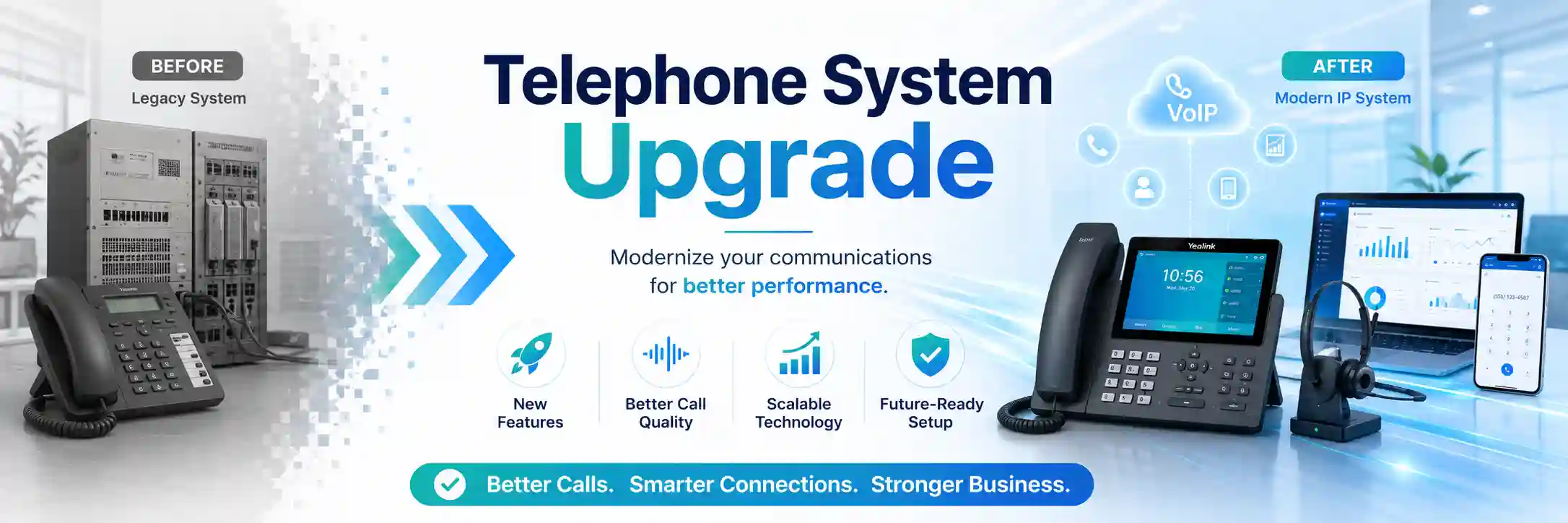
Extensions, numbers, trunks, call flows and users should be inventoried before change.
Downtime, staging and scheduling depend on the existing environment and provider actions.
Switching, PoE, VLANs, firewall behaviour, bandwidth and site links can affect voice performance.
Inbound, outbound, transfer, queue, voicemail and user workflows should be tested after migration.
What does IP PBX migration mean for a business?
IP PBX migration is the planned movement of business calling services from one telephone-system state to another. The destination may be a newer on-premises IP PBX, a hosted or cloud-managed platform, a consolidated multi-site system, or a redesigned installation using new network and provider arrangements. The migration can involve extensions, direct numbers, main reception numbers, SIP trunks, inbound rules, outbound rules, ring groups, call queues, voicemail, business-hour schedules, auto attendants, softphones, desk phones, remote users, analogue gateways and application integrations. Businesses should consider migration when an existing system is aging, hard to support, poorly documented, limited by previous design choices, difficult to expand, or no longer suitable for current workflows. Before work is confirmed, the customer should prepare information about the existing PBX, user count, extension list, telephone numbers, provider details, handsets, network, branch sites, call flows, licensing, access and the acceptable maintenance window. The exact approach is environment dependent and should be confirmed through assessment rather than assumption.
What an IP PBX migration project may cover
Existing telephone environment
Discovery may include the current PBX platform, software or firmware level, extension numbering, handset models, analogue devices, gateways, reception consoles, branch links, remote extensions, voicemail, greetings, schedules, call reports and administration method. The purpose is to create a usable record of what must continue, what can be simplified and what may require redesign.
Numbers and provider dependencies
Main numbers, direct numbers, SIP trunks, provider credentials, routing ownership, number-porting requirements and telecom account details can shape the migration sequence. Some changes depend on provider lead times or actions outside the PBX itself, so commercial and technical coordination should be identified early.
Network and security path
Voice traffic relies on cabling, switch ports, PoE, IP addressing, VLANs, routing, DNS, internet access, firewall policies and sometimes a session border controller or provider-specific edge device. Migration planning should confirm which parts of this path are already suitable and which parts need approved adjustment.
Users and call handling
A telephone system is defined by business behaviour as much as by technology. Reception handling, department queues, sales calls, after-hours routing, hunt groups, voicemail, mobile users, call forwarding and internal transfer patterns should be mapped so the new configuration supports the way staff actually work.
Who may need IP PBX migration support?
Migration support can be relevant to a company replacing a legacy PBX, moving away from an unsupported or difficult-to-maintain platform, consolidating separate office phone systems, preparing a new headquarters, adding branches, redesigning call queues, enabling more remote users, changing telecom providers, or recovering from years of undocumented configuration changes. It can also be useful when a business has technically functional telephony but the operational design no longer matches the organisation.
A growing office may have run out of extensions or PoE switch capacity. A multi-branch company may want extension-to-extension calling and central administration but currently has separate local systems. A reception team may rely on complex manual forwarding because the current PBX was never updated when departments changed. Remote users may be using informal workarounds instead of an approved softphone or secure connection method. A business may also have a telephone platform that still works but depends on hardware, licensing or vendor knowledge that is increasingly difficult to obtain.
None of these situations automatically means a full replacement is required. The first decision is whether the problem is the PBX platform, the network, the provider, the current configuration, handset compatibility, user workflow, documentation, or a combination of these. FourTeck can help separate the reasons for change from assumptions about the solution so the migration scope reflects a real business requirement.
Business triggers that often lead to a PBX migration
Expansion without a clear voice plan
New employees, departments or branches can expose limits in extension capacity, call handling, licensing, switch ports or administrator visibility. Migration may be considered when repeated additions create an inconsistent environment that is harder to support than a planned redesign.
Recurring call-routing problems
Missed reception calls, incorrect after-hours behaviour, queue overflow, unresolved forwarding rules or outdated department mappings may indicate configuration debt. Migration can be an opportunity to document and rebuild call flows, but only after the current business requirements are confirmed.
Aging or unsupported components
End-of-life hardware, unsupported operating systems, obsolete interface cards, difficult licensing or unavailable replacement parts can increase maintenance risk. The migration plan should identify which devices can be retained, which require replacement and which functions need an alternative method.
Provider or connectivity change
A new SIP service, internet circuit, office relocation or branch connectivity redesign can affect telephone registration and routing. Coordinating the PBX change with the network and provider work can reduce the risk of treating interconnected tasks as separate projects.
What can happen when migration risks are not mapped early?
A PBX migration affects a customer-facing service, so incomplete planning can create operational problems that are larger than a technical configuration error. The business may discover during cutover that a main number depends on a provider account no one can access, that an old handset cannot register to the new platform, that a door phone requires an analogue gateway, or that a reception queue was never documented. A new firewall policy may block signalling or audio. A voice VLAN may not reach a new server. An extension list may contain former employees or duplicate numbers. A branch may use a separate dial plan that conflicts with the new numbering scheme.
The practical impact can include missed calls, callers reaching the wrong department, inbound calls working while outbound calls fail, one-way audio, lost voicemail greetings, incorrect business-hour routing, unmanaged remote access, weak call quality or staff confusion during the first working day after the change. These issues do not prove that the new PBX is unsuitable; they often show that a dependency was not identified or validated before migration.
Controlled planning reduces this uncertainty. It does not remove all risk, because third-party providers, legacy devices and undocumented systems can still create surprises. It does, however, give the business a defined baseline, test plan, escalation path and rollback decision point.
Possible IP PBX migration assistance
Depending on the confirmed scope, FourTeck assistance may include an initial consultation, remote review, on-site inspection, extension inventory, handset and gateway inventory, trunk and telephone-number review, call-flow mapping, network readiness checks, switch and PoE review, voice VLAN assessment, firewall dependency review, configuration export or backup, migration planning, user grouping, extension creation, approved call-routing configuration, handset provisioning, softphone preparation, gateway coordination, provider coordination, staged migration, functional testing, administrator handover, documentation and post-change support.
Not every migration requires every activity. A small office moving between similar IP PBX platforms may have a comparatively simple dependency map but still require careful trunk, routing and handset checks. A multi-site business with reception queues, remote users, call recording, custom integrations, analogue endpoints and several providers may require a wider project plan. A business moving from a traditional or hybrid system to IP telephony may also need additional cabling, PoE switching, network segmentation, gateway design and user preparation.
The quotation should identify what FourTeck is responsible for, what the customer must provide, which third parties are involved, what equipment or licenses are separate, the testing responsibility, the planned change window and any known exclusions. This avoids treating migration as an undefined package.
Is this service a good fit for your current situation?
| Business situation | Relevant assistance | What must be confirmed |
|---|---|---|
| Existing PBX is aging or difficult to maintain | Current-state inventory, risk review, replacement or migration planning | Required features, phone compatibility, provider services, available backups and target platform |
| Several offices use separate telephone systems | Extension-plan review, site dependency mapping, centralisation options and staged cutover | Site links, local numbers, survivability needs, network design and provider boundaries |
| Call handling no longer matches business structure | Queue, ring group, schedule and routing discovery before redesign | Department ownership, reception process, overflow rules, voicemail and after-hours requirements |
| Business is moving office | Telephony migration coordinated with network, cabling and internet readiness | New-site connectivity, building access, switch ports, PoE, provider handover and cutover sequence |
| More staff need approved remote calling | Softphone, extension, security and remote connectivity planning | Licensing, supported clients, authentication, firewall or SBC requirements and user devices |
IP PBX migration service information
| Service topic | IP PBX migration planning, configuration, cutover assistance and validation |
|---|---|
| Main purpose | Move business telephony to an approved target state while preserving required call behaviour and controlling migration risk |
| Typical systems involved | PBX platform, SIP trunks, IP phones, softphones, gateways, switches, VLANs, firewall, internet, branch links, voicemail, queues and related integrations |
| Assessment method | Remote discovery and configuration review, with on-site inspection where physical infrastructure or local testing is required |
| Customer access required | Authorised administrative, provider and network access as relevant; access dependent |
| Backup considerations | Existing configuration exports, backups and rollback material should be reviewed where the platform supports them |
| Testing and validation | Scope dependent; may include inbound, outbound, internal, transfer, queue, voicemail, schedule, remote-user and failover scenarios |
| Vendor coordination | May be required for telecom providers, PBX vendors, application suppliers, internet providers and device support |
| Service location | Dubai and UAE service coordination, subject to issue, location, access, scheduling and approved scope |
| Quotation requirement | Final commercial scope depends on the current environment, target design, user count, sites, dependencies and work required |
Remote planning versus on-site migration work
When remote assistance can be suitable
Remote work may be practical for reviewing exported configuration, extension lists, licensing information, logs, provider settings, dial plans and proposed call flows. It can also support target-system preparation, administrator configuration, softphone setup, documentation review and some validation when secure authorised access is available.
Remote support depends on working internet access, a customer contact who can assist locally where needed, suitable remote-management methods and a scope that does not require physical inspection. It should not be assumed that every migration can be completed remotely, especially when handset replacement, cabling, gateways, switch configuration or local call testing is part of the project.
When an on-site visit may be appropriate
On-site work may be recommended when phones, patch panels, PoE switches, gateways, analogue devices, reception consoles or cabling need hands-on inspection. It may also be useful during a cutover that affects many users, when multiple departments need call-flow testing, when the site is inaccessible remotely, or when the network environment is poorly documented.
Site attendance is subject to confirmed location, access, scheduling and quotation. Building access, rack-room permissions, parking or security procedures, work permits where applicable, equipment availability and coordination with other contractors can influence the service plan.
How a migration assessment usually begins
- Clarify the business reason for change. The project should begin with the operational goal: replace an aging platform, improve maintainability, support more users, consolidate branches, prepare a relocation, redesign call handling or change service providers.
- Identify affected users, departments and sites. Extension counts alone are not enough. The assessment should identify reception, shared queues, remote staff, warehouse or shop-floor phones, conference rooms, analogue endpoints and any location-specific requirements.
- Collect the current call-flow evidence. This can include main numbers, direct numbers, business hours, holidays, IVR menus, queue logic, ring groups, voicemail routing, overflow behaviour, forwarding rules and outbound permissions.
- Map provider and network dependencies. SIP trunks, internet circuits, public addressing, firewall rules, DNS, switches, voice VLANs, PoE, site-to-site links and remote-user connectivity should be understood before the target design is approved.
- Review access, backup and rollback options. Existing administrator access, configuration exports, provider portals, license records and recovery options should be confirmed without exposing credentials in public communication.
- Define the evidence needed for quotation. The final scope should separate discovery, design, implementation, equipment or licenses, provider work, testing, documentation and post-migration assistance.
From current-state inventory to controlled cutover
Once the existing environment is understood, the migration can be organised into a sequence rather than treated as one large change. The first planning output is normally a current-state inventory: users, extensions, numbers, devices, trunks, call flows, voicemail, queues, schedules, integrations, network dependencies, provider contacts and known limitations. This inventory helps identify what should be migrated, what should be redesigned and what should be retired.
The target-state plan then defines the intended extension scheme, user groups, call routing, device approach, provider connectivity, network placement, administration model and security boundaries. Compatibility checks are important before assuming that existing phones, headsets, gateways or analogue devices can be reused. Support may depend on vendor provisioning methods, firmware, licensing and the feature set of the destination platform. A device that can technically register may still lack required keys, line appearances, directory functions or management capability.
Where practical, a pilot or staged migration can reduce the number of variables changed at once. A small user group, test number, secondary site or non-critical department may be used to validate registration, audio, routing and user workflow before the wider move. Whether this is possible depends on the current and target systems, provider configuration, number routing and project constraints.
The cutover plan should identify the maintenance window, communication steps, responsible contacts, provider actions, configuration freeze point, backup status, go/no-go criteria, test cases, rollback trigger and the period of post-change observation. Zero downtime should not be assumed unless the environment and provider process have been specifically assessed to support it.
Capability focus: preserve the call journeys that matter to customers
A migration is successful when the new PBX supports the business conversation, not only when phones show a registered status. For many companies, the critical journey begins with an external caller reaching the main number. The call may then pass through an IVR, reception team, ring group, queue, branch, mobile user or voicemail. The migration must preserve or intentionally redesign this sequence.
During discovery, it is useful to ask which numbers appear on public websites, invoices, advertising, vehicles, customer portals or supplier records. Direct numbers assigned to key employees may have different risk from unused historical numbers. Queue overflow may depend on time of day. After-hours routing may send calls to a security desk, duty mobile or recorded message. Holiday schedules can differ from normal business hours. These details are easy to miss if the project focuses only on extension creation.
FourTeck can help translate the current call journey into an implementation and test plan. The final behaviour remains dependent on the features available in the chosen platform, provider capabilities, licensing and approved business requirements. Where an old feature cannot be reproduced exactly, the difference should be identified before cutover so the customer can decide whether to accept an alternative workflow.
Capability focus: make the network ready for real-time voice
An IP PBX depends on the network that connects phones, the PBX, trunks and users. Voice can reveal problems that normal web browsing does not. A brief burst of packet loss, jitter or latency may be barely noticed when loading a webpage but can produce clipped audio, robotic speech or a dropped call. Power delivery also matters because many desk phones rely on PoE switches. A migration that adds more phones can exceed available switch-port or PoE capacity even when the data network appears healthy.
Network readiness may include reviewing cabling, switch interfaces, uplinks, PoE budgets, addressing, VLAN design, DHCP options where used, DNS, routing, internet capacity, firewall policies and the path to any hosted PBX or SIP provider. Quality-of-service configuration can be relevant, but QoS is not a substitute for sufficient capacity or a healthy connection. The correct approach depends on the actual network topology and the way voice traffic leaves or crosses the site.
Security should be considered at the same time. PBX administration, SIP connectivity, remote extensions and provisioning should use controlled access appropriate to the chosen platform. Broadly exposing PBX services to the internet without understanding platform and provider requirements can create risk. Any firewall change should be authorised, documented, limited to the required service path and tested for unintended impact.
Capability focus: build rollback and documentation into the project
A telephone migration should have a recovery route appropriate to the risk. Rollback does not always mean restoring the old system with one click. It may involve preserving the old PBX, keeping provider routing unchanged until validation, retaining configuration backups, staging handset changes, maintaining temporary forwarding or defining a clear point after which the migration cannot be reversed without provider assistance. The available options depend on the source platform, target platform, number movement and telecom-provider process.
Documentation supports both rollback and long-term maintenance. Useful records can include the extension plan, telephone-number ownership, trunk references, call-flow diagrams, queue membership, business hours, device assignments, gateway details, network dependencies, administrative ownership, backup location, provider contacts and test results. Sensitive credentials should be stored only through the customer’s approved secure method, not in general project notes or public correspondence.
Good documentation also makes later changes safer. When a new employee joins, a branch opens or reception routing changes, the administrator can work from an understood baseline instead of rediscovering historical settings. FourTeck can include documentation and handover within the agreed migration scope so the new PBX is not left as another undocumented system.
Testing, validation and handover after the PBX change
Testing should follow the business call paths that were identified before migration. A basic registration check only confirms that a device can connect to the PBX. It does not prove that the main number reaches reception, that a queue overflows correctly, that voicemail is delivered as expected, that outbound caller identification is appropriate, or that remote users have two-way audio.
A migration test plan may include internal extension calls, inbound calls to main and direct numbers, outbound calls, caller identification, transfer and hold behaviour, ring groups, queues, IVR options, business-hours routing, after-hours routing, voicemail, conference functions, remote softphones, branch-to-branch calling, analogue devices, emergency or special dialling requirements where applicable to the customer environment, failover paths and any approved application integrations. Not every item applies to every business, and tests should be adapted to the actual scope.
User acceptance is also important. Reception staff may notice call-handling differences that technical teams do not. A sales team may rely on a particular transfer sequence. Managers may need access to reports or voicemail. Remote staff may need guidance on a new client. Administrators may need to know how to add an extension, change a queue member, update business hours or obtain support without changing unrelated settings.
The handover should record completed work, test results, known limitations, outstanding third-party actions, backup status and recommended follow-up. A successful test on migration day does not remove the need for monitoring, maintenance and review as real users begin working with the new environment.
Dependencies that should be confirmed before a quotation
Which numbers are active, which provider delivers them, whether any porting or routing change is required, and who is authorised to request provider changes.
Access to the existing PBX, target platform, firewall, switch, provider portal and DNS where relevant. Credentials should be shared securely after authorisation is confirmed.
User, extension, trunk, recording, call-centre, remote-client or integration capabilities may depend on the selected platform and commercial license.
Existing IP phones may require supported provisioning, suitable firmware or manual configuration. Some models may not support required features on the new platform.
Available switch ports, PoE capacity, VLANs, DHCP, DNS, firewall behaviour, internet quality and branch links can influence design and cutover.
Door phones, paging systems, fax devices, analogue lines, intercoms, call recorders, CRM links or custom applications should be identified because they may require separate compatibility checks.
Migration risks, limitations and exclusions to understand
Migration planning reduces risk but cannot remove every dependency. A provider may control number routing or SIP activation. A legacy device may not have supported integration with the target platform. An old PBX may not provide a complete export of call flows. A configuration backup may restore only to the same product family or software level. A third-party application may require its own vendor to update an integration. Unsupported handsets may need replacement. A firewall or internet service may require changes outside the telephone-system scope.
Downtime depends on the source and destination systems, provider process, migration method, user count and whether services can run in parallel. Zero downtime should not be promised without an assessed design. Configuration changes should be planned for an approved maintenance window when there is a meaningful risk of service interruption. Hardware supply, new licenses, provider charges, cabling work, replacement parts and specialist third-party services may be outside support labour unless the quotation includes them.
A successful migration test confirms the agreed scenarios at that time; it does not guarantee that the network will never experience packet loss, that a provider will never have an outage, or that future platform updates will not require maintenance. Ongoing backups, monitoring, security review, documentation and maintenance remain part of responsible operation.
Final commercial terms, scheduling and inclusions depend on the approved quotation or service agreement. Contact FourTeck to confirm the service scope before planning a cutover date.
Business environments where migration planning can be especially important
Professional offices often depend on reception, direct numbers, meeting-room phones, mobile users and department call groups. For these businesses, the migration must preserve a familiar customer journey while giving administrators a manageable extension and routing structure. A poorly planned change can create confusion even when every handset is technically online.
Retail and showroom environments may combine office phones with front-desk devices, warehouse extensions, paging or call forwarding to mobile staff. Their migration plan should identify which locations must remain reachable during opening hours and whether there are periods when a staged change is practical. Warehouses and logistics sites may have phones distributed across offices, loading areas, security points and operational zones, sometimes across separate network segments.
Clinics, schools, training centres and hospitality operations can have strong dependence on reception and departmental routing. The relevant requirement is not sector-specific compliance unless separately assessed; it is the operational need to keep inbound calls understandable, maintain internal communication and control who can change call behaviour. Multi-branch companies add another layer because local numbers, site links, central queues, extension dialling and branch survivability may need to be considered together.
Remote and hybrid teams introduce endpoint and connectivity diversity. Some staff may use desk phones at home, others softphones on managed computers or mobiles, and others may work across offices. The migration should define an approved connection method, licensing, security controls and support responsibility rather than allowing each user to create a separate workaround.
Operational, security and maintenance considerations after migration
The end of the cutover is the beginning of the operating phase. A new PBX needs an owner, an access method, a backup process, a maintenance approach and a record of how the system connects to the network and provider. Administrator accounts should be limited to authorised users. Shared administrator credentials can make accountability difficult, especially when several vendors or contractors support different parts of the environment.
Remote administration and remote extensions should follow the security method supported by the chosen platform. Depending on the architecture, this may involve secure web administration, VPN, platform-specific tunnelling, a session border controller, controlled firewall rules, multifactor authentication where available, or other vendor-supported methods. The exact configuration should follow current platform requirements rather than generic port-opening advice.
Backups should be reviewed to confirm what they contain, where they are stored, how they are protected and what is required to restore them. A backup that has never been tested or whose password is unknown may not provide the expected recovery path. Firmware, software and security updates should be planned rather than applied blindly to a business-critical PBX. Changes should consider compatibility with phones, trunks, gateways and integrations.
Operational documentation should be updated when staff, departments, numbers, queues or providers change. This reduces configuration drift and makes future troubleshooting faster. Periodic review can also identify unused extensions, inactive forwarding, stale administrator accounts, old devices, certificate issues, backup failures, storage growth or network changes that have altered the voice path.
Before you contact FourTeck about an IP PBX migration
Preparing a clear starting set of information helps FourTeck determine whether the next step should be a remote discovery session, an on-site assessment or a broader migration-planning exercise.
- The Dubai or UAE site location and the main technical or operational contact.
- The current PBX platform and any known software or hardware version information.
- Approximate number of active users, extensions and office locations.
- Main published numbers, direct numbers and any known SIP trunk or telecom provider information.
- A simple description of reception, queue, IVR, voicemail and after-hours call behaviour.
- Handset models, softphone use and any analogue devices such as fax, door phones or paging interfaces.
- Whether administrative access to the current PBX and network is available.
- Whether configuration backups or exports exist and when they were last checked.
- Network information such as switch type, PoE availability, voice VLANs, firewall and branch connectivity where known.
- Any CRM, recording, reporting, door-entry or other application integration that depends on the telephone system.
- Recent changes, recurring voice problems or known limitations that are motivating the migration.
- Required business outcome: replacement, consolidation, relocation, provider change, remote-user support or call-flow redesign.
- The preferred maintenance window and any periods when telephone disruption would have high business impact.
- Building, rack-room, security or site-access restrictions that may affect an on-site visit.
- Any target platform already selected, together with license status and vendor or provider contacts if applicable.
Service evaluation checklist for a migration quotation
- Confirm the exact business objective and the reason the current PBX is being changed.
- Confirm the number of users, extensions, locations and remote users in scope.
- Identify which existing phones, gateways and network devices are intended for reuse.
- Define whether provider, number-porting or SIP-trunk work is part of the engagement.
- Define whether network changes such as VLANs, PoE switches, firewall rules or cabling are required.
- Confirm whether the target PBX, licensing and hosting arrangement are already approved.
- List the call flows, queues, schedules, voicemail and integrations that must be migrated or redesigned.
- Decide which tasks can be performed remotely and which require on-site attendance.
- Agree the backup, rollback and configuration-freeze approach appropriate to the migration.
- Define the test cases and the customer representatives responsible for user acceptance.
- Confirm documentation, administrator handover and user-guidance requirements.
- Identify exclusions, third-party responsibilities, equipment supply and follow-up maintenance expectations.
How FourTeck can support the migration journey
FourTeck’s role can begin before a target system is selected or after the customer has already approved one. The first priority is to understand the existing telephone environment and the business outcome, then identify the technical boundaries that could affect migration. This can include PBX configuration, users, handsets, providers, network, firewall, branches, remote users and integrations.
For planning work, FourTeck can help organise extension and number inventories, map required call flows, document known dependencies and identify questions for telecom or software vendors. For implementation, assistance can include approved configuration, user and extension preparation, device provisioning, network coordination, cutover support and testing according to the confirmed scope. Where another provider controls a dependency, FourTeck can help organise evidence and technical information so the correct party can act.
The objective is not to force every telephone environment into the same design. A small office, a multi-branch business, a warehouse and a customer-service team may need very different call behaviour. The target should be understandable, maintainable and aligned with real operations. FourTeck can also support documentation and post-migration review so recurring issues become visible rather than remaining as informal workarounds.
For broader background on the company’s connected-support approach, visit About FourTeck IT Services. For a broader view of infrastructure and support capabilities, see FourTeck business technology support.
Dubai and UAE service coordination
IP PBX migration work can combine remote preparation with planned on-site activity. For a Dubai office, remote discovery may establish the current configuration and provider dependencies before a site visit is scheduled for physical checks, handset changes or cutover support. For other UAE locations, the same principle applies: the service method should match the technical task rather than assuming that everything requires attendance or that everything can be completed remotely.
On-site planning depends on the site location, building access, work restrictions, engineer availability, customer contacts, required parts or devices, telecom-provider coordination and the approved scope. If the migration is part of an office move, internet activation, network installation, switch deployment and cabling readiness may need to be coordinated before the PBX can be moved. If number porting or provider changes are involved, the provider schedule can become a critical project dependency.
Customers should avoid fixing a cutover date solely around an internal preference before provider, access and technical prerequisites are confirmed. FourTeck can help build these dependencies into the service plan and quotation so the business understands what must happen before, during and after the approved migration window.
Service coordination across Dubai, Abu Dhabi, Sharjah and Ajman
Businesses with offices in Dubai, Abu Dhabi, Sharjah and Ajman may have different telephone environments at each location. One site may use a local PBX, another may have remote extensions to a central system, and another may depend on a separate provider or internet circuit. A multi-site migration should therefore start by identifying which functions are local and which are shared.
Service coordination may include remote configuration review, planned on-site assessment, handset or network checks, migration preparation, provider coordination, staged cutover, call-flow testing and post-change support depending on the confirmed scope. Travel, building access, site conditions, maintenance windows, equipment availability and third-party actions can affect the final plan. The presence of offices in several emirates does not automatically require identical local designs; the goal is a supportable architecture that reflects the business’s calling pattern and continuity needs.
Contact FourTeck to confirm remote and on-site options for the relevant locations before scheduling migration activity.
Related FourTeck IT services that can affect PBX migration
For call-routing faults, extension problems, registration issues and ongoing telephone-system assistance.
Network and WiFi support
For switching, VLAN, PoE, cabling, connectivity and performance dependencies that can influence voice quality.
Firewall and secure connectivity support
For authorised firewall, remote-access and traffic-path review when PBX services cross network boundaries.
Business IT migration and project support
For office moves, network changes, user preparation and other infrastructure work that may run alongside telephony migration.
Why businesses contact FourTeck for a migration assessment
Telephone migration often crosses several technical ownership areas. The PBX may be supported by one company, the SIP trunk by another, the firewall by an IT provider, the switches by an internal administrator and the cabling by a separate contractor. When a call fails, each component can appear healthy in isolation while the end-to-end service is still broken. FourTeck’s connected-support approach is useful where the customer needs one assessment that considers users, devices, network, provider, PBX configuration and business call flow together.
Businesses also need a migration plan that can be explained to non-technical decision-makers. A manager may not need the details of every SIP header, but does need to understand which numbers are at risk, whether a provider action is required, what the maintenance window affects, which phones may need replacement, what testing will occur and what the rollback decision means. Clear scope supports better approval and budgeting.
FourTeck can help clarify the reported requirement, organise remote or on-site assessment, identify dependencies, coordinate approved technical work, document the outcome and prepare a quotation based on the actual environment. No response time, migration duration or outcome should be assumed before the system, access and project dependencies are assessed.
Questions businesses ask before choosing IP PBX migration support
Can our IP PBX migration be completed without changing every desk phone?
Possibly, but handset reuse is compatibility dependent. Existing IP phones may use standard SIP, yet practical support can still depend on the target PBX’s provisioning method, supported firmware, key programming, security settings and feature compatibility. A phone that can place a basic call may not provide the required line keys, directory functions, BLF status, transfer behaviour or central management. The migration assessment should therefore inventory handset models and group them into supported, conditionally reusable and replacement-required categories before a quotation is finalised. The same principle applies to conference phones, reception devices and analogue gateways.
Can FourTeck check the migration remotely before anyone visits the office?
Remote discovery is often useful when authorised access exists. Configuration exports, extension lists, call-flow screenshots, provider details, network diagrams, logs and license information can be reviewed without visiting the site. This can make an on-site assessment more focused because the physical checks can concentrate on phones, switches, PoE, cabling, gateways, rack layout and areas that cannot be confirmed remotely. If the existing system is inaccessible, undocumented or dependent on physical devices, on-site assessment may need to happen earlier. The correct service method should be chosen after the first information review.
How do we know whether the problem requires migration or only better PBX support?
Start by separating the business symptom from the assumed solution. Poor call quality can come from the network or provider rather than the PBX. Incorrect call routing may be a configuration issue. Repeated registration failures may involve firewall or connectivity. Migration becomes more appropriate when the current platform has lifecycle limitations, cannot support required workflows, has difficult licensing or hardware constraints, has become unmaintainable, or no longer aligns with business direction. FourTeck can assess the current state and help distinguish corrective support from a genuine migration requirement. This can prevent a business from replacing a platform when the underlying issue sits elsewhere.
What information should we gather about our telephone numbers?
Prepare a list of main published numbers, direct numbers, department lines, toll-free or special numbers if applicable, provider account references and any known routing relationships. Mark which numbers are business critical and where they should terminate after migration. If the project includes changing providers or porting numbers, identify the legal or account owner and the person authorised to request changes. Number movement is often one of the most important external dependencies because the PBX cannot control routing that remains with a telecom provider.
What can affect the final migration cost and scope?
The main factors are usually the complexity of the current environment rather than extension count alone. Scope can change with the number of sites, handsets, trunks, direct numbers, call queues, IVR levels, analogue devices, branch links, remote users, integrations, network changes, provider tasks, cabling requirements, licenses, documentation quality, maintenance window and testing depth. A small site with many special devices may require more planning than a larger office with a simple call flow. The quotation should identify labour, equipment or licensing dependencies, third-party work, travel or site requirements where applicable, and any activities that remain customer responsibility.
Should we migrate the PBX before or after an office move?
The answer depends on whether the old and new sites can operate in parallel, when the new internet service becomes available, whether numbers are tied to a provider process, and whether the target PBX is on premises or hosted. Migrating too early can create temporary routing complexity; migrating too late can make the move dependent on an old system that was never tested in the new network. A combined office-move and telephony plan should map internet activation, firewall readiness, switches, PoE, cabling, handset deployment, provider actions, user communication and the physical cutover. FourTeck can help identify which sequence has the lowest practical risk for the assessed environment.
Is voice VLAN configuration always required for an IP PBX migration?
Not automatically. Voice VLANs can improve separation, administration and traffic handling in many business networks, but the correct design depends on the existing switches, phones, addressing, security requirements, network size and operational support model. Adding a VLAN without understanding routing, DHCP, firewall policies and switch configuration can create new problems. The migration assessment should determine whether the current network already has a usable voice segment, whether a new segment is justified or whether another design is more appropriate. Network changes should be documented and tested with both voice and other connected services.
Can existing SIP trunks stay in place while only the PBX changes?
Sometimes they can, but provider compatibility and authentication requirements must be confirmed. A trunk may be tied to a particular IP address, registration method, codec, security method, customer-premises device or provider-approved configuration. The provider may also need to approve or change the destination of the service. Do not assume that a working trunk on the old PBX will connect to the new platform unchanged. Collect provider documentation and account ownership details early so any required coordination happens before the maintenance window.
What should we test immediately after cutover?
Start with the highest-value customer and staff call paths. Test the main number from an external phone, direct numbers, reception transfer, queue distribution, internal extension calling and an outbound call. Then validate business-hour and after-hours behaviour, voicemail, remote users, branch calling, caller identification and special devices included in the scope. Do not rely on a single test call. Different numbers or routes may use different provider paths. Record results and unresolved items so the team knows whether the migration can continue, needs corrective work or has reached a rollback decision point.
What if we have no reliable documentation for the old PBX?
Lack of documentation increases discovery work but does not make planning impossible. The assessment can build an inventory from available administrator screens, configuration exports, handset labels, provider records, user interviews, call tests and network information. Reception staff are often valuable sources because they know how calls actually arrive and overflow. The business should avoid making broad configuration changes simply to discover behaviour. Instead, record the current state methodically, identify uncertain areas and include additional validation in the migration plan. Unknown dependencies should be treated as risks rather than quietly assumed away.
Do we need a rollback plan if the new system has already been tested?
Yes, a tested target system can still behave differently when production numbers, real users, provider routing and full call volume are introduced. The rollback method can be simple or complex depending on the project, but the team should know what constitutes a failed cutover, who makes the decision, what configuration or provider routing can be restored, and when reversal stops being practical. A rollback plan is not a prediction that the migration will fail; it is a controlled response to an uncertain change. Where provider actions cannot be instantly reversed, the plan may include temporary forwarding or another continuity method rather than a full restoration.
Can a PBX migration improve call quality?
It can remove some platform or configuration limitations, but call quality depends on the complete voice path. Handsets, cabling, PoE switches, VLANs, local routing, internet quality, firewall handling, codecs, provider performance and remote-user connectivity may all influence audio. Replacing the PBX without checking these layers can leave the original problem unchanged. If call quality is one reason for migration, include measurable symptoms such as one-way audio, clipping, delay, intermittent drops or problems at specific sites. This allows the project to test the relevant network and provider layers instead of assuming that a new PBX alone will solve voice quality.
When should we involve our telecom or internet provider?
Involve the provider when the migration affects SIP trunk credentials, public IP requirements, number routing, number porting, provider-supplied routers, managed firewalls, hosted voice edge devices or service activation. Provider input can also be needed when testing indicates packet loss, routing or signalling problems outside the customer network. Contacting the provider early is valuable when their work has a lead time, but the request should be specific. FourTeck can help organise the technical information so the provider receives clear details about the source service, target change, timing and evidence rather than a generic statement that calls are not working.
What should a business expect after the migration is complete?
Expect a period of real-user validation and small adjustments. Even with a thorough test plan, users may identify preferences around ring timing, queue membership, key layout, voicemail notifications or forwarding behaviour once normal work resumes. These should be treated as controlled follow-up changes, not undocumented ad hoc fixes. The business should receive or maintain an extension list, call-flow record, ownership information, backup plan and support contacts appropriate to the agreed scope. If the new environment is complex, a post-migration review can help separate actual faults from user-training needs and identify maintenance tasks that should be scheduled.
How do we decide between one-time migration support and ongoing PBX maintenance?
A one-time project may be enough when the customer has internal administration, a stable provider relationship, good documentation and a clear maintenance process. Ongoing support can be more useful when the business lacks a dedicated telephony administrator, has several branches, depends heavily on queues or remote users, or expects frequent staff and call-flow changes. The service agreement should define what is included, how changes are requested, which systems and sites are covered, and which project work or hardware remains separate. Unlimited support or fixed response times should not be assumed unless explicitly stated in an approved contract.
Frequently asked questions about IP PBX migration in Dubai
How long does an IP PBX migration take?
There is no responsible fixed duration without assessment. Timing depends on users, sites, current documentation, provider work, number movement, network changes, handset preparation, integrations, testing and the approved maintenance window.
Will our telephone numbers change?
Not necessarily. Number retention depends on the telecom service and whether provider or porting changes are part of the migration. Existing numbers should be inventoried and confirmed with the relevant provider before cutover.
Can migration be done outside business hours?
A maintenance window can be planned where appropriate, but scheduling depends on engineer availability, customer access, provider participation, site conditions and the confirmed scope. The quotation should state the agreed change window.
Can remote employees be included?
Yes when the target platform, licensing and security design support them. Remote users may need approved softphones, authentication, firewall or SBC configuration and reliable internet access.
Will FourTeck configure the network too?
Network work can be included when it is required and identified in the approved scope. Voice VLANs, PoE, switching, firewall rules, cabling or bandwidth issues should not be assumed to be included automatically.
What happens to the old PBX?
The decommissioning approach depends on rollback needs, data retention, hardware ownership, provider connections and customer policy. It may need to remain available temporarily until the new system is validated.
Can voicemail and greetings be migrated?
Sometimes. Export and import options vary by platform. Where direct migration is not supported, greetings or voicemail structures may need to be recreated. This should be checked during discovery rather than assumed.
Do you need our passwords before assessment?
Do not send passwords through a public webpage or general enquiry. FourTeck may require authorised administrative access later, but credentials should be shared only through an approved secure method after identity and scope are confirmed.
Can a PBX migration include new call queues?
Yes when the target platform supports the required queue behaviour and the design is included in scope. Queue membership, overflow, announcements, schedules, reporting and licensing should be defined before implementation.
Do you provide support after cutover?
Post-migration validation, corrective work, documentation updates or ongoing support can be included according to the approved quotation or service agreement. The exact coverage should be confirmed before the project begins.
Discuss your IP PBX migration before choosing a cutover date
Share the current PBX, user count, main numbers, provider details, handsets, call-flow requirements, site locations and the business reason for migration. FourTeck can review the available information, identify missing dependencies and confirm whether the next step should be remote discovery, an on-site assessment or a broader migration-planning scope.
Installation, configuration, provider coordination, network changes, testing, documentation and post-migration support should be stated clearly in the approved quotation. Scheduling depends on access, site conditions, third-party actions, engineer availability and the confirmed work scope.