
IP PBX IVR Configuration in Dubai, UAE
An IVR, often described as an automated attendant or digital receptionist, gives callers a structured menu before the call reaches a person or department. A useful IVR is not simply a recorded greeting. It is a controlled call-routing design that connects telephone numbers, business hours, menu options, destinations, fallback rules, prompts and testing into one understandable caller journey.
FourTeck can assist with reviewing an existing IP PBX, defining the required menu, configuring approved routing changes, validating calls from outside the organisation and documenting the final flow. The exact work depends on the PBX platform, telecom provider, available access, current configuration and the business outcome you want to achieve.
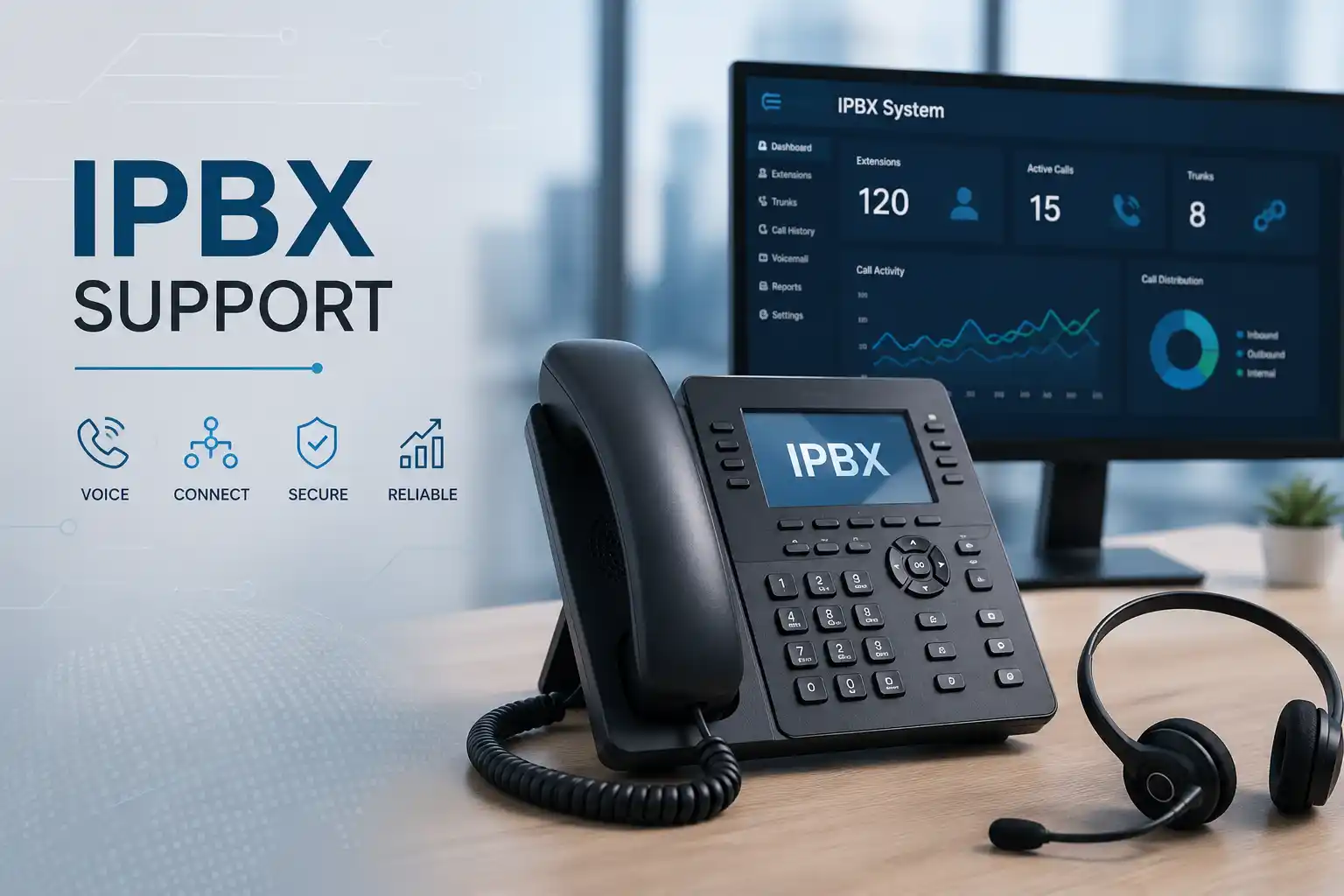
What does IP PBX IVR configuration involve?
IP PBX IVR configuration is the process of defining how inbound calls are answered by an automated menu and then moved to the correct business destination. It is mainly used to reduce unnecessary transfers, guide callers by department or service, apply different routing during open and closed hours, and provide controlled fallback behaviour when a selected destination is unavailable. Businesses should consider it when the existing phone menu is confusing, departments have changed, new numbers or branches are being introduced, after-hours handling is inconsistent, or the PBX is being reconfigured. Before work begins, the customer should identify the PBX platform, inbound numbers, required departments, business and holiday hours, existing prompts, preferred language, destination extensions or groups, administrator access and any call-handling rules that must remain unchanged. The final scope is configuration dependent and may also involve the SIP trunk, telecom provider, network, gateways or handsets.
What a practical IVR service may cover
Call-menu design
The menu should reflect how customers actually contact the organisation. This may include a reception option, sales, support, accounts, reservations, a service desk or another department. The number of levels, order of options and wording of prompts should be kept manageable so callers can make a clear choice without navigating a maze of nested menus.
Routing configuration
Each menu choice needs an approved destination. Depending on the platform and business process, the destination may be an extension, ring group, call queue, voicemail box, operator, announcement or another IVR. Routing also needs clear handling for unanswered calls, invalid selections and callers who make no selection.
Time-based call handling
Open hours, breaks, weekends and holidays may require different prompts and destinations. The exact method depends on the PBX. Time rules should be reviewed alongside the organisation’s actual operating schedule so that a technically correct rule does not send callers to a team that is not working.
Testing and documentation
A change is not complete when the settings are saved. External calls should be used to confirm the greeting, DTMF key recognition, routing, ringing behaviour, audio path and fallback destinations. The final menu and major dependencies should then be documented so later changes can be made with less guesswork.
Who may need IVR configuration?
An organisation may need IVR configuration when the structure of the business has moved ahead of the telephone system. A company that started with one receptionist may now have separate sales, operations and support teams. A clinic may want callers to distinguish appointments from administration. A hospitality site may need reservations to follow a different route from supplier calls. A property-management team may want service requests to reach a dedicated group instead of the general office.
The service can also be relevant after a relocation, PBX replacement, SIP trunk change, branch opening, new main number, department reorganisation, staffing change or acquisition. In these cases the goal is often not to make the IVR more complex, but to ensure that it still matches the business. A menu designed several years ago can contain obsolete names, extensions that no longer exist, destinations with no active members or opening-hour rules that no longer reflect actual working patterns.
Businesses with high-value or time-sensitive calls should pay particular attention to fallback behaviour. If nobody answers a department, the next action should be deliberate rather than accidental. Depending on business requirements, a fallback may be another team, a queue, voicemail, an announcement or a return to reception. The correct choice is operational rather than purely technical.
Common signs the current IVR needs attention
- Callers repeatedly press the wrong menu option or ask reception to transfer them again.
- A department name, working schedule or team structure has changed but the phone menu has not.
- Calls reach voicemail or disconnect when a group is busy, unavailable or no longer configured correctly.
- The same main number needs different handling during business hours, breaks, weekends or holidays.
- External callers report that keypad selections are not recognised consistently.
- The greeting is too long, unclear, outdated or inconsistent with the destinations that follow.
- Different branches or numbers use unrelated call flows that are difficult for administrators to maintain.
- Nobody can explain the complete path from the inbound number to each final destination.
Why poor IVR design becomes an operational problem
A badly structured IVR can create friction before a customer reaches an employee. The impact is not limited to caller convenience. Incorrect routing can increase receptionist workload because staff spend time repairing transfers that the menu should have handled. It can also distribute calls unevenly, causing one department to receive enquiries intended for another. If the no-answer path is not defined, important calls can land in a mailbox nobody checks or return to an extension that is already unavailable.
Changes made without documenting the original configuration can also increase technical risk. A call-flow edit may interact with office-hour rules, inbound number mapping, ring groups, queues, extension schedules, forwarding policies, voicemail or provider settings. A small adjustment at one point can therefore have a wider effect. For this reason, production changes should be planned with the current routing understood, suitable access authorised, configuration backup or export considered where supported, and a practical rollback approach defined.
Another common problem is treating every call-routing symptom as an IVR problem. If callers hear the menu but the call fails after selection, the issue may sit at the destination, network, trunk, codec, gateway, endpoint or provider layer. If key presses are not detected, DTMF handling may need to be checked across the PBX and telecom path. If only one phone does not ring, changing the menu itself may be the wrong action. FourTeck’s assessment therefore looks at the complete call path before recommending changes.
Possible configuration scope
Depending on the confirmed environment and quotation, assistance may include reviewing the existing inbound call flow, identifying the main DID or telephone numbers, confirming SIP trunk or provider dependencies, mapping current IVR options, creating or revising greetings, assigning key selections, setting destination extensions, configuring ring groups or queues, defining operator handling, adjusting timeout behaviour, setting invalid-input actions, aligning business hours, creating after-hours routing, reviewing holiday handling, checking voicemail destinations, planning multilingual menus, testing call transfers and documenting the completed flow.
The scope may also extend to related telephone-system issues when they prevent the IVR from working as intended. Examples include an extension that is not registered, a group with no available members, a queue with outdated agents, a gateway that is unreachable, an inbound number that maps to the wrong entry point, or network conditions that affect voice traffic. These are not automatically included in every IVR engagement; they should be identified and agreed as part of the support or project scope.
Prompt production may be customer supplied or handled as a separate requirement depending on the engagement. The business should confirm wording, pronunciation, language, department names, legal or compliance announcements and who approves the final recording. FourTeck can help align prompt sequencing with the configured menu, but the customer remains responsible for approving customer-facing wording and organisational policy statements.
Service-fit matrix for IVR configuration
| Business situation | Relevant assistance | What must be confirmed |
|---|---|---|
| Callers reach the wrong department | Review menu labels, key assignments and destination mapping | Current call flow, required departments and live destination extensions |
| After-hours calls are handled inconsistently | Review schedules, closed-hours prompts and fallback destinations | Official business hours, holiday rules and approved after-hours action |
| Key presses are not recognised | Test DTMF handling through the PBX and telecom path | Provider, trunk, PBX platform and reproducible external call examples |
| Departments have been reorganised | Redesign menu and destinations around the current structure | New team names, ownership, call priority and overflow rules |
| A new main number or branch is being added | Plan inbound mapping and branch-specific or shared IVR routing | Number ownership, trunk capability, branch extensions, hours and network readiness |
| Existing IVR is undocumented | Discovery, mapping, controlled changes and handover notes | Administrator access, current live behaviour and any critical call paths |
Service information at a glance
| Service topic | IP PBX IVR configuration and call-routing support |
|---|---|
| Main purpose | Create or improve structured inbound call menus, routing and fallback behaviour |
| Typical systems involved | IP PBX, SIP trunk or telecom service, inbound numbers, extensions, groups, queues, voicemail and network connectivity |
| Remote support suitability | Often suitable when authorised secure administration and reliable internet access are available |
| On-site support suitability | May be required for gateways, cabling, local network faults, physical handsets or site coordination |
| Customer information required | PBX platform, numbers, desired menu, destinations, business hours, prompts, access availability and target outcome |
| Testing and validation | External inbound calls, menu options, invalid or no-input paths, destination ringing, audio and approved fallbacks |
| Service location | Dubai and UAE coordination, subject to confirmed remote or on-site scope |
| Scope dependency | Platform, licensing, access, provider, current configuration and required call flow |
| Quotation requirement | Contact FourTeck to confirm the assessment, configuration and testing scope |
Remote configuration or on-site assistance?
When remote work may be suitable
IVR configuration is often software driven. Remote assistance may therefore be practical when the PBX is reachable through an authorised secure administration method, the internet connection is stable, the customer can approve changes, and no physical testing is required. Remote sessions can support discovery, configuration review, prompt assignment, menu changes, route testing and documentation. A local user or administrator may still be needed to place test calls, confirm caller experience or verify internal destinations.
Remote suitability does not mean every issue can be solved remotely. If the PBX itself is unavailable, the network is unstable, a gateway has failed or the problem depends on a physical device, the engagement may need to move to an on-site or mixed approach.
When an on-site visit may be appropriate
On-site support may be useful when call routing is affected by local gateways, analogue interfaces, cabling, switch ports, voice VLANs, power, network equipment or phones that cannot be checked remotely. It can also help when several users need coordinated testing, a branch is being deployed, physical equipment is being replaced, or the customer does not have reliable remote administration in place.
The visit should have a defined objective. Pure IVR changes may not require site attendance, while broader telephone-system problems can. FourTeck can help determine which work belongs in remote configuration and which work needs hands-on access before the final scope is confirmed.
How the IVR assessment and configuration process can be organised
Start with the business outcome: which callers use the number, which departments should be reachable, which calls are most important and what should happen if nobody answers. The desired experience should be understandable before technical settings are changed.
Identify the PBX, inbound number, trunk or provider relationship, current IVR, groups, queues, extensions, prompts, schedules and fallback routes. Existing behaviour should be recorded so changes can be compared with a known baseline.
Administrator access, maintenance window, approval contacts and configuration backup options should be confirmed. Credentials should be shared only through an approved secure method after identity and authorisation are established.
Create a simple flow showing each menu key, destination, timeout, invalid choice, business-hours rule and no-answer path. Complex menus should be justified by a real operational requirement rather than added because the platform allows them.
Configuration is implemented in a controlled sequence. Where practical, changes are staged so the main inbound path can be validated before additional options are introduced. Provider or licensing dependencies are addressed separately if required.
External calls are important because they exercise the real inbound path. Each key option, no-input condition, invalid entry, after-hours route and fallback should be checked as relevant, together with two-way audio and the expected final destination.
The customer confirms that the prompt wording, menu logic and final routing reflect the intended process. Technical success alone is not enough if callers are being sent to the wrong operational team.
Record the live menu, key mappings, destinations, schedules, exceptional handling and any unresolved dependency. This creates a practical reference for future staff changes, holiday updates, branch additions or troubleshooting.
Testing should follow the real caller path
A useful IVR test starts outside the business telephone system. Internal extension-to-extension testing can confirm that destinations exist, but it may not prove that the inbound number, telecom provider, trunk, IVR and endpoint all work together. External tests should confirm that the correct greeting is heard, audio is clear enough for the menu to be understood, key presses are recognised, the selected route is followed and the destination rings as expected.
Testing should include more than the happy path. If a caller presses a key that is not assigned, the result should be deliberate. If the caller makes no selection, a timeout action should be defined. If a destination does not answer, the configured fallback should match the business decision. If the business has open and closed schedules, both conditions should be checked when practical. Holiday behaviour should be reviewed before a holiday period rather than discovered by customers after the office closes.
Where a call reaches an agent, two-way audio should also be confirmed. If the IVR accepts the key but the conversation has one-way or no audio, the cause may be outside the IVR itself. Similarly, if only calls from a particular provider or route fail to deliver key presses, the test evidence should be recorded for deeper trunk or provider investigation.
The handover should note what was tested, which scenarios were not available to test and which changes remain customer, vendor or provider dependent. This avoids treating an incomplete test as a guaranteed result.
Capability focus: making the menu easier for callers to use
The most useful IVR is usually the one that helps callers decide quickly. Menu wording should use language that matches the way customers describe the business. If the website says “support” but the phone menu says “technical operations,” callers may hesitate even though both refer to the same team. Short, direct choices reduce confusion, especially when callers are using a mobile phone in a noisy environment or are unfamiliar with the organisation.
Menu depth also matters. Adding more layers can create precise routing, but every layer asks the caller to listen, understand and choose again. The right design depends on call volume, team structure and the importance of self-selection. A small office may need only a single menu, while a larger organisation may need a carefully controlled second level for a specific department. The design should not assume that more automation is automatically better.
Prompts need operational ownership. A department should know who approves wording when its name changes, when a seasonal service is added or when an office moves. If recordings are provided in more than one language, both the recordings and their destination logic should be maintained together. FourTeck can help translate the approved business structure into a technically consistent menu, while content approval remains with the customer.
Capability focus: controlling what happens when the first route fails
Many IVR problems are really fallback problems. The primary menu option may work, but the caller experience becomes uncertain if the chosen department is busy, logged out, closed or no longer staffed. An IVR project should therefore consider the complete path beyond the first destination. The business needs to decide whether unanswered calls should overflow to another group, remain in a queue, return to reception, move to voicemail, play an announcement or follow a different process.
This decision can differ by department. A sales call may be routed to another available team member, while an accounts enquiry may be better directed to a shared voicemail that is checked by the finance team. A support call may need a queue when staff are available and a separate after-hours message when they are not. The PBX can only enforce the rules it is given; operational ownership must be clear first.
Fallback planning should also consider dependencies. A voicemail destination needs ownership and monitoring. A queue needs valid members and sensible agent availability. An operator route requires somebody to answer it. A mobile forwarding destination may depend on provider rules and outbound calling permissions. FourTeck can help identify these dependencies during the call-flow review so that the fallback is not merely configured but also usable.
Capability focus: keeping future IVR changes maintainable
A phone menu should be easy to explain after the original project is complete. If only one administrator understands why an inbound number routes through several hidden conditions before reaching an IVR, routine updates become risky. Documentation should therefore show the relationship between the number, schedule, menu, key options, destination objects and exceptional handling in language that an authorised administrator can follow.
Maintainability is especially important for businesses with staff turnover or seasonal changes. If the sales manager changes, it should not require redesigning the entire IVR. Routing to a group or queue can sometimes reduce dependence on a single extension, provided that group membership is maintained. If holiday prompts are updated frequently, the process and ownership should be documented. If several branches share a standard menu, differences between branches should be explicit rather than hidden in undocumented rules.
A maintainable design also avoids unnecessary complexity. Call flows built from too many exceptions can become difficult to test and easy to break. FourTeck can help simplify existing routing by identifying obsolete options, destinations that no longer exist, duplicated prompts and rules that are no longer required, subject to customer approval. The aim is not to remove useful features but to make the live configuration easier to understand, support and change safely.
Dependencies, access and information the customer controls
IVR work depends on more than menu wording. FourTeck may need authorised administrative access to the IP PBX, visibility of the current call handling, information about the SIP trunk or telecom provider, inbound number ownership, the extension or group structure and any licensing that controls call-routing features. The customer should identify who is authorised to approve telephone-system changes and who can confirm that the final call flow matches business policy.
If the PBX is hosted by a third party, some settings may only be available through the provider or may require their involvement. If telephone numbers are being moved or newly activated, routing may depend on provider completion. If the business uses local gateways, analogue lines or special interfaces, those devices may introduce additional dependencies. If the network is unstable, voice VLAN, firewall, switch or internet checks may be needed before the IVR can be judged properly.
FourTeck does not need passwords published in a website request. Credentials should be exchanged only through an approved secure method once the service relationship, identity and authorisation are confirmed. Customers should also identify any maintenance restrictions, critical call periods and emergency routes that must not be interrupted during configuration.
Prompt recordings, translations and announcements may require separate approval. If a call-recording notice, privacy message or regulated statement is required, the customer should provide or approve the correct wording and seek appropriate legal or compliance guidance where necessary. Technical configuration does not itself establish compliance.
Risk, limitation and exclusion guidance
Changing production call routing can affect active business communication. The scope should therefore identify a suitable change window, what can be backed up or exported from the existing platform, what should be documented before editing and how a rollback would be performed if the new behaviour is not accepted. Some platforms provide stronger backup and versioning options than others, so the exact rollback method is environment dependent.
A configuration change cannot correct every underlying telephone problem. DTMF recognition may depend on how tones are handled between the caller, provider and PBX. Call quality may be affected by packet loss, latency, jitter, firewall behaviour, bandwidth or endpoint conditions. Missing inbound calls may involve provider routing or number activation. A failed handset may require physical repair or replacement. These issues can be investigated, but they may fall outside a narrowly defined IVR configuration quotation.
Third-party provider, vendor or hosting action may be required when the customer does not control a relevant setting. Licensing or subscription terms can limit available features. Legacy systems may have restricted configuration options or may no longer support the desired design safely. In those cases, FourTeck can explain practical alternatives, but compatibility cannot be assumed before the environment is assessed.
On-site work depends on location, access, scheduling and the approved scope. Service timing can also depend on engineer availability, building access, telecom providers, maintenance windows, equipment condition and customer approvals. Final commercial terms follow the agreed quotation or service arrangement.
Business environments where IVR planning can be useful
Professional offices
Law, consultancy, engineering, finance and administrative teams may use a simple IVR to separate reception, client enquiries, accounts and support. The design should reflect who actually owns each type of call and what happens when a department is unavailable.
Clinics and service centres
Callers may need to distinguish appointment or booking enquiries from billing, general administration or follow-up support. Routing should be planned around staffing and privacy responsibilities without making unsupported assumptions about clinical or regulatory workflows.
Retail and hospitality
Reservations, customer service, deliveries, supplier calls and management enquiries may need different destinations. Time-based routing is often important because front-of-house operating hours can differ from office administration hours.
Warehouses and logistics
A central number may serve operations, dispatch, customer service and accounts. IVR routing can reduce transfers when callers know which team they need, provided that destinations are staffed and the fallback path is clear.
Multi-branch businesses
A shared menu may route by department, branch or service. The design must consider whether branches operate the same hours, share staff, use one PBX or multiple systems, and how calls should be handled when a local team is not available.
Growing organisations
A company adding employees or departments can outgrow direct-to-reception routing. IVR configuration can create structure, but it should be paired with sensible extension, group and queue administration so the menu remains accurate as the organisation changes.
Operational, security and maintenance considerations
IVR administration should be limited to authorised users. PBX administrator accounts can control inbound routing, extensions and other sensitive settings, so broad account sharing makes change tracking difficult and increases risk. Where the platform supports role-based administration, permissions should be aligned with job responsibility. Remote management should use an approved secure access method rather than unnecessary public exposure.
The call flow should be reviewed whenever the business structure changes. New employees, leavers, renamed departments, new branches, changed opening hours and altered customer processes can all make an IVR inaccurate. A simple review during major organisational changes can prevent callers from being routed to obsolete extensions or unavailable groups. Holiday schedules deserve particular attention because they may be edited infrequently and can be missed until a closure occurs.
Prompt files should have clear ownership and naming. A business should be able to identify which recording is live, which language it represents and when it was approved. If the platform allows multiple prompts, old recordings should not remain in active use accidentally. Documentation can record the logical purpose of each prompt without exposing credentials or sensitive configuration details.
After significant PBX upgrades or provider changes, the IVR should be included in post-change testing. Even when the menu itself is unchanged, its inbound number, DTMF behaviour, destination groups and audio path may depend on components altered elsewhere. Maintenance therefore means verifying relationships, not simply checking whether the IVR object still exists.
Before you contact FourTeck
Preparing a small amount of information can make the first assessment more productive. You do not need to know every technical detail, but the following items help establish the current state and the intended outcome.
Do not send passwords in a public contact form. FourTeck can confirm an appropriate secure method for credentials after the engagement and authorisation are established.
Service evaluation checklist for a quotation
The quotation should reflect the work actually required rather than assume that every telephone-system task is included. The following questions help define the engagement.
How FourTeck can assist with the engagement
FourTeck can start by clarifying the reported problem or desired call journey. For a new menu, that means understanding how the business wants callers to reach teams and what should happen outside working hours. For a fault, it means reproducing the symptom, identifying the affected numbers and testing whether the issue begins at the IVR or elsewhere in the telephone path.
The next step may include reviewing the existing PBX configuration, checking call destinations, confirming user or group availability, assessing time rules, gathering provider details and identifying whether network or endpoint conditions also need attention. Once the current state is understood, FourTeck can define the approved configuration work and explain any dependency that remains with the customer, PBX host, telecom provider or another vendor.
Implementation can be coordinated remotely or on site depending on the task. Changes should be tested against the required caller scenarios and then recorded in a practical handover. If the assessment identifies wider telephony concerns, such as weak network readiness, outdated gateways, undocumented trunk settings or inconsistent extension administration, those items can be separated into recommendations rather than silently added to the original work.
To discuss a requirement, use the FourTeck contact page and share the PBX platform, main number, current issue or desired menu, business hours and location. FourTeck can then confirm the next assessment step and quotation scope.
Dubai and UAE service coordination
For businesses in Dubai and elsewhere in the UAE, IVR configuration may be delivered as remote administration, a planned on-site visit or a combination of both. The right approach depends on whether the work is limited to software configuration or also includes local network, gateway, handset or physical infrastructure checks. A remotely accessible hosted PBX may require no site work, while a telephone system with local equipment and an unresolved network fault may need hands-on testing.
Service timing should be coordinated around business call patterns. A company that receives most calls during office hours may prefer an approved maintenance window outside its busiest period. A hospitality, clinic or service operation may need a different window because calls continue into evenings or weekends. The quotation and change plan should identify any time-sensitive routing, emergency contacts or numbers that cannot be interrupted.
Telecom-provider dependencies can also affect the plan. If a number is being activated, moved or changed by a provider, IVR configuration may need to wait until that upstream work is complete or be staged around it. Building access, local contact availability and equipment access can affect on-site work. Contact FourTeck to confirm the service scope and scheduling options rather than assuming a fixed attendance or completion time.
Dubai, Abu Dhabi, Sharjah and Ajman coverage
FourTeck can coordinate IP PBX IVR assessment, remote troubleshooting, configuration planning, testing and planned on-site support for businesses in Dubai, Abu Dhabi, Sharjah and Ajman, subject to the confirmed requirement and quotation. Remote assistance can be efficient when the PBX is securely accessible and the issue is configuration related. On-site support may be recommended when local gateways, cabling, voice networks, handsets or physical equipment also need inspection. Travel, building access, site conditions, customer availability, maintenance windows, equipment availability and third-party telecom providers can affect the service plan. Multi-site customers should identify whether all branches share one PBX or use separate systems, because that changes how numbers, schedules, prompts and fallback routing should be assessed. The objective is to define one practical support plan based on the actual telephone environment rather than assume the same method is suitable for every location.
Related FourTeck IT services
IVR configuration often touches other business technology areas. The following service categories may be relevant when the call-flow assessment identifies a wider dependency. Full availability and the exact scope should be confirmed through FourTeck.
For IP phones, extensions, call routing, groups, queues and voice troubleshooting.Office network support
For switch, VLAN, connectivity and local network issues affecting IP telephony.Internet support
For connectivity or provider issues that affect hosted PBX and remote voice services.Business IT services
For planned infrastructure, relocation, deployment and connected-system projects.
You can review the wider service approach on the FourTeck IT Services home page or learn more about the company through the FourTeck company overview.
Why businesses contact FourTeck for call-flow work
A telephone menu sits at the intersection of business process and technical configuration. Businesses may contact FourTeck when they need somebody to look at both sides: what the caller is trying to achieve and what the PBX must do to deliver that result. This avoids treating the IVR as an isolated recording while ignoring the groups, schedules, trunk, network and people behind it.
The engagement can provide a clear initial assessment, a mapped current state, remote or on-site coordination, controlled configuration changes, test scenarios, provider coordination where required and documentation of the final flow. Just as importantly, it can identify what is outside the requested scope. If a provider must change number routing, if a failed gateway needs replacement or if a separate network issue is affecting voice traffic, that dependency should be made visible rather than hidden inside a vague configuration promise.
FourTeck’s role is to help define the practical next action and quotation around the actual environment. This may be a focused IVR change, a broader PBX support task, a network check or a staged telephone-system improvement. The recommendation should follow the evidence and approved business requirement.
Questions businesses often ask before changing an IP PBX IVR
Can our IVR be checked and changed remotely?
Often, yes, when the PBX can be securely administered remotely and the internet connection is stable. Remote work is well suited to reviewing call-flow objects, prompts, key assignments, schedules and destinations. The customer should have an authorised contact available to approve the change and help confirm caller behaviour. External test calls may still be required. If the problem involves a local gateway, switch, cabling, power, voice VLAN or handset that cannot be assessed remotely, an on-site visit may be more appropriate. The first assessment should therefore separate the software configuration from any physical or local network dependency before deciding how the work will be delivered.
How many menu options should an IVR have?
There is no useful fixed number that applies to every business. The menu should contain enough choices to route common caller needs without forcing people through unnecessary levels. A small office may need reception, sales and accounts, while a larger organisation may need a second level for a particular service department. The design should start with call types and team ownership, not with the technical maximum the PBX can support. If callers routinely hesitate, choose the wrong option or press zero to escape the menu, the structure may be too complicated or the wording may not match the customer’s language. FourTeck can help map the options before configuration so complexity is introduced only where it solves a real routing problem.
What should happen when a caller does not press a key?
The no-input path should be defined deliberately. Depending on the business process and PBX capabilities, the call might repeat the menu, route to reception, move to a queue, reach voicemail or play another announcement. The right decision depends on staffing, call importance and the type of customer contacting the business. Repeating the menu indefinitely can frustrate callers, while sending every timeout to reception may create workload the IVR was meant to reduce. The selected action should also be tested from an external call. If the PBX has a configurable timeout, its value should be chosen to give callers enough time to respond without creating an excessive pause. The final design should be documented so future administrators know that the timeout behaviour is intentional.
Why do some callers say the IVR does not recognise keypad selections?
Keypad selection depends on DTMF tones being handled correctly across the caller’s network, telecom provider, trunk and PBX. A symptom that looks like a menu problem may therefore need testing across several layers. The first useful step is to collect examples: which number was called, whether the greeting played normally, which key was pressed, whether the fault occurs on every external network and whether other menu options behave differently. Configuration should not be changed by guesswork. FourTeck can test the call path and determine whether the IVR receives the expected input or whether the issue requires PBX, trunk or provider investigation. Provider action may be necessary if the relevant behaviour sits outside the customer’s environment.
Can we use different IVR routing after office hours?
Many IP PBX platforms support time-based call handling, but the exact configuration method depends on the system. The business should first define its official open hours, breaks, weekends, holidays and any departments that operate on different schedules. After-hours routing might use a closed message, voicemail, an on-call destination or another approved path. The critical point is that the schedule must match real operations. A technically correct rule that closes the line too early can be just as disruptive as a misconfigured menu. When multiple departments or branches use different hours, the call-flow map should show those differences explicitly. Holiday settings should be reviewed in advance and included in the acceptance test where practical.
Should callers go to a ring group or a queue?
The choice depends on how the team handles calls. A ring group can be suitable when several people should be alerted together or according to a defined ringing pattern. A queue may be more appropriate when callers should wait for an available agent and the business wants queue-specific handling. The PBX’s available functions and licensing also matter. Neither destination is automatically better. The business should confirm how many people answer the line, whether calls should wait, what happens when nobody is available, and whether agents need to log in or out. FourTeck can incorporate the chosen destination into the IVR after these operational rules are agreed, and can identify when separate queue configuration is needed beyond the IVR scope.
What information is needed before we request a quotation?
A useful quotation starts with the current PBX platform, main inbound number, current behaviour, desired menu, department destinations, operating hours, prompt requirements, number of locations and access situation. If there is a fault, include a few real examples with approximate times and symptoms. If the work is a new configuration, provide a simple menu such as “Press 1 for sales, 2 for service, 3 for accounts, 0 for reception,” together with the destination for each option and the after-hours rule. State whether the PBX is hosted by a provider and whether the customer can authorise administrative access. Also identify any related gateway, network or handset problem so it can be separated from the IVR configuration rather than discovered after work begins.
Do we need new prompt recordings before configuration starts?
Not always. Discovery and routing design can begin with draft wording or existing recordings, but the production menu needs approved prompt content before final acceptance. The business should decide who owns the wording, language, pronunciation of names and any announcements. If multiple languages are required, the menu logic should show how callers select or reach each language path. Existing prompts can be reused if they remain accurate and compatible with the PBX, subject to assessment. New recording support may be a separate item depending on the engagement. FourTeck can help align prompt order and call routing, but customer-facing content should be approved by the organisation before it becomes the live greeting.
How should we prepare for a live IVR change?
Identify a suitable maintenance window, confirm an authorised decision-maker, preserve the current configuration or a record of it where the platform allows, and prepare test callers and destination users. The business should decide in advance what result would trigger a rollback. Critical numbers, emergency routes and high-priority departments should be highlighted so they are not changed unintentionally. Prompt files and destination details should be ready before the window starts. After the configuration is applied, test from an external line rather than relying only on internal calls. Record what was changed and what remains dependent on a provider or later task. This preparation reduces uncertainty and makes it easier to restore the previous path if the new flow is not accepted.
Can one IVR support several branches?
It can be possible, but the correct design depends on how the branches share telephone infrastructure. If all sites use one centrally managed PBX, a common menu may route callers by branch or department. If each location has a separate PBX or provider, the design may require several independent call flows or inter-system routing. Business hours can also differ by branch. Before choosing a shared menu, confirm how callers identify the branch they need, whether staff can overflow between sites, and what should happen if one location is closed. Network and provider dependencies should be mapped as well. FourTeck can assess the current topology and recommend a maintainable structure rather than assuming that one menu object can cover every site.
When should we redesign the IVR instead of just fixing one option?
A focused change is appropriate when the rest of the call flow is current and understood. A broader redesign may be more efficient when several options are obsolete, departments have changed, prompts are inconsistent, schedules are no longer accurate, or administrators cannot explain the existing routing. Repeated small fixes can create layers of exceptions that are difficult to test. The decision should be based on evidence rather than aesthetics. FourTeck can map the live flow, identify what still serves a purpose and separate necessary changes from optional improvements. The goal is a menu that reflects the current business and can be maintained later, not a redesign simply for the sake of changing the caller experience.
What should we check after the IVR has been changed?
Confirm every important inbound number, listen to the complete prompt, test each menu selection, try an invalid key, allow the menu to time out and verify the no-input path. Call during the appropriate schedule to confirm open or closed handling. Make sure each destination has the expected users or agents and that two-way audio works once the call is answered. Verify voicemail ownership if any route ends there. Review the final flow with the business owner, reception or department leads because they may notice a process issue that a technical test cannot detect. Finally, update documentation and note any provider dependency or scenario that could not be tested. A successful test proves the checked path at that time; ongoing administration remains important.
Frequently asked questions about IP PBX IVR configuration
What is an IVR in an IP PBX?
An IVR is an automated call-handling menu that plays a prompt and routes callers according to defined choices or rules. In a business PBX it can direct calls to extensions, groups, queues, voicemail, reception or other call-flow destinations. Exact features differ by platform.
Can FourTeck modify an existing IVR instead of replacing it?
Yes, subject to assessment, access and platform capability. A review can identify which parts of the current call flow remain useful and which options, prompts, schedules or destinations need to be changed. The approved scope should define whether the task is a targeted modification or a wider redesign.
Will changing the IVR interrupt incoming calls?
A production call-flow change can affect inbound calls, so the risk should be reviewed before implementation. The exact impact depends on the PBX and changes required. A maintenance window, existing-configuration record, backup where supported and rollback plan may be appropriate.
Can the IVR route to mobile numbers?
Some PBX environments can route or forward calls externally, but this depends on platform configuration, outbound permissions, provider rules, licensing and commercial call charges. The requirement should be checked before it is included in the design.
Can we have separate menus for different telephone numbers?
Potentially, yes. Separate inbound numbers can often be mapped to different destinations or call flows, subject to the PBX and provider configuration. The design should identify which number belongs to which business function and whether those flows share schedules or destinations.
Can the IVR support more than one language?
Multilingual routing may be possible depending on the PBX and available prompt structure. The business should supply or approve each language prompt and decide how callers select the language. The flow should remain simple enough to test and maintain.
What if our PBX is hosted by another provider?
FourTeck can assess the requirement, but configuration access may depend on the hosting provider. Some settings may need provider action or may be restricted by the service plan. The provider relationship should be identified early so responsibilities are clear.
Do you test every menu option after configuration?
The test plan should cover the approved scope, including important menu selections, timeouts, invalid input and destination behaviour as relevant. Some scenarios may depend on business hours, provider actions or third-party systems and therefore need coordinated testing.
Can IVR configuration fix poor call quality?
Not necessarily. Poor audio can be caused by network, internet, firewall, trunk, gateway or endpoint conditions. IVR configuration can be assessed as part of the call path, but voice-quality troubleshooting may require a broader telephone or network support scope.
What documentation can be handed over?
Depending on the agreed scope, documentation may describe inbound numbers, menu choices, destinations, schedules, fallback rules, prompt references, tested scenarios and remaining dependencies. Sensitive credentials should not be embedded in general handover documents.
Do we need a maintenance contract after the IVR is configured?
Not necessarily. Some businesses need a one-time configuration project, while others prefer recurring telephone-system support because staff, schedules and call flows change regularly. Ongoing inclusions depend on the agreed service plan and should not be assumed from a one-time IVR task.
How do we request service in Dubai or the UAE?
Contact FourTeck with your location, PBX platform, inbound number, current issue or desired menu, operating hours and access situation. FourTeck can then confirm whether remote assessment, on-site assistance or a combined approach is appropriate and prepare the scope accordingly.
Plan the IVR around your real caller journey
Share the current PBX platform, main telephone number, existing issue or required menu, department destinations, business hours and Dubai or UAE location. FourTeck can review the requirement, identify access and provider dependencies, define whether remote or on-site work is appropriate, and prepare a configuration and testing scope. The final quotation should clearly state what is included, what depends on third parties and what information is needed before the live change.