
SURVEILLANCE TROUBLESHOOTING • RECORDING • NETWORK DEPENDENCIES
IP CCTV Support in Dubai, UAE
An IP CCTV problem is rarely just a camera problem. Video depends on power, cabling, switches, addressing, recorder configuration, storage, time settings, permissions and secure network access. FourTeck helps businesses assess faults across that full path so the support scope can be based on evidence rather than guesswork.
Support may involve remote diagnostics, planned on-site inspection, corrective configuration, recording verification, image-quality checks, documentation, maintenance guidance or upgrade planning. The exact work depends on the current environment, authorised access, equipment condition, location and approved quotation.
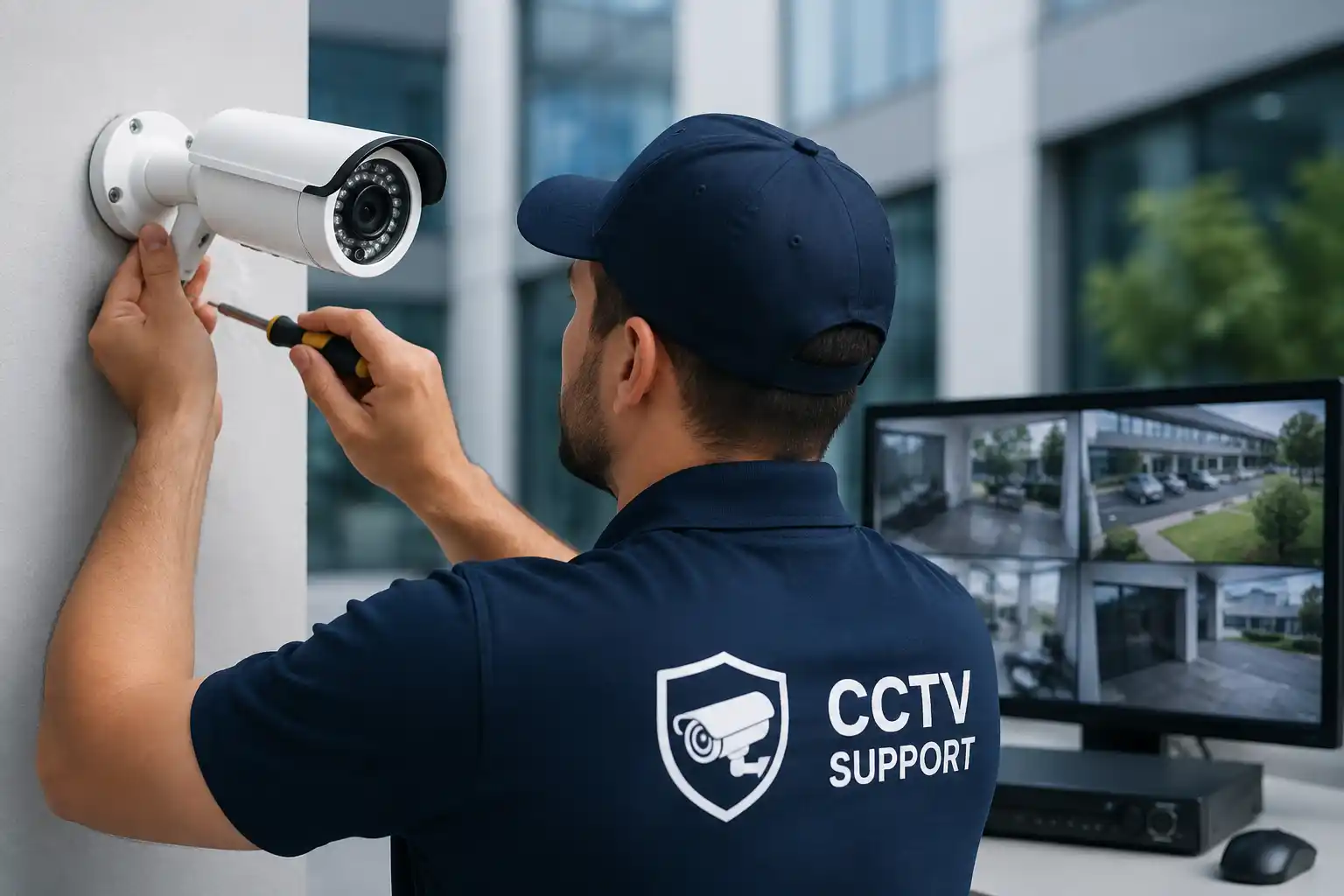
Camera to recorder path
Recording and playback
Authorised remote access
What does IP CCTV support actually cover?
IP CCTV support is the assessment, troubleshooting, configuration, maintenance and practical coordination required to keep network-connected surveillance cameras and their recording path working as intended. It is mainly used when cameras are offline, recordings cannot be found, playback is incomplete, images are poor, remote viewing is unstable, storage is full or unhealthy, camera time is incorrect, users cannot sign in, or an existing system needs to be understood before expansion or repair. Businesses should consider support when the fault affects operational visibility, incident review or confidence that recordings are being retained. Before work is confirmed, the customer should identify the affected site, cameras or areas, recorder type, symptoms, recent changes, available authorised access and desired outcome. Physical inspection may be necessary when cabling, power, PoE, mounting, environmental conditions or hardware condition are part of the problem.
What the service can address
Depending on the confirmed scope, assistance may include IP camera discovery, camera connectivity checks, PoE verification, switch-port testing, address and gateway review, NVR registration, recording schedules, storage status, playback, time synchronisation, stream settings, authorised user permissions, mobile or desktop viewing, secure remote-access review, cable-path checks, configuration backup where practical, maintenance recommendations and documentation. Installation, replacement or expansion tasks are assessed separately where physical work or new equipment is required.
Who may need this support
The service can suit offices, warehouses, retail locations, clinics, education sites, hospitality operations, property-management locations, showrooms, workshops and multi-branch businesses. It is particularly relevant where the surveillance system has been extended over time, uses mixed components, lacks current documentation, depends on the corporate network, or must be checked before a business move, recorder upgrade, network change or camera addition. The final support method depends on the site and the fault, not simply the number of cameras.
Common IP CCTV symptoms and the technical layers behind them
A surveillance symptom should be treated as evidence, not as proof of one cause. A camera that shows “offline” may have lost power, the cable may be damaged, a PoE switch port may be disabled, the address may have changed, an IP conflict may exist, the NVR may no longer be able to reach the device, or the camera itself may have failed. Likewise, remote viewing can stop working even while local recording continues, because internet service, firewall rules, name resolution, application settings, account permissions or vendor platform conditions may be involved.
Offline or intermittent cameras
Possible areas include power, PoE budget, port state, structured cabling, connectors, addressing, VLAN membership, uplinks, device condition or recorder registration. The next step is to establish whether one camera, one switch segment or a wider group is affected.
Missing or incomplete recordings
Recording problems can involve schedules, storage capacity, disk condition, camera stream availability, recorder services, date and time, motion rules or retention settings. Live video alone does not prove that usable footage is being stored.
Blurred, dark or unstable images
Image concerns may relate to focus, lens cleanliness, glare, reflections, low-light conditions, mounting angle, exposure, stream settings, bandwidth or hardware limits. Assessment should reflect the actual operational lighting and viewing objective.
Remote viewing failures
The camera system may still be healthy on site while remote access fails. Internet connectivity, firewall policy, application configuration, authorised accounts, remote-service dependencies and security settings should be reviewed without unnecessarily exposing the recorder to the internet.
Why unresolved CCTV faults can become an operational problem
The business impact of a surveillance fault is not limited to a blank screen. An organisation may discover too late that a camera stopped recording days earlier, that timestamps are inaccurate, that storage retention is shorter than expected, or that only some users can retrieve video. This can make incident review slower and reduce confidence in the system. Repeated intermittent faults can also consume staff time when employees repeatedly restart equipment or call different vendors without a clear technical owner.
An unmanaged network change can affect surveillance in less obvious ways. Moving cameras to a different switch, changing VLANs, replacing a firewall, renumbering the local network or altering DNS and gateway settings may interrupt viewing or recorder communication even when the cameras themselves are working. Conversely, adding high-bandwidth camera streams without checking switch capacity, uplinks, PoE requirements and storage may create performance problems beyond the new devices.
A structured support process aims to establish what still works, what has failed, whether existing recordings are at risk, and which corrective action is justified. It also creates an opportunity to improve naming, access control, documentation and maintenance so future faults can be isolated more efficiently.
Possible IP CCTV support scope
The exact scope is defined after the environment and business requirement are understood. The following activities are examples of work that may be relevant, not a promise that every activity is included in every engagement.
Fault diagnosis
Trace the symptom across camera, power, cabling, switch, network, recorder, storage, application and account layers.
Configuration review
Review approved addressing, recorder registration, schedules, time settings, streams, user permissions and remote-viewing configuration where access allows.
Physical inspection
Check camera mounting, connectors, power, PoE, patching, equipment condition and local image behaviour where on-site work is required.
Maintenance planning
Identify recurring checks for recording, storage, camera visibility, time, access, physical condition and documentation according to the agreed service plan.
Service-fit matrix: what should happen next?
| Observed situation | Possible technical areas | Recommended next step |
|---|---|---|
| One IP camera is offline | Camera power, PoE port, patch lead, cable, address, camera hardware or NVR registration | Check whether the camera has power/link and compare it with a working camera before approving replacement. |
| Several cameras fail together | Shared switch, uplink, VLAN, power source, recorder interface or network change | Treat it as a shared-path incident and inspect common dependencies first. |
| Live view works but playback is missing | Recording schedule, storage, disk condition, stream mapping, date/time or recorder process | Review recording status and storage before assuming the camera is at fault. |
| Local viewing works but mobile viewing fails | Internet, firewall, remote service, user account, application or security configuration | Confirm local health first, then test the authorised remote-access path. |
| New cameras are being added | PoE budget, ports, bandwidth, addressing, NVR compatibility, licenses where applicable and storage | Complete a capacity and compatibility review before installation. |
IP CCTV service information for quotation planning
| Main purpose | Fault assessment, configuration support, recording verification, maintenance planning, expansion review and practical handover for network-connected CCTV environments. |
|---|---|
| Typical systems involved | IP cameras, NVRs, storage drives, PoE switches, structured cabling, routers or firewalls, monitoring workstations and authorised viewing applications. |
| Remote support suitability | Access dependent. Suitable for many configuration, log, account, recorder and network checks when the system is reachable and secure remote access is authorised. |
| On-site support suitability | Suitable when physical camera, cabling, PoE, switch, rack, recorder, mounting, image-angle or environmental inspection is required. |
| Customer information required | Site, affected areas, symptoms, recorder details, approximate camera count, recent changes, authorised access availability, current vendor involvement and desired result. |
| Testing and validation | Scope dependent; may include live view, playback, recording continuity, time checks, camera connectivity, remote viewing and approved user access. |
| Scheduling | Depends on engineer availability, site access, urgency, maintenance windows, required parts, third-party providers and confirmed work scope. |
| Quotation | Prepared according to the assessed requirement. Hardware, replacement parts, cabling work, licences and third-party charges should be confirmed separately where relevant. |
When remote IP CCTV support may be appropriate
Remote assistance can be useful when the site has working internet access, the CCTV system is reachable through an authorised and secure method, and the issue is mainly related to configuration, recorder status, network settings, logs, user permissions or viewing software. A local employee or administrator may still be required to confirm indicator lights, identify camera names or assist with basic physical observations. Remote support can also help determine whether a site visit is necessary by narrowing the fault before an engineer travels.
Remote access should not be treated as permission to expose a recorder directly to the public internet. The approved access method, customer authorisation and security impact should be understood before work begins. Some faults cannot be resolved remotely, especially when the camera has no power, cabling is damaged, a switch is inaccessible, image placement must be inspected or storage hardware is failing.
When an on-site visit is usually more useful
On-site support is often the better choice when the issue involves camera mounting, physical image quality, PoE power, cable continuity, damaged connectors, network cabinets, local monitor output, recorder hardware, storage drives, environmental exposure or several cameras connected through the same infrastructure. It may also be needed when the system cannot be reached remotely or when the current installation is undocumented and must be mapped before corrective work can be planned.
A site visit should have a clear objective. The customer can help by identifying the affected areas, arranging building access, confirming who can authorise changes and making existing records available. Attendance timing depends on location, engineer availability, access restrictions and the approved quotation; it should not be assumed before scheduling is confirmed.
A diagnostic journey from reported symptom to verified result
Confirm what is not working, whether recording or only viewing is affected, how many cameras are involved, when the issue began and whether footage is urgently required for a business reason.
Identify the camera, power source, cable route, switch, network segment, recorder, storage, monitoring device and remote-access dependencies relevant to the symptom.
Confirm authorisation, preserve configuration or evidence where appropriate, and avoid broad resets that may erase settings or make the original fault harder to understand.
Check link, power, addressing, reachability, recorder status, storage, time, stream and user-access conditions relevant to the approved scope.
Carry out approved configuration, reconnection, repair coordination, replacement or planning tasks with rollback considerations where a change could affect wider operation.
Confirm live video, recording, playback, time, required viewing and remaining limitations, then document useful next steps for the customer.
Planning corrective work without creating a new fault
CCTV systems often share infrastructure with office networks, wireless access points, IP phones, servers and internet services. That means a change intended to recover one camera can have consequences elsewhere if the environment is not understood. Rebooting a shared PoE switch can disconnect cameras and phones. Changing a VLAN can affect recorder reachability. Resetting an NVR may alter user access, recording schedules or remote-viewing settings. Firmware changes can require compatibility checks and a maintenance window. A safe approach is therefore based on controlled steps rather than broad resets.
Before a corrective change, the current configuration and dependencies should be recorded where possible. If the change carries material risk, a rollback approach should be considered. For example, if addressing is being corrected, the existing IP plan and gateway should be documented. If recorder storage is being worked on, the customer should understand whether existing footage may be affected. If a firewall rule is changing, the exact remote-viewing requirement should be defined rather than opening unnecessary access.
Where the root issue is hardware failure or a design limitation, configuration alone may not be sufficient. FourTeck can help separate repairable faults from capacity, compatibility or lifecycle limitations so the customer can decide whether to repair, replace or plan a phased improvement.
Testing, validation and handover after CCTV work
A camera showing a picture after a change is only one part of validation. The agreed test should match the business objective. If the issue concerned recording, the technician may need to confirm that the recorder is receiving the stream, that the schedule is active, that the correct time is shown and that playback can retrieve newly recorded footage. If the issue concerned remote viewing, both local operation and the authorised remote path should be tested so a remote-access change does not hide a local problem. If a camera was repositioned, the real scene should be reviewed in the relevant lighting rather than judged only from a configuration screen.
Handover can include camera names, affected ports, recorder details, key configuration decisions, remaining risks, user-access notes, storage observations and recommended maintenance actions. Credentials should not be written into public documentation or shared through insecure channels. Where administrator access must be transferred, the customer should use an approved secure method after identity and authorisation are confirmed.
Successful testing at one moment does not eliminate the need for ongoing maintenance. Storage, disks, network links, power supplies, outdoor connectors, time settings and remote access can change or deteriorate. A clear record makes later support faster and reduces dependence on memory.
Capability: faster fault isolation across camera and network layers
IP cameras are network devices, so camera support benefits from network visibility. Comparing an affected camera with a working device can reveal whether power, port negotiation, addressing, routing or recorder registration differs. Looking for shared patterns also matters: three cameras failing on the same switch suggests a different path from three cameras spread across unrelated areas. This structured comparison reduces unnecessary camera replacement and helps identify the smallest justified corrective action.
The limitation is that diagnosis depends on access and evidence. If the switch is unmanaged, labels are missing, credentials are unavailable or cable routes cannot be traced, the assessment may require more physical work before a conclusion can be reached.
Capability: better confidence in recording and retrieval
A useful surveillance system should do more than display live video. Support can include checking whether expected cameras are recording, whether time and date are sensible, whether playback works, whether storage has warnings and whether retention behaviour matches the configured environment. These checks can reveal gaps that are not obvious from a monitor wall.
Retention depends on factors such as capacity, number of cameras, resolution, frame rate, recording mode and device capabilities. It should therefore be treated as configuration dependent rather than promised as a fixed number of days without assessment.
Capability: clearer maintenance and future expansion planning
When a CCTV environment is documented, future changes become easier to evaluate. Camera names, physical locations, switch ports, recorder channels, addressing, storage and authorised users can be recorded at an appropriate level. Before expansion, the current PoE budget, available ports, network capacity, NVR compatibility, storage headroom and licensing dependencies can be reviewed.
Documentation does not guarantee compatibility, especially in mixed-brand or older environments. It does provide a clearer basis for deciding whether an existing platform can be expanded or whether a staged upgrade is more practical.
Dependencies, access and customer inputs that can affect the support plan
The support scope depends on more than the CCTV equipment itself. Useful access may include the NVR interface, camera management pages, managed switch or network information, viewing application details and physical access to the rack or camera location. Customers should not publish or send passwords through an open website form. Administrative credentials should be shared only through an approved secure method after the customer has confirmed identity, ownership and authorisation.
Other dependencies may include building access, ceiling height, lift equipment, restricted rooms, landlord or facilities permissions, change windows, internet-provider involvement, firewall administration, third-party monitoring services, vendor portals, subscriptions or licences where applicable, spare parts and compatibility with existing recorders. Outdoor cameras may require inspection of housings, glands, connectors and environmental exposure. Multi-tenant buildings may impose additional access procedures.
Before support begins, FourTeck may ask for the business location, a contact person, the affected areas, approximate number of cameras, NVR or recorder information, symptoms, time of failure, recent changes, network status, current vendor involvement, access availability and the outcome the business expects. These details help determine whether remote diagnosis is practical or an on-site assessment is more appropriate.
Risk, limitation and exclusion guidance
CCTV support should be scoped with realistic technical and commercial limits. Diagnosis depends on available evidence, authorised access and the condition of the equipment. A camera that cannot be reached and has no visible power may require physical testing before any cause can be confirmed. A failed recorder disk may require replacement, but the existence and recoverability of historical footage cannot be guaranteed. Unsupported or obsolete equipment may have limited configuration, security or replacement options, and a newer camera may not be compatible with an older recorder.
Some faults may depend on third parties. Remote access can be affected by the internet service, firewall administration, mobile application platform or vendor cloud service. Building cabling may require access through facilities or fit-out teams. Parts, replacement hardware, licences and specialist access equipment may be outside the initial support labour unless included in the approved quotation.
Configuration changes can temporarily affect live view or recording and may need an agreed maintenance window. Security improvements reduce exposure but do not guarantee complete protection. On-site work is subject to location, safe access, scheduling and confirmed scope. Final commercial terms are defined by the approved quotation or service agreement, not by general descriptions on this page.
Business environments where IP CCTV support can be useful
Offices and professional workplaces
Reception areas, entrances, corridors, server rooms and shared operational spaces may rely on cameras that share network switches with other business systems. Support should consider the wider network before changes are made.
Retail and showrooms
Retail sites may need reliable views of entrances, counters, stock areas and customer spaces. A camera angle that covers a large area may still fail to provide the detail needed for the actual business objective, so image quality should be assessed in context.
Warehouses and logistics sites
Large areas can involve long cable routes, distributed PoE switches, loading zones, varied lighting and outdoor exposure. Mapping the physical and network path can be especially important when several cameras fail together.
Hospitality and property locations
Multiple floors, public areas, back-of-house spaces and shared facilities can create access and coordination requirements. Support may involve facilities teams, network administrators and authorised management users.
Clinics and service centres
Reception, entrances and operational areas may require a carefully controlled balance of monitoring, access and privacy. Support focuses on technical operation and authorised use within the customer’s policies and applicable requirements.
Multi-branch businesses
Different branches may use different recorders, naming methods or remote-viewing arrangements. Standardising records and support contacts can make future troubleshooting and expansion more manageable.
Operational, security and maintenance considerations
IP CCTV systems should be maintained as connected infrastructure rather than forgotten after installation. Recording should be checked periodically because a live image does not prove that storage is healthy. Camera clocks and recorder time should remain sensible for incident review. Outdoor lenses and housings may need cleaning or inspection. Switch ports and PoE loads can change as other devices are added. Storage utilisation can increase when resolution, frame rate or recording mode changes. Remote-viewing accounts should remain limited to authorised users, especially after staff changes.
Security deserves specific attention because cameras and recorders are network-connected devices. Default credentials should not remain in use. Shared administrator accounts make accountability harder. Unnecessary internet exposure should be avoided. Firmware and vendor support status may need review, but updates should be planned rather than applied blindly because compatibility and service interruption can be relevant. Network separation can be useful where the environment supports it, but segmentation must be designed so the recorder, management stations and approved remote paths still function.
Maintenance frequency is scope dependent. A small office with a few indoor cameras has different requirements from a warehouse with many outdoor devices. FourTeck can help identify which checks matter most for the customer’s environment and define them within a maintenance or support quotation.
Before you contact FourTeck about an IP CCTV issue
Preparing a small amount of accurate information can shorten the discovery stage and help determine the right support method. You do not need to diagnose the fault yourself. The purpose of this checklist is to describe what you can observe safely and what access may be available.
- The site location and the best on-site contact person.
- Which camera, area, branch or recorder appears to be affected.
- Whether the problem affects live view, recording, playback, image quality, remote access or several functions.
- When the issue was first noticed and whether it is constant or intermittent.
- Any recent changes to switches, internet service, firewall, recorder, cabling, cameras, power or office layout.
- Approximate camera count and recorder type or model if known.
- Whether other network devices are also having connectivity problems.
- Whether authorised administrator access is available without sharing passwords publicly.
- Whether the network switch is managed and whether its login is controlled by another vendor.
- Any visible storage, disk, recording or system warnings on the recorder.
- Whether the affected cameras are indoor, outdoor or located in restricted areas.
- Any building-access, ceiling-height or work-permit restrictions that may affect a site visit.
- The business impact, such as missing footage, inability to monitor an area or a planned expansion that is blocked.
- Whether you prefer an initial remote assessment or believe physical inspection is required.
- The outcome you want: restore service, confirm recording, improve image quality, secure viewing, add cameras, document the system or plan an upgrade.
Service evaluation checklist for defining the quotation
The quotation should make clear which tasks are included and which depend on further findings. Before approval, consider confirming the following points with FourTeck:
- Exact service objective and the business priority behind it.
- Number of sites, recorders and approximate cameras in scope.
- Whether the work is diagnosis only, corrective configuration, physical repair coordination, replacement, expansion or maintenance.
- Remote access requirements and the approved secure access method.
- Whether on-site testing, cable work, high-level access or rack work is expected.
- Whether replacement cameras, storage, PoE switches or other parts may be required.
- Whether vendor, ISP, firewall or facilities coordination is included.
- Any maintenance window needed for changes that may interrupt recording.
- Testing criteria for live view, recording, playback, time, image quality and remote viewing.
- Documentation or camera naming expected at handover.
- Whether user guidance or administrator handover is required.
- Any excluded devices, legacy sections or third-party work that should be stated clearly.
How FourTeck can assist with IP CCTV support
FourTeck’s role can begin by clarifying the reported business problem and identifying which technical layers are likely to require evidence. For a camera outage, that can mean distinguishing between camera failure and a shared network or power issue. For missing recordings, it can mean reviewing the recorder and storage path rather than focusing only on the camera. For remote-viewing problems, it can mean separating local CCTV health from internet, firewall, application and account dependencies.
Depending on the approved scope, assistance may combine remote investigation with an on-site visit, configuration work, cabling or switch checks, storage review, recorder testing, camera-level inspection, user-access review, documentation, vendor coordination or maintenance planning. Where replacement or expansion is the practical next step, FourTeck can help define requirements before changes are made so the customer understands capacity, compatibility and network dependencies.
The goal of the quotation process is clarity: what will be checked, what changes are authorised, what may require parts or third parties, how testing will be handled and what the customer should expect at handover. For broader company information, customers can review FourTeck IT Services information or discuss the CCTV requirement directly through the support contact process.
Dubai and UAE service coordination
For a Dubai CCTV support request, the most useful starting point is to determine whether the problem can be assessed remotely or whether physical inspection is clearly required. Remote diagnosis may be practical for reachable recorders, user access, configuration, playback checks and some network issues. An on-site visit may be recommended for camera mounting, cabling, PoE, switch ports, local equipment, storage hardware, environmental image problems or an installation that is not documented well enough to understand remotely.
Service timing depends on engineer availability, customer access, site conditions, urgency, required parts, third-party providers and the confirmed work scope. Installation, configuration, replacement, cabling and maintenance tasks should be explicitly included in the approved quotation rather than assumed. Customers with managed buildings should also confirm security-desk access, work permits, equipment-room access and any restrictions on ladders or elevated work.
FourTeck can coordinate support requirements across Dubai and other UAE locations according to the specific job. Contact the team to confirm service scope and scheduling options before planning operational changes around an expected visit.
Dubai, Abu Dhabi, Sharjah and Ajman coverage in one service plan
Businesses with one or several locations in Dubai, Abu Dhabi, Sharjah and Ajman may need a consistent way to report CCTV faults even when the local installations are different. Service coordination can include remote troubleshooting, planned on-site visits, assessment, maintenance, camera or recorder configuration, expansion review and project support according to the confirmed requirement. A multi-site customer can benefit from keeping a simple inventory of recorder names, camera counts, branch contacts, network owners and access methods so each incident starts with useful context.
The service plan should still reflect the conditions at each site. Travel, building access, engineer scheduling, equipment availability, third-party vendors, cabling routes and network design can affect how work is delivered. A fault that can be checked remotely in one branch may require physical inspection in another. Similarly, a camera addition that is simple on one NVR may require a capacity or compatibility review on an older system elsewhere.
FourTeck can help organise the technical information, identify shared standards that make sense and prepare a quotation for the agreed locations. This does not imply permanent on-site staffing in every emirate; the support method and schedule are confirmed for the actual requirement.
Related FourTeck IT services that may affect CCTV reliability
An IP surveillance system often depends on infrastructure outside the recorder. The following service areas can become relevant when the fault crosses technical boundaries. You can review the wider FourTeck business IT services portfolio for context.
Network support
Useful when camera reachability, PoE switching, VLANs, IP conflicts, uplinks or wider connectivity are involved.
Firewall and remote access support
Relevant where authorised external viewing, VPN access or a network-security change affects the CCTV path.
Business IT support
Helpful when the surveillance issue overlaps with switches, workstations, internet service, shared infrastructure or vendor coordination.
Preventive maintenance
Suitable when the business wants recurring checks for recording, storage, visibility, access and documentation under an agreed service plan.
Why businesses contact FourTeck for this type of issue
A CCTV fault can sit between surveillance, networking, storage, internet access and user permissions. Businesses often need one technical view that can follow those dependencies without assuming the first visible device is the cause. FourTeck can help clarify the symptom, organise remote or on-site assessment, coordinate with existing network or facilities vendors, define controlled corrective work, test the agreed result and document next actions.
This practical approach is useful when the environment has been inherited from another tenant, expanded by several installers, changed during an office move, or left without clear port and camera records. It is also useful when management needs to decide whether repeated repairs still make sense or whether an upgrade should be planned. The decision can be based on system condition, compatibility, capacity, security, maintainability and business need rather than on a blanket recommendation to replace everything.
Customers can also start from the FourTeck IT Services home page to understand the wider support context around networks, servers, user systems and communication infrastructure.
Questions businesses ask before requesting IP CCTV support
The following decision guidance addresses practical questions that often arise before a support request is scoped. It is designed to help a customer prepare useful information, understand likely dependencies and decide whether remote or on-site assistance is more appropriate without trying risky changes first.
Can an offline IP camera be checked remotely?
Sometimes. If the recorder, switch management interface or camera network can be reached through an authorised secure method, remote checks may show whether the camera is responding, whether the switch port is active, whether an address conflict exists or whether the NVR registration has failed. Remote access cannot confirm every physical condition. A disconnected cable, failed PoE injector, damaged connector, water ingress, loose camera connection or failed camera may require on-site inspection. The most useful first information is whether one camera or several are affected and whether other devices on the same switch are working.
Why does my CCTV show live video but no old recordings?
Live video and recorded video use overlapping but different parts of the system. The camera may be streaming correctly while the recorder schedule is disabled, storage is unavailable, a disk has failed, retention settings have changed, time is incorrect or the recorder is not writing the expected stream. The safest next step is to preserve the current state and review recording status, storage alerts, date and time and playback behaviour before formatting disks or resetting the recorder. If historical footage is important, avoid changes that could overwrite or erase evidence until the storage condition is understood.
Should we replace a camera that keeps going offline?
Not automatically. Repeated camera outages can be caused by the camera, but they can also come from unstable PoE, an overloaded switch, cable damage, moisture, a loose connector, an IP conflict or a failing network path. A useful assessment compares the affected device with a working camera and checks whether the fault follows the camera or remains with the port or cable. Replacement becomes more justified when the physical path is healthy and the device still fails, or when the camera is unsupported, damaged or unable to meet the required image objective.
What should we check when remote viewing stopped after a firewall or internet change?
First confirm whether local live view and recording still work. If the system is healthy on site, the fault is more likely to sit in the remote-access path rather than the camera layer. Relevant areas can include the internet connection, firewall policy, VPN, name resolution, external address changes, application settings, authorised user accounts or vendor remote-service dependencies. Avoid simply exposing the NVR directly to the internet to restore convenience. The support goal should be to recover the approved remote-viewing method while maintaining appropriate access control.
How do we know whether our NVR storage is enough?
Storage needs depend on the number of cameras, resolution, frame rate, compression, recording mode, hours of activity, retention expectation and recorder capabilities. A fixed retention period should not be promised without reviewing these factors. The practical assessment starts with the business requirement: how much footage needs to be available and which cameras are most important. Current disk capacity, recorded bitrate, actual playback history and storage health can then be compared with that goal. Expansion may require additional compatible storage, adjusted recording settings or a recorder review.
Can new IP cameras be added to our existing system?
Possibly, but compatibility and capacity should be confirmed first. The current NVR may have limits on channel count, supported camera protocols, stream resolution, decoding capacity, storage or licensed features. The network also needs enough switch ports, PoE capacity and bandwidth, and the addressing plan should avoid conflicts. Adding cameras without checking these dependencies can create intermittent video or overload existing infrastructure. Before purchase or installation, provide the recorder details, desired camera locations, expected image purpose and available network information so the addition can be assessed as part of the full environment.
When is on-site CCTV support more appropriate than remote troubleshooting?
On-site assistance is usually more appropriate when physical evidence matters. Examples include no camera power, suspected cable damage, repeated PoE faults, loose or corroded connectors, recorder hardware warnings, poor camera angle, glare, night-image problems, environmental damage, inaccessible network equipment or an inherited installation with no documentation. It is also useful when several devices fail through the same physical path. A remote assessment can still be valuable first if it narrows the likely area and helps the engineer arrive with a clearer work plan.
What information should we prepare before asking for a CCTV maintenance quotation?
Prepare the number of sites, approximate camera and recorder count, indoor versus outdoor locations, current known faults, storage expectations, remote-viewing requirements, network ownership, access restrictions and any existing documentation. Explain whether the goal is preventive checking, recurring fault support, scheduled site visits, documentation improvement or a combination. Maintenance inclusion is contract dependent, so ask the quotation to state which systems are covered, which checks are planned, how incidents are handled, whether parts are separate and how vendor coordination is treated.
How should a business handle CCTV passwords and administrator access during support?
The business should confirm who is authorised to approve access and avoid posting credentials in public forms or ordinary page content. Administrator passwords, recovery information and remote-access details should be shared through an approved secure method after identity and ownership are confirmed. Shared accounts should be limited where practical because they make accountability and staff changes harder to manage. If access is missing, the reset or recovery path depends on the specific device or platform, and a reset may affect configuration. That risk should be understood before any recovery action is approved.
Is one-time troubleshooting enough, or should we consider recurring CCTV maintenance?
One-time support can be suitable for a specific, well-defined fault or project. Recurring maintenance becomes more useful when the business has many cameras, outdoor devices, several sites, important recording requirements, repeated storage warnings or limited internal staff to verify system health. Maintenance can be scoped around recording checks, storage, image visibility, access, physical condition and documentation, but the frequency and inclusions should match the actual environment. A support assessment can identify which recurring checks add value rather than applying the same schedule to every customer.
What affects the final cost and scope of IP CCTV support in Dubai?
The scope can be affected by the number of cameras and recorders, whether the fault is remote or physical, how well the system is documented, whether authorised access is available, the condition and age of equipment, site access, cable routes, ceiling height, network ownership, required parts, vendor involvement and whether work must happen in a maintenance window. A simple configuration issue may be suitable for remote assistance, while an undocumented multi-floor system can require a wider site assessment. Contact FourTeck with the observed symptoms and environment details so the quotation reflects the actual requirement.
What should we expect after the fault is corrected?
The agreed result should be tested against the original problem. If the camera was offline, confirm stable live view and recorder communication. If recordings were missing, confirm that new footage is being stored and can be played back. If remote viewing failed, verify both local operation and authorised remote access. If image quality was the issue, review the actual scene and lighting. Useful handover notes can record what was changed, what remains dependent on third parties, any ageing equipment or capacity concerns and the next maintenance action. A successful test confirms the immediate outcome but does not remove the need for future monitoring and maintenance.
Frequently asked questions about IP CCTV support in Dubai
Does the service cover NVR and recording problems?
It can. Depending on scope and access, support may include recording status, schedules, storage health indicators, playback, time settings, stream mapping and connectivity between cameras and the recorder. Disk replacement or data-recovery work should be confirmed separately where relevant.
Can FourTeck support mixed-brand CCTV environments?
Mixed systems can be assessed, but compatibility and access are environment dependent. The first step is to identify the recorder, cameras, network path and supported interfaces before assuming that every device can be configured or expanded together.
Can you fix blurry or dark camera images?
Image-quality support may include checking lens condition, focus, exposure, glare, reflections, mounting, lighting and supported stream settings. Some limitations come from the camera or lens itself, so an improvement cannot be promised before assessment.
Do you check PoE switches and camera network connections?
Where they are part of the CCTV fault, the support scope may include port status, PoE delivery, uplinks, VLANs, addressing, conflicts and connectivity between cameras and the recorder. Managed access and authorisation may be required.
Can remote viewing be configured securely?
Remote access can be reviewed around the supported platform and customer security requirements. The preferred method depends on the recorder, network, firewall, authorised users and available services. Unnecessary public exposure should be avoided.
What if we do not have the administrator password?
Missing access can limit diagnosis and configuration. Recovery or reset options depend on the device and proof of authorised ownership. A reset may affect settings, so the impact should be reviewed before any recovery action is approved.
Can you help after an office move or network change?
Yes, a post-change review can be scoped to reconnect cameras, confirm addressing, switch connectivity, recorder reachability, remote access and recording. The work depends on how the old and new networks are designed and what records are available.
Is CCTV cabling included in support?
Cable testing or physical cabling work may be relevant, but it should be stated in the quotation. New cable routes, building permissions, ceiling work, access equipment and fit-out coordination can affect the final scope.
Can you guarantee old footage will be recovered?
No. The availability of historical footage depends on whether it was recorded, overwritten, deleted, corrupted or affected by storage failure. Support can assess the situation, but data recovery cannot be guaranteed.
Do you provide CCTV support outside Dubai?
Service coordination may be available for Dubai, Abu Dhabi, Sharjah, Ajman and other UAE requirements according to the job. Remote or on-site delivery depends on location, access, scheduling and approved scope.
Will a support visit include replacement hardware?
Replacement cameras, disks, switches, injectors, connectors or other parts should be confirmed in the quotation. A diagnostic visit does not automatically mean every required part is included.
How do we request a quotation?
Provide the site, symptoms, affected cameras or recorder, approximate system size, access situation, recent changes and required outcome. FourTeck can then determine what needs remote review, on-site assessment or a defined project scope.
Request an IP CCTV assessment or support quotation
If your cameras are offline, recordings are missing, remote viewing has stopped, image quality is poor, storage is uncertain or an existing system needs to be reviewed before expansion, provide FourTeck with the site details and observed symptoms. The next step can be selected according to the evidence: remote diagnosis where suitable, an on-site inspection when physical checks are needed, or a planned scope for maintenance, corrective work or upgrade preparation.
The final service plan depends on the current configuration, authorised access, equipment condition, site location, urgency, third-party dependencies and the approved quotation. Avoid resetting equipment or erasing storage simply to test a theory when existing recordings or configuration may be important.