
IP CCTV Installation in Dubai, UAE
A dependable IP CCTV system is a connected service, not a collection of isolated cameras. Camera positions, PoE power, structured cabling, network addressing, switching, recording, storage, user permissions and remote viewing all have to work together. FourTeck helps businesses plan and implement these elements so the finished surveillance environment is easier to operate, test, maintain and expand.
Installation scope is confirmed after reviewing the site, business purpose, required viewing areas, existing infrastructure, authorised access, recording expectations and any third-party building or network dependencies. Physical installation normally requires on-site work, while selected design, configuration and administrative tasks may be supported remotely when secure access is available.
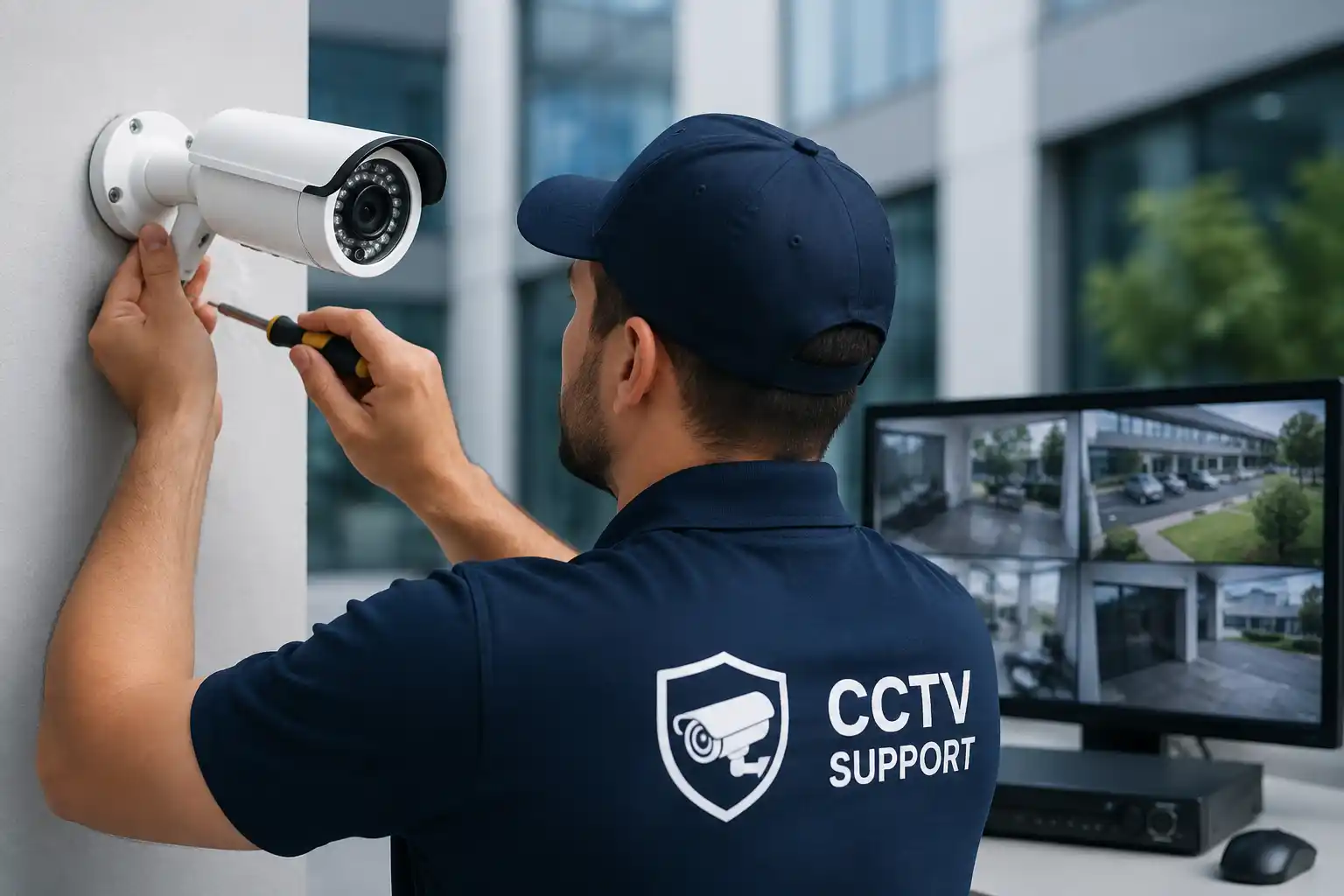
Each camera position should have a defined operational purpose.
PoE, switching, addressing and bandwidth are considered together.
Live view alone is not enough; playback and storage must be tested.
Camera names, access roles and core settings should be understandable later.
What does IP CCTV installation include?
IP CCTV installation is the process of planning, mounting, connecting, configuring and validating network-based surveillance cameras and the systems that support them. It is mainly used when a business needs new surveillance coverage, wants to expand an existing network-camera system, is relocating to a new site, or needs a more maintainable recording environment. The work can involve cameras, PoE switches, cabling, network addressing, NVR configuration, storage, monitors, authorised viewing devices and remote connectivity. Businesses should consider the service when camera coverage has a defined operational or security purpose and when the supporting network can be assessed as part of the project. Before proceeding, the customer should confirm the site layout, important areas to view, expected recording period, available network and power infrastructure, authorised users, physical access conditions and any relevant building or third-party requirements. Final design, equipment suitability, timing and commercial scope remain subject to assessment.
What the installation service can cover
A useful surveillance deployment begins with the purpose of each view. An entrance camera may need a different angle and level of detail from a loading-bay camera, reception area, corridor, stock room, parking zone or building perimeter. FourTeck can help translate those operational requirements into a practical layout, then examine whether the existing cabling, switching, network cabinet and recording environment can support the proposed design. Depending on the confirmed scope, assistance may include site discovery, camera-location planning, cable-route coordination, PoE capacity review, network addressing, recorder setup, storage planning, user-access configuration, remote-viewing setup, time synchronisation, camera naming, image adjustment, playback testing and documentation.
Not every project requires every activity. A new shell-and-core office may require close coordination with the fit-out contractor before ceilings close, while an existing retail store may already have usable cabling and a suitable recorder. A warehouse may require longer cable routes, elevated mounting positions and additional planning for lighting or environmental exposure. A multi-branch business may value consistent camera naming, user roles and remote-viewing procedures across locations. The first assessment should therefore separate what already exists from what must be added, replaced, configured or simply verified.
The network element is especially important with IP cameras. A camera may receive power through PoE and transport video across the same structured network used by other services. Switch capacity, PoE budget, uplink capacity, IP address planning and network segmentation can affect stability. Recorder performance and storage also depend on the number of streams, selected resolution, frame rate, compression, recording mode and retention target. These variables should be considered as one system rather than treated independently.
Who may need this service?
The service may suit organisations opening a new office, fitting out a retail location, expanding warehouse surveillance, replacing an ageing recorder environment, adding cameras to an existing network, standardising several branches, or moving into a previously occupied site where the surveillance infrastructure is incomplete or undocumented. It can also be relevant when management wants camera views aligned with real operational needs rather than accepting inherited positions that no longer match entrances, counters, storage areas or staff workflows.
Suitable environments can include professional offices, clinics, schools and training centres, restaurants, hotels, warehouses, logistics sites, showrooms, property-management locations, construction offices and multi-branch businesses. Each environment has different priorities, so the design should be based on the site and intended use instead of a generic camera count.
Planning triggers that deserve a closer review
A business may request installation because a new site has no surveillance, the current coverage has blind areas, a network upgrade creates capacity for IP cameras, the existing recorder cannot support the planned expansion, remote viewing is difficult to manage, or repeated ad-hoc additions have left the system difficult to understand. A renovation, office move or new branch is also a useful point to review camera positions before ceilings, walls and furniture make cable routes harder to change.
These triggers do not automatically mean the entire system should be replaced. Existing cameras, cabling, switches or storage may remain useful if they are compatible and in suitable condition. Assessment helps distinguish reusable infrastructure from components that limit reliability, security, capacity or maintainability.
Why poor CCTV planning creates business problems later
A camera can be technically online and still fail to deliver the result a business expects. The view may be too wide to identify useful detail, a bright doorway may make faces difficult to see, a camera may be blocked after furniture changes, or recorded footage may be unavailable because the storage design was not checked. Network congestion, insufficient PoE capacity, duplicate IP addresses or poorly documented access can create intermittent faults that are difficult to isolate after the project is finished.
Operational impact can include missing footage during incident review, slower investigation because camera names do not match real locations, uncontrolled sharing of viewing accounts, repeated support calls, staff confusion about who can access playback, and unplanned replacement costs when the recorder or network has no room to expand. In a multi-site environment, inconsistent configuration can create different procedures at every branch, increasing administrative effort and making remote support harder.
Good installation planning reduces these avoidable problems by treating coverage, infrastructure, access, storage and maintenance as connected decisions. It does not guarantee that every future fault will be prevented, but it gives the organisation a clearer baseline from which faults can be identified, changes can be controlled and future expansion can be planned.
Possible installation scope
Depending on the confirmed site requirements and quotation, FourTeck assistance may include some or all of the following activities. The final engagement should identify exactly which tasks are included and which require third-party coordination or separate work.
Discovery and layout
Review viewing objectives, floor plans, entrances, service counters, circulation routes, loading areas, parking, stock areas and other relevant locations. Identify physical constraints, possible mounting positions and cable pathways.
Network and PoE readiness
Check switching capacity, available PoE budget, uplinks, rack space, network addressing, segmentation and the relationship between the camera network and other business services.
Recorder and storage planning
Review the NVR or recording platform, available channels, expected video streams, storage capacity, retention expectations, recording schedules, event settings and playback requirements.
Installation and configuration
Mount agreed cameras, connect cabling, register devices, apply approved addressing and stream settings, configure camera names and align views according to the planned purpose of each location.
Access and remote viewing
Create or review authorised user roles, configure approved viewing endpoints, consider firewall and internet dependencies and avoid unnecessary exposure of management interfaces.
Testing and handover
Validate live views, recording, playback, timestamps, selected remote access, user permissions and basic operational procedures. Record the essential information needed for later support.
Service-fit matrix
| Business situation | Relevant assistance | What must be confirmed |
|---|---|---|
| New office or branch | Coverage planning, cable-route coordination, camera deployment, NVR and network setup. | Floor plan, handover date, fit-out access, target areas, network readiness and building rules. |
| Existing system expansion | Compatibility review, PoE and switch capacity checks, channel and storage assessment, camera addition. | Current recorder model, camera types, available licenses or channels, cabling and access. |
| Inherited undocumented CCTV | Current-state assessment, device identification, network tracing, camera naming and practical documentation. | Authorised credentials where available, ownership information, physical access and equipment condition. |
| Need for better retention | Storage review, recording-mode assessment and retention planning. | Camera count, stream settings, recording schedule, desired retention and recorder capability. |
| Remote viewing requirement | Authorised access design, application setup and network/firewall review. | Internet access, platform capability, user roles, security approval and third-party restrictions. |
Service information for planning and quotation
| Main purpose | Plan and deploy network-based CCTV with usable coverage, recording, controlled access and documented integration. |
|---|---|
| Typical systems involved | IP cameras, PoE switches, structured cabling, NVR or compatible recording platform, storage, firewall/router, monitors and authorised viewing devices. |
| Assessment method | Site and environment dependent; may combine floor-plan review, technical discovery, physical inspection and network assessment. |
| Remote support suitability | Suitable for selected planning, configuration review, user administration and approved remote-viewing checks when secure access is available. |
| On-site support suitability | Normally required for physical installation, cabling, mounting, angle adjustment, cabinet work, PoE testing and field validation. |
| Customer access required | Site access, authorised system administration and suitable coordination with building, network or facilities contacts where relevant. |
| Testing and validation | Live view, recording, playback, time, selected remote viewing, user permissions and key network paths, subject to the agreed scope. |
| Documentation and handover | Scope dependent; may include camera naming, location reference, network details, recorder information, authorised roles and important operational notes. |
| Scheduling dependency | Engineer availability, building access, fit-out progress, equipment availability, cable readiness, third-party approvals and confirmed work scope. |
| Quotation requirement | Required after the system objectives, camera quantity, site conditions, infrastructure and responsibilities are understood. |
Remote planning versus on-site installation
Where remote assistance can help
Remote work may be suitable for reviewing floor plans, discussing camera objectives, checking compatible recorder settings, confirming network addressing, examining selected logs, preparing camera names, configuring authorised user roles, reviewing storage settings or assisting with viewing software when the environment is already reachable through an approved secure method. A local contact or administrator may need to verify physical indicators or perform approved checks.
Remote access is not a substitute for site inspection when coverage, cable condition, mounting, lighting, PoE delivery or cabinet wiring must be physically assessed. If the network itself is unavailable, a remote session may also be impossible.
Where on-site work is normally needed
Physical installation, cable tracing, termination, mounting, height and angle checks, lens cleaning, cabinet work, switch-port testing, PoE measurement, recorder connections and real-world field-of-view validation require local access. On-site assessment is also useful when the property has concealed cable routes, mixed generations of equipment, incomplete documentation or several areas that must be reviewed with facilities staff.
An attendance time should not be assumed until the location, access arrangements, installation scope, required equipment and scheduling have been confirmed.
How the assessment and discovery process may work
- Clarify the business purpose. Identify why each viewing area matters. The requirement may be entrance visibility, stock movement, customer areas, loading activity, parking coverage, corridor observation or another defined operational need.
- Map the affected site. Review the floor plan, camera locations, network cabinet, cable routes, power, access restrictions, ceiling type, mounting surfaces and any zones requiring coordination with a landlord or fit-out contractor.
- Inventory existing infrastructure. Where equipment already exists, record usable cameras, recorder type, channels, switches, PoE capacity, cabling, storage, network addressing and viewing applications. Existing components should not be assumed compatible until checked.
- Confirm security and access. Establish who is authorised to administer the system, who needs live or playback access and how credentials or administrative rights will be shared securely after identity and approval are confirmed.
- Review recording expectations. Discuss whether recording is continuous, scheduled or event-based, what level of image detail is needed and how much retention is expected. Storage calculations depend on actual stream settings and recorder capability.
- Check network dependencies. Confirm switching, PoE, uplinks, segmentation, address availability, firewall rules and internet dependencies. Camera traffic should not be added to a business network without understanding available capacity and management requirements.
- Identify risks before change. Existing configuration may need backup, temporary downtime may need approval and inherited systems may have unknown credentials or undocumented dependencies. A rollback path should be considered where configuration changes could affect working services.
- Define the quotation scope. Separate installation labour, cabling, configuration, equipment, access equipment, civil or fit-out dependencies, testing, documentation and post-installation support so responsibilities are clear.
Designing camera positions around useful evidence
Camera placement should begin with the question, “What decision should this view help the business make later?” A wide overview of a reception may be suitable for understanding movement, while an entrance may need more detail at the point where people approach the door. A loading area may require coverage of vehicle and goods movement. A cashier area may need a position that avoids being blocked by displays or queues. Outdoor areas can change dramatically between daylight, artificial lighting and night conditions, so the expected lighting should influence placement and configuration.
Height and angle matter because a camera mounted too high can show the top of a person’s head rather than useful facial detail, while a camera mounted too low may be easy to obstruct or interfere with. Reflections from glass, strong backlighting, infrared bounce from nearby surfaces, moving doors and signage can also reduce image value. The installer may need to balance coverage with detail instead of assuming that one very wide view can replace several purposeful views.
The design should also consider future site changes. Shelving, partitions, displays, vehicles, racking or new doors can create blind areas after installation. Where future fit-out changes are known, camera positions and cable routes should be planned with them in mind. For a growing business, spare switch capacity, additional addresses and recorder expansion capability may reduce disruption when extra cameras are needed later.
Privacy and internal policy also matter. The business should decide which areas genuinely require surveillance, who may view or export recordings and how requests for footage will be handled. FourTeck can support the technical implementation, but customer management should confirm the organisation’s authorised use and any applicable building, contractual or regulatory requirements before installation.
Planning the network, PoE and cabling path
Every IP camera is a network device. It needs a reliable physical path, power, an address and a route to the recording or management platform. For PoE cameras, the switch must have enough power budget for the connected devices and enough ports for the planned quantity. The network cabinet should have suitable rack space, patching, ventilation and power arrangements. Long or damaged cable runs can create intermittent problems that may appear as camera faults even when the camera itself is healthy.
Address planning matters in both small and large systems. Static addressing, reserved addresses or platform-based discovery may be used depending on the environment, but duplicate addresses and unmanaged changes should be avoided. Device names should match real locations so support staff can identify the affected view quickly. Where appropriate, surveillance traffic may be separated from general office traffic using network segmentation. The exact design depends on the switches, routing, firewall policies, recorder location and how users access the system.
Bandwidth should be considered at more than one point. Each camera sends a stream to the recorder, the recorder may serve playback to local users, and remote viewers may use internet upload capacity. A branch may also send video across a private connection or VPN. Increasing resolution or frame rate can improve certain views but also increases traffic and storage demand. The best setting is therefore the setting that meets the business purpose without consuming unnecessary resources.
Structured cabling should be coordinated with the building layout. Cable routes may pass through ceilings, risers, cabinets or containment managed by other contractors. Access permits, working-at-height requirements, ceiling restrictions and fire-stopping responsibilities can affect the installation. These items should be identified early instead of being discovered after equipment arrives on site.
Recording, storage and retention planning
A CCTV system is valuable only if recordings can be found and played back when needed. Storage planning should therefore be based on more than the number of cameras. Resolution, frame rate, video compression, scene activity, continuous versus event recording, stream count, storage overhead and the retention target all influence capacity. The recorder or platform also has limits on channels, incoming bandwidth, supported drives, total storage and sometimes licensing. These details should be checked before cameras are added.
The business should define a practical retention objective rather than assume that the recorder will automatically keep a particular number of days. A busy retail entrance may generate different data from a quiet corridor, and a high-detail view may use more storage than a general overview. If event-based recording is proposed, detection settings should be tested under real conditions so important activity is not missed. If continuous recording is required, capacity must be planned accordingly.
Storage condition should be monitored over time. A newly installed disk can still fail later, and a full recorder usually overwrites older footage by design. Users responsible for incident review should understand how to search the correct camera and time range, export approved evidence and confirm that the system clock is accurate. Time synchronisation is particularly important in environments where footage may need to be correlated with access systems, transactions, alarms or other events.
No installation should imply that stored footage is immune from failure. Recording systems depend on hardware condition, power, configuration and ongoing maintenance. Where surveillance is business critical, the customer should discuss suitable monitoring, maintenance and recovery expectations as a separate operational requirement.
Implementation, change control and installation sequence
Once the design is agreed, implementation should follow a controlled sequence. Existing systems may need configuration backups before changes. New switch ports can be prepared and labelled, cable routes can be coordinated, cameras can be mounted in approved positions and network settings can be applied according to the planned address structure. The recorder can then be configured to recognise each camera, apply suitable streams, recording schedules and names, and verify available storage.
Work in occupied offices often needs to be staged so technicians do not interrupt employees or customer areas unnecessarily. Retail locations may require work outside busy periods. Warehouses may need coordination around forklifts, loading schedules or elevated access. Construction and fit-out projects may depend on ceiling completion, power availability and final wall finishes. The project schedule should reflect these realities rather than assume that all locations are equally accessible.
If the project replaces an existing recording system, migration requires extra care. Camera compatibility, addressing, existing user access, stored footage requirements and downtime expectations should be reviewed. Some older cameras may not support the planned recorder or may operate only with reduced functionality. A phased change may be preferable when the business needs to maintain partial coverage during the transition.
During configuration, administrative access should be controlled. Default credentials should not remain in use, shared administrator accounts should be minimised where the platform supports separate roles, and management interfaces should not be exposed to the internet without a justified and secure design. Any remote access method should reflect the customer’s security policy, the platform capability and network environment.
Testing, validation and handover after installation
Testing should prove that the system works from the customer’s point of view, not just that each device responds on the network. Every agreed camera should have a live view, a meaningful name and the intended field of view. Recorded footage should be checked by searching a recent time period and playing it back. Timestamps should be reviewed, and selected remote viewing should be tested from an authorised device where that capability is part of the scope.
Image validation should consider real operating conditions. Daylight testing may not reveal night glare or poor low-light performance. A loading dock may look fine when empty but be blocked when a vehicle parks in the expected position. A reception camera may need review after furniture and signage are installed. If important conditions cannot be tested during the installation window, they should be recorded as follow-up items rather than assumed successful.
Handover should make the system easier to support. Useful documentation may include camera names and locations, recorder details, selected IP information, network-port references, authorised user roles, remote-viewing method, storage notes, time settings and any unresolved limitations. The exact documentation depends on the engagement, but a simple, accurate record is more valuable than relying on one person to remember the installation.
Users responsible for daily operation may also need guidance on live view, playback, searching, exporting authorised footage, checking recorder status and reporting a fault. Administrator guidance can cover account ownership, safe access and which settings should not be changed without a controlled review.
Capability: clearer fault isolation
A documented IP CCTV design makes future troubleshooting more focused. When a camera goes offline, support can follow the path from the camera through cabling, PoE, switch port, address, network route and recorder instead of immediately replacing hardware. If several cameras fail together, the shared switch, power source or uplink becomes a stronger area to investigate. If only remote viewing fails, the local recorder and camera path may still be healthy.
This does not remove the need for diagnostics, but consistent naming and network records reduce guesswork. The business benefits because technicians can understand dependencies faster and avoid unnecessary changes to unrelated systems.
Capability: controlled access to surveillance
CCTV access should match job responsibilities. Reception staff may need selected live views, a manager may need playback, while administration rights should be limited to authorised technical personnel. Where the platform supports role separation, this can reduce accidental changes and improve accountability.
Remote access also needs careful design. Convenience should not result in unnecessary internet exposure. The right approach depends on the recorder or management platform, firewall, internet service and customer security policy. Credentials should be shared only through an approved secure method after identity and authorisation are confirmed.
Capability: easier expansion and maintenance
A system designed with spare capacity is easier to expand. Available switch ports, PoE headroom, recorder channels, storage expansion, rack space and an organised addressing plan can all reduce disruption when cameras are added later. Maintenance is also simpler when cameras have location-based names and the cabinet is labelled.
Capacity should still be reassessed before each expansion. Adding cameras changes bandwidth, power and storage demand, and older recorders may have limits that were not reached during the first installation. A documented baseline makes those decisions more transparent.
Dependencies, access and information the customer may need to provide
Installation depends on both technical and practical access. FourTeck may need the site address, floor plan, required viewing areas, contact person, building-access procedure, ceiling or mounting restrictions, network-cabinet location, internet and firewall details, existing camera and recorder information, switch models, available PoE capacity, recorder credentials, camera licenses where relevant, storage requirements and the target date for the site to become operational. If the site is under construction, fit-out milestones and responsible contractors are also important.
Administrative credentials should not be posted in public forms or included in unsecured page content. Customers should confirm that the person authorising the work has the right to provide access, then use the approved secure method agreed for the engagement. If access to an inherited device is missing, the available recovery or reset path depends on the manufacturer, platform, ownership information and current configuration. A reset can affect existing settings and should not be treated as risk free.
Third parties can affect the project. Building management may control cable routes or access times. An internet provider may be involved in remote-viewing dependencies. A fit-out contractor may provide containment or power. A security or facilities team may need to approve camera positions. These responsibilities should be identified before the installation schedule is committed.
Risks, limitations and exclusions to confirm
The exact installation result depends on the current environment and approved scope. Existing cabling may be damaged or unsuitable. Older cameras may not be fully compatible with a new recorder. A switch may not have enough PoE budget. Storage may be insufficient for the requested retention. Building access may limit mounting positions. Internet upload capacity may affect remote viewing. Third-party applications or manufacturer services may have their own account, license or compatibility requirements.
Physical equipment can fail after installation, and stored video cannot be guaranteed against every hardware, power or configuration failure. CCTV installation also does not by itself guarantee complete security or prevent incidents. It provides surveillance capability whose usefulness depends on design, operation, access control and maintenance.
Civil works, specialist access equipment, new electrical circuits, concealed-cable repairs, authority approvals, replacement parts, licenses, internet-provider changes or structural work may fall outside the base installation unless specifically included. Any requirement affecting the quotation should be documented before work begins. When a change could interrupt an existing surveillance service, the maintenance window and rollback considerations should be agreed.
Business environments and installation use cases
Professional offices may need coverage at entrances, reception, corridors, server or storage rooms and selected common areas. The design should fit around client privacy, staff workflows and the building’s network infrastructure rather than adding cameras wherever a cable happens to be available.
Retail stores and showrooms often need views around entrances, sales floors, cashier areas, stock rooms and delivery points. Displays change, queues form and bright storefront glass can affect images, so field-of-view testing should reflect the real layout.
Warehouses and logistics sites may involve high ceilings, long cable routes, loading bays, racks, vehicle movement and large open spaces. Mounting access, environmental conditions, night lighting and network distribution can have a larger impact than in a small office.
Clinics, education and service centres may need carefully selected coverage in reception and circulation areas while management defines how access to footage is controlled. Technical installation should follow the organisation’s internal privacy and operational policies.
Hospitality and food-service locations can combine guest areas, service corridors, cash handling, delivery points and back-of-house operations. Camera planning should consider movement, changing lighting and how staff will review footage without disrupting normal operations.
Multi-branch organisations benefit from standard camera naming, consistent recorder access, repeatable network design and documented user roles. Standardisation should still allow for differences in each site’s layout, internet service and building constraints.
Operational security and maintenance after deployment
Installation is the start of the system lifecycle. Cameras can become dirty, mounts can move, outdoor connectors can deteriorate, disks can develop errors, user accounts can remain active after staff changes and firmware or viewing applications may require attention. Network changes can also affect recording or remote access. A basic maintenance plan should therefore define who checks recording health, how faults are reported, when storage status is reviewed and who owns user access.
Security reviews should include administrator ownership, user roles, password practices, unnecessary services, internet exposure, network segmentation and the handling of retired devices. Firmware updates may address known issues, but they should be planned carefully because updates can affect compatibility or cause temporary service interruption. Configuration backups and a rollback approach are useful before major changes.
Periodic playback testing is particularly valuable. A live image can create false confidence if recording has stopped or the clock is wrong. The business should test representative cameras, verify recent footage and confirm that responsible users know how to retrieve it. Any retention target should also be rechecked after camera additions or stream-setting changes because storage demand may have increased.
Before you contact FourTeck
Providing a clear starting picture helps the assessment focus on the real requirement and can reduce avoidable follow-up questions. Prepare as many of the following items as practical:
- The Dubai or UAE site location and the main on-site contact.
- A floor plan, sketch or description of the areas that need camera coverage.
- The business purpose for each important view, such as entrance, stock or loading activity.
- Approximate number of new cameras and any existing cameras expected to remain.
- Details of the current NVR, recorder or surveillance platform, if one exists.
- Known switch models, available PoE ports and the location of the network cabinet.
- Existing structured-cabling information or known restrictions on new cable routes.
- The desired recording period or current retention problem.
- Names or roles of users who need live view, playback or administration.
- Whether remote viewing is required and from which approved device types or locations.
- Any recent renovation, network change or equipment replacement that affects the project.
- Building-access rules, working-hour restrictions or fit-out coordination requirements.
- The target operational date and any maintenance window available for changes.
- Known budget priorities or whether the project may need a phased implementation.
Service evaluation and quotation checklist
Before approving an installation, confirm the engagement boundaries so technical expectations and commercial responsibilities match.
- Exact coverage objective and agreed camera positions.
- Number of new, reused and replaced cameras.
- Cabling, containment and termination responsibilities.
- PoE switch, network and addressing requirements.
- Recorder channels, storage and expected retention basis.
- Remote-viewing and firewall configuration scope.
- User-account creation and administrator handover.
- Required access equipment, permits or building coordination.
- Testing criteria for live view, recording, playback and time accuracy.
- Documentation expected at handover.
- Any old equipment removal, migration or disposal responsibility.
- Post-installation maintenance or support expectations.
How FourTeck can assist with the installation journey
FourTeck can help turn a broad request such as “we need cameras for this office” into a defined technical scope. The process can start with the business purpose and site layout, then connect those needs to camera positions, cabling, switching, PoE, recording, storage, access and remote viewing. Where an existing system is present, FourTeck can assess which elements may remain serviceable and which areas create compatibility, capacity or maintenance concerns.
During implementation, assistance can cover coordinated installation, approved configuration, network integration, recorder setup, user access, testing and handover according to the quotation. If a third-party fit-out contractor, internet provider, building manager or specialist vendor is involved, FourTeck can help identify the technical information each party needs so dependencies are not discovered too late.
After the installation, the business can request support for camera faults, playback concerns, recording checks, storage review, remote-access issues, network changes or future expansion. The goal is to leave a system that is understandable and supportable, with remaining limitations clearly recorded rather than hidden behind a completed-installation label. For broader company information, visit the FourTeck IT Services overview.
Dubai and UAE service coordination
IP CCTV installation in Dubai often combines technical work with practical site coordination. Building access, contractor schedules, ceiling completion, network-room availability and permitted working periods can affect the sequence. Remote preparation can reduce some on-site configuration time, but physical camera installation, cable work, alignment and field testing normally require a planned visit. Contact FourTeck to confirm the service scope and scheduling options based on the location, site condition, urgency and approved quotation.
Across the UAE, service planning may involve remote troubleshooting, on-site assessment, installation, maintenance, migration or project support depending on the requirement. Equipment availability, travel, building permissions, third-party providers and customer access can affect the final plan. Where the project spans several branches, it is useful to define one technical standard for camera naming, network design, user roles and handover, then document site-specific exceptions instead of allowing every location to evolve differently.
Dubai, Abu Dhabi, Sharjah and Ajman coverage considerations
Businesses with sites in Dubai, Abu Dhabi, Sharjah and Ajman may require different combinations of planning, remote configuration and scheduled on-site work. A branch with an established network may be suitable for more remote preparation, while a new warehouse or office may require physical survey, cable-path review, mounting work and local coordination. The technical design can be standardised where practical, but site conditions should still be assessed individually.
Scheduling and travel depend on the confirmed scope, engineer availability, building access, site readiness, equipment availability and any third-party responsibilities. For multi-site projects, the quotation should identify which locations require assessment, whether installation will be phased, what local contact is needed and how testing will be recorded at each site. A consistent handover format can then help central management understand what was installed without assuming that every branch has identical infrastructure.
Related FourTeck IT services
For existing cameras, recorders, playback, storage, image quality and preventive checks.
IP camera and business IT supportFor camera connectivity, network dependencies, remote viewing and broader office technology support.
Office network supportFor switches, routing, VLANs, structured cabling and the network path supporting IP cameras.
New office IT setup consultationCoordinate CCTV with networks, Wi-Fi, phones, user systems and fit-out planning.
Why businesses contact FourTeck for CCTV projects
Businesses often need more than a camera installer. They need someone to understand how the surveillance system depends on the network, switching, PoE, recorder, storage, firewall, internet connection and user access. FourTeck approaches the work from that connected infrastructure view. This is useful when the project sits inside a wider office move, network upgrade, branch opening or existing support environment.
A clear initial assessment helps separate essential work from optional improvements. It can reveal whether existing cabling is reusable, whether the switch has enough power and ports, whether the recorder can accept additional cameras, whether storage matches the retention target and whether remote access can be implemented within the current network design. Findings can then be discussed in business terms before changes are approved.
FourTeck can also help coordinate responsibilities. The fit-out contractor may provide containment, the network team may manage switching, the building may control access and the customer may decide viewing permissions. Documenting those boundaries reduces confusion during installation and provides a clearer basis for the quotation, testing and handover.
Questions businesses often ask before choosing an IP CCTV installation service
Can an IP CCTV installation be planned before the office is finished?
Yes, early planning can be valuable because cable routes, network points, camera positions, rack space and power can be coordinated before ceilings and finishes are complete. A floor plan can help identify entrances, reception, corridors, service counters, loading areas, storage zones and other locations that may need coverage. The plan should still be validated on site because drawings do not show every obstruction, lighting condition or mounting limitation. If furniture, partitions or shelving are still changing, the project should identify which positions are provisional and which are ready for final installation.
How do we know how many cameras our site needs?
Camera quantity should follow coverage objectives, not a generic formula based on square metres. Start by listing the events or areas the business needs to review. One camera may provide a useful overview of a small reception but may not provide enough detail at both the entrance and a distant counter. Warehouses may require separate views for loading, aisles and entrances because obstructions and distance reduce useful detail. FourTeck can help map each objective to a view, then confirm positions after the site is assessed.
Should we replace an existing analogue or mixed CCTV system, or extend it?
The answer depends on condition, compatibility, required image quality, available cabling, recorder limits, storage and the reason for the project. If an existing camera still serves its purpose and the recorder can support it, reuse may be reasonable. If the equipment is unreliable, unsupported, insecure or unable to meet the required coverage or retention, replacement may be the better long-term path. Mixed environments can sometimes be maintained temporarily, but the business should understand the operational cost of supporting several technologies and access methods.
Can we use the same network switch as our computers?
It may be possible, but the decision should be based on port availability, PoE budget, uplink capacity, network design and security requirements. Camera traffic is continuous and can be substantial. If a switch is already heavily used by computers, phones or wireless access points, adding cameras without a capacity review can create power or bandwidth constraints. Network segmentation may also be appropriate so surveillance devices are managed separately from general user devices. The exact approach depends on the existing switch, firewall, addressing plan and recorder location.
How much storage do we need for CCTV recordings?
Storage cannot be determined accurately from camera count alone. Resolution, frame rate, compression, recording mode, scene activity, number of streams and desired retention all matter. A high-detail entrance camera recording continuously may use more space than a low-activity corridor. The recorder itself may have limits on supported drives or total capacity. Before a storage quantity is confirmed, the planned streams and retention target should be reviewed together. After installation, retention should be checked against real recordings because actual usage can differ from estimates.
Can CCTV installation and configuration be completed remotely?
Only selected parts can normally be handled remotely. Design discussions, floor-plan review, approved configuration, user access and some recorder or viewing checks may be suitable for remote assistance. Physical camera mounting, cabling, PoE testing, cabinet work, lens or field-of-view adjustment and validation of real lighting conditions require on-site access. A project that already has cameras physically installed may allow more remote configuration than a new site that requires full deployment.
When should we request an on-site CCTV survey?
An on-site survey is useful when the site has complex cable routes, high ceilings, outdoor areas, mixed existing equipment, uncertain network capacity, restricted mounting surfaces or several viewing objectives that cannot be judged from a plan. It is also valuable when a business inherits a system without documentation. The survey can identify which cameras, cables, switches and recording components already exist and what information is still missing before a firm installation scope can be prepared.
What information should our facilities or IT team prepare?
Prepare the floor plan or site sketch, target viewing areas, current camera and recorder details, network cabinet location, switch information, known cable routes, internet and firewall environment, access restrictions, target operational date and authorised users. If the site is part of a fit-out, include the contractor contact and relevant milestones. If there is an existing system, confirm whether administrative access is available. Do not send passwords through an unsecured channel; share credentials only through the approved method after authorisation is confirmed.
What can make the final quotation different from an initial estimate?
Camera quantity is only one factor. Mounting height, cable distance, containment, access equipment, ceiling type, existing cabling condition, PoE switch capacity, recorder channels, storage, network changes, firewall configuration, building permissions, working-hour restrictions and integration with an existing system can all affect the work. A site that appears simple on a floor plan may require more coordination once physical routes are inspected. The quotation should clearly list installation, cabling, configuration, equipment, testing, documentation and any exclusions so the customer can compare scope rather than price alone.
How should we compare two CCTV installation proposals?
Compare whether each proposal explains the viewing objective, camera placement, network and PoE requirements, recording design, retention basis, user access, remote viewing, cabling responsibility, testing, documentation and post-installation support. A lower camera count is not automatically better, and a higher resolution is not automatically more useful. The important question is whether the design supports the real business requirement and whether the dependencies are clearly defined. Ask what happens if existing cabling or switching proves unsuitable and whether that work is included or separately quoted.
What should happen after the cameras are installed?
The project should move into validation and handover. Live views should be checked, recordings should be played back, timestamps should be reviewed and authorised users should verify access. Camera names should match real locations so future support is easier. Important configuration and location information should be recorded. The business should also decide who will monitor recorder health, review storage, manage user accounts and report faults. If maintenance is required, the expected frequency and included tasks should be agreed separately rather than assumed.
What if our internet connection is unreliable?
Local recording may continue even when internet access is unavailable, depending on the system design, but remote viewing and cloud-dependent functions can be affected. The installation should distinguish between the local camera-to-recorder path and the external path used by remote users. If remote access is important, internet reliability, upload capacity, firewall configuration and any backup connectivity should be considered. A surveillance design should not assume that the internet is always available unless the customer has an appropriate service and resilience plan.
Do we need maintenance after a new installation?
Ongoing checks are sensible because cameras operate continuously and are affected by dust, heat, network changes, storage wear and user-account changes. The business should periodically confirm that important cameras are recording, footage can be played back and timestamps are correct. Outdoor camera housings and connectors may need physical inspection. Storage health, firmware planning and remote-access settings may also need review. The exact maintenance schedule should reflect the site, equipment, business risk and agreed service plan.
Can the same design be copied to every branch?
A standard architecture can make multi-site support easier, but the camera layout should still follow each branch’s actual geometry, lighting, entrances and operations. One site may have a compact reception while another has a large warehouse or outdoor yard. Network switches, internet services and building access can also differ. A useful multi-site approach standardises naming, user roles, recorder administration and documentation while allowing camera positions and local infrastructure to be adapted to each location.
When is it better to plan a phased installation?
Phasing can help when the site is being renovated in stages, budget is prioritised by risk, an old system must remain operational during transition, or multiple branches cannot be changed at once. The first phase may cover entrances and critical operational areas while later phases add secondary coverage. A phased design should still consider final switch, recorder and storage capacity so early choices do not block later expansion. The quotation should show which dependencies belong to the overall design and which tasks are specific to each phase.
Frequently asked questions
Does FourTeck install only new IP CCTV systems?
No. Depending on the existing environment, FourTeck can assess expansion, replacement or reconfiguration of an installed system. Existing cameras, cabling, switches or recorders may be reusable if they are compatible, accessible and in suitable condition. The final recommendation is based on assessment rather than an assumption that everything should be replaced.
Can existing network cabling be reused?
It may be reusable if the cable path, termination, length, condition and performance are suitable for the intended cameras. Existing cabling should be tested rather than accepted only because it is present. Damaged, poorly terminated or undocumented runs may need correction or replacement.
Will the cameras keep recording if the internet fails?
That depends on the system design. A locally connected IP camera and NVR can often continue local recording without internet, while remote viewing or cloud-dependent functions may stop. The local recording path and external access path should be reviewed separately during design.
Can FourTeck configure remote viewing?
Remote viewing can be included where the platform, internet connection, firewall design, customer security policy and authorised access allow it. The method should avoid unnecessary exposure of management interfaces. Final configuration is environment and platform dependent.
How is camera storage calculated?
Storage is estimated from the number of cameras, resolution, frame rate, compression, recording mode, scene activity and required retention. Recorder limits and supported storage also matter. The estimate should be validated after installation using real recording conditions.
Can installation be completed without interrupting the existing system?
Sometimes work can be staged, but zero interruption cannot be guaranteed. Recorder replacement, network changes, PoE switch work or migration of existing cameras may require a maintenance window. The change sequence should be agreed after the environment is assessed.
What happens if administrator credentials are missing?
Available recovery options depend on the camera or recorder platform, ownership information and manufacturer process. A reset may remove configuration. FourTeck can review authorised recovery paths, but access cannot be assumed where ownership or credentials are unavailable.
Is a site survey always required?
Not every project requires the same level of survey, but physical assessment is strongly useful when camera positions, cable routes, mounting, lighting, high ceilings or inherited infrastructure are uncertain. A small addition to a well-documented system may need less discovery than a new warehouse installation.
Do you provide documentation after installation?
Documentation can be included according to the agreed scope. Useful records may cover camera names and locations, recorder details, selected network information, user roles, remote-viewing notes and remaining limitations. The quotation should specify the expected handover documents.
How do we request a quotation for Dubai?
Share the site location, target viewing areas, approximate camera quantity, current infrastructure, retention expectation, required user access, target schedule and any building restrictions. FourTeck can then advise whether a remote discussion or on-site assessment is the appropriate next step before finalising the scope.
Plan the CCTV installation around your real site
A useful quotation starts with the site, intended camera views, network readiness, recording expectations and access requirements. FourTeck can review these details and help define whether the next step should be a planning discussion, on-site assessment, installation proposal or review of the existing CCTV environment. Timing, attendance and final commercial terms depend on the confirmed scope, site access, equipment availability and third-party dependencies.