
CONTROLLED PBX CHANGE FOR BUSINESS CONTINUITY
Grandstream UCM Migration in Dubai, UAE
A Grandstream UCM migration should preserve the communication workflows people actually depend on, not simply move a configuration file from one appliance to another. FourTeck helps businesses document the current PBX, map extensions and call routes, review backup readiness, identify phone and network dependencies, plan a controlled change window, test critical calling paths and record the final environment. The exact method depends on the source UCM, target platform, firmware, capacity, connected endpoints, SIP provider and features in use.
The aim is a migration plan that management can understand: what will move, what needs to be rebuilt, what must be tested, what could interrupt service, what evidence is required before cutover, and what rollback option remains if an important dependency does not behave as expected.
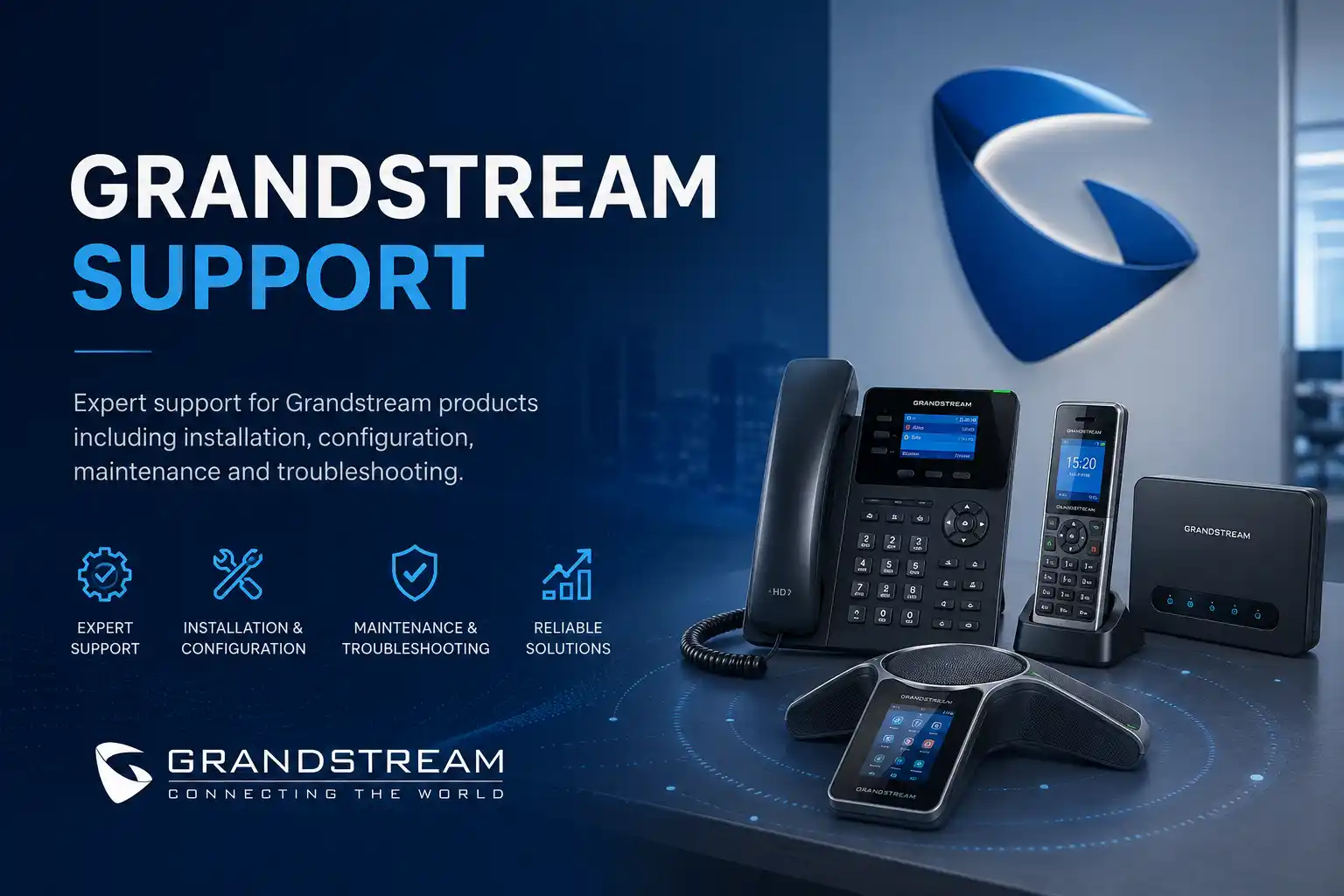
Migration scope is confirmed from the actual UCM environment, connected phones, provider services, business call flows and approved maintenance window.
Extensions, trunks, routes, prompts, phones and dependencies are mapped before change.
Existing settings and recovery options are reviewed before migration work is approved.
Incoming, outgoing, internal, reception, queue and after-hours behaviour can be validated.
Remote and on-site activity is planned around access, location, scope and scheduling.
What is Grandstream UCM migration support?
Grandstream UCM migration support is the assessment, planning, configuration transfer or rebuild, validation and handover work needed when a business changes from one UCM environment to another or reorganises a UCM deployment. It is mainly used to reduce uncertainty around extensions, call routing, SIP trunks, queues, IVR menus, voicemail, phone provisioning, remote users and related network settings during a planned change. Businesses should consider it when an existing PBX is ageing, capacity or features no longer fit the organisation, a site is moving, the telephone environment is being standardised, or a newer UCM platform is being introduced. Before work can be confirmed, the customer should provide the current and target UCM details, firmware information where available, extension and phone counts, trunk/provider information, important call flows, backup status, administrator access through an approved secure method, site details and a suitable maintenance window. Compatibility and migration method remain environment dependent.
What the migration service may cover
Depending on the confirmed scope, FourTeck may help inventory extensions, user names, direct numbers, ring groups, queues, IVR prompts, office-hour rules, outbound permissions, voicemail, recordings or recording policies, SIP trunks, analogue interfaces, paging or intercom links, remote users, phone models and provisioning methods. The assessment also considers the local network because a PBX migration can expose unrelated problems such as unstable switching, incorrect voice VLAN configuration, firewall rules, DNS issues, weak internet links or unsupported endpoint firmware.
The migration method may involve restoring a compatible backup, rebuilding selected configuration on the target system, adapting settings that differ between platforms, or staging a new environment beside the existing PBX before cutover. A direct restore is never assumed simply because both systems carry the UCM name. Model capacity, firmware, port layout and functions in use must be checked first.
Who may need this service
The service can suit offices replacing an older Grandstream UCM, companies moving to a different UCM capacity, organisations consolidating several telephone configurations, businesses relocating to a new Dubai office, and teams that need to document a PBX before changing it. It can also help when a previously managed system has incomplete records and the new administrator needs a reliable view of extensions, trunks, schedules, call groups and phone assignments before any upgrade is attempted.
Multi-branch companies may need additional planning because branch phones, site-to-site connectivity, remote extensions, public numbers and reception rules can cross locations. Clinics, professional offices, retail businesses, warehouses, hospitality environments, training centres and service companies may each have different priorities. The migration plan should therefore start from operational call requirements rather than from a generic configuration checklist.
Why businesses plan a UCM migration
Ageing or unsupported environment
An older PBX may continue to place calls while still creating maintenance risk. Limited firmware paths, unavailable parts, missing documentation or changing security expectations can make a planned migration more sensible than waiting for a disruptive failure.
Office move or expansion
A relocation may require new internet service, new public IP information, different switch ports, changed VLANs, new cabling, more phones and a revised reception flow. Treating the move as a controlled migration reduces last-minute telephone changes.
Capacity or workflow change
Additional staff, more departments, remote users, new queues or changed customer service processes may justify a different PBX design. Migration planning provides a chance to remove unused extensions and document the rules that still matter.
Recurring support difficulty
Repeated call-routing faults, undocumented changes, uncertain administrator access and inconsistent phone provisioning can make support expensive. A migration project can be structured to improve documentation and establish a clearer baseline.
No single symptom proves that migration is necessary. A call-quality problem may be caused by the network or provider rather than the PBX. A missing incoming call may be a carrier route, firewall rule, trunk registration, time condition or destination issue. FourTeck can help distinguish a support fault from a genuine migration requirement before the project scope is finalised.
Business impact of an unplanned PBX change
Telephone systems often appear simple to users because the most visible action is picking up a handset and dialling. Behind that action can be a chain of extension credentials, phone provisioning, switch power, VLAN settings, DNS, firewall policy, SIP registration, carrier routing, time conditions and destination logic. Changing several of these layers at once without an inventory makes it difficult to know which change caused a failure. A rushed migration can therefore produce problems that only become visible after normal business traffic returns.
Reception may discover that one published number reaches the wrong team. Sales calls may stop overflowing when agents are busy. An after-hours route may still follow an old schedule. A remote user may register but have one-way audio. A gateway may not pass analogue lines as expected. Voicemail delivery, emergency calling procedures, call recording, door-phone integration or paging can also require separate checks. The business impact can range from missed customer contact to confusion during internal transfers and repeated support calls from staff.
A controlled project does not guarantee that every legacy behaviour will transfer unchanged. It does, however, create a documented basis for deciding what must be retained, what can be improved, what depends on a third party and what requires an explicit test before the old system is removed.
Possible Grandstream UCM migration assistance
The final service is shaped by the source and target environment. Depending on the approved quotation, assistance may include the following work. Items are not automatically included simply because they are listed here; the purpose is to show the areas that commonly need attention during a business telephone migration.
Review the current UCM model, firmware, administrator access, extension ranges, user assignments, trunks, routes, IVRs, queues, ring groups, time conditions, prompts, phone inventory, network details and known integrations.
Create or verify appropriate configuration backups where access and platform capability allow, record current settings, confirm where recoverable copies are stored, and keep the current-state evidence needed for rollback planning.
Check target capacity, firmware path, interfaces, network addressing, switch connectivity, provider requirements, phone compatibility and any feature differences that could affect the migration approach.
Apply a compatible restore, rebuild settings or transfer selected configuration according to the verified method. Changes are planned around authorisation, backup and a realistic rollback path rather than treated as an automatic copy.
Map supported phones to users and extensions, review provisioning, validate registration, confirm programmable-key requirements where relevant and identify endpoints that need manual attention.
Test agreed calling scenarios, verify trunk behaviour, confirm important queues and office-hour routes, record remaining exceptions and provide an administrator-focused summary of the migrated environment.
Service-fit matrix for common migration situations
| Business situation | Relevant assistance | What must be confirmed |
|---|---|---|
| Older UCM is still working but documentation is incomplete. | Current-state inventory, backup review, call-flow mapping, endpoint list and migration options. | Administrator access, model, firmware, trunk ownership, essential call paths and available backup. |
| Business is moving office and wants to retain numbers and phone workflows. | New-site readiness, network and VLAN review, provider coordination, phone relocation plan and cutover testing. | Carrier transfer process, internet activation, public IP or trunk requirements, cabling, switch capacity and building access. |
| Target UCM differs from the current model. | Compatibility assessment, configuration comparison, restore feasibility review and manual rebuild planning where needed. | Capacity, ports, firmware, supported features, extension count, conference or analogue requirements and endpoint compatibility. |
| Remote users and branch phones are part of the deployment. | Remote-registration review, network-path checks, security assessment, user testing and documentation. | Internet quality, firewall behaviour, remote access method, endpoint support and user locations. |
| Migration is being considered because of poor calls. | Diagnostic review before migration approval to determine whether the PBX, network, provider or endpoint is responsible. | Call examples, timestamps, packet-loss indicators, trunk status, network errors and whether one or many users are affected. |
| Business wants a cleaner design rather than a like-for-like copy. | Call-flow workshop, extension rationalisation, queue and IVR redesign, permission review and documentation. | Approved business rules, department owners, published numbers, after-hours expectations and acceptance testing criteria. |
Grandstream UCM migration service information
| Service topic | Grandstream UCM migration planning, configuration transition, testing and handover. |
|---|---|
| Main purpose | Move or rebuild a business PBX environment in a controlled way while preserving required call flows and documenting dependencies. |
| Typical systems involved | Grandstream UCM appliance or supported UCM environment, IP phones, SIP trunks, gateways, switches, voice VLANs, firewall, internet service and remote-user connectivity. |
| Assessment method | Remote configuration review, documentation collection and call-flow discovery, with on-site inspection where physical equipment, cabling, analogue ports or local network work is involved. |
| Customer access required | Authorised administrative access to the PBX and relevant network or provider information. Credentials should be shared only through an approved secure method after authorisation is confirmed. |
| Backup considerations | Backup capability, current firmware, recoverable configuration, data size and target compatibility should be reviewed before relying on a restore-based migration. |
| Migration support | Scope dependent. May include compatible restore, manual configuration rebuild, trunk coordination, endpoint provisioning, staged cutover and validation. |
| Testing and validation | Agreed tests can cover internal calls, inbound numbers, outbound calling, caller identification, reception routes, queues, IVR, office hours, voicemail, transfer and selected remote users. |
| Documentation and handover | Can include extension lists, trunk notes, routing summary, network dependencies, exception list, backup location guidance and administrator next steps. |
| Service location | Dubai and UAE service coordination. Remote or on-site method depends on access, issue type, location and approved scope. |
| Scheduling dependency | Maintenance window, engineer availability, customer access, carrier activity, building access, equipment readiness and third-party timing. |
| Important note | Compatibility and feature transfer are environment dependent. Zero downtime and complete legacy-feature retention should not be assumed before assessment. |
Remote planning versus on-site migration assistance
When remote assistance may be suitable
Remote support can be effective for configuration review, extension and route documentation, backup preparation, log checks, firmware planning, target configuration work, phone provisioning review and selected test calls when the business has a stable internet connection and authorised secure remote access. It can also help before an on-site change by resolving administrative questions in advance, reducing the amount of discovery that must happen during the maintenance window.
Remote work still needs a local contact when physical confirmation is required. Someone may need to identify a cable, power-cycle a device under instruction, confirm the label on a gateway or test a phone in a specific area. If the PBX is unreachable, the local network is unstable or the migration includes physical replacement, remote work alone may not be enough.
When an on-site visit may be needed
On-site assistance can be appropriate when the UCM appliance must be replaced in a rack, analogue lines or gateways require testing, phone ports or PoE need checking, switch and VLAN changes are part of the cutover, the new office needs physical deployment, or several users require coordinated endpoint changes. It is also useful when documentation is poor and device identification is a significant part of discovery.
Attendance timing depends on confirmed scope, engineer availability, building access, customer authorisation, travel and any required parts or third-party appointments. The migration plan should distinguish work that can be prepared remotely from work that must happen at the site so the agreed maintenance window is used efficiently.
How the UCM migration assessment usually begins
A reliable migration starts with evidence rather than assumptions. The sequence below can be adapted to the actual environment, but each stage answers a different business question: what exists now, what must continue to work, what can change safely, and what needs to be proved before the old PBX is retired.
- Define business impact and priorities. Identify which public numbers, departments, reception routes, queues, remote staff and internal functions are critical. A rarely used test extension should not receive the same migration priority as the main published telephone number.
- Inventory the source UCM. Record model, firmware, IP information, extension range, trunks, routes, time conditions, prompts, queues, groups, voicemail behaviour, recording requirements, gateways and connected services. The goal is to understand the current operating state rather than only the intended design.
- Map endpoints and users. Create a practical list of phone models, MAC addresses where available, assigned users, extension numbers, reception sets, common-area devices and any analogue or special endpoints. This reduces uncertainty when devices reconnect to the target system.
- Review provider dependencies. Confirm SIP trunk ownership, public numbers, authentication method, provider contact, IP restrictions, number-porting activity if any and responsibilities on cutover day. Some telephone failures cannot be corrected from the PBX side without provider action.
- Review the network path. Check how phones reach the PBX, whether voice VLANs are used, how DHCP and DNS are delivered, whether firewall rules or NAT are relevant, and whether branch or remote endpoints rely on separate internet links.
- Confirm backup and rollback. Determine which settings and data can be backed up, where the backup is stored, whether the target can use it, and what practical action is available if testing fails. A rollback plan can be as important as the migration plan.
- Build a target-state checklist. Decide which old rules remain, which extensions are removed, which call flows change and which new requirements are introduced. This prevents outdated configuration from being copied simply because it exists.
- Agree acceptance tests. Write down the calls and functions that must pass before the project is accepted. Tests should represent real operations, including external callers and after-hours behaviour where appropriate.
Migration planning, implementation and corrective work
Once discovery is complete, the project can be divided into preparation, target configuration, cutover and validation. Preparation can include cleaning the extension list, confirming trunk information, exporting or recording prompts, checking backup files, preparing endpoint lists, allocating target addresses and confirming who is authorised to approve changes. If the migration is tied to an office move, internet handoff, cabling, switch configuration, power and rack position should be ready before the telephone cutover begins.
Target configuration may be produced by a supported restore method or by rebuilding required settings. The correct path depends on the source and target UCM models, firmware and the features in use. Grandstream documentation shows that backup and restore are supported features across UCM families, but compatibility can be constrained by model capacity and configuration differences. That is why a backup file should be treated as a migration input, not as a promise that every setting will transfer to every target without adjustment.
Where a newer UCM6300-series environment is involved, firmware planning deserves specific attention. Current Grandstream guidance warns administrators to create a full backup before particular firmware transitions and notes that downgrade behaviour can change around newer encrypted firmware branches. FourTeck therefore reviews the actual firmware state before recommending an upgrade sequence or restore operation. The service page does not assume that the latest firmware can simply be installed in one step on every existing PBX.
Cutover should be sequenced around the business. A common approach is to prepare as much as possible while the existing PBX remains available, schedule provider or network changes, move or register selected endpoints, test agreed calling scenarios and keep the old environment available for rollback where technically and operationally possible. The right sequence varies. A small office with one SIP trunk and twenty phones is different from a multi-branch setup with reception queues, analogue gateways, remote users and multiple published numbers.
Corrective work after cutover is part of realistic planning. A phone may need reprovisioning, a provider may need to update an IP restriction, an IVR prompt may need a revised recording, or a route may need adjustment after users test a real workflow. The important point is to distinguish a controlled correction from an unplanned redesign. Changes that alter agreed business behaviour should be documented and approved rather than applied casually during troubleshooting.
Testing, validation and handover after migration
A PBX can appear healthy in the administration interface while still failing an important business scenario. Validation therefore needs to be based on real calls and user actions, not only system status. The agreed test list may include extension-to-extension calls, outbound calls to mobile and landline destinations, inbound calls to each important public number, reception handling, blind and attended transfer, queue distribution, IVR selections, voicemail deposit and retrieval, after-hours routing, caller identification, call permissions and selected remote endpoints. If analogue lines, gateways, paging, door phones or intercoms are in scope, they need their own functional checks.
Call quality should also be observed during testing. Registration success does not prove that media will be reliable. One-way audio, intermittent speech, delay or dropouts can involve NAT, firewall handling, network congestion, packet loss, endpoint configuration or carrier behaviour. Where relevant evidence is available, FourTeck can help isolate whether a problem follows the endpoint, network path, PBX or provider.
Handover should leave the business with a clearer environment than before the project. Useful records can include the final extension list, key call flows, trunk details without exposing credentials, network dependencies, backup location, administrator ownership, exceptions that remain open, and instructions for future support. If staff procedures changed, reception and administrators may need short user guidance. A successful test at handover is not a substitute for maintenance; backups, firmware planning, access control and documentation should continue after migration.
Capability focus 1: safer backup and recovery preparation
Backups are central to a UCM migration, but the phrase “we have a backup” is not enough. The project needs to know what the backup contains, when it was created, which firmware produced it, whether important user data or prompts are stored separately, and whether the target environment can accept the file. Grandstream UCM platforms provide backup and restore functions, and UCM6300 environments can also use supported backup options associated with Grandstream’s management ecosystem. The migration plan should still verify the specific appliance and service configuration rather than assuming identical behaviour across generations.
A good recovery position includes more than one copy of the current-state evidence. Configuration screenshots, extension lists, exported phone details, trunk notes and call-flow diagrams can be valuable if a full restore is not appropriate. These records make a manual rebuild possible and help the engineer compare the migrated state with the original system. They are also useful when the source PBX is poorly documented or has accumulated years of changes.
Rollback planning asks a separate question: if the target fails an acceptance test, what practical action restores calling? The answer may involve reconnecting the old PBX, reverting provider routing, restoring a previous configuration or applying a narrower corrective change. The feasible option depends on network addressing, equipment ownership, provider timing and whether the old system remains physically available. FourTeck can document the chosen rollback path before cutover so decisions are not made under pressure.
Capability focus 2: preserving call flows and provider connectivity
Users often describe a phone system by extension numbers, but the business depends on routes and behaviour. A main number may reach an IVR, then send sales calls to a queue, overflow unanswered calls to reception, follow a different rule outside office hours and finally send a voicemail notification. Another number may ring a specific department directly. Outbound calls may follow permissions by user, department or destination. If these relationships are not documented, a migration can preserve extensions while still breaking the customer journey.
FourTeck can help map incoming DIDs or public numbers to their destinations, identify IVR menus and prompts, record ring groups and queue members, confirm time conditions, check forwarding and voicemail behaviour, and note special outbound rules. The purpose is not to copy every historical setting. It is to separate active business logic from obsolete configuration and confirm which behaviours managers want on the target platform.
SIP trunk coordination is equally important. Authentication, IP restrictions, registration, codecs, caller identification, number formatting and provider routing can vary by service. The migration may require the carrier to update a permitted public IP, move a number route or verify a trunk profile. Provider actions remain vendor dependent, so the cutover plan should include contact details and escalation responsibility. FourTeck can gather evidence and coordinate the technical side where included, but cannot control a third-party carrier’s change window or internal process.
Capability focus 3: phones, networks and remote-user readiness
A PBX migration reaches beyond the PBX because every endpoint must find, trust and register to the new environment. Grandstream phones may use provisioning, DHCP options, DNS records, local configuration or management services depending on the deployment. Other SIP endpoints can follow different methods. A migration plan therefore needs an endpoint inventory rather than only a user list. Reusing existing phones may be practical when the models remain compatible with the target system and required functions, but that must be assessed instead of assumed.
The network can determine whether otherwise correct telephony settings work reliably. Switch ports must provide appropriate connectivity and power where PoE is used. Voice VLANs, DHCP, routing, firewall policy, DNS and internet performance can affect registration and audio. A change of office or public IP can also affect SIP provider rules or remote access. FourTeck can include network checks when they form part of the confirmed migration scope.
Remote staff add another layer. Grandstream’s current UCM ecosystem includes on-premise, hybrid, cloud and software options, and UCM6300 deployments can integrate with Grandstream remote-access and management services. The correct approach depends on the platform being used, subscriptions or service availability, endpoint type and security policy. The page does not assume that every remote feature is enabled or licensed. Remote users should be tested from representative external networks before the migration is considered complete.
Dependencies, access and customer inputs
A migration can only be planned accurately when the people responsible for the business and the technical environment provide enough context. FourTeck may need the service location, source and target UCM models, current firmware, number of users, extension range, phone inventory, SIP provider, public numbers, gateway details, network diagram, switch and firewall information, remote-user requirements, backup status, recent changes and known faults. The project also benefits from a named business owner who can confirm how incoming calls should behave and approve any change from the current call flow.
Administrative access should be available for authorised engineers, but passwords should not be placed in public forms, page comments or unsecured messages. Credentials can be shared through an approved secure method after identity and authorisation are confirmed. If previous administrators or vendors still control accounts, the business may need to recover ownership before technical work can proceed.
External dependencies can include telecom carriers, internet providers, cloud or management subscriptions, building IT teams, landlords, structured-cabling contractors and other application vendors. An office relocation may also require rack access, electrical power, UPS availability, patch-panel identification and building permission. These dependencies affect scheduling and can create waiting time that is outside the PBX configuration itself.
A realistic maintenance window should reflect the number of users and complexity of the change. Some preparation can happen during normal hours, while service-affecting work may need an agreed lower-impact period. FourTeck does not assume zero downtime, a fixed project duration or immediate attendance. Timing is confirmed after scope, access and third-party requirements are understood.
Risks, limitations and exclusions to understand before migration
Migration reduces some lifecycle and support risks, but the project itself introduces change risk. A configuration that worked on the source system may depend on an old endpoint, provider behaviour, analogue interface, firmware-specific setting or undocumented work-around. A target platform may implement the same business function differently. Compatibility must therefore be checked at the level of the real environment rather than inferred from the product family name.
- A backup may not be restorable to every target model or firmware in the same way. Capacity and configuration differences can block or limit a direct restore.
- Legacy phones, gateways or integrations may require reconfiguration, firmware work or replacement if they do not suit the target environment.
- Carrier-side changes remain dependent on the telecom provider. FourTeck can coordinate technical information where agreed but cannot guarantee provider timing.
- Call recordings, voicemail, prompts and historical data may have different migration requirements from the PBX configuration itself. Data retention should be confirmed before cutover.
- Network or firewall faults can remain after a PBX replacement. A migration should not be used as a substitute for diagnosing known connectivity issues.
- Unsupported or very old environments may have limited safe upgrade paths. An assessment may recommend staged work rather than a direct change.
- Final commercial terms, visit requirements, documentation level and post-migration support depend on the approved quotation or service agreement.
Business environments where controlled UCM migration matters
Professional offices
Consultancies, property firms, legal and accounting teams may rely on direct numbers, receptionist transfers, department groups and remote users. Migration testing should reflect customer-facing calls and internal handover between staff.
Retail and showrooms
Published store numbers, call overflow, manager extensions and branch connectivity can make missed routing visible immediately. Cutover should be coordinated around trading activity and site access.
Warehouses and logistics
Large sites may use desk phones, cordless endpoints, paging, gates or remote offices. Physical network coverage, PoE, gateways and operational hours can influence whether on-site testing is required.
Clinics and service centres
Reception, appointment lines, call queues and voicemail can be central to daily scheduling. Acceptance tests should cover the paths patients or customers actually use.
Hospitality operations
Front desk, back office, guest-service extensions and analogue or gateway-connected devices can create additional dependencies. The migration scope should distinguish administrative calling from operational endpoints.
Multi-branch businesses
Branches may share numbering, trunks, remote extensions or central reception. A staged migration can be more suitable than moving every site at once when operational risk is high.
Operational, security and maintenance considerations
A migration is a good time to review who owns PBX administration and how access is controlled. Old shared administrator accounts, unknown remote access paths and undocumented provider credentials can make future support difficult. The business should know which internal role can approve telephony changes, where configuration backups are kept and which external provider is responsible for numbers and trunk service. Access should be limited to authorised people and reviewed when staff or vendors change.
Firmware decisions should be planned, not performed simply because an update is available. Grandstream currently publishes firmware for several UCM families and provides upgrade notes that can include backup requirements and restrictions. The migration project should therefore record the target version and future update responsibility. Where a system is deliberately held on a particular release because of compatibility, the reason should be documented rather than forgotten.
Maintenance after cutover can include backup checks, configuration review, endpoint health, trunk monitoring, capacity review, user changes and documentation updates depending on the agreed support arrangement. A working migration does not remove the need to maintain phones, switches, UPS units, gateways, internet links and provider relationships. Telephone reliability depends on the complete path from user handset to external network.
Before you contact FourTeck about a UCM migration
Preparing the following information helps turn an initial request into a useful technical discussion. Exact details are not mandatory in every case, but the more that is known, the easier it is to identify dependencies and prepare an accurate scope.
- Dubai or UAE service location and site contact.
- Current Grandstream UCM model and target model or intended platform.
- Current firmware version if available.
- Approximate number of extensions and users.
- List of desk-phone and other endpoint models.
- SIP trunk or telecom provider details.
- Public numbers that must be retained and tested.
- Important queues, IVRs, ring groups and after-hours rules.
- Any analogue lines, gateways, paging or door-phone connections.
- Remote users or branch phones that must continue working.
- Current backup status and where recoverable copies are stored.
- Recent faults or known call-quality issues.
- Availability of authorised administrator access.
- Preferred maintenance window and business-critical hours.
- Expected outcome: like-for-like migration, redesign, office move or expansion.
- Any security, building-access or vendor coordination restrictions.
Service evaluation checklist for quotation and engagement
How FourTeck can assist
FourTeck can help clarify the migration objective, identify the current technical layers, organise remote discovery or on-site inspection, document call flows, review backup readiness, assess the target environment, coordinate approved configuration work, test the migrated service and record next actions. Where a carrier, internet provider, building contractor or other vendor is involved, technical information can be gathered so responsibilities are clearer.
The quotation is based on the confirmed environment rather than a generic migration package. A small office with one site and a standard trunk may need a different plan from a multi-site environment with analogue gateways, remote users, complex queues and several provider dependencies. FourTeck can explain which tasks are included, which are conditional and which require a separate vendor or customer action.
For wider company information, visit About FourTeck IT Services or review the FourTeck IT Services UAE home page.
Dubai and UAE service coordination
Migration work can combine remote preparation with planned on-site activity. Configuration review, inventory work, backup checks and some target setup may be possible remotely when secure access is available. Physical replacement, rack changes, cabling, phone moves, gateway testing and local network work may need an on-site visit. The mix is selected after the current environment is understood.
Service timing depends on engineer availability, customer access, site conditions, maintenance windows, required equipment and third-party providers. Carrier changes or number routing can introduce dependencies that are outside FourTeck’s direct control. Contact FourTeck to confirm the scope and scheduling options instead of assuming a fixed attendance or cutover time.
Businesses can also review FourTeck’s broader IT and telephony support services when the migration includes network, firewall or endpoint work.
Service coordination across Dubai, Abu Dhabi, Sharjah and Ajman
FourTeck can coordinate Grandstream UCM migration assistance for business environments in Dubai and, subject to scope and scheduling, other UAE locations including Abu Dhabi, Sharjah and Ajman. The service plan can combine remote discovery, configuration preparation, planned on-site visits, endpoint work, migration support and post-change checks. It is not necessary for every task to happen in the same location or at the same time. For example, PBX configuration may be prepared remotely while a local site contact verifies phones and cabling, or an engineer may attend the main site while branch users complete remote acceptance tests.
Travel, building access, security approval, site working hours, rack availability, equipment delivery and provider appointments can affect how work is scheduled. Multi-site businesses should identify which location hosts the PBX, which branches depend on it and which public numbers or remote users are critical at each site. This helps determine whether a staged change is safer than a single cutover. Contact FourTeck with the site list and migration objective so the remote and on-site balance can be defined in the quotation.
Related FourTeck services that may support the migration
IP PBX and telephone support
Useful when the project includes extension administration, call routing, queues, IVR, voicemail, trunk troubleshooting or ongoing PBX maintenance.
Network support
Relevant when phones depend on voice VLANs, PoE switches, branch routing, cabling, DHCP, DNS or unstable network links.
Firewall and internet coordination
May be needed where SIP registration, remote users, public IP changes or carrier traffic depend on firewall and internet behaviour.
Office relocation support
Useful when the UCM migration is part of a wider move involving internet activation, network readiness, new cabling, phones, users and site handover.
The FourTeck services page provides a broader view of business IT, network and communication support that can be combined with a telephone migration when relevant.
Why businesses contact FourTeck for migration planning
A UCM migration can involve the PBX, phones, local network, firewall, internet connection, SIP provider and business call logic at the same time. Businesses often contact FourTeck because they want one technical view across those dependencies rather than separate troubleshooting conversations that never connect. The value of that approach is practical: the same symptom can originate in several layers, so a migration decision should be based on evidence rather than on replacing equipment first and investigating later.
FourTeck’s role can include clarifying the issue, preparing an inventory, explaining the migration path in business terms, organising remote and on-site work, coordinating providers where agreed, applying authorised changes, testing outcomes and documenting the environment. The objective is not to claim that every problem disappears after migration. It is to make the change controlled, understandable and supportable.
For a quotation, the most useful starting point is a clear description of the current system and the desired outcome. FourTeck can then identify what must be assessed before the final work plan is confirmed. This is particularly important when the existing UCM is older, when backup compatibility is uncertain, when provider information is incomplete or when the telephone system has been changed by several administrators over time.
Questions businesses ask before choosing Grandstream UCM migration support
Can our existing Grandstream UCM be migrated remotely?
Much of the discovery and configuration work may be possible remotely when the PBX is reachable, the customer authorises secure access and the internet connection is stable. Remote work can include reviewing extensions, trunks, routes, backups, firmware, logs and target settings. Physical replacement, analogue line testing, rack work, switch changes or phone moves may still require someone on site. A useful first question is not simply “remote or on-site?” but “which parts of the migration can safely be prepared remotely, and which require physical confirmation?” FourTeck can split the work accordingly after assessment.
Can we copy the backup from the old UCM directly to the new one?
Possibly, but a direct restore should not be assumed before the source and target are compared. Grandstream has supported backup and restore across UCM products, and documentation for older UCM families explains cross-model compatibility within defined conditions. At the same time, model capacity, FXO ports, extension limits, conference resources, firmware and feature differences can affect whether a backup is accepted or whether settings need adjustment. The safe approach is to inspect the backup source, target model and active configuration before using restore as the migration method. If compatibility is uncertain, a manual or staged rebuild may provide better control.
Do we need to replace every Grandstream phone during the migration?
Not necessarily. Existing phones may be reusable when they are in good condition, supported by the target environment and capable of the functions the business needs. The decision should consider phone model, firmware, provisioning method, PoE requirement, button layout, headset use, directory functions and any special reception or call-centre needs. Older or mixed endpoint fleets may need more manual work. A migration inventory should therefore record the phones as carefully as the extensions. Reusing suitable endpoints can reduce disruption, while replacing unsupported or unreliable devices may improve maintainability.
What should we test before the old PBX is disconnected?
Test the scenarios that matter to the business rather than relying only on a successful registration screen. Start with the main published numbers, then check outbound calling, internal calls, reception handling, transfer, queues, IVR selections, office-hour and after-hours routes, voicemail and caller identification. Test remote users and special endpoints if they are part of the design. Where the business uses analogue gateways, paging or door phones, those paths need separate validation. The acceptance list should be written before cutover so everyone knows what “working” means.
Will a migration solve poor call quality?
Only if the PBX or its configuration is actually part of the problem. Poor audio can come from packet loss, unstable internet, congested links, incorrect QoS, switch faults, cabling, endpoint problems, firewall handling or the telecom provider. Replacing the PBX without diagnosing these layers can leave the original fault unchanged. If call quality is one reason for considering migration, provide examples with dates, times, users, destinations and whether the problem affects internal, incoming or outgoing calls. FourTeck can use that evidence to determine whether the migration should include network or provider troubleshooting.
How much downtime should we expect?
Downtime is scope dependent and should not be guessed before the environment is reviewed. A well-prepared project can perform a large amount of work before the service-affecting cutover, but the actual interruption depends on provider routing, number of endpoints, network changes, physical replacement, firmware work and how quickly acceptance tests can be completed. Some businesses may prefer a staged migration, while others can move during a single maintenance window. FourTeck can help identify the tasks that create interruption and prepare the sequence, but the page does not promise zero downtime or a fixed project duration.
Should we migrate the current configuration exactly or redesign it?
A like-for-like migration can reduce user change, but it may also carry forward old extensions, unused routes and work-arounds that no longer serve the business. A redesign can simplify administration but requires more discovery and user acceptance. The best approach is often selective: preserve critical public numbers and familiar user behaviour while removing obsolete configuration and documenting new rules. Managers should identify which call flows are business requirements and which are simply historical settings. FourTeck can use that distinction to build a target-state checklist before configuration begins.
What information does the telecom provider need during a migration?
That depends on the trunk service. Some providers authenticate with registration credentials, some restrict traffic by public IP, and some may need number routing or account changes. Provider information can also affect caller identification, number presentation, codec behaviour and failover. The business should identify the carrier account, technical contact, public numbers and any known IP restrictions before cutover. FourTeck can coordinate relevant technical details when included in the service scope, but provider changes remain dependent on the carrier’s own process and schedule.
What if we do not have good PBX documentation?
Incomplete documentation is common and does not prevent an assessment, but it usually increases discovery effort. The existing UCM can be reviewed to identify extensions, routes, groups, queues, trunks and other configuration. Phone labels and user interviews may also be needed because live settings do not always explain the business reason behind them. Call examples can reveal which paths are actually used. FourTeck can help create a baseline inventory before migration, which gives the project a reference and improves future support after handover.
Can a Dubai office migration include a move to a new building?
Yes, but the telephone migration should be integrated with the broader site plan. The new location needs internet service, suitable structured cabling, switch and PoE capacity, voice VLAN or network design, rack space, power and any required firewall rules before phones can be validated. The carrier may also need to confirm number and trunk behaviour from the new site. Building access and fit-out schedules can affect the work. A combined plan reduces the risk of discovering on move day that the PBX is ready but the network or provider handoff is not.
What happens to voicemail, recordings and prompts?
These items should be identified separately from core PBX configuration because their storage and migration method can differ. The business should decide what historical content must be retained, what can be archived outside the PBX and what must continue on the target system. Legal or internal retention requirements should be handled according to the customer’s policies; FourTeck should not assume a retention period. IVR prompts should be inventoried and tested because a correct route with the wrong or missing audio still creates a poor caller experience.
How do we know whether our target UCM is large enough?
Capacity assessment should consider more than the current extension count. Review expected users, concurrent calls, queues, conference needs, remote users, analogue interfaces, recording requirements, branch growth and any special applications. Grandstream publishes capacity information for its UCM models, but the selection still needs to match the business environment. A target that only fits today’s extension count may leave little room for growth, while an unnecessarily large design can add cost and complexity. FourTeck can help translate business requirements into a practical technical scope before the migration is approved.
When should we contact FourTeck instead of attempting the change internally?
External assistance is useful when the existing system is poorly documented, the migration crosses UCM generations, provider dependencies are unclear, the business cannot risk extended disruption, multiple sites are involved, or internal staff do not have time to inventory and test every call path. It can also help when network and firewall changes are part of the project. If your team already manages the UCM confidently, FourTeck can still assist with a focused assessment, validation plan or on-site component rather than taking over the entire project. The scope can be defined around the gap that needs support.
What should we ask for in the migration quotation?
Ask for a clear distinction between assessment, configuration work, on-site activity, carrier coordination, phone provisioning, testing, documentation and post-cutover support. Confirm whether backup review and rollback planning are included, which sites are covered, whether third-party charges are excluded and what customer access is required. If the project includes new hardware or licenses, those should be identified separately from service labour rather than implied. A quotation is most useful when it states the boundaries of the work and the assumptions that could change the final scope.
Frequently asked questions about Grandstream UCM migration in Dubai
Does FourTeck migrate only UCM6300 systems?
No single UCM model is assumed. The source and target must be identified first. Migration planning can involve older Grandstream UCM families and newer environments, but the method depends on firmware, model capacity, features, backup compatibility and the current condition of the system.
Can we keep our existing extension numbers?
Usually the internal numbering plan can be recreated when it fits the target design, but this should be confirmed with the extension inventory. Public telephone numbers depend on the carrier service and are a separate consideration from internal extensions.
Can the migration be staged by department?
A staged approach may be possible when network, numbering and provider arrangements allow the old and new environments to coexist or when endpoints can be moved in controlled groups. Feasibility is environment dependent and should be checked during planning.
Will call recordings move automatically?
Do not assume this. Recordings and other stored data can have separate backup, storage and retention requirements from the PBX configuration. The required historical data should be identified and its migration or archive method confirmed before cutover.
Do you coordinate with our SIP provider?
Provider coordination can be included when agreed. FourTeck can gather trunk and network information, share technical requirements and test calling, but carrier-side changes, approvals and timing remain controlled by the provider.
Do we need a maintenance window?
Most service-affecting migrations benefit from an agreed lower-impact period. The required window depends on preparation completed in advance, provider changes, number of phones, network work and acceptance testing. A fixed duration cannot be confirmed before assessment.
What if the current UCM has unknown administrator credentials?
Access ownership must be resolved before full configuration review is possible. FourTeck can discuss authorised recovery options where appropriate, but the business should establish legitimate ownership and avoid sharing credentials through unsecured channels.
Can network problems be handled during the migration?
Yes, if network assessment or corrective work is included in the scope. Voice VLANs, PoE, DHCP, routing, DNS, firewall behaviour and internet quality can affect UCM endpoints, so some migrations need coordinated network work.
Is on-site support available outside Dubai?
Service coordination may cover other UAE locations such as Abu Dhabi, Sharjah and Ajman subject to scope, scheduling, travel, access and approved quotation. Remote preparation can often reduce the amount of on-site work required.
What happens after handover?
Post-migration work can include agreed corrective changes, documentation updates, user guidance, backup review and ongoing telephone support. The included period and activities depend on the approved quotation or maintenance arrangement rather than being assumed automatically.
Plan the migration around your actual UCM environment
A useful migration discussion starts with the current model, target platform, extension and phone count, SIP provider, critical public numbers, important call flows, backup status, remote users and preferred change window. FourTeck can review those details, identify questions that need technical verification and prepare a scope for remote preparation, on-site work, testing, documentation and handover. Where the project depends on a carrier, network change, building access or unsupported legacy equipment, those dependencies can be identified before cutover rather than discovered during it.
Contact FourTeck to discuss the service objective and confirm whether the next step should be a remote assessment, on-site survey or structured migration quotation. No fixed duration, zero-downtime result or complete legacy compatibility is assumed before the environment has been assessed.