
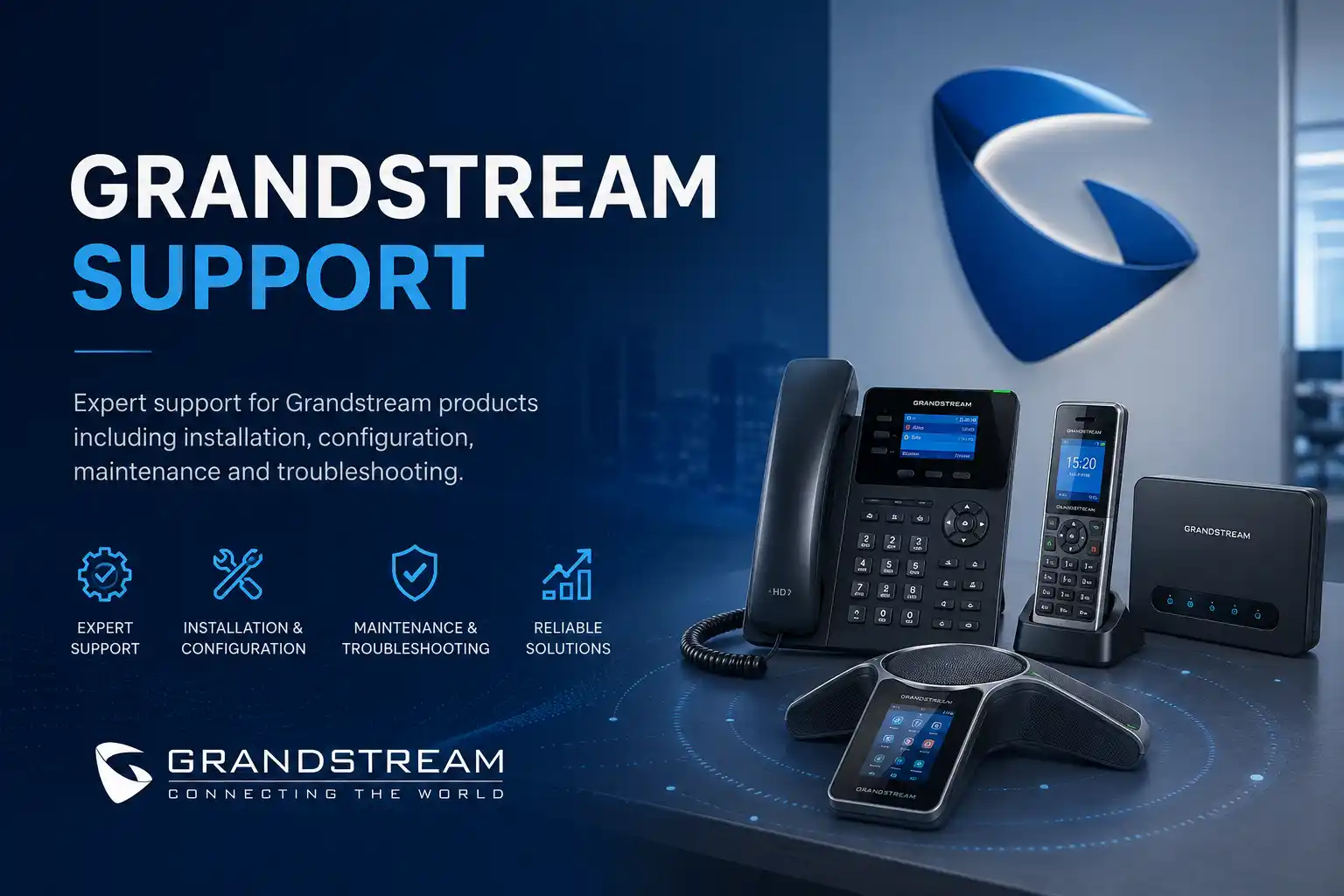
Configuration follows the confirmed call-flow requirement.
Backup, authorisation and rollback are considered before material changes.
Phones, PBX, network and provider paths may all need validation.
Remote or on-site coordination depends on access and confirmed scope.
What does Grandstream UCM configuration involve?
Grandstream UCM configuration is the process of translating an organisation’s telephone requirements into controlled IP PBX settings. It can include extensions, device registration, SIP trunks, inbound and outbound routes, ring groups, queues, IVR menus, office-hour rules, voicemail, call permissions, caller identification, recording policies, remote-user settings and related network parameters, depending on the UCM model and confirmed scope. Businesses should consider configuration assistance when deploying a new system, adding users, changing reception behaviour, integrating a voice provider, preparing remote users, correcting repeated call-routing problems or documenting an inherited setup. Before changes begin, the customer should confirm the UCM model, administrator access, current provider information, affected users, intended call flow, backup status, maintenance window and any network or firewall dependencies.
What the configuration service can cover
A UCM is more than a directory of extension numbers. It sits between users, IP phones, analogue devices where applicable, network services and external voice providers. A change to one part of the configuration can therefore alter how calls reach departments, which users may dial externally, how unanswered calls are handled, or whether a remote endpoint can register. FourTeck approaches the work as a business telephony change rather than as a collection of isolated settings.
Depending on the confirmed scope, assistance may include reviewing an existing extension plan, creating or modifying extensions, associating endpoints, preparing provisioning requirements, checking SIP account details, building inbound routes, defining outbound dial rules, configuring ring groups or queues, adjusting interactive voice response menus, applying office and holiday time conditions, configuring voicemail destinations, reviewing call-forwarding behaviour, checking caller-ID presentation, planning call-recording settings, and documenting the final call path. Grandstream documentation for the UCM family describes inbound and outbound routing, IVR destinations and SIP trunk configuration as core PBX functions; exact menus and available options vary by model and firmware.
On supported UCM6300 environments, Grandstream also provides platform features such as Zero Config provisioning for Grandstream SIP endpoints, Wave clients, GDMS management and UCM RemoteConnect. These capabilities should not be assumed for every older UCM model or every customer deployment. FourTeck first identifies the actual appliance family, firmware, licences or subscriptions where relevant, connected phone estate and network design before recommending how a requested function should be delivered.
Configuration work should also respect operational risk. If a current system is already serving customers, reception, sales or support queues, a poorly timed change can disrupt the organisation even when the intended setting is small. For that reason, material changes may require a current backup, approved maintenance window, test numbers, responsible customer contact and a defined rollback point. The final service content depends on the current environment and the approved quotation.
Who may need this service?
Businesses may need configuration support when a UCM is newly installed, inherited from a previous provider, expanded for new employees, moved to another office, connected to a new SIP service, adapted for remote staff, or reorganised after departments and working hours change. It is also useful when no current call-flow document exists and management wants to understand how calls are handled before approving further changes.
What should be defined first?
The most useful starting point is a written description of the desired behaviour: which number is called, what should ring first, how long it should ring, where it should overflow, what should happen outside working hours, which users can place which kinds of outbound calls, and what the caller should experience if nobody answers. That business logic becomes the basis for safe configuration and testing.
Common reasons businesses request UCM configuration assistance
A configuration request does not always start with a broken telephone system. Often the PBX is working, but the way it handles calls no longer matches the organisation. New staff may have been added without a consistent numbering plan. Reception may transfer calls manually that could be routed more clearly. A sales number may ring the wrong group after working hours. Remote users may need an approved method to access their extensions. A branch may be opening and require a coordinated extension range. Management may want call permissions tightened so departments use the correct trunks or dial patterns.
Other requests begin as faults. Inbound calls may reach the wrong destination, outbound calls may fail for only some numbers, an extension may register but have no audio, a queue may not ring expected agents, or an IVR option may lead to an old department. These symptoms do not prove that the UCM configuration itself is the cause. Similar behaviour can result from SIP-provider rules, firewall handling, NAT, DNS, routing, VLANs, switch faults, endpoint provisioning, cabling, PoE, internet quality or changes made outside the PBX.
A useful diagnostic question is whether the problem affects one user, one phone, one group, one external number, one site or the entire organisation. The answer narrows the technical layers that should be checked first. For example, one extension failing after a desk move suggests a different investigation from all external calls failing at the same time. FourTeck uses the business impact and the failure pattern to define the assessment path rather than assuming that every call issue requires a PBX setting change.
Planning triggers are equally important. Office relocation, new departments, mergers, staff turnover, new working hours, number changes, SIP-provider migration, phone replacement and multi-site growth can all create configuration work. Addressing these changes through a documented plan helps prevent conflicting extension numbers, abandoned routing rules, excessive administrator accounts and undocumented dependencies that become difficult to maintain later.
Business impact of unclear or outdated call routing
Missed customer calls
Calls may ring an unattended extension, terminate after a staff move or reach voicemail without the intended escalation path.
Inconsistent staff experience
Employees may have different transfer keys, permissions, names, voicemail behaviour or forwarding rules because changes were made individually over time.
Harder troubleshooting
Without a current extension list, trunk record and call-flow diagram, future incidents take longer to understand and provider escalation becomes less efficient.
Change risk
A small routing change can unexpectedly affect reception, after-hours handling, outbound permissions or a shared queue if dependencies are not reviewed first.
Possible configuration scope
Extensions and users
Create, rename, disable or reorganise extensions; align display names; review voicemail and forwarding; and plan numbering that remains understandable as the company grows.
SIP trunks and routes
Review provider details, registration or peer requirements where applicable, inbound number mapping, outbound patterns, call permissions and route priorities subject to carrier information.
Reception and departments
Build or adjust ring groups, queues, overflow paths and department destinations so calls follow the organisation’s operating process rather than an old layout.
IVR and time conditions
Configure approved menu destinations, office-hour behaviour, holiday handling and fallback routes while checking that prompts and options match current departments.
Phones and provisioning
Review registration, account assignment and supported provisioning workflows. On compatible Grandstream deployments, Zero Config or GDMS-related management may be relevant, subject to model and environment.
Backup and documentation
Create or confirm an appropriate configuration backup before substantial change, then record extension ranges, important routes, provider dependencies and agreed administrator handover information.
Not every configuration engagement includes every item above. The final scope depends on the UCM model, firmware, licences or subscriptions where relevant, number of users, voice service, phone estate, network design, requested outcome, access and approved quotation.
Service-fit matrix
| Business situation | Relevant assistance | What must be confirmed |
|---|---|---|
| New office or newly installed UCM | Extension plan, trunk setup, call routing, departments, office hours, phone provisioning, testing and handover. | User count, numbers, provider details, network readiness, phone models and required call flow. |
| Reception calls reach the wrong people | Review inbound routes, ring groups, queues, IVR destinations, time conditions and fallback behaviour. | Affected inbound numbers, expected route, office hours and whether the provider is delivering the expected DID information. |
| Some users cannot make external calls | Check outbound routes, extension privileges, dial patterns, trunk availability and call records. | Which extensions fail, which numbers fail, provider status and any recent changes. |
| Adding a branch or remote users | Plan extension identity, remote connectivity, supported UCM6300 remote options, security and network quality checks. | Model, internet path, firewall policy, remote-user method, licences or service plan if applicable, and endpoint compatibility. |
| Inherited PBX with little documentation | Current-state review, extension inventory, route mapping, trunk record, backup review and prioritised cleanup plan. | Administrator access, business ownership, provider contacts and permission to make changes. |
| Changing SIP provider or numbers | Migration planning, trunk configuration, number mapping, test plan and rollback coordination. | Carrier activation, credentials or peer information, cutover window, number ownership and fallback arrangements. |
Grandstream UCM configuration service information
| Main purpose | Align UCM telephony settings with approved business call flows, users, providers and operating hours. |
|---|---|
| Suitable for | Existing or new Grandstream UCM environments requiring configuration, correction, expansion, documentation or controlled change. |
| Typical systems involved | UCM appliance, SIP endpoints, gateways where used, LAN switches, VLANs, firewall, internet connection, SIP carrier and user devices. |
| Remote suitability | Often suitable for authorised web administration, configuration review, logs and call-flow testing when secure access and a working connection are available. |
| On-site suitability | May be required for phones, cabling, PoE, gateways, analogue lines, rack access, switch checks, local testing or environments unavailable remotely. |
| Customer access required | Authorised administrator access and, where relevant, access to network, firewall or carrier information. Credentials should be exchanged only through an approved secure method. |
| Backup considerations | A current backup or verified rollback method may be required before material configuration changes. |
| Testing | Scope dependent; may include internal calls, inbound numbers, outbound patterns, transfers, queue behaviour, IVR choices, voicemail, office hours and remote endpoints. |
| Vendor coordination | May include coordination with SIP carriers, ISPs, firewall administrators, hosted service providers or device suppliers when the fault or change crosses system boundaries. |
| Scheduling dependency | Engineer availability, customer access, maintenance window, provider actions, site access and approved scope. |
| Quotation | Required for the confirmed engagement; final commercial terms depend on the defined work and dependencies. |
Remote configuration or an on-site visit?
Remote assistance may be appropriate when
The UCM is reachable through an authorised secure method, internet service is working, and the work relates mainly to settings, user administration, call routes, trunks, logs, backups or software-side validation. A local contact may still be needed to place test calls, confirm phone displays or verify the caller experience. Remote access does not remove the need for change approval, backup planning or security controls.
On-site assistance may be appropriate when
The task involves physical phones, analogue ports, gateways, cabling, switch ports, PoE, rack equipment, local network segmentation, failed hardware, building access or tests that cannot be reproduced remotely. On-site work can also be useful when many users are affected and the relationship between phones, network infrastructure and PBX registration needs to be observed directly.
The correct service method is decided after the issue or project is understood. Some engagements begin remotely and move on-site only if physical evidence is required. Others start on-site because a new deployment needs phone placement, switch checks, cabling coordination and user handover. FourTeck can help define the most practical sequence without assuming that one method suits every UCM environment.
How a controlled UCM configuration project can progress
1. Define the business outcome
The first question is not which menu must be changed. It is what the organisation wants callers and staff to experience. FourTeck records the affected numbers, departments, users, operating hours, escalation rules, remote-working needs and any special calling restrictions. A simple written call-flow description gives the technical work a clear target.
2. Identify the UCM and connected environment
The exact UCM model and firmware are confirmed together with phone models, gateways, SIP carrier, internet connection, switch infrastructure, voice VLAN if used, firewall path and remote-user method. This matters because features and menu options can differ across UCM generations and software releases.
3. Review the current state
Existing extensions, trunk state, inbound routes, outbound rules, ring groups, queues, IVR destinations, time conditions, forwarding, voicemail and important phone registrations may be reviewed. The goal is to understand dependencies before changing them, not to delete old settings merely because they look untidy.
4. Confirm access, authorisation and backup
Administrative access should be authorised by the customer. Where the change is material, a suitable backup or rollback method is identified before implementation. Grandstream documentation for UCM6300 environments includes local and network backup functions, with additional cloud backup options associated with supported RemoteConnect/GDMS arrangements. The appropriate backup method remains model and environment dependent.
5. Build the change plan
The requested modifications are separated into logical groups such as users, trunks, routing, reception, after-hours behaviour and remote access. A maintenance window may be agreed when live calls could be affected. The plan should also identify who will approve changes and who will perform business-side acceptance testing.
6. Apply approved settings
Configuration is changed in a controlled sequence so the effect of each group of settings can be understood. Examples may include extension details, routing rules, IVR destinations, queue membership, ring strategies, office hours or SIP settings. The exact tasks are limited to the approved scope.
7. Test technical behaviour
Test calls are used to verify expected results. Depending on the project, this may include extension-to-extension calls, inbound calls to important numbers, outbound calls using expected dial patterns, transfer, hold, queue overflow, IVR selections, voicemail, after-hours routes and remote users. A successful single call is not sufficient evidence for a complex routing change.
8. Validate the user experience
Reception, managers or selected users confirm that the new behaviour matches the business request. Technical success and operational success are related but not identical. For example, a queue may work technically yet still ring the wrong staff for the organisation’s process.
9. Document the important result
Useful records can include extension ranges, key inbound routes, trunk references, queue or ring-group membership, office-hour logic, administrator dependencies, backup location and provider contacts. Documentation should be detailed enough to support future maintenance without exposing credentials in an insecure document.
10. Identify follow-up work
Testing may reveal a network fault, outdated phone, carrier limitation, unsupported configuration, cabling issue or requirement outside the original quotation. FourTeck can explain the finding and propose a separate next step rather than treating unrelated work as automatically included.
Capability focus: building call flows that match real operations
A reliable call flow starts with business roles. Reception, sales, accounts, service desks and management often need different behaviour even when they share the same PBX. FourTeck can help map an incoming number to the right destination, define whether it rings a group or queue, decide what happens when nobody answers, apply office-hour logic and set a clear fallback destination. For IVR use, the menu should be short enough for callers to understand and each option should lead to a destination that is actively managed.
Grandstream UCM routing supports the concept of inbound routes that can direct calls to destinations such as an IVR, and outbound routes that determine which trunk and dial pattern can be used. The design challenge is not merely enabling these functions; it is preventing overlaps or unexpected behaviour. A broad outbound pattern, for example, can permit calls that the organisation did not intend. A duplicated inbound rule can make troubleshooting difficult when different numbers should reach different departments.
Time conditions also require operational input. The PBX cannot know public holidays, seasonal hours or one-off closure plans unless those behaviours are configured and maintained. Organisations should decide who owns future updates and how changes are requested. This becomes more important when after-hours calls need to reach voicemail, an external number, security staff or another branch.
The outcome of this work should be understandable to the business. A call-flow document can describe the main number, first destination, timeout, overflow and after-hours path without requiring a manager to understand every UCM menu. That documentation reduces dependence on memory and provides a useful reference for future staff changes, provider migration or office relocation.
Capability focus: SIP trunks, networks and the audio path
External calling depends on more than a trunk status indicator. The UCM, local network, firewall, internet connection and voice carrier all participate in the call path. Registration failure, rejected calls, one-way audio, intermittent disconnections or incorrect caller identity can therefore require evidence from several systems. FourTeck can review the UCM side of the configuration while also identifying when information must be obtained from the SIP provider or network administrator.
Provider details should be treated as an input, not guessed. The carrier may require a registration account, specific server address, source-IP arrangement, authentication information, number format or outbound caller-ID policy. Inbound numbers may also be delivered in a particular format that must match the PBX routing logic. If a new provider is being introduced, a test plan should cover the numbers and call directions that matter to the organisation before old connectivity is removed.
Network design matters because IP phones and the PBX rely on stable addressing, switching and power. Voice VLANs, DHCP options, DNS, gateways, routing and firewall rules can all influence registration or audio. Quality problems may relate to congestion, packet loss, latency, unstable links or provider conditions rather than an extension setting. Physical phone faults, cabling damage or inadequate PoE can create symptoms that resemble a software issue.
For this reason, a configuration engagement may include network checks but does not automatically include every network remediation task. If testing points to switch replacement, cabling repair, firewall redesign or ISP action, those requirements can be scoped separately. Keeping the boundary clear helps the customer understand what has been proven, what remains dependent on another party, and what should be done next.
Capability focus: safer administration, backup and maintainability
A well-configured UCM should remain manageable after the initial project. Administrator access should be limited to authorised people, credentials should not be distributed casually, and the customer should know where backups and key configuration records are kept. When remote management is used, it should follow the security model supported by the specific UCM family and the organisation’s access policy.
Grandstream positions GDMS as a management platform for supported Grandstream devices and identifies UCM RemoteConnect as a companion service for UCM6300 remote connectivity. These options can be useful in supported deployments, but their presence does not mean every UCM should be exposed for remote administration or that every older device has the same capabilities. FourTeck can review the current model, intended remote workflow and customer authorisation before enabling or changing management paths.
Backup discipline is equally important. Before substantial routing, trunk or user changes, a restorable configuration gives the project a safer fallback point. The backup itself should be stored and handled in line with the organisation’s security requirements because it can contain sensitive system information. A backup is not a substitute for testing, but it is a useful control when combined with change notes and a maintenance window.
Maintainability also depends on standardisation. Extension numbers should have a logic that new administrators can understand. Phone naming should reflect real users or locations. Department groups should have owners. Old accounts should be reviewed when staff leave. Unused routes, temporary forwarding and abandoned test extensions should not accumulate without review. These practices reduce confusion during the next incident or expansion.
Where firmware or platform upgrades are being considered, the work should be planned separately from a routine configuration change unless the quotation includes both. Grandstream’s current firmware guidance can include backup precautions before certain upgrades. Compatibility with phones, trunks, custom settings and remote services should be reviewed before a production upgrade is approved.
Dependencies and customer inputs that may affect the work
Grandstream UCM configuration often depends on information held by more than one person or supplier. A business may own the PBX while a telecom provider controls the SIP service, another company manages the firewall, and an internal administrator manages the LAN. FourTeck can coordinate technical information, but access and authority still need to be provided by the customer or the responsible third party.
UCM model, firmware, phone models, gateways, number of users, extension range and any branch or remote-user arrangement.
SIP carrier, relevant account or circuit reference, incoming numbers, expected number format and support contact where available.
LAN addressing, voice VLAN if used, firewall ownership, internet provider, switch and PoE arrangement, and any known connectivity restrictions.
Reception flow, department ownership, office hours, escalation rules, outbound permissions, voicemail expectations and special numbers that must be tested.
Customers should not place passwords in public forms or general documents. Credentials should be shared only after identity and authorisation are confirmed and through an approved secure method. Where access cannot be provided, the assessment may be limited to observable symptoms and information supplied by the customer.
Risks, limitations and exclusions to confirm
Configuration changes are not risk-free. A routing, trunk, network or security change can interrupt live calls if dependencies are misunderstood. A suitable maintenance window, current backup and rollback path may therefore be needed for production systems. The exact approach depends on the requested change and the criticality of the telephone environment.
Diagnosis also depends on available evidence. If provider logs, firewall access or administrator credentials are unavailable, it may not be possible to prove every part of the call path during one session. Some faults require action by a SIP carrier, ISP, building cabling contractor, hardware supplier or another system administrator. FourTeck can identify and document the dependency, but cannot control a third party’s actions or schedule.
Hardware failure, replacement phones, gateways, licences, carrier charges, number-porting work and structured cabling are not assumed to be included in configuration labour unless the quotation states otherwise. Unsupported or legacy UCM models may also have restricted upgrade or integration options. A feature available on the UCM6300 family should not automatically be assumed to exist on an older platform.
Testing demonstrates the behaviour observed during the agreed test window; it does not guarantee future availability or eliminate the need for maintenance. Final commercial terms, scheduling and inclusions depend on the approved quotation or service agreement.
Business environments where UCM configuration may be useful
Professional offices often need clear reception routing, direct extensions, department groups and after-hours treatment. A legal, consulting or accounting office may prioritise direct-dial behaviour and controlled forwarding, while a customer service team may depend more heavily on queues, overflow and supervisor visibility. The configuration should reflect the work pattern rather than simply copy a generic dial plan.
Retail and hospitality environments may combine front-desk phones, back-office extensions, shared devices and different operating hours. Warehouses and logistics businesses can have offices, loading areas, security desks and branch contacts that require simple routing employees can use without memorising complex numbers. Clinics and training centres may need reception to handle bursts of calls while keeping internal staff reachable.
Multi-branch organisations have additional considerations. Extension numbering should avoid collisions, remote connectivity must match the approved design, and external numbers should reach the correct site even when teams share central resources. The network and SIP provider relationship may be different at each location. Documentation becomes especially valuable because a future fault can involve one site, one carrier or one route while other branches continue operating.
Hybrid teams can also require a mix of desk phones and supported remote clients. For UCM6300 environments, Grandstream’s Wave and RemoteConnect ecosystem may be relevant to remote communication, subject to the specific model, service plan and security requirements. FourTeck can help determine whether remote-user configuration is part of the required scope or should be treated as a separate deployment activity.
Operational, security and maintenance considerations
Telephone systems change with the organisation. Employees join and leave, numbers move between departments, office hours change, providers update services and new branches open. A UCM that is configured correctly today can become difficult to manage if every future change is made without records. Businesses should assign ownership for extension requests, after-hours updates, administrator access and provider communication.
Security should be part of routine administration. Unused accounts, shared administrator credentials, unnecessary remote exposure and outdated configurations can increase risk. Security improvement reduces risk but cannot guarantee complete protection. The appropriate controls depend on the UCM model, network design, remote-user method and organisational policy. Changes should be authorised, backed up where appropriate, tested and documented.
Maintenance should also include visibility of the wider voice environment. A PBX may be healthy while an ageing switch, unstable internet connection, insufficient PoE budget or damaged cable causes repeated phone complaints. Keeping a simple inventory of UCM, phones, gateways, switches, carrier details and critical numbers helps separate platform issues from surrounding infrastructure.
For organisations that want ongoing support rather than one-time changes, FourTeck can discuss a maintenance scope based on users, devices, sites and required assistance. Actual inclusions, remote or on-site balance, preventive checks and project work depend on the agreed service plan; unlimited support, fixed response times or automatic inclusion of parts and licences should not be assumed unless contractually confirmed.
Before you contact FourTeck
Preparing the following information helps distinguish a simple administration request from a wider telephony or network project:
- The Dubai or UAE service location and main site contact.
- Grandstream UCM model and current firmware if known.
- Approximate number of users and extensions.
- Connected Grandstream or third-party phone models.
- Main inbound telephone numbers and departments they should reach.
- SIP carrier or voice provider information.
- A simple description of the current problem or desired call flow.
- Examples of failed calls, times and numbers where relevant.
- Any configuration or provider changes made recently.
- Whether authorised administrator access is available.
- Whether a recent UCM backup exists and where it is held.
- Network or firewall administrator contact if another provider manages them.
- Preferred remote or on-site assistance, if there is a preference.
- Business impact, critical numbers and acceptable maintenance window.
- Any site-access or security restrictions for an on-site visit.
- Expected documentation or user handover after the change.
Do not send passwords in the initial enquiry. FourTeck can advise how authorised access should be provided after the engagement is confirmed.
Configuration scope checklist for a quotation
How FourTeck can assist with Grandstream UCM configuration
FourTeck can begin by clarifying whether the request is an administration change, a troubleshooting issue, a new deployment, an expansion or a provider migration. That distinction matters because the information, risks and test plan differ. A request to rename five extensions is not the same as replacing an external trunk, and a queue-routing problem is not the same as one-way audio on a single phone.
The assessment can cover the UCM configuration and the connected systems that materially affect the request. Where appropriate, FourTeck can review call routes, extension settings, phone registration, SIP details, network dependencies, backup readiness and remote access. The team can then define the work that should be performed, identify dependencies held by other providers, and prepare a quotation based on the confirmed scope.
During implementation, approved changes can be applied in a controlled sequence and tested against the intended business result. If testing reveals a problem outside the original UCM configuration scope, the finding can be documented and a separate corrective action proposed. This keeps the engagement transparent and avoids implying that every network, cabling, carrier or hardware issue is included automatically.
After testing, FourTeck can provide practical handover notes for the agreed items so managers or administrators understand the resulting call flow and important dependencies. Businesses that need wider technology support can review FourTeck IT services in the UAE or learn about the company through the FourTeck IT Services overview.
Dubai and UAE service coordination
For a Dubai business, UCM configuration may be delivered remotely, on-site or through a combination of both, depending on the change, system access and physical work required. Remote administration can be efficient for route changes, extension work and log review when secure access is available. An on-site visit may be more appropriate when phones, gateways, switch ports, racks, cabling, analogue services or local network conditions must be checked.
Service timing depends on engineer availability, customer access, site conditions, the required maintenance window, equipment availability and any action expected from the SIP carrier or another provider. A planned change to a live business telephone system should not be scheduled on an assumption that every dependency will be available at the same time. Contact FourTeck to confirm the service scope and scheduling options.
Installation, configuration, migration and maintenance tasks should be clearly included in the quotation. If a project begins as configuration but later requires new cabling, hardware replacement, number porting or firewall redesign, the additional work can be defined separately before proceeding.
Coordinating service across Dubai, Abu Dhabi, Sharjah and Ajman
Businesses operating across Dubai, Abu Dhabi, Sharjah and Ajman may use one UCM, several PBXs or a mixture of central and local voice services. The service plan should reflect the actual architecture rather than treating every site as identical. Remote troubleshooting can help identify configuration or provider issues before travel is arranged, while planned on-site work may be required for local phones, gateways, switch infrastructure, analogue connectivity or rack access.
Scheduling and travel, building-access rules, equipment availability, maintenance windows, site contacts and third-party provider actions can affect the order of work. Multi-site customers should prepare a site list, key numbers, affected users, carrier information and a clear statement of which locations require changes. FourTeck can then determine whether the engagement should be handled as one coordinated project or as separate stages with testing at each site.
Related FourTeck IT services
Call routing, trunks, queues, voicemail and telephone-system troubleshooting.IP phone support
Registration, provisioning, PoE, user settings and call-quality investigation.Office network support
Switching, VLANs, cabling, addressing and connectivity dependencies for voice services.Firewall and internet support
Network-path review where SIP registration, remote users or audio depend on connectivity.Business IT support
Connected assistance for users, devices, networks, communication systems and ongoing maintenance.
Why businesses contact FourTeck for configuration projects
A telephone system problem often crosses technical boundaries. FourTeck can look at the UCM together with connected phones, the office network, firewall, internet service and provider information when those areas affect the requested outcome. This wider view is useful when a business needs to determine whether a symptom is caused by the PBX, an endpoint, the LAN or an external service.
The engagement can also be structured around safe change. FourTeck can help define the current state, identify what the customer wants to change, consider backup and rollback, agree the test cases and document the important result. This creates a clearer path than making live configuration changes without a written objective.
Customers can use FourTeck for a focused UCM task or discuss a broader support requirement covering phones, network infrastructure, remote users, migration planning and ongoing maintenance. The emphasis is on a confirmed technical scope and practical next actions rather than unsupported promises about resolution time or guaranteed outcomes.
Questions businesses often ask before requesting UCM configuration
Can Grandstream UCM configuration be done remotely?
Often, yes, when the PBX is reachable through an authorised secure method and the task is mainly administrative. Extension changes, route review, queue settings, IVR destinations, backup checks and logs may be handled remotely in suitable environments. The important limitation is that remote access only shows systems that are reachable and observable. If the problem involves a handset, cable, analogue line, gateway, switch port, PoE issue or local network condition, someone on site may need to test the physical layer or an on-site visit may be recommended. The correct method depends on the symptoms and approved scope.
What information is needed to configure a UCM for a new office?
Start with people and calls. Prepare the user count, departments, extension plan, main and direct numbers, reception workflow, office hours, after-hours destination, outbound calling permissions and any queue or IVR requirements. Then add the technical information: UCM model, phone models, switch and PoE readiness, VLAN design if used, firewall ownership, internet service and SIP-provider details. If the office includes remote staff or another branch, explain how those users should participate in the same telephone environment. This information allows FourTeck to separate PBX configuration from network, carrier or installation tasks that may need separate scope.
Why do incoming calls sometimes reach the wrong extension after a change?
The cause can be an inbound route, time condition, IVR destination, ring group, queue rule, forwarding setting or the number format delivered by the carrier. The same symptom can also appear after a provider-side change. Troubleshooting should begin with a real example: the number called, the time of the call, the destination that rang and the destination that should have rung. From there, the routing path can be traced through the relevant rules. Changing several settings at once without reproducing the problem can make the result harder to verify.
Should a business use ring groups or queues?
The choice depends on how calls should be distributed and managed. A simple group may suit a small department where several phones should ring according to a straightforward pattern. A queue can be more appropriate when calls need organised agent handling, waiting behaviour or overflow logic. The decision should be based on staffing, caller volume, operating process and the UCM features supported by the specific model. FourTeck can help map the desired behaviour before the configuration is changed so the technical choice follows the workflow.
What should be tested after changing SIP trunk settings?
Test more than one direction. Confirm key inbound numbers, expected destinations, common outbound number types, caller identity where relevant, transfer behaviour, audio in both directions and any after-hours route that depends on the trunk. If the business has multiple outbound routes or backup trunks, those priorities may also need validation. When a carrier migration is involved, testing should be coordinated with provider activation and the old service should not be removed until the agreed acceptance checks are complete and the customer has approved the result.
Can configuration fix one-way audio?
Sometimes the relevant cause is configuration, but one-way audio should not be treated as proof of a UCM fault. The media path may involve phone settings, PBX network interfaces, NAT, firewall handling, VLANs, internet routing and the SIP provider. A useful diagnosis compares which call directions fail, whether internal calls are affected, which endpoints are involved and whether the problem occurs consistently. FourTeck can review the UCM and related network evidence, then identify whether a PBX change is justified or another provider must act.
When should a configuration backup be taken?
A suitable backup should normally be considered before material production changes, especially when trunks, routes, user structure, remote access or system-wide behaviour may be affected. The exact method depends on the UCM model and environment. A backup should also be stored securely because system configuration can contain sensitive operational information. It is a rollback aid, not a substitute for a written change plan or proper testing. For a new engagement, FourTeck may first verify whether the existing backup process is usable before changing critical settings.
Is UCM6300 remote access the same as older UCM models?
No assumption should be made that every UCM generation has the same remote-management options. Grandstream’s current UCM6300 ecosystem includes GDMS integration, Wave and UCM RemoteConnect capabilities, but older UCM families can differ. The model, firmware and existing deployment should be confirmed before remote access is planned. If a business wants to add remote users or remote administration, security, internet quality, licences or service-plan requirements and endpoint compatibility should all be checked as part of the scope.
How do we know whether we need configuration support or a full PBX migration?
Configuration support is usually appropriate when the existing UCM remains suitable and the requirement is to correct or improve how it is set up. Migration planning becomes more relevant when the platform is unsupported, capacity is insufficient, hardware reliability is poor, required features are unavailable, carrier changes are significant or the organisation wants a different architecture. The decision should follow an assessment of current users, devices, integrations, supportability, backup, call flows and future needs. FourTeck can document the current state so management can compare the risk of continued operation with the effort of a staged migration.
What can affect the final quotation?
The number of users and sites, complexity of the call flow, condition of the existing configuration, availability of documentation, remote or on-site requirements, SIP-provider coordination, network issues, testing requirements, maintenance windows and documentation expectations can all affect the scope. A simple extension update may be a focused task, while a multi-site trunk migration with queue redesign and phone reprovisioning is a project. Providing accurate information at the start helps FourTeck prepare a quotation that separates confirmed configuration work from optional or dependent items.
Frequently asked questions
What does FourTeck need before changing our UCM?
The key inputs are the UCM model, authorised administrator access, a description of the required result, affected extensions or numbers, provider information, recent changes and the preferred maintenance window. A backup and network or firewall access may also be required depending on the work.
Can you add new extensions and phones?
Extension and endpoint configuration can be part of the service. Phone compatibility, provisioning method, PoE, network access and the selected UCM model should be confirmed before deployment. Hardware supply is not assumed to be included unless stated in the quotation.
Can an IVR and office hours be configured?
Yes, these functions can be considered where supported by the UCM model. The customer should provide the approved menu options, destinations, working hours, holiday behaviour and fallback path so the configuration can be tested against the intended caller experience.
Do you configure SIP trunks?
SIP trunk configuration and routing may be included when the provider supplies the required technical information and the customer authorises the work. Provider-side activation, number porting or carrier faults remain dependent on the telecom provider.
Can you troubleshoot failed outbound calls?
Yes, the assessment can examine extension permissions, outbound rules, trunk state, dial patterns and call evidence. Network, firewall or provider involvement may also be required because an outbound failure is not always caused by the PBX configuration.
Can you configure queues and ring groups?
Queue and ring-group work can be included where supported. FourTeck first confirms who should receive calls, the order or strategy, timeout and overflow behaviour, office-hour treatment and any voicemail destination so the result matches the department’s real workflow.
Will you update firmware during configuration?
Not automatically. Firmware work should be assessed for model support, compatibility, backup requirements and operational risk. If an upgrade is needed, it should be explicitly included in the approved scope rather than treated as a routine configuration step.
Can you support remote users on UCM6300?
Supported UCM6300 environments can use Grandstream remote-collaboration options including Wave and UCM RemoteConnect. The exact setup depends on the model, service plan, security requirements, internet connectivity and endpoint compatibility, so these factors are confirmed before implementation.
What happens if the issue is caused by the network?
FourTeck can document the evidence and, where within scope, assess relevant switching, VLAN, firewall or internet dependencies. If cabling repair, equipment replacement or another provider’s action is required, that work can be quoted or coordinated separately.
Do you provide documentation after configuration?
Documentation can be included in the confirmed scope. Useful handover records may cover extension ranges, key call routes, provider references, queue membership, office-hour logic, backup location and important administrative dependencies without exposing credentials insecurely.
Can FourTeck support sites outside Dubai?
FourTeck can coordinate service requirements across the UAE. Remote or on-site assistance depends on the issue, location, access, scheduling and approved quotation. Travel, building access and third-party dependencies can affect the service plan.
Is ongoing UCM maintenance available?
Ongoing support can be discussed as a separate maintenance scope covering the users, devices, sites and activities agreed by the customer. Actual support channels, inclusions, preventive checks and chargeable project work depend on the service agreement.
Plan the UCM change before it affects live calls
Share the UCM model, affected users, current problem or desired call flow, SIP-provider details and preferred service method. FourTeck can review the requirement, identify the likely configuration and infrastructure dependencies, and prepare a quotation based on the confirmed scope. For wider telephone, network or business technology requirements, the engagement can be coordinated with related FourTeck services.