
Grandstream UCM and Panasonic PBX Integration in Dubai, UAE
Connecting two business telephone platforms is not simply a matter of creating a trunk and placing a test call. A dependable integration has to respect the existing extension plan, reception flow, direct numbers, outbound permissions, voicemail behaviour, legacy handsets, network path, security controls and the operational reasons for keeping both systems active. FourTeck helps businesses assess these dependencies, define a controlled interconnection design and implement approved changes with testing and documentation.
What does Grandstream UCM and Panasonic PBX integration mean?
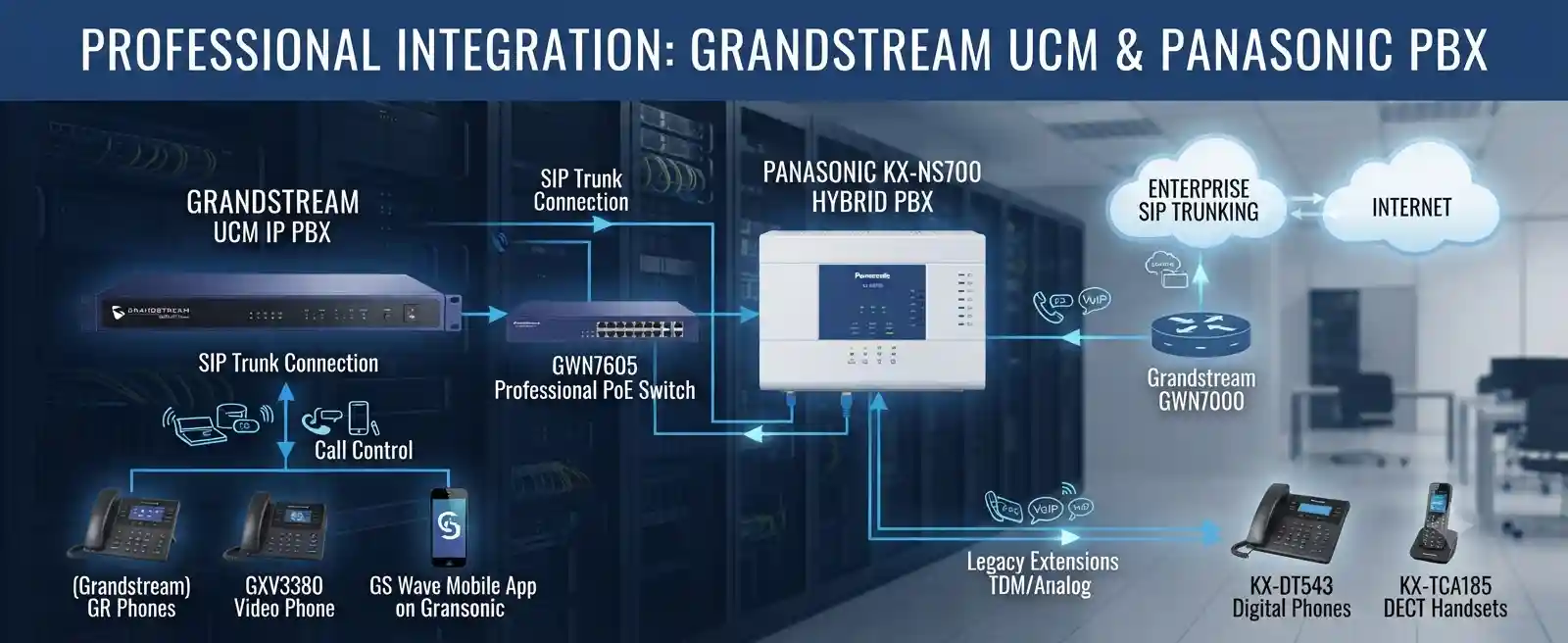
It means designing a controlled path that allows selected calls, extensions or telephone services to operate across two separate PBX environments. The connection may use SIP trunking when both sides provide compatible SIP functions, or it may require gateways or other interfaces where one side depends on legacy analogue or digital technology. The service is mainly used for phased migration, branch interconnection, preservation of existing Panasonic handsets, gradual adoption of Grandstream UCM features, or a transition period in which both systems must remain operational. Before work is confirmed, the customer should provide the exact PBX models, software versions, extension ranges, trunk details, network topology, call-flow requirements, administrative access availability and any known licensing constraints. Compatibility should be assessed rather than assumed, especially when the Panasonic system is an older platform or when third-party voice services are involved.
What the integration service can cover
A business may want to keep a Panasonic PBX for existing digital or analogue phones while introducing a Grandstream UCM for new IP users, SIP services, a new branch, or a planned migration. In another environment, the two systems may belong to different offices and need controlled extension-to-extension dialing. The technical design should follow the business call flow rather than forcing the business to work around the equipment.
Depending on the confirmed scope, assistance may include current-state review, extension and numbering analysis, SIP trunk or gateway planning, inbound and outbound route configuration, caller ID handling, codec review, network and firewall checks, dial-pattern design, failover considerations, test planning, documentation and handover. A preliminary assessment is important because different Panasonic PBX families expose different interfaces and licensing options, while Grandstream UCM models and software versions may also differ in supported configuration choices.
Who may need this service?
The service can be relevant to organisations that have invested in a Panasonic telephone environment but now need to add IP telephony, connect a new office, introduce a Grandstream UCM, consolidate external trunks, or migrate users in stages. It may also suit companies that inherit mixed systems after an office move, merger, branch acquisition or vendor change.
Typical users include offices with reception and department call flows, warehouses with a mixture of desk and cordless phones, clinics that cannot change every extension in one maintenance window, hospitality or property sites with legacy handsets, and multi-branch organisations that need internal dialing between locations. The service is not limited to a single integration pattern. FourTeck first identifies what the customer wants callers and staff to experience, then maps that requirement to the available capabilities of each PBX and the surrounding network.
Common reasons businesses connect two PBX platforms
Phased migration
A company may want to move departments to Grandstream UCM gradually while the existing Panasonic PBX continues serving users that cannot be migrated immediately. Interconnection can provide a temporary bridge, but extension overlap, transfer behaviour, voicemail ownership and outbound routes must be planned carefully.
Branch connectivity
One site may run Grandstream UCM while another keeps Panasonic. The business may want short extension dialing or selected call transfer between offices. Network reachability, numbering plans, security, latency and local fallback arrangements can affect the design.
Preserving legacy endpoints
Existing digital, analogue or cordless Panasonic devices may still be useful. Keeping them can reduce disruption, but the integration must account for features that do not necessarily pass cleanly between different PBX technologies.
Routing consolidation
A customer may want one PBX to handle selected external trunks while the other serves a user group. This requires careful route design so calls do not loop, bypass expected permissions or produce inconsistent caller identification.
Symptoms and planning triggers that deserve assessment
A mixed PBX project can begin as a planned integration or as troubleshooting after someone has already connected the systems. The same symptom can arise from several technical layers, so a failed call should not be blamed on one PBX until the complete signaling and media path has been checked.
This may involve routing, dial patterns, authentication, caller ID matching, firewall rules or asymmetric network paths. A successful call in one direction does not confirm that the reverse route is correct.
Signaling may succeed while RTP media fails because of NAT, firewall, address translation, codec negotiation or network routing. Phone replacement alone may not solve the issue.
If both PBXs use the same extension range, simple prefix or pattern routing can become ambiguous. A numbering strategy may be needed before reliable inter-PBX dialing can be created.
Cross-platform feature behaviour depends on signaling support and configuration on both sides. The required result should be defined and tested rather than assumed from same-platform behaviour.
Interconnection can support a staged move when some users must remain on Panasonic while others move to Grandstream UCM. The temporary state still needs documentation and a clear end-state plan.
Unknown trunks, undocumented direct numbers, inherited extension ranges and unclear administrator access can make even a small routing change risky. Discovery may be required before configuration begins.
Business impact of an unmanaged PBX interconnection
Poorly planned telephony integration can create more than an occasional failed call. Reception may not know which system owns an extension, outbound calls may leave through the wrong route, transferred calls may lose caller information, branch users may be unable to reach one another, and troubleshooting can become difficult because neither platform has a complete view of the call path. If a migration is underway, undocumented temporary routes can also remain in service long after the project ends.
A controlled design reduces this uncertainty by defining which system is authoritative for each extension range, external number, department and call flow. It also creates a test plan and rollback approach before approved changes are applied. This does not guarantee that every legacy feature can be preserved, but it gives the business a clear basis for deciding what can be integrated, what must be changed and what may need replacement or vendor action.
Possible service scope
The final scope depends on assessment and quotation. Not every environment requires every activity below. A small same-site SIP link may be mainly configuration work, while a legacy Panasonic system with analogue interfaces, multiple sites and undocumented carriers may need wider discovery and on-site checks.
Models, software, licenses, trunks, extension ranges, call flows, connected endpoints and network topology.
SIP or gateway path, dial plan, route ownership, calling permissions and phased migration logic.
Existing trunks, codecs, NAT, caller ID, inbound and outbound patterns, time conditions and system backups.
IP addressing, VLANs, routing, firewall rules, QoS considerations, reachability and voice media path.
Approved trunk, route and dial-plan changes with backups and a defined maintenance window where necessary.
Extension dialing, inbound and outbound scenarios, transfers, caller ID, audio checks, documentation and next-step recommendations.
Service-fit matrix for common business situations
| Business situation | Relevant assistance | What must be confirmed |
|---|---|---|
| Keep Panasonic phones while adding Grandstream UCM users | Inter-PBX call routing, numbering plan and phased migration support | Panasonic model, interfaces, licenses, extension ranges and required cross-system features |
| Connect two offices using different PBXs | SIP or gateway design, network path review and route configuration | Site connectivity, addressing, firewall rules, latency, security approval and numbering plan |
| Move external voice routes to one platform | Trunk ownership planning, inbound and outbound routing and provider coordination | Carrier requirements, number ownership, caller ID rules, emergency calling expectations and fallback |
| Existing integration has one-way calls or audio | Call trace, routing, NAT, firewall, codec and media-path troubleshooting | Administrative access, logs, test extensions, recent changes and reproduction details |
| Prepare for a later PBX replacement | Inventory, documentation, dependency mapping and migration planning | Which devices and features must be retained, target state, maintenance windows and business priority |
Service information at a glance
| Service topic | Grandstream UCM and Panasonic PBX integration, interconnection and migration assistance |
|---|---|
| Main purpose | Enable controlled call exchange or phased transition between two telephone platforms |
| Typical systems involved | Grandstream UCM, Panasonic PBX, IP phones, legacy phones, gateways, switches, firewall, voice carrier and local network |
| Assessment method | Remote review where secure access is available, with on-site inspection when physical interfaces or cabling must be checked |
| Customer access required | Authorised administrative access to relevant PBX and network systems, shared through an approved secure method |
| Configuration support | Scope dependent and subject to compatibility, backup and change approval |
| Testing | Internal calls, external calls, transfers, caller ID, audio, route selection and agreed business scenarios |
| Documentation | Route map, extension ranges, trunk references, key dependencies and remaining limitations where included in scope |
| Service location | Dubai and UAE, with remote or on-site coordination depending on the confirmed requirement |
| Scheduling dependency | Engineer availability, site access, maintenance window, third-party providers and approved quotation |
| Important note | Cross-vendor feature compatibility is environment dependent and should be verified through assessment and testing. |
Can the integration be handled remotely or is an on-site visit needed?
Remote assistance may be suitable when
Both PBXs and the relevant network equipment are reachable through an authorised, secure administrative path; internet access is stable; someone at the customer site can help with test calls; and the work mainly involves configuration, logs, routing, dial patterns, trunk status or software settings. Remote assessment can also be useful before an on-site visit because it helps identify which equipment and information need physical inspection.
Remote support is not automatically the safest choice for every change. If the environment has weak documentation, no recent configuration backup, unclear provider settings or a high-risk reception call flow, FourTeck may recommend a planned maintenance window before configuration is altered.
On-site assistance may be suitable when
Physical PBX cards, gateways, analogue or digital interfaces, cabling, network ports, racks or legacy phones must be checked. An on-site visit may also be useful when neither system can be reached remotely, when the current wiring is unclear, or when multiple teams need coordinated testing during a migration or cutover.
Attendance depends on the service location, site access, engineer scheduling, required equipment and the approved work scope. FourTeck can combine remote preparation with a planned visit so on-site time is used for tasks that genuinely require local access rather than for discovery that could have been completed beforehand.
How FourTeck assesses a mixed Grandstream and Panasonic environment
A useful assessment starts with business behaviour rather than menus and settings. FourTeck first identifies which calls are failing, which users need to communicate across systems, what the desired future state looks like and what must remain operational during the change. The technical review then maps those requirements to the actual PBX and network environment.
Define the business call flow
Identify departments, reception handling, direct numbers, internal extension dialing, outbound permissions, after-hours behaviour, voicemail ownership and any temporary migration requirements. This creates a target that can be tested later.
Inventory both PBXs
Record exact Grandstream UCM and Panasonic models, software versions, extension ranges, trunk types, connected endpoints, gateways, licenses where relevant, and any special features the customer considers essential.
Review the network path
Confirm addressing, routing, VLANs, firewall behaviour, NAT, internet or site-to-site links, DNS where relevant and whether signaling and media can pass between systems without unnecessary exposure.
Check compatibility and constraints
Review available SIP capabilities, gateway needs, codecs, authentication requirements, numbering conflicts, caller ID expectations and feature dependencies. Some older Panasonic environments may have limited or license-dependent options.
Protect the existing configuration
Where supported, back up relevant system settings and record the current working call routes before change. A rollback plan is particularly important when reception, sales, support or other business-critical numbers are affected.
Build and validate a test plan
Select representative extensions and call scenarios. Test internal calls in both directions, transfers, external routes, caller identification, audio, busy handling and any agreed after-hours or failover behaviour before wider rollout.
Planning and implementation: from design to controlled change
Once the current environment is understood, FourTeck can prepare an implementation path that limits ambiguity. The exact technical steps depend on the available interfaces and approved design, but the project normally follows a sequence that protects existing call handling while introducing the new interconnection in a measurable way.
1. Establish route ownership
The first design question is which PBX owns which extension range and which system should receive particular external calls. If Grandstream UCM extensions occupy one range and Panasonic users another, the plan can be simple. If the ranges overlap, prefixes, translation rules or renumbering may be required. The goal is to prevent loops and ensure each dialed pattern has one clear destination.
2. Choose an interconnection method that fits the equipment
Where both platforms support compatible SIP trunking, SIP can provide a flexible IP-based connection between the systems. Grandstream documentation describes peer SIP trunks as a way to interconnect IP-PBX systems, while Panasonic KX-NS documentation includes SIP trunk configuration support. That does not mean every Grandstream and Panasonic combination will work identically. Model, release, licensing, authentication, transport, codecs and vendor-specific behaviour must be confirmed. If direct SIP is not practical, a gateway or legacy interface may be considered where suitable.
3. Align numbering and call permissions
Users should understand how to reach colleagues on the other PBX. A clean design may preserve familiar extension numbers, or it may add a prefix for the temporary migration period. Outbound permissions should also be reviewed so the new link does not accidentally allow calls that the original system restricted. Department rules, international dialing permissions, premium destinations and emergency-call handling should be treated deliberately.
4. Configure signaling and media parameters
The trunk configuration may involve host addresses, authentication method, SIP transport, codecs, caller identification behaviour, number formatting and NAT or firewall treatment. Audio uses a media path that can fail even when call signaling succeeds. For this reason, firewall and network checks are part of integration rather than an afterthought. The chosen security settings should avoid unnecessary public exposure and should fit the topology approved by the customer.
5. Stage the change
A high-impact environment should not move every route at once unless the scope justifies it. FourTeck can start with a limited extension group or a non-critical path, confirm call behaviour, then expand the change. This makes it easier to isolate unexpected behaviour and reduces the number of users affected if a route requires adjustment.
6. Confirm the business result
A trunk showing an available status is not the same as a completed integration. The project should confirm the real workflows users depend on: reception transfer to the other PBX, department dialing, outgoing calls, incoming direct numbers, caller ID display, voicemail destination, after-hours routing and any agreed failover. Unavailable cross-platform features should be documented so users and managers know what to expect.
Testing, validation and handover
Testing should reflect how the business actually uses the telephone system. A single extension-to-extension call proves only one path. A stronger validation plan includes calls in both directions, internal-to-external and external-to-internal scenarios, transferred calls, caller identification, unanswered calls, busy destinations, voicemail or overflow behaviour, and audio in both directions. If the systems are in different locations, tests should be performed over the intended production network path.
The handover should record the agreed extension ranges, trunk purpose, key route rules, important provider or gateway dependencies, configuration backup location where included, and any features that remain platform specific. For a phased migration, documentation should also show which users are still on Panasonic, which are on Grandstream UCM, and what action is required to complete the next phase.
Where administrator guidance is part of the scope, FourTeck can explain how to recognise common route or registration symptoms, what information to collect before making changes, and which settings should not be altered without a backup and change plan. This reduces the chance that a later user move or extension edit unintentionally breaks the inter-PBX route.
Capability focus: clearer fault isolation across two telephony systems
When two PBXs are interconnected, every call has more possible failure points. A user can dial the correct number and still fail because the originating route does not match, the inter-PBX trunk is unavailable, the receiving PBX does not recognise the number format, a firewall blocks signaling or media, the destination extension is not registered, or the external carrier rejects the caller identification. Treating every failure as a handset problem wastes time and can create unnecessary equipment changes.
A structured troubleshooting method follows the call from source to destination. FourTeck can compare the expected dial pattern with the actual route, review trunk status and logs where available, test a known extension, check whether signaling reaches the second PBX, and then confirm whether the media path is also working. This evidence-led sequence makes it easier to identify whether the problem belongs to the Grandstream UCM, the Panasonic PBX, the network, the firewall, a gateway, or the service provider.
The limitation is that diagnosis depends on access and evidence. If one PBX has no available administrator credentials, if logs have already rolled over, if a carrier does not expose call traces, or if the fault is intermittent, additional monitoring or vendor coordination may be required. The purpose of the service is to narrow the problem responsibly rather than to guess the cause from one symptom.
Capability focus: safer phased migration from legacy telephony
Many businesses cannot replace a complete PBX estate in one maintenance window. Reception phones, cordless devices, analogue lines, lift or door interfaces, fax equipment, department workflows and long-established extension numbers can make an immediate cutover impractical. Interconnecting Grandstream UCM with an existing Panasonic PBX can support a staged migration when the technology and licensing allow it.
A phased design can move one department at a time while preserving internal calling between old and new users. The migration plan should show where voicemail resides, which PBX owns each incoming number, how external calls leave the business, how users transfer calls across systems, and when the temporary interconnection can be retired. Without this end-state plan, a temporary link can become permanent technical debt that nobody understands later.
Some legacy features may not translate directly across the interconnection. Proprietary Panasonic digital functions, system-specific presence features, special button behaviour or old analogue dependencies may remain local to the original PBX. FourTeck can identify these items during discovery and help the customer decide whether to retain them temporarily, redesign the workflow or include replacement work in a later phase. This keeps migration decisions based on operational value rather than on assumptions.
Capability focus: better documentation for mixed-platform support
Mixed PBX environments become difficult to support when only one engineer understands the route logic. A useful integration record should explain which PBX owns each extension block, what the trunk between systems is called, how number translation works, which firewall or network path carries the traffic, what external carrier each route depends on, and which features are intentionally kept local to one platform.
Documentation is especially important during staff changes, office moves, carrier changes and later migration phases. When a new administrator can see the route map and known limitations, the business is less dependent on trial and error. It also becomes easier to prepare a change request because the existing state is visible before configuration is touched.
Documentation does not replace secure backups or administrator access. Both should be managed appropriately. Sensitive credentials should not be placed in public diagrams or ordinary shared documents. FourTeck can record technical references without exposing passwords and can advise the customer to store credentials through an approved secure method controlled by authorised personnel.
Dependencies, access and information the project may require
PBX integration depends on more than the two PBX names. A useful assessment needs enough detail to understand what is technically available and what the business expects after the change.
Grandstream UCM model, Panasonic PBX family, software or firmware version and any known expansion hardware.
Authorised management access to both PBXs and relevant network equipment. Credentials should be shared only through an approved secure method after authorisation is confirmed.
Some PBX capabilities can depend on installed options, software level or vendor licenses. These should be verified before the design is treated as final.
IP ranges, VLANs, routing, firewall, site links, internet services and any NAT between the systems.
Extension ranges on both PBXs, direct numbers, reception numbers, department groups and outbound prefixes.
SIP provider, analogue or digital line interfaces, gateway models and any third-party equipment that participates in the call path.
Which users need cross-system dialing, how reception should transfer calls, who owns voicemail and which routes are business critical.
An authorised person should be available to approve changes and validate the business result during agreed testing.
Risks, limitations and exclusions to consider before integration
Cross-vendor PBX integration is configuration and environment dependent. A feature available within one system does not automatically work across the link in the same way. Advanced presence, proprietary digital-phone functions, some transfer behaviours, voicemail integration and special caller-ID handling may require testing or may remain system specific.
Older or discontinued Panasonic platforms may have limited vendor support, licensing availability or replacement parts. A technically functioning link does not remove lifecycle risk. If a hardware card fails, if the system uses unsupported software or if configuration access is unavailable, the customer may need a separate upgrade or replacement plan.
Network and carrier dependencies also matter. SIP signaling and voice media can be affected by firewall policies, NAT, internet quality, site-to-site links, codec support and provider requirements. Some faults may need coordination with a telecom provider, ISP, firewall administrator or equipment vendor. FourTeck can help collect evidence and define the technical requirement, but third-party action remains subject to that provider.
Configuration changes may require a maintenance window and a backup or rollback plan. Final commercial terms, visit requirements, parts, licenses, gateways and project duration depend on the approved quotation and confirmed scope. The service should not be treated as a guarantee that every legacy device or proprietary feature can be retained.
Business environments where a mixed PBX design can be useful
Professional offices
An office may retain Panasonic reception and existing handsets while new departments move to Grandstream UCM. The integration can support internal calling during the transition, provided numbering and transfer requirements are defined.
Warehouses and logistics sites
Large sites may use legacy cordless or analogue extensions in operational areas while office users adopt IP phones. A mixed design can preserve working endpoints while new network-based telephony is introduced in stages.
Clinics and customer-facing locations
Reception and appointment calls may be too important for an abrupt change. A staged migration allows selected back-office users to move first while front-desk workflows are tested separately.
Multi-branch businesses
Different branches may have been deployed at different times with different PBX vendors. Interconnection can provide a controlled way to exchange calls while the business standardises future sites.
Hospitality and property sites
Legacy room, service or building extensions can make immediate replacement difficult. An assessment can identify which functions are practical to retain and which are tightly coupled to the original Panasonic environment.
Project and relocation environments
During an office move, a temporary link may help keep old and new locations connected while users, numbers and carriers are moved in stages. Site connectivity and rollback planning become central to the design.
Operational, security and maintenance considerations
A PBX interconnection becomes part of the production voice environment and should be maintained accordingly. Administrator access should be limited to authorised personnel, unnecessary public exposure should be avoided, and configuration backups should be kept where supported. The customer should know who is responsible for the Grandstream UCM, the Panasonic PBX, the firewall and the external voice service so incidents can be escalated efficiently.
Firmware and software changes deserve planning. Updating one PBX can affect signaling behaviour, codecs, certificates or other integration parameters. A maintenance process should therefore record the current versions, vendor support status and any known dependencies before upgrades are applied. When one platform is legacy or discontinued, the business should also consider how long the temporary integration is expected to remain in service and what the replacement path looks like.
Voice quality depends on the network. Packet loss, unstable links, congestion and poor switching can affect calls even when the PBX configuration is correct. If the integration spans sites, the network path should be monitored at a level appropriate to the business. Voice VLANs, QoS policies and firewall settings can help when designed correctly, but they are not substitutes for adequate bandwidth and stable connectivity.
Finally, routine changes should respect the integration map. Adding a new extension range, changing an outbound prefix, replacing a gateway or moving a site can affect routes between the systems. A small documentation update after each approved change can prevent future troubleshooting from starting at zero.
Before you contact FourTeck
Preparing a few details helps FourTeck understand whether the first step should be a remote review, an on-site assessment or a wider migration discussion. You do not need to expose passwords in an email or public form. Simply confirm whether authorised access can be arranged through a secure method.
Service evaluation checklist for quotation planning
- Confirm the exact integration objective and the reason both PBXs must remain active.
- Confirm the number of sites, users and extension ranges affected.
- Identify whether direct SIP, a gateway or another interface must be assessed.
- Confirm which external trunks and numbers are involved.
- Define the required inbound, outbound and inter-extension call flows.
- Confirm administrator access, backups and change authorisation.
- Decide whether remote-only work is realistic or physical inspection is required.
- Identify network, firewall and site-connectivity dependencies.
- Confirm which cross-system features must be tested.
- Agree the maintenance window and rollback expectations.
- Confirm documentation and handover requirements.
- Identify third-party carrier, ISP, vendor or building-access dependencies.
Each item helps define the engagement but does not imply that every task is included automatically. FourTeck can prepare the quotation after the required scope and dependencies are understood.
How FourTeck can help with the integration and quotation process
FourTeck can begin by clarifying the business objective and determining whether the project is primarily troubleshooting, planned interconnection, phased migration or preparation for a future PBX replacement. That distinction matters because each path requires different evidence and testing. A fault investigation may focus on call traces and network behaviour, while a migration project needs inventory, dependency mapping, user communication and rollback planning.
After reviewing the available information, FourTeck can define the technical areas that require access, identify where an on-site visit may be necessary, and outline the configuration or assessment work to include in the quotation. If telecom providers, internet providers or other vendors must participate, the required information can be gathered in a form that makes escalation more productive.
The objective is a clear scope rather than an open-ended promise. The quotation can distinguish assessment, configuration, physical installation, gateway work, network changes, testing, documentation and post-change assistance where relevant. This helps the customer understand what is included and which items remain dependent on compatibility, vendor action, licenses, parts or additional approval.
Dubai and UAE service coordination
FourTeck can coordinate Grandstream UCM and Panasonic PBX integration assistance for businesses in Dubai and across the UAE. The service method depends on the issue, access, location, urgency and approved scope. Remote assessment can be efficient for configuration review and evidence collection, while an on-site visit may be recommended for legacy interfaces, gateways, rack equipment, cabling, local testing or a cutover that requires physical coordination.
Service timing depends on engineer availability, customer access, building rules, site conditions, required equipment and third-party providers. Contact FourTeck to confirm the most appropriate next step rather than assuming that a remote session or site visit will be sufficient before the environment has been assessed.
Dubai, Abu Dhabi, Sharjah and Ajman coverage
For projects involving Dubai, Abu Dhabi, Sharjah or Ajman, coordination may combine remote troubleshooting, planned on-site visits, configuration work, migration support or a technical assessment. A multi-site business can also use the planning stage to standardise extension ranges, route naming, network requirements and documentation across locations.
Travel, scheduling, building access, maintenance windows, equipment availability and third-party telecom or internet dependencies can affect the service plan. FourTeck can define these items during scoping so the customer knows which activities can be completed remotely and which require local access at the relevant site.
Related FourTeck IT services
Network and voice connectivity assistanceReview the switching, routing, VLAN and firewall dependencies that can affect IP telephony.
Business IT project supportLearn how FourTeck approaches connected business technology and infrastructure assistance in the UAE.
FourTeck IT Services homeReview the wider service coverage for users, networks, servers, telephony and connected office systems.
Why businesses contact FourTeck for mixed PBX work
A cross-vendor telephone project sits between several technical disciplines. The PBX configuration matters, but so do the LAN, firewall, site connectivity, voice carrier, gateways, legacy endpoints and the business call flow. FourTeck approaches the work as a connected service rather than treating each component as an isolated device.
The initial objective is to make the current state understandable: which users and numbers belong to which platform, what should happen to a call, what access is available, and what risks exist if the route is changed. From there, the service can move into configuration, troubleshooting, testing, documentation or migration planning according to the approved scope.
Businesses also contact FourTeck when they need technical findings explained in practical terms. A manager may not need to know every SIP header, but they do need to know whether the problem is internal, network related, provider dependent, license dependent or tied to legacy hardware. Clear findings support better decisions about whether to repair, retain, integrate or replace parts of the existing telephony environment.
Questions businesses often ask before integrating Grandstream UCM with Panasonic PBX
The following decision guidance is designed around the questions a business may need answered before requesting an assessment or quotation. The answers are intentionally conditional because the exact Grandstream and Panasonic models, network layout and current call routing determine what is practical.
Can Grandstream UCM connect directly to a Panasonic PBX?
A direct connection may be possible when both systems support compatible SIP trunking and the required signaling, codecs, authentication and network path can be aligned. Grandstream UCM platforms support SIP trunks, including peer-trunk concepts for IP-PBX interconnection, and Panasonic KX-NS systems support SIP trunk functions. However, cross-vendor compatibility should be verified for the exact models and versions rather than assumed from those general capabilities. If direct SIP is not suitable, a gateway or other supported interface may be considered.
Can we keep our Panasonic phones and add Grandstream users gradually?
Yes, a phased approach may be practical when the Panasonic phones remain connected to their existing PBX while new users operate on Grandstream UCM. The interconnection then carries calls between the systems. The important planning questions are extension numbering, reception transfers, voicemail ownership, outbound route selection and which features must work across the link. Proprietary handset features usually remain dependent on the PBX that controls those handsets.
Do we need to renumber extensions?
Not always. If each PBX already uses a unique extension range, routing can often be designed around those ranges. If both systems use overlapping numbers, the integration may need prefixes, translation rules or a renumbering plan. The best choice depends on how many users are affected, how long both systems will coexist and whether external direct-dial numbers map to those extensions.
Can our reception team transfer calls between the two systems?
Cross-system transfers may be possible, but the exact behaviour should be tested with the configured trunk and phones. A transfer is not only a dialing event; caller identification, hold behaviour, ringback, attended versus blind transfer and the receiving extension state can all affect the user experience. FourTeck can include representative reception scenarios in the test plan rather than assuming that every same-PBX feature will behave identically across vendors.
Why do calls connect but have no audio?
Call signaling and voice media are separate parts of an IP call. The PBXs may successfully exchange SIP messages while RTP audio is blocked or sent to the wrong address. Common technical areas to review include NAT, firewall rules, routing, network addressing, codecs and session handling. The correct diagnosis depends on packet flow and logs, so broad firewall changes should not be made without understanding the existing security design.
Can one PBX use the other PBX external trunk?
That may be possible if the design, carrier rules and PBX configuration permit it. The routing needs to define which calls can leave through the shared trunk, how caller identification is presented, how number formatting is handled and what happens if the primary path is unavailable. Provider restrictions can also affect the result. This should be tested with the actual carrier service rather than treated as a generic capability.
Is a SIP trunk always the best integration method?
SIP is often a practical IP-based method when both platforms expose compatible trunking functions, but it is not automatically the correct answer for every Panasonic environment. Older systems may rely on analogue, digital or other interfaces, and the available licensing or hardware can influence the design. A gateway may sometimes be more practical, particularly when the goal is to preserve a limited legacy function during migration. FourTeck can assess the available options before the quotation is finalised.
Can the assessment start remotely?
Often yes. If authorised administrative access is available and the systems are reachable, a remote review can collect model details, extension plans, trunk configuration, route information and logs. This can reduce unnecessary site discovery. An on-site visit may still be needed for physical PBX cards, gateways, rack cabling, analogue or digital lines, inaccessible equipment or local testing that cannot be reproduced remotely.
How do we know whether to integrate or replace the Panasonic PBX?
The decision should consider remaining business value, hardware condition, vendor support status, licensing, availability of replacement parts, user requirements, migration risk and how long the mixed environment is expected to exist. Integration can be a useful bridge, but it should not hide lifecycle risk. FourTeck can document dependencies and help the customer compare a temporary interconnection with a planned replacement path.
What should we test before moving more users to Grandstream UCM?
Test representative calls in both directions, external inbound and outbound calls, caller ID, reception transfers, voicemail or overflow, after-hours routing, busy conditions and audio quality. If the project spans sites, include tests over the real production link. Record results and any limitations before expanding the migration. A successful first test is useful evidence, but it does not replace validation of the workflows used by different departments.
What information helps FourTeck prepare a more accurate scope?
Provide the exact PBX models, software versions if known, extension ranges, external trunk information, number of sites, network diagram if available, business call-flow requirements, known problems, recent changes, backup status and the preferred maintenance window. Also explain why both PBXs need to remain connected and how long the mixed environment is expected to last. This helps distinguish a small routing task from a broader migration or network project.
Will every Panasonic feature appear on Grandstream phones after integration?
No assumption should be made that proprietary features cross between platforms. Basic calling may be possible while system-specific key functions, presence, voicemail integration, paging behaviour or other features remain local. The exact result depends on the models, protocols and configuration. If a particular feature is operationally important, it should be identified during discovery and included in the test plan.
What can affect the final price and project scope?
The scope can change based on the number of PBXs and sites, available remote access, documentation quality, required gateways, licensing, network changes, firewall work, carrier coordination, number of call-flow scenarios, maintenance-window restrictions, physical cabling and the amount of migration or user handover required. A clear assessment reduces uncertainty before a quotation is approved.
When should we involve the telecom provider?
Provider involvement may be necessary when the project changes which PBX terminates an external SIP trunk, changes caller identification, moves numbers, requires new authentication details or encounters call failures outside the customer network. FourTeck can help identify the evidence and configuration questions to raise, but the provider controls its own network and service settings.
Can this integration support a future office relocation?
It can be part of a relocation plan when old and new sites must overlap temporarily. The design should consider which PBX moves first, how extensions reach each other during the transition, how external numbers are routed, what network connectivity is available between sites, and what rollback is possible if the carrier or internet move is delayed. Relocation work should be planned as a project rather than relying on the inter-PBX trunk as an undocumented temporary fix.
Frequently asked questions
What is included in a Grandstream UCM and Panasonic PBX integration service?
Depending on the confirmed scope, it may include discovery, compatibility review, trunk or gateway planning, dial-plan design, routing, network checks, controlled configuration, test calls, documentation and migration guidance. The quotation should identify which activities are included for the specific environment.
Does FourTeck guarantee direct compatibility between every UCM and Panasonic PBX?
No. Cross-vendor compatibility depends on the exact models, versions, available interfaces, licensing, signaling behaviour and network design. FourTeck assesses these factors and tests the agreed call scenarios before the integration is treated as complete.
Can existing Panasonic digital phones register directly to Grandstream UCM?
Proprietary digital handsets generally depend on the Panasonic PBX technology that supports them, so direct registration to a different IP PBX should not be assumed. A phased design may keep those phones on Panasonic while calls pass between systems.
Can FourTeck troubleshoot an integration installed by another provider?
Yes, subject to authorised access and available evidence. The first step is to document the existing route, reproduce the issue and identify whether the fault is in the PBX configuration, network, firewall, gateway or external carrier path.
Do we need a configuration backup before changes?
A backup is strongly recommended where the platform supports it, especially when production call routes are being modified. FourTeck also records the relevant current configuration and plans rollback for higher-impact changes.
Can the two PBXs be in different buildings or emirates?
Potentially, if the network path is suitable and secure. Site-to-site connectivity, routing, firewall policies, internet quality and latency should be assessed. Physical location also affects on-site coordination and maintenance planning.
Will internal extension dialing work both ways?
It can when routing is configured in both directions and the extension plan does not create ambiguity. Overlapping ranges, prefixes or translation rules may require additional design. Bidirectional testing should be included before user rollout.
Can one system remain as a fallback?
A fallback design may be possible, but it must be planned against the actual trunks, gateways and number ownership. Failover should not be assumed. The customer should define which calls are critical and what should happen if one PBX or link is unavailable.
How long does PBX integration take?
There is no fixed duration without assessment. A documented same-site configuration is different from a multi-site migration with legacy gateways and carrier changes. Timing depends on access, compatibility, testing requirements, third parties and the approved maintenance window.
What happens after the integration is tested?
FourTeck can document the final routing, note known limitations, confirm backup and handover requirements, and recommend next actions. For a phased migration, the next action may be moving another department or preparing the retirement of legacy components.
Plan the integration around your actual call flow
If your business needs Grandstream UCM and Panasonic PBX systems to work together, start with the exact models, extension plan, external trunk details, locations and the calls users need to make. FourTeck can assess whether a direct SIP path, gateway-based approach or phased migration design is suitable, then define the configuration, testing and documentation needed for the approved scope. Compatibility, licensing, carrier requirements and legacy hardware should be confirmed before production changes are made.