
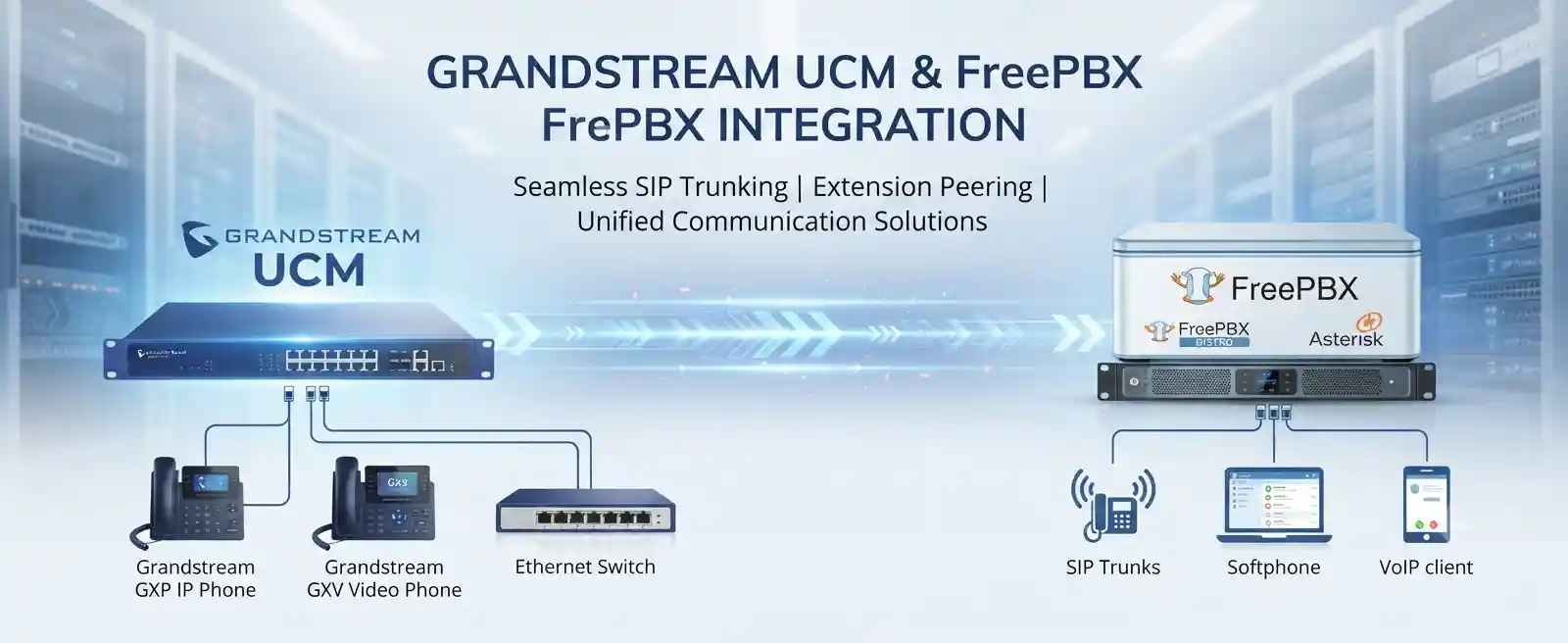
Controlled calling between two PBX environments.
SIP reachability, routing and compatible media settings.
Backup, planned configuration, test and rollback.
Remote or on-site, depending on access and physical checks.
What Does Grandstream UCM and FreePBX Integration Mean?
Grandstream UCM and FreePBX integration is the planned interconnection of two independent telephone-system environments so that calls can pass between them according to a defined dial plan. In many deployments, the connection is established through SIP trunking between the two PBXs. The business reason may be branch-to-branch calling, a staged migration, coexistence during a system change, access to a service hosted on the other PBX, or a requirement to retain part of an established call flow while another part is being modernised.
The integration is not simply a matter of entering one IP address on each side. The two systems need compatible signalling, reachable network paths, non-conflicting extension ranges, suitable codecs, clear caller-identification behaviour, inbound and outbound rules, and firewall or NAT treatment appropriate to the deployment. If either PBX is behind a firewall, across a routed WAN, or reachable over the internet, security and address translation become part of the design rather than an afterthought.
Businesses should prepare the Grandstream UCM model and firmware level, the FreePBX and underlying Asterisk versions, current extension ranges, network addresses, existing SIP trunks, dialling requirements, provider details, and administrator access through an approved secure method. FourTeck can then assess whether the requested integration is suitable, what changes are required, and whether the work can be completed remotely or requires on-site network or hardware checks.
What the Integration Service Can Cover
PBX discovery
Review the role of each PBX, the UCM model, FreePBX deployment, extension numbering, existing trunks, phone population, call queues, IVRs, hunt groups and business-critical routes. This creates a map of what must continue working before a new inter-PBX path is introduced.
SIP trunk planning
Determine whether the environment calls for a peer-style or authenticated SIP relationship, which addresses should be trusted, what transport and media settings are appropriate, and how the trunk should be limited so it carries only the intended traffic.
Dial-plan design
Define which extension ranges belong to each system, whether prefixes are needed, which users may place cross-system calls, how calls should be presented, and what should happen when a destination is unavailable or does not exist.
Network and firewall review
Check routing, VLANs, NAT, firewall policies, DNS where applicable, SIP signalling reachability and RTP media flow. One-way audio and intermittent call setup often require network-path investigation rather than repeated PBX changes.
Call-flow configuration
Create or adjust the approved inbound and outbound routes, extension patterns, caller-ID handling, permissions, time conditions or transfer paths needed for the required business workflow. Existing provider trunks should be protected from accidental re-routing.
Testing and documentation
Validate internal calls, transfers, caller identity, DTMF where required, audio in both directions, fail behaviour and selected external-call scenarios. Record the essential trunk, route, extension and dependency information for future support.
Depending on the confirmed scope, FourTeck may provide some or all of these activities. Existing licences, carrier services, third-party firewalls, unsupported hardware, replacement parts and wider telephony changes are separate dependencies unless they are specifically included in the approved quotation.
Who May Need This Service?
The service can be relevant when two parts of a business already use different PBX platforms and management wants the environments to cooperate rather than operate as isolated islands. A head office may use Grandstream UCM while a branch uses FreePBX. A newly acquired company may have one platform while the parent organisation uses the other. An IT team may also be migrating away from one PBX gradually and need both systems available during a controlled transition.
It may also suit organisations that want to preserve an existing call queue, analogue gateway, local PSTN connection, receptionist workflow or specialised endpoint on one platform while users on the other platform need to reach it. Integration can be a practical bridge, but it should not be used to hide an undocumented or unsupported environment indefinitely.
FourTeck can help identify whether interconnection is the right approach or whether consolidation, migration, gateway replacement or network remediation would produce a more maintainable result.
Typical Planning Triggers
- A branch office must dial another site’s extensions directly.
- A business is moving users from FreePBX to Grandstream UCM, or the reverse, in stages.
- Departments on different PBXs need internal transfer paths.
- Existing number ranges must remain active during a cutover.
- One PBX hosts a gateway, carrier connection or call service needed by the other.
- An office relocation changes how the PBXs reach one another.
- Repeated trunk failures require a structured configuration and network review.
- Documentation is incomplete and future support depends on understanding the current call path.
Symptoms and Business Problems That May Point to an Integration Issue
A failed call between two PBXs does not identify the cause by itself. The same symptom can originate from dial-plan logic, SIP signalling, firewall treatment, authentication, codecs, RTP routing, caller-ID formatting or even an incorrect extension range. FourTeck therefore treats symptoms as evidence to be tested rather than proof of one fault.
Possible areas include an unmatched dial pattern, rejected SIP request, unreachable trunk, authentication mismatch or route pointing to the wrong destination.
The call may establish successfully while RTP media takes an unsuitable path because of NAT, firewall, routing or address-advertising conditions.
Caller-ID presentation, trunk identity, extension identity and route behaviour may need to be reviewed on both systems.
Transfer handling may expose differences in dial-plan reachability, permissions, SIP messaging or the way each PBX interprets the target number.
Interactive menus can fail even when speech audio is clear. DTMF method, codec negotiation and intermediary network devices should be considered.
NAT timeouts, unstable links, SIP inspection, DNS changes, routing asymmetry or firewall state handling may be involved.
The operational effect can be larger than the technical symptom. Reception staff may be unable to transfer customers, teams may fall back to mobile numbers, branch offices may lose internal dialling, and support staff may waste time testing the wrong platform. A structured review narrows the fault domain and reduces the chance that a change on one PBX disrupts a provider trunk, queue or emergency calling route elsewhere.
Business Impact if the Integration Is Unstable or Unclear
An inter-PBX trunk often sits between departments or sites. When it becomes unreliable, employees may still have working phones but lose the ability to reach the people, queues or services they depend on. That can create fragmented communication, missed transfers, duplicate external calls and a confusing support experience because users cannot tell which PBX owns a given extension or route.
Poor documentation creates a second risk. A technician may alter a route to fix one symptom without realising that the same pattern also carries calls to another site. An overlapping extension range can make the wrong destination appear to be local. An overly broad peer relationship can expose dialling paths that were never intended. These are manageable issues when the environment is mapped before changes are made.
FourTeck focuses on making the integration understandable: which PBX owns each range, which trunk carries which calls, what network path is required, which external providers are involved, and what should be tested after any future change. The goal is not only to make a call connect once, but to create an arrangement that can be supported later without depending on guesswork.
Service-Fit Matrix for Common Integration Scenarios
| Business Situation | Relevant Assistance | What Must Be Confirmed |
|---|---|---|
| Head office and branch use different PBXs | Inter-PBX SIP trunk, extension routing and call tests | WAN reachability, numbering ranges, security policy and required call directions |
| Staged migration between platforms | Coexistence plan, temporary routes, user movement and rollback planning | Migration sequence, number ownership, carrier changes and cutover windows |
| Calls connect but have one-way audio | RTP path, NAT, firewall and advertised-address review | Network topology, public/private addressing and firewall access |
| Some extension numbers route incorrectly | Dial-pattern and extension-plan review | All local ranges, reserved numbers and prefix requirements |
| One PBX must reach a service on the other | Restricted route design to queue, IVR, extension or gateway | Destination, permissions, caller identity and fallback behaviour |
| Existing integration is undocumented | Discovery, configuration review, test plan and technical documentation | Administrative access, backups and approval before any change |
Grandstream UCM and FreePBX Integration Service Information
| Main Purpose | Enable controlled call exchange between Grandstream UCM and FreePBX environments. |
|---|---|
| Typical Systems Involved | UCM IP PBX, FreePBX/Asterisk host, network switches, routers or firewalls, SIP trunks, IP phones and possibly gateways or carrier services. |
| Assessment Method | Configuration review, call-flow mapping, network-path checks, test calls and log or trace review where available. |
| Remote Support Suitability | Suitable when secure administrative access and reliable connectivity are available and physical testing is not required. |
| On-Site Support Suitability | Useful for cabling, local firewall or switching checks, gateway access, rack work, packet-path investigation or environments that cannot be reached securely. |
| Customer Access Required | Authorised PBX and network access, provided through a secure method after identity and scope are confirmed. |
| Configuration Support | Scope dependent; may include trunks, routes, dial patterns, permissions, caller ID, codec choices and NAT-related settings. |
| Testing and Validation | Representative extension calls, inbound/outbound paths where in scope, transfers, DTMF, caller ID, two-way audio and failure handling. |
| Documentation and Handover | Can include route ownership, extension ranges, trunk purpose, network dependencies, test results and remaining actions. |
| Service Location | Dubai and UAE coordination, subject to confirmed scope, access and scheduling. |
| Scope Dependency | Environment, version, topology, carrier, licensing, security and change-window dependent. |
| Quotation Requirement | Contact FourTeck to confirm the requested outcome and exact service scope. |
Remote Support or On-Site Assistance?
When remote work may be practical
A large part of PBX integration is configuration and evidence review. Remote support may be appropriate when the UCM, FreePBX server and relevant firewall or network management interfaces are reachable through an approved secure access method. It is especially useful for reviewing dial plans, SIP trunk settings, logs, extension ranges, call routes and known network parameters.
A customer administrator or authorised contact should be available to confirm the intended call behaviour and help place test calls from both sides. A working internet connection is also necessary. If the fault itself disrupts the only remote-access path, a remote session may not be sufficient.
Remote access does not mean that every setting should be changed immediately. Backups, business impact, rollback and maintenance windows remain relevant when a configuration change could affect active calling.
When an on-site visit may be useful
On-site assistance may be needed when the integration problem involves a physical gateway, analogue interface, switch port, cable path, local firewall appliance, rack connection or phone testing that cannot be reproduced remotely. It can also be helpful when several systems share the same voice network and the actual cabling or VLAN arrangement differs from the available documentation.
A local visit can support packet-path checks, switch-port verification, PoE or physical link review, gateway inspection and coordinated test calls between desks, reception and branch users. Building access, equipment access and an authorised contact should be arranged in advance.
FourTeck can advise whether remote discovery should come first. In many cases, an initial remote review reduces on-site time because the technician arrives with a clearer test plan and a known list of devices or network segments to inspect.
Assessment and Diagnostic Process
Confirm which users, branches, queues or services must be reachable and in which direction. A request such as “connect the two PBXs” is too broad until the required call behaviour is written clearly.
Identify the UCM model, FreePBX platform, software versions, IP addressing, extension ranges, provider trunks, gateways, firewalls, WAN links and remote locations involved.
Review error messages, call records, SIP status, route patterns, recent changes and user reports. Evidence helps distinguish a route problem from a media or network problem.
Before making changes, confirm authorised administrator access and create or verify configuration backups where appropriate. Credentials should be shared only by an approved secure method.
Check reachability, SIP signalling, route selection, number translation, authentication where used, codec negotiation, media flow and firewall behaviour in a logical order.
Determine whether the main issue sits on UCM, FreePBX, the network path, a firewall, a carrier, or a combination. Avoid changing multiple unrelated settings at once.
Explain the proposed change, possible impact, maintenance requirement and rollback approach before altering active routes or trunks.
Place real test calls representing daily workflows, not only a technical trunk test. Verify audio, identity, transfer and destination behaviour in both intended directions.
This sequence is adjusted to the actual environment. A new integration may focus more on design and change planning, while an existing broken trunk may focus first on evidence collection and fault isolation. The objective is to reduce unnecessary changes and leave a clear explanation of what was tested and why.
Planning the SIP and Dial-Plan Relationship
Grandstream documentation for UCM systems describes peer SIP trunks as a method for interconnecting PBXs, while FreePBX environments commonly use SIP trunk configuration built on the Asterisk telephony stack. That provides a technical basis for interoperability, but it does not mean every UCM and FreePBX pair should use identical settings. Models, firmware, FreePBX releases, Asterisk versions, security controls and network designs vary. An older configuration example should therefore be treated as a reference concept rather than copied blindly into a modern production system.
A sensible design begins with addressing and trust. If the two PBXs are on a private routed network, the interconnection may be simpler than a path crossing public networks. If public addresses, NAT or remote sites are involved, the design must account for how each PBX advertises its signalling and media addresses, which ports are permitted, whether source addresses are predictable, and how unauthorised traffic is prevented. Broadly exposing SIP services to the internet simply to make a peer reachable is not a suitable substitute for a controlled network design.
The extension plan is equally important. Each PBX should have a clear range so an entered number can be classified as local or remote. If both platforms use extension 200 for different people, a direct four-digit dial plan becomes ambiguous. Options may include renumbering, adding site prefixes, translating numbers on the trunk, or restricting cross-system calling to selected ranges. The best choice depends on user habits, migration plans and how long the two systems are expected to coexist.
Caller-ID behaviour should be decided rather than discovered after deployment. Management may want the original extension identity preserved across the trunk, a site prefix added, or a main business number presented on certain external paths. Any design that allows one PBX to send calls to the other PBX’s carrier trunk should be reviewed carefully for permissions, cost control and abuse risk. Cross-PBX routing should be limited to the destinations the business actually requires.
Implementation, Change Control and Rollback
A PBX integration can affect live business calling, so configuration work should be treated as a controlled change rather than an informal experiment. Before implementation, FourTeck can help identify the routes and trunks that are already in production, create or verify configuration backups, define representative test calls, and agree when disruptive changes may be made. If the environment supports a maintenance window, high-impact route changes are normally better performed when the business can tolerate a short interruption or retest period.
The implementation sequence depends on the design. A new trunk may first be created in a disabled or restricted state, the counterpart defined on the other PBX, and network reachability confirmed before routing normal extensions into it. A small test range can reduce risk during a staged migration. Once signalling is established, calls can be tested with controlled patterns before more users or destinations are added. This makes it easier to identify which change introduced unexpected behaviour.
Rollback planning matters because a technically valid configuration may still produce an undesirable business outcome. A route could capture numbers intended for another trunk, a caller-ID change could affect an external provider, or a firewall policy could disrupt existing remote phones. The rollback plan should identify which settings will be restored, how backups are accessed, who authorises reversal, and what evidence should be kept for later troubleshooting.
Where a provider, managed firewall vendor, hosting company or remote-site administrator controls part of the path, the implementation plan should include their responsibilities. FourTeck can coordinate the required technical information, but third-party response, account ownership and platform limitations remain external dependencies. The final quotation should state which systems FourTeck is expected to configure and which changes require customer or provider action.
Testing, Validation and Handover After Integration
A successful trunk status alone does not prove that the business workflow works. Testing should reflect the calls users actually make. If the purpose is branch-to-branch dialling, test several representative extensions in both directions. If reception transfers calls from one PBX to another, test blind and attended transfer behaviour where supported by the workflow. If callers need an IVR or queue on the other system, confirm the digits, prompts and destination logic required for that path.
Audio should be checked in both directions for more than a few seconds. Caller identification should be reviewed on the receiving endpoint. If DTMF is important for menus or door systems, test it specifically. Where external calling across the inter-PBX trunk is part of the approved design, verify that only authorised users and intended routes can use it. Failure cases also matter: an unavailable extension should not create a loop between PBXs, and an invalid number should be handled predictably.
Handover can include a concise record of the trunk purpose, peer addresses, extension ownership, route patterns, network dependencies, firewall considerations, known limitations, backups and the test cases that passed. The document should avoid embedding plain-text passwords. Administrative credentials should remain under the customer’s approved secure-access process.
When the integration is part of a migration, the handover should also identify what remains temporary. Temporary prefixes, parallel routes and duplicate services should have a planned review point so a short-term bridge does not become a permanent source of complexity.
Capability 1: Clear Extension Ownership and Predictable Dialling
A two-PBX environment becomes difficult when nobody can explain which system owns a number. FourTeck can help create a simple extension map that shows local ranges, remote ranges, reserved numbers and any prefixes used during migration. The map supports both configuration and user communication.
Predictable dialling reduces accidental route capture. A user entering 4105 should reach the same intended person regardless of which approved phone is used. Where that cannot be achieved because numbering overlaps, the business can choose between renumbering, prefixes or translation rules. The right option depends on the number of affected users, how long coexistence will last and whether external caller-ID or carrier routing also uses those digits.
This work does not eliminate every future change. Staff movement, new departments and acquisitions can alter numbering requirements. The benefit is a documented logic that can be updated deliberately rather than a collection of unexplained exceptions.
Capability 2: Controlled Call Paths Between Systems
Integration should expose only the call paths that are needed. A branch may need to reach internal extensions but not use the other site’s outbound carrier. A migration group may need access to a legacy queue but not to every service on the old PBX. FourTeck can define route patterns and permissions around these real business requirements.
Controlling the path also improves troubleshooting. When a call fails, support staff can determine which PBX should receive the number and which trunk should carry it. Broad catch-all patterns make that harder and can create loops or unexpected billing paths. Clear routing limits reduce ambiguity and support safer expansion.
The exact controls depend on what each platform and version supports, the carrier arrangement and the organisation’s security policy. A route design should be validated with live test calls and reviewed again when a major PBX, firewall or WAN change occurs.
Capability 3: Better Supportability Across Voice and Network Layers
A PBX-to-PBX call depends on more than the two telephony applications. The signalling path crosses interfaces, switches, routers, firewalls or WAN connections, while the RTP media path may follow different rules. A configuration that looks correct on both PBXs can still produce one-way audio if the network path is wrong.
FourTeck’s service approach links telephony diagnosis with network checks. This can include confirming VLAN placement, routes, permitted source and destination addresses, NAT behaviour, packet loss, latency symptoms and relevant firewall policies. The objective is to determine which layer is failing before changes are made.
Network improvement can reduce voice problems, but no single setting guarantees call quality. Internet conditions, WAN congestion, endpoint behaviour, codecs and provider performance can all affect the result. Documentation should therefore record the dependencies that future support staff need to test.
Dependencies, Access, Compatibility and Customer Inputs
The exact scope depends on the condition and ownership of the current environment. FourTeck may need administrator access to the UCM and FreePBX systems, plus read or change access to the relevant firewall, router or switch when network settings are part of the problem. Access should be authorised by the customer and shared only through an approved secure method. Public web pages or ordinary email should not be used to publish PBX passwords, SIP secrets, VPN credentials or private keys.
Version compatibility also matters. Grandstream UCM families have changed over time, and FreePBX deployments may run different Asterisk generations and SIP channel drivers. A configuration that worked on an old environment may not be the appropriate design for a current platform. The service therefore begins by recording the actual versions and checking the relevant current vendor guidance before applying changes that depend on specific features.
Network information should include the IP addresses or hostnames used by the two PBXs, whether either side sits behind NAT, what VLANs carry voice, which firewalls sit in the path, and whether the connection is local, site-to-site, VPN based or internet facing. If DNS, certificates or encrypted SIP transport are involved, ownership and renewal responsibility should also be clear.
Finally, the customer must define the desired call outcome. Technical integration cannot be designed well without knowing which users may call which destinations, whether external PSTN access is shared, how caller ID should appear, what hours or permissions apply, and which services are business critical. These decisions shape the route design more than the PBX brand names alone.
Risk, Limitation and Exclusion Guidance
PBX integration changes can affect active telephone service. Configuration backup and rollback planning are therefore important when routes, trunks, firewall policies or production dial patterns will be changed. A successful laboratory or one-extension test does not guarantee that every existing call path will behave identically, so validation should include representative departments and special services that are within the confirmed scope.
Diagnosis depends on available evidence and access. If one PBX is managed by another vendor, if the firewall is controlled by a third party, or if the carrier does not provide the required account details, some tests or changes may have to wait for that party. FourTeck can help identify and communicate the dependency but cannot make unauthorised changes to systems outside the agreed access.
Unsupported or legacy systems can limit options. Older software may rely on deprecated SIP components or undocumented custom dial-plan behaviour. Hardware failure, expired subscriptions, replacement gateways, carrier charges, internet service, public IP changes and third-party licensing are not automatically included in integration labour. Any required additions should be identified in the quotation.
Security improvements reduce exposure but do not guarantee that a communications system can never be attacked or interrupted. Internet-facing SIP services should be minimised and access controls reviewed carefully. Final commercial terms, scheduling, on-site attendance and included deliverables depend on the approved quotation or service agreement.
Business Environments and Practical Use Cases
Multi-branch offices
A branch using FreePBX may need direct extension access to a head office using Grandstream UCM. The design should consider extension ranges, WAN reliability, who may call which departments and how branch users behave when the inter-site path is unavailable.
Phased PBX migration
A business can move departments in stages rather than switching every extension at once. Temporary routes allow migrated and non-migrated users to continue calling each other. The migration plan should state when those temporary rules will be removed.
Warehouse and office combinations
A warehouse may retain an established local PBX while administration moves to a different platform. Integration can connect selected extensions, reception or dispatch groups while network links and operational resilience are assessed.
Clinics and professional practices
Reception, appointment teams and back-office users may sit on different systems after an expansion or acquisition. Call routing must reflect the actual workflow and any privacy or access requirements set by the organisation.
Retail or hospitality groups
Locations may need internal calling to a central office while preserving local numbers and provider links. Integration can be useful when sites are upgraded at different times, provided the route and WAN dependencies are documented.
Project and temporary sites
A project office may need a limited voice path to a main office without becoming part of the permanent numbering plan. Scope should include how the route will be retired when the temporary site closes or changes platform.
Operational, Security and Maintenance Considerations
Once the integration is working, it becomes part of the production communications path and should be maintained accordingly. Configuration backups should be kept according to the customer’s operational policy. A record of extension ranges, trunk addresses, route patterns, firewall dependencies and provider contacts can shorten future troubleshooting. If an administrator leaves the organisation, access ownership should be reviewed rather than allowing shared or personal credentials to remain indefinitely.
Software and firmware changes require planning. An upgrade on either PBX can alter SIP behaviour, supported ciphers, default transport settings, module behaviour or dial-plan processing. The fact that a trunk works today does not mean an upgrade should be applied without a backup and post-change call test. FourTeck can include integration checks within wider PBX maintenance or upgrade planning where this is part of the agreed scope.
Security should focus on minimum necessary exposure. The PBXs should not accept unauthorised guest calling merely to simplify interconnection. Firewalls should restrict sources and destinations where practical, and any internet-facing management or SIP service should be reviewed carefully. Strong administration practices, current supported software and controlled remote access all contribute to a safer environment, but they are not substitutes for monitoring and periodic review.
Voice quality should also be watched over time. A new backup job, cloud migration, CCTV expansion or WAN change can increase traffic on the same network used by voice. If users report clipping, delay or intermittent audio after an unrelated IT change, the PBX integration may still be configured correctly while the network conditions have changed. Capacity and quality-of-service policies can be reviewed as part of wider business IT support.
Maintenance should be proportionate to the importance of the call path. A critical link between reception and a call centre may require more formal change records and testing than a small optional branch route. FourTeck can help customers decide what documentation and review cycle makes sense, subject to the agreed maintenance arrangement.
Before You Contact FourTeck
Preparing a few facts before the first technical discussion makes it easier to estimate scope and identify whether the work is likely to be remote, on-site or a combination.
- Business location and the sites involved in the PBX connection.
- Grandstream UCM model and current firmware level if known.
- FreePBX version and underlying Asterisk version if available.
- Current extension ranges on both systems.
- The exact calling outcome required between the two PBXs.
- Whether the systems are on one LAN, separate sites, VPN, routed WAN or public networks.
- Known IP addresses, hostnames, VLANs and firewall devices involved.
- Existing SIP provider or telecom service details relevant to the call path.
- Examples of failed calls, error messages and approximate times if troubleshooting.
- Any recent PBX, firewall, ISP, router or network changes.
- Availability of authorised administrator access for both PBXs.
- Backup status and whether current configuration backups are available.
- Business impact and which users or departments are affected.
- Preferred change window and whether an on-site contact can assist with testing.
Do not send passwords or SIP secrets through a public enquiry form. FourTeck can confirm an approved secure method for access information after the service request and authorisation are established.
Service Evaluation and Quotation Checklist
The quotation should describe the work that is actually required rather than assume that every possible telephony task is included. Useful confirmation points include:
How FourTeck Can Assist With the Integration
FourTeck can begin by translating the customer’s business request into a technical call-flow requirement. That may mean “users 4xxx on FreePBX must call users 6xxx on UCM,” “reception on UCM must transfer to a support queue on FreePBX,” or “users being migrated must keep internal dialling to colleagues who remain on the old system.” Defining the target first prevents unnecessary configuration work.
The next step can include reviewing the existing PBX and network environment, identifying route conflicts, assessing whether a direct SIP relationship is appropriate, checking access and backup readiness, and creating a controlled test plan. Depending on the approved scope, FourTeck can configure trunks and routes, adjust required network policies, coordinate with providers or another IT administrator, and validate calls from both systems.
When the integration is part of a broader change, FourTeck can also support migration planning, extension mapping, user communication, staged cutover and documentation. If the review shows that the main obstacle is a network fault, firewall issue or unsupported legacy platform, the customer can receive practical next actions rather than repeated PBX changes that do not address the root dependency.
To understand the wider company service approach, customers can review FourTeck’s IT service background. The final integration scope and commercial terms are confirmed after the current environment, access needs and desired call paths have been reviewed.
Dubai and UAE Service Coordination
Grandstream UCM and FreePBX integration can often begin with a remote discovery session, particularly when the business already has secure administrative access to both PBXs and the network path is documented. An on-site visit may be recommended when physical gateways, switches, cabling, rack equipment, phones or local firewall conditions need inspection.
For businesses in Dubai and across the UAE, service planning should account for site access, the availability of a local contact, approved maintenance windows, engineer scheduling, equipment ownership and any telecom-provider dependencies. A change involving active public numbers or carrier trunks may need coordination with a provider even when the inter-PBX link itself is under customer control.
Contact FourTeck to confirm the service scope and scheduling options. Remote or on-site assistance depends on the issue, access, location, urgency and approved quotation. Installation, configuration, migration and maintenance tasks should be clearly identified in the quotation so the customer understands which systems and deliverables are included.
Coordination Across Dubai, Abu Dhabi, Sharjah and Ajman
Businesses with offices in Dubai, Abu Dhabi, Sharjah and Ajman may have different PBX platforms because sites were opened at different times, acquired through expansion, or supported by different vendors. A cross-site UCM and FreePBX integration can provide a temporary or longer-term voice path between these locations, but the network and operational conditions should be assessed for each participating site.
Service coordination may include remote PBX discovery, planned on-site visits, network checks, SIP trunk configuration, call-route changes, migration assistance, testing and documentation depending on the confirmed scope. Scheduling, travel, building access, site conditions, maintenance windows, equipment availability and third-party provider actions can affect the plan.
A multi-emirate project should also define who can approve changes at each location and who will help place test calls. This avoids delays where the technical systems are accessible but the operational users needed for validation are unavailable. FourTeck can structure the work around a documented sequence so each site knows what is being changed and what must be checked afterwards.
Related FourTeck IT Services
Support for extensions, routing, SIP trunks, call flows, phones and planned PBX changes.
Network Support
Routing, switching, VLAN, cabling and connectivity checks for voice and connected office systems.
Firewall and VPN Support
Review of controlled network access, NAT, VPN and firewall policies affecting PBX reachability.
Telephony Migration Planning
Discuss staged migration, coexistence, rollback, testing and handover requirements.
Why Businesses Contact FourTeck for PBX Integration Work
PBX problems frequently cross technology boundaries. The call may start on an IP phone, reach a switch and voice VLAN, pass through a firewall or routed link, enter one PBX, traverse a SIP trunk to the second PBX, and finally ring another endpoint or queue. Troubleshooting only one device can miss the actual fault. FourTeck approaches the request from the complete path so PBX, network and provider dependencies can be considered together.
Businesses also contact FourTeck when they need clearer change planning. A small route edit can affect many users if it captures the wrong dial pattern. A migration can become difficult if extension ownership is not documented. A trunk can appear healthy while audio fails because of a network condition. The service process therefore emphasises discovery, controlled changes, representative testing, documentation and practical explanation of remaining dependencies.
FourTeck does not assume every customer needs a complete telephony replacement. The first task is to understand the required outcome and the condition of the existing environment. In some cases, an integration is a suitable long-term design. In others, it is better used as a temporary bridge during a consolidation or upgrade. The recommendation should be based on maintainability, security, business workflow and the actual systems in place.
For a broader view of available technical assistance, visit the FourTeck services overview or use the IT service contact page to describe the current PBX environment and required calling outcome.
Frequently Asked Questions
Can Grandstream UCM and FreePBX be connected directly?
Both platforms support SIP-based telephony, and Grandstream publishes guidance showing UCM systems interconnected with FreePBX through SIP trunking. The exact design still depends on the specific UCM model, FreePBX/Asterisk version, addressing, firewall path, authentication model and business dial plan. FourTeck can review the current environment before selecting the appropriate interconnection method.
Do both PBXs need different extension ranges?
Distinct ranges are strongly preferable because they make routing predictable. If both systems use the same extension numbers, the PBXs may treat a remote destination as local. Overlap can sometimes be handled with prefixes or number translation, but the user experience and migration plan should be reviewed before choosing that approach.
Can the integration be completed remotely?
Remote work may be suitable when secure administrator access is available to the required PBX and network systems, the internet connection is stable, and no physical cabling, gateway or switch investigation is needed. An on-site visit may be recommended when the fault involves hardware, local connectivity or an inaccessible network path.
Why do calls connect but have audio in only one direction?
One-way audio often indicates a media-path problem rather than a basic dial-plan failure. NAT, firewall rules, incorrect advertised addresses, routing asymmetry or other network conditions may be involved. The actual cause should be confirmed through network and PBX evidence before settings are changed.
Can one PBX use the other PBX’s external SIP trunk?
It may be technically possible in some designs, but it should not be enabled by default. The business must define whether shared external calling is required, which users are authorised, how caller ID should appear, and what carrier restrictions apply. Routes should be limited so the inter-PBX link does not create unintended outbound-call access.
Will an old Grandstream UCM and a current FreePBX version use the same settings as an old integration guide?
Not necessarily. Vendor interfaces, SIP stacks, security defaults and supported features change over time. Older documentation can explain the concept of the interconnection, but the active versions should be identified and current platform guidance checked before a production change is made.
What information should we provide for troubleshooting?
Useful information includes both PBX versions, extension ranges, the specific numbers called, time of failed calls, whether signalling completes, whether audio is present in both directions, recent changes, network topology and any firewall or provider equipment in the path. Administrator access can be arranged securely after the request is authorised.
Can FourTeck help during a staged migration from one PBX to the other?
Yes, migration planning can be part of the scope. This may include current-state inventory, extension mapping, temporary routes, test groups, cutover planning, rollback considerations, user communication and post-change checks. The exact sequence depends on the number of users, provider dependencies and how much downtime the business can tolerate.
Does integration guarantee call quality between sites?
No. Correct PBX configuration is only one part of the path. WAN quality, packet loss, latency, jitter, firewall behaviour, codecs, endpoint conditions and provider performance can affect voice quality. FourTeck can test relevant network layers and recommend changes, but service quality remains dependent on the complete environment.
What happens after the integration is tested?
The handover can record the agreed call paths, extension ranges, trunk purpose, key network dependencies, test results and any remaining actions. For a temporary migration bridge, the document should also identify the routes that will later be removed. Ongoing maintenance can be discussed separately if the business wants recurring review or support.
Plan a Clear, Supportable PBX Integration
Tell FourTeck which Grandstream UCM and FreePBX systems are involved, where they are located, what extensions or services must communicate, and whether the request is a new integration, migration or troubleshooting case. FourTeck can review the dependencies and prepare a scope for assessment, configuration, testing and documentation.