
Enterprise IP PBX Solutions in Dubai, UAE
Build, improve or migrate an enterprise telephone environment around real call flows, network readiness, user roles and operational priorities rather than treating the PBX as an isolated appliance. FourTeck helps businesses assess extensions, trunks, routing, phones, branches, remote users and supporting infrastructure before configuration or project work is confirmed.
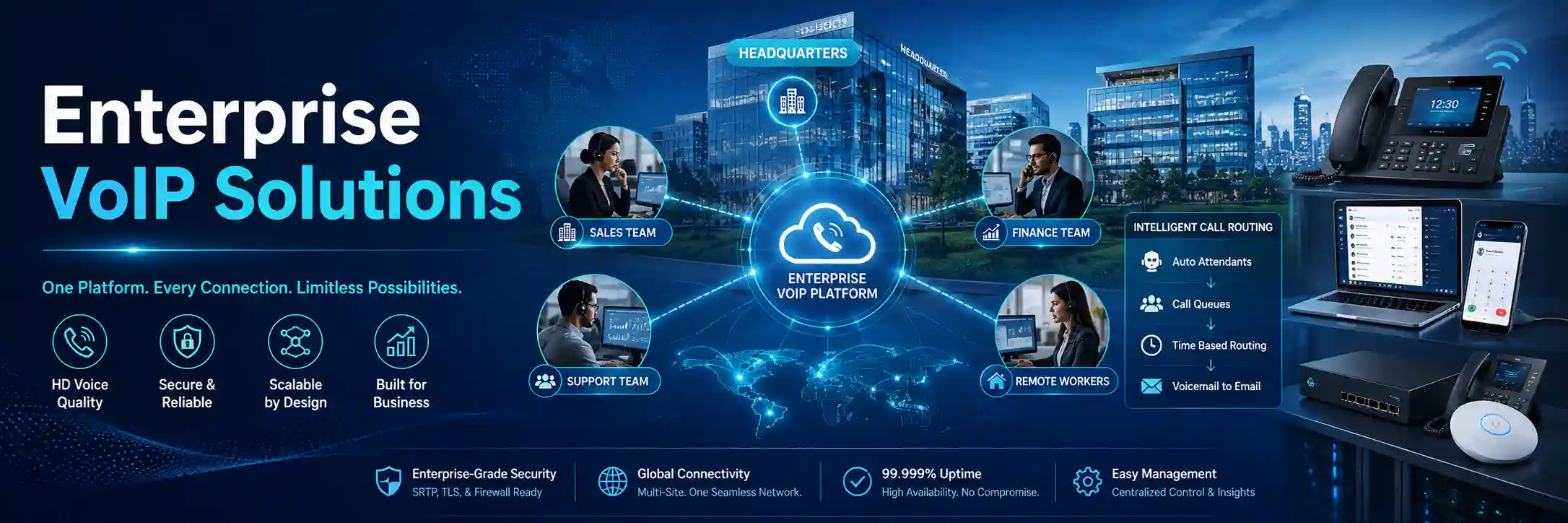
Design begins with how customers, reception and departments should communicate.
Switching, PoE, VLANs, internet and firewall dependencies are considered with the PBX.
Backups, testing, rollback options and maintenance windows matter for production systems.
Licensing, providers, hardware condition and existing configuration can affect the work required.
What are enterprise IP PBX solutions?
An enterprise IP PBX is the central call-control environment used to manage business extensions, inbound and outbound calling, reception routes, queues, groups, voicemail, office-hour behaviour, remote users and other telephony functions over an IP network. The service around that platform includes far more than activating extensions. It can involve discovery, design, deployment, migration, configuration, troubleshooting, network preparation, provider coordination, security review, testing, documentation and user handover.
Businesses should consider an assessment when an existing telephone system is difficult to manage, call routes no longer match the organisation, branches need a coordinated plan, repeated call-quality issues are occurring, a legacy PBX is being replaced, or a new office needs a scalable voice setup. Before work is confirmed, FourTeck normally needs to understand the number of users and sites, current numbers and trunks, desired call flow, phone models, remote-working needs, network layout, administrator access, provider responsibilities and any timing constraints. The exact service scope is environment dependent and should be confirmed before production changes are made.
What the service can cover
Depending on the confirmed requirement, an enterprise PBX engagement may cover the current telephone platform, IP phones, softphones, mobile clients, SIP trunks, gateways, reception consoles, extension plans, queues, ring groups, auto-attendant menus, voicemail, office-hours rules, direct numbers, caller identification, outbound permissions, recording settings, remote-user connectivity and branch links.
The supporting environment is equally important. Voice services can depend on Ethernet cabling, PoE switches, routers, firewalls, DNS, DHCP, VLANs, QoS policies, public internet connectivity and telecom or SIP providers. FourTeck can review these dependencies when they affect deployment, migration or fault isolation. Final inclusions are subject to assessment and quotation.
Who may need this service
The service can suit growing offices, corporate headquarters, professional firms, clinics, warehouses, hospitality operations, schools, customer-service teams, retail groups and multi-branch organisations that rely on structured telephone workflows. It is also relevant where reception, sales, service desks or operations teams need clearer rules for how calls enter, move through and leave the business.
A company does not need to be replacing its complete telephone system to benefit from an assessment. Existing PBX environments may need documentation, call-flow redesign, user expansion, phone reprovisioning, provider coordination, branch planning, security review or troubleshooting before a larger project is considered.
Business situations that often trigger an IP PBX project
Enterprise voice projects often begin with an operational symptom rather than a technical specification. Reception may be transferring calls manually because department routing has grown confusing. New staff may be added without a consistent extension plan. Remote employees may depend on workarounds that are difficult to support. A branch may have its own telephone system, provider and numbering logic, making changes slow and difficult to document. In other cases, a business knows that the current platform is ageing but does not yet know whether it should be retained, upgraded, reconfigured or replaced.
Call routing no longer fits the business
Incoming numbers may reach the wrong team, overflow rules may be inconsistent, after-hours calls may not follow the intended path, or callers may be transferred repeatedly. The correct response is to map the required business flow before changing PBX rules.
Users or branches are growing
Expansion can expose limitations in numbering, switch capacity, PoE budgets, internet quality, licensing, device management and remote connectivity. A structured capacity review helps identify which elements need change and which can remain in service.
Call quality is inconsistent
One-way audio, dropped calls, delay or intermittent registration can involve phones, PBX settings, switches, VLANs, firewall behaviour, bandwidth, internet conditions or the upstream voice provider. The symptom alone does not prove the cause.
The existing system is undocumented
Missing extension lists, unknown administrator ownership, unclear trunk details and undocumented call routes increase risk during faults, staff changes and migrations. Discovery and documentation can be valuable even before a platform decision is made.
Why unresolved PBX issues can become wider business problems
A business telephone platform connects people, numbers, departments and external carriers. When it is unreliable or poorly documented, the impact can spread beyond one phone. Reception may struggle to direct customers, sales calls may reach unavailable staff, support queues may not distribute work as expected, and managers may not know whether a complaint comes from a handset, the network, the PBX or the carrier. Repeated manual workarounds can also make future changes harder because the live configuration stops matching the business process that staff believe is in place.
For multi-site organisations, inconsistent telephone design can create another layer of difficulty. Each branch may use different extension ranges, dial rules, handsets, providers or failover arrangements. Staff moving between sites can have different experiences, while the support team must relearn each environment during every incident. A structured enterprise approach aims to improve maintainability by defining ownership, standardising where practical and documenting important dependencies.
Security and continuity also require attention. Administrative access should be controlled, remote connectivity should be authorised, configuration backups should be protected, and changes should be planned around business risk. These measures reduce avoidable problems, but they do not guarantee that a voice service will never fail. External providers, internet links, power, hardware condition and third-party hosting can still affect availability.
Possible FourTeck assistance for an enterprise PBX environment
Depending on the confirmed scope, FourTeck can help with discovery, configuration, implementation planning, troubleshooting, migration preparation and ongoing support. The service is designed around the customer environment rather than a fixed list of tasks. Some organisations need a focused call-flow correction; others need a broader project involving network readiness, phone provisioning, branch coordination and provider migration.
Review extensions, direct numbers, trunks, routes, queues, office hours, prompts, devices, branch relationships and administrator dependencies.
Create or update approved extensions, groups, queues, routing, voicemail, user permissions, phone settings and business-hour behaviour.
Review switching, PoE, addressing, VLAN design, firewall dependencies, internet connectivity and the network path used by phones and remote users.
Collect trunk details, confirm responsibilities, support testing and coordinate evidence with the relevant telecom or voice provider where required.
Inventory the current environment, map dependencies, plan cutover steps, confirm backups, test critical call paths and define fallback considerations.
Validate key inbound and outbound calls, department routing, user registration and agreed functions, then document the completed environment and remaining actions.
Service-fit matrix: when different types of help may be appropriate
| Business situation | Relevant assistance | What must be confirmed |
|---|---|---|
| New office or new floor | Requirements discovery, extension plan, device deployment, call-flow setup and network readiness | User count, phone locations, cabling, PoE, internet, numbers, carrier and target go-live window |
| Existing system with confusing routing | Call-flow review, route documentation and approved configuration changes | Desired reception, department, overflow, office-hours and voicemail behaviour |
| Poor or intermittent call quality | Evidence collection across phone, PBX, LAN, firewall, internet and provider layers | Affected users, timing, call direction, provider details, network condition and available logs |
| Legacy PBX replacement | Inventory, compatibility review, migration planning, testing and rollback preparation | Phones, gateways, numbers, trunks, recordings, integrations, licences and critical call paths |
| Multiple UAE branches | Standardisation, branch extension planning, remote-user review and central documentation | Site connectivity, local providers, branch ownership, security model and numbering requirements |
Enterprise IP PBX service information
| Main purpose | Plan, configure, support, troubleshoot, migrate and document business IP telephony environments. |
|---|---|
| Typical systems involved | PBX platform, IP phones, softphones, mobile clients, SIP trunks, gateways, LAN switching, VLANs, firewalls, internet links and provider services. |
| Remote support suitability | Suitable for many configuration reviews, user changes, log analysis and call-flow tasks when secure authorised access is available. |
| On-site suitability | May be needed for phone deployment, cabling, switch or rack access, physical fault isolation, local testing and site coordination. |
| Customer information | User and extension list, numbers, call-flow requirements, platform details, provider contacts, network information, recent changes and desired outcome. |
| Access dependency | Administrative access, approved remote access and relevant provider or hosting access may be required. Credentials should be shared only through an approved secure method after authorisation is confirmed. |
| Testing and validation | Scope dependent; may include registration, inbound/outbound calls, transfer, queue, office-hours, voicemail, remote-user and selected failover checks. |
| Service location | Dubai and UAE coordination, subject to location, access, scheduling, engineer availability and approved scope. |
| Commercial scope | Assessment and quotation dependent. Hardware, licences, carrier services, third-party work and replacement parts are not assumed to be included. |
Can enterprise PBX work be completed remotely?
Remote assistance may be suitable when
The PBX is reachable through an approved secure method, the customer has working internet connectivity, an authorised contact is available and the task concerns configuration, user administration, call-flow review, registration, logs, provider testing or documentation. Remote work can also be useful for pre-assessment because the existing extension list, screenshots, route settings and diagnostic evidence can be reviewed before a site visit is scheduled.
Remote access does not remove the need for change control. A configuration backup, maintenance-window decision, approval path and test plan may still be required, particularly when a change affects reception, critical numbers or multiple departments.
On-site assistance may be recommended when
Phones, switches, cables, patch panels, gateways or rack equipment need physical inspection; a site has no reliable remote path; multiple users are affected and local testing is more efficient; or deployment work requires device installation, labelling and user handover. Site attendance may also be useful when a new office or branch needs coordinated checks across voice points, PoE capacity, network cabinets and actual user locations.
The decision between remote and on-site support depends on the evidence, risk, access and confirmed work scope. Neither method should be assumed to resolve every type of fault.
How an enterprise IP PBX assessment usually begins
The first objective is to understand the business impact, not to change settings immediately. FourTeck can begin by asking which users, departments, numbers or sites are affected; when the issue or project requirement started; whether there were recent network, provider, firewall or PBX changes; and what the customer expects the telephone environment to do. This establishes a measurable target for the technical work.
Identify affected users, numbers, branches and business functions. Separate one-user issues from site-wide or carrier-wide symptoms.
Gather call examples, timestamps, error messages, registration status, recent changes, network details and provider information.
Check authorised administration, secure remote access, backup availability, carrier contacts and any site-entry restrictions.
Review the phone-to-PBX-to-network-to-provider path rather than assuming the fault belongs to one device or service.
Once the environment is understood, likely technical areas can be tested in a controlled order. For example, a failed external call may require checking the extension permission, outbound route, trunk registration, firewall path and provider response. A phone that will not register may involve power, VLAN assignment, addressing, provisioning, credentials, PBX reachability or a device-specific problem. Diagnosis should follow evidence and should not treat one symptom as proof of one cause.
Planning implementation, configuration and corrective changes
When changes are required, the project should translate business requirements into a controlled configuration plan. A useful plan identifies what will change, what should remain untouched, which users or numbers are affected, who approves the work, whether a maintenance window is needed, how the current configuration is protected, what tests will be run and what fallback is available if the expected result is not achieved.
For a new deployment, the work may include defining extension ranges, creating user roles, assigning numbers, programming reception and department routes, configuring queues and groups, preparing voicemail and office-hours behaviour, registering trunks, provisioning phones and testing the network. For an existing system, the same disciplines apply on a smaller scale. A request such as “make the sales number ring three people and then reception” should be translated into a precise route with timing, overflow, voicemail and out-of-hours decisions before implementation.
Where a platform migration is involved, the current state should be inventoried before the target system is built. Important details include extensions, direct numbers, caller IDs, trunks, prompts, queue members, office-hour logic, emergency or priority routes, recordings, gateway ports, phone models and any integrations. Compatibility, licensing and provider responsibilities must be checked rather than assumed. A migration may be staged where practical, but zero downtime cannot be guaranteed because the outcome depends on the existing platform, carrier changes, number provisioning, access, testing and other third parties.
Testing, validation and handover after PBX changes
A successful configuration is not defined by whether the administration screen accepts the change. It is defined by whether the agreed business behaviour works from the user’s point of view. Testing should therefore include representative call journeys. An inbound main number may need to reach reception during business hours, route to a department queue, overflow correctly, present the expected caller information and follow a different path after hours. Outbound testing may need to cover internal extensions, local external calls, selected permissions and any business-critical destinations defined by the customer.
Phone registration, transfer, hold, voicemail, queue membership and remote-user behaviour can be validated where they form part of the scope. If the change also affects network policies, firewall rules or trunk connectivity, checks should confirm that the voice service remains stable without disrupting unrelated business traffic. The exact test set depends on the environment and the approved change.
Handover should record what was changed, what was tested, which dependencies remain with third parties and which follow-up actions are recommended. Useful documentation can include extension lists, direct-number mapping, call-flow diagrams, provider details, device inventory, backup location, administrator ownership and known limitations. Clear records reduce reliance on memory and make later user changes, fault diagnosis, office moves and upgrades easier to manage.
Capability focus: clearer call-flow control
Enterprise telephony becomes easier to support when the intended call journey is documented in business language before it is translated into PBX rules. Reception, sales, accounts, service teams and management often have different expectations for ringing, overflow, forwarding, voicemail and after-hours behaviour. Without a shared map, one small configuration change can solve one complaint while creating another.
FourTeck can help document these workflows and then compare them with the live configuration. The outcome may be a corrective change, a standardised route design or simply a list of decisions the business needs to make. Some functions depend on the PBX platform, licence, trunk service or available endpoints, so desired behaviour must be checked against the actual environment.
Capability focus: network-ready voice
IP telephony shares infrastructure with other business traffic. Phones may rely on PoE power, switch ports, DHCP, DNS, voice VLANs, gateways, firewalls and internet connectivity. When these layers are undocumented or overloaded, the PBX can appear unreliable even when its own configuration is correct.
A network-aware review can look at the path used by affected phones and remote users, available switch capacity, power budgets, segmentation and the relationship between local connectivity and upstream provider service. Quality of Service settings can be relevant in some environments, but they are not a substitute for adequate bandwidth, stable links or correct design. Any network change should be authorised, backed up where applicable and validated against other business services.
Capability focus: maintainable multi-site telephony
Multi-branch telephone systems become difficult to manage when each location grows independently. Different extension ranges, phone models, provider contacts, routing rules and local support arrangements can slow troubleshooting and make staff moves more complicated.
FourTeck can help businesses review where standardisation is practical, define branch-specific exceptions, record local dependencies and create a clearer ownership model. Centralised management may be appropriate for some platforms and organisations, while other environments may retain local systems. The right approach depends on connectivity, resilience expectations, platform architecture, provider availability, security policy and business priorities. The aim is not standardisation for its own sake, but a design that support teams and users can understand.
Dependencies, access and customer inputs that can affect the project
Enterprise PBX work often crosses organisational boundaries. The customer may own the PBX while a telecom provider owns the SIP service, an ISP provides internet connectivity, a firewall vendor controls security policy, a building contractor owns cabling work, and a hosted platform provider manages the virtual server. Identifying these responsibilities early prevents technical work from being delayed by missing access or unclear ownership.
Useful customer inputs include the service location, affected departments, user count, extension list, direct numbers, existing PBX platform, phone and gateway models, provider details, current call-flow expectations, remote-user requirements, recent changes, network diagram if available, backup status, administrative access, preferred change window and the business priority. For migrations, additional information such as number porting responsibilities, licence status, recordings, prompts and integrations may be required.
Passwords and private credentials should not be placed in public notes or enquiry text. Access details should be shared only through an approved secure method after the authorised customer contact and service scope have been confirmed. If administrative access is unavailable, the project may need a recovery, vendor or ownership step before configuration can begin.
Risk, limitation and exclusion guidance
The exact outcome of PBX work depends on the current environment, available evidence, authorised access, network condition, third-party providers, hardware condition, licence status and compatibility. A successful configuration test reduces uncertainty but does not guarantee that an external carrier, internet service, power supply or device will never fail. Changes to production routing can also create user impact if they are made without a clear test and rollback plan.
Hardware replacement, new phones, gateways, licences, carrier charges, number porting, cabling, electrical work, internet services and vendor-specific professional services may require separate quotation or third-party engagement. Legacy platforms can have limited support options, and some existing devices may not be suitable for reuse on a target platform. Call recording or other regulated functions may also require the customer to confirm its own legal, policy and consent obligations.
Remote diagnosis is access dependent, while on-site work depends on location, scheduling, building access and the agreed task. FourTeck can help define practical next steps, but the confirmed quotation or service agreement should identify inclusions, exclusions, responsibilities and any assumptions before work starts.
Business environments where enterprise IP PBX planning can be useful
Different organisations use telephony in different ways. A professional office may need direct numbers, reception coverage and mobile clients for travelling staff. A clinic may depend on reception queues and clear transfer paths between departments. A warehouse or logistics operation may need desk phones, cordless or mobile users and reliable calling between operational areas. A hospitality site may have front-desk, administration and back-office requirements that need distinct call permissions. A multi-branch retailer may need common extension logic and a simple way to manage location changes.
The value of an enterprise PBX assessment is that it connects these operational requirements to the technical environment. A queue only helps if its membership, overflow and working hours match staff availability. Remote users only help if the platform, connectivity and security model support them. Existing handsets only reduce project cost if they are compatible, supportable and appropriate for the required functions. Branch links only simplify communication if the network and addressing plan are reliable.
FourTeck can support small and medium organisations as well as larger businesses requiring project assistance, but the recommended architecture and service scope should be based on the real number of users, sites, call patterns and operational dependencies rather than a generic package.
Operational, security and maintenance considerations
A PBX environment remains maintainable when ownership and routine administration are clear. Businesses benefit from knowing who can approve user changes, who holds platform administration, where backups are stored, which provider supports each trunk, which numbers are business critical and how new employees are added or removed. This basic governance reduces the chance of emergency changes being made without context.
Security review should consider administrative accounts, remote access, exposed services, firewall policies, password handling, update planning and the permissions given to users and devices. Security improvement reduces risk but does not guarantee complete protection. Controls must fit the deployment model and should not be changed broadly without understanding how phones, trunks, remote clients and integrations communicate.
Preventive maintenance may include reviewing backups, licence status, capacity, extension records, device inventory, provider contacts, unsupported components and recurring incidents. Some businesses may prefer periodic checks, while others may incorporate telephony into a wider managed IT or maintenance arrangement. Actual inclusions, frequency, remote/on-site balance and chargeable project work depend on the agreed service plan.
Before you contact FourTeck about an enterprise PBX requirement
Preparing a small amount of information can make the first assessment more useful and reduce time spent establishing basic scope. You do not need to know every technical detail. Business information about what is happening, who is affected and what you need the system to do is often the best starting point.
Service evaluation checklist for a quotation or engagement
The quotation should describe the confirmed objective and the boundaries of the work. Before approval, it is useful to confirm the following points so the business and technical teams share the same expectation.
- Exact service objective: assessment, troubleshooting, installation, configuration, migration, upgrade or maintenance.
- Number of users, phones, branches and PBX instances in scope.
- Current platform, network and provider environment that FourTeck will need to interact with.
- Required administrative and site access, including who authorises it.
- Remote tasks versus on-site tasks and any location-specific constraints.
- Whether new hardware, licences, cabling or provider services are required separately.
- Which call routes, numbers, queues and user functions are business critical.
- Backup, rollback and maintenance-window expectations for production changes.
- Testing and user acceptance requirements after implementation.
- Documentation, administrator notes or user handover required at completion.
- Third-party carrier, ISP, hosting or vendor coordination responsibilities.
- Any follow-on maintenance or support requirement that should be quoted separately or included in an agreed service plan.
How FourTeck can help define the right scope
FourTeck’s role can begin before a customer has decided on the final platform or migration path. The initial conversation can focus on the current telephone environment, business pain points, user growth, branch requirements, support concerns and the result that management wants to achieve. From there, the technical scope can be narrowed to the layers that require assessment.
For an existing fault, FourTeck can help distinguish whether the evidence points toward a user device, the PBX, network connectivity, firewall handling, internet service or an upstream voice provider. For a new deployment, the team can help organise requirements around extensions, call routing, device locations, network readiness, security, provider connectivity, testing and documentation. For a migration, the emphasis shifts toward inventory, compatibility, backups, cutover sequencing, fallback planning and post-change verification.
When external vendors are involved, FourTeck can help collect relevant technical information and coordinate the checks needed from each party. The aim is to reduce uncertainty about ownership and next steps. A quotation can then be prepared around the confirmed tasks rather than assuming that every possible PBX, network, phone or carrier activity is included.
You can review the broader FourTeck IT support approach or learn more about the company through the FourTeck IT Services overview.
Dubai and UAE service coordination
Enterprise IP PBX work in Dubai may be handled remotely, on site or through a combination of both methods. The practical service plan depends on the current system, access, business impact, number of locations, need for physical inspection, change risk and approved quotation. Remote assistance may be appropriate for configuration reviews, call-routing adjustments, log analysis and provider coordination. An on-site visit may be recommended for phone deployment, cable or switch checks, gateway work, rack access, site testing or issues that cannot be reproduced remotely.
Scheduling depends on engineer availability, customer access, building rules, site conditions, provider appointments, required parts and the confirmed task. A project involving number migration or carrier changes may also depend on third-party timelines that FourTeck does not control. Customers should therefore confirm critical dates and dependencies during scoping rather than assume a fixed implementation duration.
Coordinating projects across Dubai, Abu Dhabi, Sharjah and Ajman
For organisations with offices in Dubai, Abu Dhabi, Sharjah and Ajman, the telephone environment may need both a common enterprise design and practical allowance for local site conditions. FourTeck can coordinate assessment, remote troubleshooting, planned on-site work, installation support, migration activity and maintenance tasks according to the confirmed scope.
Multi-location planning should identify which functions are central, which services remain local and how branches depend on internet links, firewalls, provider services and shared PBX resources. Extension ranges, reception procedures, direct numbers and user roles can be documented consistently where that helps support, while local exceptions can be recorded rather than hidden in ad-hoc configuration.
Travel, building access, local contacts, equipment availability, site readiness and third-party provider scheduling can affect the service plan. FourTeck does not assume permanent engineer presence or fixed attendance times in every emirate. Contact the team to confirm the appropriate combination of remote and on-site assistance for the actual locations involved.
Related FourTeck services that may support an IP PBX project
Useful when phones depend on switch capacity, PoE, VLANs, cabling, routing or unstable LAN connectivity.
IP phone support and provisioningRelevant for handset registration, extension changes, user moves, programmable keys, phone deployment and call-quality checks.
Business IT servicesHelpful when a telephony project also touches servers, firewalls, internet links, branches, office moves or wider infrastructure changes.
Managed and preventive supportConsider when the business wants recurring checks, documentation updates, user-change support and maintenance planning under an agreed service scope.
Why businesses contact FourTeck for PBX assistance
Businesses often need help because telephone faults and projects cross several technical layers at once. A call-quality complaint may involve the PBX, but it may also involve the local network, firewall, internet link or provider. A migration may appear to be a software project, but it can also depend on handset compatibility, licences, number routing, branch connectivity and user communication. FourTeck approaches the work from this connected infrastructure perspective.
The service can include clear initial assessment, remote and on-site coordination, business-focused call-flow planning, safer change preparation, provider coordination, testing, documentation and a quotation built around the actual work required. Findings can be explained in practical language so decision-makers understand which issue is confirmed, which points remain dependent on another supplier and which improvements should be prioritised.
This approach does not replace vendor responsibilities or guarantee a particular outcome. It provides a structured way to assess the environment, organise the work and make technical decisions with better evidence. Customers can use the FourTeck contact page to share the business requirement and request an assessment or quotation.
Questions businesses commonly ask before choosing enterprise IP PBX assistance
The questions below are designed around the real decisions that usually come before a support request, migration, upgrade or new deployment. They can help a business identify what information is needed before the technical scope is confirmed.
Can our existing telephone system be improved without replacing everything?
Often, the right first step is an assessment rather than an immediate replacement. If the current PBX is supportable and the required business functions are available, improvements may involve call-flow changes, extension cleanup, phone reprovisioning, network correction, provider coordination or better documentation. However, an older platform may have limits around capacity, security updates, licensing, remote users, supported handsets or integration. FourTeck can review the current state and identify which requirements can reasonably be met with the existing environment. The decision should consider not only whether the system still makes calls, but whether it can be maintained, backed up, administered and expanded without increasing operational risk.
How do we know whether poor call quality is a PBX problem or a network problem?
The same symptom can come from different layers, so the cause should be traced rather than guessed. One-way audio can relate to signaling and media paths, firewall or NAT behaviour, provider conditions or endpoint settings. Delay and broken audio can be influenced by local congestion, unstable switching, internet conditions, wireless links or the remote party. A useful diagnostic starts with examples: who called whom, when it happened, whether the issue was inbound or outbound, whether all users were affected and whether internal extension-to-extension calls were normal. FourTeck can combine those observations with PBX logs, registration status, network checks and provider evidence to narrow the fault domain.
Should a larger company use one central PBX or separate systems at each branch?
There is no universal answer because the design depends on connectivity, resilience, platform architecture, local carrier services, security requirements, user workflows and operational ownership. A centralised environment can simplify administration and extension planning, but it can also make branches more dependent on shared connectivity. Separate systems may preserve local independence but can create more configuration and support overhead. A hybrid design may also be possible on some platforms. Before choosing an architecture, the business should map branch size, critical numbers, failover expectations, inter-office calling, provider arrangements, remote users and the consequences of an internet outage at each site.
Can we keep our existing IP phones during a migration?
Possibly, but compatibility should be confirmed model by model and against the target PBX, firmware, provisioning method and required features. A phone may support basic SIP registration yet still lack reliable auto-provisioning, secure management, supported codecs, programmable functions or vendor support expected in the new environment. Power requirements and network design also matter. Keeping suitable devices can reduce change, but retaining unsupported or inconsistent phones may increase long-term administration. A device inventory with model, firmware, user role and condition is useful before the migration scope is finalised.
What information should we prepare before requesting a PBX migration quotation?
Start with the current system rather than the desired brand. Prepare the approximate user and extension count, business numbers, direct numbers, current carrier or SIP service, branch list, phone models, gateways, reception requirements, queues, office hours, remote-user needs and any call recording or integration requirements. If available, include the current extension list, call-flow documentation, PBX backup status and network diagram. Also identify the desired cutover window and any periods when telephone disruption would be unacceptable. This information allows the migration plan to address dependencies instead of focusing only on software installation.
Is remote support enough for a new enterprise PBX deployment?
Remote work can cover a significant portion of system configuration when secure access, network readiness and local assistance are available. It may be suitable for platform setup, extension creation, call routing, trunk configuration, user administration and remote testing. However, new office deployments often involve physical tasks such as rack access, switch verification, PoE checks, phone installation, cable patching, labelling and user handover. If the site has undocumented cabling or multiple vendors, on-site coordination can reduce uncertainty. A blended plan is common because it separates configuration tasks from physical deployment tasks rather than forcing all work into one method.
What can affect the final cost and scope of an enterprise PBX project?
The main variables include user count, number of sites, current platform condition, device inventory, network readiness, carrier dependencies, required call flows, integrations, remote-user requirements, licensing, migration complexity, documentation quality and how much on-site work is needed. A project that reuses a well-documented network-ready environment is different from one that requires cabling correction, switch upgrades, provider changes, phone replacement and a legacy PBX discovery phase. The quotation should therefore identify assumptions and separate third-party services, hardware, licences or out-of-scope work rather than hiding them inside a generic package.
When should we consider an on-site PBX assessment in Dubai?
An on-site assessment is useful when the condition of the physical environment affects the decision. Examples include unknown patching, inconsistent phone cabling, limited PoE capacity, ageing gateways, rack constraints, branch wiring, repeated physical faults or a new office where device locations need to be checked against the floor plan. It can also help when several departments report inconsistent behaviour that cannot be reproduced remotely. The visit should still have a defined objective, such as validating network readiness, documenting hardware, tracing a fault or preparing a deployment plan. Scheduling depends on access, location and approved scope.
How should a business prepare for the risk of a PBX configuration change?
Production changes should be authorised and planned around their potential effect. The current configuration should be backed up where the platform supports it, the business should identify critical numbers and routes, and a test plan should be agreed before implementation. For a significant change, a maintenance window and rollback approach may be appropriate. Users who rely on the affected route should know when testing is taking place. A configuration change can appear small in the administration interface but may affect many callers if it changes trunk selection, reception routing, office-hours logic or extension permissions.
What should we expect after implementation or migration is complete?
The project should end with evidence that the agreed functions were tested and with enough documentation to support future changes. Depending on the scope, this may include an updated extension list, direct-number map, call-flow notes, provider details, backup information, device inventory and a list of remaining dependencies. Users or reception staff may need concise guidance on transfer, voicemail, queue membership or new client applications. Any unresolved carrier, network or legacy issue should be recorded rather than presented as complete. Businesses should also decide who will handle future onboarding, extension changes, updates and preventive checks.
Frequently asked questions about enterprise IP PBX services
What does an enterprise IP PBX service include?
It can include assessment, design, installation, configuration, troubleshooting, migration planning, phone provisioning, SIP coordination, testing, documentation and maintenance guidance. The exact tasks depend on the confirmed environment and quotation.
Can FourTeck work with an existing PBX rather than a new installation?
Yes, support can begin with the existing environment for troubleshooting, user changes, documentation, call-flow improvements or migration preparation. Platform supportability, access and compatibility must be assessed first.
What access is normally required?
PBX administration, network access, provider information or hosting access may be needed depending on the task. Credentials should be shared through an approved secure method after customer authorisation is confirmed.
Can call routing be changed without affecting other users?
Sometimes, but the impact depends on how routes, trunks, queues and shared settings are structured. Changes should be reviewed, backed up where appropriate and tested against affected business call paths.
Does a PBX migration guarantee zero downtime?
No. Downtime depends on the existing platform, carrier changes, number routing, connectivity, access, testing and third parties. The project should plan the cutover and fallback rather than promise zero interruption.
Can old desk phones always be reused?
No. Reuse is subject to model compatibility, firmware, provisioning support, power requirements, condition and the functions required on the target PBX.
Do voice VLANs and QoS solve all call-quality issues?
No. They can be part of a sound network design, but call quality also depends on capacity, link stability, internet conditions, endpoints, firewalls, providers and the remote party.
Is on-site work available outside Dubai?
UAE service coordination can include planned on-site work in locations such as Abu Dhabi, Sharjah and Ajman, subject to the issue, location, access, scheduling and approved quotation.
What documentation can be produced after the work?
Depending on scope, documentation may include extension and number maps, call-flow notes, device inventory, provider dependencies, change records, test results and recommended next actions.
How do we request a quotation?
Share the business objective, user and site count, current platform, provider details, main symptoms or required functions and any timing constraints. FourTeck can then confirm what assessment is needed before pricing the work.
Discuss your enterprise IP PBX requirement with FourTeck
Whether the requirement is a new office deployment, a confusing call-flow problem, branch expansion, phone rollout, provider change, platform migration or recurring call-quality issue, the useful first step is to define the environment and the business outcome. Share the affected users or sites, existing platform, current voice provider, numbers, call-routing needs, recent changes and any deadlines that influence planning. FourTeck can advise whether remote assessment, on-site inspection or a combined approach is appropriate and can prepare a quotation around the confirmed tasks, dependencies and responsibilities.