
SURVEILLANCE TROUBLESHOOTING • MAINTENANCE • SYSTEM REVIEW
CCTV Support Dubai in Dubai, UAE
A CCTV problem is rarely just a camera problem. Recording depends on the camera, power, cabling, network path, recorder, storage, time settings, user access and viewing method working together. FourTeck helps businesses assess these connected layers so the support plan is based on evidence rather than assumptions.
Support can begin with a focused review of the reported symptom and may progress to remote troubleshooting, an on-site inspection, corrective configuration, maintenance work, testing or upgrade planning. The final scope depends on access, system condition, site requirements and the approved quotation.
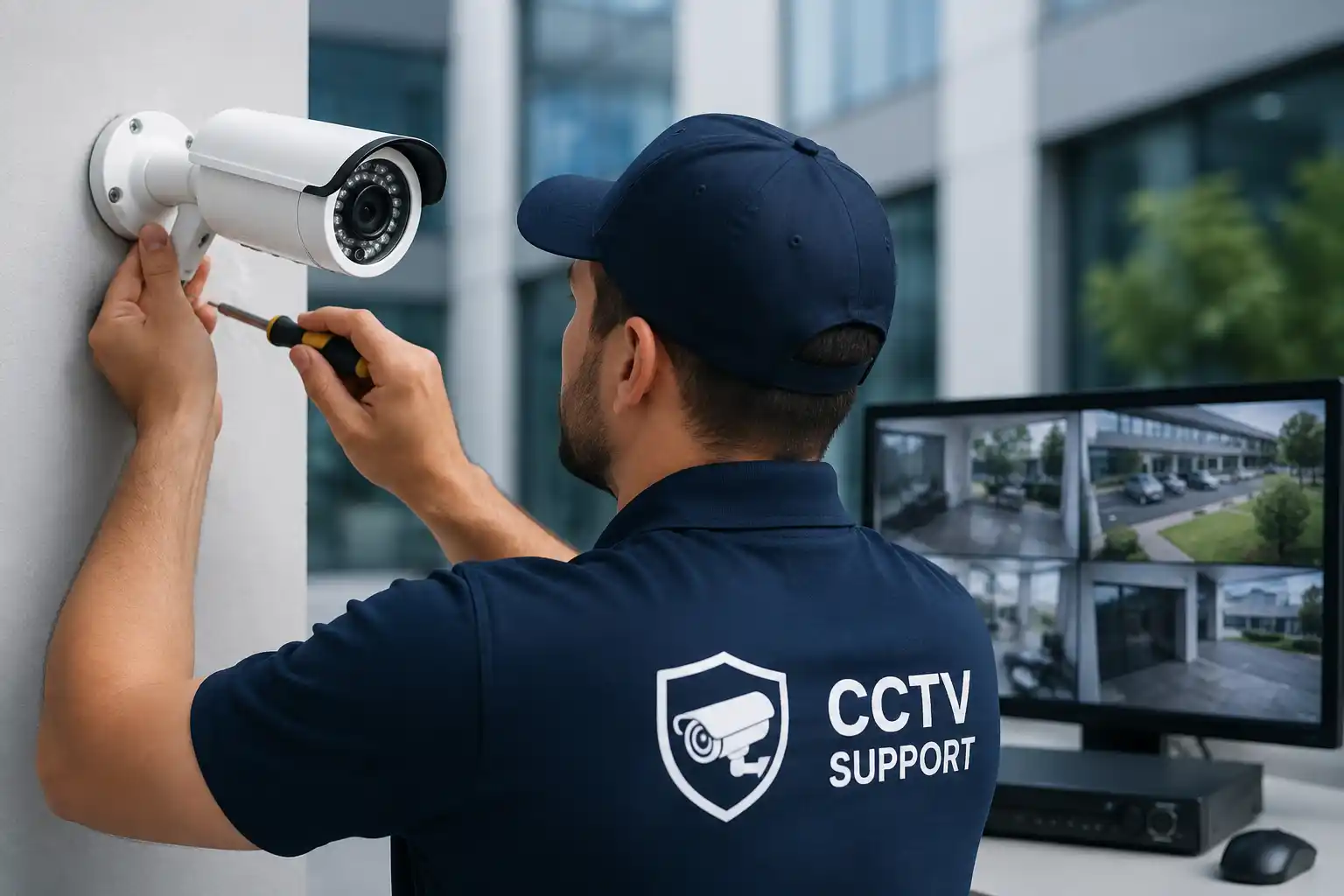
Camera, recorder, storage, power and network layers.
Suitable where secure access and connectivity are available.
Useful for physical equipment, cabling and local testing.
Work depends on assessment, access and approved quotation.
What does CCTV support in Dubai involve?
CCTV support is the structured assessment and troubleshooting of an existing surveillance environment when cameras, recording, playback, storage, remote viewing, user access or related connectivity are not working as expected. It is mainly used to identify the affected technical layer, restore useful operation where the fault can be corrected within scope, document remaining issues and plan repairs, changes or maintenance. Businesses with one camera problem, multiple offline cameras, missing footage, unstable remote access, unclear images, time errors or an inherited and undocumented system may all need this type of assistance. Before work is confirmed, prepare the site location, system or recorder details, affected cameras, symptoms, when the problem began, recent changes, authorised access availability and the operational impact. These details help determine whether remote diagnosis is practical or whether physical inspection is likely to be required.
What the service may cover
Depending on the confirmed scope, assistance may include camera status checks, DVR or NVR review, recording schedule verification, playback testing, storage-health review, power and PoE checks, cable-path inspection, switch-port and network checks, authorised user-access review, time and date verification, remote-viewing troubleshooting, image-quality assessment, camera naming, basic documentation and recommendations for repair or improvement.
A useful CCTV assessment follows the complete path of video. For an IP camera this may include the camera, PoE source, cable, switch port, addressing, network path, recorder registration, stream settings, storage and viewing application. For an analogue system the path may involve the camera, local power, connectors, cable, recorder channel, recording profile, storage and monitor or client software. The service should not assume that the first visible symptom identifies the failed component.
Who may need CCTV support?
The service may suit offices, retail stores, warehouses, clinics, showrooms, hospitality locations, education facilities, property-management sites, restaurants, construction offices and organisations operating more than one location. A small site may need help with a recorder that no longer stores footage, while a larger environment may need assistance tracing repeated camera outages across switches, power sources or network segments.
It can also be useful when a business moves into premises with an existing surveillance installation but has limited documentation, unclear administrative ownership or a mix of equipment installed at different times. In that situation, the first objective is usually to establish what is present, which components still operate, what access is available and what the business actually needs from the system before changes are proposed.
For a broader view of connected workplace assistance, review the FourTeck IT services overview, where surveillance, network, server, desktop and communication dependencies can be considered together.
Common CCTV symptoms and what they can mean
The same CCTV symptom can come from several technical layers, so support should begin by defining the pattern rather than jumping to a replacement. One offline camera is a different diagnostic situation from an entire recorder becoming unavailable. A remote-viewing problem with local recording still working is different from a system that has stopped recording altogether. Capturing these differences early helps reduce unnecessary changes and keeps the investigation focused.
A camera shows offline
Possible areas include local power, PoE availability, loose or damaged cabling, switch-port status, incorrect addressing, recorder registration, configuration changes or camera failure. The recommended next step is to check whether the issue is isolated to one camera or follows a wider power or network pattern.
Playback is missing
A live image does not by itself confirm that recording is healthy. Missing playback can relate to recording schedules, storage status, time settings, channel configuration, overwrite behaviour, disk faults or access permissions. Support should verify actual recorded footage across a known time range.
Remote viewing stopped
If local viewing and recording continue, the issue may sit with internet connectivity, addressing, firewall rules, application settings, account permissions or a vendor-dependent remote service. Secure access and ownership details may be needed before troubleshooting can proceed.
Image quality is poor
Blur, glare, darkness, reflections, dirty lenses, unsuitable angles, limited lighting, compression or stream settings can all affect usefulness. Physical positioning and the intended identification area matter as much as a camera’s headline resolution.
Time or date is wrong
Incorrect timestamps can make footage difficult to locate and correlate with business events. The issue may relate to recorder settings, camera settings, network time configuration, time zone or an earlier reset. Any correction should be tested without assuming historic footage will automatically change.
Cameras drop intermittently
Intermittent video often requires evidence over time. Possible areas include unstable power, marginal cabling, overheating, overloaded switching, address conflicts, network loss, device instability or recorder-side communication. Repeated resets can hide the pattern, so observation and logging may be more useful than immediate broad changes.
Why unresolved CCTV faults matter to business operations
A surveillance system can appear normal until a business needs to retrieve a specific event. If recording has stopped, timestamps are incorrect, storage is unhealthy or access is restricted to an unavailable administrator, the problem becomes visible at the worst possible time. The operational impact varies by site, but it can include incomplete incident review, reduced visibility over entrances or stock areas, time spent searching for footage that was never recorded, repeated staff complaints, uncertainty over system ownership and unplanned spending on parts that do not address the cause.
A disciplined support process reduces that uncertainty. It distinguishes a failed component from a configuration issue, a camera problem from a network problem, and a temporary symptom from a design limitation. The outcome may be a straightforward correction, a need for replacement parts, a recommendation to improve storage or network capacity, or a larger upgrade plan. The important point is that the recommendation follows evidence from the actual environment.
CCTV support scope: from initial review to corrective work
A CCTV support request can be narrow or broad. Some customers need help with one specific fault; others need a complete review because the system has been modified by several suppliers over time. The following areas illustrate what may be considered. They are not automatic inclusions. The final work should be stated in the quotation or service agreement after the current environment is understood.
Camera and image checks
Status, orientation, focus, cleanliness, day and night visibility, stream availability, camera naming, mounting condition and whether the current view supports the business purpose.
Recorder and playback review
DVR or NVR channel status, recording schedules, time settings, playback behaviour, display output, user permissions and whether representative footage can be found and reviewed.
Storage assessment
Disk status, recording continuity, retention expectations, overwrite behaviour, capacity pressures and warnings visible through the recorder. Hardware replacement or data-recovery outcomes cannot be assumed without assessment.
Power and PoE checks
Power supplies, adapters, PoE switch availability, port status and signs that power instability may be contributing to repeated device loss. Physical work requires suitable site access and authorisation.
Network path review
IP addressing, link state, switch connectivity, gateway or routing dependencies and whether cameras or recorder traffic is affected by a broader network issue. Changes should be coordinated to avoid disrupting other business services.
Remote viewing and access
Authorised user accounts, application connectivity, internet dependency, firewall considerations and secure methods of remote access. Capabilities may depend on the device platform, current configuration and third-party services.
Documentation and labelling
Camera names, channel mapping, recorder role, network dependencies, administrator ownership and a concise record of completed work. Better records reduce guesswork during future incidents.
Maintenance and improvement planning
Preventive checks, cleaning needs, ageing components, storage growth, coverage gaps, access-control concerns and prioritised recommendations for repair, replacement or staged improvement.
Which type of CCTV assistance fits the situation?
| Observed situation | Possible technical areas | Recommended next step |
|---|---|---|
| One camera is offline | Camera, local power, PoE port, connector, cable, IP address, recorder registration | Confirm whether the fault stays with the camera or follows the connection path; on-site testing may be needed. |
| Several cameras disappear together | Shared switch, PoE budget, uplink, power source, recorder, network segment | Check the common dependency before replacing individual cameras. |
| Live view works but footage is missing | Recording schedule, storage, time settings, channel profile, disk health, permissions | Review recorder state and verify playback over known periods rather than relying on the live screen. |
| Remote viewing fails while local viewing works | Internet, firewall, external service, application, user account, address changes | Remote review may be suitable if secure access and an authorised site contact are available. |
| System is old and repeatedly failing | Ageing cameras, recorder limitations, storage wear, obsolete interfaces, undocumented wiring | Request a repair-versus-upgrade assessment based on actual condition and business requirements. |
CCTV support service information
| Main purpose | Assess CCTV faults, restore usable operation where possible within scope, and define practical next actions. |
|---|---|
| Typical systems involved | IP or analogue cameras, DVRs, NVRs, storage, power supplies, PoE switches, network equipment, monitors and authorised viewing applications. |
| Assessment method | Symptom review followed by targeted checks of the relevant video, power, network, recording, storage and access layers. |
| Remote support suitability | Access dependent. Often useful for configuration, recorder settings, playback, user access, logs and remote-viewing diagnosis when connectivity is available. |
| On-site support suitability | Recommended where camera inspection, mounting, cabling, connectors, power, PoE, storage hardware or local physical testing is required. |
| Customer information required | Site location, affected cameras or recorder, symptoms, recent changes, business impact, system details and authorised access availability. |
| Testing and validation | Scope dependent. May include live view, recording, playback, timestamp, user access, remote viewing and representative fault reproduction. |
| Documentation and handover | Can include completed actions, remaining risks, device or channel notes and recommendations, depending on the engagement. |
| Scheduling dependency | Location, engineer availability, site access, maintenance windows, equipment availability and third-party dependencies. |
| Commercial scope | Subject to assessment and approved quotation. Replacement equipment, specialist recovery or third-party services may be separate. |
Remote CCTV support or an on-site visit?
The right method depends on what needs to be observed or changed. Remote support can save time when the system is reachable, the customer authorises secure access, and the likely problem is in software, recorder settings, accounts, recording schedules, network configuration, logs or the viewing application. It is also useful for an initial assessment because a technician can often establish whether the recorder is online, which cameras are registered, whether storage warnings are present and what information should be collected before any site visit.
Remote assistance may fit when
The internet connection is working, an authorised user can provide access, the recorder or management interface is reachable, the issue concerns configuration or access, physical measurements are not required, and a site contact can confirm what is visible locally. Remote work still depends on the platform, the current security configuration and the availability of suitable administrative access.
On-site assistance may fit when
Cameras need physical inspection, cabling or connectors must be tested, PoE or local power is uncertain, storage hardware must be checked, mounting or viewing angles need assessment, the system cannot be reached remotely, multiple physical components are affected, or the business needs help mapping an undocumented installation. Building access and safe work conditions must be confirmed in advance.
Some cases need both methods. A remote review can narrow the scope, followed by an on-site visit with a clearer task list. Conversely, an on-site inspection can establish the hardware condition and restore connectivity, after which remote configuration and documentation can complete the work. Neither method should be treated as universally better; the objective is to use the method that matches the evidence and limits unnecessary disruption.
How a CCTV fault assessment is normally structured
A controlled diagnostic process reduces the risk of changing several variables at once. Exact steps vary by system, but the service journey commonly follows the sequence below.
1. Define the business impact
The first question is not only what is broken, but what the business cannot currently do. Is live monitoring unavailable, is recording missing, is one critical entrance unprotected, or is a manager unable to retrieve footage? This helps establish priority and the safe order of checks.
2. Identify the affected scope
The technician determines whether the issue affects one camera, a group of cameras, one recorder, one viewing device, one user or the entire site. A clear scope points toward shared dependencies and avoids replacing components simply because they are visible.
3. Collect evidence
Useful evidence may include screenshots, offline messages, timestamps, playback examples, device names, recorder model information, storage alerts, network status and a record of recent changes. The customer should avoid sharing passwords through public or insecure channels.
4. Confirm access and risk
Authorised administrative access, secure remote access, building access, maintenance windows and any change restrictions are confirmed. Where configuration changes could interrupt recording, backups or rollback information should be considered before work proceeds.
5. Test the relevant layers
The investigation follows the likely path: camera, power or PoE, cabling, network port, IP reachability, recorder registration, stream, recording profile, storage, display, user account and remote connection. The actual order depends on the reported symptom.
6. Isolate the likely cause or boundary
Sometimes the investigation identifies a clear failed component. In other cases it identifies a boundary, such as an ISP issue, unsupported device, inaccessible account or third-party cloud dependency that requires another provider. The finding should distinguish evidence from assumption.
7. Agree the corrective action
The customer can then approve a configuration correction, physical repair, component replacement, vendor escalation or further assessment. Larger changes may need a separate quotation or maintenance window rather than being made during the initial diagnostic session.
8. Validate and record the result
After approved work, representative cameras, recording, playback, timestamps and access are checked. Completed actions, unresolved limitations and recommended follow-up tasks should be recorded so future support starts with better information.
Planning corrective changes without creating new CCTV problems
Once the likely fault is understood, the next step should be proportionate. A configuration issue may need a controlled setting change and validation. A damaged connector may need physical repair. An unhealthy recorder disk may require replacement and reinitialisation according to the device process, with the customer understanding any effect on existing footage. A camera that cannot meet the required view may need repositioning or replacement, but only after the required viewing objective is clear.
Changes to network addressing, switch configuration, firewall rules, recording parameters or user access should be planned because CCTV often shares infrastructure with computers, phones, wireless access points and other building systems. A broad network reset performed only to recover one camera can disrupt services that were working correctly. Where possible, current settings should be recorded, a rollback path considered and the change tested against the original problem.
If the system is old, mixed-brand or undocumented, corrective work may become a small project rather than a single repair. The project can be staged: first stabilise critical views and recording, then document the environment, then address capacity, security, remote access or upgrade requirements. This approach lets the business prioritise what matters rather than replacing everything at once without evidence.
Testing, validation and handover after CCTV work
A support task is not complete simply because a live image reappears. Validation should reflect the original business need. If the problem was missing recordings, test recording and playback over a representative period. If the problem was remote access, confirm that an authorised user can connect through the approved method. If the issue was time drift, confirm the displayed and recorded timestamp and note whether historic recordings retain their previous time information. If a camera was repositioned, confirm that the final view is useful in the expected lighting conditions.
Handover can be simple or detailed depending on scope. Useful records may include camera names, recorder details, changed settings, user-access ownership, affected switch ports, replaced components, outstanding risks and a list of follow-up recommendations. When the environment is undocumented, even a concise record can make the next incident much easier to diagnose. The customer should also know which tasks were completed, which were not included, and which dependencies remain with an ISP, building provider, hardware supplier or another authorised party.
Capability 1: isolate faults across camera, power and network layers
CCTV environments become difficult to support when each part is treated in isolation. A network camera may look like a simple endpoint, but its availability can depend on PoE power, switch capacity, cable quality, address assignment, network reachability, recorder compatibility, stream configuration and permissions. A recorder can be online while individual channels fail. A camera can be online while recording is disabled. Remote viewing can fail even though local recording is healthy.
Fault isolation therefore means comparing the pattern of symptoms across shared dependencies. If every camera on one switch disappears at the same time, replacing cameras one by one is unlikely to be the first useful step. If a single camera fails while neighbouring cameras on the same switch remain stable, the path narrows. If playback disappears across all channels but live viewing continues, attention shifts toward recording configuration and storage. This layer-by-layer method does not guarantee a quick resolution, but it produces better evidence and a more defensible next action.
Capability 2: improve recording confidence, not just live viewing
Businesses often discover CCTV problems only when they need historical footage. That is why support should include a distinction between live video availability and actual recording health. Recording confidence depends on schedules, storage condition, correct time, camera stream availability, channel configuration, overwrite behaviour and the ability of authorised users to find and play back footage.
A maintenance review can sample recorded footage from different cameras and times, check whether dates and camera names make sense, review visible storage warnings and compare expected retention with available capacity. Retention cannot be promised from camera count alone because resolution, frame rate, compression, motion patterns, recording mode and storage size all influence usage. Where a specific retention objective is important, the system should be assessed rather than guessed. The result may be a configuration adjustment, storage recommendation or a clearer understanding of the limits of the existing recorder.
Capability 3: make an inherited CCTV system easier to maintain
An inherited system can be technically functional yet difficult to manage because nobody knows which cable serves which camera, who owns the administrator account, why a particular recorder setting was chosen or which network port provides PoE. Repeated additions over several years can leave duplicate camera names, inconsistent passwords, unused channels, unclear storage expectations and remote-viewing accounts tied to former staff.
Support for this type of environment begins with discovery. The objective is to identify the active cameras, recorder roles, viewing methods, network dependencies and access ownership without making unnecessary disruptive changes. From there, useful documentation can be created, device names can be rationalised where appropriate, unsupported or failed components can be identified and maintenance priorities can be agreed. The value is not a decorative diagram; it is a supportable environment where the next fault can be traced with fewer assumptions and where responsibility for access is clear.
Dependencies, access and customer inputs
CCTV support depends on more than technician time. The system may rely on building power, network switches, internet access, firewall rules, third-party applications, vendor portals, user accounts and physical access to ceilings, cabinets or outdoor areas. If any of these are unavailable, the investigation may stop at a boundary until the appropriate owner can assist.
Customers should identify an authorised contact who can approve access and changes. Administrative credentials should be shared only through an approved secure method after identity and authorisation are confirmed; passwords should not be published in a website form, public message or unprotected document. If the system belongs to a landlord, building operator or previous provider, ownership and permission to modify it should be clarified before work starts.
For network-connected CCTV, changes may also affect other services. An IP address plan, VLAN, switch or firewall setting may be shared with phones, workstations or wireless access points. The business should identify maintenance windows when a change could interrupt recording or connectivity. If the recorder contains important historical footage, backup, export or preservation requirements should be discussed before storage work or major configuration changes are approved.
Risk, limitation and exclusion guidance
Diagnosis depends on access
A technician can only verify what can be observed or accessed. Missing administrator credentials, inaccessible cameras, locked cabinets, unavailable vendor portals or incomplete ownership records may limit the assessment.
Hardware may need separate replacement
A failed camera, storage device, power supply or recorder may require parts or replacement outside the diagnostic labour scope. Compatibility should be checked before any replacement is ordered or installed.
Existing footage cannot be assumed recoverable
If storage has failed or recordings were never created, recovery may be limited or impossible. Data recovery cannot be guaranteed, and specialist recovery work may require separate assessment.
Third parties may be involved
Remote viewing, internet connectivity, cloud services, building networks or device support may depend on ISPs, platform providers, landlords or manufacturers. Some outcomes require their action.
Legacy systems can restrict options
Older recorders, cameras, applications or interfaces may not support current security, storage or integration requirements. A repair can restore limited function without removing the underlying lifecycle limitation.
Commercial scope must be confirmed
On-site work, parts, replacement devices, cabling, specialist access, vendor coordination and after-hours change windows may affect the quotation. Final terms depend on the approved scope.
Business environments where CCTV support may be useful
Different sites use surveillance for different operational purposes, so support should reflect the environment rather than apply one generic checklist. In a retail store, entrances, payment areas, stock rooms and delivery points may need reliable views and practical playback. In a warehouse, long cable runs, PoE switching, dust, heat, loading zones and large camera counts can make connectivity and maintenance more complex. In an office, the emphasis may be on controlled access to recordings, reception or corridor coverage, and integration with the existing network.
Clinics, schools and hospitality sites may have additional internal policies governing who can view or export footage. Property-management locations can involve outdoor cameras, shared communications rooms and responsibility boundaries between tenant, landlord and building systems. Construction or project offices may have temporary networking, changing camera positions or power conditions. Multi-site organisations may need consistent naming, access ownership and support records across locations so a central administrator can understand which recorder and camera belongs to which site.
FourTeck does not need to treat every site as a large project. A single-location business can request a focused fault investigation, while a larger organisation can request an assessment of several recorders, network dependencies and maintenance priorities. The right scope comes from the problem, the business requirement and the current condition of the system.
Operational, security and maintenance considerations
CCTV is both an operational system and a connected technology environment. It should be maintained with attention to recording continuity, user access, network exposure, storage condition and physical equipment. Preventive checks can look for offline cameras, changed views, dirty or obstructed lenses, unstable connectors, storage warnings, incorrect time, forgotten user accounts and remote access that is no longer required. Frequency should be set according to site risk, system size and the agreed maintenance scope rather than assumed.
Access management matters because surveillance footage may be sensitive. Administrator accounts should be controlled, former users should be removed when appropriate, and broad internet exposure should not be introduced merely to make remote viewing convenient. If the existing platform supports safer authenticated methods, those options can be reviewed within the capabilities of the installed equipment. Security improvements reduce risk but cannot guarantee complete protection.
Maintenance should also include documentation. A simple camera schedule, device naming convention, recorder identification, access ownership record and note of network dependencies can make fault response more efficient. When equipment is replaced, the record should be updated. If the business changes its floor layout, stock areas or entry points, the camera view should be reconsidered because a technically working camera can become operationally irrelevant after the environment changes.
Before you contact FourTeck about a CCTV issue
You do not need a perfect technical inventory before requesting help, but the following details can make the first assessment more productive.
- The business site location and whether more than one location is affected.
- A main contact who is authorised to approve access and changes.
- Which cameras, recorder, monitor, application or users are affected.
- The exact symptom, including any offline, storage, login or playback message.
- When the issue was first noticed and whether it is constant or intermittent.
- Any recent power outage, network change, internet change, relocation, reset or equipment replacement.
- Whether live viewing, recording, playback and remote viewing are each working or failing.
- Recorder and camera make or model details if they are easy to obtain safely.
- Whether authorised administrator access is available through a secure method.
- Whether the CCTV network or switch is shared with other business devices.
- Any known storage warning and the last time recorded footage was successfully reviewed.
- Whether physical access requires landlord, facilities, security or building approval.
- The business impact and which views are most important to restore first.
- Whether you prefer an initial remote review or believe physical inspection is required.
Checklist for defining the quotation or support engagement
- Confirm the exact objective: restore a fault, review system health, improve remote access, document the system, or plan an upgrade.
- Confirm the number of cameras, recorders and sites that need attention.
- Confirm which parts can be accessed remotely and which require on-site inspection.
- Identify any cabling, mounting, ladder, rack, ceiling or outdoor-access requirements.
- Confirm whether replacement parts or new equipment are expected to be included or quoted separately.
- Identify network, firewall, ISP, building or vendor dependencies.
- Agree the required testing, including recording, playback and authorised remote access where relevant.
- Confirm the documentation or handover detail required after work.
- Identify any maintenance window, operational restriction or security approval.
- Confirm exclusions and follow-up work before implementation begins.
How FourTeck can assist and prepare the next step
FourTeck can begin by clarifying the reported problem, affected cameras or users, business impact and available access. From there, the likely technical layers can be identified and the appropriate service method can be discussed. A narrow configuration issue may be suitable for remote troubleshooting. A physical camera, cabling, power or storage concern may need on-site inspection. An inherited or repeatedly failing environment may justify a broader assessment before repair decisions are made.
Where work involves the network, internet connection, firewall, building systems or a third-party platform, FourTeck can help organise the technical information needed for coordination. Approved corrective work can be tested and documented, and larger repair or upgrade requirements can be separated into a clear quotation rather than mixed into an undefined support visit. To understand how surveillance support fits within the wider business technology environment, visit the FourTeck IT Services home page.
Dubai and UAE CCTV service coordination
For Dubai businesses, CCTV support may be coordinated as remote troubleshooting, a planned on-site inspection, maintenance work, system assessment or a defined corrective project. The right approach depends on the issue, urgency, secure access, location, equipment condition and approved quotation. Physical inspection is often appropriate when camera mounting, cabling, PoE, power, storage hardware, local network equipment or coverage needs to be checked.
Service timing depends on engineer availability, customer access, site conditions, required parts, building permissions and third-party providers. A customer with a clearly documented problem and available access may be easier to assess than a site where ownership, cabling and credentials are unknown. Contact FourTeck to confirm the service scope and scheduling options rather than assuming a fixed attendance or completion time.
Coordinating support across Dubai, Abu Dhabi, Sharjah and Ajman
Businesses operating in Dubai, Abu Dhabi, Sharjah and Ajman may need a consistent way to report camera faults, identify recorders, control administrator access and document changes across locations. Depending on the requirement and confirmed scope, assistance can include remote troubleshooting, planned site visits, maintenance review, recorder checks, network coordination, installation work or migration and upgrade planning.
The service plan may be affected by travel, scheduling, building access, security procedures, site readiness, equipment availability and third-party dependencies. Multi-site customers can make support more efficient by using consistent camera names, site identifiers, authorised contacts and basic system records. FourTeck can help define that structure as part of an agreed engagement without implying that every location requires the same type of work.
Related FourTeck IT services
IP camera support
Useful when camera addressing, PoE, switching, recorder registration or network connectivity is central to the fault.
Network support
Relevant when camera availability depends on switch ports, VLANs, cabling, routing, bandwidth or wider office connectivity.
Firewall and remote-access support
Relevant when authorised remote viewing depends on internet connectivity, security policy or a controlled external-access method.
Preventive maintenance
Useful for recurring camera, storage and recording checks where the agreed plan defines assets, frequency and exclusions.
Browse the connected business support services to see how CCTV can be assessed alongside network, server, endpoint and communication systems.
Why businesses contact FourTeck for CCTV assistance
Businesses often need more than a quick camera check. They need someone to connect the symptom with the wider technical environment, explain what is known, separate likely causes from assumptions and define what should happen next. FourTeck’s role can include clarifying the fault, reviewing camera and recorder dependencies, coordinating remote or on-site work, assessing network or storage factors, documenting completed actions and preparing a quotation for work that falls outside the initial scope.
The emphasis is on practical support rather than unsupported claims. Customers can review FourTeck’s IT services approach and then provide the system details needed for a scoped discussion. The final recommendation may be repair, configuration correction, maintenance, vendor coordination or a phased upgrade depending on evidence from the current installation.
Questions businesses ask before requesting CCTV support
Customers often search for CCTV help only after a visible fault appears, but the useful decision is not simply who can replace a camera. It is whether the problem can be diagnosed safely, what information is needed, whether the work should be remote or on site, and how to know if repair, maintenance or an upgrade is the better path. The answers below are designed to help a business prepare a clear support request.
Can a CCTV problem be checked remotely?
Yes, some CCTV problems can be assessed remotely when the internet connection is working, secure access is authorised and the recorder or management interface can be reached. Remote troubleshooting is often useful for checking recording settings, user permissions, playback behaviour, system logs, time configuration, camera registration and remote-viewing software. It can also identify which information must be collected before a site visit. Remote work is less suitable when the likely cause is a damaged cable, failed power supply, loose connector, physical camera condition, PoE hardware, storage replacement or mounting issue. If the system is not reachable remotely, a site contact may still help by sharing safe observations such as which lights are on, which cameras show offline and whether local playback works. The next action depends on the evidence, not on a preference for one support method.
When is an on-site CCTV visit usually needed?
An on-site visit is usually needed when the investigation requires physical inspection or measurement. Examples include a camera that has lost power, a suspected cable fault, damaged connectors, a PoE switch problem, a recorder that will not start, storage hardware warnings, camera alignment, image obstruction, water or heat exposure, rack or cabinet access, or a system that cannot be reached over the network. Site visits are also useful for inherited installations where nobody has an accurate camera map or cable record. Before scheduling, confirm building access, security procedures, available site contact, safe access to equipment and whether any ceiling, outdoor or elevated work is expected. These details affect the required skill set and scope. Attendance timing should be confirmed with FourTeck based on location, access, engineer availability and the work required.
Why does one CCTV camera keep going offline?
A repeatedly offline camera can have several causes, so replacing the camera first is not always the right decision. The fault may be at the camera, its local power source, PoE switch port, connector, cable run, IP configuration, network path, recorder registration or software layer. Intermittent faults are especially important to observe because a restart may restore service temporarily while hiding the underlying pattern. Note when the camera drops, whether it returns by itself, whether nearby cameras are affected, whether the switch or recorder logs show a change and whether the issue follows temperature, power events or other site activity. That evidence helps narrow the fault. If the problem is physical, on-site testing is normally required. If the camera remains reachable but the recorder loses it, configuration or compatibility may need review.
What should we check if the cameras are live but recordings are missing?
Treat live viewing and recording as separate functions. If live video is visible, the camera and at least part of the connection path are working, but the recorder may still have a schedule, storage, time, channel or permission problem. Check whether the issue affects all cameras or only some channels, whether the recorder reports a storage warning, whether the date and time are correct and whether playback fails for all periods or only recent ones. Avoid formatting, resetting or replacing storage before the need to preserve existing footage is understood. If recordings are important for an incident, communicate that immediately so destructive troubleshooting can be avoided. A technician can then review the recorder configuration and storage state. Existing footage cannot be guaranteed recoverable if it was never written or the storage has failed.
Should we repair an old CCTV system or plan an upgrade?
The decision should be based on condition, compatibility, business need and repeated maintenance cost rather than age alone. A single failed power supply or storage device may justify repair if the rest of the system remains suitable. An upgrade becomes more reasonable when the recorder no longer supports required cameras, storage is inadequate, remote access depends on obsolete software, components fail repeatedly, image quality cannot meet the required view, or the system has become too undocumented to maintain safely. A staged approach may also work: stabilise critical cameras first, document the current environment, then replace unsupported or high-risk components in priority order. Before approving an upgrade, define the required coverage, retention expectation, authorised access model, network capacity and future expansion. FourTeck can help assess these dependencies and prepare a scope rather than assuming a full replacement is necessary.
Can CCTV support include network troubleshooting?
Yes, where the CCTV environment depends on the office network and network checks are included in the approved scope. IP cameras may rely on PoE switches, VLANs, IP addresses, uplinks, routing and firewall policies. A camera can be healthy but unreachable because its switch port, cable or address configuration is wrong. Conversely, a broad network change made only for CCTV can affect phones, computers, access points or other devices. The investigation should therefore identify shared infrastructure before changing it. Provide any known network diagram, switch information, recent network changes and the contact details of whoever manages the firewall or internet connection. Where another provider controls part of the network, FourTeck may need to coordinate evidence or request approved changes rather than bypass that ownership boundary.
What information helps FourTeck quote CCTV support accurately?
A useful quotation starts with the objective, system size and access requirements. Share the site location, approximate number of cameras and recorders, whether the system is IP, analogue or mixed if known, the reported problem, which cameras are affected, whether recording and playback work, whether remote access exists, and whether administrator access is available. Mention physical access requirements such as ceilings, outdoor areas, cabinets or shared building rooms. Also state whether you expect only fault diagnosis or want repair, replacement, cabling, documentation, maintenance or upgrade planning included. Photos of the recorder, rack and error messages can be useful when shared through an appropriate channel. These details do not replace an assessment, but they reduce ambiguity and help separate likely remote work from tasks requiring a site visit or additional materials.
What can affect the final CCTV support scope?
The final scope can change when the actual installation differs from the initial description. Hidden cable damage, failed storage, inaccessible administrator accounts, unsupported firmware, mixed-brand equipment, shared building networks, unsafe equipment access, missing power, third-party remote services or additional undocumented cameras can all add work. A simple remote-viewing complaint may reveal that the recorder is no longer connected to the internet; a single offline camera may reveal a shared PoE switch problem. For that reason, quotations should state assumptions and define what is included. If additional work becomes necessary, it should be discussed before proceeding. Replacement parts, specialist access, new cabling, vendor charges and major network changes may need separate approval. This approach gives the customer a clearer decision path and prevents an undefined support request from expanding without agreement.
How do we know whether CCTV maintenance is worth considering?
Maintenance becomes useful when the business wants to find problems before footage is needed, when the site has many cameras, when equipment operates in harsh conditions, or when repeated faults have become a pattern. A maintenance plan can include checks of camera status, image visibility, recording, playback, time settings, storage warnings, remote access, user ownership, physical condition and documentation, but the exact frequency and inclusions must be defined in the agreement. Maintenance does not guarantee that hardware will never fail. Its value is in regular verification, earlier identification of deterioration and better records for support decisions. Businesses should decide which cameras are critical, what evidence they need from maintenance reports, who will own follow-up actions and whether replacement parts are inside or outside the maintenance scope.
What should be tested after CCTV support is completed?
Testing should mirror the original fault and the required business outcome. For an offline camera, confirm stable live view and, if applicable, recording and playback. For a storage issue, confirm the recorder recognises the storage and that representative footage can be recorded and retrieved. For a remote-access problem, confirm an authorised user can connect using the approved method without exposing the system unnecessarily. For a time issue, confirm timestamps across relevant cameras and playback. If parts were replaced, record what changed. If a network setting was modified, confirm that other connected services remain operational. Handover should also identify any remaining limitation, temporary workaround or recommended follow-up. A successful test shows that the agreed result works at that moment; it does not remove the need for future monitoring or maintenance.
Frequently asked questions about CCTV support in Dubai
Does CCTV support cover DVR and NVR problems?
It can. Depending on the confirmed scope, assistance may include recorder status, camera channels, recording schedules, playback, time settings, storage warnings, monitor output, network connectivity and user access. Hardware replacement or specialist recovery may require separate work.
Can FourTeck help with cameras that show no video?
Yes, the assessment can examine whether the issue relates to camera power, PoE, cabling, connectors, network reachability, recorder registration, configuration or camera failure. Physical tests may require an on-site visit.
Can remote viewing be configured or repaired?
Remote-viewing support may be possible where the installed platform supports it and secure authorised access is available. Internet, firewall, application, account and vendor-dependent factors may all affect the final method.
Do you guarantee that missing footage can be recovered?
No. Footage may be unavailable because it was never recorded, was overwritten, storage failed or access is limited. Recovery depends on the actual storage condition and cannot be guaranteed.
Can one CCTV fault require network support too?
Yes. IP cameras and network video recorders can depend on PoE switches, cabling, IP addressing, VLANs, routing and firewall policies. Network work should be included in scope and coordinated with other business services.
What access should we prepare?
Prepare an authorised contact, recorder or camera administrator access where available, network or vendor contacts if relevant, and physical access to equipment. Credentials should be shared only through an approved secure method.
Can you support an inherited CCTV system?
Yes, subject to access and system condition. The work may begin with identifying cameras, recorders, storage, network dependencies and administrator ownership before repair or upgrade recommendations are made.
Is preventive CCTV maintenance available?
Maintenance requirements can be discussed. Actual checks, frequency, covered assets, remote or on-site balance, exclusions and reporting depend on the agreed service plan or quotation.
Do you support CCTV outside Dubai?
FourTeck can discuss service coordination for Dubai and other UAE locations including Abu Dhabi, Sharjah and Ajman. Remote or on-site options depend on location, access, scheduling and confirmed scope.
How is CCTV support priced?
Commercial terms depend on the confirmed work. System size, site access, remote versus on-site effort, physical testing, parts, cabling, vendor coordination and documentation requirements can all affect the quotation.
Discuss your CCTV support requirement with FourTeck
Provide the site location, affected cameras or recorder, the exact symptom, when it started, recent changes, available authorised access and the business impact. FourTeck can use that information to discuss whether remote assessment, an on-site inspection, maintenance review or a separately scoped corrective project is the appropriate next step.
For company background and service context, you can review how FourTeck approaches business IT support. When you are ready to define the work, use the contact page to request an assessment or quotation.