
Avaya IP Office and Asterisk Integration in Dubai, UAE
Integrating an existing Avaya IP Office environment with Asterisk is mainly a routing, interoperability and change-control project. FourTeck can help map the current telephone environment, define the SIP connection, align extension and destination patterns, test agreed calling scenarios and document what remains on each platform.
What does Avaya IP Office and Asterisk integration involve?
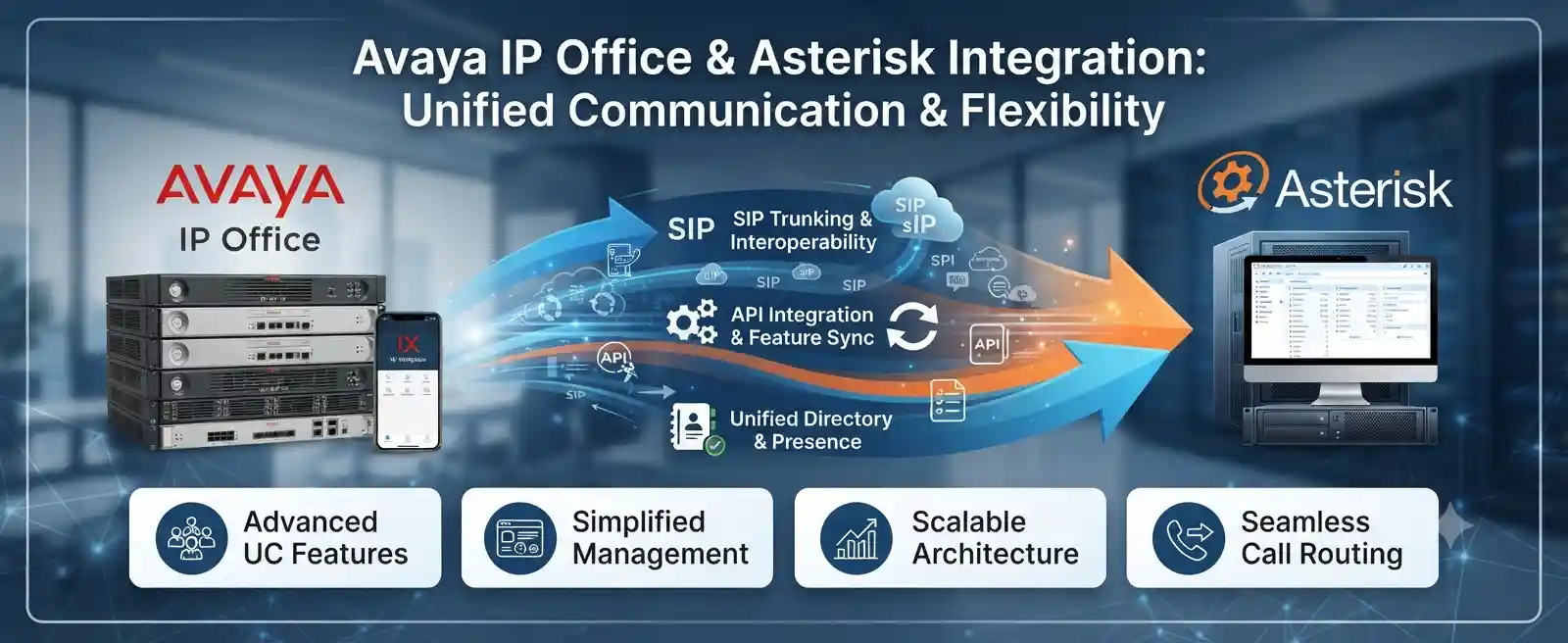
The service connects two separate business telephone platforms so approved call traffic can move between them according to an agreed numbering and routing plan. In a typical design, the platforms communicate through SIP across a trusted network path, with each PBX configured to recognise the destinations that belong on the other side. The integration can support a coexistence period, a multi-site design, a staged migration, a specialist Asterisk application, or a requirement to preserve useful parts of an Avaya deployment while introducing new routing elsewhere.
Businesses should consider this work when they need more than a basic trunk that merely places a test call. A useful integration must account for extension ranges, prefixes, inbound DID handling, caller identification, codecs, DTMF, transfer behaviour, call forwarding, voicemail routing, network security and the features users actually depend on. Before work is confirmed, the customer should prepare platform versions, administrative access through an approved secure method, current number ranges, network details, existing trunks, business-critical call flows and a suitable test window. The exact scope remains configuration, licensing, access and environment dependent.
What the integration service may cover
Depending on the confirmed scope, FourTeck can review the existing Avaya IP Office and Asterisk environments, document the intended relationship between them, establish or correct the SIP connection, align numbering and routing, review the network path, and test representative call scenarios. The objective is to turn two independent PBX systems into a controlled communication path without assuming that every feature on one platform has a direct equivalent on the other.
The service can also include migration planning, route cleanup, technical documentation and coordination with a telecom provider, firewall administrator, managed network provider or application vendor when another party controls a required dependency.
Who may need this work
This type of integration can suit an organisation with an established Avaya IP Office that wants to introduce an Asterisk-based service gradually, a company joining two sites with different PBX platforms, or a technical team using Asterisk for a specialised workflow while retaining Avaya for selected users. It can also help during acquisitions, office consolidation or a phased telephony replacement where a sudden cutover would create unnecessary operational risk.
The service is most useful when the desired call flows are known but the technical path needs assessment. If the requirement is still unclear, discovery should come before configuration so the integration is designed around business use rather than around assumed extension patterns.
Common business triggers for connecting the two PBX systems
An integration request often begins with a business change rather than a telephone fault. The need may be obvious — for example, users on one platform cannot reach users on the other — but the design decision behind that symptom can involve numbering, routing ownership, provider trunks and security boundaries. The following situations are common reasons to assess an interconnection.
Some users or departments move to Asterisk while other extensions remain on Avaya IP Office during a controlled transition.
One location uses Avaya and another uses Asterisk, but staff need predictable internal dialing and call transfer between sites.
Asterisk handles selected applications, IVR logic or routing while Avaya remains the primary system for part of the organisation.
Departments need a shared extension strategy after a merger, office move, branch opening or PBX redesign.
Why an unmanaged PBX interconnection can create repeat problems
A call that connects once does not prove that the integration is complete. Business telephony involves several stages: the originating PBX decides where to send the number, SIP signalling establishes the session, media must flow in the correct direction, both sides must agree on compatible settings, and user-facing features must behave acceptably. A routing error may cause calls to loop, fail with a busy response or reach the wrong destination. A media path problem can allow signalling to succeed while users hear one-way or no audio. Incorrect number presentation can affect callback behaviour, outbound identity or downstream call handling.
There is also an operational cost when nobody can explain which PBX owns a destination. Support teams may change routes on both systems, creating inconsistent logic and making future troubleshooting harder. When a provider trunk is involved, the path can become even less clear because inbound numbers, emergency policies, outbound presentation and external call permissions may still be controlled by one platform. A documented call-flow map reduces that ambiguity.
Integration planning therefore focuses on predictable behaviour, not only connectivity. FourTeck can help identify what must remain local, what must cross between systems, which features require testing and which dependencies belong to third parties. The result of the assessment may be a configuration task, a migration plan, a network change or a recommendation to simplify the design before further expansion.
Possible service scope
The final scope depends on the current environment and approved quotation. Assistance may include the following activities where they are relevant to the agreed objective.
Review PBX versions, extension ranges, trunks, gateways, network paths, dial rules and existing documentation.
Define peer addressing, permitted traffic, transport expectations and the logical relationship between systems.
Map extension ranges, prefixes, public numbers, translation rules and exceptions that must cross the interconnect.
Check routing, VLANs, firewall policies, NAT conditions, bandwidth and any SBC or security controls in the call path.
Test caller identity, DTMF, transfer, forwarding, ringback, voicemail paths and other agreed behaviours.
Protect existing service by documenting backups, maintenance windows, rollback steps and affected users before changes.
Plan coexistence while departments, extensions or trunks are moved in stages where a phased approach is appropriate.
Record the implemented routing logic, tested scenarios, dependencies, exclusions and recommended next actions.
Service-fit matrix: what the observed need may indicate
| Business situation | Relevant assistance | What must be confirmed |
|---|---|---|
| Avaya users cannot dial Asterisk extensions | Route review, SIP reachability checks and number-pattern validation | Extension ranges, route ownership, IP path and rejection details |
| Calls connect but audio is one-way | Media-path, NAT, firewall, RTP and codec assessment | Network topology, security devices, packet path and remote-site conditions |
| A department is moving to Asterisk gradually | Coexistence plan, staged routing and user acceptance tests | Migration order, public numbers, voicemail ownership and rollback needs |
| Caller ID changes or disappears between PBXs | Number format and identity-header review | Expected display, provider rules and internal numbering requirements |
| Transfers or DTMF fail on selected call paths | Feature-specific interoperability testing | Exact call scenario, endpoints involved, codec and DTMF expectations |
Avaya IP Office and Asterisk integration service information
| Main purpose | Controlled call routing and interoperability between Avaya IP Office and Asterisk. |
|---|---|
| Typical systems involved | Avaya IP Office, Asterisk, SIP trunks or peers, network switches, firewalls, gateways, SBCs where present, endpoints and provider services. |
| Assessment method | Configuration review, call-flow mapping, connectivity testing, log or trace review where authorised, and staged functional testing. |
| Remote support suitability | Often suitable for configuration and logical troubleshooting when secure access and a reliable network path are available. |
| On-site support suitability | May be required for gateways, cabling, physical network changes, rack work, local endpoint tests or environments unavailable remotely. |
| Customer information required | Platform versions, extension ranges, trunk details, topology, required call flows, recent changes, business impact and access availability. |
| Security considerations | Authorised access, restricted SIP exposure, appropriate firewall policy, credential handling, trusted network paths and change control. |
| Testing and validation | Scenario based and scope dependent; can include internal calling, public calling, identity, audio, DTMF, transfer, forwarding and failure cases. |
| Scheduling dependency | Depends on engineer availability, customer access, maintenance windows, provider coordination and confirmed scope. |
| Quotation requirement | Scope dependent. Contact FourTeck to confirm assessment, configuration, testing and on-site requirements. |
Remote configuration or an on-site visit?
Remote assistance
Remote work is often practical when the two PBX systems are reachable through approved administrative channels, the internet connection is stable and the issue is primarily logical. Configuration review, dial-plan analysis, SIP peer settings, logs, routing rules and many test calls can be handled without physical access to the rack.
A customer contact should still be available to confirm user experience and business impact. Remote access should be authorised and provided through the customer’s approved secure method; public pages should never be used to exchange passwords or privileged credentials.
On-site assistance
An on-site visit may be appropriate when gateways, physical interfaces, cabling, switch ports, VLAN access, rack equipment or local endpoint behaviour must be inspected. It can also help when the PBX environment is inaccessible remotely, when multiple services share the same network problem or when a planned migration requires coordinated user testing at the office.
Attendance and timing depend on location, site access, engineer availability, required parts or provider involvement and the approved quotation. Some projects combine remote preparation with a planned on-site change window.
How the assessment and integration process can be organised
Identify why the PBXs need to communicate, which users are affected and whether the project is coexistence, migration, branch connectivity, application integration or fault correction.
Review extension ranges, public numbers, trunks, gateways, hunt groups, IVRs, voicemail destinations and any routes already connecting the platforms.
Map IP reachability, routing, VLANs, firewalls, NAT, SBCs and site-to-site links so SIP signalling and media have a controlled path.
Record relevant settings and establish a rollback approach before changing production routes. Availability of backups depends on the systems and access provided.
Configure the agreed SIP relationship and dial patterns at a controlled level, avoiding unnecessary exposure or broad routing permissions.
Validate representative calls from Avaya to Asterisk and back, including the destinations and user features that matter to the business.
Use call evidence and system logs to isolate problems such as number translation, identity, media, DTMF or route selection rather than changing multiple areas at once.
Record the final routing logic, tested scenarios, access dependencies, third-party responsibilities and any follow-up work recommended for maintenance or migration.
Capability focus 1: predictable dial plans across two systems
The dial plan is the practical contract between the platforms. It answers questions such as: which extension ranges belong to Avaya, which belong to Asterisk, how many digits users dial, whether a prefix is required, how public numbers are translated and where a call should go when a destination is not local. Without this ownership model, two PBXs can both attempt to handle the same pattern or neither system may recognise it correctly.
A well-defined plan does not require every site to use identical numbering. It requires each side to know how to reach the other side and how to avoid ambiguous routes. For example, a migration may temporarily reserve one range for users already moved to Asterisk while the remaining ranges stay on Avaya. When the migration progresses, ownership can be shifted in controlled stages. The exact design depends on existing numbers, user habits, provider rules and the intended final architecture.
FourTeck can help document the number map before routes are changed. That reduces the risk of building ad-hoc exceptions that later become difficult to maintain. It also gives administrators a clearer reference for troubleshooting and future changes.
Capability focus 2: SIP signalling, media and feature interoperability
SIP is commonly used to establish the call session between modern PBX platforms, but successful signalling is only one part of the user experience. The network must also allow the related media streams to pass correctly, and the systems need compatible expectations for codecs, DTMF and number presentation. A call can therefore ring and answer while still having one-way audio, failed keypad digits, unexpected caller identity or transfer behaviour that differs from the original platform.
Asterisk deployments commonly use the PJSIP framework for SIP configuration. On the Avaya side, the exact SIP settings, available features and licensing dependencies depend on the IP Office release and configuration. FourTeck does not assume that an older build, a customised dial plan or a provider-specific trunk will behave like a fresh installation. The assessment checks what is actually present and what the business expects to preserve.
Feature testing should be based on real call journeys. If reception transfers calls from an Avaya phone to an Asterisk queue, that path should be tested. If Asterisk sends calls back to an Avaya hunt group, that scenario should also be validated. This is more useful than treating generic SIP registration as proof that the business workflow is complete.
Capability focus 3: safer coexistence during migration or multi-site operation
Many integration projects exist because the business cannot replace one PBX in a single event. Users may need to move department by department, branch by branch or application by application. A coexistence design gives the organisation a controlled period in which old and new environments can communicate while the migration is validated.
That period needs clear ownership. Administrators should know where voicemail lives, which system presents the public caller ID, which PBX owns external trunks, how emergency and special numbers are handled, and how calls behave if the inter-system link is unavailable. A migration plan should also explain how routes are changed, what user testing is required and how to return to the previous state if an approved change does not behave as expected.
For multi-site operation, the same discipline applies even when no migration is planned. Network reliability, security policy, WAN conditions and provider dependencies can affect the interconnect. FourTeck can help separate PBX configuration issues from wider network or telecom dependencies and coordinate the technical information required by other providers.
Dependencies, access and compatibility to confirm before changes
The integration cannot be scoped accurately from platform names alone. Avaya IP Office installations vary by release, licensing, topology, existing trunks and previous customisation. Asterisk systems vary by version, distribution, channel driver, dial plan, modules and the applications built around them. The network path between the systems may also cross firewalls, routers, VPNs, VLANs or an SBC.
The customer should be able to authorise access to both sides or identify the administrator or vendor that can participate. If a carrier controls a SIP trunk, DID mapping or caller-ID policy, provider coordination may be necessary. If the PBXs are in separate locations, site-to-site connectivity and media routing must be understood before assigning a fault to either telephone system.
Credentials should never be posted into a public form or page. Administrative access should be exchanged only through an approved secure method after the customer’s authority and scope are confirmed. Where configuration backups are available, they should be reviewed before significant route changes. Some legacy or unsupported environments may limit the available integration options and can require a separate upgrade or migration discussion.
Risk, limitation and exclusion guidance
Diagnosis depends on the evidence and access available. A failed call may originate from the dial plan, SIP settings, firewall, routing, provider trunk, endpoint behaviour or a third-party application. FourTeck can investigate the layers included in the agreed scope, but some corrections may require action by the telecom carrier, internet provider, software vendor, Avaya support channel, hosting provider or another administrator.
Configuration changes can interrupt active calls if they are made during production use, so a maintenance window may be appropriate. A successful test does not guarantee that every feature combination, endpoint model or future software release will behave identically. Unsupported or heavily customised systems can require additional investigation. Hardware failure, replacement parts, licensing changes, carrier work and unrelated network faults may fall outside the initial integration labour scope.
Final commercial terms depend on the approved quotation or service agreement. The integration should not be treated as risk-free or as a guarantee of zero downtime. Controlled change, backup or rollback planning, representative testing and documentation are the practical safeguards.
Business environments where this integration may be useful
Professional offices
A growing office may keep an established Avaya deployment while moving selected teams to Asterisk. Integration lets internal calling continue while the organisation validates the new environment.
Multi-branch businesses
Different branches may have inherited different PBX platforms. A controlled interconnect can support extension dialing and selected call flows without forcing an immediate replacement project at every location.
Contact and service teams
An Asterisk-based application may serve a queue, IVR or workflow while users remain on Avaya. The important task is to test the actual transfer, identity, audio and routing path users depend on.
Warehouses and operational sites
A site may retain local Avaya phones while a central Asterisk system handles selected routing. WAN stability, network segmentation and local fallback expectations become important design inputs.
Acquisitions and office consolidation
When two organisations combine, PBX integration can provide a temporary bridge while numbering, carriers, applications and long-term telephony direction are assessed.
Migration projects
A staged cutover can reduce the number of users changed at once. It still requires a tested coexistence plan, clear ownership of routes and a process for moving each group safely.
Operational, security and maintenance considerations
Once the integration is working, it should remain understandable to the people who support it. Route names, extension ranges, peer addresses and ownership boundaries should be documented. Changes to firewalls, WAN links, public IP addresses, PBX versions or carrier trunks can affect the path later, so the interconnect should be included in normal change management rather than treated as a permanent invisible bridge.
Security matters because SIP should not be exposed more broadly than necessary. Network policies should permit the required communication between known systems while limiting unwanted access. If an SBC is part of the architecture, its role should be documented. Administrative accounts should be controlled, and credentials should be transferred only through approved secure methods. Logs and traces used for troubleshooting may contain telephone numbers or operational information, so access to them should be limited to authorised participants.
Maintenance planning can include periodic review of route ownership, backups, provider dependencies, documentation accuracy and the continued need for the interconnect. If the integration exists only for a migration, a retirement plan should eventually remove obsolete routes and reduce complexity. If it is a long-term multi-site design, future software upgrades should include regression testing of the agreed cross-platform call scenarios.
Before you contact FourTeck
A useful first conversation is easier when the business can provide a concise picture of the current environment. You do not need to diagnose the integration yourself. The following information helps define the assessment and avoids unnecessary assumptions.
- Office or site location and the main technical contact.
- Avaya IP Office release, topology and known licensing position where available.
- Asterisk version, distribution and SIP channel driver in use.
- Current extension ranges and any overlapping numbers.
- Public DIDs, SIP trunks and which PBX currently owns external calling.
- Required call flows in both directions.
- Examples of failed calls, including time, source and destination.
- Recent PBX, network, firewall or carrier changes.
- Network diagram, IP ranges, VLANs or site-to-site path if documented.
- Firewall or SBC details relevant to the call path.
- Administrative access availability, shared only through an approved secure method.
- Configuration backup status for both platforms where possible.
- User features that must be tested, such as transfer, DTMF or forwarding.
- Business impact, preferred change window and any access restrictions.
Service evaluation and quotation checklist
Before a quotation is finalised, the engagement should define what success means and which tasks are included. A short checklist prevents a simple request for “integration” from expanding into an undefined migration or network project.
How FourTeck can help define and deliver the integration
FourTeck’s role is to connect the business requirement with the technical layers that make the call path work. That can begin with a discovery session to clarify which users and numbers must communicate, followed by a review of the two PBX systems and the network path between them. If the requirement is a fault, the process focuses on evidence and isolation. If the requirement is a project, the process focuses on design, change control, testing and handover.
Where the scope is confirmed, FourTeck can coordinate remote or on-site work, apply approved configuration changes, test the agreed scenarios, explain unresolved dependencies and record the resulting setup. If a carrier, managed firewall provider or another telephony vendor controls part of the path, FourTeck can help organise the technical information needed for coordinated troubleshooting.
For wider company information, visit About FourTeck IT Services. For related technology assistance across networks, systems and communications, see the FourTeck IT Services home page. The final work package, schedule and commercial terms are based on the confirmed environment and quotation.
Dubai and UAE service coordination
For businesses in Dubai and other UAE locations, PBX integration work can often combine remote preparation with planned local assistance. Remote assessment may cover configuration review, routing logic, logs and design discussions. On-site support may be more appropriate when the project includes gateways, physical network changes, cabling, rack access or user testing that requires coordination at the premises.
Service timing depends on engineer availability, customer access, maintenance-window requirements, site conditions, required parts and third-party providers. FourTeck does not assume that every integration can be completed within a fixed period. A small environment with clear access and documented call flows is different from a multi-site migration with overlapping numbering, carrier dependencies and limited change windows.
Contact FourTeck to confirm the service scope and scheduling options before arranging a change. Installation, configuration, migration and maintenance tasks should be explicitly included in the quotation so each party understands the work and responsibilities.
Dubai, Abu Dhabi, Sharjah and Ajman coverage
FourTeck can coordinate Avaya IP Office and Asterisk integration requirements for businesses with sites in Dubai, Abu Dhabi, Sharjah and Ajman, subject to the confirmed scope and scheduling. The most practical delivery method depends on where the PBX systems are located, whether authorised remote access is available, whether physical equipment must be inspected and how the business prefers to manage change windows.
A multi-emirate project may use remote troubleshooting for configuration and planned on-site visits for physical tasks or user acceptance. Travel, building access, security procedures, site readiness, network availability, equipment delivery and carrier dependencies can affect the plan. The assessment should identify these items early so the quotation reflects the work that is actually required rather than assuming identical conditions at every site.
Related FourTeck IT services
Office telephone supportAssess IP phones, call routing, PBX connectivity and related business telephony issues.
Network supportInvestigate routing, switching, VLAN, firewall and connectivity dependencies that can affect VoIP.
IT consultationDiscuss a migration, multi-site design, telephony change or a wider infrastructure assessment.
Why businesses contact FourTeck for PBX integration work
The practical value of integration support is having one technical view of the call path. A telephone issue may begin on the PBX but depend on the network, firewall, WAN link, SIP carrier, gateway or endpoint. When these layers are reviewed together, it becomes easier to separate a configuration problem from a provider or infrastructure dependency.
FourTeck can help turn a loosely defined requirement into a clear work package: what must connect, which systems are involved, what access is required, what can be done remotely, when an on-site visit is justified, what must be tested and what should be documented. This approach is useful for troubleshooting as well as planned migration because it creates a record of the reasoning behind changes rather than relying on trial and error.
The service does not depend on unsupported claims about instant resolution or fixed attendance. It depends on evidence, authorised access, controlled changes and a scope that reflects the real environment. That gives business managers and technical teams a clearer basis for deciding whether the next step should be repair, reconfiguration, expansion, migration or retirement of legacy routes.
Questions businesses often ask before choosing an Avaya–Asterisk integration approach
The questions below address the decision stage that usually comes before configuration. They are intended to help a business understand what can be assessed, what information improves the quotation and where technical or third-party dependencies can change the final design.
Can Avaya IP Office and Asterisk connect directly using SIP?
A SIP-based interconnection is a common technical approach, but “directly” still depends on the environment. The systems need IP reachability, compatible SIP settings, a defined trust or authentication method, usable number routes and an allowed media path. A firewall, SBC, VPN or routed network may sit between them. The Avaya release, Asterisk configuration and existing provider design also matter. The safest first step is to document the desired call flows and verify how each PBX currently handles SIP before creating production routes.
Can the integration be checked remotely?
Often, yes. If both PBXs can be reached through approved administrative access and the internet or private network is stable, many configuration checks can be completed remotely. That includes dial-plan review, SIP settings, routing logic, logs and test-call analysis. Remote work is less suitable when the problem may involve cabling, gateways, physical interfaces, local switching, rack equipment or a site network that cannot be reached reliably. A local contact can also be useful to verify handset behaviour during testing.
When is an on-site visit usually needed?
An on-site visit is more likely when the integration includes physical changes or when remote evidence cannot isolate the problem. Examples include checking a voice gateway, tracing a network port, confirming VLAN access at a site, replacing or moving equipment, validating cabling or coordinating a department migration. Some projects benefit from remote preparation first, followed by a shorter planned site visit for physical work and user acceptance. The final decision depends on access, location, scope and the affected infrastructure.
Why do calls ring but have no audio or one-way audio?
Ringing confirms that at least part of the SIP signalling path is working; it does not prove that the media path is correct. Audio can be affected by IP routing, NAT, firewall policy, advertised media addresses, VPN behaviour, codec negotiation or an SBC. The same symptom can have different causes, so changing codecs at random is not a reliable diagnosis. FourTeck can review the network path and call evidence included in the scope, then determine whether the corrective action belongs on a PBX, network device or third-party service.
What should we prepare before requesting a quotation?
Prepare the outcome you want, the sites involved, approximate user groups, the Avaya IP Office and Asterisk versions if known, extension ranges, public numbers, provider trunks, relevant network details and examples of the call paths that must work. Also confirm whether administrators can provide authorised access and whether a maintenance window is available. If the integration is part of a migration, explain which users move first and what must remain operational during the transition. This information helps distinguish a small routing task from a broader migration or network project.
Can we keep the Avaya system while moving selected users to Asterisk?
A coexistence model can be possible when the platforms, network and numbering plan support the required routes. The design should define which extensions remain on Avaya, which move to Asterisk, where inbound public calls land, how users reach each other and which features must work across the boundary. A staged migration also needs rollback and user communication. It is better to plan these items before the first department moves, because retrofitting route logic after users are live can create unnecessary complexity.
Do all Avaya features automatically work on Asterisk after integration?
No. An inter-system SIP connection should not be assumed to reproduce every proprietary or platform-specific feature. Basic call routing may work while transfer, diversion, voicemail indicators, special headers, presence or application integrations behave differently. The right approach is to list the features the business actually needs across the boundary and test them as individual scenarios. If a feature has no compatible behaviour, the project can then decide whether to keep that function on one PBX, change the workflow or use another supported method.
Should both systems share one extension range?
Not necessarily. A shared range may look simple but can create ambiguity if both PBXs believe the same number is local. Separate ranges are often easier to route during coexistence, while translation rules can preserve familiar dialing where required. Existing numbers, user habits and migration goals should guide the decision. The key is not whether the ranges look neat; it is whether each destination has one clear owner and whether the routing logic is easy to understand, test and later change.
What can affect caller ID between Avaya and Asterisk?
Caller identity can be influenced by number formatting, SIP headers, route rules, provider requirements and how each PBX distinguishes internal and external calls. An integration may need to translate a short extension into another format or preserve an original public number. The expected result should be agreed before configuration. If the same call later exits through a carrier trunk, the provider can apply its own restrictions, so the complete path should be considered rather than testing the PBX interconnect in isolation.
Is this a troubleshooting job or a migration project?
It depends on the objective. If an existing interconnect used to work and has developed a specific fault, the initial task is troubleshooting: collect evidence, identify what changed and isolate the failing layer. If the systems have never been connected or users are being moved between platforms, the work is a project involving discovery, design, backups, change planning, user acceptance and documentation. A clear quotation should separate immediate fault diagnosis from migration activities when both are required.
What if our firewall or telecom provider is managed by another company?
That is common in business environments. The important step is to identify which party controls each dependency and arrange authorised coordination. FourTeck can provide the technical observations and requirements from the PBX side, while the firewall provider or carrier applies the changes within its responsibility. This avoids broad security changes made without context. Scheduling can take longer when several providers must work within the same maintenance window, so third-party involvement should be disclosed during planning.
How do we know the integration is ready for users?
Readiness should be based on agreed test cases rather than a single successful call. The test plan can include Avaya-to-Asterisk calls, Asterisk-to-Avaya calls, external calls where relevant, caller identity, audio in both directions, DTMF, transfers, forwarding, hunt or queue destinations, voicemail paths and any business-specific scenarios. The implementation should also have documented routes, known limitations, rollback information and an identified support contact. If a migration is staged, a small pilot group can be useful before more users are moved.
Testing, validation and handover
Testing should mirror real use. A technical team can first verify reachability and basic calls, then move into the business scenarios that matter: reception transferring to another department, a remote branch reaching headquarters, an Asterisk queue handing a call to an Avaya extension, a user sending DTMF to an IVR or a public call returning through the expected trunk. Where practical, test cases should include both success and controlled failure so administrators understand what happens when a destination is unavailable.
Validation also includes listening for two-way audio and checking number presentation at each stage. If the integration relies on a site-to-site link or firewall rule, the test should confirm that the chosen path is stable under normal conditions. Security validation should ensure that only the required connectivity has been opened and that unnecessary exposure has not been introduced for convenience.
The handover can record peer addresses, route ownership, number translations, tested features, known exceptions, provider dependencies, backup locations where applicable and the change history. Documentation does not need to disclose passwords. It should explain enough of the architecture that a future administrator can understand why a route exists and what to check before changing it.
For migration projects, the handover should also identify which users remain on each platform and what the next stage involves. For a permanent interconnect, it should become part of the organisation’s telephony and network documentation so later firewall, WAN or PBX upgrades include the link in their change plans.
Frequently asked questions
What is included in Avaya IP Office and Asterisk integration?
The scope may include discovery, SIP interconnect configuration, dial-plan mapping, network checks, feature testing, documentation and migration planning. The actual inclusions depend on the existing systems, access and approved quotation.
Can FourTeck fix an existing interconnect that stopped working?
FourTeck can assess an existing fault by reviewing symptoms, recent changes, call routes, SIP evidence and network dependencies included in the scope. A specific cause should not be assumed until the environment is checked.
Do we need a maintenance window?
A maintenance window may be appropriate when production routing, trunks, firewall rules or shared PBX settings will change. The need and duration depend on the environment, business impact and rollback plan.
Will the integration require new licences?
Licensing is platform and configuration dependent. The Avaya IP Office release, enabled features, existing licences and Asterisk components should be reviewed before any licensing requirement is stated as definite.
Can the same SIP carrier be used by both PBXs?
Possibly, but carrier policies, registration methods, number ownership and the preferred call architecture must be confirmed. In some designs one PBX remains the carrier-facing system and routes selected calls to the other.
Can calls transfer between Avaya and Asterisk users?
Transfer can be tested as part of the agreed interoperability scope, but behaviour depends on the platforms, endpoints and call path. It should be validated with the actual user scenario rather than assumed from basic SIP connectivity.
What access does FourTeck need?
Access depends on the task. Administrative visibility into both PBXs and relevant network devices may be needed, subject to customer authorisation. Credentials should be shared only through an approved secure method after scope confirmation.
Does the service include firewall changes?
Firewall review may be part of the scope, but changes are environment and ownership dependent. If another provider manages the firewall, coordinated action and separate approval may be required.
Can this support a full move away from Avaya later?
The interconnect can form part of a staged migration, but a full migration requires a separate review of users, numbers, trunks, applications, endpoints, voicemail, features, licensing, data, cutover planning and post-move support.
Is support available across the UAE?
FourTeck can coordinate service for Dubai and wider UAE requirements, including Dubai, Abu Dhabi, Sharjah and Ajman. Remote or on-site delivery depends on location, access, scheduling and the confirmed quotation.
Plan the integration around your real call flows
Share the two PBX versions, extension ranges, network path, required call scenarios and the reason for the integration. FourTeck can review the environment and prepare a scope for assessment, configuration, testing, documentation or staged migration work.