
BUSINESS TELEPHONY INTEGRATION
Asterisk and Panasonic PBX Integration in Dubai, UAE
Connect an Asterisk environment with an existing Panasonic PBX through a planned, testable integration that respects current numbers, extensions, call flows, network conditions, user expectations, and rollback requirements.
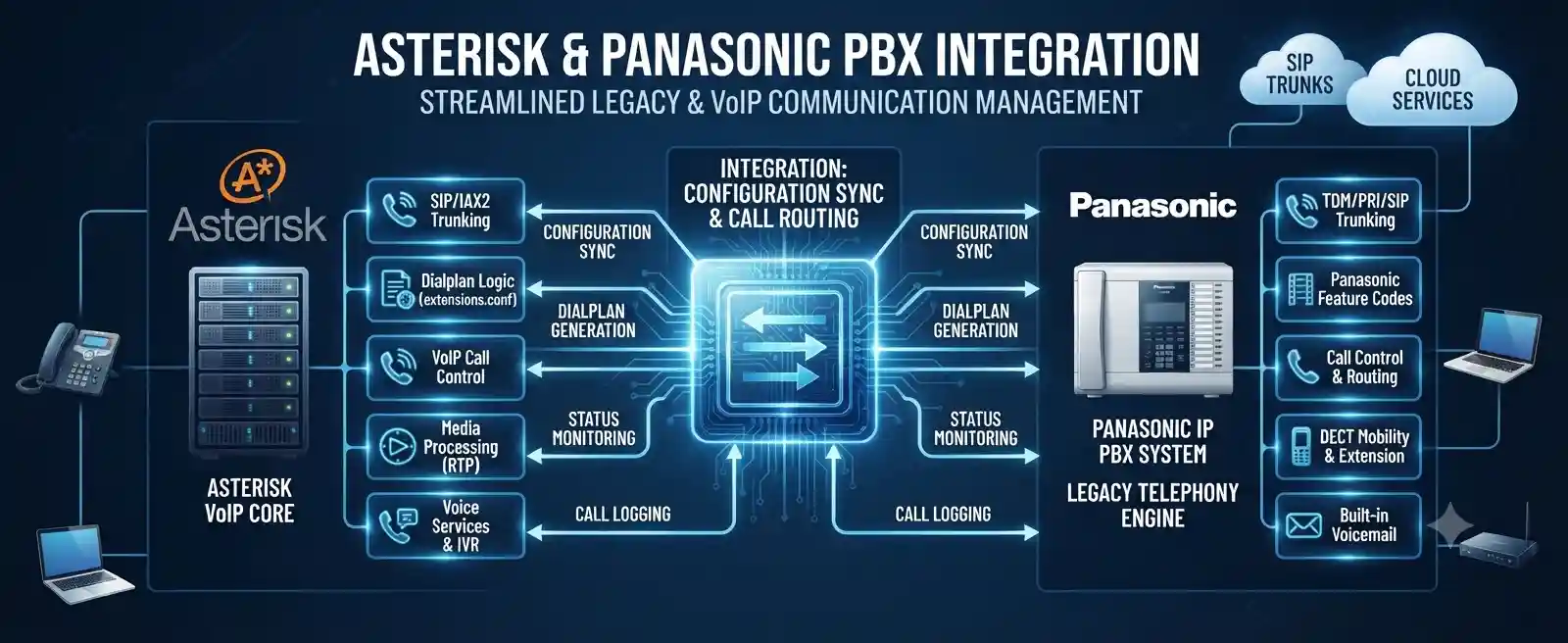
Controlled inter-PBX call routing
Compatibility and dial-plan mapping
Backup, test, validate, document
Remote or on-site as required
What does Asterisk and Panasonic PBX integration mean?
It means creating an approved voice connection and routing relationship between an Asterisk-based telephony system and a Panasonic PBX so calls can pass between the two environments according to defined business rules. The integration may be used to connect extension ranges, preserve an existing Panasonic system during a staged change, route selected calls through Asterisk, link departments or sites, or test a migration path without replacing everything at once. The correct technical design cannot be chosen from the platform names alone. FourTeck first needs the exact Panasonic model and software condition, the Asterisk release and SIP channel configuration, the current carrier trunks, extension numbering, network topology, security controls, and the call flows the business expects. The scope is therefore configuration and environment dependent. A current backup, authorised administrative access, a test plan, and an agreed maintenance window may also be required before live routing is changed.
What the integration service can cover
Depending on the confirmed scope, the work may include reviewing both PBX environments, identifying usable interconnection methods, checking SIP capability, mapping extension ranges, defining inbound and outbound routes, planning prefixes, checking caller identification behaviour, reviewing codecs and media paths, confirming network reachability, controlling firewall exposure, preparing backups, testing a pilot call path, and documenting the final configuration. Where existing analogue, ISDN, SIP, PRI, E1, gateway, or carrier services are involved, those dependencies must be identified rather than assumed.
Modern Asterisk deployments normally use the PJSIP stack. Older Asterisk environments may still contain legacy SIP configuration and should be reviewed carefully before changes, especially because older drivers and historical configuration practices may no longer match current Asterisk releases. Panasonic capability also varies by PBX family, model, firmware, licensing, and the ports or interfaces already in use. The service therefore begins with evidence, not with a generic configuration template.
Who may need this service?
The service may suit a business that has a working Panasonic PBX but wants to add Asterisk for selected routing or applications, a company planning a phased PBX migration, a multi-site organisation that needs a controlled voice link between platforms, or a team investigating failed calls between an existing Panasonic system and an Asterisk server. It can also support organisations that inherited an undocumented telephone environment and need the existing call behaviour mapped before any changes are made.
Typical customers include offices, warehouses, clinics, training centres, retail operations, hospitality sites, property-management teams, project offices, and multi-branch businesses where telephony is linked to reception, customer service, operations, security, or internal coordination. The final design depends on how the telephone system is actually used, not simply on the number of extensions installed.
Business situations that often trigger an integration request
A staged PBX migration
A business may want to move users or call flows gradually rather than replace the Panasonic PBX in one event. Integration can provide a temporary or longer-term bridge, but numbering, routing ownership, voicemail, reception logic, emergency calling, carrier trunks, and rollback all need to be planned.
Two extension groups cannot call each other
Users may report busy tones, rejected calls, wrong caller ID, one-way audio, or calls reaching the wrong destination. These symptoms can come from dial-plan rules, SIP signalling, codec negotiation, network routing, NAT, firewall policy, numbering overlap, or a platform setting. Diagnosis should isolate the layer before configuration changes are made.
A new branch or department
Asterisk may be introduced at a new site while a Panasonic PBX remains at the main office. The design then needs to consider WAN or VPN connectivity, latency, voice VLANs, IP addressing, security, failover expectations, numbering, carrier routing, and what happens when the link between locations is unavailable.
Poor documentation after previous changes
A system may technically work but remain difficult to support because extension ranges, trunks, gateways, route patterns, schedules, and administrative ownership are unclear. Mapping the environment before integration reduces the risk of breaking call paths that nobody realised were still in use.
Why integration problems can affect more than the phone system
A voice integration sits across several technical layers. A call may start at a Panasonic extension, be converted or routed through the Panasonic PBX, traverse a network or gateway, reach Asterisk through SIP signalling, establish an RTP media path for the audio, and then continue to another extension or carrier. A failure at any point may appear to the user simply as “the call is not working.” That is why a useful assessment considers signalling, media, network paths, address translation, firewall rules, number formatting, codecs, trunk capacity, user permissions, time conditions, and the external carrier where relevant.
If these dependencies are not understood, repeated faults can affect reception, sales calls, support teams, internal transfers, branch communication, voicemail, scheduled routing, or outbound calling. A rushed change can also create new problems such as duplicate extension patterns, loops, inconsistent caller identification, calls taking an unintended carrier route, or audio failing after the signalling has succeeded. The business impact is not necessarily a complete outage; partial and intermittent failures can be more difficult because they generate user complaints without a simple pattern. FourTeck therefore treats the integration as a controlled service change rather than a one-line trunk configuration.
Possible service scope
Depending on the confirmed environment, FourTeck assistance may include the following activities. These are examples of possible work, not a statement that every item is included in every quotation.
Service-fit matrix
| Business situation | Relevant assistance | What must be confirmed |
|---|---|---|
| Keep Panasonic while introducing Asterisk | Inter-PBX route design and staged testing | Panasonic SIP or gateway capability, numbering, route ownership and rollback |
| Calls connect but audio is one-way or absent | Signalling and media-path troubleshooting | Network path, NAT, firewall, RTP handling and codec negotiation |
| Branch users need to dial head-office extensions | Extension plan and site-to-site routing | WAN or VPN quality, overlapping extension ranges, security and outage behaviour |
| Legacy configuration is undocumented | Discovery, export, route mapping and documentation | Administrative access, backup status and identification of critical call flows |
| Business wants to retire Panasonic later | Migration dependency mapping and phased cutover planning | Extensions, trunks, features, voicemail, call groups, prompts, devices and user acceptance |
Service information to confirm before work begins
| Main purpose | Connect or troubleshoot call routing between Asterisk and a Panasonic PBX. |
|---|---|
| Typical systems involved | Asterisk server, Panasonic PBX, IP network, switches, firewall, gateways, SIP trunks, carrier services and user phones as applicable. |
| Remote support suitability | Suitable for many authorised configuration reviews, logs, routing checks and controlled tests when secure access is available. |
| On-site suitability | May be required for PBX hardware access, cabling, physical gateways, network ports, local carrier equipment or tests that cannot be completed remotely. |
| Customer access required | Authorised administrative access and a responsible customer contact. Credentials should be shared only through an approved secure method after authorisation is confirmed. |
| Backup considerations | Current exports or configuration backups should be available where the platform supports them, with a practical rollback plan for production changes. |
| Scheduling dependency | Scope, engineer availability, customer access, maintenance window, site conditions, vendor involvement and carrier dependencies. |
| Quotation | Required after the environment and requested outcome are understood. Additional hardware, licences or third-party services are separate unless explicitly included. |
Remote integration work versus on-site assistance
When remote work may be suitable
Remote assistance can be practical when the Asterisk and Panasonic systems are already reachable through authorised management paths and the required evidence can be collected without touching physical equipment. Typical remote tasks include reviewing Asterisk PJSIP objects, checking route patterns, examining call logs, comparing extension plans, validating IP connectivity, reviewing firewall rules with the authorised administrator, checking number formats, monitoring a test call, and documenting current behaviour. A knowledgeable on-site contact may still be useful for placing calls, confirming handset displays, checking lights or status indicators, and testing both directions.
Remote access must be approved by the customer and should not be created by bypassing existing security controls. If the remote session depends on the same unstable network that is causing the voice fault, an on-site assessment may be more efficient.
When an on-site visit may be needed
On-site work is more appropriate when the problem includes physical interfaces, gateways, PBX cards, patching, cabling, power, local network ports, switch configuration that cannot be reached remotely, or carrier handoff equipment. It may also be useful when several departments must test different call paths, the existing environment is poorly documented, or the engineer needs to trace how legacy telephone equipment is physically connected.
An on-site visit does not automatically mean that all integration work can be completed during one attendance. Compatibility findings, missing licences, unavailable credentials, carrier actions, replacement interfaces, or a required maintenance window can extend the project. FourTeck can use the visit to establish evidence and define the remaining work accurately.
How the assessment and discovery process usually works
- Define the business outcome. FourTeck first confirms why the systems need to be connected. The goal may be extension-to-extension calling, temporary coexistence during migration, branch connectivity, a new outbound path, access to Asterisk-based routing, or fault correction.
- Identify affected users and critical call flows. Reception, customer service, sales, support, finance, security desks, hunt groups, queues, voicemail destinations and external numbers may have different requirements. Critical routes should be identified before changes begin.
- Inventory both platforms. The Panasonic model, firmware or software status, expansion or interface cards, SIP capability and licensing are reviewed where information is available. The Asterisk version, deployment method, PJSIP configuration, dial plan and any front-end management layer are also identified.
- Map current numbering. Extension ranges, direct numbers, prefixes, short codes, operator destinations, carrier routes and special patterns are documented to prevent overlap or accidental loops.
- Check the network path. IP addressing, routing, VLANs, firewall policy, NAT, DNS where relevant, site-to-site connectivity and the expected SIP and RTP path are reviewed. Voice problems often appear to be PBX faults when the actual issue is between the systems.
- Collect evidence from failed or successful calls. A known test case is useful: calling number, called number, direction, time, observed result and whether audio is present both ways. Logs can then be correlated with the user report.
- Confirm backup and rollback. Existing configuration should be preserved where possible. A clear restoration path is important before route tables, trunk settings or network policies are modified.
- Choose a pilot path. Rather than redirect every call immediately, a small controlled route or test extension can be used to validate signalling, media and number formatting.
- Review the findings with the customer. If additional licensing, hardware, gateway work, carrier action, or an on-site visit is needed, the dependency is explained before the next stage.
Planning the configuration and implementation
Once discovery confirms that an integration path is appropriate, the next step is to define how each system will recognise and route calls to the other. This is not only a question of creating a SIP peer or trunk. The dial plan must decide which numbers belong to Panasonic, which belong to Asterisk, how a user reaches the other system, whether prefixes are visible to the caller, how caller identification is presented, what happens to calls outside office hours, and which system owns the external carrier path. If the two PBXs contain overlapping extension ranges, a translation or numbering strategy may be required before users can call reliably between them.
Asterisk configuration should use a method appropriate to the installed release and architecture. Current Asterisk documentation treats PJSIP as the standard SIP driver, so a new design should not blindly copy old chan_sip examples from historic deployments. On the Panasonic side, available SIP trunk behaviour and configuration options depend on the exact PBX family, model, firmware and licensing. Some Panasonic KX-NS environments, for example, include documented SIP trunk capabilities, but that does not mean every Panasonic PBX supports the same integration method. FourTeck therefore checks the specific system before proposing a route.
Network and security design are planned at the same time. The two systems need only the connectivity required for the approved design. Broadly exposing a PBX to the internet is not a substitute for correct routing. Where systems are on separate networks or sites, the project may need VPN, firewall rules, address planning, or other controlled connectivity. Media ports and NAT behaviour must be considered because SIP signalling can succeed even when RTP audio cannot reach the destination.
A change window is selected according to business impact. Backups or configuration exports are taken where supported, existing routes are recorded, and a rollback decision point is defined. The implementation is then applied in small stages so that each result can be tested before the next route is enabled. The exact sequence depends on whether this is a new integration, a repair of an existing trunk, or part of a larger migration.
Testing, validation, and handover
A successful registration or trunk status is not enough to prove that the business call flow works. Validation should include representative calls in both directions and should reflect how staff actually use the system. Depending on scope, tests may cover extension-to-extension calls, external inbound calls, outbound calls, attended and blind transfers, DTMF interaction, caller identification, ring groups, reception routing, voicemail diversion, office-hours behaviour, call forwarding, and calls between branches. Audio quality should be checked in both directions, not only whether the call connects.
If a fault appears only on certain destinations or at certain times, the test record should capture the calling number, destination, time, route taken and user-observed symptom. That creates evidence for reviewing logs or escalating to a carrier or third-party system. Testing is also a security and change-control activity. Unexpected external access, unplanned route permissions, or open firewall paths should not be introduced simply to make a test pass.
Handover can include a summary of the integration purpose, the route relationship between Asterisk and Panasonic, key addressing or trunk dependencies, extension patterns, backup location, known exclusions, test results, and any recommended follow-up work. If the integration is only a temporary bridge during migration, the documentation should also state which components are expected to be retired later so temporary routing does not become an undocumented permanent dependency.
1. Safer coexistence during a phased migration
A controlled link between the two PBXs can support a transition where some users remain on Panasonic while other users or services move to Asterisk. The important outcome is not simply that both platforms can call each other. The business needs predictable numbering, clear route ownership, tested external calling, and a plan for what happens when the interconnection is unavailable. A phased approach can reduce the pressure of moving every extension in one event, but it adds a temporary dependency that must be documented and monitored. The value comes from using the integration to make change manageable rather than allowing it to become an unexplained bridge that nobody wants to touch later.
2. Faster fault isolation between signalling, media, and network
PBX integration faults are easier to resolve when the service separates the call into technical layers. SIP signalling determines how the call is invited, accepted, redirected or rejected. Media transport carries the voice. The IP network, firewall and NAT behaviour influence whether those packets reach the correct destination. Dial-plan logic decides which route is selected. A carrier may add another layer for external numbers. By testing these elements methodically, FourTeck can avoid assuming that a busy tone proves a Panasonic fault or that one-way audio proves an Asterisk fault. The same visible symptom can come from multiple places, so evidence-based troubleshooting protects existing working routes from unnecessary changes.
3. Better documentation for future support
Telephone environments often accumulate changes over many years. Extensions are reassigned, trunks change, reception logic is updated, gateways are added, and previous engineers may leave without documenting why a route exists. Integration work is an opportunity to create a clearer record of what each system does. Useful documentation can show the extension ranges on each platform, the route used between systems, important IP addresses, carrier dependencies, test numbers, backup references, and the expected behaviour of critical calls. This helps future troubleshooting, staff changes, office moves and eventual migration because the next engineer begins with a map instead of guesswork.
Dependencies, access, compatibility, and customer inputs
The integration can only be confirmed after the specific environment is understood. Panasonic PBX capabilities vary by platform, interface, firmware and licensing. An older digital or hybrid system may require a gateway or a different interconnection method from a newer IP-capable PBX. Asterisk behaviour also depends on release, modules, operating system, dial-plan design, security controls and how it is managed. The network between the systems must support the required signalling and media paths with suitable quality.
FourTeck may need authorised access to the Asterisk administration environment and the Panasonic PBX management interface, plus network or firewall access when those systems affect the call path. The customer should nominate a person who can approve changes and confirm the expected business call flows. Where telecom-provider numbers, SIP trunks, PRI/E1 services, gateways or hosted services are involved, provider account or technical information may be required. Do not send passwords through public web forms. Credentials should be exchanged only after the engagement is confirmed and through an approved secure method.
A maintenance window may be needed when live routes are changed. The customer should identify call paths that cannot be interrupted, such as reception, customer service, building security, operations or emergency procedures. Where a complete backup cannot be obtained because of platform age or access limitations, that risk should be discussed before changes proceed.
Risk, limitation, and exclusion guidance
An integration assessment can identify a practical path, but it cannot remove every dependency from an existing telephone environment. Some Panasonic systems may not support the required SIP method without licences, interface hardware or a gateway. Legacy platforms may have limited management options or may be outside normal vendor support. Asterisk systems that have been heavily customised can also require additional discovery because route logic may be spread across configuration files, dial-plan contexts, scripts, front-end tools or third-party applications.
Carrier behaviour matters whenever external calls are involved. Number presentation, registration, inbound DID routing, emergency calling, international calling and codec policy may be controlled partly by the telecom provider. FourTeck can gather technical evidence and coordinate with the relevant provider when needed, but third-party actions and timelines are outside the direct configuration scope unless specifically agreed.
Changes to firewall rules, SIP settings, NAT, routing or dial plans can interrupt voice service if applied without a validated plan. Backups, maintenance windows, staged testing and rollback are therefore important. A successful test call also does not prove that every destination, transfer scenario, after-hours condition or branch route will behave correctly. The test plan should represent the important business cases.
Hardware faults, replacement cards, gateways, licences, structured cabling, carrier work, new phones and other equipment are not automatically included in configuration labour. On-site work depends on location, access, scheduling, site conditions and the confirmed quotation. Final commercial terms depend on the approved scope.
Suitable business environments and use cases
Asterisk and Panasonic PBX integration can be relevant anywhere a business wants to connect an established telephone system with a more flexible IP telephony environment without treating the project as a simple equipment replacement. In a professional office, the priority may be preserving reception and direct-dial behaviour while a new platform is introduced. In a warehouse or logistics operation, extension groups may need to remain available to supervisors, gate staff and operations teams while a branch system changes. In a clinic, front-desk and appointment calling may be business critical, so the test plan must reflect inbound reception, transfers and after-hours routing. In a training centre or school office, the requirement may be straightforward internal extension connectivity between buildings or systems.
Retail and hospitality locations may need multiple sites to share a numbering plan while keeping local call handling independent. Property-management teams may have legacy Panasonic systems connected to security desks or maintenance functions that cannot be moved without careful mapping. Multi-branch companies may use Asterisk at newer locations while an older Panasonic PBX remains at headquarters. In each case, the useful question is not “Can these brands connect?” in the abstract. It is “Can this exact Panasonic environment and this exact Asterisk deployment be connected in a way that preserves the business call flows we actually use?” The answer depends on model, interfaces, software, licensing, network design and the required outcome.
Operational, security, and maintenance considerations
Voice integration should be maintained as part of the wider business network. IP addresses, firewall rules, DNS records where applicable, VLANs, VPNs, gateway routes and carrier endpoints can all change over time. A PBX may continue working after a network change but fail later when a lease, route or registration state changes. For that reason, the integration record should identify the technical dependencies that must be considered during future firewall upgrades, office moves, ISP changes, subnet changes or server migrations.
Security should focus on controlled reachability and least-required access. Exposing SIP services broadly to the public internet can create avoidable risk. Administrative interfaces should be protected, credentials should be managed securely, and route permissions should reflect business needs. Where remote administration is required, it should use an authorised and supportable method rather than temporary shortcuts that remain in place after the project.
Maintenance also includes configuration backups, documentation review and periodic test calls across critical routes. If the integration is part of a migration, temporary rules should be removed when they are no longer needed. If it remains permanent, ownership should be clear: who manages Asterisk, who manages Panasonic, who owns the carrier relationship, and who must be contacted when a route fails? Clarifying these responsibilities can reduce the time spent deciding which vendor should investigate an incident.
Before you contact FourTeck
Preparing the following information can make the initial assessment more useful. It is fine if some details are unknown; the list helps identify what may need to be discovered.
Service evaluation and quotation checklist
How FourTeck can help define the engagement
FourTeck can begin by clarifying the business requirement and identifying what information is already available. If the system is operational but needs a new interconnection, the first stage can focus on architecture, compatibility and change planning. If calls are already failing, the first stage can focus on evidence collection, route tracing, network checks and reproducing a known test case. If the integration supports a migration, discovery can document users, extensions, trunks, groups, prompts, schedules and carrier dependencies before a cutover plan is prepared.
The service can coordinate technical checks across the Asterisk server, Panasonic PBX, local network, firewall, branch connectivity and telecom provider where these elements are relevant. Findings are explained in practical business terms: what is confirmed, what is still uncertain, what action is recommended, and what depends on a third party. Approved configuration changes can then be planned with backup, testing and rollback considerations.
FourTeck’s wider business IT support environment is useful when telephony depends on network, firewall, server or site infrastructure rather than the PBXs alone. Customers can also review FourTeck IT services information before requesting a quotation. Final scope is based on the actual environment and authorised work required.
Dubai and UAE service coordination
Asterisk and Panasonic PBX integration can often begin with a remote review when secure access and usable internet connectivity are available. This can help establish the current configuration, identify the likely integration method, review logs, and prepare a test plan before physical work is scheduled. An on-site visit may be recommended when the project includes PBX cards, gateways, cabling, network ports, rack equipment, local carrier handoff, or an environment that cannot be assessed reliably from remote access.
For Dubai and wider UAE customers, scheduling depends on the confirmed scope, engineer availability, customer access, building procedures, maintenance windows, equipment or licence availability, and third-party providers. The quotation should clearly state whether the engagement covers assessment only, configuration, on-site work, gateway installation, network changes, carrier coordination, testing, documentation, or follow-up support. This avoids assuming that a single task automatically includes every dependency around it.
Contact FourTeck to confirm the service scope and scheduling options for your location. No fixed attendance time or project duration is assumed before the environment is reviewed.
Service coordination across Dubai, Abu Dhabi, Sharjah, and Ajman
Businesses in Dubai, Abu Dhabi, Sharjah, and Ajman may require different combinations of remote review and planned on-site assistance. A multi-site organisation might have Asterisk at one branch and a Panasonic PBX at another, while a single-site business may need both systems assessed in the same communications room. FourTeck can review the requirement and determine whether remote troubleshooting, a planned site visit, configuration work, migration preparation, or wider network assistance is appropriate.
Travel, building access, site induction, security approvals, maintenance windows, equipment availability, local network conditions, and telecom-provider dependencies can affect the service plan. Where several sites are involved, it is useful to nominate one technical contact and agree a consistent test matrix so the same calling scenarios can be checked at each location. The service does not assume permanent engineer presence in every emirate; coordination is arranged according to the confirmed request and approved quotation.
Related FourTeck service areas
IP PBX support
For call routing, extension changes, SIP trunk coordination, queues, voicemail, and existing PBX troubleshooting. Review the FourTeck services overview.
Network support
For VLANs, switching, routing, firewall paths, branch connectivity and voice-network dependencies that affect SIP signalling or RTP audio.
Office telephone support
For business phones, extension provisioning, reception call flows, relocation work and user-facing telephone issues.
Business IT assessment
For wider reviews where the PBX integration depends on servers, firewalls, WAN links, network documentation or multiple business sites.
Why businesses contact FourTeck for a mixed telephony environment
A mixed PBX environment can involve more than one vendor, one support history and one set of assumptions. Businesses often need someone to look across the complete path rather than stop at the edge of a single platform. FourTeck can help clarify whether the next action belongs on Asterisk, Panasonic, the firewall, the IP network, a gateway, the carrier, or a combination of those areas. That broader view is useful when two vendors each report that their own system is functioning while users still cannot complete calls.
The service emphasis is on a clear initial assessment, controlled configuration work, practical explanation of findings, and documentation that makes future support easier. For planned changes, the focus is on backups, maintenance windows, test cases and rollback. For faults, the focus is on reproducible evidence rather than assumptions. For migrations, the focus is on mapping current call behaviour before users are moved. FourTeck can also coordinate remote and on-site work depending on whether the issue is logical, physical or spread across several technical layers. The final engagement remains subject to confirmed access, environment and quotation.
Questions businesses commonly ask before connecting Asterisk and Panasonic
Can Asterisk connect to every Panasonic PBX?
No single answer applies to every Panasonic model. Some Panasonic PBX families provide SIP trunk capabilities, while older or differently configured systems may require specific interface cards, licensing, gateways, or another interconnection method. The exact model, firmware, installed options and current use of ports must be checked. On the Asterisk side, the available SIP configuration also depends on the installed release and architecture. A useful first step is to provide the Panasonic model and Asterisk version rather than assuming that a configuration copied from another site will apply. FourTeck can review the environment and identify whether a direct IP integration is practical or whether another design should be considered.
Can the two PBXs share extension numbers?
They can often be designed so users on one system can dial users on the other, but overlapping extension numbers create a routing problem that must be resolved deliberately. If extension 201 exists on both systems, each PBX needs a rule that identifies which destination the caller actually means. Options may include prefixes, translated ranges, temporary migration numbers or a revised numbering plan. The best choice depends on user habits, reception workflows and how long both systems will coexist. Before work begins, prepare the current extension lists from both systems and identify any numbers that must remain unchanged. That information allows the dial plan to be designed around real business use instead of discovering conflicts during testing.
Why do calls connect but have one-way audio?
A call can signal successfully while the voice media follows a different or blocked path. One-way audio can be associated with RTP routing, NAT, firewall rules, incorrect address information, VPN behaviour, codec handling, or a gateway between the systems. It should not be treated as proof that either PBX is defective. Troubleshooting normally starts with a known test call and checks which side can hear, which addresses and ports are negotiated, and whether the media packets can reach both directions. If the PBXs are at different sites, WAN design and security policy become especially important. FourTeck can review signalling and network evidence together so the corrective action targets the actual layer involved.
Is remote support enough for this integration?
Remote support may be enough when both management interfaces are securely accessible, the network path is known, a customer contact can place test calls, and no physical equipment must be installed or traced. It can be suitable for configuration review, logs, dial-plan analysis, PJSIP settings, route changes and controlled testing. An on-site visit is more appropriate when the Panasonic PBX requires physical card checks, a gateway must be installed, cabling or switch ports are uncertain, the network cannot be reached remotely, or the site is too undocumented to understand from screenshots alone. Some projects begin remotely and move on-site only after the discovery stage identifies the physical work required.
Can we keep the Panasonic PBX while moving users to Asterisk gradually?
A phased migration may be possible when the two environments can be connected reliably and the business accepts the temporary complexity of running both systems. The project should define which extensions remain on Panasonic, which move to Asterisk, how internal calls cross between systems, which platform controls external trunks, how voicemail and reception behave, and what happens if the inter-PBX link fails. The migration plan should also include a clear retirement path so temporary routing is removed when no longer needed. Before choosing this approach, compare the benefit of reduced cutover pressure with the extra support burden of maintaining two active call-control environments during the transition.
What information is needed for a quotation?
The most useful information is the business outcome, exact Panasonic model, Asterisk version, number of sites, approximate extension count, current extension ranges, trunk types, carrier involvement, network relationship between systems, and whether the work is a new integration, migration or fault investigation. Include any known symptoms, example call failures, current backup status and whether authorised administrative access is available. If the systems are at different sites, provide the branch connectivity method and whether a VPN already exists. A quotation can then distinguish assessment, configuration, on-site work, gateway or network tasks, testing, documentation and third-party coordination instead of grouping unknown work into a vague estimate.
Do we need to change the firewall for SIP between the systems?
Possibly, but firewall changes should be based on the actual network design rather than a generic instruction to “open SIP ports.” If the PBXs are on the same controlled network, routing and segmentation may be the main considerations. If they are across sites, a VPN or other approved path may be involved. If a carrier is part of the route, its addressing requirements also matter. SIP signalling and RTP media may use different flows, and NAT can change how addresses are presented. FourTeck can identify the minimum connectivity required for the approved architecture. Broad internet exposure should not be used as a shortcut for troubleshooting, and existing security controls should not be disabled without an authorised change plan.
How can we avoid disrupting reception during the change?
Start by identifying reception as a critical call flow and documenting exactly what must continue to happen. Record the main incoming numbers, operator extensions, ring groups, overflow destinations, office-hours rules, voicemail routes and transfer behaviour. Create a maintenance window that reflects the business schedule and decide how to roll back if a test fails. Where possible, validate a non-critical route or test extension first instead of redirecting the main number immediately. During implementation, reception should have a clear test script and a way to report unexpected behaviour. The objective is to make each change reversible and observable rather than relying on users to discover problems after the work is finished.
What should we test after the integration?
Testing should reflect real call journeys. At minimum, use calls from Panasonic to Asterisk and from Asterisk to Panasonic, then test any external routes that depend on the integration. Check caller identification, two-way audio, DTMF, transfers, busy conditions, unanswered calls, forwarding and office-hours behaviour where those features are in scope. If there are branches, repeat key tests from each site. If users depend on queues or ring groups, include them. Keep a record of the calling number, destination and result. A single successful call proves only that one path worked at one moment; a small test matrix provides a more reliable basis for handover.
When is migration planning better than repairing the existing integration?
Repair is appropriate when the existing design still supports the business and the fault can be corrected without creating disproportionate risk. Migration planning becomes more attractive when the Panasonic platform is difficult to support, interfaces are limited, documentation is poor, required licences or parts are unavailable, the business needs features that the current design cannot provide, or repeated faults consume more effort than a structured replacement path. The decision should consider user impact, carrier services, devices, current investment, supportability, downtime tolerance and future growth. FourTeck can document the present environment and help compare a controlled repair with a phased migration without assuming that replacement is automatically the correct answer.
Frequently asked questions
Does integration require replacing the Panasonic PBX?
Not necessarily. The purpose may be to keep the Panasonic system and connect it to Asterisk. Replacement is considered only if the business goal, compatibility, supportability or migration plan makes it appropriate.
Can FourTeck troubleshoot an existing Asterisk-to-Panasonic trunk?
Yes, subject to access and scope. Troubleshooting may review call logs, route patterns, SIP signalling, media, network reachability, number formatting, firewall behaviour and the Panasonic side of the connection where authorised access is available.
Will all Panasonic features work across Asterisk?
Feature behaviour is compatibility dependent. Basic calling may be easier to interoperate than proprietary functions. The required features should be listed and tested rather than assumed to pass across the integration.
Do you use PJSIP for Asterisk integration?
Current Asterisk documentation treats PJSIP as the standard SIP driver. The installed Asterisk version and existing configuration are reviewed first, especially when the system was built using older SIP methods.
Can this work between two offices?
It may, provided the PBX capability and network design support the required signalling and media. Branch connectivity, VPN, latency, firewall policy, number ranges and outage behaviour should be assessed.
Is a maintenance window required?
A maintenance window is often sensible when live trunks or routes are being changed. The timing depends on business impact and scope, and should include a rollback decision point for critical calling.
Can you coordinate with our telecom provider?
Where carrier behaviour affects the integration, FourTeck can help collect technical evidence and coordinate relevant checks. Provider actions, approvals, availability and commercial terms remain third-party dependencies.
What documentation can be handed over?
Depending on scope, handover may include route relationships, extension patterns, addressing dependencies, test results, backup references, known limitations and recommended next actions.
Can the integration be used only temporarily?
Yes, it can be part of a staged migration if the architecture supports it. Temporary routes should still be documented, tested and given a clear retirement point so they do not become unmanaged dependencies.
How do we request service in the UAE?
Share the location, platform details, business objective, known call symptoms, access availability and preferred support method. FourTeck can then confirm whether the next step should be remote assessment, on-site review or a defined project quotation.
Plan the integration around your existing call flows
If your business needs to connect Asterisk with a Panasonic PBX, repair an existing inter-PBX route, or prepare a staged migration, begin with the current system details and the outcome users need. FourTeck can review the available evidence, identify compatibility and network dependencies, define a controlled test path, and prepare the next stage around authorised access, backups, risk and business priorities.
Use the FourTeck contact page to request an assessment or service quotation. Include the Panasonic model, Asterisk version, site location, example call issue or integration goal, and whether you expect remote or on-site assistance. The exact service scope and schedule will be confirmed after assessment.