
Business telephony migration planning
Analog PBX to IP PBX Migration Dubai in Dubai, UAE
Moving from a legacy analog or traditional PBX environment to an IP PBX is not simply a handset replacement. A controlled migration maps the way calls enter the business, how reception and departments handle them, which numbers and extensions must remain, what the network can support, and how the old system can be retired without losing important operating knowledge.
FourTeck can help Dubai businesses assess the existing telephone environment, prepare a migration path, coordinate required network and provider dependencies, configure the approved target design, test calling behaviour and document the completed system. Final scope, timing and onsite requirements depend on the current PBX, access, carrier arrangements, network condition, device compatibility and approved quotation.
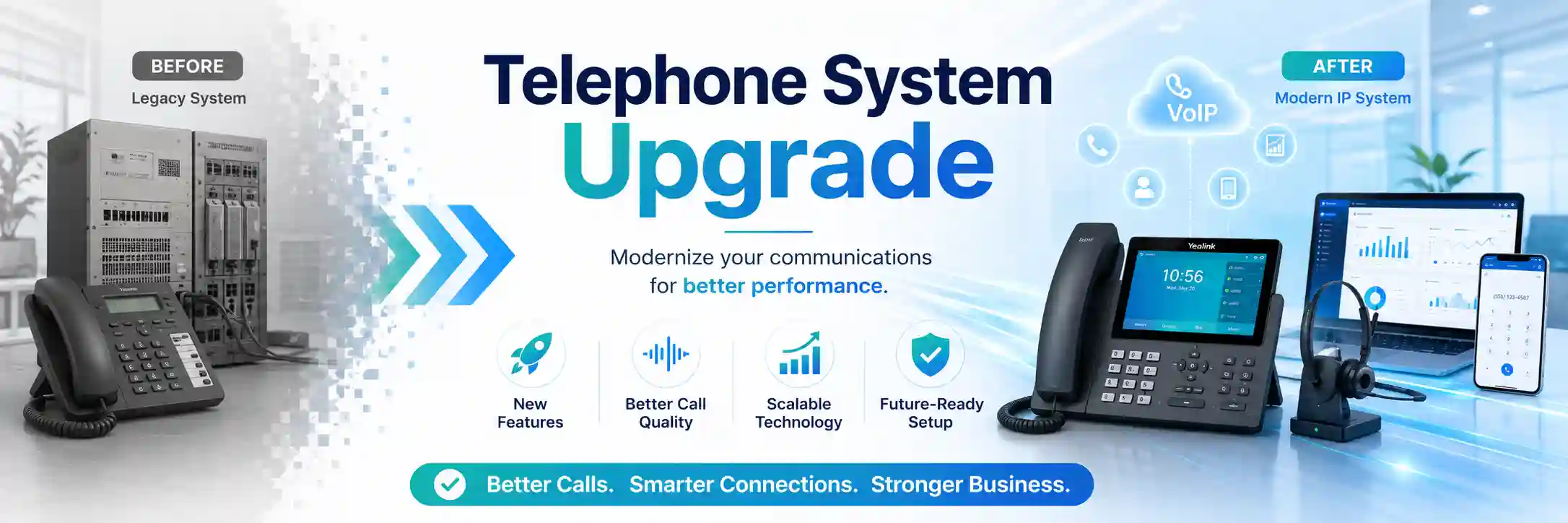
A migration plan should preserve the business call experience while changing the technical platform underneath it. Numbering, call routing, reception behaviour, network readiness and fallback options should be agreed before cutover.
Extensions, trunks, numbers, call routes, devices and dependencies are documented before change.
Switching, cabling, PoE, VLAN, firewall, internet and power requirements are reviewed for voice.
Migration stages, testing, provider coordination and rollback considerations are planned around business impact.
The completed extension plan, routes, dependencies and administrator information can be recorded for future support.
What does analog PBX to IP PBX migration involve?
Analog PBX to IP PBX migration is the process of moving business voice services from a legacy telephone platform to an IP-based system that carries voice through the organisation’s data network and, where applicable, through SIP or other provider services. The work is mainly used to modernise call handling, support easier extension management, prepare for IP phones and remote users, improve maintainability, and reduce dependency on ageing proprietary equipment.
Businesses should consider migration when the present PBX is difficult to expand, replacement parts or expertise are becoming harder to obtain, office moves are exposing cabling limitations, staff need more flexible calling options, or management wants better visibility over extensions and call routes. Before proceeding, the customer should prepare information about the existing PBX, provider lines, main numbers, direct numbers, extension list, reception flow, departments, special analogue devices, network condition, preferred maintenance window and authorised access. The exact design cannot be confirmed until those dependencies have been reviewed.
Why a telephone migration starts with the business call flow
A legacy PBX often contains years of operational decisions that were never formally documented. Reception may know which button reaches a manager, a sales group may ring in a particular order, an after-hours line may divert to a mobile, or one department may have a direct inward number that bypasses the main switchboard. If a new IP PBX is configured only from a list of extension numbers, those behaviours can disappear even though every phone appears to be working.
The first migration task is therefore to understand how the business expects calls to behave. Incoming numbers need to be associated with the correct destination. Departments may require ring groups, queues, auto-attendant options, overflow destinations or voicemail. Outbound permissions may differ by user or department. Reception users may need transfer, hold, park, busy-line and night-mode functions. Some organisations may need recorded announcements, call recording, reporting or mobile applications, but those requirements depend on policy, platform capability, licensing and applicable customer procedures.
A clear call-flow map also makes testing more useful. Instead of asking whether the new PBX can make a call, the project can verify whether the main number reaches reception, whether unanswered calls follow the agreed path, whether direct numbers reach the correct users, whether outbound caller identification is correct where supported by the carrier, and whether after-hours behaviour matches the approved design. This approach reduces the chance that a technically successful installation creates an operational problem for staff or customers.
What the migration service may cover
Depending on the confirmed scope, assistance may include a site and system review, extension and number inventory, line or trunk review, call-flow discovery, handset assessment, network readiness checks, platform planning, backup of available configuration information, IP phone provisioning, SIP or provider coordination, gateway planning for retained analogue devices, call-route configuration, pilot testing, cutover support, user guidance, documentation and post-migration checks.
Not every environment requires every activity. A small office with a simple receptionist and a few extensions may have a different path from a multi-floor organisation with direct numbers, departments, fax devices, door phones, paging interfaces, branch links or specialised recording requirements. The quotation should state which work is included and which third-party actions remain with the telecom provider, landlord, structured-cabling contractor, application supplier or customer.
Who may need this service
The service may suit established offices still operating a key system, analog PBX, digital PBX or hybrid telephone platform; businesses moving premises; organisations opening additional branches; companies with ageing desk phones; teams that need mobile or remote extension options; and managers who want a more maintainable call-routing structure. It can also be relevant when the existing carrier service is changing or when a planned network upgrade creates an opportunity to modernise voice at the same time.
Migration is not automatically the correct answer for every legacy system. A current PBX may still meet business needs, or the network may need improvement before voice traffic is moved onto it. Some proprietary digital handsets cannot be reused, while certain analogue devices may require a suitable gateway or separate strategy. Assessment is therefore important before equipment is selected or the old system is disconnected.
Common planning triggers and business problems
The old PBX is difficult to maintain
A legacy system may still operate but require specialist knowledge for every change. Adding a user, moving an extension or changing a call route can become unnecessarily dependent on obsolete software, proprietary programming tools or limited documentation.
The office is expanding or relocating
A move or expansion can expose limitations in old extension wiring and fixed PBX capacity. A new site may already have structured Ethernet cabling and PoE switching that can support a more flexible IP telephony design, subject to readiness checks.
Call handling no longer matches the organisation
Departments may have changed, direct numbers may be undocumented, mobile staff may need different access, or reception may rely on workarounds. Migration can be an opportunity to document and redesign routing rather than copy every historical setting without review.
Network and voice are being standardised
Businesses may want common switching, voice VLANs, central administration and consistent IP phones across departments or branches. This requires capacity, security and provider planning rather than simply connecting phones to available network ports.
The same business symptom can have different causes. Poor audio after a partial IP migration may come from congestion, cabling, switch configuration, firewall behaviour, internet quality, provider conditions, phone settings or the PBX itself. A failed external call may be a route configuration issue, a carrier problem or a number-authorisation condition. Migration planning should therefore separate confirmed facts from assumptions and preserve evidence before major changes are made.
Business impact of an unmanaged PBX change
Telephone systems are often treated as isolated equipment, yet they sit inside customer service, sales, reception, delivery coordination, supplier contact and management workflows. If a cutover is performed without a clear inventory, a missing direct number can prevent a customer from reaching the expected department. An incorrect office-hours rule can send calls to the wrong destination. A poorly prepared network can create choppy audio even though the new PBX is correctly configured. A forgotten fax, intercom or analogue device can stop working when the old ports are removed.
The operational risk is not only downtime. A rushed migration may create a support burden because users do not know how to transfer, park or retrieve calls on the new phones. Administrators may not know which provider supplies the voice service or where configuration backups are stored. Future changes can become dependent on memory instead of documentation. A controlled project reduces these uncertainties by agreeing the expected behaviour, recording dependencies, scheduling approved work, testing representative scenarios and handing over information that can be maintained after the project.
Service-fit matrix for a legacy-to-IP PBX project
| Business situation | Relevant assistance | What must be confirmed |
|---|---|---|
| Ageing PBX with limited support | Inventory, replacement planning, call-flow mapping and migration design | Current hardware, extensions, carrier service, required features and acceptable change window |
| Office relocation | New-site network readiness, phone placement, numbering, provider coordination and cutover planning | New cabling, internet availability, building access, carrier timelines and move schedule |
| Need to retain some analogue devices | Compatibility review and gateway or phased-retention planning where appropriate | Device type, signalling needs, platform compatibility and supportability |
| Multiple departments and complex reception flow | Call-flow design, ring-group or queue planning, office-hours rules and user acceptance testing | Approved business routing, overflow destinations, voicemail policy and direct-number mapping |
| Poor call quality on an existing IP network | Network, switching, VLAN, cabling, internet and provider assessment before further migration | Where the quality issue occurs, affected users, available logs and network access |
Service information to define before quotation
| Main purpose | Move from a legacy telephone platform to an IP PBX with controlled discovery, implementation, testing and handover. |
|---|---|
| Typical systems involved | Existing PBX, trunks or lines, handsets, extension cabling, switches, router or firewall, internet service, target PBX, IP phones, gateways and carrier services where applicable. |
| Assessment method | Remote discovery plus onsite inspection where physical PBX, ports, cabling, phones, racks or site conditions must be checked. |
| Customer information required | Extension list, main and direct numbers, department routing, current provider details, special devices, user count, sites, target outcome and maintenance-window requirements. |
| Network dependency | Environment dependent. Switching, PoE, cabling, address design, VLANs, firewall, internet quality and power protection may affect the target design. |
| Provider dependency | Vendor or telecom dependent. Number transfer, SIP service, authentication, caller ID and service activation may require provider action. |
| Testing and validation | Scope dependent. Test cases may include internal calls, inbound routes, outbound calls, transfer, hold, voicemail, office-hours behaviour, department routes and approved remote users. |
| Scheduling | Subject to assessment, engineer availability, customer access, provider timing, equipment availability, site conditions and approved work scope. |
| Quotation requirement | Required to define included discovery, installation, configuration, migration, onsite work, provider coordination, testing, documentation and exclusions. |
Remote planning versus on-site migration assistance
When remote assistance can be useful
Remote support may be suitable for collecting extension lists, reviewing call-flow requirements, inspecting available configuration exports, preparing the target PBX, discussing carrier details, reviewing logs, planning number routes and coordinating a project schedule. It depends on working internet access, secure authorised remote access, administrator availability and a system that can be reached safely. Remote access is not a substitute for physical inspection when cabling, rack space, phone ports or legacy hardware must be verified.
When an on-site visit is normally appropriate
On-site assistance may be recommended when the existing PBX must be identified, line modules need inspection, extension wiring is undocumented, phones or gateways are being installed, switch ports and PoE must be checked, a rack change is involved, or cutover testing requires local coordination. Physical work also helps confirm which analogue devices are still in use. Attendance timing depends on location, access, scope, engineer availability and the approved quotation.
Many successful migrations use both methods. Discovery can begin remotely so that obvious gaps are identified before a visit. An on-site assessment can then validate the physical environment. Configuration preparation can continue remotely, while final cutover may combine remote platform administration with a technician or customer representative at the site. The correct balance depends on risk, complexity, number of users and the availability of competent staff at the customer location.
A practical discovery and migration journey
Confirm why the system is changing, which calls are critical, which departments are affected, whether a move or provider change is involved, and what the business considers an acceptable migration window.
Record PBX make and model where available, connected lines or trunks, extension ranges, phones, direct numbers, reception routes, analogue devices, provider contacts and known configuration access.
Review network switches, cabling, PoE, internet, firewall, VLANs, power, remote sites, number ownership, special applications and third-party services that may affect the change.
Translate current business behaviour into documented routes for reception, departments, direct numbers, office hours, overflow, voicemail and any approved remote or mobile users.
Where appropriate, configure a representative group of extensions or test routes first. Validate network behaviour and user functions before moving the wider office.
Agree the change window, provider steps, communication plan, fallback options and responsibility for any issue that requires a third party.
Apply approved changes, provision phones, verify registrations, test internal and external calling, confirm reception behaviour and resolve exceptions against the agreed plan.
Record extension allocation, major call routes, provider dependencies, administration ownership, backup arrangements, remaining legacy items and recommended next actions.
Network readiness can determine whether IP voice performs well
An IP PBX moves a significant part of the telephone system onto the data network. That creates flexibility, but it also means voice quality depends on network behaviour. Each IP phone normally needs a reliable Ethernet connection or an approved alternative, an IP address, a path to the PBX and suitable power. Many business phones use Power over Ethernet, so switch PoE capacity must be checked rather than assumed. A switch can have enough physical ports and still lack the required power budget for the planned number of devices.
Voice traffic is sensitive to delay, packet loss and unstable links. A network that feels acceptable for email may still create noticeable speech problems when heavily congested. The migration review may therefore consider switch performance, uplinks, cabling condition, VLAN design, address assignment, routing, firewall handling and internet quality. Where the PBX or carrier service crosses the internet, the WAN path becomes part of the call path. A provider fault, firewall change or saturated connection can affect calling even when local phones remain registered.
Voice VLANs can help separate and manage phone traffic, but segmentation must be planned with switching, routing, DHCP, security and phone provisioning in mind. Quality-of-service settings may help prioritise time-sensitive traffic, but they should be designed for the actual network rather than applied as a generic fix. FourTeck can review these dependencies as part of the migration scope and identify whether network remediation should happen before, during or separately from the PBX change.
Preserving numbers, extensions and reception behaviour
Telephone numbers are business identities, not just technical values. Main numbers may appear on websites, invoices and signage. Direct numbers may be used by customers and suppliers. Internal extension numbers may be memorised by staff and included in procedures. Before migration, these numbers should be mapped to the new platform and categorised by importance. The customer should confirm which numbers are active, which should be retired, which must route to specific users or groups, and which are controlled by a telecom provider.
Number transfer or service migration can be provider dependent. The technical PBX project cannot guarantee carrier actions, porting dates or number presentation. Instead, provider steps should be identified early, supporting information should be prepared, and the cutover plan should reflect what the carrier has confirmed. Where a temporary overlap between old and new services is possible and appropriate, it may reduce risk, but this depends on the provider and the existing arrangement.
Reception deserves particular attention because receptionists often know the real call flow better than old configuration records. Their input can reveal overflow rules, commonly used transfers, executive screening, shared lines or after-hours habits. User acceptance testing should therefore include people who handle high call volumes, not only the project administrator. A migration is complete when the phone system supports the approved business process, not merely when extensions show as registered.
Handling analogue devices and legacy interfaces
A business may use more than desk phones on a PBX. Fax machines, cordless bases, door phones, paging interfaces, lift or emergency devices, alarm diallers and other equipment may use analogue ports. Their presence should be confirmed rather than assumed from the extension list. Some devices can work through suitable FXS gateways or other supported interfaces, while others may have signalling, reliability, compliance or vendor requirements that make reuse inappropriate. The correct choice depends on the specific device and target system.
The migration plan should therefore classify each legacy endpoint: replace with an IP equivalent, retain through a compatible gateway, keep temporarily on the old system, or move to a separate service. Critical or regulated devices should not be migrated casually. Their manufacturer, service provider or responsible contractor may need to confirm the permitted connection method. FourTeck can help identify the telephony dependency and coordinate the technical information, but third-party approval or specialist work may remain outside the PBX migration scope.
This is one reason a physical site survey can be valuable. An undocumented analogue port may serve a device in a meeting room, security desk or plant area that no one remembers until it stops. Tracing active ports and speaking with users can prevent avoidable surprises at cutover.
Safer change through backup, pilot testing and rollback planning
Migration changes should be reversible where practical. Before modifying an existing system, available configuration information should be backed up or documented, subject to system capability and access. The target PBX should also have a defined backup approach appropriate to its platform. A rollback plan does not guarantee that the old system can be restored instantly; it describes what can realistically be done if a critical test fails and which dependencies may prevent reversal.
A pilot can reduce uncertainty in larger or more complex environments. A small group of representative users can test phone registration, internal calls, outbound routes, incoming numbers, transfer behaviour, voicemail and remote functions before the main cutover. The pilot should include network conditions similar to the final deployment. If the office has multiple switches, branches or different user roles, one desk may not represent the entire environment.
The change window should match business risk. A company with constant inbound calls may need a different plan from an office that can perform work after normal operating hours. User communication is part of the technical plan: staff should know when the change occurs, what may be unavailable, how to report an issue, and whether their phone behaviour will change. The final schedule remains subject to assessment, customer approval, provider timing and resource availability.
Testing, validation and handover after cutover
Testing should be based on real call scenarios rather than a single test call. Internal extension-to-extension calls are important, but so are inbound calls to the main number, calls to direct numbers, outbound calls to representative destinations, transfer to another user, transfer to voicemail where configured, hold and resume, ring groups, queues, auto-attendant options, office-hours behaviour and authorised remote users. If call recording, reporting or other functions are part of the approved scope, they should have their own acceptance checks.
Audio quality should be checked in both directions. One-way audio can indicate a network, NAT, firewall, provider or configuration issue. Intermittent poor quality may require observation under normal load rather than a quiet test. Users should also confirm that phone names, extension numbers, programmable keys and common functions match their roles. Reception staff may require a more detailed handover because their workflow affects the whole organisation.
Documentation turns the installed system into a supportable system. Useful handover records can include an extension directory, main and direct number mapping, high-level call-flow description, provider contacts, major network dependencies, administration responsibility, backup method, retained analogue devices, known limitations and outstanding actions. Credentials should not be published in general documents; they should be handled through an approved secure method after identity and authorisation are confirmed.
Dependencies, access and customer inputs
A PBX migration depends on information and access that may be controlled by different people. The customer may need to involve the office manager, existing PBX maintainer, network administrator, telecom provider, internet provider, building team or application vendor. Missing ownership information can delay a project even when the technical design is ready.
- Administrative access to the existing PBX where available and authorised.
- Access to the target PBX, network switches, router or firewall where included in scope.
- Carrier account information or an authorised provider contact for number and trunk coordination.
- An accurate list of users, extensions, main numbers, direct numbers and departments.
- Description of reception, sales, support, after-hours and overflow call handling.
- Inventory of desk phones and any devices connected to analogue ports.
- Network diagrams, switch models, cabling records or port schedules where available.
- Details of branch offices, remote users or mobile applications that must be supported.
- Backup status and configuration exports where the current platform supports them.
- Security approval, site access, maintenance window and a customer contact for acceptance testing.
Customers should not send passwords through public website forms. Credentials should be shared only through an approved secure method after the support identity, scope and authorisation are confirmed.
Risks, limitations and exclusions to discuss before migration
Legacy systems can contain undocumented behaviour, unsupported components or configuration that cannot be exported cleanly. Some proprietary phones may not work with the new PBX. Some analogue devices may require separate interfaces or may not be suitable for migration. Number transfer can depend on the telecom provider. Internet-based voice can depend on firewall and WAN conditions. These are not reasons to avoid modernisation, but they are reasons to assess before committing to a cutover date.
A migration cannot guarantee zero downtime. Even with planning, provider activation, network changes, device replacement and user acceptance can introduce interruption. The project should identify which calls are most important and what fallback is practical. Hardware failure or missing cabling may require parts or work that was not visible during remote discovery. Building access, rack condition, power availability and third-party approvals can affect onsite work.
Security also requires careful ownership. IP PBX systems are network-connected and should be administered with controlled access, appropriate passwords, supported software, limited exposure and documented responsibility. No single configuration change guarantees security. Updates, firewall policy, account management, provider settings and monitoring all contribute to risk reduction. Final commercial terms, included tasks and exclusions should be defined in the approved quotation or service agreement.
Business environments where migration planning may be useful
Professional offices often need a predictable reception experience, direct numbers for key staff and straightforward extension changes as employees move. Retail and showroom environments may require front-desk phones, back-office extensions and coordination with multiple branches. Warehouses and logistics sites may combine office phones with cordless or paging requirements and depend on reliable call handling for deliveries. Clinics may require clear department routing and careful handling of user access. Hospitality locations can have reception, administration and operational extensions with different roles.
Multi-branch organisations add another layer: numbering plans, provider services, inter-site connectivity and local internet quality may differ by location. Some businesses want a central PBX, while others may use separate systems or hosted services. The correct architecture depends on operational requirements, platform capability, resilience expectations, security, internet connectivity and support ownership. FourTeck can help document those trade-offs before implementation rather than forcing every site into the same design without evidence.
Small and medium organisations can also benefit from a structured process. A small office may not need complex call-centre features, but it still benefits from knowing where the main number terminates, who administers the PBX, how phones are powered, which provider supplies the trunk and what to do when an employee changes desks. Good documentation scales down as well as up.
Before You Contact FourTeck
Preparing a few practical details makes the first discussion more productive and helps separate a simple configuration requirement from a larger migration project.
- Confirm the Dubai or UAE service location and whether more than one site is involved.
- Identify the main customer contact who understands the current telephone workflow.
- Estimate the number of active users, phones and extensions.
- List the main published number and any direct numbers that must be retained.
- Describe how reception handles calls during working hours and after hours.
- Note the existing PBX brand or model if known, without guessing if the information is unavailable.
- Record the current telecom provider and internet provider contacts where available.
- Identify fax, door phone, paging, cordless, alarm or other analogue devices connected to the system.
- Confirm whether network switches provide PoE and whether spare ports are available.
- Share any known network, cabling, firewall or call-quality concerns.
- Explain whether remote users, mobile applications or branch extensions are required.
- Confirm whether call recording, queues, reports or voicemail are business requirements.
- State the business impact of an outage and the preferred maintenance window.
- Confirm that authorised administrative access can be made available when required.
- Identify any move, renovation, provider cancellation or contract date that affects planning.
- Describe the expected result in business terms, such as easier extension management or support for a new office.
Service evaluation checklist for the quotation
How FourTeck can assist with the migration
FourTeck can begin by clarifying the reason for change and documenting the affected voice environment. That may involve identifying the legacy PBX, reviewing available extension records, tracing active lines, interviewing reception or administrators, and checking the network that will support the new phones. The purpose is to create an evidence-based scope before equipment is moved or provider services are changed.
Once the current state is understood, assistance can extend to target call-flow planning, network readiness review, phone provisioning, PBX configuration, carrier coordination, gateway planning, staged migration, cutover testing and documentation, depending on the approved quotation. FourTeck can also coordinate technical findings with the customer’s internet provider, telecom carrier, structured-cabling contractor, building team or application vendor where their actions affect the project.
The service is intended to make the change manageable for both technical and non-technical stakeholders. Managers should understand what is changing and what risk remains. Administrators should know who owns the platform and provider service. Users should know how their phones operate after the change. Future support should not depend entirely on the engineer who performed the migration. The broader FourTeck IT services portfolio can also help when the project reveals related network, firewall or infrastructure work that needs separate assessment.
Dubai and UAE service coordination
For Dubai businesses, migration coordination may begin remotely and move to an on-site assessment when the legacy PBX, cabling, rack, phones or analogue devices must be inspected. Installation and cutover planning should account for building access, business working hours, provider dependencies, equipment delivery, site rules and the availability of an authorised customer representative. A site with documented cabling and current network equipment can require a different preparation path from an older office where extension wiring has been changed many times.
Remote or on-site assistance depends on the issue, access, location, urgency and approved quotation. Service timing depends on engineer availability, customer access, site conditions, required parts, third-party providers and the confirmed work scope. Contact FourTeck to confirm the service scope and scheduling options rather than assuming a fixed attendance time or project duration.
Businesses can review the wider company service approach on the FourTeck IT Services UAE website and learn more about the service organisation through the FourTeck IT Services company information page.
Dubai, Abu Dhabi, Sharjah and Ajman project coverage
FourTeck can coordinate business telephony migration requirements across Dubai, Abu Dhabi, Sharjah and Ajman depending on the confirmed scope. A project may combine remote discovery, planned on-site assessment, network readiness checks, phone installation, migration work, testing and post-change support. The exact method should reflect the number of locations, local site contacts and whether the PBX is central, site-specific or hosted.
Travel, scheduling, building access, site conditions, equipment availability and third-party carrier actions can affect the service plan. Multi-site businesses should also confirm whether each branch uses the same number plan, provider, firewall design, internet service and phone models. Standardisation can simplify long-term support, but it should not override legitimate local requirements. The engagement should document which tasks occur at each location and which activities can be handled centrally.
Related FourTeck IT services around an IP PBX migration
Office network support
Useful when switches, cabling, VLANs, address assignment, PoE or uplinks need assessment before phones are moved to the IP network.
Firewall and internet coordination
Relevant when external voice services, remote phones or hosted PBX connectivity depend on firewall policy and stable WAN access.
IP phone provisioning and user support
Covers endpoint registration, naming, key layout, basic user functions and troubleshooting when phone deployment is included.
Ongoing telephone system maintenance
Suitable after migration when the business wants a defined process for extension changes, troubleshooting, documentation updates and preventive review.
Why businesses contact FourTeck for PBX change planning
A telephone migration touches more than the PBX. It can involve user workflows, switches, cabling, firewalls, internet service, number ownership, desk phones, analogue devices and third-party providers. Businesses often need one technical view that can organise those dependencies before work begins. FourTeck’s role can include clarifying the current problem, documenting the existing voice environment, identifying which technical layers require attention and preparing a quotation around the confirmed work.
The value of a structured approach is clarity. A customer should know what has been assessed, what assumptions remain, who is responsible for provider actions, which devices can be retained, what network work is required, how the cutover will be tested and what documentation will be supplied. This supports better decisions without relying on unsupported promises. It also makes future changes easier because the completed environment has a clearer ownership and support record.
Questions Dubai businesses often ask before choosing a migration approach
A prospective customer rarely starts with a complete technical specification. More often, the search begins with a practical concern: the old telephone system is difficult to maintain, a new office is being prepared, users want IP phones, or management has been told that existing lines are changing. The questions below help turn those concerns into a migration scope that can be assessed and quoted responsibly.
Can we replace the analog PBX without changing every phone on the same day?
Possibly, but the answer depends on the legacy PBX, the target IP PBX, handset compatibility, available gateways, carrier services and the desired call flow. Some projects can be phased by department or site. Others have technical dependencies that make a single coordinated cutover more practical. Proprietary digital phones from an older PBX generally cannot be assumed to work on a different IP platform, while analogue endpoints may require compatible interfaces. The right starting point is an inventory of phones and ports, followed by a design that identifies what can be reused safely and what should be replaced.
Do we need a new network before installing an IP PBX?
Not automatically. An existing network may be perfectly suitable, may require minor changes, or may need a larger upgrade. The assessment should check switch ports, PoE budget, cabling, uplinks, IP addressing, VLAN capability, router or firewall handling, internet quality and power protection. The number of phones and the way the PBX is hosted also matter. A network review prevents the organisation from blaming the new PBX for problems that are actually caused by an overloaded switch, poor cable, unstable internet link or unmanaged design.
Can our existing business numbers stay the same?
They may be retained when the provider and service arrangement support the required migration, but this must be confirmed with the telecom carrier. Number ownership, porting rules, trunk type, account status and provider timelines can affect the result. The migration plan should list every published and direct number, identify its current provider, confirm the intended destination on the new PBX and record which party is responsible for carrier coordination. A PBX engineer can configure routes, but cannot guarantee a provider’s number-transfer action.
What happens to reception and department call routing?
It should be documented and rebuilt as an approved target flow. This is an opportunity to decide whether the old behaviour still makes sense. Reception may need a main ring group, overflow to another user, a night destination and voicemail. Sales may need a queue or group. Management may use direct numbers. Support may need office-hours rules. The project should convert these requirements into a call-flow diagram or written matrix before configuration. After cutover, the people who handle calls every day should perform acceptance tests because they are best placed to recognise incorrect routing.
Can the migration be checked remotely before an engineer visits?
Yes, several planning tasks may be suitable for remote work when authorised access is available. FourTeck can collect user and number lists, review available configuration information, discuss call flows, assess provider details and examine accessible network settings. However, remote discovery cannot confirm everything. If the PBX cabinet is undocumented, cabling must be traced, analogue devices need identification, phones are being physically replaced or PoE and rack conditions must be tested, an on-site visit may be necessary. A mixed remote and on-site approach often reduces wasted site time because known information is collected first.
How much downtime should we expect during a PBX migration?
There is no responsible fixed answer before the scope is known. Downtime depends on provider actions, number migration, number of users, whether the old and new systems can overlap, network changes, phone replacement, gateway work, the complexity of call routing and the quality of preparation. A small office may have a different change window from a multi-site organisation. The project should define the critical call paths, planned change period, test sequence, user communication and practical fallback. The goal is controlled change, not an unsupported promise of zero interruption.
Should we choose an on-premises IP PBX or a hosted platform?
The decision should follow business requirements rather than a universal preference. An on-premises system can provide local control but introduces responsibilities for hardware, power, updates, backups and local connectivity. A hosted or cloud-managed platform can reduce local hardware but increases dependence on internet access, provider availability, subscription terms and supported endpoints. User count, branches, remote work, required integrations, reporting, call recording, support ownership, security policy and budget all influence the choice. FourTeck can help document these requirements and compare practical implications within the project scope.
What should we do with fax machines, door phones or other analogue devices?
Treat them as separate dependencies, not as ordinary extensions. The project should identify every device currently connected to an analogue PBX port and confirm what it does. Some equipment may work through a suitable analogue telephone adapter or gateway, but compatibility and reliability depend on the device and target platform. Other equipment may need replacement or support from its original vendor. Devices related to safety, lifts, alarms or regulated functions should follow the requirements of the responsible specialist or authority rather than being moved based on a generic telephony assumption.
Can we use the migration to support staff working from home or from another branch?
Potentially, because many IP PBX platforms support remote endpoints, desktop or mobile clients and branch connectivity. The exact capability is platform and licence dependent. Remote use also introduces network and security considerations: users need suitable internet service, secure connectivity, correct authentication and a reliable path to the PBX or provider. If remote work is an objective, it should be included during design rather than added informally after cutover. The test plan should include a representative remote user and confirm inbound, outbound, transfer and voicemail behaviour where required.
Will a new IP PBX automatically fix poor call quality?
No. Call quality can be affected by the phone, network cable, switch, PoE, VLAN, router, firewall, internet connection, PBX, codec, provider or remote destination. Replacing an old PBX may improve maintainability and introduce a new call path, but it does not eliminate network or carrier problems. If poor audio is already present on an IP segment or a pilot group, evidence should be collected before wider migration. The investigation may include affected users, time patterns, network load, switch statistics and provider tests depending on available access.
What information should we prepare before requesting a quotation?
Prepare the current user and extension count, main and direct numbers, approximate phone count, PBX model if known, provider details, number of sites, key call flows, special analogue devices, remote-user requirement, network information, desired maintenance window and reason for migration. If you already have an extension list or PBX configuration export, make it available through an approved secure process. You do not need to know every technical answer. Missing information can be identified during assessment, but clearly stating what is known helps define whether the next step should be remote discovery, an on-site survey or a more detailed project workshop.
When should we contact FourTeck instead of trying to copy the old system ourselves?
Contact FourTeck when the change affects published numbers, several users, multiple departments, provider services, network configuration, analogue devices or business-critical call flows. Specialist assistance is also useful when the old system is undocumented, the organisation is moving offices, the network has known quality issues, or management wants a rollback and handover plan. A self-managed change may appear simple until a hidden route or device is discovered. An assessment helps define those unknowns before they become a cutover problem.
Frequently asked questions
What is included in an analog-to-IP PBX migration?
Depending on the quotation, the service may include current-system discovery, number and extension mapping, network readiness review, PBX configuration, phone provisioning, carrier coordination, cutover, testing, documentation and user handover. Final inclusions are scope dependent.
Can FourTeck migrate a PBX that has no documentation?
Assessment may still be possible, but more discovery can be required. Available configuration access, line tracing, user interviews, carrier information and onsite inspection may be needed to reconstruct extensions and call flows before a migration plan is confirmed.
Can existing IP phones be reused?
Possibly, if the target PBX supports the phone model and required provisioning method and the devices are in suitable condition. Compatibility, firmware, features, PoE and supportability should be checked before reuse is included in the plan.
Do we need SIP trunks?
That depends on the target design and provider service. Many IP PBX environments use SIP services, but carrier availability, number requirements and existing contracts must be reviewed. FourTeck can coordinate technical requirements where this is included.
Can migration be done in phases?
A phased approach may be suitable when the old and new systems can coexist or departments can move independently. The design must confirm numbering, provider routing, gateways, network segmentation and fallback. Not every environment supports a clean phased transition.
What testing should happen before the old PBX is removed?
Testing should cover representative internal and external calls, inbound numbers, direct numbers, transfer, hold, department routes, voicemail, office hours, caller identification where applicable, remote users and any approved special features.
Will FourTeck handle the telecom provider?
FourTeck can assist with technical coordination where included in the scope, but account approvals, commercial changes, number transfer and service activation remain subject to the provider and authorised customer account holder.
Is user training included?
Basic handover or user guidance can be included where agreed. The amount of training depends on the phone models, platform, user roles and required functions. Reception and administrators may need more detailed guidance than standard users.
Can the old PBX be kept as a fallback?
Sometimes, but only when provider services, cabling and system condition allow a practical overlap. A fallback plan should be based on verified technical capability rather than assuming that reconnecting the old PBX will restore service immediately.
Does FourTeck support projects outside Dubai?
Service coordination can cover Dubai and other UAE locations including Abu Dhabi, Sharjah and Ajman, subject to the confirmed scope, scheduling, travel, site access, equipment availability and project requirements.
Discuss your current PBX before deciding the migration path
Share the current system, user count, number plan, known call-flow requirements, site location, provider details and the reason for change. FourTeck can use that information to identify what must be assessed remotely, what requires an on-site visit and which dependencies should be confirmed before a quotation or cutover plan is approved.
A controlled migration protects business call handling by replacing assumptions with documented requirements, tested routes and clear ownership. The final design should be maintainable after the project, not only functional on the first day.