
MULTI-SITE IP TELEPHONY CONFIGURATION
Grandstream UCM Multi-Site Configuration Dubai in Dubai, UAE
A multi-site Grandstream UCM environment should do more than let two branches call each other. It should give users predictable dialing, controlled call routes, clear ownership of extensions and trunks, documented dependencies, and a design that remains understandable when another site, provider, or working pattern is added.
FourTeck helps businesses assess, plan, configure, test, and document Grandstream UCM connectivity across offices in Dubai and the wider UAE. The final method depends on the installed UCM platform, firmware, network topology, internet links, firewall rules, carrier services, numbering plan, availability requirements, and the level of centralisation the business wants.
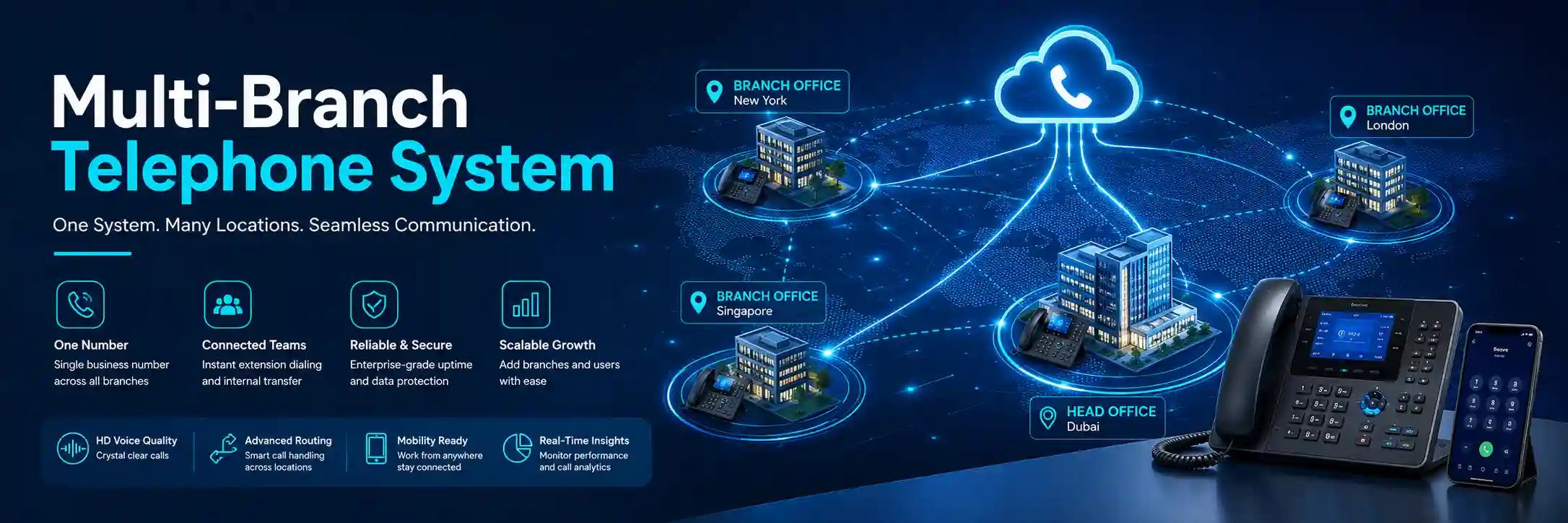
Designed around actual call flows and site roles.
WAN, firewall, NAT, VLAN and QoS conditions matter.
Backups, maintenance planning and rollback are considered.
Routing, extension dialing and documentation are validated.
What does Grandstream UCM multi-site configuration mean?
Grandstream UCM multi-site configuration is the planning and technical work required to make separate business locations operate as a coordinated telephone environment. Depending on the UCM family and confirmed design, sites may be connected through SIP peer relationships, centralised services, provider trunks, VPN paths, Grandstream management services, or a combination of methods. The goal is normally to make extension dialing, inbound routing, outbound calling, transfers, business-hour treatment, and administration predictable across locations without removing useful local independence. Businesses should consider this service when they are opening branches, consolidating separate telephone systems, replacing inconsistent dialing rules, adding remote teams, or trying to make several UCM installations easier to support. Before work is confirmed, the customer should provide the UCM models and firmware versions, site count, user and extension requirements, network and firewall information, SIP provider details, existing number ranges, current call flows, and a clear target for how calls should move between locations. Exact scope remains environment, access, provider, and compatibility dependent.
A multi-site telephone system is a business workflow, not just a trunk
When branches are configured independently over time, users often develop different habits at every location. One office may dial short extension numbers, another may depend on full external numbers, a third may send all outbound calls through a local carrier, and a newer branch may be expected to share reception or after-hours handling with the head office. Connecting the systems without understanding these workflows can create ambiguous numbers, unexpected call paths, inconsistent caller identification, and difficult fault isolation.
A useful design starts with questions about people and operations. Which teams regularly call between locations? Should reception at one site answer for another? Must every office be able to place local outbound calls if an inter-site link is unavailable? Are branch users expected to transfer callers directly to colleagues elsewhere? Do departments share hunt groups or queues? Are there analogue gateways, door phones, paging devices, call recording requirements, or third-party applications that depend on the current numbering plan? The technical configuration should reflect these answers rather than forcing the business into a topology chosen only because it is easy to configure.
FourTeck can review these requirements and convert them into a controlled configuration plan. Depending on the confirmed scope, this may include extension-range design, inter-site dialing rules, SIP trunk relationships, inbound and outbound route review, caller ID handling, time conditions, failover logic, phone provisioning considerations, network checks, security review, and documentation. No single topology is automatically correct for every company. A head office with three small branches may need a different structure from a group of equally important locations that each require local carrier service and local continuity.
What the configuration service may cover
Numbering and extension strategy
Review current extension ranges, duplicate numbers, departmental groups, site codes, direct inward dialing needs, and growth plans. A well-planned numbering structure reduces confusion when users transfer calls or when new branches are introduced later.
Inter-site call routing
Define how each UCM reaches extensions at another location, which routes are permitted, how overlapping dial patterns are avoided, and what should happen when an inter-site path is unavailable.
Network and security readiness
Check the network path that carries signaling and media, including addressing, routing, DNS, firewall policy, NAT behaviour, VPN or remote-connect requirements, voice VLANs, QoS, and authorised management access.
Carrier and DID coordination
Map SIP provider trunks, telephone numbers, inbound destinations, outbound caller identification, emergency or special dialing considerations, and any provider-specific restrictions that may affect the final design.
Testing and acceptance
Test branch-to-branch calls, transfers, inbound and outbound routes, selected groups, caller identification, failover scenarios where included, and user workflows before the change is treated as complete.
Documentation and handover
Record site roles, extension ranges, trunk relationships, routing intent, important dependencies, tested outcomes, and remaining limitations so future support does not depend on memory or guesswork.
Depending on the confirmed scope, assistance may include some or all of these activities. Additional work such as cabling, firewall replacement, provider changes, new licenses, phone replacement, gateway installation, or network remediation should be identified separately rather than assumed to be included in a basic configuration engagement.
Who may need a Grandstream UCM multi-site review?
This service may suit an organisation that already has Grandstream UCM systems in several locations but treats each branch as a separate telephone island. It can also suit a company opening a new UAE branch, relocating one office, acquiring another business, replacing a legacy PBX, or standardising telephone administration after years of independent changes. The trigger is often operational rather than technical: reception staff cannot see a simple way to transfer to another site, users maintain external numbers for colleagues who should be reachable internally, call routes behave differently by branch, or administrators are unsure which UCM controls which part of the environment.
Multi-site configuration can also become relevant when remote and hybrid working grows. Grandstream’s UCM6300 ecosystem supports remote users and centralised cloud-assisted management through its current platform options, but those capabilities still need to be considered alongside local business requirements, security policy, internet quality, licensing or service-plan dependencies, and firmware compatibility. A remote worker, a branch phone, and an office extension may appear similar to a user, yet they can rely on different network paths and therefore require different support assumptions.
The service is particularly useful where the business wants one documented design rather than a collection of point fixes. That design can clarify which site owns inbound numbers, how branch codes or extension ranges are assigned, where outbound calls should exit, which users can dial between locations, and how the organisation should respond if one internet path or carrier service is unavailable. The answer does not have to be complete centralisation. In many environments, a controlled balance between shared dialing and local independence is more maintainable.
Common planning triggers and symptoms
Two sites use the same internal numbers, or staff must remember different prefixes without clear documentation.
Receptionists place an external call instead of a direct internal transfer because the systems are not linked in a predictable way.
Users encounter inconsistent prefixes, caller ID behaviour, business-hour rules, or permissions depending on where they work.
The business wants to avoid introducing another isolated system and needs a repeatable pattern for future locations.
Calls fail, have one-way audio, drop, or behave differently after network changes. These symptoms can originate from routing, NAT, firewall, ISP, codec, bandwidth, or configuration layers and do not prove one cause.
No one has a current map of extensions, trunks, call routes, provider details, or which change created a recurring problem.
A symptom should be treated as evidence, not diagnosis. For example, one-way audio between sites can involve firewall rules, NAT, routing asymmetry, VPN behaviour, SIP media negotiation, or provider handling. A failed extension-to-extension call might result from a dial pattern, trunk permission, route order, or a network path. FourTeck’s assessment therefore begins by identifying the affected call scenario and tracing the relevant layers before changing production settings.
Business impact when multi-site telephony remains fragmented
The cost of a fragmented phone environment is often measured in repeated handling rather than complete outage. Staff may call another branch through public numbers, adding extra steps and making transfers less professional. Reception teams can spend time searching for contact numbers instead of using an agreed extension plan. Managers may find it hard to understand why one location can reach another while a third cannot. Support providers may need to rediscover the topology during every incident because no current diagram or routing record exists.
Inconsistent configuration can also make change riskier. Adding a new DID, updating an outbound route, moving a department, or changing an internet circuit may affect more call paths than expected. If the inter-site dependency is not documented, a local change can unintentionally interrupt another branch. The objective of a multi-site review is therefore not only to create connectivity. It is to make the environment easier to reason about, test, and maintain.
A planned design can separate what is truly shared from what should remain local. For example, a company may want direct extension dialing across all offices but still retain local SIP trunks so each branch has independent inbound numbers and local outbound service. Another organisation may prefer central reception and common call-routing rules. These are business choices with technical consequences. FourTeck can explain the trade-offs and document the selected approach after compatibility, access, and provider constraints are known.
Service-fit matrix for typical multi-site requirements
| Business situation | Relevant assistance | What must be confirmed |
|---|---|---|
| Two existing UCM systems need direct extension dialing | Number plan review, inter-site trunk method, routing rules, permissions and call testing | UCM models, firmware, reachability, overlapping extensions, firewall/NAT conditions and authorised access |
| A new branch must join the company telephone environment | Site role design, extension allocation, phone provisioning plan, inbound/outbound routing and acceptance testing | User count, network readiness, carrier service, cabling, phones, business hours and target go-live window |
| Branches use different SIP providers | Provider mapping, DID handling, outbound selection, local survivability discussion and route documentation | Provider account details, trunk requirements, supported caller ID rules and contractual limitations |
| Inter-site calls have one-way audio or intermittent failure | Call-path tracing, network review, SIP/media analysis, firewall and NAT validation, controlled test calls | Exact failing scenarios, timestamps, affected directions, recent network changes and log access |
| The company wants one repeatable standard for future sites | Template design, naming rules, extension ranges, route standards, security baseline and documentation structure | Growth plan, expected site size, central versus local services and management responsibilities |
Service information at a glance
| Service topic | Grandstream UCM multi-site configuration and related assessment |
|---|---|
| Main purpose | Create predictable calling and administration between multiple business locations |
| Typical systems involved | Grandstream UCM IP PBXs, SIP phones, SIP trunks, gateways where present, switches, routers, firewalls, WAN links, DNS, VLANs and provider services |
| Assessment method | Remote review and/or on-site inspection depending on access, network condition and physical dependencies |
| Remote support suitability | Often suitable for authorised configuration review, logs, routing, backups and controlled testing when connectivity is stable |
| On-site suitability | May be required for cabling, phone deployment, gateway work, switch/VLAN checks, rack access, ISP handoff testing or physical fault isolation |
| Customer access required | Authorised UCM administration, network/firewall cooperation, provider information and an on-site contact where relevant |
| Testing and validation | Scope dependent; may include inter-site extension calls, transfers, inbound/outbound routes, caller ID, failover and selected user workflows |
| Documentation | Configuration summary, numbering plan, call-path notes, dependencies and outstanding recommendations where included |
| Service location | Dubai and UAE coordination, subject to assessment, site access, scheduling and approved quotation |
| Commercial scope | Final inclusions, exclusions, parts, licenses, travel and third-party work depend on the confirmed quotation or service agreement |
Remote configuration or on-site visit: which is appropriate?
Remote assistance can be efficient when the environment is reachable
A large part of UCM multi-site work can often be assessed remotely if authorised administrative access is available and the underlying network is functioning. Configuration backups can be reviewed, extension and route patterns can be mapped, trunk status can be checked, logs can be collected, and controlled test calls can be coordinated with users at each site. Remote sessions are especially useful when the requirement is primarily logical rather than physical.
Remote work still depends on a reliable internet path and customer authorisation. It should not be assumed that remote access proves the local network is healthy. A branch may still have packet loss, switch issues, poor cabling, or local power problems that require physical investigation.
On-site assistance is useful when the call path depends on physical infrastructure
An on-site visit may be recommended when phones need to be deployed, analogue gateways must be checked, ports or VLANs require validation, cabling and patching are uncertain, the UCM is not accessible remotely, a firewall or ISP handoff needs local testing, or several users report symptoms that cannot be reproduced from outside the site. Physical access may also be needed during a new branch rollout or office relocation.
On-site timing depends on location, building access, engineer scheduling, maintenance windows, customer contacts, equipment availability and the approved work scope. A remote discovery session before the visit can often reduce wasted time by identifying exactly which systems and access arrangements should be ready.
How FourTeck assesses a multi-site UCM environment
- Clarify the business outcome. Define whether the objective is branch-to-branch extension dialing, shared reception, common routing standards, new-site deployment, fault correction, migration, or a broader redesign.
- Identify every participating site. Record the UCM at each location, user count, extension ranges, carrier trunks, internet services, network equipment and any gateways or applications that rely on the telephone system.
- Collect evidence. Review current configuration details, recent changes, call examples, errors, logs and available diagrams. For faults, timestamps and calling direction are especially useful.
- Review access and backups. Confirm authorised administration, secure credential handling, current configuration backups and an appropriate rollback position before material changes are made.
- Trace network dependencies. Check addressing, routing, DNS, firewall policy, NAT, VPN or RemoteConnect design where applicable, voice VLANs, QoS and internet quality across the sites involved.
- Design the call relationship. Define dial patterns, route order, permissions, trunk relationships, caller identity rules and handling for overlapping numbers or special cases.
- Plan the change window. Identify which changes can be made with limited user impact and which may interrupt calling. Confirm responsible contacts and a practical rollback approach.
- Implement approved work. Apply only the confirmed configuration, recording significant changes so the environment can be understood later.
- Test user journeys. Validate representative calls rather than checking only that a trunk shows as available. Test the flows users actually depend on.
- Document findings and next actions. Record completed work, remaining limitations, provider dependencies, network concerns and recommendations for future sites or maintenance.
Choosing the inter-site design: centralised, distributed, or hybrid
A multi-site UCM project commonly involves a choice about where call-control responsibilities should live. A highly centralised design can make policies and user administration easier to standardise, but it can increase dependence on the central system and the connectivity between sites. A distributed design can give each branch stronger local independence, but it may require more configuration discipline because multiple systems must remain aligned. A hybrid approach often shares selected functions while keeping local carrier services or site-specific routes where they are operationally useful.
The decision should be made from business requirements rather than from a preference for one diagram. A branch with a local reception team and local telephone numbers may need to continue handling calls even when the head-office link is unavailable. A smaller satellite office may be comfortable depending more heavily on central call control if its internet service and continuity requirements allow it. A contact centre may have different routing and reporting needs from a warehouse or showroom. FourTeck can map these requirements and explain where the design creates dependencies.
Grandstream’s current UCM6300 ecosystem includes tools for multi-location deployment, remote users, GDMS management and UCM RemoteConnect. Grandstream also documents peer SIP trunking between compatible UCM systems through RemoteConnect. Whether that method is appropriate for a particular customer still depends on the installed UCM models, firmware, current Grandstream service terms, network path, security requirements and the organisation’s topology. Legacy UCM families or mixed-platform environments may require a different approach. Compatibility should be confirmed before configuration begins.
Capability 1: create a numbering plan that can grow
A clean extension plan is one of the most valuable foundations in a multi-site system because every call route depends on what a number means. If several branches already use the same short ranges, simply connecting them can create ambiguity. A dialed number such as 201 might exist in more than one office. The system then needs either site prefixes, revised ranges, translation rules, or another deliberate method to identify the intended destination. The right choice depends on user habits and how much disruption a renumbering exercise would create.
FourTeck can help define a structure that supports current users and leaves room for expansion. The design may reserve ranges by location, department, role, or device type. Special numbers used by queues, paging groups, voicemail, conferencing, analogue endpoints, or external integrations should be included so they do not conflict with future user extensions. Emergency and provider-specific dialing must also be considered where relevant to the carrier service and business policy.
A numbering plan is useful only if people can use it naturally. A complex prefix structure may be technically elegant but unpopular with staff. Conversely, very short ranges may become difficult to expand. The planning process therefore balances clarity, growth, compatibility and migration effort. The final plan should be documented with enough context that a future administrator can allocate new extensions without recreating conflicts.
Capability 2: make call routing predictable across branches
Inter-site connectivity becomes valuable when call behaviour is easy to predict. A user should know whether dialing a colleague’s extension will stay inside the organisation, which system will route the call, and what happens when that path is unavailable. Receptionists need clear transfer behaviour. Managers need to know how outbound numbers are presented. Administrators need to understand route order so a future change does not accidentally send internal calls to an external provider.
FourTeck can review inbound routes, outbound routes, inter-site patterns, permissions, time conditions, hunt groups, queues and selected failover logic as part of a confirmed scope. The work may also consider whether calls should exit through the local branch carrier, a central trunk, or a defined alternative. Some provider services impose their own caller-ID, authentication or routing requirements, so the desired design must be compared with actual carrier capabilities rather than assumed.
Testing should include more than one successful call. Representative test cases may include extension-to-extension calls in both directions, a transfer from one branch to another, inbound DID handling, outbound caller identification, calls during and outside business hours, and failure scenarios if resilience is part of the design. A written test list makes acceptance clearer and reduces the chance that a less obvious workflow is discovered only after users begin working.
Capability 3: improve maintainability through documented dependencies
A multi-site PBX rarely fails in isolation. Calls rely on the UCM, phones, switches, DHCP or static addressing, VLANs, routers, firewalls, DNS, internet circuits, carrier trunks and sometimes VPN or cloud-assisted connectivity. When these relationships are not documented, each support incident begins with discovery. That slows troubleshooting and increases the risk that a network change is made without understanding its telephony effect.
A maintainable environment records the relationship between sites in practical terms: which UCM owns which extension range, what trunk connects to what destination, which provider serves each number group, what network path is required, who owns firewall changes, and which user workflows were tested. Credentials should not be placed into public documentation; they should be handled through an approved secure method and only by authorised personnel. The documentation should describe access responsibilities without exposing secrets.
This information becomes particularly useful during office moves, ISP changes, firewall upgrades, UCM firmware maintenance, staff turnover, provider migrations and new-branch rollouts. FourTeck can incorporate documentation and handover into the project scope so the customer receives more than a working configuration at one point in time. The objective is a system that another authorised administrator can understand and support later.
Network dependencies to confirm before changing UCM call paths
Voice traffic is sensitive to network conditions that ordinary web browsing can sometimes hide. A branch internet connection may appear usable for email and cloud applications while still introducing latency variation, packet loss or asymmetric routing that affects calls. If inter-site signaling and media cross firewalls, NAT devices, VPNs or cloud-assisted traversal services, those components must be considered part of the telephone design.
FourTeck may review IP addressing, route reachability, DNS resolution, firewall rules, NAT behaviour, SIP ALG settings where relevant, VPN configuration, switch-port status, voice VLAN assignment, DHCP options, power delivery for phones, and quality-of-service policy. The exact checks depend on the topology. A configuration change should not broadly disable security controls simply to make a call work. If a firewall rule must be adjusted, the intended source, destination, service and exposure should be understood and authorised.
Bandwidth planning should also consider simultaneous calls rather than only the number of registered users. Codec choices, encrypted transport, remote users, conferencing, recording, and other services can affect resource and network requirements. The UCM model itself has platform limits, so capacity should be checked against the actual device and firmware rather than inferred from another model in the product family. If the business is planning significant growth, a capacity review can be included before the multi-site design is finalised.
Security, authorisation and controlled change
A multi-site project increases the number of systems and network paths that must be managed consistently. Administrative access should be limited to authorised personnel, and configuration backups should be taken before material changes when the platform and scope allow. Remote management should use an approved access method rather than exposing administration interfaces unnecessarily. SIP credentials, administrator passwords, API keys and provider secrets should be shared only through secure channels after identity and authorisation are confirmed.
Firmware compatibility is another change consideration. Grandstream publishes current firmware and upgrade guidance for UCM platforms, and some versions require specific backup or upgrade preparation. A multi-site project is not automatically a reason to upgrade every system. Firmware changes should be assessed for compatibility, business need, maintenance-window impact and rollback implications. Unsupported or very old systems can limit the available options and may require a separate upgrade or replacement discussion.
Security improvement also does not mean that one setting makes the environment completely protected. Good practice combines controlled access, current supported software where feasible, firewall policy, careful exposure, sensible account management, logging, backups, monitoring and documented responsibility. FourTeck can review these areas as they relate to the telephone project, while broader cybersecurity work should be scoped separately when it extends beyond the UCM environment.
Testing, validation and handover after configuration
A configuration is not complete simply because the administrative interface accepts the settings. Validation should follow the business call paths that motivated the change. FourTeck can agree a representative test plan with the customer before implementation. This may include direct extension calls between selected sites, transfers, call pickup or groups where relevant, inbound calls to key numbers, outbound calls from each branch, caller-identification checks, voicemail behaviour, business-hours routing, and selected resilience tests if failover was explicitly included.
Testing is more useful when a person at each affected location is available. Local users can confirm audio in both directions, display information, ring behaviour and transfer outcomes. If a fault occurs, the exact time, source extension, destination and direction should be recorded so logs can be correlated. A single successful call does not prove that every route, user, codec, carrier path or time condition is correct.
Handover can include the agreed numbering plan, high-level topology, call-routing intent, significant configuration changes, dependencies, known limitations and follow-up recommendations. If the customer manages the environment internally, administrator guidance can focus on safe tasks such as adding extensions within reserved ranges or checking trunk status without changing core routing. More complex changes should follow the same backup, authorisation and testing discipline used during the original project.
Risks, limitations and exclusions to understand
Multi-site configuration depends on evidence, authorised access and systems that are technically compatible with the intended design. Some call problems can only be resolved with action from an ISP, SIP carrier, firewall provider, cloud service, building contractor, hardware supplier or other third party. FourTeck can help collect technical information and coordinate where included, but third-party timelines and service conditions remain outside a configuration change itself.
Hardware faults may require replacement parts or separate equipment outside the labour scope. Cabling remediation, switch replacement, firewall work, provider migration, licences, additional SIP channels, new telephone numbers, new phones, analogue gateways or power protection should not be assumed to be included unless stated in the approved quotation.
Configuration changes can require a maintenance window and can temporarily affect calling. Backups and rollback planning reduce risk but do not guarantee that every external dependency can be restored instantly. Legacy systems, unsupported firmware or undocumented third-party integrations may limit what can be changed safely. No multi-site design can guarantee zero downtime, perfect call quality, or uninterrupted provider service.
The final commercial and technical scope depends on the assessed environment, customer priorities, access, number of sites, network condition, required testing, documentation needs, travel or site access, and third-party work. Contact FourTeck to confirm what is included before implementation begins.
Business environments where multi-site UCM configuration can help
Professional-services firms often need reception, assistants and consultants in different offices to transfer calls without asking customers to redial. A structured extension plan and agreed cross-site routing can make that interaction easier while preserving separate local numbers if required. Retail and showroom groups may want staff to reach another branch quickly while keeping inbound numbers tied to each location. Warehouses and logistics operations may need office staff, loading areas and management teams connected through a clear dialing plan that remains usable during site expansion.
Clinics and training centres can have appointment, administration and branch-specific workflows that make predictable call handling important. Hospitality and property-management environments may include analogue devices, gate or door systems, common-area phones, or third-party applications that need to be considered before routing is changed. Construction and project offices may be temporary or move frequently, which can make documentation and repeatable configuration standards more important than a highly customised design.
Larger multi-branch organisations often benefit from defining a standard rather than treating each new site as a one-off installation. The standard can cover extension allocation, naming, trunk roles, security expectations, phone provisioning, network prerequisites, test cases and handover documents. It should still allow exceptions where a location has different carrier, regulatory, building or operational constraints. FourTeck can help document these differences so the environment remains understandable as it grows.
Before you contact FourTeck: information that makes the assessment more useful
- List every office, branch or remote location expected to participate.
- Identify the Grandstream UCM model used at each site.
- Record firmware versions if an authorised administrator can retrieve them safely.
- Estimate the number of extensions and simultaneous calls at each location.
- Describe the desired user experience for inter-site dialing and transfers.
- List existing SIP carriers, DID ranges and local telephone services.
- Note whether extension numbers overlap between sites.
- Provide recent examples of failed calls, including date, time, source and destination where possible.
- Identify recent firewall, ISP, network, UCM or provider changes.
- Confirm whether configuration backups are available and current.
- Identify who can authorise UCM and network changes.
- Confirm whether secure remote administrative access can be arranged.
- Share network diagrams or address/VLAN information if available.
- State any maintenance windows or periods when calling cannot be interrupted.
- Identify special endpoints such as gateways, paging systems, door phones or third-party integrations.
- Explain the business priority: new branch launch, reliability, standardisation, fault correction, or future expansion.
Do not send passwords or provider secrets through an unsecured enquiry form. FourTeck can confirm an approved secure method for sensitive credentials after the engagement and authorisation are established.
Checklist for defining the quotation and engagement
- Confirm the exact outcome expected from the multi-site project.
- Confirm the number of locations, UCM systems, users and phones in scope.
- Identify whether the work is configuration only or also includes network and physical deployment.
- Agree whether remote assessment, on-site inspection, or both are required.
- Identify carrier coordination and any provider-side changes that may be needed.
- Confirm whether numbering changes or user renumbering are permitted.
- Define representative call flows that must be tested for acceptance.
- Agree the maintenance window and responsible customer contacts.
- Confirm backup, rollback and access responsibilities.
- Specify the expected documentation and administrator handover.
- Identify exclusions such as new hardware, licences, cabling or provider charges.
- Decide whether ongoing PBX maintenance or post-change support should be quoted separately.
How FourTeck can assist from discovery to handover
FourTeck’s role can begin before any configuration is changed. The first task is to translate the business request into a technical scope: which locations need to communicate, which users and call flows matter, what is already working, and what should remain unchanged. This avoids the common mistake of treating a request such as “connect both PBXs” as though it defines every routing, security and resilience decision.
During discovery, FourTeck can review UCM details, extension ranges, trunks, provider information, network paths and current symptoms. Where the environment supports it, remote access can be used for efficient configuration review. If physical infrastructure must be checked, an on-site visit can be planned around the required equipment and local contacts. Findings can then be converted into an implementation plan that identifies dependencies, expected impact and approval points.
After approved configuration changes, FourTeck can coordinate test calls, capture outcomes, document the final design and identify follow-up work. If an external provider or ISP is involved, technical evidence can be organised to support escalation. If the project exposes weak network documentation, overlapping extension ranges or unsupported systems, those items can be separated into recommendations rather than hidden inside the original task. A quotation can then reflect the actual environment rather than an assumed standard installation.
Dubai and UAE service coordination
For businesses in Dubai, the first stage of a Grandstream UCM multi-site request can often be handled through a remote discovery discussion and authorised configuration review. This helps identify whether an on-site visit is necessary and which people, systems and access arrangements should be ready. Physical work may be recommended for new branch installations, phone deployment, cabling, switch and VLAN verification, analogue gateway checks, firewall or ISP handoff testing, or faults that cannot be isolated remotely.
The implementation plan should clearly distinguish remote configuration from on-site tasks. Service timing depends on engineer availability, customer access, building rules, maintenance windows, required equipment, third-party providers and the confirmed scope. If a project involves multiple sites, changes may be staged so that one location can be validated before the same standard is applied elsewhere. Staging can also make it easier to separate a design problem from a site-specific network condition.
Contact FourTeck to confirm the service scope and scheduling options. Installation, configuration, provider coordination, testing, documentation and any hardware or network remediation should be identified in the quotation rather than assumed to be included automatically.
Coordinating Dubai, Abu Dhabi, Sharjah and Ajman locations
A company with branches in Dubai, Abu Dhabi, Sharjah and Ajman may need one telephone design that respects different site conditions. Remote troubleshooting and configuration can reduce unnecessary travel when secure access and stable connectivity are available. Planned on-site visits can be arranged where physical inspection, phone rollout, rack access, cabling, gateway work, coverage testing or local coordination is part of the approved scope.
The service plan should account for travel, building access, site contacts, maintenance windows, equipment availability, telecom-provider coordination and any local network differences. One branch may use a different firewall, ISP or SIP carrier even when all sites use Grandstream UCM systems. Those differences should be documented rather than forced into an identical configuration if the operational requirements are not the same.
For multi-emirate projects, a useful sequence is to confirm the common design standard, assess each site’s exceptions, agree a test plan, implement in controlled stages, and update documentation after each location is accepted. This creates a repeatable project method without claiming that every site can be changed in the same time or with the same dependencies.
Related FourTeck IT service areas
Useful when telephony faults are tied to wider user, server, firewall or infrastructure changes.Office network and infrastructure services
Relevant where voice VLANs, switches, internet paths, routing or cabling affect UCM operation.FourTeck service approach
Review how FourTeck approaches connected business technology support across the UAE.Request a telephony assessment
Share your UCM models, branch count, current call flows and intended outcome for scope review.
Why businesses contact FourTeck for multi-site telephony work
A multi-site telephone project often crosses more than one technical boundary. The UCM configuration may be correct while a firewall blocks a media path. The network may be stable while a carrier rejects caller identification. An extension range may work at one branch but overlap with another. A new ISP circuit may change NAT behaviour and expose an assumption that was never documented. FourTeck can look at these dependencies together rather than treating the PBX as an isolated device.
The service is also structured around controlled change. Assessment comes before material modification. Backups and access are considered. The intended business call flows are identified. Testing is based on representative user journeys. Findings and next steps can be documented so managers and administrators know what was changed and what still depends on another provider or future project.
This approach is useful for organisations that want practical explanations rather than unsupported claims. A quotation can be prepared after the number of sites, UCM systems, network dependencies, testing requirements, on-site needs and third-party involvement are understood. If the discovered work is broader than multi-site configuration, such as firewall replacement, cabling remediation or telephone migration, those tasks can be scoped separately.
Questions businesses ask before a Grandstream UCM multi-site project
Can two Grandstream UCM systems call each other directly?
Compatible UCM systems can be connected for inter-site calling when the chosen method, models, firmware, network path and security requirements support it. Grandstream currently documents peer SIP trunking between UCM6300 systems through UCM RemoteConnect as one supported scenario. A real project still needs extension planning, route rules and testing. If the two sites use overlapping extension numbers, the design may require prefixes or renumbering before direct dialing is predictable.
Do all branches need the same UCM model?
Not necessarily, but compatibility must be confirmed. Mixed UCM generations or firmware levels may have different features and management options. The correct design depends on what each installed system supports and whether the business requires a feature that is available only on a particular platform. A discovery review should inventory models and firmware before any standard is assumed.
Should each branch keep its own SIP trunk?
That is a business-continuity and carrier-design decision. Local trunks can preserve local numbers and may provide useful independence, while centralised trunks can simplify some administration and routing. The trade-off depends on provider services, internet resilience, caller-ID rules, emergency dialing requirements, cost structure and what should happen during an inter-site outage. The quotation should state any provider changes separately.
Can this configuration be completed remotely?
Much of the logical assessment and UCM configuration can often be performed remotely when secure authorised access exists and the network is stable. Remote work can cover backups, extension mapping, route review, trunk configuration and test coordination. On-site work may still be needed for phones, cabling, switches, gateways, ISP handoffs or faults that require physical observation.
What if our branches use the same extension numbers?
Overlapping numbers are a common design issue. The options can include adding site prefixes, creating translation rules, changing one or more extension ranges, or adopting a longer organisation-wide plan. The best choice depends on user impact, future growth and how many existing systems or integrations reference the current numbers. Renumbering should be planned because it can affect phones, groups, voicemail, printed directories and user habits.
How do we know whether poor call quality is a UCM problem or a network problem?
The symptom alone does not identify the cause. Troubleshooting should compare the failing call path with working calls, collect timestamps, inspect network conditions, review SIP and media behaviour, and check whether the issue affects one site, one direction, one provider or all calls. Packet loss, latency, jitter, routing, NAT and firewall behaviour can affect voice even when general internet browsing seems normal. FourTeck can help isolate the layer before recommending changes.
Do we need a VPN between every branch?
Not in every design. Some organisations use site-to-site VPNs; others use platform-supported remote-connect or provider mechanisms; some use different network architectures. The choice should be based on the UCM family, security policy, firewall capability, route control, support model and operational requirements. A VPN should not be added only because it is familiar if another supported design fits better, and it should not be removed if other business systems depend on it.
Can we centralise reception for several offices?
Often this can be designed when the inbound numbers, UCM features, routes and provider services support the required workflow. The discovery process should define which numbers reception will answer, how calls are transferred to branches, what happens outside business hours, and what should occur if the central site or network path is unavailable. The test plan should include real receptionist workflows rather than only technical trunk checks.
What should we prepare before requesting a quotation?
Prepare the list of sites, UCM models, firmware versions if known, user and extension counts, current number ranges, SIP providers, main call flows, known network or firewall details, recent changes, and the desired result. If there is a fault, provide several exact call examples with timestamps. Also identify whether secure remote access is possible and whether on-site work, phone deployment or cabling is likely to be required.
Can FourTeck configure only the PBX without touching the network?
Yes, configuration-only work can be scoped when the network is already suitable and the required access exists. However, if testing shows that a firewall, routing, VLAN, ISP or cabling condition prevents the intended call path, the network dependency will need to be addressed by the customer, FourTeck under an expanded scope, or another authorised provider. Keeping those responsibilities explicit prevents a PBX change from being blamed for an unrelated network limitation.
Is it better to repair the current multi-site setup or redesign it?
The answer depends on how understandable and supportable the current design is. A single broken route may need only a focused correction. Repeated conflicts, overlapping numbers, undocumented trunks, inconsistent security, or different routing logic at every branch may justify a structured redesign. FourTeck can separate immediate restoration from longer-term standardisation so the business can prioritise work rather than replacing a complete setup unnecessarily.
What happens after the new inter-site routing is live?
After implementation, representative calls should be tested and the customer should confirm that the agreed user workflows behave as expected. Documentation should be updated with extension ranges, trunk relationships, route intent and outstanding limitations. The business can then decide whether it needs ongoing PBX maintenance, periodic configuration backup review, firmware planning, network monitoring, or support for future branch additions.
Can the same design be reused for a future branch?
A well-documented standard can make future rollout easier, but it should not be copied without checking the new site’s network, provider, user count, UCM model, firewall, number allocation and physical environment. Reuse the design principles and test process, then adapt the details. This is more reliable than assuming every branch will have identical connectivity and carrier constraints.
When is an on-site visit usually worth scheduling?
An on-site visit is most useful when the project includes physical phones, racks, gateways, cabling, switch ports, VLAN validation, ISP handoff testing, local power, or a fault that cannot be reproduced remotely. It is also useful during a new branch rollout when several physical dependencies must be coordinated. A short remote discovery first can identify which equipment, access permissions and local contacts should be available so the visit is productive.
Frequently asked questions
Does multi-site configuration include new Grandstream hardware?
Not automatically. Hardware supply, replacement, phones, gateways, switches or other equipment should be identified separately in the approved scope if required.
Will there be downtime during configuration?
Some changes can be made with limited impact, while others may interrupt selected call paths. Downtime expectations are scope dependent and should be agreed as part of the maintenance plan.
Can FourTeck work with our existing ISP or SIP provider?
FourTeck can coordinate technical information with existing providers when included. Provider-side changes, service availability and response times remain dependent on the third party.
Is UCM RemoteConnect required?
No single method is automatically required for every environment. RemoteConnect is one option within the current UCM6300 ecosystem, but the correct approach depends on models, firmware, network design, security policy and business requirements.
Can existing extension numbers be preserved?
Often they can, but overlapping ranges can create routing ambiguity. Preservation depends on the current numbering, topology and whether prefixes or translation rules are acceptable.
Do you test calls after the change?
Testing can be included and should be defined in the scope. Representative test cases are more useful than checking only that systems appear connected.
Can the service cover branch phones as well as the UCM?
Yes, phone provisioning and endpoint checks can be scoped where required. Physical deployment, cabling and replacement hardware may require on-site work and separate quotation items.
What if one branch has an older UCM?
The model and firmware should be assessed for compatibility with the target design. Legacy limitations may require a modified topology, firmware planning, or a separate upgrade discussion.
Can you document the final call routing?
Documentation and handover can be included, covering the agreed numbering plan, site relationships, route intent, dependencies and remaining recommendations.
Do you guarantee call quality between sites?
No. Call quality depends on UCM configuration, network performance, internet links, firewalls, endpoints, codecs and third-party providers. Testing can identify issues, but no configuration can guarantee external network performance.
Can the project include failover planning?
Yes, resilience and alternative routes can be discussed, but the available options depend on carrier services, network paths, UCM capabilities and the business’s acceptable failure behaviour.
How is the quotation prepared?
The quotation can be based on the number of sites, systems, users, access requirements, configuration tasks, network dependencies, on-site needs, testing, documentation and third-party coordination.
Discuss your Grandstream UCM multi-site requirements
Share the locations involved, UCM models, extension ranges, SIP providers, known network details, current problems and the call experience you want users to have. FourTeck can review whether the next step should be remote assessment, an on-site visit, a focused routing correction, or a wider multi-site design. The final configuration, testing, documentation, hardware, licences, provider coordination and site work will be confirmed through the agreed scope and quotation.