
BUSINESS TELEPHONY CAPACITY PLANNING
IP PBX Capacity Upgrade in Dubai, UAE
Growing call volumes, additional employees, new branches, remote users and changing customer-service workflows can place pressure on an IP PBX that was designed for an earlier stage of the business. A capacity upgrade is not simply a matter of adding extensions. The telephone platform, SIP services, network, switching, power, licensing, storage, security and call-routing design may all need to be reviewed together so the change supports real operational demand.
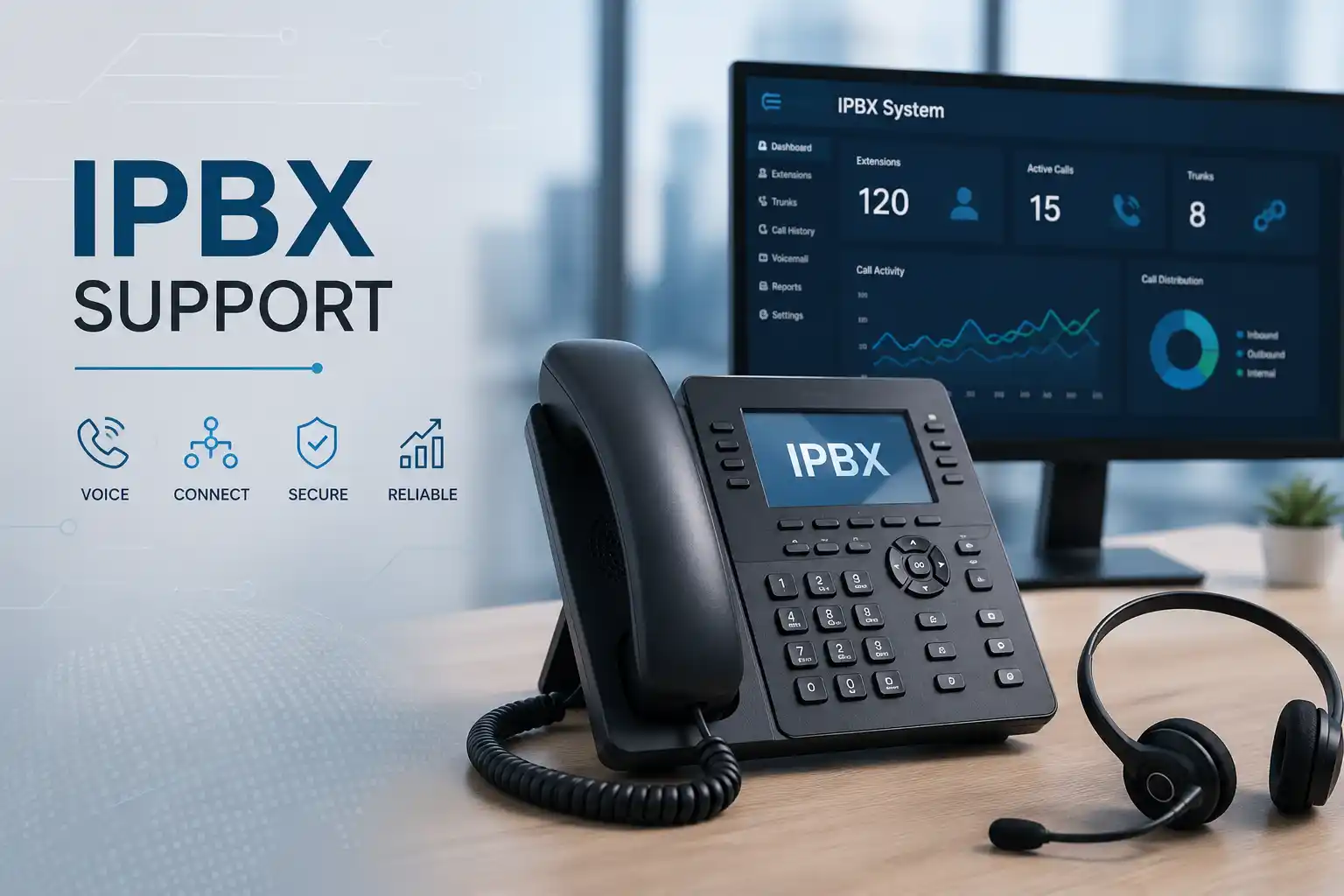
Capacity planning should begin with current usage, expected growth and the dependencies that carry voice traffic from the user to the service provider.
What Does an IP PBX Capacity Upgrade Mean?
An IP PBX capacity upgrade is a controlled change intended to increase how much business voice activity an existing telephone environment can support. The required change may relate to extension count, simultaneous calls, SIP trunk channels, queue members, recording capacity, storage, remote registrations, branch connectivity, voicemail use, application resources or the supported scale of the PBX platform itself. Businesses should consider an upgrade when planned growth or actual usage is approaching current limits, when busy periods expose call-handling constraints, or when an older design no longer matches present operations.
Before proceeding, the customer should be ready to confirm the current PBX platform, user and extension counts, incoming numbers, SIP or telecom provider, expected call concurrency, queue and reception workflows, phone and gateway models, licensing position, network layout, available switch and PoE capacity, internet links, backup status, business-critical call routes and the preferred change window. The exact upgrade path is subject to assessment because different platforms enforce different limits and may depend on licenses, hardware resources, provider services or compatibility with existing phones and gateways.
Why Capacity Problems Usually Involve More Than the PBX
A business telephone system sits in the middle of several technical relationships. Users make and receive calls through IP phones, softphones, mobile applications or gateways. Those endpoints rely on network ports, power, voice VLAN configuration, addressing, switching and local routing. External calls then depend on SIP trunks or other telecom services, firewall policies, internet quality, provider limits and number routing. Call recording may introduce additional storage and resource requirements. Remote users can increase the importance of secure access, internet stability and public connectivity. For that reason, a capacity limitation that appears to be “the PBX is full” may actually be a combination of PBX limits and supporting infrastructure constraints.
The upgrade should therefore be planned around the complete voice path. Adding fifty extensions is of little practical value if the switch has no suitable ports, the PoE budget is exhausted, the SIP trunk still allows only the existing call concurrency, or the platform license does not permit the intended feature set. Similarly, adding more SIP channels does not automatically improve call quality when the network is congested or unstable. FourTeck can help separate these dependencies so the quotation and change plan reflect what must actually be modified rather than assuming one component is responsible for every limitation.
User Growth
New staff, departments, reception positions, branch users or remote workers can require additional extension registrations, device provisioning, permissions and numbering plans.
Call Growth
Higher inbound and outbound concurrency may require changes to SIP channels, queue design, provider services, bandwidth planning and call reporting.
Feature Growth
Recording, voicemail, reporting, conferencing, integrations and multi-site workflows can place additional demands on storage, licenses, compute resources and network design.
Who May Need IP PBX Capacity Upgrade Assistance?
The service may suit an organisation that has outgrown an earlier telephone design or is preparing for a known expansion. A professional office may be adding employees and direct extensions. A retail group may be connecting additional branches. A clinic may need more reception and appointment-handling capacity. A logistics operation may require additional warehouse, dispatch and management users. A hospitality site may be expanding departments or integrating more staff endpoints. A contact-focused team may be increasing queue agents or concurrent calls. A business relocation may also create a natural point to reassess capacity because network switches, internet links, telecom circuits and equipment rooms are changing at the same time.
An upgrade can also become relevant when business processes change without a large increase in staff. For example, a company may introduce call recording, remote work, mobile applications, new queue rules, more detailed reporting or a second internet connection. Each change can alter how the PBX uses licenses, processor or memory resources, storage, network bandwidth and external services. FourTeck’s role is to identify whether the existing platform can be expanded safely, whether supporting components must be adjusted, and whether a phased migration to a different architecture should be considered when the present system cannot meet the target requirement.
Common Planning Triggers and Warning Signs
Capacity work is often requested after a visible business symptom, but the symptom alone does not prove the cause. Frequent busy responses during peak periods may indicate insufficient external channels, a call-routing problem or a provider issue. Phones failing to register after new users are added may relate to licensing, platform scale, network configuration or endpoint provisioning. Slow administration screens can indicate resource pressure, but they can also be caused by storage, operating-system or network problems. Call recording failures may be related to storage space, permissions, service status or retention settings rather than call capacity itself.
- A planned recruitment drive requires many new extensions or softphone users.
- Peak inbound traffic produces more simultaneous calls than the current trunk or queue design comfortably supports.
- A new branch must join the existing numbering, routing and reception structure.
- Remote workers need secure registrations and predictable call handling from outside the office.
- Call recording, voicemail or reporting growth is consuming storage or platform resources.
- An older PBX is approaching vendor, license, hardware or software limits.
- The company is relocating and wants to correct historical numbering, routing or network limitations before the move.
- Multiple small changes have accumulated without updated diagrams, backups or configuration records.
These signals justify assessment, not assumptions. The first task is to identify which limit is being reached and how that limit relates to the required business outcome.
Business Impact of Leaving Capacity Unplanned
A PBX can continue to operate while still becoming a constraint on the business. When call concurrency is too low, customers may encounter busy conditions or delayed handling during peaks. When extension growth is unmanaged, numbering can become inconsistent, permissions can be unclear and phones may be provisioned without a coherent standard. When network capacity is overlooked, additional phones can compete for switch ports, PoE and bandwidth. When the platform is expanded without checking storage, recording and voicemail services may be affected. The operational result may be missed calls, longer customer waits, reduced visibility, repeated support requests and more complicated troubleshooting.
Unplanned growth also makes future changes harder. An undocumented system with unclear trunks, call routes, office-hours rules and administrator dependencies can turn a simple capacity request into a risky change. Businesses benefit from reviewing the environment before the pressure becomes urgent because there is more opportunity to test, stage, document and communicate changes. The aim is not to replace equipment unnecessarily. It is to understand the current ceiling, the desired operating range and the most supportable way to move from one to the other.
Possible Scope of FourTeck Capacity Upgrade Assistance
Depending on the confirmed scope, assistance may include current-state discovery, user and extension inventory, call-concurrency review, SIP trunk assessment, licensing checks, PBX resource review, call-flow mapping, backup verification, network and PoE review, voice VLAN assessment, firewall dependency review, remote-user requirements, branch connectivity, recording and storage considerations, change planning, configuration work, endpoint provisioning, provider coordination, controlled testing, documentation and post-change support. Not every activity is required for every business, and the quotation should state which tasks are included.
| Business Situation | Relevant Assistance | What Must Be Confirmed |
|---|---|---|
| Adding employees or departments | Extension, license, numbering and endpoint capacity review | Target user count, phone method, permissions and platform limits |
| More simultaneous external calls | Call concurrency, SIP trunk and routing assessment | Provider service, channel limits, numbers and traffic pattern |
| New branch or remote workforce | Branch design, remote registration and network dependency review | Internet links, security model, addressing and endpoint compatibility |
| More recording or voicemail | Storage, retention and service resource review | Retention objective, legal policy, storage location and platform capability |
| Current system cannot reach target scale | Upgrade or migration planning | Compatibility, budget, downtime tolerance, provider and legacy dependencies |
Service Information for Decision Makers
| Service Topic | IP PBX capacity upgrade planning, configuration and support |
|---|---|
| Main Purpose | Increase supported voice users, call activity or related functionality in a controlled and documented manner |
| Typical Systems Involved | IP PBX, IP phones, softphones, SIP trunks, gateways, switches, PoE, voice VLANs, firewall, internet links and storage where relevant |
| Assessment Method | Remote review, customer discovery and on-site inspection as required by the environment |
| Remote Support Suitability | Suitable for authorised configuration, logs, license, call-flow and administrative review when secure access is available |
| On-Site Suitability | Recommended when cabling, phones, switches, PoE, gateways, racks or physical testing are involved |
| Customer Access Required | Authorised administrative and provider access as needed; credentials should be shared only through an approved secure method after authorisation is confirmed |
| Testing and Validation | Scope dependent; may include internal, inbound, outbound, transfer, queue, voicemail, failover or remote-user tests relevant to the approved change |
| Scheduling Dependency | Engineer availability, customer access, maintenance window, provider actions, parts or licenses and the confirmed work scope |
| Quotation Requirement | Final commercial terms depend on assessment and the approved quotation or service agreement |
When Remote Assessment May Be Enough
Remote work can be useful when the PBX administration interface is reachable through an authorised secure method and the customer can provide relevant service details. FourTeck may be able to review extension counts, call routing, licenses, logs, backups, trunk configuration, queue structure, remote-user settings and resource indicators without attending the premises. A user or administrator may also be asked to confirm symptoms or perform simple call tests. Remote assessment is especially useful for defining the likely scope before a quotation or maintenance window is arranged.
Remote access does not remove physical dependencies. If the capacity change requires new phones, gateways, switches, rack changes, cabling, PoE adjustments or local troubleshooting, an on-site visit may still be needed. Internet failure or security restrictions can also make remote work impractical.
When an On-Site Visit Is Usually More Appropriate
On-site assistance is valuable when capacity depends on the physical environment. Engineers may need to inspect rack space, patching, switch ports, PoE availability, power, gateway connections, analogue interfaces, phone placement or local cabling. A site visit can also help when several departments report inconsistent symptoms and the issue cannot be reproduced remotely.
Physical work should be included clearly in the agreed scope. Building access, security procedures, equipment availability, site contact details and suitable timing may affect the visit plan. The presence of an engineer on site does not itself guarantee that a provider-side or vendor-side dependency can be resolved locally, so escalation paths should remain part of the planning.
Assessment and Discovery Process
A useful capacity project begins with the business outcome. FourTeck first needs to understand why the organisation wants more capacity: additional employees, more concurrent calls, new queues, a branch rollout, remote users, recording growth, improved reporting or preparation for a relocation. This avoids increasing one technical limit while overlooking the actual operational requirement.
- Define business impact and target growth. Confirm current pain points, the expected number of users and the planned operating model.
- Inventory the existing voice environment. Record PBX platform, version where available, extensions, phones, gateways, trunks, numbers, queues, recordings and relevant integrations.
- Review observed usage. Look at call patterns, busy periods, concurrency, failed registrations, storage use or other evidence that helps identify the actual capacity boundary.
- Map supporting dependencies. Check network switches, PoE, voice VLANs, internet connectivity, firewall, branch links, provider services and power where they affect the target design.
- Confirm access and protection. Establish authorised administrator access, configuration backup, provider contacts and a rollback path before major changes.
- Identify options and trade-offs. Determine whether the existing platform can be expanded, whether supporting infrastructure must change, or whether migration should be evaluated.
- Prepare the change and test plan. Define what will be modified, what will be checked afterward and which business users need to participate in validation.
The output of discovery should reduce uncertainty. It should tell the customer what is known, what still depends on a vendor or provider, what must be changed first and what can be scheduled later.
Planning the Upgrade, Migration or Corrective Change
Once the current state and target are understood, the implementation path can be defined. In some environments the existing PBX may support the additional extensions or concurrent calls after an appropriate license, configuration or resource change. In others, a hardware appliance may require a larger supported platform. A virtual PBX may need additional compute, storage or host resources. A hosted service may depend on subscription level or provider capacity. A legacy PBX may be technically expandable but commercially difficult to maintain, making migration planning more sensible than continued incremental growth.
The safest path is environment dependent. A planned change can include a configuration backup, documentation of existing call flows, confirmation of number routes, a defined maintenance window, stakeholder communication, staged provisioning, selected pilot users, provider coordination and fallback arrangements. New extensions should be tested for registration, internal calling and the appropriate outbound permissions. Incoming numbers should be checked against their intended destination. Queues, reception rules, office hours, voicemail and recording should be validated only where they form part of the approved scope.
Where a migration is necessary, the project should also include compatibility review for existing phones and gateways, number-porting or trunk changes when applicable, user communication, backup and restore planning, rollback considerations, and a realistic acceptance process. Zero downtime should not be assumed. The maintenance window and fallback plan should reflect the importance of business calling and the level of third-party involvement.
Testing, Validation and Handover After Capacity Changes
A capacity upgrade is not complete when the configuration saves successfully. The result must be checked from the user and business perspective. Testing should be designed around the actual change. If extension capacity increased, representative new and existing extensions should register correctly and reach the destinations they are permitted to call. If simultaneous call capacity increased, the provider service and PBX should be checked at an agreed level without creating unnecessary disruption. If queues changed, distribution, overflow and timeout behaviour should match the approved call flow. If remote users were added, registration and call handling should be tested from the supported remote method.
Handover should leave the environment easier to support. Useful records can include updated extension ranges, new queue or ring-group memberships, trunk references, provider contacts, relevant license information, backup status, network dependencies and any remaining limitations. Administrators should know which changes were completed, which recommendations remain pending and what symptoms would justify a follow-up review. Where the customer maintains its own change control, FourTeck can align technical records with the agreed handover requirement.
Capacity That Matches Real Call Demand
User count and call concurrency are different measurements. A company can have many extensions but only moderate external call activity, while a smaller customer-service team may create high concurrency during busy periods. Capacity planning should use actual workflow rather than a simple one-extension-per-user assumption. The target should account for growth, but excessive over-sizing can add cost and complexity without improving operations. Provider limits and license terms must be confirmed before a final design is accepted.
Network Readiness for More Voice Endpoints
Additional phones and remote users increase dependency on the network. Switch ports, PoE, addressing, voice VLAN design, uplinks, firewall rules and internet quality may need review. Voice quality depends on more than bandwidth; loss, latency, jitter, congestion and unstable links can matter. FourTeck can include network checks in the scope where the PBX expansion depends on them, but any internet-provider issue may require separate provider action.
Documentation That Supports the Next Expansion
A well-documented upgrade reduces future guesswork. Clear extension ranges, call routes, queue membership, trunk dependencies, provider contacts, backup locations and network relationships help support teams understand the environment when the next user, branch or feature is added. Documentation does not remove the need for assessment, but it shortens discovery and makes changes easier to plan responsibly.
Dependencies, Access and Customer Inputs
The customer remains an important part of the capacity project because technical decisions depend on business information that an engineer cannot infer from configuration alone. FourTeck may need a nominated contact who can confirm department requirements, priority phone numbers, reception workflows, emergency or special call handling, business hours and the timing of acceptable disruption. Technical access may also be needed to the PBX, network equipment, firewall, provider portal or hosting environment, depending on the design. Credentials should not be published or sent through an uncontrolled channel; they should be shared only through an approved secure method after identity and authorisation are confirmed.
Other dependencies can include an active support entitlement, valid licensing, vendor support status, available SIP channels, number-porting arrangements, internet service, rack space, power, PoE, switch ports, cabling, compatible phones, gateways, storage and backup quality. A capacity upgrade can be delayed if one of these items is unavailable. It is therefore useful to identify third-party actions early and separate FourTeck work from provider, vendor or customer responsibilities in the quotation and project plan.
Risks, Limitations and Exclusions to Confirm
Diagnosis and capacity recommendations depend on available evidence, authorised access and the accuracy of current system information. Some older or unsupported PBX platforms may have limited upgrade options, even when they are still operating. Existing phones or gateways may not remain compatible with every new platform or software release. Licensing can restrict extension count, concurrent calls or feature use and should be verified against the specific environment. Provider changes may have their own lead times, approval steps or commercial terms outside FourTeck’s control.
Configuration changes can affect active calls, registrations, queues or routing, so a maintenance window may be appropriate. A successful test after the change does not remove the need for ongoing monitoring, backup and maintenance. Hardware failure may require replacement parts or equipment that is separate from support labour. Internet or telecom faults may require ISP or carrier action. Call recording and retention requirements can involve customer policy or regulatory considerations that should be confirmed by the customer. Final commercial terms, included tasks and exclusions depend on the approved quotation or service agreement.
Business Environments Where Capacity Planning Can Add Value
Professional offices often need additional extensions as teams grow, but they may also require changes to direct numbers, department ring groups and reception routing. Retail businesses can need branch integration so calls reach local stores or a central service desk without creating inconsistent numbering. Warehouses and logistics operations may add dispatch, gate, loading and management users who depend on reliable switching and coverage. Clinics can have concentrated reception traffic and may need queue or overflow adjustments as appointment volume grows. Hospitality locations can have numerous internal endpoints and complex routing between reception, reservations, administration and operational departments.
Multi-branch businesses introduce another layer because users, numbers and call flows may be distributed across several internet connections and local networks. The right approach depends on whether each site operates independently, shares one central PBX or uses a hosted platform. Remote and hybrid teams may also change capacity needs because softphones and mobile applications can add registrations even when the number of physical desk phones remains stable. FourTeck can help translate these operating models into a technical assessment without assuming that one design suits every organisation.
Operational, Security and Maintenance Considerations
Increasing capacity should not weaken administrative control. New extensions need appropriate permissions rather than broad access by default. Remote users should be added through the supported security model for the platform and customer environment. Administrator accounts should be limited to authorised personnel, and shared credentials should be avoided where the system supports individual administration. Firewall exposure and remote-access rules should be reviewed when the upgrade changes how users connect. Security improvement reduces risk but cannot guarantee complete protection, so patching, access review, backup and monitoring remain ongoing responsibilities.
Maintenance also matters after expansion. More users produce more moves, additions and changes. Extension records, queue membership, voicemail ownership and departed-user access can drift if there is no process. Capacity should be reviewed again when the business opens another site, adds a major department, changes telecom providers, introduces recording, moves to a new building or experiences repeat peak-period limitations. A maintenance plan can help identify storage growth, license headroom, configuration drift and provider dependencies before they become urgent, subject to the agreed support scope.
Before You Contact FourTeck
Preparing a concise description of the current environment helps the initial discussion focus on the real capacity requirement. You do not need to know every technical detail, but the following information can make assessment and quotation more accurate.
- Dubai or UAE service location and any branch locations involved
- Primary business contact and technical contact, if different
- Current PBX platform or vendor name if known
- Approximate current extension and user count
- Expected number of new users or endpoints
- Approximate peak call activity or known busy periods
- SIP or telecom provider and trunk information if available
- Key incoming numbers and important call destinations
- Queues, auto-attendants, recording or voicemail requirements
- Remote-user or new-branch requirements
- Recent changes, recurring symptoms or capacity warnings
- Administrative access availability through an authorised method
- Current configuration backup status if known
- Network, switch or PoE information where new phones are planned
- Preferred maintenance window and acceptable disruption
- Target date, business priority and expected outcome
Service Evaluation and Quotation Checklist
The final engagement should define the work clearly enough that technical and business stakeholders understand what is included. Before approving a capacity upgrade, confirm the following points with FourTeck and any relevant provider.
- The exact capacity objective: users, calls, branches, features or a combination.
- The current platform and whether it can support the target scale.
- The number and type of endpoints that will be added or reused.
- The SIP trunk or telecom capacity required after the change.
- Whether network, PoE, cabling, firewall or internet work is part of the same scope.
- Any license, subscription, hardware or provider actions required before implementation.
- The backup, rollback and maintenance-window approach.
- Which call flows, queues, numbers and remote users must be tested.
- Whether documentation and administrator handover are required.
- Whether user guidance or phone provisioning is included.
- Any branch, building-access or after-hours coordination requirements.
- Tasks that are excluded or depend on third parties.
How FourTeck Can Assist With the Upgrade
FourTeck can begin by clarifying the business reason for the upgrade and identifying which technical layers may constrain growth. The assessment can connect PBX configuration with extensions, phones, SIP trunks, networks, firewalls, internet links, branch connectivity and storage where those components affect the target. From there, FourTeck can help define whether the requirement is a configuration change, a license or resource increase, a physical network expansion, provider coordination, a phased migration or a combination of tasks.
For approved work, assistance may include change planning, configuration, endpoint provisioning, network coordination, SIP provider liaison, test execution, troubleshooting, documentation and handover. FourTeck can also identify follow-up recommendations that are useful but not essential to the immediate capacity objective. This distinction helps customers separate required work from future improvement. To begin, share the current issue or growth plan through the FourTeck contact page. Broader connected-office assistance is described on the FourTeck IT services page.
Dubai and UAE Service Coordination
For businesses in Dubai and across the UAE, remote or on-site assistance depends on the current issue, authorised access, site location, urgency and approved quotation. A remote review may be a practical starting point when the PBX administration interface and supporting information are available. An on-site visit may be recommended when physical phones, switches, PoE, gateways, cabling, racks or local testing are involved. Installation, configuration, migration and maintenance tasks should be identified explicitly in the quotation rather than assumed.
Service timing depends on engineer availability, customer access, site conditions, required equipment or licenses, third-party providers and the confirmed work scope. FourTeck can coordinate planned support for Dubai, Abu Dhabi, Sharjah and Ajman as one combined UAE service requirement. Depending on the project, this may include remote discovery, scheduled site visits, assessment, configuration, migration or testing. Travel, building access, site rules, provider actions and equipment availability can affect the final plan, so customers should confirm scheduling options before committing a maintenance window.
Related FourTeck IT Services
Help with call routing, extensions, queues, SIP dependencies, troubleshooting and upgrade planning.Office Network Support
Switching, routing, VLAN, cabling and connected-device support where network readiness affects voice.Business IT Support
Connected support across users, devices, networks, servers and communication systems.FourTeck Service Approach
Learn about the wider business technology support and infrastructure focus.
Why Businesses Contact FourTeck for PBX Growth Projects
Capacity work often crosses the boundary between telephony and IT. A PBX administrator may see extension and trunk settings, while a network administrator sees switching, VLANs and firewall rules. The telecom provider controls external numbers and service limits. The customer knows which departments and call flows matter most. FourTeck can bring these viewpoints into one structured assessment so technical changes are linked to the business requirement.
Customers may also need an independent way to organise an inherited or poorly documented telephone environment. FourTeck can help record what exists, identify dependencies, explain practical options, coordinate remote and on-site work, test approved changes and document next steps. The emphasis is on clear scope and controlled change rather than unsupported promises. Final recommendations depend on the actual platform, access, provider, network condition, compatibility, licensing and the priorities confirmed by the customer.
Questions Businesses Ask Before an IP PBX Capacity Upgrade
Can we add more extensions without replacing the IP PBX?
Possibly, but the answer depends on the platform, current license, supported extension count, hardware or virtual resources, software release, endpoint compatibility and the number of existing users. The network may also need more switch ports, PoE or addressing capacity if physical phones are being added. A useful first step is to inventory the current system and compare the target number of users with the platform’s supported and licensed limits. If there is adequate headroom, a controlled expansion may be more practical than replacement. If the platform is at or near its supported ceiling, a larger instance, hardware refresh, hosted option or migration may need to be considered. FourTeck can assess the environment and separate the PBX requirement from the network and provider changes that may be needed alongside it.
How do we know whether we need more SIP channels or just more extensions?
Extensions represent users or endpoints, while SIP channels or equivalent trunk capacity relate more closely to simultaneous external call activity. A business can add many internal extensions without needing the same number of external channels, but a contact-heavy team may require higher concurrency even with fewer users. The right figure depends on call patterns, busy periods, inbound queues, outbound campaigns, branch traffic and any provider-specific limits. Reviewing call records or available traffic statistics can help estimate actual demand. The provider should confirm what the current service allows and what changes are commercially or technically available. Capacity should be sized for realistic peaks and planned growth rather than simply matching one channel to every extension.
Can an IP PBX capacity upgrade be checked remotely?
A significant part of discovery can often be done remotely when the customer authorises secure access and the PBX administration interface is available. Remote review may cover extensions, licenses, trunks, queues, logs, backups, call routing, storage indicators and software configuration. It can also be used to collect information for a quotation before a site visit. On-site work is more likely when the project includes new desk phones, gateway changes, additional switch ports, PoE, cabling, rack changes or physical fault investigation. If the internet connection is unstable or remote administration is not permitted, the assessment method may also need to change. FourTeck can recommend the balance after understanding the environment.
Will increasing capacity improve poor call quality?
Not necessarily. Call quality problems can come from network congestion, packet loss, latency, jitter, unstable internet service, Wi-Fi conditions, cabling, switch issues, endpoint faults, codec handling, firewall behaviour or provider-side problems. More PBX capacity is useful only when the limitation is actually related to platform resources or supported call volume. If users report choppy audio, one-way sound, delay or dropped calls, the voice path should be tested before capacity changes are treated as the cure. FourTeck can include network and provider dependency checks in the assessment where appropriate. The goal is to identify the technical layer causing the symptom before approving changes.
What should we prepare if we are opening a new branch?
Prepare the branch address, expected user count, target opening date, preferred numbering approach, reception or queue requirements, internet service information, network design, switch and PoE availability, phone or softphone plan, remote administration policy and any local analogue or gateway requirements. It is also useful to decide whether the branch should share the existing PBX, use a separate system or connect through a hosted platform. The answer depends on the current architecture and business continuity goals. Building access, cabling completion and provider readiness can affect the schedule, so those dependencies should be confirmed before a cutover date is set.
Should we upgrade the existing PBX or migrate to a new platform?
The decision should compare the target scale with the remaining life and supportability of the current system. Expansion may make sense when the platform is supported, compatible with the required endpoints, capable of the target capacity and economical to maintain. Migration may be more appropriate when the current system has reached a technical ceiling, depends on unsupported software or hardware, cannot provide required features, or would require disproportionate investment to extend. The migration option must then be evaluated for phone compatibility, trunk arrangements, call flows, recordings, integrations, downtime, user impact and rollback. FourTeck can help document these trade-offs so the customer can decide based on operational priorities rather than a generic replacement cycle.
Can we keep our existing IP phones after the capacity upgrade?
Existing phones may be reusable when they remain compatible with the chosen PBX platform, firmware, provisioning method, network and security requirements. Compatibility must be checked rather than assumed, particularly when the project involves a major software upgrade or migration to a different PBX. Some phones may technically register but lack full provisioning, security or feature support. The customer should provide model details where possible. Reusing suitable phones can reduce disruption and cost, but forcing unsupported endpoints into a new environment can create long-term support problems. A staged replacement may be preferable when only part of the phone estate is suitable.
What can affect the final service quotation?
The quotation can be affected by the number of users, extensions and sites; the current PBX platform; the target call concurrency; SIP provider requirements; licensing; endpoint compatibility; network and PoE capacity; gateway needs; branch or remote-user design; call recording or storage; the amount of undocumented configuration; maintenance-window requirements; site access; provider coordination; testing expectations; documentation and handover. A small configuration increase can be straightforward in one environment and become a larger migration in another. FourTeck therefore needs enough information to separate required tasks, optional improvements, third-party actions and exclusions before commercial terms are confirmed.
Frequently Asked Questions
What is normally included in an IP PBX capacity assessment?
The assessment may review user and extension counts, call patterns, trunks, licenses, queues, recordings, platform resources, backups, network dependencies, remote-user needs and the target growth plan. The exact scope depends on the environment and approved quotation.
Do you need administrator access?
Authorised administrative access is commonly required for a meaningful configuration review. Provider or network access may also be needed depending on the issue. Credentials should be shared only through an approved secure method after identity and authorisation are confirmed.
Can the upgrade be completed without downtime?
Zero downtime should not be assumed. Some changes may be low impact, while others require a maintenance window, service restart, trunk change, endpoint reprovisioning or migration. The expected interruption should be assessed and communicated before implementation.
Can FourTeck coordinate with our SIP provider?
Provider coordination can be included when trunk capacity, number routing, authentication, porting or service-side troubleshooting affects the project. Provider actions and commercial terms remain dependent on that third party and should be identified separately.
Do we need to replace our network switches?
Not automatically. Switch replacement may be relevant if there are insufficient ports, limited PoE capacity, unsupported features, performance problems or an unsuitable topology. A network review should confirm the need before equipment changes are recommended.
What happens if our current PBX cannot scale further?
FourTeck can help compare practical options such as a larger supported appliance, additional resources for a virtual deployment, a hosted platform or a staged migration. Compatibility, downtime, trunks, phones, licensing, recordings and integrations should be assessed before a direction is chosen.
Will you test call flows after the change?
Testing can be included according to the approved scope. Typical validation may cover internal, inbound and outbound calls, queues, transfer behaviour, voicemail, office-hours routing, remote users or other functions affected by the change.
Can capacity planning include multiple UAE sites?
Yes, the assessment can consider multi-site requirements where the PBX, branches, internet links and routing are related. Remote and on-site coordination depends on location, access, site conditions, travel and the confirmed quotation.
Is documentation available after the upgrade?
Documentation and handover can be included when required. The useful level depends on the project, but it may cover extension ranges, call routes, trunk dependencies, provider contacts, backups and outstanding recommendations.
How do we request a quotation?
Share the current PBX details, user count, target growth, call or branch requirements, known provider information, access availability and preferred schedule. FourTeck can use that information to determine whether remote discovery or an on-site assessment is the appropriate next step.
Plan the Next Stage of Your Business Telephone System
If your organisation is adding users, increasing call traffic, opening a branch, expanding remote work or approaching the limits of an existing IP PBX, FourTeck can help define the current environment and the capacity required for the next stage. The first step is to share what is changing, what users are experiencing and what business outcome you need. FourTeck can then recommend a suitable assessment method and prepare the service scope around authorised access, compatibility, network readiness, provider dependencies, testing and handover.
Contact FourTeck to confirm service scope and scheduling options. Remote or on-site assistance depends on the issue, location, access, site conditions and approved quotation.