
Emergency CCTV Support in Dubai, UAE
A failed camera, recorder, storage path, power source, network connection, or viewing application can remove visibility at the moment a business needs it most. FourTeck helps organisations assess urgent CCTV faults methodically, identify which technical layer is affected, and coordinate remote or on-site assistance according to access, risk, location, and the approved scope.
The word emergency describes the operational priority of the CCTV fault; it does not mean guaranteed immediate attendance, a fixed response time, or continuous 24-hour coverage. Contact FourTeck so the situation, business impact, evidence requirements, site access, engineer availability, and safe next action can be confirmed.
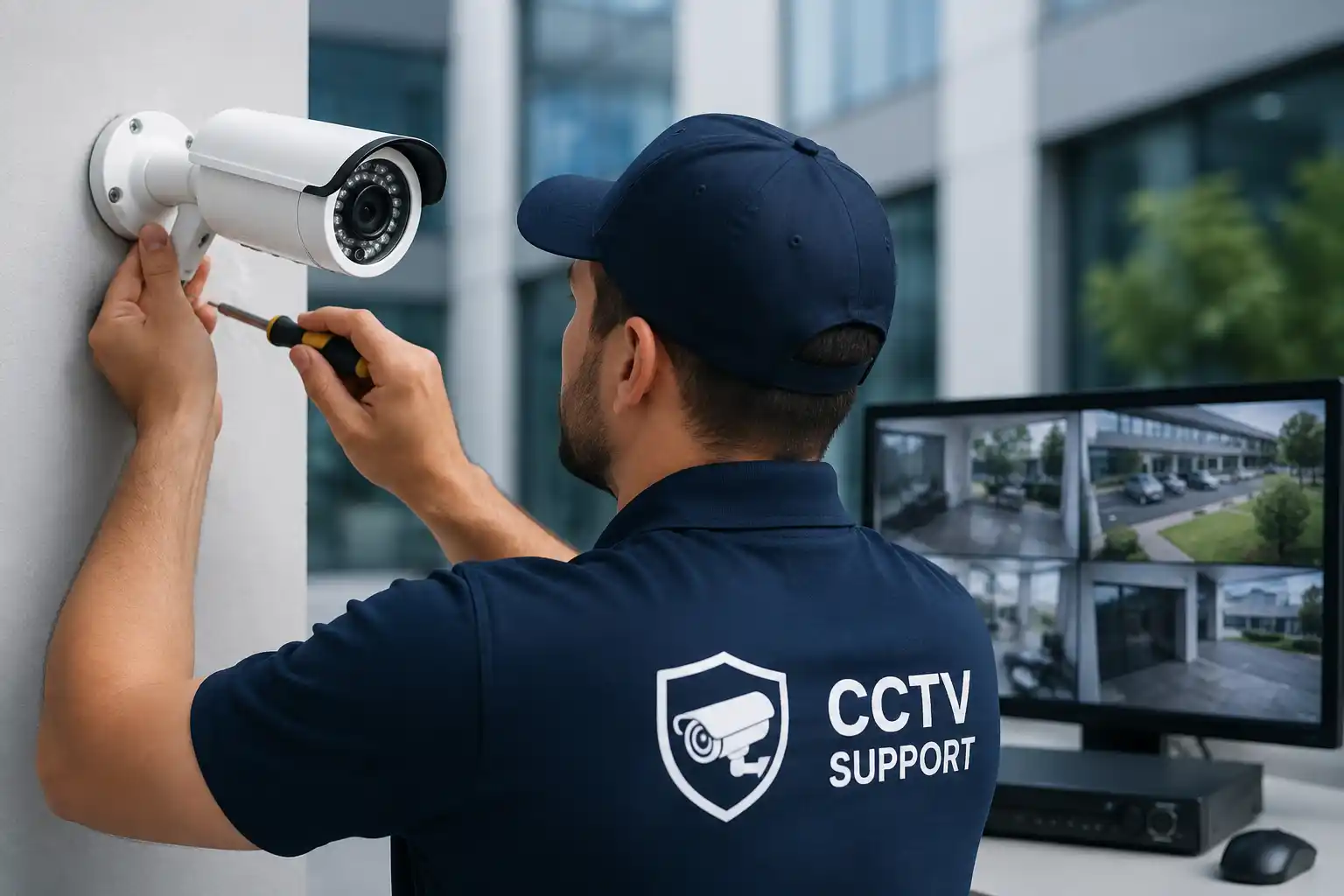
What emergency CCTV support means for a business
Emergency CCTV support is a priority technical-assistance service for a surveillance problem that is disrupting live monitoring, recording, incident review, authorised remote access, or confidence that a critical area is being captured correctly. It is mainly used when a site cannot safely wait for the next routine maintenance visit because the fault affects an important entrance, cash-handling point, warehouse aisle, reception area, loading zone, office perimeter, or other business-defined surveillance area. Organisations should consider this service when the issue has material operational or security significance and needs structured diagnosis. Before work can be confirmed, the customer should provide the site location, affected devices or camera channels, visible symptoms, approximate start time, recent changes, recorder details where known, business impact, and authorised access availability. The exact support route depends on whether the problem can be investigated remotely or requires physical testing at the premises.
What urgent CCTV troubleshooting may cover
A surveillance system is a chain rather than a single appliance. A camera can be physically healthy while recording fails because a network link is unstable. A recorder can appear online while a storage drive is not writing correctly. A mobile application can show a connection error even though local monitoring works. For that reason, urgent troubleshooting should begin by identifying the exact failure point instead of replacing equipment based on the first symptom.
Camera and image path
Checks may involve camera power, PoE delivery, video signal, image availability, lens obstruction, local environmental conditions, camera registration, addressing, stream status, and whether the correct channel is mapped to the recorder. Physical inspection may be needed when a camera is damaged, exposed, loose, wet, obstructed, or unreachable through the network.
Recorder and storage
An NVR or DVR fault may involve power, startup state, storage health, recording schedules, channel configuration, capacity, date and time settings, display output, user permissions, or a software condition. If recordings may be required for an incident, preservation should be considered before resets, disk initialisation, formatting, or other changes that could affect stored video.
Network and remote viewing
IP surveillance depends on switching, cabling, addressing, gateways, DNS where relevant, firewall policy, internet service, bandwidth, and secure remote-access design. A local camera may work while remote viewing fails, or remote access may work intermittently because the underlying network path is unstable. The fault should be isolated without broadly weakening security controls.
Power and physical infrastructure
Cameras, recorders, PoE switches, displays, network devices, power supplies, UPS equipment, connectors, racks, and structured cabling can all affect CCTV availability. On-site work is often the better route when power measurement, port testing, cable tracing, hardware inspection, equipment reseating, or safe physical replacement is required.
Who may need emergency CCTV assistance
The service may suit offices, retail premises, warehouses, clinics, restaurants, hospitality sites, showrooms, schools, property-management locations, logistics operations, construction offices, and multi-branch businesses when surveillance visibility has become operationally important. The trigger is not the industry label; it is the effect of the fault. A retailer may need help because cash-counter video is missing. A warehouse may have cameras offline at a loading bay. A property team may be unable to retrieve footage after an incident. An office may have lost remote viewing after a network or internet change. A multi-site organisation may see one branch disappear from its monitoring platform.
The first question should be whether the issue affects one camera, a group of channels, an entire recorder, remote access only, recording only, or the wider network and power environment. That distinction helps determine whether the incident is likely to remain within the CCTV system or requires coordination with networking, electrical, internet, storage, vendor, or building-management teams.
Common urgent symptoms and the technical layers behind them
A symptom is evidence, not a diagnosis. Two sites can report “camera offline” for completely different reasons, and changing the wrong setting may make the situation harder to understand. FourTeck’s assessment can therefore consider the relationship among camera hardware, power, cabling, network switching, IP configuration, the recorder, storage, applications, firewall rules, internet service, and authorised user accounts.
| Observed issue | Possible technical areas to assess | Recommended first step |
|---|---|---|
| One camera shows offline | Camera power, PoE port, patching, cable, addressing, camera status, recorder channel mapping. | Confirm whether neighbouring cameras work and record the affected channel without resetting it. |
| Several cameras fail together | Shared PoE switch, power source, network uplink, recorder interface, VLAN or broader network change. | Identify the common equipment or location shared by the affected cameras. |
| Live video works but recordings are missing | Recording schedule, storage condition, recorder service, time settings, channel configuration, retention capacity. | Note the missing time range and avoid storage changes until evidence requirements are understood. |
| Local viewing works but remote access fails | Internet service, firewall policy, secure remote-access method, application account, DNS or vendor service dependency. | Confirm whether the failure affects all authorised remote users or only one device or account. |
| Recorder cannot be reached | Power, display output, network link, address, local interface, hardware state, storage or operating condition. | Check visible status indicators and business impact without repeatedly power cycling the unit. |
| Image freezes, drops or becomes unclear | Network stability, cabling, PoE, camera condition, bitrate, recorder load, lighting, lens condition or physical obstruction. | Record whether the issue is constant, time based, weather related, or limited to specific channels. |
Business impact when surveillance visibility is interrupted
A CCTV fault can affect more than a security screen. Missing live views can make it harder for authorised staff to observe entrances, loading zones, customer areas, stock movement, or other monitored activity. Missing recordings can delay incident review, internal investigation, insurance preparation, operational review, or communication with building management and authorities. In a multi-site business, one failed recorder can also remove central visibility for a complete location.
The appropriate response depends on the business importance of the affected cameras. A fault on a low-priority interior view may be handled differently from an outage across all perimeter or cash-handling cameras. FourTeck can help the customer classify the impact, identify what is still working, and define the next safe action rather than assuming every fault requires the same intervention.
Where there is a personal safety emergency, suspected crime in progress, fire, or another immediate security incident, customers should follow their organisation’s emergency procedure and contact the appropriate authority or building-security team. Technical CCTV support assists with surveillance systems; it is not a substitute for emergency services.
Possible service scope for an urgent CCTV incident
Depending on the confirmed scope, assistance may include initial incident clarification, remote diagnosis, on-site inspection, camera and recorder checks, storage review, network and PoE testing, authorised account review, application troubleshooting, cable or port checks, corrective configuration, replacement planning, vendor coordination, testing, documentation, and preventive recommendations. Not every task is included automatically. The quotation and service plan should identify which systems, locations, devices, changes, and tests are approved.
Incident assessment
Clarify what stopped working, when it changed, which cameras or users are affected, whether recording is still active, and whether recent network, power, construction, password, firmware, storage, or equipment changes may be relevant.
Technical isolation
Check the path from camera to power source, cable, switch, recorder, storage, viewing client, network and remote-access method as needed. The objective is to narrow the fault before corrective work is approved.
Corrective action
Approved work may involve configuration correction, account or permission repair, port or cable remediation, recorder settings, storage action, application reconfiguration, camera replacement planning, network adjustment, or coordination with another responsible provider.
Validation and records
After changes, test live view, recording, playback, relevant remote access, date and time, affected channels, and user access within the approved scope. Record what was changed, what remains unresolved, and what should be monitored or planned next.
Service-fit matrix: when this support route may be appropriate
| Business situation | Relevant assistance | What must be confirmed |
|---|---|---|
| Critical camera views disappeared unexpectedly. | Camera, PoE, network, recorder and channel-path assessment. | Affected channels, site access, recent changes and whether physical testing is required. |
| Footage cannot be found for a specific incident period. | Recording-status, time, schedule and storage assessment, with evidence preservation in mind. | Exact time range, recorder access, retention conditions and whether footage exists. |
| Remote monitoring stopped after an IT or internet change. | Application, account, firewall, network and remote-connectivity review. | Authorised access, current network design, internet status and change history. |
| Recorder shows storage warnings or has stopped recording. | Storage, recorder health, capacity and recording-configuration assessment. | Whether existing recordings must be preserved and whether hardware work is authorised. |
| Recurring outages keep returning after temporary fixes. | Wider fault-history review, dependency mapping, documentation and maintenance planning. | Previous work, recurring pattern, affected infrastructure and acceptable maintenance window. |
Emergency CCTV support information at a glance
| Main purpose | Assess and troubleshoot operationally urgent CCTV faults affecting live view, recording, playback, storage, camera availability or authorised remote access. |
|---|---|
| Typical systems involved | IP or analogue cameras, NVR or DVR, storage drives, PoE switches, cabling, network equipment, displays, viewing applications and supporting internet or firewall services. |
| Assessment method | Remote and/or on-site, depending on secure access, internet availability, physical testing needs, urgency, location and approved scope. |
| Customer access required | Authorised administrative or local access may be required. Credentials should only be shared through an approved secure method after identity and authorisation are confirmed. |
| Evidence consideration | If stored footage may be needed for an incident, avoid unnecessary reset, format, initialisation or replacement actions before preservation requirements are assessed. |
| Testing and validation | Scope dependent; may include live view, recording, playback, date and time, channel status, remote access and authorised user tests. |
| Vendor coordination | May be required where cloud services, proprietary applications, warranties, locked accounts, firmware, ISP services or manufacturer support affect the fault. |
| Scheduling | Subject to assessment, engineer availability, site access, travel, building restrictions, required parts, third-party dependencies and the approved quotation. |
| Commercial scope | Final inclusions, exclusions and charges depend on the confirmed work and approved quotation or service agreement. |
Can the CCTV problem be checked remotely?
Remote support may be suitable
Remote troubleshooting can be useful when the site still has working internet connectivity, authorised secure access is available, and the problem appears related to recorder settings, user accounts, applications, network configuration, channel mapping, time settings, logs, or remote viewing. A responsible user or administrator may need to confirm local indicators, test a view, or describe what is shown on the recorder.
Remote diagnosis can also help determine whether an on-site visit is worthwhile and what equipment or access will be needed. It should not be treated as a guarantee of resolution when the problem involves hardware, cabling, storage, power, physical damage, or a site condition that cannot be observed remotely.
On-site support may be more appropriate
A physical visit may be needed when cameras have no power, PoE ports require testing, cables or connectors must be inspected, the recorder cannot be accessed over the network, storage hardware needs checking, equipment has been damaged, a camera must be reached physically, rack equipment requires attention, or the fault affects several systems and the shared infrastructure is uncertain.
Site work depends on location, building access, permits or escort requirements where applicable, working-at-height considerations, safe equipment access, engineer availability, required replacement items and the confirmed scope. A quotation should identify installation or replacement work rather than assuming it is included in troubleshooting labour.
How the urgent CCTV assessment can proceed
A disciplined response is especially important when the problem feels urgent. The purpose is to restore useful visibility while protecting evidence, avoiding unnecessary configuration changes, and understanding dependencies before work expands.
- Establish the business impact. Identify which areas are no longer visible, whether recording is affected, whether an incident has occurred, and whether the problem affects one camera, several cameras, one recorder, one user, one site or the whole surveillance environment.
- Collect the timeline. Record when the symptom was first noticed, the last time the system was known to work, and any recent network changes, power events, maintenance, password changes, building works, equipment replacement, firmware work or ISP changes.
- Protect potentially relevant footage. If recordings may be needed, note the required date and time range and avoid unnecessary formatting, factory resets, storage initialisation or repeated power cycling until the situation is assessed.
- Confirm authorised access. Determine who can approve work, who can provide access to the CCTV room or rack, and whether administrative access is available. Sensitive credentials should be handled only through an approved secure method.
- Check the least invasive evidence first. Review observable channel status, visible error messages, recorder indicators, application symptoms, network reachability, and whether the failure follows a shared component. This helps narrow the problem without changing the environment prematurely.
- Test the relevant technical layers. Depending on the issue, this may include camera power, PoE, switching, cable links, addressing, recorder status, storage, recording configuration, playback, user permissions, viewing applications, firewall rules or internet service.
- Separate the immediate fault from underlying weaknesses. Restoring one channel may solve the immediate problem, but repeated failures, overloaded storage, undocumented addressing, weak power resilience or unstable cabling may require a separate maintenance or improvement plan.
- Agree the corrective action. Explain the likely fault area, the work proposed, service interruption risk, backup or rollback considerations, parts or vendor dependencies, and whether the work can be completed within the existing scope.
- Validate the result. Check the functions that matter to the business, such as live view, recording, playback, timestamp, remote access, user permissions and specific high-priority channels.
- Document the outcome. Record completed work, unresolved items, equipment that may need replacement, recurring risks, monitoring points and recommended maintenance so the next incident starts with better information.
Corrective work should be controlled, not improvised
Urgency can create pressure to change multiple settings at once, restart every device, replace equipment immediately, or open broad internet access simply to restore remote viewing. That approach can destroy useful diagnostic evidence, introduce new faults, or weaken security. A better corrective process changes only what is necessary, records the previous state where practical, considers rollback, and confirms the effect after each approved action.
For example, if the issue began after a network change, the CCTV path should be reviewed in relation to the new switch, firewall, addressing or VLAN conditions rather than assuming the camera is defective. If recording stopped after a storage warning, the recorder and storage status should be assessed before a drive is reformatted. If remote access stopped after an account change, user permissions and the supported remote-connectivity method should be reviewed before exposing the recorder directly to the internet.
Where a replacement is required, compatibility, power, physical mounting, stream support, recorder capacity, retention requirements, licensing where applicable, network capacity and future maintenance should be considered. Replacement is a project decision when it changes the design, not merely a troubleshooting step.
Testing, validation and handover after urgent work
A camera appearing on screen is only one part of a successful test. If the approved work affected recording, the validation should confirm that new video is being stored and can be played back. If remote access was repaired, authorised users should confirm the intended viewing method without sharing administrator accounts unnecessarily. If a network or PoE fault was corrected, the affected channels should be observed for stability rather than assuming one successful frame proves the issue is gone.
Useful handover can include a short record of the fault symptoms, the technical area identified, configuration or physical work completed, channels tested, remaining limitations, parts still required, vendor actions, and recommendations for maintenance or monitoring. Where the site has undocumented camera numbers, switch ports, recorder channels or credentials ownership, the incident may be a good point to improve those records.
If the fix is temporary because a failing drive, damaged cable, unstable power source, unsupported device or third-party service remains in place, that should be stated clearly. A temporary restoration and a completed long-term repair are not the same outcome.
Capability focus: preserving the usefulness of surveillance evidence
When a business contacts support because footage is needed after an incident, the objective changes from ordinary fault fixing to careful evidence-aware troubleshooting. The first practical task is to clarify the required time window, affected camera views, recorder involved, and whether the customer can already access any portion of the recording. Unnecessary resets, storage initialisation, drive replacement, date changes, or configuration changes can make the situation more difficult, so the environment should be assessed before destructive action.
FourTeck can help check whether recording was active, whether the recorder time appears accurate, whether the correct channels are available, and whether playback or export functions are accessible within the authorised scope. The existence or recoverability of missing footage cannot be guaranteed; results depend on whether data was recorded, storage condition, retention behaviour, overwriting, recorder function, time settings, and the condition of the underlying media.
Where footage relates to a legal, insurance, disciplinary, or security matter, the customer should also follow its own evidence-handling policy and any instructions from relevant authorities, insurers, legal advisers or building management. Technical support can assist with system access and integrity; it does not replace the customer’s formal evidence process.
Capability focus: isolating a CCTV fault across connected infrastructure
Modern surveillance frequently depends on infrastructure managed by different teams. The camera may be owned by security, the PoE switch by IT, the cabling by a facilities contractor, the internet link by an ISP, the firewall by a managed provider, and the mobile application by a manufacturer or cloud service. When a fault crosses these boundaries, every supplier may see only one piece of the problem.
A useful assessment maps the signal path. For an IP camera, that path may run from camera power and cable to a switch port, VLAN or local network, recorder, storage, firewall and remote application. For an analogue or hybrid installation, the path may include camera power, coaxial cabling, the DVR, storage, display output and network connection for remote viewing. Testing should follow the actual architecture rather than assume all CCTV systems work the same way.
This connected view is particularly valuable when several cameras fail together, the fault began after an IT change, or remote viewing is the only symptom. It allows the business to direct corrective work to the responsible layer and coordinate vendors with clearer evidence.
Capability focus: reducing repeat CCTV incidents
An urgent restoration is valuable, but repeated faults usually indicate that the environment needs more than isolated incident work. Recurrence may be associated with unstable power, poor cabling, overloaded storage, undocumented network settings, aging hardware, weak environmental protection, unmanaged firmware, insufficient PoE capacity, inconsistent user access, or changes made without records. The correct explanation depends on evidence from the specific site.
After the immediate incident is stable, a maintenance review can separate urgent remediation from planned improvement. The business may benefit from a camera and recorder inventory, channel map, switch-port record, storage-retention review, backup of supported configuration where appropriate, user-access review, remote-viewing review, physical inspection of exposed equipment, time-synchronisation check, and a clear escalation contact for third-party services.
FourTeck can help turn the incident history into practical recommendations instead of repeatedly treating the same symptom. The frequency and content of any preventive maintenance plan should be agreed according to the number of sites, cameras, recorders, critical areas, environment, support expectations and commercial scope.
Dependencies, access and customer inputs that can affect the response
An urgent CCTV problem can only be assessed as far as available evidence and authorised access allow. Before support begins, it helps to identify the person who can approve work, the person who can provide physical access to the site, and the person who understands how the system is normally used. For shared buildings, the customer may also need building-management approval, an escort, roof or ceiling access, or coordination with facilities staff.
Technical dependencies can include the recorder administrator account, camera or switch access, firewall or router access, viewing-application account, vendor portal, network diagram, IP address information, ISP details, equipment model details, previous maintenance records, and a known-good display or local user. Not all of these are required for every case. FourTeck should confirm only the access relevant to the fault.
Do not send passwords, private keys, or other sensitive credentials through an unapproved public channel. Credentials should be exchanged only after authorisation is established and through a secure method agreed for the engagement. If the existing administrator credentials are unavailable, recovery options may depend on the platform, ownership evidence, vendor procedure, local access and whether a reset would affect configuration or recordings.
Commercial and scheduling dependencies include engineer availability, distance, site opening rules, working-at-height needs, spare parts, compatible replacement equipment, third-party provider response, customer maintenance windows, and the need to protect ongoing business activity. These factors should be included in the support plan rather than hidden behind an assumed response promise.
Risks, limitations and exclusions to confirm before work
Diagnosis depends on access to the affected system and the quality of available evidence. If a recorder cannot power on, a camera is physically inaccessible, the network is controlled by another provider, the administrator account is unavailable, or the required footage has already been overwritten, the support options may be limited. A technical assessment can identify these constraints, but it cannot create evidence that was never recorded or guarantee data recovery from failed storage.
Hardware faults may require parts or replacement equipment that are outside troubleshooting labour. Cabling repair, electrical work, civil work, high-access equipment, specialist lifting, new containment, extensive rewiring, or major system redesign may require separate planning and quotation. Unsupported or legacy equipment may have limited configuration, security or replacement options. Proprietary cloud services, vendor accounts or warranty processes can also require manufacturer or distributor involvement.
Configuration changes can carry interruption risk. Where practical, the current state should be recorded and a rollback path considered before changing recorder, network or firewall settings. Security controls should not be broadly disabled simply to restore remote viewing. A successful test after repair does not eliminate the need for ongoing monitoring, maintenance and user discipline.
Final commercial terms, attendance arrangements, replacement parts, after-hours requirements, recurring support, travel, third-party work and exclusions depend on the approved quotation or service agreement. Contact FourTeck to confirm what is included for the specific incident.
Business environments where urgent surveillance support may matter
Retail and customer-facing sites
Cash counters, entrances, stock areas and customer spaces may have different surveillance priorities. An outage can affect incident review or internal operational checks, so the business should identify which views are critical rather than treating every camera equally.
Warehouses and logistics operations
Loading bays, gates, aisles and dispatch areas may depend on cameras that are exposed to heat, dust, vibration, long cable runs or shared network infrastructure. On-site testing may be necessary when the fault involves physical equipment or remote sections of the site.
Offices and professional premises
Reception, entrances, common areas and restricted zones may be monitored through a recorder that also depends on the office network. A firewall, switch or internet change can therefore affect remote access even when local cameras continue to record.
Multi-site organisations
Central monitoring can make a branch-level fault look like a platform-wide problem. The assessment should identify whether the issue is at the branch camera or recorder, the local internet connection, a central viewing platform, a user account, or the path between sites.
Operational, security and maintenance considerations after restoration
CCTV reliability depends on routine attention even when no fault is visible. The useful maintenance questions are practical: Are all intended cameras online? Are critical views still correctly aimed? Is the recorder actually storing video? Can authorised users play back a recent recording? Is the date and time credible? Is storage capacity appropriate for the required retention? Are remote accounts still assigned to people who need them? Are camera and recorder credentials controlled rather than shared widely? Are network and power changes documented?
Network-connected CCTV should be treated as part of the organisation’s IT security environment. Default credentials, unused accounts, unnecessary internet exposure, outdated devices, unmanaged remote-access methods and undocumented firewall rules can increase risk. Improving these areas reduces exposure but does not guarantee complete security. Changes should be compatible with the installed platform and tested so that security work does not accidentally disable required recording or monitoring.
Maintenance frequency should be scope dependent. A small office with a few indoor cameras has different needs from a large warehouse, hospitality property or multi-site operation. FourTeck can help identify a reasonable checklist, record recurring problems, recommend upgrade priorities and define which work belongs to routine maintenance versus a separate repair or project quotation.
Before you contact FourTeck about an urgent CCTV fault
You do not need a perfect technical report before asking for help. A concise set of facts can reduce guesswork and help determine whether remote or on-site assessment is likely to be more useful.
Service evaluation checklist for the quotation and engagement
Before the work scope is approved, confirm the following points so the engagement matches the actual incident rather than an assumed package.
- The exact service objective: restore live view, restore recording, retrieve accessible footage, repair remote access, diagnose recurring faults, or another defined outcome.
- Number of affected cameras, recorders, users and sites.
- Current CCTV architecture and known network dependencies.
- Required physical and administrative access.
- Whether remote diagnosis is authorised and technically possible.
- Whether on-site hardware, cabling, power or storage testing is expected.
- Whether replacement parts or compatible equipment may be required.
- Evidence-preservation or recording-retention concerns.
- Testing and acceptance requirements after corrective work.
- Documentation or handover required by the customer.
- Vendor, ISP, facilities or building-management coordination.
- Maintenance recommendations or recurring support expected after the incident.
How FourTeck can assist and define the next step
FourTeck’s role can begin with clarifying the reported problem and the operational priority. From there, the affected technical layer can be assessed across cameras, recorder, storage, network, power, cabling, authorised users and viewing applications as relevant. The first support action may be remote when secure access exists and physical testing is unnecessary, or an on-site visit may be recommended when the system needs hands-on inspection.
After initial findings, FourTeck can explain which corrective actions fit the current support request and which items need a separate quotation. This distinction matters when an urgent fault exposes a larger requirement such as extensive cabling repair, recorder replacement, camera expansion, storage redesign, network improvement, access-control changes, a maintenance programme or vendor escalation.
The quotation should describe the systems and locations covered, approved troubleshooting or installation work, access dependencies, testing expectations, replacement or third-party dependencies, exclusions and scheduling assumptions. For broader information about the company and service approach, visit FourTeck IT Services information or review the business IT support overview.
Dubai and UAE service coordination
For a Dubai CCTV incident, FourTeck can review the reported symptoms and decide whether remote assessment may provide useful evidence before site work is arranged. An on-site visit may be recommended when camera hardware, cabling, PoE, power, recorder equipment, storage, rack connections, physical damage or local network infrastructure must be inspected. The support method should follow the fault rather than a fixed template.
Service timing depends on engineer availability, the customer’s location and access, building rules, site conditions, required parts or tools, working-at-height requirements, third-party providers and the confirmed work scope. Emergency wording should not be interpreted as a guaranteed same-day visit, guaranteed response time or guaranteed repair. Contact FourTeck to confirm current scheduling options for the specific case.
For businesses with locations across the UAE, remote diagnosis can also help determine whether the problem is local to one site or connected to a central network, application or user account. Planned site work, maintenance, upgrades or system standardisation can then be quoted separately where the immediate incident reveals a wider need.
Coordinating CCTV support across Dubai, Abu Dhabi, Sharjah and Ajman
Businesses operating in Dubai, Abu Dhabi, Sharjah and Ajman may need a consistent way to report and assess CCTV faults even when the installed systems differ by site. FourTeck can coordinate remote troubleshooting, planned on-site inspection, maintenance, corrective configuration, replacement planning or project assistance according to the confirmed scope. A central incident record can help compare affected cameras, recorders, connectivity and user symptoms across branches before engineers or vendors are dispatched.
Scheduling and service planning depend on travel, site opening times, building access, local contact availability, equipment condition, safe access to cameras, replacement availability and third-party dependencies. The presence of a business location in an emirate does not by itself confirm immediate attendance or a permanent local engineer. Customers should provide each affected site address, contact person, business impact and preferred service window so the practical support plan can be confirmed.
Related FourTeck IT services that may connect to a CCTV fault
Surveillance problems often touch other parts of the business infrastructure. The broader FourTeck IT services directory can help customers discuss related network, server, desktop, internet, IP camera and business IT requirements. These services are not automatically included in an emergency CCTV request; they may be relevant when the assessment shows that another technical layer is contributing to the issue.
Why businesses contact FourTeck for CCTV fault coordination
An urgent surveillance fault can involve several service owners at once. FourTeck can provide a practical technical view across the camera, recorder, storage, network, power, firewall, internet connection and authorised viewing environment so the customer can avoid sending unrelated vendors in different directions without a shared diagnosis. The aim is not to claim that every incident has one provider or one simple cause; it is to organise the evidence and identify what should be checked next.
Businesses may also need a clear distinction between incident restoration and follow-up improvement. An emergency visit can reveal poor camera labelling, undocumented switch ports, unknown administrator ownership, weak retention, aging storage, inconsistent time settings, unreliable remote access or insufficient maintenance. These findings can be documented and prioritised without expanding the urgent job automatically.
FourTeck can coordinate troubleshooting, explain findings in business language, plan safe configuration changes, arrange on-site inspection where needed, communicate with third-party providers, test approved corrective work, document the outcome and prepare a quotation for any broader repair, replacement, maintenance or upgrade requirement.
Questions businesses often ask before requesting urgent CCTV support
Can an emergency CCTV issue be diagnosed without visiting the site?
Sometimes. Remote diagnosis is most useful when the recorder or camera system is reachable through an authorised secure method, the site internet is working, and a local user can describe physical indicators if required. Configuration, user-access, application, recording schedule, remote-viewing and some network issues may be investigated remotely. A camera with no power, damaged cabling, a failed PoE port, inaccessible rack equipment, storage hardware problems, physical damage, or a fault that appears only under local conditions will often need on-site testing. The right question is not “remote or site visit?” in isolation; it is “what evidence can we obtain safely, and which layer cannot be checked remotely?”
What should we do first if several cameras suddenly go offline?
Identify what the affected cameras have in common. They may share a PoE switch, power source, network uplink, recorder interface, rack, cable route or local area. Confirm whether other cameras remain online and whether the recorder itself is reachable. Note any recent power, network, construction or equipment changes. Avoid changing multiple settings at once, because that can remove evidence about the original condition. If the cameras cover critical areas, tell FourTeck which views matter most so assessment can be prioritised around business impact.
Our cameras show live video but there is no playback. Is that a camera problem?
Not necessarily. Live video and recording rely on overlapping but different parts of the system. Missing playback may relate to the recorder, storage condition, recording schedule, channel configuration, date and time, retention, capacity or another recorder function even when the camera stream is healthy. Before making storage changes, identify the missing date and time range and whether the footage may be needed for an incident. The assessment should determine whether the recording was never created, cannot currently be found, or exists but cannot be accessed through the normal interface.
Can FourTeck recover CCTV footage that is missing?
The first step is to determine whether the footage was recorded and whether the storage still contains it. Recovery cannot be guaranteed. Results depend on recorder operation, storage health, overwriting, retention behaviour, recording schedules, timestamps, data condition and the platform involved. If footage is important, avoid factory resets, reformatting, disk initialisation or replacement until the preservation implications are understood. FourTeck can assess the system and explain available technical options within the approved scope, but some cases may require specialist recovery or vendor involvement.
Remote viewing stopped, but the cameras work on the local monitor. What does that suggest?
It suggests that the local camera-to-recorder path may still be functioning, while the remote-access path needs assessment. Relevant areas can include the site internet connection, firewall configuration, supported remote-access method, vendor cloud service, DNS where applicable, user account, mobile or desktop application, or a recent network change. It does not prove that the firewall or ISP is at fault. FourTeck can compare local and remote behaviour and test the authorised connection path without weakening security controls simply to make the application connect.
When should we consider repair versus replacement?
Replacement should be considered when the affected hardware is confirmed faulty, unsupported, unreliable, incompatible with the required environment, uneconomical to repair, or unable to meet the business requirement. An emergency symptom alone is not enough evidence to replace a camera or recorder. The assessment should consider current condition, compatibility, required recording quality, storage, PoE and network capacity, physical installation, availability of parts, future maintenance and whether changing one component affects others. Replacement work may require a separate quotation when it moves beyond the approved troubleshooting scope.
What information makes an emergency CCTV support request easier to assess?
Provide the site location, key contact, affected camera numbers or areas, whether live view or recording is affected, recorder details if known, the time the problem started, any error messages, recent changes, internet status, business impact, and whether an incident-related recording must be preserved. Also confirm whether administrative and physical access are available. This information allows FourTeck to decide what can be checked remotely, what needs an on-site visit, whether another provider may be involved, and what should be included in the quotation.
Does “emergency CCTV support” mean guaranteed same-day attendance?
No fixed attendance promise should be assumed from the service name. The term describes the operational urgency of the customer’s surveillance fault. Actual scheduling depends on engineer availability, location, building access, site conditions, required parts or tools, the need for specialist equipment, third-party dependencies and the confirmed work scope. Contact FourTeck with the business impact and site details so available remote or on-site options can be discussed for the current situation.
Should we reset the recorder if it has stopped responding?
A reset should not be the automatic first step, especially when stored footage may matter. Before changing the recorder state, note visible indicators, error messages, the time of the failure, whether live cameras were still available, whether the unit recently restarted, and whether there has been a power or storage warning. Repeated power cycling, factory reset or storage initialisation can complicate diagnosis or affect data. A controlled assessment can determine the safest next action based on the platform and business requirement.
Can one CCTV fault actually be a network problem?
Yes, but that must be established through testing rather than assumed. IP cameras depend on power, cabling, switching, addressing and network paths before the recorder can receive video. Remote viewing adds the internet connection, firewall and application path. If several cameras connected to the same switch fail together, or the problem began after a network change, the network becomes a relevant area to inspect. If one camera alone fails while others on the same infrastructure remain healthy, the assessment may focus more closely on that camera, port or cable.
What if our CCTV system is old or poorly documented?
Support can still begin with discovery, but the assessment may take longer because camera identities, recorder channels, addresses, switch ports, passwords, cabling routes or previous changes are unknown. Legacy equipment may also have limited security, vendor support or replacement compatibility. FourTeck can document what can be verified during the incident and distinguish immediate restoration from a later improvement project. The customer should provide any old drawings, invoices, screenshots, model details or former provider information that may help reconstruct the environment.
How do we decide between one-time emergency support and ongoing CCTV maintenance?
A one-time incident may be sufficient when the cause is isolated, the system is otherwise stable, and the business has a reliable way to monitor recording and maintain the equipment. Recurring offline cameras, repeated storage warnings, frequent remote-access failures, poor documentation, aging hardware or multiple sites may justify a maintenance review. Ongoing service should define covered assets, preventive checks, remote and on-site activities, exclusions, reporting, escalation and chargeable work. It should not be assumed to include unlimited support unless the agreement explicitly says so.
Frequently asked questions about Emergency CCTV Support Dubai
What does the service cover?
Scope may include urgent fault assessment, camera and recorder checks, storage review, PoE or network testing, remote-viewing troubleshooting, authorised account review, corrective configuration, on-site inspection, testing and documentation. Final inclusions depend on assessment and quotation.
Can one offline camera be fixed remotely?
It depends on whether the device is reachable and whether the fault is configuration related. No power, failed cabling, damaged hardware or a failed PoE port usually requires physical testing.
Do you need our CCTV password?
Authorised administrative access may be required, but credentials should not be posted publicly. FourTeck should confirm the secure method for access after the customer’s identity and authorisation are established.
What if the NVR or DVR will not start?
The assessment may need to consider power, hardware state, display output, storage condition and the recorder itself. Avoid repeated power cycling when recordings may be important; provide visible status information and the last known working time.
Can you help after a power outage?
Yes, the outage can be assessed as a possible event in the timeline, but the actual cause still needs testing. Cameras, switches, recorders, storage, UPS equipment, power supplies or network devices may have been affected differently.
Can a full storage drive stop recording?
Storage capacity and recorder behaviour are relevant when recordings stop, but the exact effect depends on the recorder configuration and storage condition. FourTeck can review the available evidence before any formatting or replacement action.
Will every urgent fault require new hardware?
No. Some issues may be configuration, access, cabling, network, power or software related. Replacement should follow assessment. Parts, installation and compatibility work may require a separate quotation.
Can FourTeck coordinate with our ISP or CCTV vendor?
Vendor or provider coordination can be part of the approved scope when the incident depends on an internet service, cloud platform, proprietary account, warranty process or another provider’s infrastructure.
What is tested after the repair?
Testing is scope dependent and may include affected live views, recording, playback, date and time, channel stability, remote access and authorised user functions. Remaining limitations should be documented.
Do you support sites outside Dubai?
FourTeck can discuss remote or planned on-site assistance across the UAE, including Abu Dhabi, Sharjah and Ajman, subject to location, access, scheduling, travel, site conditions and the confirmed quotation.
Request an assessment for an urgent CCTV fault
Tell FourTeck which cameras, recorder functions or viewing methods are affected, when the problem began, whether recordings may be required for an incident, and whether authorised remote or physical access is available. The support route can then be matched to the fault, with remote diagnosis, on-site inspection, vendor coordination, corrective work, testing or follow-up planning included only where relevant to the confirmed scope.
For quotation or scheduling discussions, use the FourTeck contact page. Avoid unapproved resets or storage changes if evidence may be important, and share credentials only through a secure method agreed after authorisation.
Emergency support describes the operational priority of the incident. Availability, attendance, completion time and resolution depend on the technical condition, access, engineer schedule, site circumstances, parts and third-party dependencies.