
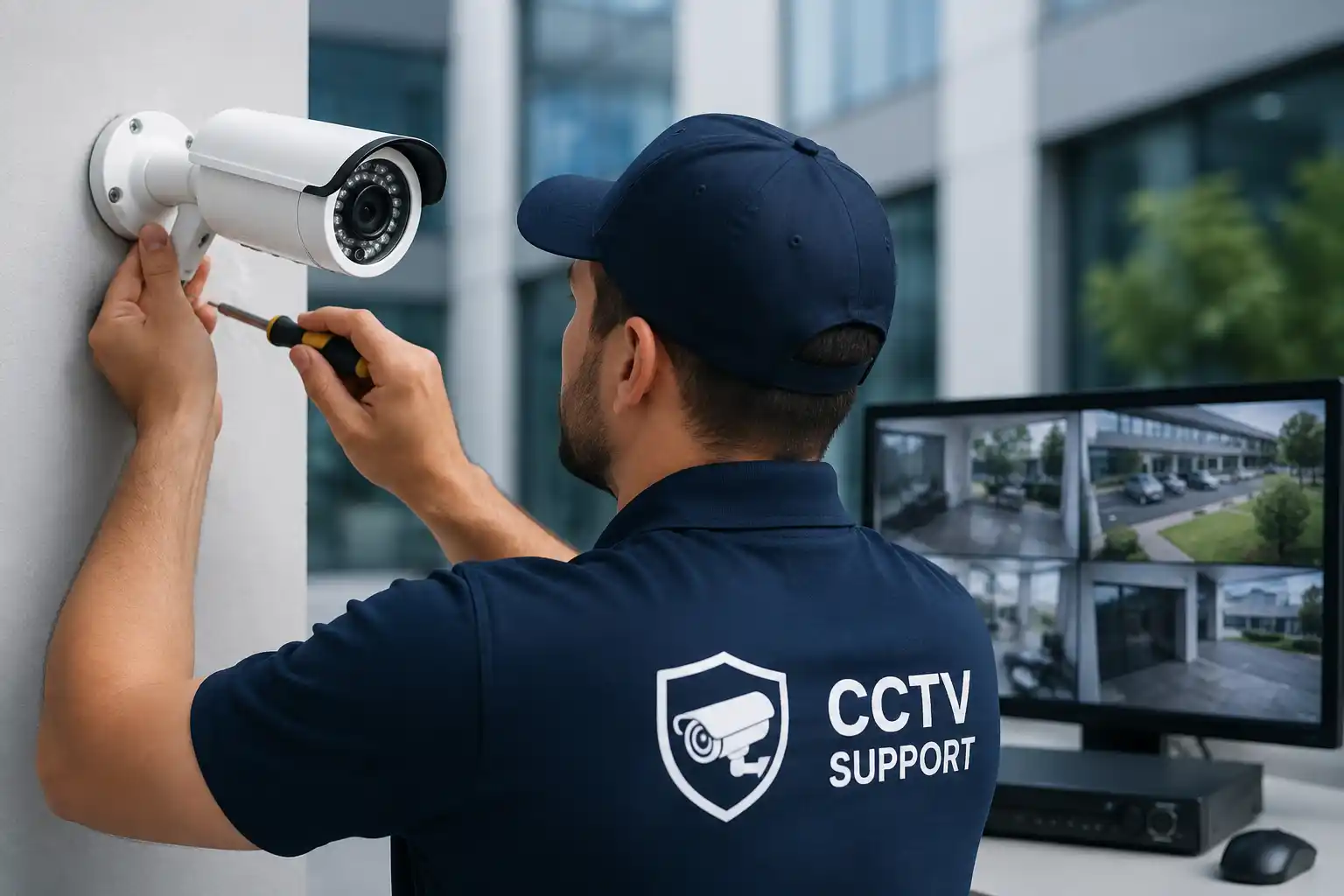
Coverage is planned around real operational areas and viewing objectives.
Cameras depend on power, cabling, switches, recorders, storage and network access.
Viewing rights and remote connectivity should be limited to authorised users.
Live view, recording, playback, time, storage and access should be validated before handover.
What does CCTV camera installation involve?
CCTV camera installation is the coordinated work of deciding what must be seen, selecting suitable camera positions, preparing power and data paths, connecting cameras to a recorder or network, setting recording and user access, and testing the finished system in the conditions in which it will actually operate. Businesses should consider the service when they are opening a new premises, adding coverage, replacing an unreliable system, reorganising a site or trying to make an inherited installation easier to manage. Before work is confirmed, the customer should identify the premises, priority viewing areas, operating hours, authorised viewers, existing equipment, available network or recorder infrastructure, preferred recording retention, physical access restrictions and any building or authority requirements that may apply. Those details allow the installation scope and quotation to be based on the real environment rather than assumptions.
A camera is only one part of the surveillance path
A business may think of CCTV as a set of cameras, but reliable surveillance depends on a chain of connected components. The camera needs a usable angle, suitable light, stable mounting and dependable power. The video then has to travel through a cable, connector, switch or other transport path to the recorder or recording platform. The recorder requires sufficient channels, compatible streams, available storage and correct time settings. Users need authorised viewing access, and remote viewing may depend on the local network, firewall, internet service and the method supported by the chosen system. Weakness in any one of these layers can reduce the usefulness of the installation even when the camera itself is functioning.
For that reason, FourTeck approaches a new installation by defining the required outcome before deciding the technical arrangement. A reception entrance may need a different field of view from a warehouse aisle. A cash-handling location may need useful detail at a shorter distance, while a parking area may require wider coverage, outdoor mounting and careful night-time testing. A corridor camera may be easy to cable but difficult to position without backlighting. A site that already has a recorder may appear ready for extra cameras until channel count, storage capacity, network throughput, PoE power or compatibility is reviewed. The correct design is therefore environment dependent and should be confirmed before installation starts.
What the installation service may cover
Depending on the confirmed scope, assistance may include a site walk-through, coverage discussion, review of existing cameras and recorders, camera position planning, cable-route coordination, switch and PoE checks, recorder preparation, storage review, network addressing, secure user access, camera naming, recording schedules, image adjustments, remote viewing setup, playback checks, documentation and basic administrator handover. New installation and extension work should also consider how the surveillance system will be maintained after the project is completed.
Who may need this service
The service can suit businesses preparing a new office, shop, clinic, restaurant, showroom, warehouse, reception area, loading zone, hospitality site or multi-room premises. It may also be relevant where an existing system has blind spots, poor image usefulness, inconsistent recording, difficult remote access, undocumented camera names or limited capacity for additional channels. An installation assessment is equally useful when a company has moved into a site with existing CCTV but does not know which components are reusable, where cables run or whether the recorder and cameras still meet the required operational purpose.
Common reasons businesses plan a new CCTV installation
New premises
A new office or commercial site needs surveillance coverage planned alongside cabling, racks, network switches, power, access control and other infrastructure rather than added as an afterthought.
Expansion or layout change
New entrances, additional stock areas, extra rooms, changed customer flow or extended working areas may leave important activity outside the original camera plan.
Unusable images
A camera may technically be online yet still fail the business objective because of angle, glare, low-light conditions, excessive distance, obstruction or a field of view that is too broad for the required detail.
Ageing or mixed equipment
An inherited or repeatedly extended system may contain different technologies, undocumented settings and limited recorder capacity. Assessment helps separate reusable infrastructure from components that constrain the project.
These triggers do not automatically determine the final technical solution. Two sites with similar floor area can need different camera types, cable paths, recording capacity and viewing arrangements because their lighting, ceiling access, customer movement, operating hours and security objectives are different. The installation plan should therefore be based on the actual premises and intended use.
Why poor planning can create operational problems later
A CCTV installation that is treated as a mounting exercise can create recurring problems after the installer leaves. Cameras may point at the right general area but fail to provide the detail needed during playback. Cable routes may be difficult to service, camera names may not match physical locations, storage may fill sooner than expected, time settings may drift, or remote access may be configured without a clear ownership model. If the recorder is placed in an unsuitable location, power, heat, physical access or accidental disconnection can become a concern. If network-connected cameras are added without considering switch capacity or address planning, the wider office network may become harder to troubleshoot.
The business impact can be significant even when no dramatic failure occurs. Staff may spend time searching through the wrong channels, managers may discover that a required period was not retained, a camera may go offline without anyone noticing, or authorised users may be uncertain about how to retrieve footage. A well-planned project aims to reduce these avoidable issues by combining coverage design, infrastructure review, controlled configuration, testing and documentation. It does not guarantee that every future event will be captured or that equipment will never fail, but it creates a more manageable starting point for operation and maintenance.
Possible installation scope
The exact scope should be defined after assessment because the work can range from adding one camera to an existing recorder through to planning a multi-area installation. Depending on what is approved, FourTeck assistance may include the following activities. Not every item is automatically included, and physical equipment, civil work, specialist access, licenses, storage, replacement components or third-party services may require separate confirmation.
- Identify priority areas, viewing purpose, expected image detail and operational concerns for each camera position.
- Review existing cameras, DVR or NVR capacity, network switches, PoE availability, cabling, storage and monitor arrangements where present.
- Plan practical camera locations with attention to height, access, lighting, environmental exposure, obstruction and serviceability.
- Coordinate cable routes and connection points, subject to the building layout, ceiling access, containment and any separate cabling or facilities scope.
- Prepare or review recorder channels, camera registration, addressing, device naming, time settings and recording schedules.
- Review expected retention against storage capacity and the selected recording settings, subject to the capabilities of the installed system.
- Configure authorised viewing access and remote connectivity where supported and where the customer approves the access method.
- Test live view, playback, camera naming, time, basic image usefulness and access from approved viewing devices.
- Record key installation information such as camera names, main equipment location, network dependencies and administrator handover notes.
- Provide maintenance recommendations and identify areas that may need future expansion, replacement or periodic checks.
CCTV installation service-fit matrix
| Business situation | Relevant assistance | What must be confirmed |
|---|---|---|
| New office or commercial premises | Coverage planning, infrastructure review, installation coordination, recorder setup and testing. | Floor plan, priority areas, access dates, ceiling and cable routes, network readiness and site rules. |
| Existing system needs more cameras | Capacity review, compatibility check, placement planning, channel addition and validation. | Recorder model, free channels, storage, switch and PoE capacity, existing camera technology and network addressing. |
| Poor image usefulness or blind spots | Real-world viewing assessment, angle review, relocation or replacement planning where needed. | Required identification detail, lighting, distance, obstructions, mounting options and equipment capability. |
| Inherited undocumented CCTV | Inventory, recorder and camera checks, cable tracing where practical, access review and improvement plan. | Authorised credentials, ownership information, physical access, existing documentation and any unknown third-party dependencies. |
| Multi-area or phased deployment | Priority planning, staged implementation, naming standards, capacity planning and phase-by-phase testing. | Budget priority, operational windows, network and storage headroom, site access and future expansion goals. |
Service information before a quotation is prepared
| Service topic | Business CCTV camera installation, extension, replacement planning and handover. |
|---|---|
| Main purpose | Create useful surveillance coverage with recording, controlled access and maintainable supporting infrastructure. |
| Typical systems involved | IP or analogue cameras, DVR or NVR, storage, network switches, PoE, structured cabling, monitors, local network and authorised viewing applications. |
| Assessment method | Site and requirement review, existing-system inspection where applicable, infrastructure and access checks, and coverage discussion. |
| Remote support suitability | Useful for discovery, configuration review, recorder settings, network planning and authorised remote-viewing assistance when secure access is available. |
| On-site support suitability | Normally required for camera positioning, mounting, cable and power checks, physical installation, environmental assessment and real-view testing. |
| Customer access required | Premises access, authorised system access, network or recorder access where applicable, and approval for configuration changes. |
| Testing and validation | Scope dependent; may include live view, playback, time, channel naming, recording, storage status and approved user-access tests. |
| Security considerations | Controlled administrator access, unique authorised users where supported, suitable network exposure and secure credential handover. |
| Service location | Dubai and UAE coordination, subject to location, access, scheduling, approved scope and engineer availability. |
| Quotation requirement | Required for confirmed project scope, labour, equipment, cabling or associated work as applicable. |
Remote planning versus on-site CCTV work
When remote assistance can help
Remote assistance can be useful during discovery when the customer can share floor plans, camera lists, recorder details, screenshots and existing network information. With authorised secure access, technicians may also be able to review recorder settings, camera names, recording schedules, storage status, network addressing or user-access configuration. This can reduce unnecessary site time and help prepare a more focused visit. Remote work cannot replace physical inspection where mounting, cabling, lighting, power, environmental exposure, camera angle or access-route conditions need to be confirmed.
When an on-site visit is usually needed
New installation normally requires on-site assessment and physical work because camera usefulness depends on the actual view from the intended mounting point. Cabling, ceiling access, wall construction, available power, rack location, outdoor exposure, lighting, blind spots and safe access are all site-specific. On-site work may also be necessary to inspect existing recorder ports, switches, patching, connectors and cable routes. Attendance timing depends on the confirmed scope, customer access, site conditions, required equipment and scheduling; it should not be assumed before the project has been assessed.
How the assessment and discovery process can work
A structured installation project starts by understanding the business objective. The first discussion should identify why the customer wants surveillance, which activities or access points matter, who may need to review footage and whether the project is new, an extension, a replacement or an inherited system review. This prevents the design from becoming a simple exercise in filling ceilings with cameras. Each proposed view should have a reason, such as monitoring an entrance, protecting a stock movement area, confirming activity around a reception desk or improving visibility across a loading zone.
- Define the operational objective. Confirm the areas that matter, the type of activity the business needs to observe, the importance of day and night visibility, and any privacy or internal policy considerations that affect where cameras should or should not be placed.
- Review the physical environment. Check entrances, rooms, ceilings, walls, mounting surfaces, likely obstructions, lighting, outdoor exposure, maintenance access, cable paths and the location where central equipment could be installed securely and serviceably.
- Identify existing infrastructure. Where a system already exists, record the camera technology, recorder, available channels, storage, switch ports, PoE capacity, network range, monitor setup and any usable cabling. Reuse should be based on compatibility and condition rather than assumption.
- Map technical dependencies. IP cameras may depend on Ethernet cabling, network switches, PoE power, IP addressing, recorder connectivity and available bandwidth. Remote viewing may also depend on the firewall, internet connection and supported access method. Analogue systems have different cable and recorder dependencies but still require power, storage and reliable connections.
- Confirm access and authorisation. The customer should identify who can approve installation positions, who can provide network or recorder administration, and who should receive user or administrator access after handover. Passwords should be shared only through an approved secure method after identity and authorisation are confirmed.
- Agree the installation boundary. Clarify whether the work includes cameras only, recorder changes, network switches, cabling, containment, displays, storage, remote-viewing setup, documentation, removal of old equipment, testing or future maintenance. This is essential for a clear quotation.
The assessment should produce a practical scope rather than a fixed promise before the environment is understood. Some sites reveal constraints that cannot be seen from a floor plan, such as inaccessible ceiling voids, unsuitable mounting surfaces, long cable runs, limited rack space, restricted work windows or existing infrastructure that cannot support additional devices. Those conditions should be discussed before implementation so the customer can decide how to proceed.
From approved plan to installation and configuration
Once the scope is agreed, implementation should follow a controlled sequence. The order may change according to the site, but a sensible process is to confirm equipment locations and access, prepare cable paths, mount cameras, connect power and data, commission the recorder or network path, apply approved settings, name each channel clearly, configure recording and then test the system from the user’s point of view. Where an existing CCTV environment is being modified, configuration backups or records should be taken when supported and appropriate before material changes are made.
Camera positioning deserves particular attention because a technically correct installation can still produce poor operational value if the view is wrong. The final angle should be checked from the live display after mounting rather than relying only on drawings. Daylight through windows, reflective surfaces, vehicle headlights, shadows, external lighting and infrared reflection can all change the usable image. A wide-angle view can be helpful for general situational awareness but may provide less detail on a distant subject. The right balance depends on the customer’s purpose, distance, lighting and equipment capability.
For IP cameras, the network should be treated as part of the surveillance design. Address assignment should be organised, switch ports should be identified, PoE load should be considered, and camera traffic should not be added blindly to an already stressed network. Network segmentation may be appropriate depending on the customer’s architecture and security policy. Remote access should use the method supported by the platform and approved by the customer, with unnecessary exposure avoided. For analogue or hybrid environments, connector quality, cable condition, recorder compatibility and power distribution remain important.
Recording configuration should match the business requirement within the capability of the system. Retention depends on storage capacity, number of channels, recording method, resolution, frame rate, scene activity, compression and recorder behaviour. It should not be promised from camera count alone. The customer should explain how far back they normally need to review footage so storage planning can be assessed realistically. Where legal, contractual or authority-specific retention requirements apply to the customer’s premises, those requirements should be confirmed with the relevant responsible party rather than assumed by the installer.
User access is another project stage, not an afterthought. The business should decide who needs live viewing, playback, export rights or administrator control. Shared administrator credentials make later auditing and staff changes harder where the platform supports separate accounts. A cleaner handover records the authorised users, preserves administrative ownership, and explains how access changes should be managed when employees change roles or leave the organisation. Any mobile or remote access should also be tested on the intended approved devices, subject to the customer’s internet service and platform capabilities.
Testing, validation and handover after installation
Installation is not complete when the last camera is physically mounted. The surveillance path should be tested from camera to recorder, storage and authorised viewer. A useful handover verifies that each camera appears under the correct name, the displayed time is sensible, recording is active according to the approved schedule, playback works, the expected storage status is visible, and authorised users can reach the views they are meant to use. Where remote viewing is included, it should be tested from the approved connection path rather than assumed from local access.
Image checks should be performed in conditions that represent the customer’s real operation where practical. A reception camera may need to handle bright daylight from a glass door. An outdoor camera may need a night test or at least a discussion of how the scene changes after dark. A stock area may need confirmation that shelving does not block the key view. If a camera cannot meet the intended detail because of physical distance, lighting or equipment limitations, that should be explained instead of hidden behind a successful network test.
Handover information can include a camera list, clear channel names, central equipment location, basic network dependencies, authorised access notes, key maintenance points and any unresolved limitations. The level of documentation depends on the approved scope, but even a simple location-and-name record makes later troubleshooting easier. The customer should also know who is responsible for routine playback checks, storage monitoring, cleaning, user changes and reporting a camera that goes offline.
Capability: coverage that matches the business objective
The value of a camera comes from what the customer can actually understand from the image. FourTeck can help translate a general request such as “cover the entrance” into a more specific goal: see movement through the doorway, monitor reception interaction, observe a delivery route or capture a useful view of a controlled access point. That purpose guides placement, angle and expected detail. Physical limitations still matter; walls, ceiling height, distance, lighting and available mounting positions can restrict the result, and those constraints should be discussed before final approval.
Capability: recording that can be checked and understood
A surveillance system should make it clear whether recording is active, where footage is stored and how authorised staff can retrieve it. Installation planning can include recorder capacity, storage condition, recording schedules, channel names and playback validation. Retention is configuration and capacity dependent, so it should be assessed rather than guessed. Clear naming and time settings reduce confusion when an incident must be reviewed. Documentation also helps future support teams understand the intended arrangement without rebuilding the system map from scratch.
Capability: a surveillance system that remains maintainable
CCTV operates continuously and is exposed to changing site conditions. Dust, heat, loose connections, ageing storage, moved furniture, building work or network changes can all affect performance later. A maintainable installation uses clear camera names, accessible equipment locations where practical, organised cabling, documented dependencies and sensible user ownership. These measures do not eliminate faults, but they make future checks more efficient and reduce the risk that a simple problem becomes difficult to diagnose because no one knows how the system was originally arranged.
Dependencies, access and customer inputs
A CCTV project touches physical premises, network infrastructure, user permissions and operational policy, so several inputs may be needed before implementation can be confirmed. The customer should provide a responsible contact who can approve viewing areas and site access. If the project extends an existing system, details of the recorder, cameras, network switches, storage and current access method are helpful. Existing drawings, cable labels, camera lists or configuration exports can reduce discovery time where available, but an installation can still be assessed when documentation is incomplete.
Administrative access may be required to register cameras, review recorder settings, create authorised users or configure network parameters. Credentials should not be posted publicly or sent through insecure channels. FourTeck can confirm an approved secure method after identity and authorisation are established. If a third party controls the firewall, internet service, building cabling, access control, facilities management or a hosted surveillance service, coordination may be needed before the installation can be completed. Third-party schedules and permissions can therefore affect the project timeline.
Physical access can be equally important. Ceiling voids may be restricted, high mounting points may require suitable access arrangements, some buildings limit noisy or dusty work to specific periods, and external areas may require facilities approval. These factors are not visible from a camera list. The customer should mention known restrictions, working-hour limits, permit processes or areas that cannot be interrupted. Installation timing and labour scope should then be planned around the actual conditions rather than an assumed standard visit.
Risk, limitation and exclusion guidance
CCTV installation reduces uncertainty only when the design and operating process are appropriate; it does not guarantee that every event will be visible, recorded or identifiable. Coverage is limited by camera position, lighting, obstructions, resolution, distance, environment, storage, network availability and equipment condition. A camera can be online while recording is stopped, and a recorder can be operational while older footage has already been overwritten. Regular checks remain necessary after installation.
Existing or legacy components may not support new cameras, current access methods or the capacity required for expansion. Hardware faults can require parts or replacement outside the labour scope. Cabling routes, civil work, electrical work, specialist access equipment, building approvals, authority requirements, third-party subscriptions or vendor-specific licenses may need separate confirmation. Remote access may depend on the customer’s internet service, firewall policy and platform support. Configuration changes should be authorised and, where appropriate, backed up or documented before modification.
On-site work depends on location, scheduling, site access, engineer availability, equipment availability and the approved quotation. No fixed attendance time, project duration or guaranteed outcome should be assumed before assessment. Final commercial terms are determined by the quotation or service agreement accepted for the specific installation.
Business environments where planned CCTV installation can be useful
Offices and professional workplaces
Reception, main entrances, shared corridors, selected access points and operational areas may require coverage that supports incident review without turning every workspace into a monitored zone. Planning should reflect internal policy, privacy expectations and the business purpose of each view.
Retail and showrooms
Customer entrances, cashier areas, stock access, display zones and delivery points can have very different viewing needs. Lighting and customer movement can change throughout the day, so live positioning and playback testing are important.
Warehouses and logistics locations
Long aisles, loading bays, high ceilings and broad open spaces make distance, mounting height, cable length and night conditions important. A camera count alone does not determine whether useful detail will be available.
Clinics, training centres and service premises
Public entrances, reception areas and back-office access may need different treatment. The organisation should define legitimate operational needs, staff access to recordings and any privacy or site-specific requirements before final placement.
Hospitality and food-service environments
Busy entrances, service counters, receiving areas and back-of-house spaces may involve changing light, heat, moisture or restricted mounting options. Camera placement should be selected with both the viewing objective and maintenance access in mind.
Multi-branch businesses
Several locations benefit from consistent naming, recorder documentation, user-access rules and a common installation standard. Actual equipment may differ by site, so standardisation should focus on operational clarity rather than forcing identical hardware where it is not suitable.
Security, operations and maintenance after commissioning
A new installation should include an ownership plan. Someone within the customer organisation should know who is authorised to view live video, who can export recordings, who has administrative control and who should be contacted when a camera or recorder shows a fault. Where the platform supports individual accounts, separating normal viewing from administration can make access management clearer. Default or shared credentials should not remain in use unnecessarily, and remote access should be limited to approved methods rather than exposing devices broadly to the internet.
Operational checks are simple but important. A user should periodically confirm that the expected cameras are online, the recorder time is correct, playback works and the available retention remains consistent with the business requirement. Outdoor camera lenses can become dusty, dirty or affected by weather. Indoor views can be blocked by shelves, signs or layout changes. Storage devices can age. Network changes can alter camera reachability. These are reasons to treat CCTV as maintained infrastructure rather than a one-time installation.
Maintenance frequency depends on the environment, equipment, business risk and agreed service plan. FourTeck can discuss preventive checking, troubleshooting and future expansion, but inclusions, visit frequency, monitoring and response expectations must be defined in the relevant quotation or maintenance agreement. An installation handover should not be interpreted as unlimited ongoing support unless that arrangement has been separately agreed.
Before you contact FourTeck about CCTV camera installation
Providing a clear starting picture helps FourTeck understand whether the next step should be a remote planning discussion, an on-site assessment or a request for additional technical information. You do not need to know every technical detail, but the following points are useful.
- The service location and type of premises.
- The main areas you want to view and why they matter operationally.
- Whether this is a new installation, expansion, replacement or inherited system.
- Approximate number of existing and proposed camera points, if known.
- Existing recorder, camera, switch or storage details where available.
- Any known blind spots, poor images, offline channels or recording concerns.
- Your normal operating hours and preferred installation window.
- Ceiling, wall, outdoor, height or building-access restrictions that may affect mounting.
- Whether network or PoE infrastructure already exists at the proposed locations.
- Who should be authorised for live view, playback or administration.
- Desired recording retention or review expectations, if defined by your organisation.
- Whether remote viewing is required and which approved users need it.
- Availability of authorised administrator access for existing systems.
- Any facilities, landlord, building-management or authority processes known to apply.
- The business priority, required completion window and any dates that cannot be disrupted.
Checklist for defining the installation quotation
- Confirm the exact surveillance objective for each priority area.
- Confirm the number of premises, floors or operational zones included.
- Separate new camera work from reuse or relocation of existing equipment.
- Identify whether cabling, containment, PoE switching, recorder, storage or monitor work is required.
- Confirm any network configuration or remote-viewing work expected from FourTeck.
- Agree which tests are required at handover, including playback and authorised access.
- Define the level of camera naming, location records and administrator documentation required.
- Confirm work-hour, permit, ceiling-access, height-access or facilities restrictions.
- Identify equipment, subscriptions, licenses or third-party work that sits outside the installation labour scope.
- Decide whether preventive maintenance or post-installation support should be quoted separately.
How FourTeck can assist with the project
FourTeck can help turn a broad request for “CCTV cameras” into a defined installation scope. The process can begin with a discussion of business concerns, affected areas and the current environment. Where useful, the team can review existing recorder and network infrastructure, identify what information is missing, recommend an on-site assessment and document the technical dependencies that need to be resolved before installation. This approach is designed to reduce avoidable surprises during implementation.
After the scope is confirmed, FourTeck can coordinate approved installation and configuration tasks, test the system, explain material limitations and provide handover information according to the quotation. If a dependency sits with another party, such as a facilities contractor, internet provider, firewall administrator or building-management team, FourTeck can help identify the technical information that needs to be exchanged. The objective is not to claim control over every dependency but to make the project responsibilities clearer.
Customers who want to understand FourTeck’s wider service approach can review the FourTeck IT services company overview. For connected infrastructure work beyond surveillance, the FourTeck IT support home page explains how network, server, desktop, telephony and CCTV dependencies can be considered together.
Dubai and UAE service coordination
For CCTV installation in Dubai, the correct next step depends on the type of premises and the amount of physical work required. A remote discussion can help collect the initial requirement, but an on-site assessment may be recommended where camera positions, cable routes, mounting access, environmental conditions or existing infrastructure must be inspected. Service timing depends on engineer availability, customer access, site conditions, equipment requirements, third-party providers and the approved work scope.
Installation, configuration, migration from an older recorder, camera replacement, cabling coordination, remote-viewing setup and maintenance should be clearly identified in the quotation rather than assumed as one open-ended service. Customers should also advise FourTeck about building-access procedures, loading or parking restrictions, work permits, ceiling access, security desk requirements and preferred work windows. These operational details can have as much effect on scheduling as the technical work itself.
Coordinating CCTV work in Dubai, Abu Dhabi, Sharjah and Ajman
Businesses with sites in Dubai, Abu Dhabi, Sharjah and Ajman may need a combination of remote planning and scheduled on-site work. A multi-location project benefits from a shared camera-naming approach, common documentation, a consistent list of required tests and a clear record of who administers each recorder or viewing platform. At the same time, every site can have different cabling, access, building management, network design and equipment age, so the scope should still be confirmed location by location.
Travel, building access, site readiness, equipment availability, maintenance windows and coordination with facilities or third-party providers can affect the service plan. FourTeck can discuss how to sequence assessments, installation work, troubleshooting, maintenance or phased expansion across the UAE, but the schedule and commercial scope should be agreed through the applicable quotation. A remote review may resolve planning questions before a visit, while physical installation and coverage validation remain site dependent.
Related FourTeck service areas
CCTV service and maintenance
For existing systems that need camera checks, recording review, storage troubleshooting, remote-access assistance or preventive maintenance.
IP camera and network support
Useful when camera availability depends on PoE, switch ports, IP addressing, recorder registration, network routing or authorised remote connectivity.
Office network support
Relevant where the surveillance environment shares switching, structured cabling, routing, firewall or internet dependencies with the business network.
Business IT project support
Helpful when CCTV is one part of a new office setup, relocation, infrastructure refresh or wider technical project.
See the FourTeck services overview for the current business IT, network, server, endpoint, communication and surveillance service areas.
Why businesses contact FourTeck for CCTV installation planning
A surveillance project often crosses responsibilities. The security objective may be defined by management, the cable route may need facilities approval, the switch may be managed by IT, the recorder may be inherited from a previous provider, and remote viewing may depend on a firewall or internet service controlled by another party. Businesses contact FourTeck when they want those dependencies explained in one technical conversation rather than handled as isolated devices.
FourTeck can help clarify the requested outcome, identify the physical and technical layers involved, separate assumptions from confirmed requirements, and prepare the information needed for a practical quotation. During implementation, approved work can be tested and documented so the customer understands what was changed and what remains dependent on third parties, existing equipment or future maintenance. The focus is on a usable, supportable installation with clear next actions, not unsupported claims about guaranteed coverage, resolution or response times.
Questions businesses usually ask before approving a CCTV installation
The following decision guidance addresses practical questions that commonly come up before a company commits to installation work. The answer can change with the premises, system design and access, so each point should be used to prepare the assessment rather than as a substitute for it.
How many CCTV cameras does our business actually need?
The number should come from the viewing objective for each area, not from floor area alone. One carefully placed camera may cover a small entrance well, while a larger room may need several views because shelving, walls, doors or customer movement create blind spots. A warehouse can require fewer cameras for broad situational coverage or more cameras when specific loading, stock or access points need useful detail. The assessment should identify the areas that matter, the detail expected and the physical conditions at each point. From there, camera count becomes an output of the design rather than a starting assumption.
Can our existing recorder be reused?
Possibly, but reuse should be confirmed by checking the recorder’s available channels, supported camera technology, storage capacity, network connectivity, firmware or support condition, remote-access method and the business’s required recording settings. An older recorder may continue to work with current cameras already installed but have no practical headroom for expansion. Another recorder may accept additional channels but lack enough storage for the desired retention. Reuse can be sensible when compatibility and condition are confirmed; replacing equipment simply because it is old is not always necessary, but extending unsupported or constrained equipment without assessment can create repeated cost.
Can CCTV camera installation be planned remotely?
Early planning can often begin remotely. Floor plans, photographs, existing camera lists, recorder details and a clear explanation of the areas to be monitored are useful starting points. Remote review can also help determine whether an on-site survey is necessary. However, physical installation decisions often depend on things that drawings do not show: ceiling access, wall material, lighting, reflections, cable routes, actual viewing height, environmental exposure and the availability of power or network points. For new camera positions, an on-site assessment is commonly the better way to confirm a workable design before labour and materials are committed.
What should we decide about recording retention before installation?
Start with the business requirement: how far back do authorised users normally expect to review footage, and are there any customer, insurer, landlord, policy or authority requirements that the organisation is responsible for meeting? Retention is then a storage-planning question. It depends on channel count, recording method, resolution, frame rate, compression, scene activity and available storage. A headline hard-drive size does not by itself guarantee a retention period. The installation plan should document the target, assess available capacity and explain any assumptions. If requirements are mandatory, the responsible customer should confirm them before final configuration.
Should cameras use the same network as office computers?
That depends on the existing network design, security policy, switch capacity and the scale of the surveillance system. IP cameras create continuous network traffic and may rely on PoE switches, address management and recorder connectivity. In some environments, separating surveillance traffic through suitable network design can improve manageability and access control. In smaller sites, the same physical switching infrastructure may be used with logical separation or other controls. The correct approach is configuration dependent. Before new IP cameras are added, the network should be reviewed for available ports, PoE budget, addressing, bandwidth and the way authorised viewers will reach the system.
How do we know whether a camera position will provide useful evidence?
The most reliable method is to define what the business expects to see and then validate the real image from the proposed position. A camera aimed at a doorway may show the whole entrance but provide little facial detail if it is too far away or affected by strong backlight. A wide warehouse view may help understand movement but not show small details on distant stock. Mounting height, angle, lighting, lens capability, distance and scene movement all matter. During installation, live viewing should be used to refine the angle, and playback should be checked so the business can confirm that the result matches the stated purpose.
What can make an installation quotation change after a site visit?
Site conditions often reveal work that cannot be confirmed from a phone discussion. Cable routes may be longer or blocked, ceilings may require different access, external mounting may need weather-protected connections, the existing recorder may lack channels, or the switch may not have enough PoE capacity. Building access may be restricted to certain hours, and some areas may require facilities approval. A clear quotation should identify the confirmed tasks and state which items are optional, dependent on further access or excluded. If new information changes the project materially, the scope should be updated before the additional work proceeds.
Is a camera replacement enough when the current picture is poor?
Not necessarily. Poor images can come from the camera, but they can also result from dirty covers, reflections, weak lighting, incorrect angle, loose mounting, cable loss, network problems, recorder settings, stream settings or the physical limits of the current view. Replacing the camera without checking the complete path can leave the original problem unchanged. If the business is planning an upgrade because current footage is not useful, the assessment should first identify whether the limitation is caused by placement, environment, infrastructure or equipment capability. That evidence supports a more targeted recommendation.
What should happen before staff receive remote viewing access?
The business should decide who is authorised, what each person needs to do, which devices are acceptable and who is responsible for removing access when roles change. The technical method should follow the capabilities of the installed platform and the customer’s security requirements. Administrator access should not be handed to every viewer by default. Remote viewing also depends on working internet connectivity and may involve firewall or cloud-platform settings. It should be tested using the approved method, documented at handover and reviewed when staff leave or when the organisation’s network design changes.
When is maintenance worth planning at the same time as installation?
Maintenance is worth discussing when the business depends on CCTV for regular incident review, operates outdoor cameras, has many channels, has several sites or lacks internal staff who can routinely check recording and camera health. Installation is the best time to define camera names, equipment locations, access ownership and the basic checklist that future maintenance will follow. That does not mean an open-ended maintenance contract is automatically required. The customer can choose one-time installation, periodic checks or a broader support arrangement, with inclusions and frequency defined separately according to operational need and quotation.
Frequently asked questions
Does FourTeck install both new and additional CCTV cameras?
FourTeck can assess new installations and extensions to existing systems. For additions, compatibility, free recorder channels, storage, network capacity, PoE and usable cabling should be checked before the work is confirmed.
Can an existing camera be relocated instead of replaced?
Relocation may be possible if the camera remains suitable, the cable path can support the new position and the mounting environment is appropriate. The decision should follow a physical and compatibility review.
Will remote viewing always work after installation?
Remote viewing depends on the installed platform, internet connection, network and firewall configuration, authorised credentials and the approved access method. It should be included and tested only when it is part of the confirmed scope.
Can the installation be completed without an on-site survey?
Some simple extensions may be scoped from reliable documentation, but new positions often benefit from on-site assessment because angle, lighting, ceiling access, cable route and mounting conditions are physical constraints.
What information is needed about our network?
For IP cameras, useful information can include switch locations, free ports, PoE availability, IP addressing, recorder connectivity, firewall ownership and who can authorise network changes. The exact requirement depends on the design.
Can FourTeck work with an existing DVR or NVR?
Existing recorders can be reviewed for condition, channel capacity, storage, compatibility and access. Reuse is scope dependent and should be confirmed before cameras or storage are added.
How is the required storage decided?
Storage planning depends on channel count, resolution, frame rate, recording method, compression, scene activity and required retention. The target should be discussed before the recorder or storage design is finalised.
Do you provide documentation after installation?
Documentation can be included according to the quotation and may cover camera naming, equipment location, key network dependencies, access ownership, test results and maintenance notes. The required depth should be agreed before handover.
What if building management or another contractor controls part of the work?
FourTeck can help identify the technical information and access needed, but third-party approvals, permits, cabling, electrical work or facilities tasks remain dependent on the responsible party and may affect scheduling.
Is ongoing CCTV maintenance included with installation?
Ongoing maintenance is not automatically assumed. Preventive checks, recurring visits, troubleshooting coverage and service expectations should be defined separately in the quotation or maintenance agreement.
Discuss your CCTV camera installation requirement
If you are planning cameras for a new site, extending an existing system or trying to understand an inherited installation, start by sharing the premises type, priority areas, current equipment and expected outcome. FourTeck can review the available information, identify what still needs to be assessed and advise whether remote discovery or an on-site visit is the more suitable next step. The final installation, configuration, testing, documentation and maintenance scope will be based on the confirmed environment and approved quotation.
For direct enquiry details, use the FourTeck contact page. Contact FourTeck to confirm the service scope and scheduling options for your Dubai or UAE location.