
CCTV Camera Maintenance in Dubai, UAE
A surveillance system can show live video and still have hidden maintenance problems. Recording may be incomplete, time may be incorrect, a hard drive may be reporting errors, a camera may be losing power intermittently, or remote viewing may stop after a network change. Planned CCTV maintenance checks the complete path from camera and power to recorder, storage, network and authorised viewing so the system can be evaluated as an operating service rather than a collection of devices.
FourTeck supports businesses that need preventive checks, fault investigation, maintenance planning, recording verification, camera condition review and practical recommendations. Final scope depends on the installed equipment, site access, system condition, documentation, credentials, physical work required and approved quotation.
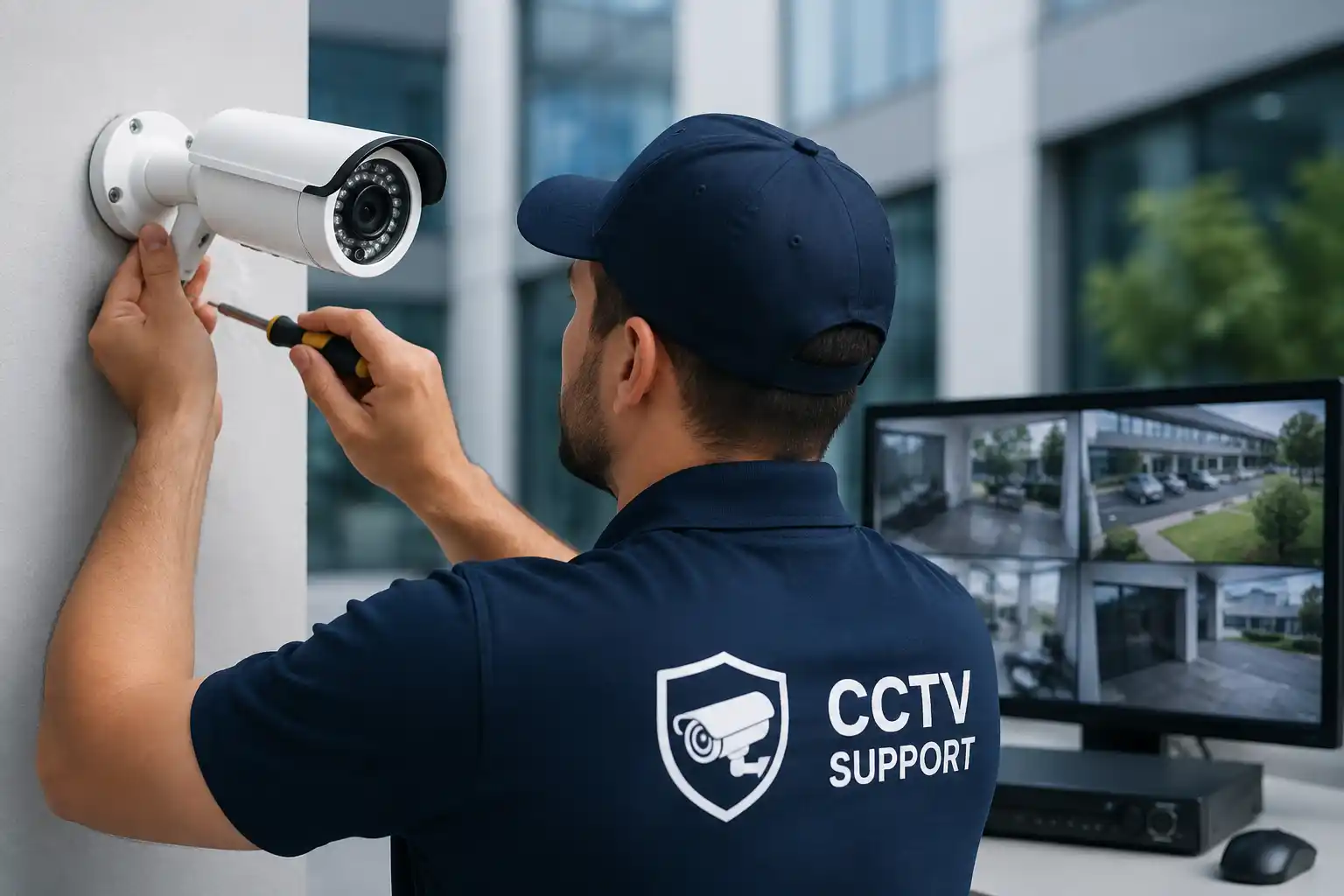
What Does CCTV Camera Maintenance Actually Cover?
CCTV camera maintenance is a structured review of the parts that allow surveillance video to be captured, transported, recorded, stored, displayed and accessed by approved users. It is mainly used to identify faults before they become operational failures, confirm that required cameras are recording, maintain useful image quality and determine whether ageing or damaged components need corrective work. Businesses with cameras that run continuously, systems inherited from a previous tenant, mixed-brand installations, recurring offline alerts, storage concerns or weak documentation should consider a maintenance assessment.
Before work is confirmed, the customer should prepare the site location, approximate camera count, recorder type where known, reported symptoms, recent network or electrical changes, maintenance history and authorised access to the system. The most appropriate service method depends on what must be checked. Recorder settings, logs, camera status and remote-viewing configuration may sometimes be reviewed remotely, while lens condition, mounts, weather exposure, cable routes, PoE power, connectors and physical camera faults generally require on-site access.
What the Service Is For
Maintenance focuses on keeping an existing surveillance environment supportable. The work may include visual inspection, recording tests, storage review, access checks, fault isolation, corrective configuration, condition reporting and recommendations for repair, replacement or phased improvement.
Who Usually Needs It
Offices, retail premises, warehouses, clinics, hospitality sites, schools, buildings, showrooms and multi-branch organisations may need maintenance when surveillance is operationally important or when no one has recently verified that recordings remain complete and retrievable.
What Changes the Scope
Camera quantity, heights and access, indoor or outdoor placement, recorder model, storage condition, analogue or IP design, cable condition, PoE switching, network segmentation, credentials, third-party software, building access and the desired maintenance depth all affect the final scope.
Why CCTV Maintenance Is More Than Cleaning Camera Lenses
A dirty dome or camera glass can reduce image quality, especially at night, but a maintenance visit that stops at cleaning does not confirm that the system is dependable. A CCTV environment is a chain. The camera requires suitable power. The video path requires working cabling or network connectivity. An IP camera may depend on a PoE switch, VLAN, address assignment, gateway, bandwidth and recorder registration. A DVR or NVR must be able to write video to healthy storage. The recording schedule and date settings must match the intended operating requirement. Playback must work. Authorised users need a practical way to retrieve footage. Remote access may also depend on firewall, application, account and internet conditions.
Maintenance therefore looks for evidence that each critical layer is doing its job. A camera that appears online is not proof that useful footage is being retained. A recorder with free space is not proof that every channel is recording the correct stream. A mobile application that opens today is not proof that remote access is appropriately controlled. Good maintenance distinguishes visible symptoms from underlying technical dependencies and records what was actually checked.
This approach is particularly important for systems that have evolved over time. A business may add cameras in stages, replace a switch, move an internet connection, change a router, upgrade a recorder, transfer premises or inherit equipment from a previous occupant. Each change can create undocumented differences in addressing, passwords, channel names, retention settings, network paths or physical cable quality. A maintenance review helps re-establish an understandable baseline before future faults or upgrades are handled.
Common Maintenance Signals and the Technical Areas Behind Them
The same CCTV symptom can have several causes. Maintenance should collect evidence before a component is blamed or replaced.
Camera Goes Offline
Possible areas include power, PoE budget, switch port, cabling, connectors, network addressing, recorder registration, camera condition or a local configuration change. The pattern and timing of the outage help narrow the path.
Image Is Blurred or Washed Out
Lens contamination, focus, condensation, glare, mounting angle, low-light conditions, reflections, stream settings or ageing equipment may be involved. Day and night performance should be considered separately.
Footage Cannot Be Found
Recording schedules, date and time, channel settings, storage condition, retention, drive errors, recorder health or user permissions may need review. A live picture alone does not confirm recording.
Remote Viewing Stops Working
Internet changes, firewall rules, application settings, account access, service-provider changes, device registration or network configuration can affect remote viewing even when local recording continues normally.
Night View Is Poor
Dirty covers, nearby reflective surfaces, infrared glare, insufficient scene lighting, unsuitable placement, obstructions or camera limitations may reduce useful detail after dark.
Recorder Shows Storage Warnings
Disk condition, recording load, retention settings, unsupported drive replacement, temperature, recorder faults or capacity planning may be relevant. Storage work should consider existing evidence and backup requirements where applicable.
What Can Happen When Maintenance Is Deferred?
The operational impact of neglected CCTV is often delayed. Unlike a failed workstation, a camera or recorder problem may not stop an employee from working immediately. That makes surveillance faults easy to postpone. The difficulty appears later when management needs to review an incident and discovers that the required camera was offline, the timestamp was inaccurate, the recording window was shorter than expected or the image did not show enough detail for the intended purpose.
Repeated small faults can also consume support time. A camera that disconnects every few days may generate repeated calls without anyone checking the shared dependency. A recorder with ageing storage may show warnings that are cleared without understanding the trend. Outdoor connections may deteriorate gradually. Camera names may become inconsistent after replacements, making it harder for users to locate the correct view. Remote access may remain assigned to people who no longer require it. None of these examples proves that a major failure will occur, but they illustrate why periodic inspection and documentation can improve supportability.
For management, maintenance creates a clearer decision point. The question is not simply whether the system is working today. It is whether the current condition, recording quality, coverage, storage, access and documentation are suitable for the business purpose. When a limitation is identified, the business can decide whether to repair a component, schedule corrective work, change a configuration, improve protection around equipment, replace ageing hardware or plan a staged upgrade.
CCTV Camera Maintenance Scope: What Assistance May Include
Depending on the confirmed scope, maintenance assistance may include a combination of preventive inspection and targeted troubleshooting. Not every task is automatically included in every visit or service agreement. The current installation should first be reviewed so that the quotation reflects the number of devices, physical access requirements, system architecture and business priorities.
Camera Condition
Visual check of camera housing, lens or dome, mounting stability, obvious damage, contamination, orientation and image condition. Cleaning or adjustment may be considered where safe access and the confirmed scope permit it.
Power and Connectivity
Checks may cover camera power, PoE switch status, network link, connectors, local cable path, address conflicts or obvious physical defects. Additional cabling work can require separate scope and access planning.
Recording and Playback
Channel recording state, schedule, playback, date and time, event recording where configured, recorder health and user retrieval can be checked against the intended operational requirement.
Storage Review
Available capacity, visible disk warnings, retention behaviour and recording load may be reviewed. Replacement or data-handling decisions depend on recorder compatibility, drive condition, required retention and the importance of existing footage.
User and Remote Access
Authorised local and remote viewing can be reviewed for functionality, ownership and account clarity. Credential changes should be controlled and shared only through an approved secure method after authorisation is confirmed.
Documentation and Recommendations
Camera labels, recorder details, network dependencies, observed faults, completed work, unresolved risks and suggested next actions can be documented to make future support more efficient.
Service-Fit Matrix for CCTV Maintenance Decisions
CCTV Maintenance Service Information
| Service Topic | CCTV camera maintenance, preventive checks and fault-focused support |
|---|---|
| Main Purpose | Verify camera condition, recording, storage, connectivity and access while identifying corrective or improvement needs |
| Suitable For | Businesses with existing analogue, IP or mixed CCTV environments, subject to assessment |
| Typical Systems Involved | Cameras, DVRs, NVRs, storage drives, monitors, power supplies, PoE switches, cabling, local network, viewing applications and authorised user accounts |
| Assessment Method | Remote review where practical, combined with on-site inspection when physical testing or access is required |
| Remote Support Suitability | Access dependent; useful for certain recorder, application, user, network and configuration checks |
| On-Site Support Suitability | Often appropriate for camera condition, mounting, power, cable, connector, PoE, line-of-sight and physical equipment inspection |
| Customer Access Required | Authorised site access, system administration where available and local contact support; exact requirement is scope dependent |
| Testing and Validation | May include live view, recording, playback, time, remote access, channel status and affected-path retesting after approved work |
| Documentation | Scope dependent; may include findings, camera references, completed tasks, remaining issues and recommendations |
| Service Location | Dubai and coordinated UAE service subject to location, scheduling, site access and approved scope |
| Quotation Requirement | Final commercial terms depend on the assessed system and approved quotation or service agreement |
When Remote Maintenance Support May Help
Remote assistance can be useful when the site has working internet, secure access is authorised and the question mainly concerns recorder status, camera connectivity, playback, account access, application behaviour, logs or configuration. A local user or administrator may need to describe the physical state of the equipment while the remote technician checks the system view.
Remote access does not remove the need for physical inspection. It cannot reliably confirm lens contamination, loose mounts, damaged external connectors, moisture exposure, cable condition inside a route or power faults that require measurement. If the evidence points to a physical layer, an on-site visit may be recommended.
When an On-Site CCTV Visit Is Usually More Appropriate
On-site assistance is more suitable when cameras must be physically inspected, cleaned, adjusted or reached; when cabling, connectors, local power or PoE must be tested; when recorder hardware or storage requires hands-on attention; or when the system cannot be accessed remotely. Site work may also be necessary to compare actual viewing angles with the business requirement.
Building access, work-at-height requirements, equipment location, ceiling or outdoor access, parking, security procedures, permitted working windows and third-party coordination can all affect planning. These details should be identified before the quotation and schedule are confirmed.
How a CCTV Maintenance Assessment Can Be Structured
A useful maintenance process begins with the business purpose rather than a generic checklist. The technician needs to know which areas matter most, what the users have noticed and whether there have been any recent changes. From there, the system can be assessed in a sequence that protects useful evidence and avoids unnecessary configuration changes.
- Confirm the operational objective. Identify why the cameras are used, which views are important, how users normally review incidents and whether the current concern is preventive maintenance or a known fault.
- Map the affected scope. Record which cameras, channels, recorder, monitor, application or site area is involved. One affected camera suggests a different path from simultaneous problems across several channels.
- Collect evidence before changing settings. Note warning messages, channel status, outage times, storage indicators, relevant screenshots, camera names and recent network, power or building work.
- Confirm authorised access. Determine which administrator accounts, recorder interfaces, network devices and physical areas can be accessed. Credentials should not be published or sent through an insecure public channel.
- Review the recording layer. Check whether required channels are recording, whether playback is available for appropriate test periods, whether time is correct and whether visible storage warnings require action.
- Review camera and transport layers. For IP systems, this may include PoE, switch links, address reachability and recorder registration. For analogue systems, cable path, connectors, power and channel behaviour may be relevant.
- Inspect physical condition where included. Check accessible lenses, housings, mounts, obvious cable or connector damage, environmental exposure and whether the view remains aligned with the required area.
- Explain findings before corrective work. Separate confirmed faults, probable causes requiring further testing, design limitations and optional improvements so the customer can approve the next action with clear context.
- Apply approved maintenance or repair actions. Changes should follow the confirmed scope, preserve relevant configuration information and consider backup or rollback where settings may affect several cameras or users.
- Retest and document. Verify the affected functions after work, note what remains outside scope and provide practical recommendations for later maintenance or upgrade planning.
From Maintenance Findings to Corrective Action
Preventive maintenance is most valuable when findings lead to controlled action. A report that lists symptoms without priorities can leave the customer uncertain about what should happen next. The corrective path should distinguish what can be addressed within the maintenance scope from work that requires approval, parts, specialist access or a separate project.
For example, an image-quality concern may be improved through cleaning, angle adjustment or supported stream settings. A camera that repeatedly loses power may require testing of the PoE source, local power adapter, connector or cable path before replacement is justified. A recorder that shows storage errors may require compatibility checks and consideration of existing recordings before any drive change. Remote viewing that stopped after a router replacement may require network and access review rather than camera work. Each of these situations has a different risk and dependency profile.
Where configuration changes are required, the business outcome should be stated first. If a recording schedule changes, the customer should confirm the intended hours. If image settings change, the result should be checked under relevant lighting. If user access changes, the organisation should confirm who requires viewing or administrative privileges. Where network changes are involved, the impact on other cameras and services should be considered. Broader changes are easier to support when the current configuration is recorded and a rollback path is available.
A maintenance visit can also identify when continued repair is no longer efficient. Obsolete recorders, unsupported applications, unavailable parts, heavily damaged cabling or cameras that cannot meet the intended viewing objective may justify replacement planning. That does not automatically mean the entire system must be changed. A staged approach may be possible after compatibility, recording, network and operational dependencies are reviewed.
Testing, Validation and Handover After Maintenance
Maintenance should end with evidence that the agreed checks and approved changes were validated. The exact test plan depends on the system, but it commonly includes confirming live video from affected channels, checking that the expected channels are recording, performing playback from a recent test period, verifying date and time, confirming the user can locate the correct camera, and checking remote viewing where that function is part of the agreed scope.
When a camera was adjusted, the view should be compared with the intended area rather than judged only by whether a picture exists. When a network fault was corrected, stability should be observed long enough to show that the original symptom is no longer immediately reproducible, while recognising that intermittent issues may need further monitoring. When storage has been addressed, the recorder should be checked for normal status and the customer should understand any limitations affecting retention or existing footage.
Handover can include a concise record of what was inspected, what was changed, which faults remain, which items were not accessible, and what should be scheduled later. Camera naming and a simple location reference can greatly improve future incident review. Administrative ownership should also be clear. A business should know who controls the recorder account, who is authorised for remote viewing and who approves future configuration changes.
Capability 1: Better Recording Confidence
A maintenance review can help answer the practical question that matters most: is the expected footage actually being recorded and can authorised users retrieve it? This involves more than checking free disk space. Channel state, schedule, date, time, playback, storage warnings and recorder health may all be relevant.
The result remains dependent on equipment condition, retention settings, storage capacity and any existing damage or data loss. Maintenance can verify current behaviour and identify risks, but it cannot recreate footage that was never recorded or guarantee future storage health.
Capability 2: More Useful Camera Views
A camera can be technically online yet poorly positioned for the business objective. Maintenance provides an opportunity to review whether important views are obstructed, misaligned, dirty, affected by glare or limited in low light. Small physical or supported configuration adjustments may improve usability.
Some limitations are inherent to the camera model, lens, mounting point or scene lighting. Where the existing equipment cannot provide the required detail, the limitation should be explained before replacement or redesign is proposed.
Capability 3: Clearer CCTV Dependencies
IP surveillance often shares switches, racks, internet access and network services with the rest of the business. Maintenance can identify which switch powers the cameras, how the recorder connects, which addresses are important and whether remote access depends on firewall or application settings.
Better documentation does not eliminate faults, but it reduces guesswork when a camera, recorder, switch or internet connection changes. It also helps different service providers coordinate when the issue crosses CCTV and network boundaries.
Dependencies, Access and Customer Inputs That Affect Maintenance
The effectiveness of CCTV maintenance depends on what can be safely inspected and what information is available. A technician may need access to the recorder location, camera mounting areas, network cabinet, relevant switches, power points and approved viewing devices. Where cameras are mounted high, outdoors or in restricted areas, access equipment or building coordination may be required and should be confirmed in advance.
Administrative access is another common dependency. If the organisation cannot access the recorder or camera administration, some configuration and diagnostic tasks may be limited. Password recovery or reset options vary by device and may affect existing settings. Customers should not publish passwords in a support request. Credentials should be shared only through an approved secure method after the responsible person confirms authorisation.
Network-connected cameras may also depend on infrastructure managed by another provider or internal team. Changes to switches, VLANs, DHCP, firewalls, routers, internet service or remote-access platforms can affect surveillance. In such cases, FourTeck may need to coordinate technical information with the relevant authorised party. Vendor portals, licenses, subscriptions or cloud services can introduce additional dependencies that must be confirmed for the installed platform.
Finally, the customer should define the required outcome. “Check all cameras” is a starting point, but the maintenance plan becomes more useful when the business identifies critical entrances, cash points, storage areas, loading zones, reception areas or other views where recording and retrieval are especially important.
Maintenance Risks, Limitations and Exclusions to Understand
CCTV maintenance is an assessment and support service, not a guarantee that every component can be restored or that every previous recording is recoverable. Diagnosis depends on available evidence, physical access, system credentials, equipment condition and whether the relevant device can still be supported. A camera may fail because of a damaged cable that is inaccessible without building work. A recorder may use obsolete hardware for which suitable parts are difficult to obtain. A remote-viewing service may depend on a third-party platform outside the maintenance provider’s control.
Hardware failure may require replacement parts outside the labour scope. Cabling routes, civil work, ceiling access, boom-lift or ladder arrangements, weatherproofing, electrical work, rack alterations and major repositioning should be specifically included when required. Storage replacement needs careful handling because the recorder may contain recordings that the customer wishes to preserve. Data recovery cannot be guaranteed and should not be assumed as part of routine maintenance.
Configuration changes can also carry operational risk. A reset, firmware change, network change or broad settings adjustment can affect several channels or remote users. Where such work is necessary, access, configuration backup where supported, maintenance window, user impact and rollback options should be reviewed first. Older or mixed-brand systems may have limited compatibility and incomplete documentation, which can increase the time required to isolate faults.
Any improvement in maintenance or security reduces avoidable risk but does not guarantee complete protection or uninterrupted service. Final work, exclusions, parts, visits, scheduling and commercial terms depend on the approved quotation or service agreement.
Business Environments Where CCTV Maintenance Can Be Useful
Different premises create different maintenance priorities. In a professional office, the focus may be reception, entrances, shared areas, parking access and reliable playback for management. The cameras may be physically easy to reach, but remote viewing and network integration can be more important because the IT cabinet also supports phones, Wi-Fi and user devices.
Retail and showroom environments often need usable views around entrances, counters, stock zones and customer areas. Lighting can change significantly during the day, displays may move, and fixtures can gradually block a camera. Maintenance can review whether the current image still aligns with the purpose for which the camera was installed.
Warehouses and logistics operations may have cameras positioned over larger areas, loading bays, gates or high storage zones. Dust, heat, long cable runs, physical vibration, vehicle movement and difficult access can make preventive inspection more important. High mounting positions also make service planning and site safety part of the quotation rather than an afterthought.
Clinics, schools, hospitality sites and property-managed buildings may have multiple stakeholders who need different levels of access. Maintenance should consider who is authorised to view or administer the system, whether camera names are clear, and how the business handles requests for footage. The technical service should fit the organisation’s own policies and any applicable requirements without assuming that one generic access model is suitable for every site.
Multi-branch businesses benefit from consistent naming, documentation and maintenance records. When one branch uses different recorder settings or camera labels from another, remote support becomes slower. A structured maintenance approach can identify differences and help management decide where standardisation is practical.
Operational, Security and Ongoing Care Considerations
A CCTV system sits between physical security, IT infrastructure and user administration. Maintenance should therefore consider operational use as well as technical condition. A business may have a perfectly clear camera image but poor processes for finding the right channel. Another site may have strong recording but too many people with administrator access. A third may have secure local operation but weak documentation that makes every future change dependent on one individual.
For IP camera environments, network separation can be relevant where the existing design supports it. Camera traffic, recorder access and management interfaces should be understood in the context of the wider network. This does not mean that every maintenance visit should redesign the network. It means the technician should avoid treating the camera as independent when switch capacity, PoE, addressing, firewall policy or internet changes are clearly part of the fault path.
User access should follow business ownership. Shared administrator accounts make it difficult to know who changed a setting. Former employees or contractors may no longer need remote viewing. New users should receive only the access required for their role. Any access review should be authorised by management and implemented in a way that does not unnecessarily lock out legitimate users.
Maintenance frequency is scope dependent. A small indoor system in a controlled office may have different needs from outdoor cameras exposed to heat, dust and frequent environmental change. Rather than inventing a universal schedule, the service plan should consider camera quantity, operating environment, business criticality, fault history, access difficulty, storage condition and how quickly the customer would notice a failed channel.
A maintenance record becomes more useful over time when it captures recurring incidents. If the same camera, switch port, power supply or storage warning appears repeatedly, the pattern can support a more informed repair-or-replace decision. Preventive service should create visibility, not simply close individual tickets.
Before You Contact FourTeck for CCTV Maintenance
Providing a clear starting picture helps the service team distinguish a routine maintenance request from a fault that needs targeted assessment. Prepare as much of the following information as is reasonably available. Missing information does not prevent an enquiry, but it can affect how quickly the scope is understood.
- The Dubai or UAE service location and type of premises.
- The main on-site contact and who can authorise technical changes.
- Approximate number of cameras and whether the system is IP, analogue or mixed.
- Recorder type or model details if known.
- Which cameras or channels are showing a problem.
- The symptom, frequency and when it was first noticed.
- Whether live viewing, recording, playback or remote access is affected.
- Any warning messages or storage alerts visible on the recorder.
- Recent internet, router, firewall, switch, cabling, electrical or office changes.
- Whether authorised administrator access is available.
- Whether camera locations are physically accessible and whether height access is needed.
- The last known maintenance or repair date, if recorded.
- Any business-critical views that should receive priority.
- Preferred remote assessment or on-site review, if there is a preference.
- Building access restrictions or permitted maintenance windows.
- The expected result, such as preventive inspection, fault diagnosis, recording verification or upgrade assessment.
Checklist for Defining the Maintenance Quotation
The quotation or service agreement should make the expected work clear. The following points help separate routine maintenance from repairs, replacements and project activity that may need separate approval.
- Exact maintenance objective and known faults to be investigated.
- Number of cameras, recorders and physical sites to be covered.
- Indoor, outdoor, high-level or restricted camera access requirements.
- Remote checks versus required on-site inspection.
- Whether lens cleaning, angle correction or physical tightening is within scope.
- Whether cable, connector, power or PoE troubleshooting is included.
- Recorder, storage and playback checks required.
- Remote-viewing and user-access testing required.
- Any configuration backup, change-control or maintenance-window requirement.
- Expected documentation, camera list or maintenance report.
- Parts, replacement equipment or cabling work that should be quoted separately if needed.
- Whether the customer wants one-time maintenance or discussion of an ongoing preventive service plan.
How FourTeck Can Assist With CCTV Maintenance
FourTeck can help organise the technical steps around an existing surveillance system without treating every symptom as a camera replacement. The service can begin by clarifying the reported problem, identifying the affected site and cameras, reviewing available access and deciding whether remote information gathering or an on-site assessment is more appropriate.
During assessment, the work may connect camera condition with recording, storage, network and power dependencies. If a fault crosses into switching, firewall or general IT infrastructure, the issue can be described in a way that supports coordination with the relevant provider or internal administrator. Where the installed equipment is ageing or undocumented, the maintenance process can establish a practical inventory and identify which components appear serviceable, which need further investigation and which may justify replacement planning.
FourTeck can also help businesses define the difference between immediate corrective tasks and longer-term improvement. An offline camera may need a local fix. A recurring group of camera faults may point to an overloaded or failing PoE switch. Weak night footage may require changes to lighting or camera placement. Short retention may reflect storage capacity rather than a recorder fault. Clear findings allow management to prioritise work based on operational need instead of replacing components without context.
Quotation preparation depends on the confirmed scope. The service team may need the camera count, recorder details, site layout, access restrictions, known faults and expected maintenance result. On-site timing depends on engineer availability, customer access, building conditions, required parts, third-party coordination and approved work. Customers can review the wider FourTeck IT support approach or learn more about the company through the FourTeck IT Services overview.
Dubai and UAE CCTV Service Coordination
For a Dubai maintenance request, service planning begins with the site, the affected system and the type of physical or remote access required. A recorder or remote-viewing issue may allow initial remote troubleshooting when secure access is available, while camera cleaning, angle checks, cabling, power, outdoor inspection or recorder hardware work may require a planned on-site visit.
Businesses operating across Dubai, Abu Dhabi, Sharjah and Ajman can also discuss coordinated support for one or more locations. The practical plan depends on the number of sites, common equipment, urgency, travel, building access, maintenance windows, equipment availability and whether third-party network, security or facility teams must participate. One branch may be suitable for remote assessment while another requires physical inspection.
Service timing should be confirmed after scope review rather than assumed in advance. Contact FourTeck to confirm scheduling options, the required access, whether parts or specialist equipment may be needed and which tasks should be included in the approved quotation.
Related FourTeck Services That May Affect a CCTV Maintenance Job
CCTV faults can cross into the rest of the business infrastructure. The most relevant supporting services depend on what the assessment finds. Rather than treating these as automatic inclusions, they can be reviewed when a surveillance issue clearly depends on another technical layer.
Network Support
Useful when IP cameras depend on switches, VLANs, PoE, addressing, uplinks or shared network infrastructure.
Firewall and Remote Access Support
Relevant when authorised viewing outside the premises is affected by internet, routing, firewall or secure-access changes.
Business IT Support
Helpful where surveillance shares racks, UPS, network equipment, workstations or broader technical ownership with office IT.
Preventive Maintenance Planning
Appropriate when the customer wants recurring checks across CCTV and other business systems under a defined service agreement.
Why Businesses Contact FourTeck for This Type of Work
Businesses often need help when a CCTV issue sits between surveillance, networking, storage and site infrastructure. One provider may look only at the camera, another only at the switch, and the customer is left coordinating the gap. A practical maintenance service starts by defining the symptom and tracing the dependencies that matter for the affected channel or function.
FourTeck’s role can include clear initial assessment, remote and on-site coordination, structured troubleshooting, controlled change planning, testing, documentation and technical communication with other authorised providers. The purpose is to give the customer a usable explanation of what has been checked, what requires action and what remains uncertain rather than presenting a list of unsupported assumptions.
For businesses deciding between another repair, preventive maintenance or a larger CCTV improvement project, the current-state assessment provides evidence for that decision. The FourTeck services page provides broader context on connected business technology support.
Questions Businesses Ask Before Booking CCTV Camera Maintenance
The questions below reflect the practical decisions that usually come before a maintenance visit. They are intentionally answer-first so a business can decide what information to prepare, whether remote or on-site assistance is likely to fit, and which points should be confirmed in the quotation.
Can a CCTV maintenance issue be checked remotely?
Some issues can be assessed remotely, especially when the recorder, camera status, playback, user access or remote-viewing configuration is available through an authorised secure connection. Remote support can help establish whether the problem appears to be configuration, network, storage or account related before a site visit is arranged. It is less suitable when the problem requires lens cleaning, mount adjustment, cable testing, connector inspection, local power measurement, physical storage replacement or access to equipment that is offline. The best starting point is to state what the user sees, whether local viewing still works and whether a responsible person can provide authorised access.
When is an on-site CCTV maintenance visit usually needed?
An on-site visit is usually appropriate when the maintenance task involves the physical camera or infrastructure. Examples include a loose or shifted camera, blurred images caused by dirt or environmental exposure, suspected cable damage, unstable PoE power, damaged connectors, recorder hardware concerns, inaccessible cameras, or a requirement to inspect the real viewing area. Physical work can also depend on camera height, ceiling type, outdoor access, building permissions and safe working arrangements. These details should be shared before scheduling because they can change both the service plan and the equipment needed for the visit.
How do we know whether a camera is actually recording?
The practical test is playback, not the live picture alone. A camera may show live video while the recorder is not saving that channel correctly. Maintenance can include checking the channel’s recording state, schedule, date and time, storage indicators and recent playback. The test period should be appropriate for the business, and any known gaps should be recorded. If footage is already missing, maintenance can help identify current causes and risks, but it cannot guarantee recovery of video that was never written or that has been overwritten.
Why does one CCTV camera keep going offline?
A repeated offline condition can come from more than the camera itself. For an IP system, the path may include PoE power, switch port, cable, connector, IP addressing, recorder registration, network stability and the camera. For an analogue system, local power, cable, connectors, recorder input and camera condition are relevant. The useful maintenance approach is to note when the failure occurs, whether the same device returns without intervention and whether other cameras share the same switch or power source. That evidence helps avoid replacing a camera when the real cause sits elsewhere.
Should we repair an older CCTV system or replace it?
The answer depends on condition, compatibility, business requirement and the cost of repeated faults. Maintenance can establish whether the current recorder and cameras still provide acceptable recording, image quality, retention, access and supportability. A single failed power supply or camera may justify a focused repair. An obsolete recorder, unavailable parts, repeated storage failures, poor remote-access options or cameras that cannot meet the required scene detail may support replacement planning. A full replacement is not automatically necessary; a phased approach may be possible if compatibility and network capacity are understood.
What should we prepare before asking for a CCTV maintenance quotation?
Prepare the site location, approximate camera count, recorder details if known, main symptoms, affected areas, access restrictions, recent changes and the desired outcome. It also helps to state whether the system is IP, analogue or mixed, whether remote access exists, whether the organisation has authorised administrator credentials and whether any cameras are mounted in difficult locations. If the business wants a recurring maintenance arrangement rather than a one-time visit, say which sites and systems should be covered so the service plan can distinguish routine checks from chargeable project or replacement work.
Can CCTV maintenance improve blurry or dark camera images?
Maintenance may improve some image problems, but the correct action depends on the cause. Dirty glass, a shifted angle, reflections, moisture, supported focus settings or exposure configuration can affect the picture. Low-light performance also depends on the camera’s capability, available lighting and scene conditions. A maintenance assessment can compare daytime and nighttime results, inspect the physical condition and identify whether adjustment is likely to help. If the equipment or mounting location cannot provide the detail the customer expects, that limitation should be explained before an upgrade is recommended.
Why does remote CCTV viewing fail while local recording still works?
Remote viewing and local recording use different dependencies. The recorder may continue to record internally even when the internet connection, router, firewall, mobile application, account, cloud service or external addressing changes. A maintenance or support review can first confirm that local recording is healthy and then trace the remote path. If the failure began after an internet or network change, share that information. Avoid broad resets before the current configuration is understood because remote settings may be linked to other authorised users or services.
Does maintenance include replacing faulty cameras, hard drives or cables?
Replacement work should be clearly included in the quotation rather than assumed. A maintenance visit may identify a failed or deteriorating component, but parts, compatibility checks, procurement, cabling, access equipment and installation labour can be separate. Storage changes need particular care because existing recordings may be important and not all drives or capacities are supported by every recorder. If the customer wants likely replacement items included from the start, provide the recorder model, camera types and known faults so the service team can assess what can reasonably be planned.
How often should a business arrange CCTV maintenance?
There is no single maintenance interval that fits every site. Frequency depends on the environment, camera exposure, business criticality, device age, storage condition, fault history and how quickly staff would notice a failed camera. Outdoor cameras in dusty or harsh areas may need different attention from indoor office cameras. A business with many sites may also benefit from a planned rotation and central maintenance record. The maintenance interval should therefore be agreed after the current installation and operational priorities are understood.
What can make a CCTV maintenance job take longer than expected?
Undocumented equipment, missing access, intermittent faults, high or restricted camera locations, damaged cable routes, mixed generations of hardware, unavailable parts and third-party network dependencies can all extend the work. Intermittent problems are especially difficult because a camera may appear healthy during a short visit. Providing fault times, screenshots, channel names and a description of recent changes can reduce unnecessary investigation. If work requires building access, a maintenance window or another provider’s participation, those dependencies should be arranged before the visit where possible.
Can maintenance help if the CCTV system was installed by another company?
An existing installation can often be assessed even if another company installed it, but the final support options depend on access, equipment condition, compatibility and available documentation. The first visit may need more discovery because camera names, passwords, cable routes or recorder settings may not be recorded. The goal is to understand the current environment without assuming that previous settings are correct or that every component can be supported. Where manufacturer or vendor action is required, the maintenance process can identify the relevant technical evidence for coordination.
What is the difference between one-time CCTV troubleshooting and preventive maintenance?
One-time troubleshooting begins with a specific symptom such as an offline camera, missing playback or failed remote viewing. Preventive maintenance begins with the broader question of whether the system is healthy, usable and supportable even when no urgent fault has been reported. A maintenance visit may discover issues that users have not noticed, such as time drift, weak night images or unclear camera names. Businesses with recurring faults or operational dependence on recorded video may prefer a defined maintenance plan, while others may need a single baseline assessment before deciding.
Can CCTV maintenance be coordinated with network maintenance?
Yes, when IP cameras share switches, PoE, racks, VLANs or network uplinks with the business, there is value in coordinating the relevant checks. Camera traffic should not be treated as isolated if the fault pattern points to shared infrastructure. At the same time, the quotation should define which network tasks are part of the CCTV maintenance scope. A switch firmware change, VLAN redesign or large cabling project may need separate planning even if the maintenance visit identifies the requirement.
What should we expect after the maintenance visit?
The customer should have a clearer view of system condition and agreed next actions. Depending on scope, this may include confirmation of checked cameras, recording or playback results, observed physical issues, storage warnings, access concerns, completed corrective tasks and recommendations. Items that could not be tested should be noted rather than assumed to be healthy. If further work is needed, the recommendation should distinguish urgent operational faults from planned improvements and identify dependencies such as parts, access, vendor coordination or a maintenance window.
Frequently Asked Questions About CCTV Camera Maintenance in Dubai
Does maintenance cover both IP and analogue CCTV?
Many existing IP, analogue and mixed systems can be assessed. The exact tasks depend on the recorder, camera types, power design, network dependencies, access and equipment condition.
Can you check NVR or DVR recording problems?
Recording support may include channel status, schedule, playback, date and time, visible storage alerts and relevant configuration. Hardware or drive replacement is subject to assessment and quotation.
Do we need to provide passwords before requesting service?
No password should be posted in a public enquiry. Confirm whether authorised access exists, then share credentials only through an approved secure method after identity and authorisation are established.
Can a maintenance visit guarantee that no camera will fail later?
No. Maintenance can identify current faults, visible risks and preventive actions, but equipment can still fail later. Ongoing monitoring and periodic review remain important where surveillance is operationally significant.
Can outdoor camera problems be inspected?
Outdoor condition can be included when the site and access are suitable. Height, weather exposure, safe access, building permission and any specialist equipment should be confirmed before the visit.
What if the original CCTV installer is unavailable?
The current system can still be assessed, but undocumented credentials, cable routes or mixed hardware may increase discovery time. Support options remain dependent on access and compatibility.
Can FourTeck help plan a phased CCTV upgrade after maintenance?
Maintenance findings can support upgrade planning by identifying serviceable equipment, recurring faults, coverage gaps, storage limits and network dependencies. A separate project scope may be needed for implementation.
Is remote-viewing security part of maintenance?
Authorised access and remote-viewing configuration can be reviewed where included. The work may depend on the recorder, application, account model, firewall, internet service and available administration.
Do you provide maintenance outside Dubai?
UAE service coordination can be discussed for Dubai, Abu Dhabi, Sharjah and Ajman. Remote or on-site suitability depends on location, access, scheduling, site conditions and approved scope.
How is the final maintenance price determined?
Commercial terms depend on the assessed scope, number of devices and sites, access conditions, remote versus on-site work, required corrective tasks, parts, documentation and any third-party coordination.
Plan a Practical CCTV Maintenance Review
If your business needs preventive checks, recording verification, camera-condition review, recurring-fault investigation or a clearer maintenance plan, FourTeck can review the environment and help define the next step. Share the site location, approximate camera count, recorder details, main symptoms, access considerations and the outcome you want. The service scope, remote or on-site method, scheduling and quotation can then be confirmed around the actual installation.
For broader information about connected business technology support, visit the FourTeck IT Services website. Service scope, scheduling, parts and site attendance remain subject to assessment and approved quotation.