
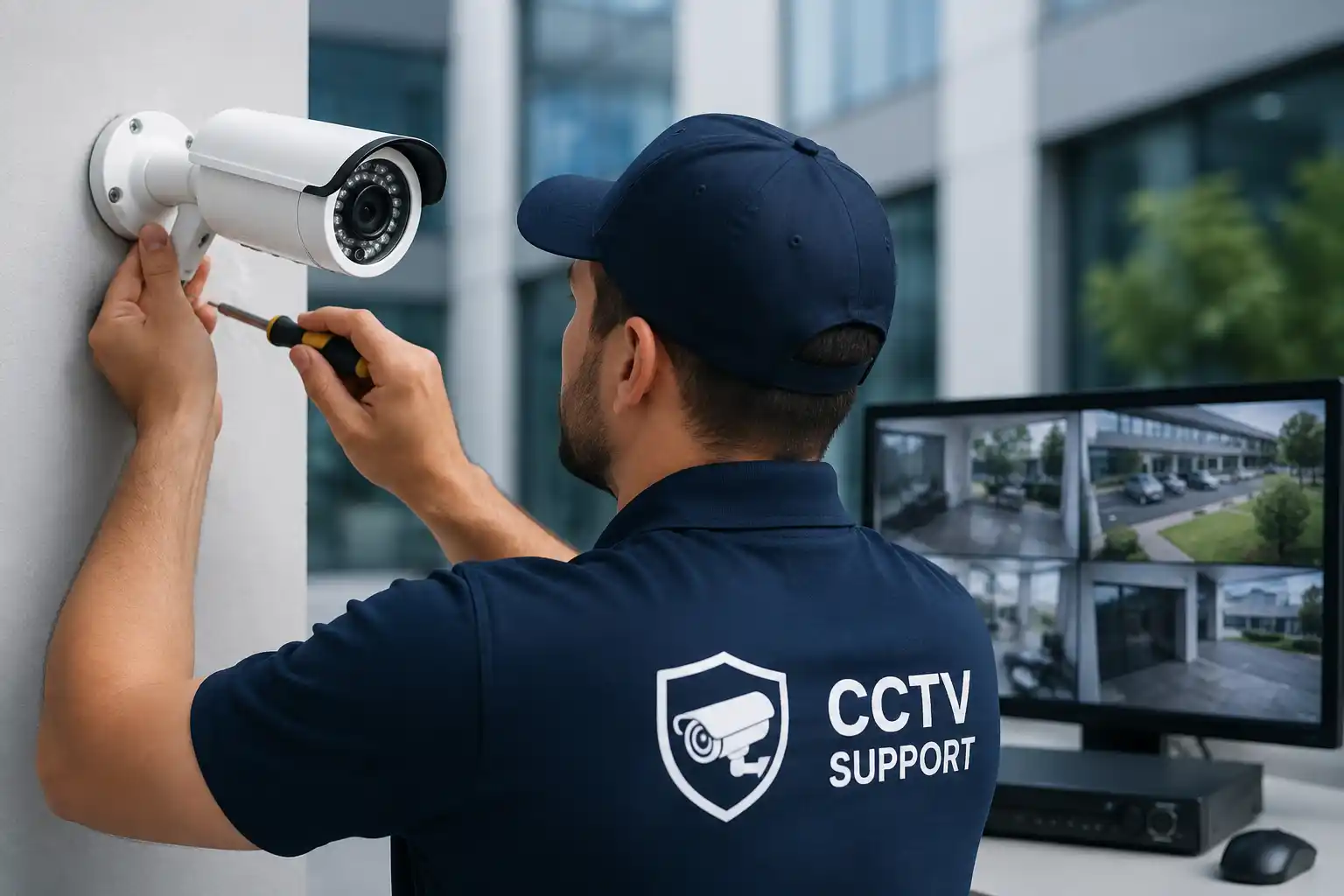
Camera, recorder, network, storage, power and access are considered together.
The service method depends on secure access, symptoms and whether physical testing is required.
A live picture is not enough if expected footage cannot be stored, found or played back.
Access, site conditions, hardware state and third-party dependencies should be confirmed before work begins.
What Does Security Camera Support Actually Cover?
Security camera support is the assessment, troubleshooting, configuration, maintenance and practical coordination needed to keep a business surveillance environment useful. It may cover CCTV cameras, IP cameras, DVR or NVR recorders, storage drives, monitors, PoE switches, power supplies, network links, remote-viewing applications and authorised user access. Businesses should consider support when cameras are offline, footage is missing, images are poor, recording is unreliable, remote access fails, storage warnings appear, or a planned change could affect surveillance. Before work is confirmed, the customer should be ready to identify the affected site, number of cameras, observed symptoms, approximate time the problem began, recent network or equipment changes, available administrative access, recorder and camera information, and any priority footage or operational concern. The exact service route depends on evidence, access, equipment condition and whether physical testing is necessary.
A Security Camera Is Part of a Larger Technical Path
A camera can appear to be a self-contained device because the visible symptom is simple: there is no image, the image freezes, the picture is dark, or the camera is missing from the recorder. In practice, a working surveillance path can involve the camera sensor and lens, local power or Power over Ethernet, connectors, cable runs, patch panels, switch ports, VLAN settings, IP addressing, gateways, recorder registration, storage health, time synchronisation, user accounts, display outputs, internet connectivity and the remote application. A failure anywhere along that path can create a similar user-facing result.
This is why effective troubleshooting begins by locating the boundary of the problem. If one camera is offline while all others remain available, the investigation may concentrate on that camera, its cable, port, power source or configuration. If several cameras disappear together, a shared switch, power source, network segment or recorder condition becomes more relevant. If live video works but recordings are missing, the focus moves toward recorder settings, storage status, time, schedule, stream configuration or capacity. If cameras work locally but not from a phone or remote computer, the issue may sit with authorised remote access, internet connectivity, application configuration, user permissions or a third-party service. The same visible symptom does not prove a single cause, so changes should follow evidence rather than assumption.
What the Service May Include
Depending on the confirmed scope, assistance may include camera connectivity checks, power and PoE review, recorder access, recording schedule review, storage-health observations, playback testing, image-quality investigation, stream and time-setting review, switch-port checks, address conflicts, authorised user-access checks, local display issues, remote-viewing troubleshooting, cabling assessment, replacement planning, configuration documentation and coordination with a network, internet or equipment provider. Not every task is included automatically; the applicable work should be confirmed after the environment and symptoms are understood.
Who May Need This Support
The service may suit offices, retail locations, warehouses, clinics, schools, restaurants, hospitality sites, property-management locations, showrooms, construction offices and multi-branch businesses using surveillance for operational visibility, incident review or authorised security monitoring. It can also help companies taking over an existing site where camera labels, passwords, recorder ownership, network details or recording expectations are unclear. The need is not limited to total failure; recurring camera drops, difficult playback, unexplained storage gaps and unstable mobile access can justify assessment before a more disruptive outage occurs.
Common Symptoms and What They Can Mean
Security camera problems often arrive as short descriptions such as “camera not working” or “no recording.” Those descriptions are useful starting points, but the support process needs to expand them into testable observations. A black screen may represent lost power, an unplugged cable, a failed port, a damaged camera, incorrect credentials, a recorder channel problem or a display issue. An intermittent picture may relate to unstable power, cabling, network errors, bandwidth, temperature, a failing device or configuration. A blurry image may result from focus, dirty or damaged covers, lighting, motion, compression settings, condensation, incorrect positioning or a camera that no longer suits the viewing purpose.
Camera Offline
Possible areas include local power, PoE, cable continuity, connector condition, switch port, IP settings, address conflicts, recorder registration or camera hardware. The next step is to identify whether the device is reachable and whether the failure is local or shared.
Recording Gaps
Live video can work while recorded video fails. Storage health, retention settings, recording schedules, time settings, stream availability, recorder load and disk condition may need review. Important evidence requests should be communicated early because later recording may overwrite older data.
Remote Viewing Fails
If local viewing works, the camera path may be healthy while internet, firewall, mobile application, user permission, cloud relay, DNS or account conditions affect remote access. The exact method depends on the existing system and authorised configuration.
Poor Image Quality
Lighting, camera position, lens condition, resolution, bitrate, motion, weather exposure, glare, low-light settings and the viewing display can influence usefulness. A higher resolution alone does not correct poor placement or difficult lighting.
Recorder Alerts
Warnings may relate to storage, temperature, network loss, drive errors, recording settings or device health. Alerts should be investigated in context, especially where footage retention is operationally important.
Wrong Time or Date
Incorrect time can make footage difficult to locate and can affect incident review. Camera and recorder clocks, time-zone settings and network time configuration may need to be checked without assuming one device controls every channel.
Business Impact When Surveillance Faults Remain Unresolved
A surveillance fault does not always stop staff from working, which can make it easier to postpone than an email or network outage. The operational impact may appear later, when footage is needed and cannot be found, an entrance is not covered, a warehouse area has an intermittent camera, or an authorised manager cannot view a remote site. Repeated unexplained faults can also create additional support cost because staff restart recorders, reconnect cameras or contact several vendors without a clear technical record.
The business risk is therefore not only “camera unavailable.” It can include reduced visibility over deliveries, reception, stock areas, parking, loading points or other monitored spaces; difficulty reviewing an incident; confusion over who owns the recorder or remote-access account; and uncertainty over whether footage is actually being retained as expected. A structured assessment helps the organisation separate urgent restoration from planned improvements. It also identifies whether the weakness is local to a single device or reflects wider issues such as aging storage, undocumented network changes, overloaded PoE capacity, poor cabling, unmanaged remote access or inconsistent administration.
Security Camera Support Fit Matrix
| Observed Situation | Technical Areas That May Be Relevant | Recommended Next Step |
|---|---|---|
| One camera is offline | Camera power, PoE, cable, switch port, address, credentials, recorder channel | Confirm whether the camera is reachable and compare it with a working channel before replacement is considered. |
| Several cameras disappear together | Shared switch, uplink, PoE capacity, power, VLAN, recorder network connection | Check the shared path and recent network or electrical changes before working camera by camera. |
| Live view works but playback is missing | Recording schedule, storage, disk condition, time, stream settings, recorder load | Review recorder evidence and retention status promptly, particularly if specific footage is needed. |
| Phone viewing fails but local monitor works | Internet, remote-access method, app, account, firewall, user permissions | Confirm the authorised remote-access design and identify whether the failure is account, network or service related. |
| Images are too dark or unclear | Lighting, placement, lens, focus, environmental condition, image settings, viewing purpose | Assess the scene and required identification detail before changing resolution or replacing equipment. |
| Camera system changed after office network work | IP scheme, VLANs, gateways, switch ports, firewall, DHCP, static addresses | Compare the previous and current network design and restore approved camera connectivity without broad security bypasses. |
Service Information to Define Before Work Starts
| Main Purpose | Troubleshoot, maintain, configure or assess business security camera and recording environments. |
|---|---|
| Typical Systems Involved | CCTV or IP cameras, DVR/NVR, storage, monitors, PoE switches, cabling, network, internet access and viewing applications. |
| Remote Support Suitability | Suitable for selected configuration, account, recorder, application, log or network checks when secure authorised access and connectivity are available. |
| On-Site Support Suitability | Often appropriate for physical cameras, cable tests, PoE checks, switch ports, power, storage hardware, camera alignment, environment inspection and inaccessible systems. |
| Customer Access Required | Authorised access is scope dependent. Administrative credentials should only be shared through an approved secure method after identity and authorisation are confirmed. |
| Testing and Validation | May include live view, recording, playback, time, local display, approved remote access, selected camera channels and user workflow tests. |
| Vendor Coordination | May be required when hardware, firmware, subscriptions, cloud services, warranty, manufacturer tools or third-party managed networks are involved. |
| Scheduling Dependency | Depends on access, location, urgency, engineer availability, site conditions, maintenance windows and the approved quotation. |
| Quotation Requirement | Final commercial scope should be confirmed after the affected system, support method, site requirements and requested outcome are understood. |
Remote Camera Support Versus an On-Site Visit
When Remote Support May Be Suitable
Remote support may be useful when the recorder or management interface is reachable, the internet connection is working, the customer authorises secure access, and a local contact can describe the symptom or assist with simple observations. Configuration review, user permissions, mobile-viewing settings, selected network checks, recorder menus, time settings, log review and some recording investigations can often begin remotely. Remote work is particularly useful for determining whether an on-site visit is actually necessary and what equipment or access may be needed if a visit follows.
Remote access should not be treated as permission to make unrestricted changes. Existing settings may affect recording, network security and user access. Significant changes should be authorised, documented and, where appropriate, backed up or supported by a rollback approach.
When On-Site Support Is More Appropriate
An on-site visit may be needed when a camera or recorder cannot be reached, cables or connectors require testing, a PoE port is suspect, equipment has physical damage, camera position or focus must be inspected, a storage drive needs hands-on assessment, the local display is unavailable, a rack or switch must be checked, or the fault affects several physical components. Site work can also be necessary when installation, relocation or replacement is involved.
The useful on-site scope depends on building access, camera height, safe working conditions, rack access, network ownership, equipment availability and the ability to coordinate with an authorised site contact. Attendance timing should be confirmed with FourTeck after the requirement is reviewed.
How the Assessment and Diagnostic Process May Work
Identify whether the concern affects active monitoring, recording, incident review, remote access, one camera, one zone or the complete site. Priority should be based on the operational consequence, not only the number of error messages.
List camera channels, recorder, network connections, storage, monitor, switch and remote application involved. This helps determine whether there is a shared point of failure.
Useful evidence may include error messages, channel status, screenshots, device models, timestamps, recent changes, recorder alerts, switch status and examples of missing footage. Evidence should be collected without exposing passwords publicly.
Before configuration work, confirm authorisation, backup options, maintenance constraints, administrative ownership and whether a change could interrupt recording or other network services.
Testing can progress from the camera and power path through cabling, network reachability, recorder registration, storage and application access. The order is adapted to the symptom so unnecessary changes are avoided.
The objective is to separate confirmed observations from assumptions. Sometimes the result is a direct repair path; in other cases it is a clear escalation to a vendor, ISP, building team or replacement decision.
Configuration changes, component replacement, cable work or account adjustments should stay inside the agreed scope and consider rollback where settings are altered.
A camera ping or green status icon is not the complete result. Live view, intended recording, playback, time, authorised access and the actual business use should be checked where they form part of the service.
Corrective Work, Change Planning and Safe Implementation
Once the fault or weak area is understood, the next action may be a small configuration correction, cable repair, switch-port change, camera replacement, recorder-storage action, network adjustment, user-access correction or a wider upgrade plan. The right response depends on the age and condition of the equipment, the importance of retained footage, compatibility among cameras and recorders, the customer’s maintenance window and whether another provider controls part of the path. For example, replacing an offline IP camera may still require network addressing, PoE capacity, recorder compatibility and stream registration to be confirmed. Replacing a recorder can involve storage planning, camera compatibility, user permissions, time settings, remote access and a transition plan for any footage on the old system.
Configuration changes should be controlled because surveillance systems frequently share switches, internet connections or firewall policies with other business technology. A broad network change made only to restore remote viewing can unintentionally affect users or reduce security. Where practical, existing settings should be recorded, approved changes should be scoped, and validation should cover both the corrected camera function and adjacent services. If a third party owns the router, firewall, cloud relay or building network, FourTeck may need to coordinate evidence and requested changes rather than making unauthorised adjustments.
Testing, Validation and Handover After Support Work
Testing should match the reason the customer requested support. If the complaint was one offline camera, the test should include that camera’s live stream and stability over a reasonable observation period within the service scope. If the complaint was missing recordings, the result should include recording creation, playback and time verification rather than only confirming live video. If the issue involved remote viewing, both local operation and the authorised remote method should be checked so the team does not accidentally fix one path while another remains broken.
A useful handover can record the affected component, the observed cause or scope, changes made, components replaced if applicable, validation performed, remaining risks and recommended next actions. Where multiple vendors are involved, the notes should distinguish what FourTeck checked from what remains with the internet provider, equipment supplier, building contractor or application owner. Administrators may also benefit from basic labels, camera-to-channel mapping, recorder ownership, storage observations and a list of authorised viewing methods. Documentation should be kept according to the customer’s security policy and should not expose credentials unnecessarily.
Capability 1: Isolating Repeat Camera Faults Instead of Resetting Devices
A recurring camera problem often creates a cycle: the device is restarted, video returns, and the business considers the issue closed until it fails again. Repeated resets can hide a deeper condition such as unstable PoE delivery, a damaged cable, an address conflict, switch errors, thermal stress, overloaded recorder resources or a device that is reaching the end of reliable service. FourTeck’s role can be to build a clearer fault history, compare the failing channel with working channels and identify shared dependencies. The objective is not to guarantee that every intermittent issue will appear immediately during a visit; intermittent faults can require evidence over time. However, better observations reduce random replacement and create more useful decisions about repair, network correction, monitoring or scheduled replacement.
For businesses with many cameras, the difference between one recurring endpoint fault and a wider infrastructure weakness matters. A single camera that fails in the afternoon may require environmental or local investigation, while a group of cameras failing when another device is added could point to power or network capacity. Clearer isolation helps protect the rest of the surveillance environment from unnecessary changes.
Capability 2: Improving Recording Readiness, Not Just Live Viewing
A surveillance system can look healthy on a monitor while its recording function is weak. A live stream shows only what is happening now; incident review depends on storage, recording schedules, correct time, available streams, recorder health and sufficient capacity for the configured workload. Support should therefore consider the business question “Can we retrieve the footage we expect?” rather than only “Can we see the cameras?”
Recording assessment may involve checking whether expected channels are configured to record, whether the recorder reports storage warnings, whether playback is available for sample periods, whether timestamps are sensible, and whether retention expectations match the actual storage and stream configuration. The available retention period can vary with the number of cameras, resolution, frame rate, compression, recording mode, storage capacity and event patterns. It should not be promised without reviewing the real setup. Where storage hardware is degraded, the customer may need replacement planning outside the initial support labour scope. Where important historical footage is already missing or overwritten, recovery cannot be assumed or guaranteed. Early reporting of critical footage needs is therefore important.
Capability 3: Making Camera Networks Easier to Maintain
IP surveillance becomes difficult to support when camera addresses are unknown, switch ports are unlabeled, several people share one administrator account, remote access is undocumented, or nobody knows which device owns time, storage and user permissions. A technically working system can still be operationally fragile. Documentation and controlled administration make later faults, office moves and camera additions easier to manage.
Depending on scope, FourTeck can help organise useful records such as camera names, logical locations, recorder channels, network information, responsible contacts, approved remote-access methods, device ownership and significant configuration notes. The exact level of documentation should reflect customer security requirements; detailed credentials should be handled through an approved secure process rather than embedded in public or general documents. Network separation and administrative access may also be reviewed where appropriate, especially when cameras share business switches or internet connectivity. Improving maintainability does not mean every legacy device must be replaced. It means the customer has a clearer view of what exists, how it connects and what requires attention before the next change.
Dependencies, Access and Customer Inputs
A camera support request can depend on information and access controlled by several parties. The customer may own the cameras and recorder but use a building-managed network. A previous installer may hold recorder details. An internet provider may control the router. A facilities team may be responsible for power or cabling. Remote viewing may depend on a vendor application or account. These boundaries should be identified before changes are made so responsibilities are clear and the support visit is productive.
Useful inputs include the service address, authorised site contact, number of affected cameras, recorder location, visible symptoms, time the problem began, frequency of recurrence, recent electrical or network work, device or platform names, existing diagrams, network ownership, available administrator access, expected recording period, current backup of configuration if available, building-access restrictions, preferred maintenance window and the business outcome required. Do not send passwords through an unapproved public channel. Credentials should be exchanged only through a secure method agreed after the requester’s identity and authorisation are confirmed.
Risks, Limitations and Exclusions to Understand
Diagnosis depends on available evidence, authorised access and the condition of the equipment when it is inspected. Intermittent faults may not appear during a short test and can require additional evidence or observation. Hardware failure may require replacement parts or devices outside the labour scope. Existing footage may be unavailable if it was never recorded, has already been overwritten, storage has failed or the system was configured differently from the expected retention policy. Data or video recovery cannot be guaranteed.
Some corrective work may require action from a manufacturer, equipment supplier, internet provider, building contractor, electrical contractor, cloud-service provider or another party that owns the relevant system. Unsupported or obsolete cameras and recorders may have limited configuration, firmware or replacement options. Changes to network, firewall, recorder or camera settings can interrupt live view or recording and may require a maintenance window, backup or rollback plan. A successful support test shows the observed function at that time; it does not eliminate the need for ongoing maintenance or guarantee future availability. On-site work depends on safe access, location, scheduling and the approved scope. Final commercial terms are defined by the quotation or service agreement.
Business Environments Where Camera Support Is Commonly Needed
Offices and Professional Workplaces
Reception areas, entrances, corridors, server-room approaches and parking access may be monitored. Support may involve one failed camera, difficult playback, recorder storage or secure management access. Work should consider office network dependencies and minimise unnecessary disruption.
Retail and Showrooms
Cameras may support review of entrances, tills, displays and stock movement. Image usefulness, time accuracy and dependable recording can matter as much as camera count. Support can also help when network or internet changes affect remote viewing.
Warehouses and Logistics Sites
Long cable runs, larger PoE networks, loading areas, heat, dust and distributed switching can create additional troubleshooting layers. A group of offline cameras may need shared infrastructure checks rather than individual device replacement.
Clinics and Service Locations
Surveillance should be managed around authorised access and the organisation’s privacy and operational requirements. Support can focus on availability, recording, user permissions and equipment condition without making unsupported compliance claims.
Hospitality and Restaurants
Entrances, service areas, stores and customer-facing spaces may depend on continuous recording. Busy operating hours can make change windows important, and local staff may need clear guidance for basic playback or reporting a failed channel.
Multi-Branch Businesses
Different recorders, networks, site contacts and internet providers can complicate remote support. Standard naming, documented ownership and a clear escalation route make repeated support easier across locations.
Operational, Security and Maintenance Considerations
A security camera system should be maintained as operational infrastructure, not only checked after an incident. Periodic review can identify cameras that have shifted, covers that need cleaning, intermittent links, storage warnings, incorrect time, failed channels, unmanaged users, outdated documentation or environmental conditions that reduce image usefulness. The appropriate check frequency depends on the number of sites, business risk, environment, camera importance and the maintenance arrangement. A maintenance plan should state what assets are covered, what inspections are included, what requires separate approval and how faults are reported.
Access also deserves attention. Administrator accounts, mobile viewing and remote management can create unnecessary exposure when they are shared, undocumented or left active after staff changes. Security improvement should focus on authorised accounts, controlled privileges, suitable network separation, current supported software where practical and remote access that matches the real business need. No single setting can guarantee complete security, and changes should consider compatibility with the existing recorder, cameras and user workflow. Where a device is too old to support appropriate controls, replacement planning may be more realistic than repeated configuration work.
For ongoing maintenance, the organisation should know who owns the system, where the recorder is located, which network equipment supports the cameras, who is authorised to retrieve footage, how faults are reported and what third-party contracts apply. These simple ownership details often shorten future support more than a long list of unverified technical settings.
Before You Contact FourTeck
You do not need to diagnose the fault yourself. The following information helps FourTeck understand the request and decide whether remote assessment, an on-site visit or a planned quotation is the better next step.
- The Dubai or UAE service location and the authorised on-site contact.
- Whether the problem affects one camera, several cameras, the recorder, playback or remote viewing.
- When the issue was first noticed and whether it is constant or intermittent.
- Any recent power, cabling, switch, internet, firewall, recorder or camera changes.
- The camera and recorder brands or model references if available.
- Visible recorder warnings, channel messages or application errors.
- Whether live viewing works locally at the recorder or monitor.
- Whether recordings can be played back for other channels or time periods.
- Whether the site internet and wider business network are working normally.
- Whether administrative access is available through an approved secure process.
- Who manages the network, firewall, internet connection and building cabling.
- Whether any particular footage or time period is operationally important.
- Any site-access, camera-height, rack, parking or working-hour restrictions.
- The business impact and the result you need from the support request.
Service Evaluation and Quotation Checklist
How FourTeck Can Assist With the Support and Quotation Process
FourTeck can begin by clarifying the symptom, affected cameras, recorder status, business impact and available access. The request can then be mapped to the most relevant technical layers: camera hardware, power, cabling, switching, addressing, recorder, storage, viewing application, network, firewall or internet path. Where the evidence supports remote troubleshooting, FourTeck can define an authorised remote session. Where the problem requires physical inspection, the team can organise an on-site scope subject to location, site access, scheduling and quotation.
For planned corrective work, FourTeck can help identify prerequisites, compatibility concerns, required maintenance windows, testing steps and third-party coordination. The completed work may include validation and practical documentation according to the approved scope. If the assessment shows that replacement, expansion or a wider network improvement is more suitable than repeated repair, that recommendation can be separated from the immediate fault so the customer can make a considered decision.
Customers can review the broader FourTeck IT support approach, explore the connected business technology services, learn more about FourTeck IT Services, or send the camera support requirement for review.
Dubai and UAE Service Coordination
Security camera support in Dubai may begin remotely or require an on-site visit depending on the symptom. Configuration, user access, recorder settings and some network checks may be possible remotely when the system is reachable and secure access is authorised. Physical camera faults, cabling, power, PoE, switch ports, camera alignment, storage hardware and local equipment access usually require site coordination. FourTeck should be given the service location, site contact, affected equipment and any access restrictions so the service route can be planned accurately.
Scheduling depends on the confirmed work scope, engineer availability, customer access, site conditions, required equipment or parts, building rules and third-party providers. Installation, replacement, configuration, network changes, recording work and maintenance tasks should be explicitly included in the quotation when they are required. If a camera is mounted in a location that needs special access or additional safety arrangements, that dependency should be identified before attendance. The same applies when the recorder or switch is inside a restricted communications room or managed by another contractor.
Coordinating Security Camera Support Across Dubai, Abu Dhabi, Sharjah and Ajman
Businesses with sites in Dubai, Abu Dhabi, Sharjah and Ajman may use different camera systems, network providers, building contacts and recorder configurations at each location. Support coordination can include remote troubleshooting, planned on-site visits, camera or recorder assessment, maintenance work, configuration review, network investigation or project support according to the confirmed scope. Multi-site work benefits from clear site names, camera counts, responsible contacts and a consistent way to report faults.
Travel, scheduling, building access, equipment availability, site conditions and third-party dependencies can affect the service plan. A remote check at one branch does not automatically prove that another branch has the same fault, even when the visible symptom is similar. For larger multi-site requirements, FourTeck can help define which sites need physical inspection and which can be assessed remotely so the quotation reflects the actual work rather than assuming identical conditions everywhere.
Related FourTeck IT Services Around a Camera Environment
Camera systems share infrastructure with other business technology, so a surveillance fault may connect to a wider support area. The most useful related services depend on what the assessment finds.
Office Network Support
Useful when cameras depend on managed switches, VLANs, uplinks, IP addressing or cabling and the fault extends beyond one endpoint.
Firewall and Remote Access Support
Relevant where authorised remote viewing, site-to-site connectivity or controlled access crosses the firewall and requires careful review.
Server and Storage Support
Applicable when camera recordings interact with separate storage, shared infrastructure or a server-managed environment rather than a standalone recorder.
General IT Support
Helpful when a camera symptom appears alongside wider internet, switch, workstation, display or infrastructure problems at the same location.
Why Businesses Contact FourTeck for Camera Support
The value of a camera support provider is not an unsupported promise of instant repair. It is the ability to understand how the surveillance system connects to the surrounding business infrastructure, ask for the right evidence, identify whether remote or on-site work is appropriate and explain the next action in practical terms. FourTeck works across users, networks, servers, firewalls, internet connectivity, IP telephony and CCTV, which can be useful when a camera issue crosses technical boundaries.
Customers may contact FourTeck when they need an initial assessment, a second technical view on a recurring fault, remote troubleshooting, planned on-site inspection, clearer documentation, network coordination, recorder or storage review, a controlled configuration change, a maintenance plan or a quotation for corrective work. The final scope remains environment dependent. If the evidence shows that another provider owns the fault, useful technical findings can support escalation instead of repeated trial and error. If the issue is internal, the support route can be shaped around the affected business function and the risk of change.
Questions Businesses Commonly Ask Before Requesting Security Camera Support
The following decision guidance addresses the kinds of practical questions a Dubai business may have before contacting a camera support provider. The answers are deliberately scope-aware because the correct action depends on the existing system, access and evidence.
Can a security camera problem be checked remotely?
Some camera issues can be assessed remotely when the recorder, camera management interface or network is reachable and the customer can authorise secure access. Remote diagnosis can be useful for channel status, user permissions, time settings, selected network checks, recorder configuration, playback observations and remote-viewing applications. It may also identify whether a camera is unreachable from the network, which helps prepare an on-site visit. Remote support is less suitable when power, cable condition, physical damage, lens position, camera mounting, switch hardware or inaccessible local equipment must be inspected. A good first step is to report whether local viewing works and whether the issue affects one camera or many.
When is an on-site camera visit usually needed?
An on-site visit is usually considered when hands-on testing is necessary. Typical examples include a camera with no power, suspected cable damage, PoE problems, loose or corroded connectors, a recorder that cannot be accessed remotely, physical storage warnings, poor image caused by position or environment, camera replacement, alignment, rack checks or several cameras failing around the same switch. Site access requirements matter. If a camera is high, outdoors, above a loading area or inside a restricted location, the customer should mention this before scheduling so the work can be scoped correctly.
Why does a CCTV camera keep going offline and then return?
Intermittent camera faults can come from several layers, including unstable power, marginal PoE delivery, damaged cabling, switch errors, duplicate IP addresses, environmental conditions, network congestion, firmware or device instability. The same symptom can also appear when the recorder temporarily loses the stream rather than the camera itself failing. Because intermittent faults may disappear during a test, timestamps and a simple history are valuable. Note when the camera fails, how long it stays offline, whether other cameras are affected and whether anything else changes at the same time. This evidence can help separate a local endpoint problem from a shared infrastructure issue.
What should we do if live video works but old footage is missing?
Report the missing period and its importance as early as possible. Live video and recording are different functions. The recorder may be showing a current stream even if the recording schedule, storage, time settings or recorded stream has a problem. Support can review recorder alerts, sample playback, channel settings, storage condition and time. However, footage that was never recorded, has been overwritten or sits on failed storage may not be recoverable. The support scope should therefore focus first on preserving the current state and understanding what is actually available before making broad changes to the recorder.
Can a network change make cameras stop working?
Yes. IP cameras depend on addresses, gateways, VLANs, switch ports, PoE and routes to the recorder. A new router, switch replacement, subnet change, DHCP adjustment, firewall modification or office relocation can interrupt the camera path even when the camera hardware is healthy. When the issue begins after network work, share the timing and what changed. The support process can compare the camera design with the new network state instead of resetting devices individually. Network changes should be controlled because a quick workaround that exposes cameras broadly or removes segmentation may create a security problem.
Should we repair an old camera or replace it?
The decision should be based on the condition, fault, compatibility, viewing purpose and wider system rather than age alone. A camera with a damaged connector may be repairable, while an unsupported device with repeated faults may be a poor maintenance choice. Replacement also needs compatibility checks: physical position, power or PoE, cabling, network support, recorder compatibility, stream settings and image requirements. FourTeck can help define whether the existing component can reasonably remain in service or whether replacement should be quoted. A replacement recommendation should not be confused with proof that every surrounding component is healthy.
How do we know whether the NVR or the camera is the problem?
The answer comes from comparison and testing. If the camera is reachable on the network but does not appear on the NVR, recorder registration, credentials, stream compatibility or channel settings may be relevant. If the camera is unreachable from the network and shows no local status, power, cabling, switch or camera hardware may need attention. If several known-good cameras fail only on one recorder, the recorder or its network path becomes more important. Support should avoid declaring the NVR or camera faulty until these relationships are checked.
What information should we prepare for a security camera support quotation?
Provide the service location, number of sites, approximate camera count, number of affected channels, recorder type if known, problem description, recent changes, whether local viewing works, whether recordings are available, network ownership, access availability and whether on-site physical work is expected. If the request includes camera replacement, new cabling, storage expansion, remote-access changes or a maintenance contract, mention that separately because each can change the scope. Photos of equipment labels or screenshots can be useful, but passwords should not be sent through an unsecured enquiry.
Is one-time troubleshooting enough, or should we consider maintenance?
One-time support can be appropriate for a specific fault with a clear cause and stable surrounding system. Maintenance becomes more relevant when the business has many cameras, several sites, repeated faults, critical recording requirements, aging storage, frequent user changes or limited internal oversight. A maintenance plan can include periodic checks, fault reporting, documentation updates and improvement recommendations, but the actual inclusions and frequency should be defined in the agreement. Unlimited support, fixed visits or replacement parts should not be assumed unless explicitly included.
What if another contractor installed the cameras?
Support can still begin with the current condition, provided the customer has authority to request work and suitable access can be arranged. The challenge is often documentation: camera maps, passwords, network information, recorder ownership, warranty details or remote-service accounts may still belong to the previous installer or another provider. FourTeck can identify what information is missing and what can be tested independently. Where manufacturer-specific tools, warranties or subscriptions are required, coordination with the original supplier or vendor may be necessary.
Can camera support include remote viewing on a phone?
It can, when the remote-viewing method is supported by the existing system and the customer authorises the required account and network changes. The support path may involve the recorder, mobile application, internet access, firewall, cloud relay or user permissions. The goal should be controlled access for approved users, not simply exposing the recorder to the internet. Existing vendor services, subscriptions or account ownership may affect what can be configured. If the system is legacy or the remote method is no longer supported, a different solution may need to be planned.
How should a business prepare for camera support at a busy site?
Identify the least disruptive time for work, the site contact, access to the recorder or communications room and any restrictions around customer areas, loading zones or camera locations. If a change could interrupt recording, agree a maintenance window. For cameras at height or difficult outdoor positions, explain the access conditions in advance. If the fault is intermittent, collect timestamps before the visit. If a specific recording is important, communicate the date and time immediately. These details allow the support scope to reflect real site conditions instead of treating every camera visit as identical.
What should we expect after the support work is completed?
The expected outcome should be agreed before work begins. For troubleshooting, this may be restored operation, an identified cause, an escalation package or a replacement recommendation. For configuration, it may be validated live view, recording, playback and authorised remote access. For maintenance, it may be a condition report and prioritised actions. Documentation can record what was changed and what remains outstanding. If a third party must take the next step, the customer should know which evidence has been collected and what action is still required.
Frequently Asked Questions
Does FourTeck support both CCTV and IP cameras?
FourTeck can assist with business surveillance environments that may include CCTV or IP cameras, DVR or NVR recorders, storage, monitors, cabling, PoE and network dependencies. The exact platforms and tasks should be confirmed from the installed environment before work is quoted.
Can you troubleshoot a camera that shows no video?
Yes, subject to assessment and access. Troubleshooting may consider camera power, cabling, PoE, switch connectivity, IP configuration, recorder registration, credentials and hardware condition. No-video symptoms do not automatically mean the camera must be replaced.
Can you check why recordings are missing?
Recording issues can be assessed by reviewing recorder status, schedules, storage, time, playback and stream availability within the approved scope. Historical footage recovery cannot be guaranteed, especially if data was never written, has been overwritten or storage has failed.
Do you provide on-site security camera support in Dubai?
On-site assistance can be coordinated when physical inspection, cabling, power, PoE, storage, camera access or local equipment work is required. Scheduling depends on location, access, confirmed scope, site conditions and the approved quotation.
Can remote support fix all camera problems?
No. Remote support is useful for selected configuration, account, recorder and network checks when secure access is available. Physical faults, cable tests, camera positioning, hardware replacement and inaccessible systems generally require on-site work.
Do you support camera network issues?
Where IP cameras depend on business switching, VLANs, addressing, gateways, PoE or firewalls, FourTeck can assess those network relationships within the authorised scope. Shared network changes should be handled carefully to avoid affecting other business services.
Can FourTeck help with camera replacement planning?
Yes. Replacement planning can consider the confirmed fault, camera location, power, cabling, PoE, recorder compatibility, network requirements and viewing purpose. Hardware supply or specialist access should be included separately in the quotation when required.
What access is required for troubleshooting?
Access depends on the issue. It may include the recorder, camera management interface, network switch, viewing application or physical equipment. Credentials should be shared only through an approved secure method after the requester’s authority is confirmed.
Can you support a system installed by another company?
Support can be considered when the customer authorises the work and enough access is available. Some equipment may still require original vendor accounts, subscriptions, warranty channels or manufacturer-specific tools, which can create third-party dependencies.
Will support interrupt recording?
Some diagnostic or configuration work can be completed without planned interruption, while recorder restarts, network changes, storage work or hardware replacement may affect recording. The risk should be identified and a maintenance window agreed where needed.
Can you provide maintenance after troubleshooting?
Ongoing maintenance can be discussed based on the number of cameras, locations, required checks, reporting needs and support expectations. Actual inclusions, visit frequency, exclusions and chargeable work depend on the agreed service plan.
How do we request a quotation?
Send FourTeck the service location, affected cameras or recorder, main symptom, recent changes, access availability and required outcome. Additional information may be requested before remote work or an on-site quotation is confirmed.
Discuss Your Security Camera Issue With FourTeck
Start with what you can observe: which camera or recorder is affected, whether live viewing or playback works, when the issue began, what changed recently, where the site is located and what outcome the business needs. FourTeck can use that information to determine whether the next step should be remote troubleshooting, an on-site assessment, a maintenance discussion, vendor coordination or a quotation for corrective work. The exact scope depends on the current system, access, equipment condition and approved service plan.