
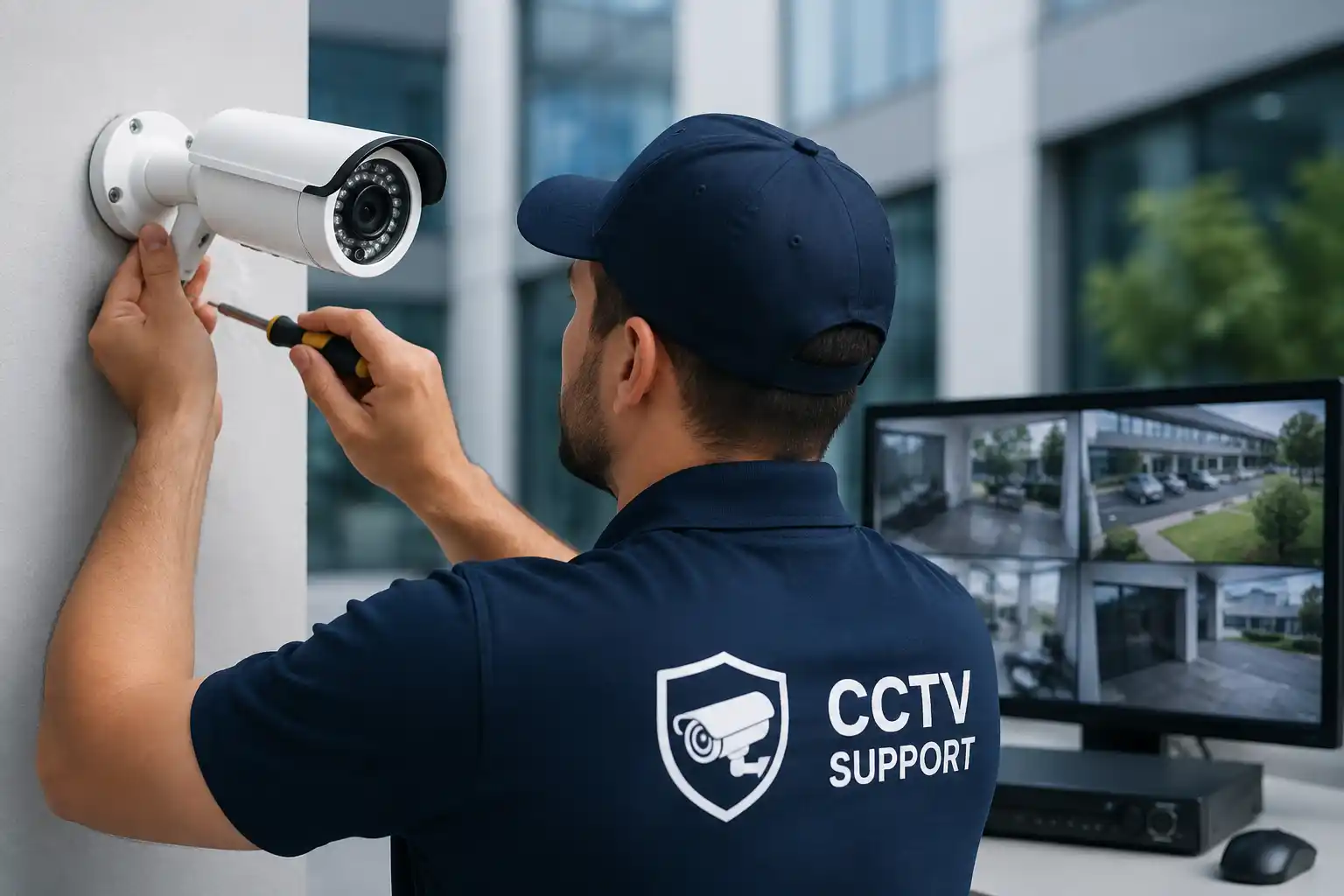
Recorder, storage, camera, power and network layers reviewed in context.
The support method is matched to access and the physical work required.
Hardware condition, compatibility and replacement economics are considered.
Recording, playback, timestamps and authorised viewing are validated after work.
What does DVR repair support cover?
DVR repair support is the structured assessment and corrective work used to restore or stabilise a CCTV digital video recorder and the functions that depend on it. It is mainly used when cameras are not recording correctly, footage cannot be searched or played back, the recorder shows storage errors, the unit restarts or freezes, the monitor has no useful output, or remote viewing stops working. Businesses that rely on recorded video for incident review, operations, loss prevention or site oversight should consider assessment when these symptoms are repeated or affect evidence availability.
Before work is confirmed, the customer should prepare the site location, recorder brand and model if available, approximate age, number of connected cameras, description of the fault, when it started, recent power or network changes, visible alarms or messages, and whether local or remote administrator access is available. The condition of hard drives, existing camera technology, power supplies, cabling and network connectivity can influence the final repair path. FourTeck can use this information to decide whether remote troubleshooting is useful first or whether an on-site inspection is more appropriate.
A DVR fault is often a system fault, not only a recorder fault
A digital video recorder sits at the centre of many analogue or HD-over-coax CCTV environments. Cameras send video toward the recorder, separate power supplies may feed the cameras, hard drives retain recordings, a monitor provides local viewing, and a network connection may allow authorised users to view cameras from computers or mobile applications. Some recorder platforms can also accept selected network camera channels or integrate with other surveillance components. Because these relationships vary by model and site design, a symptom at the recorder can originate somewhere else.
For example, one black camera tile may point to a camera, power or cable problem rather than a failed DVR channel. Several cameras disappearing together may suggest a shared power issue. Playback that stops at certain dates may be related to storage condition, recording schedules, retention limits or overwritten data. A recorder that displays locally but cannot be reached from a phone can involve network addressing, internet access, firewall policy, cloud or peer-to-peer connectivity, account permissions or an application change. A unit that repeatedly reboots may require investigation of power quality, internal hardware, storage or thermal conditions. The purpose of a repair assessment is to separate these layers rather than assume the most visible device must be replaced.
This approach matters for businesses because unnecessary replacement can create new compatibility problems. Existing cameras may use a particular signal format, resolution, channel count or connection method. A replacement recorder may also need sufficient storage capacity, suitable video inputs, network configuration and user-access settings. If the old unit contains recordings that may still be required, the handling of storage should be planned before any reset, disk replacement or reinitialisation. FourTeck can review the environment and explain which actions are low risk, which require customer approval, and which may depend on a manufacturer, supplier or specialist data-recovery provider.
What the service may include
Depending on the confirmed scope, assistance may include power and startup checks, local display testing, camera-channel review, storage-health assessment, recording schedule checks, playback testing, time and date verification, user-permission review, network configuration checks, remote-viewing troubleshooting, controlled configuration correction, firmware or system-setting review where appropriate, hard-drive replacement planning, recorder replacement planning, camera compatibility checks, and post-repair validation.
The service can also include coordination with a CCTV supplier, hard-drive vendor, internet provider or application provider when the evidence shows that another party controls the required action.
Who may need DVR assistance
The service may suit offices, warehouses, retail shops, clinics, restaurants, hospitality sites, workshops, showrooms, property-management locations, educational facilities and other organisations that already operate a DVR-based surveillance system. It is particularly relevant when security or operations teams cannot reliably retrieve footage, when several users report access problems, when cameras appear intermittently, or when the recorder is ageing and management needs to decide between repair and replacement.
For multi-site organisations, the assessment can also consider whether recorder naming, user access, time settings, retention expectations and remote-viewing methods are consistent across locations.
Common DVR symptoms and the technical areas behind them
The same CCTV symptom can have several possible causes, so diagnosis should start with evidence rather than assumptions. The examples below show why fault isolation matters. They are not a statement that any one cause applies to a particular site before testing.
DVR powers on but cameras are missing
Possible areas include camera power, coaxial connectors, individual channels, signal-format compatibility, damaged cable runs, shared power supplies or camera faults. Testing one known-good path can help separate a recorder input problem from a field-device problem.
Live video works but recordings are unavailable
The recorder may require checks of hard-drive detection, disk health, recording schedules, overwrite settings, date filters, channel schedules, storage capacity and the time range being searched. A visible live image does not prove that evidence is being stored correctly.
Remote viewing has stopped
The issue may involve the recorder network interface, changed local addressing, router or firewall settings, internet service, DNS, a vendor cloud service, a mobile application, account permissions or a password change. Local recording may continue even while remote access fails.
The recorder freezes or restarts
Power supply stability, overheating, hard-drive faults, internal hardware, configuration corruption or software issues may need investigation. Repeated restarts should be approached carefully because they can affect recording continuity and may worsen an unstable storage condition.
Playback time does not match real events
Incorrect time zone, manual clock changes, failed time synchronisation, daylight-saving settings on some systems or inconsistent camera and recorder clocks can make evidence difficult to locate. Time correction should be planned with awareness of how the recorder stores and indexes footage.
A hard-drive alarm appears
Disk detection, health indicators, cabling, capacity, file-system state or physical drive failure may be involved. If existing recordings are important, the customer should avoid unnecessary formatting and explain the evidence requirement before repair actions are approved.
Why unresolved recorder faults can affect business operations
A DVR is often treated as a background device until footage is needed. If recording has been unreliable for days or weeks, a business may discover the gap only when an incident must be reviewed. Missing evidence can make it harder to investigate stock discrepancies, access events, property damage, workplace incidents or customer complaints. Operational teams can also lose time repeatedly rebooting a recorder, reconnecting cameras or searching through unclear playback without understanding the underlying issue.
The practical impact depends on how the organisation uses CCTV. A warehouse may rely on recordings around loading areas, a retail site may need reliable cash-counter coverage, an office may need entrance and common-area visibility, and a property manager may require consistent access across several locations. Repair assessment helps management understand whether the immediate issue can be corrected, whether an ageing component is creating repeated risk, and whether maintenance or replacement planning should follow.
DVR repair service-fit matrix
| Observed situation | Possible technical areas | Recommended next step |
|---|---|---|
| One or two cameras show no video | Camera power, connectors, cable path, channel input, camera condition or signal compatibility. | On-site path testing is often useful if simple local checks do not identify the fault. |
| All cameras are visible but no recent recordings can be found | Storage detection, disk health, recording mode, schedule, retention, date search or recorder clock. | Preserve required evidence and assess storage before formatting or replacing drives. |
| Remote app fails while the local monitor works | Recorder network settings, router, firewall, internet service, user account, vendor connectivity or app configuration. | Remote diagnosis may be suitable if secure authorised access and internet connectivity remain available. |
| DVR has no power or repeatedly reboots | Power adapter or internal supply, electrical feed, storage, overheating or recorder hardware. | Plan an on-site hardware assessment; avoid repeated uncontrolled power cycling. |
| Recorder is old and faults return after temporary fixes | Ageing storage, power components, limited compatibility, unsupported software or general hardware wear. | Compare repair cost and risk with a controlled replacement plan that considers existing cameras. |
| Footage is needed for an important incident | Playback search, time accuracy, retention, storage condition, export function and evidence handling. | State the evidence requirement before repair work. Some cases may require specialist data-recovery or forensic handling outside normal repair scope. |
Service information for planning a DVR support request
| Service topic | DVR troubleshooting, repair assessment, configuration support and maintenance guidance. |
|---|---|
| Main purpose | Restore reliable recording, playback, camera visibility and authorised access where technically possible after assessment. |
| Typical systems involved | DVR, CCTV cameras, camera power supplies, coaxial cabling, storage drives, monitor, local network, router or firewall, user accounts and viewing applications. |
| Remote support suitability | Suitable for selected configuration, playback, user-access and network issues when the recorder is reachable and remote access is authorised. |
| On-site support suitability | Recommended for no-power faults, storage inspection, physical camera or cabling tests, recorder replacement, local display checks and inaccessible systems. |
| Customer information required | Location, symptoms, affected channels, model if known, recent changes, error messages, evidence needs, access availability and business impact. |
| Testing and validation | Scope dependent. May include live view, recording, playback, storage status, clock accuracy, export, network access and authorised remote viewing. |
| Parts and replacement | Subject to diagnosis, compatibility, availability and approved quotation. Replacement components are not assumed to be included. |
| Service location | Dubai and UAE service coordination, with remote or on-site assistance depending on the confirmed requirement. |
| Quotation requirement | The final commercial scope depends on assessment, access, site conditions, required labour, parts, third-party dependencies and testing requirements. |
Can DVR problems be checked remotely, or is an on-site visit needed?
Remote support may be useful when
The recorder is powered, connected to the local network and reachable through an approved method; the issue concerns settings, user accounts, recording schedules, date and time, playback, network configuration or remote viewing; and someone at the site can confirm what appears on the local screen. Remote work can reduce unnecessary travel for configuration-led faults, but it cannot replace physical tests when a cable, power supply, disk or recorder component may be failing.
The customer should authorise access and share credentials only through an approved secure method after identity and scope are confirmed. Passwords should not be placed in a public contact form or public page.
On-site support is usually more suitable when
The DVR does not power on, the unit restarts, storage drives require inspection, camera connectors or power feeds need testing, the local monitor is unavailable, several physical channels are affected, the system is not reachable remotely, or a replacement recorder must be installed and connected. On-site work may also be required when footage must be checked with the customer, racks or cabinets must be accessed, or the site has restrictions that prevent remote administration.
Scheduling depends on location, engineer availability, building access, site working rules, required parts and the approved quotation. Contact FourTeck to confirm the appropriate service method.
How the DVR diagnostic process is organised
A good recorder diagnosis is a sequence of narrowing questions and controlled tests. It should protect existing evidence, avoid changing several variables at once and record what has been observed. The exact sequence changes with the fault, but a business support case may follow the stages below.
- Confirm the business impact. The first question is what the business cannot currently do. Is live viewing unavailable, are cameras missing, is playback incomplete, is export failing, or has remote access stopped? A fault affecting one camera has a different priority and diagnostic path from a recorder that has stopped recording every channel.
- Identify the affected components. The recorder model, camera count, camera technology, monitor, storage drives, network connection, remote-viewing method and power arrangement are noted where available. This creates a working map of the surveillance chain.
- Collect evidence before making changes. Error messages, alarm icons, beeps, screenshots, status pages, dates of missing footage, hard-drive warnings, channel patterns and recent changes are useful. If evidence retention is important, that requirement should be stated before storage work begins.
- Review access and authorisation. The technician may need local administrator access, a site contact, permission to inspect the cabinet, or approved remote access. Credentials should be handled securely and should not be published or shared through unsuitable channels.
- Check the physical foundation. Where the fault suggests hardware, the process may include power, visible damage, heat, fans, connectors, camera feeds, display output and storage connections. These checks help establish whether the unit itself is unstable or whether a connected component is creating the symptom.
- Review recording and storage state. The DVR may be checked for drive detection, capacity, recording mode, scheduled periods, overwrite behaviour, channel settings and playback availability. A healthy drive indicator alone does not replace a real playback test.
- Test network and remote-viewing dependencies. If external access is affected, the recorder network configuration, gateway, DNS where relevant, local reachability, router or firewall path, internet status, authorised accounts and viewing application may be assessed. Third-party cloud or platform dependencies can limit what can be corrected locally.
- Isolate the likely cause or repair scope. Once evidence points to a layer, the next action can be explained. It may be a controlled configuration correction, storage replacement, power repair, cable work, account reset, network change, firmware planning, recorder replacement or vendor escalation.
- Apply only approved corrective work. Changes that may affect recorded evidence, network access or system availability should be agreed with the customer. Where practical, relevant configuration should be backed up and a rollback path considered before major changes.
- Validate from the user perspective. The job is not complete because a menu opens. Recording, playback, camera visibility, time, search, export and remote access should be checked according to the confirmed scope, followed by notes on remaining risk or recommended maintenance.
Repair, replacement or a wider CCTV upgrade?
Not every DVR fault justifies replacing the complete surveillance system. If the recorder hardware is serviceable and the problem is a failed storage drive, incorrect configuration, unstable power source, damaged connector or network change, a focused repair may be the most practical response. A repair should still consider the remaining age of the recorder, the condition of other components and whether replacement parts are supported and available.
Replacement may be more sensible when the recorder has repeated hardware failures, storage interfaces are unreliable, the unit no longer meets recording or security needs, remote-viewing support is problematic, required camera formats are no longer practical, or repair cost and downtime approach the value of a better supported platform. A replacement decision should map existing camera types and channels before selecting the next recorder. Changing the central recorder without checking compatibility can leave working cameras unusable or require additional conversion work.
A wider CCTV upgrade may be appropriate when the current problem is only one part of a larger limitation, such as poor image coverage, ageing cameras, inadequate retention, undocumented cabling, weak remote access, missing user controls or a desire to move toward network-based surveillance. FourTeck can help define the current-state inventory and separate what must be fixed now from improvements that can be planned later. The final choice remains scope, compatibility, budget and risk dependent.
Testing, validation and handover after DVR work
A recorder should be tested around the functions the customer actually depends on. Depending on the approved scope, validation may include confirming every expected camera is visible, verifying recording is active on required channels, searching recent footage, checking that playback begins and moves through the selected period, confirming the recorder clock and timestamps, reviewing storage recognition, testing an export method, checking authorised local users and verifying remote access from an approved device.
Where a hard drive or recorder has been replaced, the customer should understand whether old footage was retained, transferred, unavailable or outside the repair scope. Storage retention also needs realistic expectations: the number of cameras, recording quality, frame rate, motion settings, compression method, hours of activity and disk capacity all influence how long footage remains before overwrite. The exact retention should be validated against the actual configuration rather than assumed from a generic calculation.
Handover can include a concise record of the DVR model, network address where appropriate, storage arrangement, camera count, user-access approach, time settings, work completed, faults found, components replaced, remaining concerns and recommended maintenance. Sensitive credentials should not be written into unsecured documentation. Clear records help the next technician or administrator understand the environment without repeating the same discovery work.
Faster fault isolation without guessing
A repeated CCTV fault often becomes expensive because each visit treats the symptom differently. One person resets the recorder, another replaces a camera, and a third changes network settings without a common record of what happened. Structured fault isolation creates a clearer sequence. It separates live-video problems from recording problems, local faults from remote-access faults, and single-channel issues from system-wide failures.
The benefit is not a promise that every recorder can be repaired. It is a more useful decision path. If testing shows the DVR is healthy but camera power is unstable, the repair can move to the correct layer. If storage is failing, attention can focus on disk condition and evidence requirements. If the recorder is obsolete or physically damaged, management can receive a replacement recommendation rather than paying for repeated temporary work.
More reliable recording and evidence readiness
A CCTV system is useful only if required footage can be found when needed. That means recording status, storage condition, time accuracy and playback should be checked, not assumed. A recorder can show live video for months while one disk is unhealthy or one channel is excluded from the expected schedule. Periodic playback testing gives the business stronger confidence that the system is doing more than displaying cameras.
Evidence readiness also means knowing who is authorised to export footage, how the export is performed, which time reference the recorder uses and how long recordings are expected to remain. FourTeck can help document these operational details as part of repair or maintenance work. Where legal, regulatory or forensic requirements apply, the customer should follow its own policies and obtain specialist advice; ordinary DVR repair should not be represented as formal forensic evidence handling.
A clearer path for ageing surveillance equipment
Older DVR environments can remain useful, but maintenance becomes harder when documentation is missing and components come from several generations. A fault is a good point to inventory camera channels, power supplies, storage, remote-viewing methods and network dependencies. This creates information the business can use even if the immediate repair is successful.
Lifecycle planning can distinguish components that are still supportable from those that create recurring risk. The organisation may decide to keep working cameras while replacing the recorder, phase camera upgrades over time, standardise storage, improve network access or document cabling. Compatibility must be checked before any plan is approved. FourTeck can help translate technical constraints into a staged decision rather than forcing a complete replacement where it is not justified.
Dependencies, access and customer inputs that can affect the repair
The quality of a DVR assessment depends on the information and access available. A technician may need to inspect the recorder, identify camera inputs, view the local interface, review storage status, test playback and confirm network settings. The customer should identify an authorised contact who can explain how the system is normally used and approve changes that may affect recording or access.
Administrative access can be important, but credentials should be shared only through an approved secure method after the customer and service provider have confirmed the request. If the administrator password is unknown, recovery options depend on the specific recorder platform, ownership verification and vendor process. It is not appropriate to assume that every recorder can be reset without data, configuration or security consequences.
Hardware repair can depend on replacement-part availability. Storage drives must be selected with compatibility, capacity, workload and recorder support in mind. Power supplies, fans or proprietary components may require model-specific sourcing. If the recorder is under a manufacturer or supplier warranty, the customer may prefer vendor repair rather than third-party component work. FourTeck can help identify the practical dependency and provide supporting technical observations, but third-party approval and parts delivery remain outside the direct control of a troubleshooting visit.
Network-related DVR faults can also depend on routers, firewalls, internet service, mobile applications and vendor cloud platforms. A local technician can verify the site-side configuration, but an outage or account restriction in an external service may need the responsible provider to act. This is why the final scope and quotation should distinguish recorder work from cabling, network changes, camera replacement, internet-provider coordination and specialist data recovery.
Risk, limitation and exclusion guidance
DVR repair should be planned with realistic limits. Diagnosis depends on the evidence available and the ability to access the system safely. A failed recorder may have more than one fault, and a successful repair of one component does not prove that ageing cameras, cables, power supplies or storage will remain reliable indefinitely. Hardware that is physically damaged or no longer supported may have limited repair options.
Recorded footage deserves special care. If a customer needs historical video, the requirement should be stated before disks are formatted, replaced or initialised. Standard support cannot guarantee data recovery from a failed hard drive, damaged file system or overwritten recording. Specialist recovery may be possible in some cases, but success depends on the condition of the media, recorder format and available tools, and should be separately assessed.
Configuration changes can temporarily interrupt viewing or recording and may require an agreed maintenance window. Firmware work, resets or recorder replacement can also change application compatibility or account behaviour. Backups of relevant configuration should be considered where the platform supports them and where the current state is stable enough to capture safely.
The repair labour scope does not automatically include replacement hard drives, power supplies, cameras, cabling, network switches, internet-provider work, licenses, subscriptions or vendor services. These items should be confirmed in the quotation when required. Scheduling and on-site attendance depend on location, building access, engineer availability, site conditions and the approved work scope.
Business environments where DVR repair may be useful
Different workplaces depend on surveillance in different ways. In a retail shop, a recorder fault may affect the ability to review till areas, entrances or stock movement. The diagnostic priority may be recent recording availability and quick confirmation that all expected channels are being stored. In a warehouse, long cable runs, shared camera power and wide physical areas may make on-site testing more important, especially when only one zone has lost video.
An office may use CCTV mainly for entrances, receptions and shared areas. Here the issue may be remote viewing for authorised managers or playback after an access incident. A clinic or education environment may need particular attention to privacy and authorised access, so user permissions and export handling should be included in the discussion. Hospitality and restaurant sites may operate cameras across front-of-house, service corridors, cash points and storage areas, with recording reliability important outside normal office hours even if the repair visit is planned during an agreed window.
Property-management and multi-branch organisations often face a different challenge: several recorders with inconsistent naming, passwords, time settings and remote-access methods. One repair request can reveal the value of creating a simple asset register and standard support notes across locations. FourTeck can help organise this information as part of a broader business IT support approach, while keeping the immediate DVR fault as the first priority.
Operational, security and maintenance considerations for a repaired DVR
A repaired recorder still needs sensible operating practices. The customer should know which cameras are expected to record, who can administer the system, which staff may view or export footage, how storage is monitored and how faults are reported. Shared administrator accounts and undocumented remote-access methods make future support harder and can create unnecessary security exposure. Where the platform allows, access should be limited to authorised users and reviewed when staff responsibilities change.
Remote viewing should not be treated as a reason to expose a recorder broadly to the internet. The secure method depends on the platform and customer network. The network path, firewall controls, supported vendor service, user authentication and software maintenance all matter. FourTeck can review the site-side arrangement and recommend practical changes, but no single configuration setting can guarantee complete security.
Preventive maintenance can include checking recorder health, reviewing storage warnings, confirming recording status, testing playback, verifying timestamps, inspecting ventilation, confirming camera channels, checking power conditions and reviewing remote access. The frequency should match the business importance of the system, the environment and the agreed maintenance plan rather than a generic promise. Dusty, hot or poorly ventilated cabinets may need more physical attention than a clean controlled communications room.
Documentation also reduces repeat faults. A concise record of the recorder model, channel count, storage configuration, local network details, authorised viewing method, maintenance history and known limitations can save significant troubleshooting time. Businesses seeking a broader plan can review FourTeck’s IT services and infrastructure support to connect CCTV maintenance with network, internet and user-support requirements.
Before you contact FourTeck about a DVR fault
Providing a short, accurate picture of the problem helps the support team decide whether remote diagnosis is worth trying first and what may be needed for an on-site visit. You do not need to know every technical detail. Prepare what is readily available and avoid opening equipment or changing settings simply to complete the list.
- The business location and the best on-site contact person.
- The DVR brand and model if it is visible on the unit or interface.
- The approximate number of cameras connected to the recorder.
- Which cameras, channels or functions are affected.
- What the local monitor currently shows.
- Any beeping, warning lights, storage messages or error text.
- When the problem was first noticed and whether it is intermittent.
- Any recent power outage, electrical work, network change or equipment move.
- Whether live video, recording, playback and remote viewing are all affected or only one function.
- Whether historical footage is important and which dates are required.
- Whether administrator access is available through an authorised person.
- Whether the DVR is connected to the internet or business network.
- Any recent hard-drive, camera, router or firewall replacement.
- Building-access rules, parking or security procedures relevant to an on-site visit.
- The business impact and the outcome you need from the support request.
Checklist for defining the repair quotation or engagement
- Confirm whether the request is fault diagnosis, repair, recorder replacement or maintenance.
- Confirm the number of DVR units and affected camera channels.
- Confirm whether historical recordings must be preserved or recovered.
- Confirm remote-access availability and whether on-site physical testing is required.
- Confirm whether storage, power supplies, cameras or cabling may need separate work.
- Confirm whether network or firewall troubleshooting is part of the same scope.
- Confirm any recorder replacement compatibility checks required for existing cameras.
- Confirm testing requirements for live view, recording, playback, export and remote access.
- Confirm documentation or administrator handover requirements.
- Confirm site access, preferred maintenance window and operational restrictions.
- Confirm third-party vendor or internet-provider coordination, if needed.
- Confirm exclusions and which replacement parts or subscriptions are separately chargeable.
How FourTeck can assist with a DVR repair request
FourTeck can begin by clarifying the reported problem, affected channels, business impact and evidence requirements. Based on the information available, the next step may be a remote configuration review or an on-site technical assessment. The work can look across the recorder, cameras, power, storage, local network and authorised remote-viewing path rather than treating each component as unrelated.
Once the likely scope is clearer, FourTeck can explain practical corrective options. These may include configuration correction, storage replacement, power or connection work, network changes, recorder replacement planning, camera compatibility checks, testing or coordination with another vendor. The customer can then approve the relevant work through a defined quotation rather than assuming every possible task is included.
After approved work, FourTeck can validate the functions within scope and record important findings, remaining limitations and next actions. Businesses that need broader CCTV maintenance, network support or ongoing IT coordination can discuss those requirements separately. For company background, visit About FourTeck IT Services, or use the FourTeck contact page to describe the DVR issue and request a quotation.
DVR repair coordination in Dubai and across the UAE
For Dubai businesses, the support plan can combine remote troubleshooting with a planned on-site visit when the recorder, camera connections, storage, power or cabinet must be inspected physically. Remote diagnosis may be a useful first step if the DVR remains online, because it can identify whether the issue is configuration, user access or network related before a site visit is scheduled. An on-site visit may be recommended when hardware testing or replacement is required.
For organisations operating in Dubai, Abu Dhabi, Sharjah and Ajman, FourTeck can coordinate remote troubleshooting, planned on-site assessment, recorder replacement, CCTV maintenance or wider infrastructure assistance depending on the confirmed scope. The practical service plan can be affected by travel, building access, site security procedures, equipment availability, third-party providers and the maintenance window approved by the customer. The presence of a business in a particular emirate does not by itself determine attendance timing.
Multi-site customers should identify whether the problem is limited to one DVR or repeated across several locations. If multiple sites use similar recorders, user accounts, remote-viewing applications or network designs, one fault can reveal a common maintenance issue worth checking elsewhere. Any wider review should be separately agreed rather than assumed as part of a single-site repair request.
Related FourTeck services that may support the same CCTV environment
For camera, recorder, storage, playback and preventive-maintenance requirements across the wider surveillance system.
Office network support
Useful when remote viewing, recorder connectivity, switching, addressing or internet access contributes to the fault.
Business IT support
For organisations that want CCTV faults coordinated with computers, networks, servers, internet and other connected office systems.
Technical assessment and quotation
Use the contact channel to describe the current recorder problem and confirm the appropriate support scope.
Why businesses contact FourTeck for recorder troubleshooting
Businesses often need more than a simple statement that the DVR is “working” or “not working.” They need to know which part of the system is responsible, what can be done safely, what may require replacement and what should be documented to avoid repeating the same fault. FourTeck can bring the recorder, storage, camera path, network and user-access layers into one technical view so the investigation follows the real dependencies.
This is particularly useful when several vendors are involved. The camera installer may focus on camera hardware, the internet provider may focus on connectivity, and the mobile application may depend on a recorder platform or cloud service. FourTeck can help collect observations and identify which party controls the next action. Vendor coordination does not guarantee a third party’s response or outcome, but better technical information can make the escalation more precise.
The support objective is a clear next step: repair the fault where practical, plan replacement where repair is poor value, document the environment, validate the functions that matter to the customer and explain any remaining dependencies. That approach helps business owners, office managers and IT teams make a controlled decision instead of repeatedly resetting equipment without understanding the problem.
Questions Dubai businesses ask before arranging DVR repair
Can a DVR be repaired if it has stopped recording? Often the first task is to determine whether the recorder has truly stopped recording or whether playback, storage, date search or a subset of channels is affected. A DVR can show live cameras while failing to store video correctly, and it can also retain recordings while remote users cannot reach them. Assessment may include hard-drive status, recording schedules, storage capacity, error messages and playback tests. If the issue is a failed disk or another replaceable component, repair may be practical. If the recorder hardware is unstable or obsolete, replacement may be the safer long-term choice. Historical footage should be treated carefully before any disk is initialised or formatted.
Why is my CCTV DVR beeping? A beep is an alert rather than a diagnosis. Depending on the recorder platform, it may be associated with storage, video loss, network state or another configured exception. The useful next step is to note when the beeping started, check any visible warning message and identify whether recording or camera channels have changed. Repeatedly muting or rebooting the unit may hide the alert without addressing the cause. If the system contains footage that matters, explain this before storage changes are made.
Why does the DVR show “no video” on one camera? A single missing channel may be caused by the camera, its power supply, connector, cable, signal format or recorder input. Swapping channels without a plan can make the fault harder to track, especially in a poorly labelled cabinet. A technician can test the path methodically to determine whether the video reaches the recorder. If several cameras fail at the same time, a shared power source or common infrastructure issue may deserve attention.
Can FourTeck repair a DVR remotely? Remote support can help with selected configuration, playback, user-access and network issues when the recorder is online, authorised remote access is available and someone at the site can assist. It cannot physically test a power supply, replace a hard drive, inspect coaxial connectors, check overheating or replace the DVR. If the symptom suggests hardware or the system cannot be reached remotely, an on-site assessment is likely to be more useful.
Is DVR repair better than replacing the recorder? The answer depends on the fault, recorder age, parts availability, camera compatibility, evidence needs and cost of repeated downtime. Repair makes sense when the failed component is identifiable and the remaining system is serviceable. Replacement becomes more attractive when faults recur, parts are difficult to obtain, storage interfaces are unreliable, remote access is unsupported or the existing recorder no longer meets the business requirement. A proper replacement review should confirm existing camera formats and channel count before equipment is selected.
What if the hard drive has failed? The priority is to distinguish the need for future recording from the need to recover old footage. Installing a new compatible drive may restore future recording after configuration and testing, but it does not recover data from the failed drive. If old recordings are important, the disk should be handled carefully and specialist recovery may need separate assessment. No service provider should guarantee recovery before the media condition and recorder format are understood.
Why can I see the cameras on the monitor but not on my phone? This usually indicates that the local video path and recorder are at least partly functioning while the remote-access path has a problem. Possible areas include the DVR’s network address, gateway, router or firewall, internet service, vendor connectivity service, user account, mobile application or a recent password change. Local recording should be checked independently so the business knows whether only remote visibility is affected.
Can you fix wrong date and time on CCTV recordings? Time settings can often be reviewed, but they should be changed carefully because recorded footage may be indexed under the existing clock. The assessment should identify the current time zone, recorder clock, any time-synchronisation method and the dates needed for evidence. After correction, new recordings should be checked for accurate timestamps. Historical recordings may still reflect the earlier incorrect clock and should be interpreted accordingly.
What should I do if the DVR keeps restarting? Avoid treating repeated power cycling as a permanent fix. A restarting unit may have power, storage, temperature, internal hardware or software-related problems. Note whether the restart occurs at startup, during playback, under camera load or randomly. If the recorder contains important footage, tell the support team before opening the unit or replacing storage. An on-site inspection is often appropriate for repeated restart faults.
Can existing CCTV cameras be kept if the DVR must be replaced? Sometimes, but compatibility must be verified. Camera signal technology, supported resolution, channel count, connector type and recorder capabilities all matter. Some mixed or older environments also contain special converters or hybrid channels. A site inventory prevents the business from buying a recorder that cannot use the existing cameras or cannot meet the required recording quality and storage needs.
How much storage does a replacement DVR need? Storage should be based on the real recording requirement rather than a generic number. Camera count, resolution, frame rate, compression, continuous versus motion recording, activity level and desired retention all influence capacity. The recorder itself may also limit supported drive sizes or the number of disks. FourTeck can review the current retention and discuss a practical target before replacement storage is specified.
Do you need the DVR password before visiting? Administrative access is helpful for many configuration and playback tasks, but customers should not send passwords in public messages. Confirm that an authorised person can provide access securely when needed. If the password is unknown, recovery depends on the specific recorder and vendor process. Ownership and authorisation may need to be confirmed, and a reset can have configuration consequences that should be understood first.
What information helps you quote DVR repair in Dubai? Share the site location, DVR model if known, number of cameras, main symptom, whether the unit powers on, any warning messages, whether recording and playback are affected, whether remote viewing works, and whether historical footage is important. Mention recent electrical, network or camera work. This information helps distinguish a likely remote-support case from a hardware visit and identifies whether parts or wider CCTV work may need separate pricing.
Can one DVR fault affect all cameras? Yes, a central recorder failure can affect viewing or recording across many channels, but several cameras can also fail together because they share power or another common dependency. The pattern matters. If every channel disappears but the recorder remains responsive, the investigation may differ from a unit that has no display and no network response. Diagnostic testing should follow the shared dependencies rather than assume every camera failed simultaneously.
Should a DVR be replaced after a power surge? Not automatically. The recorder, power supply, storage and connected camera paths should be checked for damage. A surge can affect one component while others remain usable, but intermittent faults can also appear later. If the site experiences unstable power, the broader electrical and UPS arrangement may deserve review. Electrical work should be handled by appropriately qualified parties where it falls outside IT or CCTV support scope.
What is the difference between a one-time repair and CCTV maintenance? A one-time repair focuses on the reported fault and approved corrective work. Maintenance is broader and recurring: it may include recorder health checks, storage warnings, playback tests, camera channel review, time accuracy, remote access checks, ventilation and documentation, depending on the agreed plan. Maintenance does not mean unlimited repair labour or free replacement parts unless the contract specifically states that.
When should we request an on-site assessment instead of remote help? Choose on-site assessment when the DVR has no power, frequently restarts, storage needs physical replacement, camera connections or power must be tested, the local cabinet is inaccessible remotely, or the recorder itself may need replacement. Remote support is more suitable when the recorder is stable and reachable and the problem is likely to involve settings, accounts, playback search or network access. FourTeck can help decide after a short description of the symptoms.
What happens after a repair if the system is still unreliable? The remaining cause should be documented rather than hidden. The next step may be camera replacement, cabling work, storage expansion, power correction, network changes, recorder replacement or a broader CCTV upgrade. If a third party controls the failing service, such as an internet provider or vendor platform, the customer may need to engage that provider. FourTeck can help provide the technical findings needed for the next decision.
Frequently asked questions about DVR repair in Dubai
Does DVR repair include hard-drive replacement?
Hard-drive replacement may be recommended if diagnosis shows a storage fault, but the drive, labour and configuration should be confirmed in the quotation. Existing footage recovery is a separate consideration and cannot be guaranteed.
Can you repair a DVR that has no display?
The fault can be assessed. The cause may involve the monitor, video output, cable, recorder startup, power or internal hardware. Physical testing is usually required if the unit cannot be reached remotely.
Will a repair recover deleted CCTV footage?
Not necessarily. Deleted, overwritten or damaged recordings may not be recoverable. If footage is important, stop unnecessary changes and explain the requirement before repair so specialist recovery can be considered where appropriate.
Can you reconnect remote mobile viewing?
Remote-viewing support may include recorder network settings, local connectivity, authorised user accounts and application configuration. The outcome can depend on the internet provider, firewall and vendor platform used by the recorder.
Do you support old analogue CCTV recorders?
Older systems can be assessed, but repair options depend on the model, hardware condition, parts availability and camera compatibility. In some cases a replacement plan is more practical than component repair.
Can recording be tested after the repair?
Yes, testing within the approved scope can include live view, recording, playback, time accuracy, storage status and selected export or remote-viewing functions. The test plan should reflect how the business uses the system.
Is camera repair included with DVR repair?
Camera faults may be identified during diagnosis, but camera replacement, cabling, power work or wider CCTV servicing should be confirmed as part of the quotation rather than assumed to be included.
Can FourTeck support more than one DVR site?
Multi-site support can be discussed for Dubai and other UAE locations. The scope should identify each recorder, site access, remote connectivity, affected functions and whether visits or standardisation work are required.
How long does DVR repair take?
Timing depends on diagnosis, access, recorder condition, parts, evidence requirements, site scheduling and third-party dependencies. A fixed duration should not be assumed before the fault and scope are assessed.
How do I request a quotation?
Use the FourTeck contact page and provide the site location, DVR model if known, number of cameras, symptoms, recent changes and whether historical footage is important. FourTeck can then confirm the assessment method and scope.
Request a DVR assessment or repair quotation
If your recorder is not storing footage, has lost camera channels, reports a disk problem, restarts unexpectedly or can no longer be viewed remotely, send FourTeck a concise description of the issue. Include the Dubai or UAE site location, DVR model if known, number of cameras, what changed, any visible alerts and whether existing recordings must be preserved. This helps identify whether a remote check is useful or whether an on-site hardware assessment should be planned.
The final repair scope depends on the actual condition of the recorder and the surrounding CCTV environment. Required parts, camera work, cabling, network changes, vendor coordination, data-recovery activity and replacement equipment should be clearly identified in the quotation when applicable.