
Authorised recorder and network access may be required.
Cloud, VPN or other supported methods depend on the system.
The service approach follows the fault and physical requirements.
Approved viewing paths should be validated before handover.
What does CCTV remote viewing configuration involve?
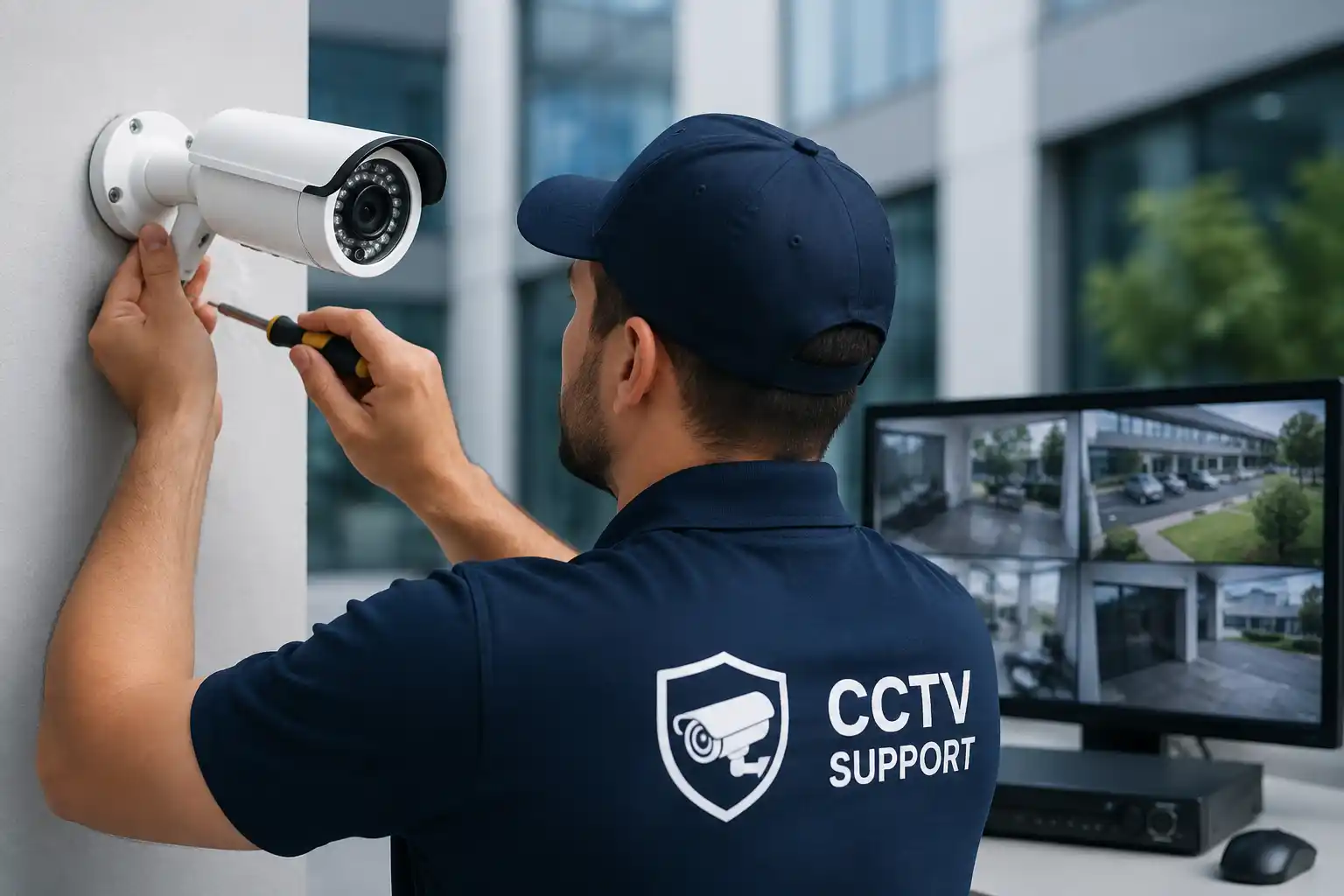
CCTV remote viewing configuration is the controlled setup that allows approved users to view surveillance cameras or recordings from outside the monitored premises. It is mainly used by business owners, managers, security teams and authorised operational staff who need visibility when they are not physically beside the DVR, NVR or local monitoring screen. A working solution may depend on the recorder, camera network, internet service, router or firewall, supported mobile or desktop application, account permissions and security settings. Before work begins, the customer should confirm the CCTV system in use, who is authorised to access it, which remote devices are required, whether the site internet is working, whether administrator access is available and whether any recent network change has affected viewing. FourTeck can assess these dependencies, define an appropriate configuration path and confirm whether the initial work can be performed remotely or requires a site visit.
What the service may cover
Depending on the confirmed scope, assistance may include identifying the recorder and its network role, checking local live view, reviewing current remote-access settings, confirming address and gateway information, testing name resolution and internet reachability, reviewing router or firewall dependencies, setting up supported viewing software, creating or adjusting authorised user accounts, checking device registration, and validating live and playback access from an approved external connection.
The service may also include correcting configuration after an ISP, router or firewall change, reviewing multi-site viewing requirements, checking time synchronisation so recordings can be found accurately, documenting the agreed access method and explaining the practical limits of the existing system. Final inclusions depend on equipment support, credentials, network access, licensing where applicable, site conditions and the approved quotation.
Who may need remote CCTV access support
The service can be relevant when a business has a functioning local CCTV display but authorised staff cannot view it from outside the premises, when remote access worked before a network change and then stopped, when a new manager needs approved access, when a replacement phone cannot connect, or when a branch needs to be added to a central monitoring arrangement.
Typical environments include professional offices, retail shops, warehouses, clinics, hospitality locations, restaurants, showrooms, property-management sites, construction offices and multi-branch businesses. The exact design should reflect who needs access, how often they need it, what they are allowed to view, which locations are involved and how remote access is protected.
Common signs that the remote viewing path needs assessment
Remote viewing problems often appear simple from the user side: the application shows “offline,” live video spins without loading, a recorder is visible on the office monitor but not on a phone, playback works locally but not remotely, or one user can connect while another cannot. Those symptoms do not identify the cause by themselves. The issue can sit at the viewing device, user account, application, recorder, local network, internet connection, firewall, DNS or vendor service layer.
Remote app reports the system offline
The recorder may still record locally while its external connectivity, account registration, gateway, DNS or internet path has failed.
Viewing stopped after router or ISP changes
Addressing, firewall rules, DNS behaviour, public connectivity or the supported remote-access method may no longer match the old configuration.
Only some cameras appear remotely
The problem can involve recorder channel mapping, camera registration, stream settings, permissions or a wider camera-side fault that must be separated from remote access.
A new phone cannot connect
The correct application, account ownership, authentication method, device approval and supported configuration must be confirmed rather than copying unknown settings.
Remote video is slow or unstable
Upload bandwidth, connection quality, stream selection, mobile connectivity and recorder performance can all contribute to the user experience.
Passwords or ownership are unclear
Authorised recovery, transfer or reset options depend on the device and may affect existing settings. Work should not proceed without confirmed ownership and approval.
Business impact when remote surveillance access is unreliable
A remote-viewing problem does not necessarily mean recording has stopped, but it can reduce the usefulness of the CCTV system for authorised staff who depend on off-site visibility. A manager may be unable to check an alarm-related event, a property team may need to travel to the site only to verify a simple condition, or a multi-branch operator may lose the central view used to support local teams. When playback access is affected, reviewing an incident can take longer because someone must use the recorder directly.
There is also a security-management issue. Remote access that has been repeatedly altered without documentation can leave shared accounts, old mobile devices, forgotten users or unnecessary exposure. The objective should not be to make the cameras reachable by any method available. The objective is to create an authorised, supportable path that meets the operational need while preserving appropriate access controls.
FourTeck therefore treats remote viewing as part of the wider surveillance and network environment. The system should still record correctly, local users should retain required access, approved remote users should be tested, and configuration changes should be documented so that a later router replacement, staff change or recorder upgrade can be handled with less guesswork.
Possible CCTV remote viewing assistance
The exact scope depends on assessment. The following areas show how an engagement may be structured; they are not a promise that every task is included in every request.
Recorder connectivity review
Check whether the DVR or NVR has appropriate local addressing, gateway and DNS configuration and whether it can reach the services required for its supported remote-access method.
Authorised application setup
Install or configure the appropriate supported viewing application on approved phones, tablets or computers and connect it using the system’s permitted access method.
User and permission review
Separate administrator requirements from day-to-day viewing where supported, check which cameras or functions users need and remove obsolete access only after customer approval.
Network and firewall coordination
Review the network path and any security appliance dependencies. Configuration should avoid unnecessary internet exposure and should not weaken unrelated business controls.
Remote viewing recovery
Investigate remote access that previously worked and stopped after ISP, router, recorder, app, credential or network changes, using evidence rather than broad resets.
Testing and handover
Validate live view and, where authorised and supported, playback from an external connection. Record the agreed method and practical customer steps for future support.
Is this service the right next step?
| Business situation | Relevant assistance | What must be confirmed |
|---|---|---|
| Cameras are visible on the local monitor but not remotely. | Recorder network, internet path, application and account checks. | Recorder model, site internet status and authorised access. |
| Remote viewing stopped after an ISP or firewall replacement. | New network path review and controlled reconfiguration. | Old and new network details, admin access and approved maintenance window if changes can affect users. |
| A new authorised manager needs mobile access. | Application setup, user permissions and external connectivity testing. | Authorisation, viewing scope and supported user-management capability. |
| Multiple branches need a more manageable viewing arrangement. | Discovery, access model review, network dependency mapping and documentation. | Number of sites, recorder platforms, internet links, user roles and central-view requirement. |
| Recorder or cameras are also offline locally. | Broader CCTV or network troubleshooting before remote viewing is configured. | Power, cabling, recorder status, camera status and whether physical inspection is required. |
Service information for planning and quotation
| Service topic | CCTV remote viewing configuration and related access troubleshooting. |
|---|---|
| Main purpose | Enable or restore authorised off-site viewing through a method supported by the existing surveillance environment. |
| Typical systems involved | DVR or NVR, IP cameras where relevant, local network, router or firewall, internet connection, mobile or desktop viewing application and user accounts. |
| Assessment method | Remote review where access and connectivity permit; on-site assessment when physical systems or inaccessible equipment must be checked. |
| Customer access required | Authorised access to relevant CCTV and network administration, shared through an approved secure method after identity and approval are confirmed. |
| Remote support suitability | Access dependent. Suitable when the system is reachable and the required work does not involve physical testing. |
| On-site support suitability | Recommended when the recorder, cameras, cabling, switch, power, router or local display requires hands-on inspection. |
| Security considerations | User permissions, account ownership, unnecessary internet exposure, obsolete access and the security impact of network changes should be reviewed. |
| Testing and validation | Scope dependent. Testing should verify the approved viewing method from an external connection without disrupting local recording. |
| Documentation and handover | Can include the agreed access method, user roles, network dependencies and practical future-change notes without publishing passwords. |
| Service location | Dubai and UAE support coordination, subject to issue type, site access, scheduling and confirmed quotation. |
| Scope dependency | Environment, equipment capability, access, internet service, third-party platform and configuration dependent. |
| Quotation requirement | Contact FourTeck to confirm the current environment and define the required service scope. |
Can CCTV remote viewing be configured remotely, or is an on-site visit needed?
Remote assistance may be practical when
The site internet is working, the CCTV recorder is online, secure remote administration is already authorised, an on-site contact can assist if needed and the work is mainly related to configuration, user access, application setup, logs or connectivity checks. Remote assessment is often useful for determining whether the problem is limited to the viewing application or whether a deeper network or recorder issue is involved.
Remote work still depends on access. If the system cannot be reached, administrator credentials are unavailable, the recorder has lost network connectivity or a physical change is required, the task may need to move to on-site support.
An on-site visit may be recommended when
The recorder must be inspected directly, a monitor and mouse are needed for local configuration, the device is not connected to the network, the cabling or switch port must be checked, cameras are offline, a router or firewall replacement is part of the job, or local equipment access is required to identify the correct system.
Physical work can also be necessary in inherited or undocumented installations where the customer is unsure which recorder belongs to which cameras, how the network is connected or whether a previous remote-access method still applies. Scheduling depends on site location, building access, engineer availability and the confirmed scope.
How FourTeck assesses a remote viewing problem
A controlled assessment starts with the operational need rather than immediately changing ports, passwords or network rules. This helps preserve working services and reduces the chance that an unrelated part of the CCTV or office network is disturbed.
- Define the required outcome. Confirm which authorised users need live view, playback or both, from which type of device and for which cameras or sites.
- Confirm the current state. Determine whether local live view and recording are working, whether remote access ever worked and what changed before the problem started.
- Identify the equipment. Record the DVR or NVR platform, relevant camera type, network connection, router or firewall environment and the viewing application currently being used.
- Review authorisation and access. Confirm who owns the system, who may approve changes and whether administrative access is available through an appropriate secure process.
- Check the local network path. Validate addressing, gateway, DNS, link status and the recorder’s ability to communicate with the required local and external services.
- Review the supported remote method. Determine whether the equipment uses a vendor account, device registration, VPN access, managed remote service or another supported approach and whether that method remains available for the installed system.
- Inspect security dependencies. Review relevant firewall, router and user-account controls without opening broad access simply to make the application connect.
- Apply approved changes. Back up settings where practical, make only the changes needed for the confirmed objective and preserve a rollback path when network changes could affect other systems.
- Test from outside the site. A true remote test should use an approved external connection rather than relying only on a phone connected to the same local WiFi network.
- Document the result. Record the supported application, user roles, relevant network dependency and any remaining limitation so future staff changes or network upgrades can be handled more predictably.
Planning configuration changes without weakening the wider network
Remote CCTV viewing touches two different responsibilities: surveillance operation and network access. A configuration that fixes the mobile application but bypasses sensible network controls is not a good result. The required business outcome should first be defined, followed by a review of the existing supported access method, account ownership and network policy.
Where the recorder supports an account-based remote service, the device may need correct internet connectivity, date and time, DNS, platform registration and authorised account binding. Where a VPN-based approach is used, the VPN must be designed around approved users and the network resources they are permitted to reach. Other legacy or specialised methods can have different dependencies. FourTeck does not assume one method fits every recorder.
Before a firewall or router setting is changed, the current configuration should be understood and backed up where practical. If the network appliance also supports office users, VoIP phones, WiFi, servers or cloud connectivity, an apparently small CCTV change can affect unrelated traffic. A maintenance window may therefore be appropriate for some changes even when the requested outcome is only remote viewing.
The implementation step should end with functional and security-oriented validation. The remote user should see only what the approved account permits, local recording should continue, the correct cameras should be labelled, and obsolete or test access should not be left in place without a reason. The agreed settings can then be documented for future maintenance.
Testing, validation and handover after remote access is configured
A configuration should not be considered complete simply because one live camera appears on one phone. Validation needs to reflect the approved business use. For a manager who needs to review incidents, playback access and accurate recorder time may matter as much as live view. For a security supervisor, camera naming and multi-channel selection may be important. For a multi-site business, each branch must be clearly identified so the user does not open the wrong recorder during an event.
Testing may include confirming the CCTV system still records locally, checking that an approved user can sign in from an external mobile or fixed connection, verifying selected live channels, validating playback where it is part of the permission set, confirming time and date, and checking that the viewing application reconnects after it is closed and opened again. If more than one user is involved, role differences should be tested rather than assuming every account behaves like the administrator.
Handover should explain the supported application, who owns the primary account where applicable, which user roles were configured, what to do when a staff member leaves, and which network changes are likely to affect remote viewing. Credentials should not be published in general documentation. They should be handled through the customer’s approved secure process.
FourTeck can record the work completed, known dependencies and any recommended follow-up. If the recorder is legacy equipment with limited account control or unsupported software, the handover should state that limitation instead of implying the environment now has controls that the platform cannot provide.
Capability 1: Build a clearer and safer access path
Remote viewing is easier to support when the path is understandable. The CCTV recorder should have a known network identity, the router or firewall should have a documented relationship to the service, and users should connect through a method that the installed system actually supports. Ad hoc settings created over several years can make every future change difficult because no one knows which rule, account or application is still required.
FourTeck can help replace that uncertainty with a defined access path and practical notes. This does not remove all security risk and it does not guarantee that a third-party cloud or internet service will always be available, but it makes ownership and troubleshooting clearer. When the ISP changes, a recorder is replaced or a manager leaves, the business has a better starting point for controlled change.
Capability 2: Separate user viewing from administrator control
A common operational problem is using one administrator account on every phone because it appears convenient. Where the surveillance platform supports separate users and permissions, a better arrangement is to match access to responsibility. A branch manager may only need selected cameras. A security supervisor may need broader viewing and playback. Network or CCTV administrators may need configuration rights that normal viewers do not.
FourTeck can review available user-management functions and configure approved roles within the limits of the equipment. Legacy systems may have fewer permission options, so the exact result is platform dependent. The business should also maintain a process for staff changes: remove obsolete users, review lost or replaced phones, and avoid leaving access with former employees or vendors without a current business need.
Capability 3: Make future network changes easier to manage
Remote CCTV access often stops after a network change because the original setup was never documented. A new router, firewall, ISP connection, public-address arrangement, DNS change or network segmentation project can alter the path the recorder depends on. If no one knows how the previous method worked, the customer may have to rediscover the configuration during a time-sensitive incident.
A supportable setup records the important dependencies without exposing credentials. FourTeck can note the recorder’s role, the supported viewing method, relevant account ownership, network assumptions and testing steps. This information helps future network engineers preserve required CCTV connectivity while still allowing security policies and infrastructure to be upgraded when needed.
Dependencies, access and customer inputs to confirm
The service can move faster when the customer can explain the current environment and authorise the correct people to assist. FourTeck may need to know whether the cameras record through an NVR or DVR, whether the system is IP based, whether the recorder has local internet connectivity, which router or firewall is installed, and whether the remote application has ever worked successfully.
Administrative access is often necessary, but public web-page content should never ask a customer to publish passwords. Credentials should be shared only through an approved secure method after the customer’s identity and authority have been confirmed. If the system was installed by another vendor, ownership information, prior documentation, account registration details or vendor portal access may be needed. Some account recovery or transfer tasks are vendor dependent and cannot be bypassed by a support provider.
Internet and network dependencies also matter. If the site has no working internet, a remote application cannot be expected to connect until the local connectivity problem is addressed. If the recorder is on an isolated CCTV network, the design needs to respect that segmentation rather than disabling it without assessment. If the firewall is managed by another IT provider, configuration may require coordination and an approved change window.
The customer should also state the operational objective: how many remote users are required, whether live view or playback is needed, which locations are involved, whether the viewing devices are company managed, and what business impact exists today. These details help distinguish a small user-setup task from a broader network or multi-site CCTV project.
Risk, limitation and exclusion guidance
Diagnosis depends on available evidence and authorised access. A remote-viewing symptom can involve the recorder, cameras, local network, internet provider, mobile connection, firewall, account service or vendor platform. FourTeck can isolate the likely technical area, but some actions may require the original vendor, account owner, internet provider or equipment manufacturer.
Legacy systems can have limited remote-access options, outdated applications or restricted account control. If the installed equipment no longer supports the required method, configuration alone may not meet the business objective and replacement or upgrade planning may be the practical next step. Hardware failure, damaged cabling, failed storage, power problems and camera faults may also fall outside a configuration-only request and require a separate scope.
Network changes can affect more than CCTV. Firewall, routing, DNS or addressing work may need a maintenance window, configuration backup and rollback plan. Security improvement can reduce unnecessary exposure, but no single setting can guarantee complete protection. Remote access should be reviewed alongside user management, firmware or software support, account ownership and the wider network policy.
On-site work depends on location, site access, scheduling and confirmed requirements. Final commercial terms, included tasks and any ongoing maintenance are governed by the approved quotation or service agreement. Contact FourTeck to confirm what can be done with the existing equipment before assuming that every recorder or application can be configured in the same way.
Business environments where remote viewing can support operations
Retail and showrooms
Approved managers may need off-site visibility of entrances, sales areas, stock access points or closing conditions. Access design should reflect the cameras each role needs rather than giving every user unrestricted administration.
Warehouses and logistics sites
Supervisors may use remote viewing to review loading areas, gates and operational zones. Network stability, upload capacity, recorder performance and accurate camera naming are especially helpful when many channels are involved.
Professional offices
Remote access may support facilities and management teams that oversee reception, entry points or common areas. The configuration should remain consistent with internal privacy and access policies.
Hospitality and food-service operations
Authorised operational managers may require selected site views while travelling between locations. Multi-site naming, account separation and reliable playback can be more important than simply showing every camera in one screen.
Property and facility management
Teams responsible for several premises may need controlled access to different recorders. Discovery should identify ownership, existing accounts, network providers and which sites can be standardised.
Multi-branch businesses
Central visibility can reduce the need to log into unrelated devices manually, but compatibility and account models vary. A common operational plan should be designed around actual recorder capabilities.
Operational, security and maintenance considerations
Remote viewing should be treated as an ongoing business capability rather than a one-time phone setup. Mobile devices are replaced, staff change roles, internet contracts change, routers are upgraded and CCTV recorders eventually reach the limits of their software or hardware. A system that works today can become difficult to support if account ownership and configuration are not maintained.
Access review is one of the most practical maintenance tasks. The customer should know who has remote viewing, whether each person still needs it, which devices are registered and who controls the primary administrative account. Shared administrator credentials should be avoided where the platform offers suitable role-based alternatives. Lost phones and former staff accounts should be handled according to the organisation’s access-removal process.
Recorder health also matters because remote viewing is only useful if the source system is working correctly. Maintenance may include checking live camera status, recording schedules, playback, storage health, date and time, camera naming and network connectivity. If the recorder is repeatedly overloaded, remote viewing may appear slow even when the internet connection is healthy.
Network documentation reduces future disruption. The CCTV segment, recorder address, gateway, relevant firewall dependency and supported access method should be understood before a router, switch or security appliance is replaced. Where another provider manages the network, the CCTV requirement can be documented so changes are coordinated rather than discovered after remote access stops.
Maintenance frequency is scope dependent. FourTeck can discuss one-time configuration support, corrective troubleshooting or a broader CCTV maintenance requirement. Actual recurring inclusions depend on the agreed service plan and should not be assumed from a configuration page alone.
Before you contact FourTeck
Preparing the following information can help determine whether the first step should be remote assessment, an on-site visit or a broader CCTV/network review.
- The Dubai or UAE site location where the CCTV system is installed.
- The main contact person who can authorise access and changes.
- The DVR or NVR brand and model if known.
- Whether live view and recording work correctly on the local monitor.
- The remote viewing application currently used, if any.
- Whether remote viewing worked previously and when it stopped.
- Any recent ISP, router, firewall, network, recorder or phone changes.
- The number of authorised remote users required.
- Whether users need live view only or playback as well.
- Whether the recorder currently has working internet connectivity.
- Whether authorised administrator access is available for the recorder and relevant network equipment.
- Any security or building-access restrictions that affect support work.
- The business impact of the current remote-viewing problem.
- The preferred service approach and any required maintenance window, subject to assessment.
Service evaluation checklist for a clear quotation
The quotation should reflect the real work required rather than an assumed “remote viewing setup” package. The following points help define the engagement.
- Exact objective: new access, failed access recovery, user change or multi-site viewing.
- Number of CCTV recorders and physical sites involved.
- Number of authorised users and viewing devices.
- Current recorder, camera and network environment.
- Availability of authorised administrative access.
- Remote assessment versus on-site inspection requirements.
- Need for router, firewall or network configuration work.
- Requirement for playback as well as live viewing.
- Testing expectations across mobile data or external internet.
- Documentation and administrator handover requirements.
- Third-party vendor or ISP coordination requirements.
- Any ongoing CCTV maintenance or support requirement after configuration.
How FourTeck can help from assessment to quotation
FourTeck approaches CCTV remote viewing as a connected IT and surveillance service. The first task is to clarify the reported problem and determine whether the local CCTV system itself is healthy. If cameras and recording work locally, attention can shift to the recorder’s network connectivity, user accounts, viewing application, internet path and firewall or router dependencies. If local cameras are also offline, the service scope may need to expand into camera, PoE, cabling, power or recorder troubleshooting.
Once the technical layer is clearer, FourTeck can explain whether remote support is practical or whether an on-site inspection would reduce uncertainty. The service can include configuration review, authorised user setup, network coordination, supported remote-access setup, testing, documentation and practical next-step recommendations. If a third-party installer, ISP or firewall administrator controls part of the path, FourTeck can help coordinate the technical information required for that provider.
A quotation can then be prepared around the confirmed requirement rather than an assumed set of tasks. Installation, network changes, account recovery, hardware replacement, new cabling, recorder upgrades or ongoing maintenance should be clearly identified if they are required. This makes it easier for the customer to understand what is being changed and what remains outside the current scope.
For broader background on FourTeck’s business technology approach, customers can visit the FourTeck IT Services home page or learn more about the company through the FourTeck IT services overview.
Dubai and UAE service coordination
For Dubai customers, the first step is to confirm whether the problem can be assessed securely from the existing network or whether physical inspection is required. A local DVR or NVR that is recording correctly but has lost remote access may be suitable for remote configuration review when authorised administration is available. An on-site visit may be recommended when the recorder cannot be reached, the customer does not know the network layout, cabling or switches must be tested, a router or firewall must be physically replaced, or camera-side faults are also present.
Service timing depends on the confirmed scope, engineer availability, customer access, site conditions, required equipment and third-party providers. Where network changes can affect other users or services, work may need a planned maintenance window. Where an ISP or external CCTV account provider must take action, the overall resolution also depends on that party’s process.
Contact FourTeck to confirm the service scope and scheduling options. The quotation should state whether the requirement is limited to configuration and testing or includes broader CCTV, network, firewall, hardware or maintenance work.
Support coordination across Dubai, Abu Dhabi, Sharjah and Ajman
Businesses operating across Dubai, Abu Dhabi, Sharjah and Ajman may use different CCTV recorders, internet providers and network arrangements at each site. FourTeck can coordinate remote troubleshooting, planned on-site assessment, configuration work, network dependency review, testing or a wider surveillance-support project depending on the confirmed requirement. A multi-site engagement should begin with an inventory of locations, recorder platforms, remote users and the business purpose of central viewing.
Remote assistance can reduce unnecessary travel when the recorder and network are reachable, but it is not a substitute for physical work when local equipment must be identified or tested. Planned visits may be needed for undocumented installations, recorder replacement, cabling faults, switch issues, camera outages or network changes that require hands-on verification. Scheduling and travel are influenced by site access, building procedures, engineer availability and the work required at each location.
The service plan may also depend on equipment availability and third-party actions. An ISP change, managed firewall, vendor cloud account or manufacturer-specific recovery process can affect the sequence. FourTeck can help map those dependencies and define which party is responsible for each action before implementation begins.
Related FourTeck IT services
Broader checks for cameras, recorders, storage, playback, power and maintenance needs.
IP camera support
Assistance with camera addressing, PoE, stream availability, recorder registration and network dependencies.
Office network support
Network troubleshooting where switches, addressing, routing or connectivity affect the CCTV environment.
Firewall and secure access support
Controlled firewall, routing and remote-access review when security appliances affect CCTV connectivity.
Why businesses contact FourTeck for this type of work
Remote CCTV access sits between surveillance and IT infrastructure. A camera installer may focus on the recorder, while a network provider may focus on the firewall. FourTeck can review the relationship between those layers so the customer is not left moving between vendors without a clear technical picture.
The service begins with the actual business objective and the current symptoms. FourTeck can assess the recorder, camera availability, network connectivity, user access, internet path and remote application in context. The aim is to isolate the relevant layer before changing settings. Where remote and on-site work must be combined, the initial assessment can help define what equipment access, site contact and technical information are needed before a visit.
Documentation and controlled change are also important. A working remote view is more maintainable when account ownership and network dependencies are known, obsolete access is reviewed and future engineers can see how the system is intended to work. Where a third party controls part of the environment, FourTeck can help provide clearer technical information for vendor or ISP coordination.
The final scope remains assessment dependent. FourTeck does not assume that every legacy recorder can support modern access methods or that configuration alone can correct a hardware or network fault. The customer receives practical next actions based on what the installed environment can support.
Questions Dubai businesses often ask before requesting CCTV remote viewing support
Businesses usually contact support after a visible symptom, but the most useful questions are not limited to “why is the app offline?” Remote viewing depends on a chain of systems. Understanding that chain helps management decide whether the next step is a user setup, network change, CCTV repair, security review or a broader upgrade. The guidance below addresses common decision-stage questions without assuming the cause before assessment.
Why can I see the cameras in the office but not on my phone?
If local viewing works, the cameras and recorder may still be functioning even though the remote path has failed. The problem may involve the recorder’s gateway or DNS settings, internet access, the remote service registration, account ownership, the mobile application, user permissions or a router or firewall change. The useful next step is to confirm whether recording is healthy locally and whether the recorder itself can reach the required external service. Avoid repeatedly resetting the recorder or opening broad firewall rules, because that can remove useful evidence or create a new security problem. Share the recorder model, application name, internet status and recent network changes with FourTeck so the correct layer can be assessed.
Can remote viewing be fixed without visiting the site?
Often it can be assessed remotely when the CCTV system is already connected to the network, secure administration is available and a local contact can confirm what is displayed on the recorder. Software setup, user permissions, account checks, DNS or gateway review and some network configuration can be handled without physical attendance. However, a site visit is usually more appropriate when the recorder has no network link, the customer cannot identify the equipment, local monitor access is required, cabling or switch ports must be checked, cameras are offline or a router or firewall needs hands-on work. The decision should follow the evidence, not a fixed assumption that remote support is always faster.
Remote access stopped after we changed our internet provider. What should be checked?
An ISP change can alter several parts of the path even if office web browsing works normally. The router may have been replaced, internal addressing may have changed, DNS behaviour may be different, the public connectivity model may have changed, or old firewall settings may no longer exist. The recorder should first be checked for valid local network settings and internet reachability. The supported remote-access method then needs to be reviewed against the new environment. If another IT provider manages the firewall or router, configuration may require their cooperation. The goal is to adapt the CCTV connection without unnecessarily weakening the new network security policy.
Should we use a cloud or account-based CCTV app, a VPN, or another method?
The appropriate method depends on what the recorder supports, who manages the network, the security requirements and how many users or sites are involved. Some systems provide a vendor account or device-registration service. Other environments may use a managed VPN or a different supported architecture. A method should not be selected only because it is quick to configure. Account ownership, user permissions, third-party dependence, network exposure, application support and future maintenance all matter. FourTeck can review the existing system and explain the practical options that the installed equipment actually supports. Unsupported workarounds should not be treated as a long-term business solution.
Is direct port forwarding the only way to view CCTV remotely?
No. Remote viewing architectures vary by equipment and network design, and many modern systems support other approaches. Because direct exposure of recorder services to the public internet can increase security risk, the first question should be which remote-access method the system supports and which approach fits the customer’s security policy. If an existing legacy installation already uses port forwarding, FourTeck can review why it is present, what service it exposes and whether a supported alternative is available. Changes should be planned carefully because removing a rule without understanding it can interrupt required access, while adding broad exposure can create unnecessary risk.
Why does remote video load slowly even though the cameras look fine locally?
Remote performance depends on more than the camera image. The site’s internet upload capacity, current bandwidth use, recorder processing load, selected stream, resolution, frame rate, mobile connection and third-party relay or service conditions can all affect how quickly video appears. A phone on a weak mobile signal can make a healthy CCTV system seem faulty. The diagnostic approach should compare local playback and live view with remote behaviour and identify whether the limitation is at the recorder, network or viewing-device side. Changing video settings may reduce bandwidth, but the effect on image detail and recording requirements should be understood before permanent changes are made.
Can one manager view several Dubai branches from one device?
Possibly, but compatibility and account models differ between recorder platforms. If the branches use the same supported ecosystem, one approved application may be able to present several sites. Mixed systems may require separate applications or a broader central-management approach. Before deciding, list each branch, recorder model, current application, internet connection and the cameras the manager needs. Also decide whether the manager requires live view only or playback. FourTeck can assess whether the current environment can be standardised or whether some sites need different handling. The objective is a usable, clearly named multi-site view rather than a collection of unlabeled device entries.
What if the previous installer created the main CCTV account?
Account ownership should be clarified before new remote users are added. If the recorder is bound to a vendor account controlled by a previous installer or employee, the available transfer, recovery or reset path depends on the platform and proof of ownership. FourTeck should not bypass access controls or assume that a device can be detached without consequence. Gather purchase or installation records, device identifiers and any existing account information the business legitimately holds. The next step may require the account provider or manufacturer. Once ownership is recovered, the business should keep administrative control with an appropriate internal owner and use separate authorised users where the platform allows.
Do we need a static public IP address for remote CCTV viewing?
Not every remote-viewing method requires the same public-address arrangement. Some account-based or brokered services work without the customer manually managing a fixed public address, while other architectures can depend on static addressing, dynamic name services, VPN design or provider-specific connectivity. The answer therefore depends on the recorder and network method in use. Before ordering a new internet option, confirm how the system is intended to connect. FourTeck can review the current configuration and coordinate with the ISP where needed. Buying a static address by itself will not correct a recorder that has the wrong gateway, failed registration, unsupported software or user-account problem.
Can a new mobile phone be added without changing the recorder?
Often yes when the recorder remains supported and the correct viewing application and account information are available. The new device may need the approved app, account sign-in, device registration, multi-factor authentication where supported, or a configured connection profile. The old phone should also be considered: if it is lost, sold or assigned to someone else, its access may need to be removed. If the application is no longer available for the new phone’s operating system or the recorder uses an obsolete method, the business may need a wider upgrade assessment. Do not erase the old phone or reset the recorder until important account information has been recovered through an authorised process.
What information should we prepare before asking for a quotation?
Prepare the site location, recorder brand and model, number of recorders, current viewing application, number of remote users, whether local viewing and recording work, whether playback is required remotely, the site internet status, any recent router or ISP change and whether authorised administrator access exists. Explain the business impact and whether the request is urgent because of an operational event or is part of a planned improvement. This information helps separate a simple application setup from a broader network or CCTV fault. If a site visit may be required, include building access rules, available contact person and any maintenance-window restrictions.
How do we know whether the issue belongs to the CCTV system or the office network?
Start by comparing local and remote behaviour. If cameras are offline on the recorder itself, the issue may involve camera power, cabling, PoE, addressing, recorder registration or the camera. If all cameras work locally but nothing is accessible externally, the problem is more likely in the recorder’s remote service, account, gateway, DNS, internet or firewall path. If only one phone fails while another remote user works, the issue may be on the device or account side. This layered comparison is why FourTeck checks the complete path instead of replacing equipment based on one symptom.
When should a business consider upgrading rather than repeatedly repairing remote access?
An upgrade becomes worth assessing when the recorder relies on unsupported software, cannot provide sensible user separation, repeatedly loses compatibility with current mobile devices, has limited security controls, cannot support the required number of sites or users, or has other age-related problems such as storage faults and unstable hardware. Configuration support can only work within the capability of the installed platform. FourTeck can compare continued maintenance with replacement requirements and identify what must be preserved, including camera compatibility, recording needs, storage retention, network capacity, user roles and remote viewing expectations. The correct decision depends on condition, support status, business need and budget rather than age alone.
Does configuring remote viewing also fix missing recordings or offline cameras?
Not necessarily. Remote viewing configuration addresses the access path between authorised users and the surveillance system. Missing recordings can involve storage failure, recording schedules, camera loss, recorder faults, time settings or retention limitations. Offline cameras can involve power, cabling, PoE, switch ports, addressing or hardware failure. If these symptoms are present, the project should be broadened into CCTV troubleshooting rather than treating them as remote-access settings. FourTeck can assess the wider system and define which corrective tasks belong in the quotation. A mobile application cannot display footage that the recorder never received or stored.
How should remote access be handled when an employee leaves?
The business should remove or disable the departing user’s access through the supported account-management process and review any registered devices or shared credentials associated with that person. If a common administrator password has been used across several phones, the change can affect other users and should be planned carefully. A better long-term model, where the platform supports it, is named or role-based access so one person can be removed without disrupting everyone. FourTeck can help review existing users during configuration or maintenance, but access changes should always be approved by an authorised customer representative.
What should be tested before the technician leaves or closes the remote session?
The agreed test should match the business requirement. At minimum, confirm that local recording still works and that the approved remote user can connect from outside the site network. Check the correct cameras, useful image quality and stable reconnect behaviour. If playback is required, verify that the user can search the correct date and time and access only the permitted channels. If several branches are involved, confirm site names. Record any remaining limitation such as slow upload bandwidth, unsupported app version or dependence on a third-party account service. Testing from the office WiFi alone is not enough to prove external remote access.
Frequently asked questions
What does CCTV remote viewing configuration include?
Depending on the scope, it can include recorder connectivity review, supported application setup, authorised user configuration, network and firewall dependency checks, external testing and documentation. Hardware repair or cabling work is separate unless included in the quotation.
Can FourTeck configure an existing CCTV system?
FourTeck can assess many existing CCTV environments. The result depends on recorder capability, system condition, account ownership, supported software, network access and available credentials. Legacy equipment may have limited options.
Will remote viewing work if the site internet is down?
No normal internet-based remote method can work without a functioning connectivity path. Local recording may continue if the CCTV system itself is healthy, but remote access generally depends on the site’s internet or other designed external connection.
Do you need our passwords before a quotation?
Do not publish or send passwords through an unapproved channel. For initial scoping, describe whether authorised access is available. Credentials should be shared only through an approved secure method after identity, authority and service scope are confirmed.
Can remote access be limited to selected cameras?
Many systems support user or channel permissions, but the exact capability is platform dependent. FourTeck can review the installed recorder and configure approved access within the functions it provides.
What happens if the main account belongs to a previous installer?
The account recovery or transfer process depends on the vendor and proof of ownership. FourTeck can help identify the required information, but it cannot bypass access controls or guarantee that every legacy account can be transferred without vendor involvement.
Can you help after a router or firewall replacement?
Yes, subject to assessment and authorised access. FourTeck can review how the CCTV recorder reaches the internet or remote service and coordinate required network changes without assuming the old configuration should simply be recreated.
Is an on-site visit always required in Dubai?
No. Some configuration and troubleshooting can be performed remotely when the system is reachable and secure access is available. Physical inspection is recommended when equipment, cabling, switches, power or local network access must be tested.
Does the service include ongoing maintenance?
Only if recurring support or maintenance is included in the agreed service plan. A one-time remote viewing configuration does not automatically include future changes, equipment replacement, unlimited support or scheduled maintenance.
How is the final scope confirmed?
FourTeck reviews the site, equipment, symptoms, required users, access, network dependencies and whether remote or on-site work is needed. The quotation should then identify the included configuration, testing, documentation and any separate corrective work.
Discuss your CCTV remote viewing requirement with FourTeck
If remote cameras cannot be viewed outside the site, if a new authorised user needs access, or if a router, firewall or ISP change has interrupted an existing setup, FourTeck can review the environment and define a controlled next step. Share the recorder type, current symptom, site location, number of users and any recent network change. FourTeck can then determine whether remote assessment is practical or whether an on-site inspection should be included.
The final service scope depends on equipment capability, authorised access, network conditions, third-party services and the work required. Configuration, troubleshooting, hardware tasks, cabling, network changes, documentation and ongoing maintenance should be clearly identified in the quotation before implementation.