
SURVEILLANCE MODERNISATION • DUBAI & UAE
Analog CCTV to IP CCTV Migration Dubai in Dubai, UAE
Moving from an analog CCTV system to IP surveillance is not simply a camera replacement exercise. It changes how video is powered, transported, recorded, stored, viewed, secured, named, and supported. FourTeck helps businesses assess the existing installation, decide what can remain, plan the network and recording platform, stage the migration, test the finished environment, and document the handover.
The final design depends on site conditions, required coverage, existing cable routes, compatible equipment, storage objectives, authorised access, maintenance windows, and the business tolerance for disruption.
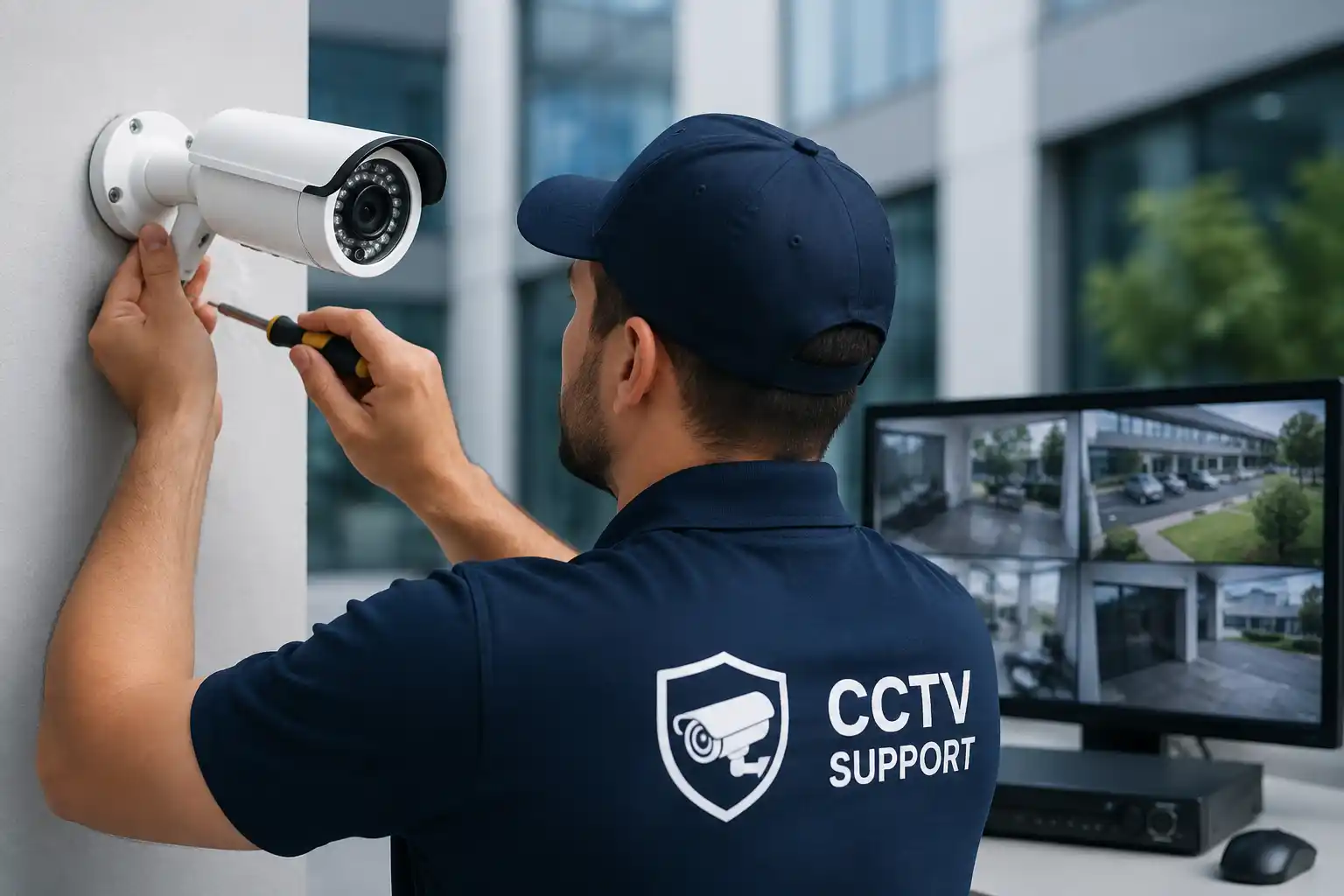
Migration starts with evidence, not assumptions
An inherited analog system may contain usable cable routes, serviceable power infrastructure, undocumented camera locations, ageing DVR hardware, and viewing requirements that have changed over time. A site assessment helps separate components that can reasonably remain from items that should be replaced, redesigned, or moved into a later phase.
Cameras, DVR, cable routes, power, viewing and recording behaviour.
Switching, PoE, addressing, bandwidth, segmentation and rack capacity.
Pilot, phased replacement, agreed downtime and rollback considerations.
Recording tests, playback checks, user access, naming and documentation.
What does analog CCTV to IP CCTV migration mean?
Analog-to-IP CCTV migration is the controlled replacement or transition of a surveillance system that primarily sends camera video to a digital video recorder over legacy camera connections toward a network-based architecture in which IP cameras communicate across Ethernet switching to an NVR, video management platform, storage system, approved viewing stations, or another compatible recording environment. The migration is mainly used when a business needs better manageability, easier expansion, improved image options, structured remote access, centralised recording, or a supportable replacement path for ageing analog equipment.
Businesses should consider it when the current system is difficult to maintain, the recorder no longer matches operational requirements, new areas must be covered, existing images do not provide the required detail, or network-based surveillance would integrate better with the site infrastructure. Before work is confirmed, the customer should prepare basic information about the site, camera count, current recorder, important viewing areas, required users, available drawings, known faults, retention expectations, network equipment, building-access limits, and the business times when surveillance interruption would be least disruptive.
A migration does not automatically mean every cable, camera, monitor, cabinet, or storage component must be removed on day one. The practical design may be full replacement, phased transition, or a temporary hybrid arrangement. Compatibility, condition, security, cost, operational risk, and maintainability should be assessed before the final scope is quoted.
Why the move from analog to IP needs migration planning
An analog CCTV installation has a relatively direct signal path: a camera receives power, video travels through an installed medium, the DVR digitises and records the feed, and users view the output locally or through configured remote-access functions. An IP surveillance environment distributes those responsibilities differently. The camera itself is a network device, switching and address management become part of the video path, Power over Ethernet may supply electrical power, the recording platform receives network streams, storage consumption is influenced by stream settings, and remote access depends on permissions, network design, and security controls. Because those layers are connected, a migration can expose limitations that were not relevant to the old system.
For example, an office may have enough network ports for computers but not enough spare PoE capacity for cameras. A warehouse may have suitable camera positions but cable routes that do not meet the new topology without additional switching or structured cabling work. A building may require a different recorder location because existing analog runs terminate in a legacy cabinet. A customer may want longer retention while also choosing higher-resolution streams, which changes storage planning. A remote-viewing requirement may involve firewall policy, user permissions, mobile applications, or provider connectivity that should be considered before the cutover rather than after cameras are installed.
FourTeck approaches the project as a service journey: understand the current environment, define the business objective, map the physical and network dependencies, identify compatible migration options, agree the staging method, protect the existing configuration where possible, perform authorised changes, validate recording and viewing, and leave usable documentation. The goal is to avoid a situation in which new cameras are technically installed but the surrounding network, storage, naming, permissions, or operating process remains unclear.
What the migration service may cover
Depending on the confirmed scope, assistance may include an inventory of analog cameras and DVR channels, review of image quality and camera purpose, inspection of power and cable routes, identification of current recording and remote-viewing behaviour, evaluation of rack and equipment space, network port and PoE planning, IP addressing, recorder or NVR integration, user-access planning, storage estimation, phased camera replacement, structured cabling coordination, physical mounting, stream configuration, recording schedules, time synchronisation, playback checks, remote-viewing validation, documentation, and post-change support.
Not every project requires every activity. A small office replacing eight cameras may have a different path from a warehouse with several buildings, long cable routes, inherited DVRs, external cameras, and multiple authorised viewers. The quotation should identify the agreed tasks, equipment responsibilities, dependencies, exclusions, testing expectations, and whether any third-party work is required.
Who may need this service
The service can suit businesses using an older analog surveillance system that still operates but is difficult to expand, organisations taking over a site with undocumented CCTV, companies replacing a failed or obsolete recorder, facilities teams adding new areas that are awkward to serve with the existing architecture, multi-branch businesses seeking more consistent management, and organisations planning an office renovation or relocation that creates an opportunity to modernise surveillance.
It can also be relevant when recurring image, recording, or access problems make repeated repair uneconomical. Migration should still be based on evidence. A single failed camera, power supply, connector, or hard drive does not by itself prove that a complete IP upgrade is necessary. FourTeck can help distinguish repairable faults from design limitations and then prepare a migration path if modernisation is the better business decision.
Common planning triggers before an IP CCTV upgrade
Expansion is becoming difficult
The DVR is full, cable routes are awkward, or additional cameras cannot be introduced cleanly without redesigning the existing system.
Recording is unreliable
Missing footage, unstable playback, storage warnings, incorrect time, or recorder faults raise questions about whether continued repair is the right path.
Image needs have changed
Entrances, payment points, stock areas, loading zones, or parking areas require better detail or a different field of view than the inherited design provides.
The site is being renovated
A fit-out, office move, rack change, or cabling project creates an opportunity to redesign the surveillance path before walls, ceilings, and furniture make changes more difficult.
Support knowledge is missing
Camera labels, credentials, diagrams, cable destinations, or recorder settings are unclear, making every fault slower to diagnose and every change harder to approve safely.
Remote viewing needs control
Management requires approved access for specific users or locations, and the existing remote-viewing method is unreliable, undocumented, or no longer appropriate.
Business impact of leaving an ageing CCTV environment unmanaged
Surveillance problems are often discovered late because a camera can show a live picture while recording has stopped, a storage issue can reduce retention without an obvious alert, or an administrator may assume remote viewing is the only problem when the underlying recorder is unstable. When the system is needed for incident review, missing video, incorrect timestamps, poor angles, or inaccessible playback can reduce its operational value. The business impact is not limited to security. Facilities teams may spend repeated time chasing suppliers, managers may be unable to verify events, new branches may inherit different camera conventions, and staff may depend on one person who remembers old settings but has never documented them.
A controlled migration can improve maintainability because camera identities, network locations, recorder roles, authorised users, and support dependencies can be documented as part of the change. However, migration itself also creates risk if it is rushed. Removing an old recorder before new recording is validated can create a coverage gap. Reusing unidentified cables can produce intermittent faults. Introducing IP cameras without reviewing the network can overload a PoE budget or create address conflicts. Changing remote access without identifying the approved user group can cause unnecessary exposure or lock out legitimate viewers. These are reasons to plan the project around business operations rather than treating it as a simple hardware swap.
Service-fit matrix: when migration assistance may be appropriate
| Business situation | Relevant assistance | What must be confirmed |
|---|---|---|
| Old DVR is unstable but cameras still operate | Recorder assessment, camera inventory, migration options, storage and viewing review | Camera condition, signal path, compatibility, retention needs, budget and downtime window |
| New cameras are needed in additional areas | Coverage review, IP design, switch and PoE planning, phased integration | Cable routes, mounting points, network capacity, lighting, environmental exposure and recording platform |
| Business is moving or renovating | Current-state documentation, new-site planning, cabling coordination, staged cutover | Floor plans, rack location, network readiness, contractor schedule, access and handover dates |
| Image detail is insufficient for important views | View-purpose review, camera-position planning and technical upgrade path | Required scene detail, lighting, distance, field of view and privacy considerations |
| Mixed analog and IP systems exist across branches | Inventory, standardisation planning, network and recording review, documentation | Site differences, existing platforms, access rights, bandwidth, storage and support ownership |
Service information for quotation and project planning
| Main purpose | Plan and implement a controlled transition from an analog CCTV environment to an IP-based surveillance architecture. |
|---|---|
| Typical systems involved | Analog cameras, DVRs, power supplies, legacy cable runs, monitors, IP cameras, NVR or recording platform, storage, Ethernet cabling, PoE switches, routers or firewalls, viewing workstations and authorised mobile access. |
| Assessment method | Remote discovery plus on-site inspection where physical infrastructure, camera placement, cabling, power or rack conditions must be confirmed. |
| Remote support suitability | Useful for information gathering, configuration review, documentation, approved access checks and some post-installation verification. Access dependent. |
| On-site suitability | Normally required for physical camera inspection, cable testing, mounting, cabinet work, switch installation, coverage checks and final local validation. |
| Customer information required | Site details, camera and recorder information, known faults, required views, authorised users, retention expectations, network details, access conditions and target outcome. |
| Backup considerations | Existing configuration, exported settings, evidence retention, recordings that must be preserved and rollback options should be reviewed before disruptive changes. |
| Testing and validation | Live view, recording, playback, timestamps, camera naming, storage behaviour, authorised user access and relevant remote viewing. |
| Scheduling dependency | Scope dependent and affected by site access, engineer availability, customer maintenance windows, equipment availability, building rules and third-party coordination. |
| Quotation requirement | The final commercial scope should be confirmed after assessment or sufficient discovery information is available. |
Remote planning versus on-site migration work
When remote assistance can help
Remote work can be useful during discovery if a customer can provide recorder details, camera lists, photos of racks and power arrangements, network information, floor plans, screenshots, current remote-viewing behaviour, and authorised access to relevant management interfaces. It can also support configuration review, IP addressing plans, naming conventions, storage discussions, change documentation, and post-installation checks when the network and viewing systems are reachable securely.
Remote assessment should not be used to guess physical conditions. Cable type, connector condition, camera mounting, environmental exposure, PoE behaviour, rack space, cable path, and field of view may require local inspection. If the site cannot be assessed reliably from supplied evidence, an on-site survey may be the safer next step.
When an on-site visit is usually needed
On-site work is normally appropriate where cameras must be inspected, old connections identified, cable continuity tested, new Ethernet runs assessed, PoE switch ports connected, cabinets reorganised, devices mounted, lens angles adjusted, or actual recording coverage checked. It may also be required when the existing system is undocumented and remote access cannot show how equipment is physically connected.
A site visit may involve local coordination with building management, facilities staff, fit-out contractors, electricians, network teams, or another CCTV vendor. Scheduling therefore depends on approved access, working-hour restrictions, equipment availability, safety requirements, and the confirmed quotation. FourTeck does not assume that every migration can be completed remotely or within a fixed attendance window.
How the current CCTV environment is assessed
- Define the business objective. Clarify whether the priority is replacing failing equipment, improving important views, extending coverage, simplifying support, enabling controlled remote viewing, preparing for a move, or standardising several locations.
- Record the existing inventory. Identify camera locations, DVR channels, monitor outputs, storage devices, power supplies, cable routes, current users and any network-connected components already in place.
- Check what is actually working. Review live views, recording schedules, playback, time accuracy, image quality, night performance, storage status, remote access and known intermittent faults.
- Map physical dependencies. Understand where cables terminate, whether cabinets have space and power, which routes can be reused, and where new Ethernet or fibre links may be needed.
- Review network readiness. Check switching, spare ports, uplink capacity, PoE budget, IP address planning, segmentation, management access, and whether CCTV traffic should be separated from ordinary user traffic.
- Identify storage and retention needs. Required retention depends on camera count, stream settings, recording schedules, available storage and business policy. The target should be defined before the recorder or storage design is finalised.
- Confirm authorised access. Establish who needs live view, playback, export, administration or mobile access, and how those permissions should be controlled.
- Review change risk. Identify maintenance windows, areas that cannot lose coverage, recordings that must be preserved, and how the old environment can be retained or restored if an early migration stage does not validate correctly.
- Prepare a migration sequence. Decide whether the project should be a single cutover, a camera-by-camera transition, a floor-by-floor change, or a phased hybrid period.
- Agree acceptance checks. Define how camera views, recording, playback, time, storage, user access, and documentation will be checked before handover.
A practical migration journey from old recorder to managed IP surveillance
1. Baseline
Document current cameras, views, faults, recording behaviour, users and physical termination points. Preserve available configuration information before major changes.
2. Target design
Define required views, camera roles, recorder architecture, storage approach, network placement, user access and any components that will remain temporarily.
3. Network preparation
Prepare switching, PoE, addressing, uplinks, rack space, cabling and management access before introducing production camera traffic.
4. Pilot or first phase
Install a controlled subset where suitable, then validate image, recording, storage, playback, time, naming and user access before repeating the design broadly.
5. Staged replacement
Move cameras by area or priority so coverage gaps can be managed and faults can be isolated without changing the entire site at once.
6. Cutover control
Coordinate any recorder transition, monitor changes, user-access changes and old-system retirement only after the new recording path has been confirmed.
7. Validation
Test live video, playback, timestamps, recording continuity, exports where included, remote access for approved users, and critical views under normal operating conditions.
8. Handover
Record camera names, locations, relevant network information, recorder roles, access responsibilities, remaining limitations and recommended maintenance actions.
Capability focus: design each camera around the business purpose of the view
A successful IP migration should not preserve weak camera positions simply because those positions already exist. The first question for each important view is what the business expects to see. An entrance camera may need a different framing objective from a warehouse overview, loading zone, reception, cashier position, corridor, parking lane, gate, stock room, or perimeter. The required detail, lighting, viewing distance, movement, mounting height, environmental exposure, and privacy considerations affect the practical design. A wide picture can look impressive on a monitor while still failing to show enough detail for the intended operational purpose.
During assessment, FourTeck can help map each current camera to a purpose and identify views that should remain, be repositioned, be split into multiple cameras, or be reconsidered. This does not mean every legacy location is wrong. Existing positions may be perfectly usable, but they should be validated under realistic daytime and night conditions where practical. Reflections, backlighting, dirty covers, infrared glare, weather exposure, and changing interior lighting can alter the value of an image.
The outcome is a migration plan tied to what the business actually needs to observe rather than a channel-for-channel replacement exercise. Final performance still depends on the selected equipment, physical environment, configuration, installation quality, and site conditions, so the scope should avoid unsupported promises about image detail until requirements are assessed.
Capability focus: prepare the network for camera traffic and PoE power
IP cameras turn the surveillance system into part of the business network infrastructure. Each camera needs a reliable physical link, an address, a route to the recording environment, and enough power when PoE is used. The switch design should therefore consider more than spare port count. Available PoE capacity, uplink bandwidth, switch location, cabinet cooling and power, network segmentation, management access, address allocation, and future expansion all influence whether the platform will remain manageable.
A migration is a good time to document which switch ports serve which cameras, use clear device names, separate camera-management responsibilities from ordinary user access, and identify dependencies on routers or firewalls for approved remote viewing. A poorly planned network can produce camera drops, unstable streams, duplicate addresses, difficult troubleshooting, or unexpected interactions with other business services. Broad network changes should therefore be controlled and tested because the same infrastructure may carry phones, computers, wireless access points, servers, printers, or cloud traffic.
FourTeck can coordinate CCTV planning with wider network and infrastructure services so the surveillance design is considered alongside switching, cabling and other connected systems. The exact VLAN, addressing, security or switch design is environment dependent and should be confirmed from the actual network rather than copied from a generic template.
Capability focus: align recording, storage and retention with the new camera design
Higher-detail cameras can change storage consumption significantly compared with the old analog environment. Retention planning should consider the number of cameras, stream settings, recording mode, motion behaviour where used, frame rate, available storage, expected growth and the business period for which recordings are intended to remain accessible. The design should also consider what happens when storage becomes full, how health is checked, who can review alerts, and how playback is tested.
A migration provides an opportunity to correct weaknesses such as unclear recording schedules, cameras that display live video but are not recording, incorrect date and time, inconsistent naming, or storage that has never been reviewed. Before the old recorder is retired, any recordings that the business must preserve should be identified. Export or retention requirements are dependent on the existing device, available access, data condition, storage capacity and customer policy; they should not be assumed to be possible in every legacy system.
After implementation, acceptance testing should use playback from several important cameras and time periods, not only a live-grid check. The handover should state which platform records each camera, the intended recording behaviour, where storage resides, which users can retrieve footage, and what routine checks are recommended. A successful test at handover does not remove the need for ongoing maintenance and periodic recording verification.
Can analog and IP cameras operate during the same migration period?
A phased or hybrid period may be possible in some environments, but it is not something to assume before the actual recorder, camera types, connectivity, and target platform are reviewed. Businesses sometimes prefer staging because it reduces the amount of physical work performed at once, allows critical areas to remain covered while another area is changed, spreads the project across approved maintenance windows, or gives the team time to validate the new network and recording design before retiring the old system.
The practical approach may involve keeping the analog DVR active for existing cameras while new IP cameras record on a separate NVR, using compatible transition equipment where appropriate, or replacing one group of cameras at a time. Each option creates operational questions: where should users look for playback during the transition, how should camera names be coordinated, which system owns remote viewing, how are timestamps kept consistent, and when is the old recorder safe to decommission? If those questions are not answered, a temporary hybrid design can become a permanent support problem.
FourTeck can help define the boundary between the old and new environments and document the migration sequence. Compatibility, licensing, network capacity, recorder capability and equipment condition remain platform dependent. Where a bridge approach introduces more complexity than value, a cleaner cutover may be recommended instead, subject to the agreed downtime and site conditions.
Security and authorised access should be designed into the IP system
Analog cameras are usually not individually reachable as network devices, while IP cameras, recorders and management interfaces may have their own accounts, firmware, services and network settings. Migration therefore changes the security responsibility. Default credentials, shared administrator accounts, unnecessary external exposure, unmanaged mobile viewing, old user accounts and undocumented remote-access methods can create avoidable risk. The project should identify who genuinely needs administration, who needs playback, who only needs live viewing, and which access paths are required for support.
Credentials should not be exchanged through public page content or insecure channels. Customers should provide authorised access only through an approved secure method after identity and permission have been confirmed. Administrative accounts should be treated differently from everyday viewing accounts where the platform supports role separation. Network rules should be limited to the traffic required by the design, and broad firewall changes should not be made merely to make remote access work quickly.
Security changes reduce risk but cannot guarantee complete protection. Firmware support, vendor lifecycle, network configuration, remote-access design, user behaviour, password management, and wider infrastructure all matter. Where a third-party cloud service, mobile application, telecom provider, building network or vendor portal is involved, availability and capability may depend on that provider. These dependencies should be recorded rather than hidden inside the installation process.
Naming, timestamps and documentation are part of usable surveillance
A new system can have excellent cameras and still be frustrating to operate if devices are named Camera 01, Camera 02 and Camera 03 without any relationship to real locations. During migration, camera names should be aligned with useful site references such as Main Entrance, Reception East, Warehouse Aisle 4, Loading Gate, Cashier 2 or Parking Exit, provided the customer agrees the naming convention. A simple location schedule makes user handover easier and allows future support staff to match a fault report to a physical device without walking the entire site.
Time accuracy also matters. Playback is far more useful when cameras and recorders share consistent time and the business understands the configured timezone. Any migration plan should include checks for current time, recording timeline and playback after changes. If several systems are used during a phased transition, consistency becomes even more important because staff may need to compare footage from old and new recorders.
Documentation does not need to become a large engineering manual to be valuable. A practical handover can record camera names and locations, recorder identity, relevant network addresses, switch or rack notes, approved user roles, remote-access method, storage overview, warranty or supplier references where available, configuration backups where supported, and known limitations. These records reduce dependency on memory and help later maintenance, moves, incident investigation and expansion.
Dependencies, access and customer inputs that can affect the project
Physical access
Ceilings, risers, roof areas, poles, external walls, cabinets, parking areas and restricted rooms may require building approval, safe access and local coordination before work can start.
Network ownership
If switching, firewalls or VLANs are managed by another provider, changes may require their approval, credentials, configuration support or maintenance window.
Legacy condition
Old cables, connectors, power supplies, cameras and DVRs may have hidden faults. Reuse should be based on inspection and testing rather than age alone.
Recorder compatibility
Camera support, stream handling, licensing, storage capability and firmware vary by platform. Compatibility is vendor and model dependent.
Operational window
Critical sites may require staged work so coverage remains available. The acceptable interruption period should be confirmed by the customer before the cutover plan is approved.
Customer policy
Retention, user permissions, privacy rules, export handling and access approvals may be governed by internal policy or applicable requirements that the customer must identify for the project.
Migration risks, limitations and exclusions to discuss before approval
CCTV migration is environment dependent. Diagnosis relies on access and available evidence, and some legacy devices may not expose complete configuration or health information. Old cameras or recorders may fail during testing because they are already unstable. Existing recordings may not always be exportable or transferable to the new platform. Unsupported hardware may have limited recovery or integration options. Cable routes that appear reusable may fail testing, and hidden building conditions may require additional work after inspection.
Network configuration changes can affect other services if the environment is shared, so backups and rollback planning are important before changing switches, routers or firewalls. A maintenance window may be required for recorder replacement, cable changes, rack work or network cutover. Hardware failure may require replacement parts outside labour scope. Access to cloud viewing, vendor services, internet connectivity or telecom links can depend on third parties. Building permits, landlord approvals, authority requirements or access equipment may also sit outside the core technical scope and should be identified when relevant.
No migration should be presented as guaranteed zero downtime or guaranteed compatibility. The approved quotation should state the agreed work, equipment responsibilities, assumptions, testing, exclusions and customer dependencies. Where a limitation becomes visible during discovery, FourTeck can explain the available options before additional work proceeds.
Business environments where a phased CCTV modernisation can help
Professional offices may use a migration to improve entrance, reception, corridor and common-area coverage while aligning camera network design with an office network refresh. Retail shops and showrooms may prioritise entrances, counters, stock areas and customer zones, with careful attention to viewing detail and business operating hours. Warehouses and logistics sites can have longer cable routes, high mounting points, loading areas, yards and changing lighting, so physical access and network extension planning become important parts of the project.
Clinics, schools and training centres may need a clear internal approval process for camera placement, authorised viewing and retention policies. Hospitality locations and restaurants may operate long hours, making phased work and maintenance-window planning particularly important. Property-management sites may inherit systems installed by different contractors over several years, so the first challenge is often creating a reliable inventory before deciding which assets to retain. Construction or temporary project offices may value an IP design that can be documented and expanded without reproducing an improvised analog layout.
Multi-branch businesses can use migration planning to establish a common naming approach, consistent recorder responsibilities, predictable network requirements and clearer support ownership across locations. Standardisation does not mean every branch must have identical hardware. Site size, risk, cable distance, operational hours, viewing needs and local conditions can justify different technical choices. The aim is to reduce unnecessary variation while preserving the design differences that are genuinely useful.
Before you contact FourTeck about an analog-to-IP CCTV migration
Providing a concise picture of the current environment helps the first discussion focus on the real scope. You do not need perfect documentation. Share what is available and identify what is unknown.
- The service location and building or site type.
- The main contact person for facilities, IT or operations.
- Approximate number of installed analog cameras and active DVR channels.
- Any existing IP cameras already connected at the site.
- Recorder brand or model details if readily available.
- The business areas that require the most important coverage.
- Known faults such as missing recordings, poor image, offline channels or remote-viewing issues.
- Existing network switch, rack and cabling information where available.
- Required authorised viewers and whether they need live view, playback or administration.
- Retention expectations or internal recording policy.
- Any floor plan, camera schedule or old installation drawing.
- Whether historical recordings must be preserved before recorder changes.
- Building-access, working-height, ceiling, landlord or site-entry restrictions.
- Preferred maintenance window and any areas that cannot lose coverage.
- Recent network, recorder, renovation or security changes.
- The target outcome: repair, partial modernisation, full migration, expansion or standardisation.
Do not send passwords in an initial public enquiry. Administrative credentials should be shared only through an approved secure process after authorisation is confirmed.
Service evaluation checklist for a clear migration quotation
How FourTeck can assist with the migration and quotation process
FourTeck can begin by clarifying the reported problem or upgrade objective and identifying whether the current limitation sits at the camera, cable, power, recorder, storage, network, remote-access or documentation layer. From there, the service can move into an on-site survey when physical conditions must be confirmed. The assessment can map existing cameras, identify critical views, review the recorder and storage environment, examine network readiness, note site-access constraints and discuss which components may remain during a phased change.
Once the requirements are understood, FourTeck can define migration tasks at a useful level: network preparation, cabling coordination, camera replacement, recorder or NVR work, user-access configuration, testing, naming, documentation and handover. Where another vendor, internet provider, building contractor or facilities team owns part of the dependency, FourTeck can help organise the technical information needed for coordination. The quotation should reflect the confirmed scope rather than assume that all physical, network and platform work is automatically included.
After implementation, FourTeck can validate the agreed camera views, recording, playback, timestamps, user access and relevant remote viewing, then record remaining limitations or follow-up recommendations. Customers who want broader assistance can review FourTeck IT support services or learn more about the company through the FourTeck IT Services overview.
Dubai and UAE service coordination
For a Dubai CCTV migration, the service plan can combine remote discovery with scheduled on-site assessment and implementation. Remote work is useful for gathering system information, reviewing available documentation and preparing a change plan, while physical migration normally requires local access for cameras, cable routes, cabinets, switches and recording hardware. Contact FourTeck to confirm the service scope and scheduling options. Timing depends on engineer availability, customer access, site conditions, required equipment, third-party providers and the approved work scope.
Across Dubai, Abu Dhabi, Sharjah and Ajman, project coordination may include remote troubleshooting, planned surveys, migration work, network preparation, camera replacement, recorder configuration, testing and follow-up support depending on the confirmed requirement. Travel, building entry, work permits, ceiling or roof access, parking, equipment delivery, working-hour restrictions and local contractor coordination can affect the practical sequence. FourTeck does not assume permanent local attendance or fixed project duration for every emirate; the appropriate service method is confirmed against the site and quotation.
For businesses with several UAE locations, the project can also consider standard camera naming, consistent documentation, user roles, recorder responsibilities and support records. Each site should still be assessed on its own physical and operational conditions. A branch with eight indoor cameras is not the same project as a warehouse with external coverage, long cable paths and multiple cabinets, even if both are part of the same company.
Related FourTeck services that may support a CCTV migration
Camera, recorder, storage, playback and preventive system checks.IP camera support
Addressing, PoE, stream, recorder registration and authorised viewing support.Office network support
Switching, cabling, VLAN, uplink and address planning for connected systems.Business IT services
Infrastructure assessment, project coordination, documentation and broader support.
Why businesses contact FourTeck for surveillance migration planning
CCTV modernisation often crosses the boundary between security equipment and ordinary IT infrastructure. A camera fault may involve power or cabling, while an IP migration can depend on switching, rack space, address management, firewall rules, storage and user permissions. FourTeck brings those layers into one technical view so the project can be planned around dependencies rather than divided into isolated tasks. The starting point is a clear assessment of what exists, what the business wants to achieve and what must be verified before changes are made.
Businesses also contact FourTeck when they need help converting an inherited or undocumented system into a supportable environment. Camera schedules, device names, recorder roles, network notes and user responsibilities make future service easier. When a third party owns the building network, internet service, fit-out work or specialist platform, the project can include practical coordination instead of leaving the customer to translate between suppliers.
The emphasis is on controlled change, testing and explanation rather than unsupported claims. FourTeck can present repair, phased migration or fuller replacement options where the evidence supports them, identify dependencies that require separate approval, and prepare the quotation around confirmed tasks. That helps management understand what is being changed, why it is needed, which risks remain and what should be maintained after handover.
Questions Dubai businesses ask before deciding to migrate analog CCTV to IP
Can we upgrade to IP cameras without replacing everything at once?
Often the decision can be phased, but the answer depends on the existing recorder, cabling, camera condition, network readiness and target platform. A business may keep serviceable analog cameras on the existing DVR while a new IP recording environment is introduced for selected areas. That approach can reduce immediate disruption and provide a controlled pilot. It also creates two environments to operate during the transition, so playback responsibility, camera naming, time synchronisation and user access must remain clear. If the hybrid period becomes too complex or if the old recorder is unreliable, a shorter transition may be safer. The next step is to inventory the existing channels and define which views are critical before a phased plan is quoted.
Can the existing analog camera cables be reused for an IP migration?
Do not assume that every legacy cable can or should be reused. IP cameras normally require network connectivity, while many analog installations use a different cable topology and power arrangement. Some sites can reuse pathways, containment, conduits or selected infrastructure even when the actual camera cable changes. Other environments may use transition equipment, but that choice is compatibility and design dependent. Cable condition, length, termination points, available routes, electrical environment and future maintenance should be considered. Reusing an unsuitable path merely to reduce immediate work can create recurring instability. A physical survey is usually the correct way to confirm what can be retained.
Will IP CCTV use the same office network as computers and phones?
It can share switching infrastructure in some designs, but the network should be planned deliberately. Cameras generate continuous traffic and may require PoE power, predictable uplinks, address management and controlled access to the recorder. The environment may already carry computers, IP phones, wireless access points, printers, servers and cloud traffic. The migration assessment should therefore review switch capacity, PoE budget, uplinks and segmentation before cameras are added. Separating CCTV traffic logically can improve control and troubleshooting, but the exact design depends on the existing network. A broad network change should not be made without configuration backup, authorisation and a rollback path.
How do we know whether to repair the DVR or move to an NVR-based system?
The decision should be based on the recorder’s condition, current camera requirements, storage needs, supportability, expansion plans and the cost of keeping the surrounding analog environment serviceable. A failed storage drive may be repairable without replacing the platform. Repeated recorder faults, limited channels, poor support options, difficult remote viewing or a planned camera expansion may make migration more sensible. FourTeck can first separate a component fault from a design limitation. Management can then compare a repair path with a staged or full IP upgrade instead of replacing the entire system because one symptom appeared.
How much network bandwidth will the new cameras require?
There is no responsible single figure without knowing the camera count, stream configuration, resolution, frame rate, compression behaviour, recording mode and network path. The migration design should calculate expected camera traffic and check switch uplinks, recorder interfaces and any routed links that will carry video. Remote viewing across the internet is a separate consideration because only selected streams may need to leave the site. The useful planning question is not simply whether the internet connection is fast; most local recording traffic may remain inside the premises. FourTeck can review the actual topology and identify where capacity matters.
Can this migration be planned remotely before anyone visits the site?
Yes, useful preparation can often start remotely. Photos of the DVR and rack, camera list, floor plan, network diagram, screenshots, recorder model, known faults, retention requirements and business priorities can reduce on-site discovery time. Remote planning can also establish a provisional migration sequence and identify questions for the survey. It cannot reliably confirm cable condition, physical access, mounting constraints, cabinet space, actual PoE availability or the real quality of important camera views. When those factors affect the design, an on-site assessment remains necessary before the final scope is confirmed.
What should we do with recordings stored on the old DVR?
First identify whether any existing recordings must be preserved for operational, internal or other authorised reasons. Do not disconnect or erase the old recorder simply because the new system is ready. Export capability, format, storage space, password access and media condition vary by recorder, and some old devices can be difficult to extract data from. The migration plan should state whether historical data preservation is part of the scope, who approves it, how long the old recorder should remain available and when it can be retired. If data is important, the customer should communicate that requirement before physical changes begin.
How can we reduce camera downtime during the change?
The main tools are staging, preparation and acceptance testing. Network ports, PoE, NVR configuration, camera naming and user permissions can be prepared before critical cameras are moved where the environment allows. Cameras can then be migrated by area or business priority instead of changing the entire site at once. An old recorder may remain active until the replacement recording path has passed playback checks. The acceptable level of interruption must still be agreed with the customer because some physical changes require a temporary coverage gap. Zero downtime should not be promised unless a specific engineered design has been verified.
Do we need a new network switch for IP cameras?
Possibly, but not automatically. Existing managed switches may have enough spare ports, PoE capacity and uplink performance for the planned camera load. Other sites may have unmanaged switches, insufficient power budget, no rack space or a topology that makes additional camera traffic difficult to support. The assessment should check the current switching environment and future expansion rather than adding hardware by assumption. If a new switch is required, its role, power capacity, management access, uplinks and location should be part of the documented design.
What information helps FourTeck prepare an accurate migration quotation?
The most useful starting information is the site location, approximate camera count, current recorder details, important viewing areas, known faults, target outcome, existing network information, required retention, authorised viewers, building-access restrictions and preferred work window. Photos of the rack, DVR, power supplies and representative cameras can help. If there are several branches, provide a separate count and basic layout for each site rather than one combined number. The quotation becomes clearer when the customer also identifies whether cabling, network changes, camera supply, recorder work, installation, testing, documentation and post-migration support are expected to be included.
Frequently asked questions about analog CCTV to IP CCTV migration
Does every analog camera have to be replaced?
Not necessarily on the first day. A phased migration can sometimes retain serviceable analog channels temporarily while IP cameras are introduced. The practical answer depends on the recorder, camera condition, target architecture, supportability and the complexity created by running both environments.
Will IP cameras automatically give better usable evidence?
Not automatically. Resolution is only one factor. Camera placement, lens choice, distance, lighting, scene movement, configuration and viewing objective all affect usable detail. The migration should review the purpose of critical views rather than compare cameras only by headline specifications.
Can FourTeck check an inherited CCTV system before we decide?
Yes, the service can begin with current-state discovery. This may include identifying recorder and camera types, checking live and recorded video, reviewing cable and power arrangements, examining network dependencies and documenting what is known. The final migration scope remains subject to access and assessment.
Is remote viewing included in every migration?
It should be included only when it is part of the approved scope. Remote viewing can depend on the chosen platform, user roles, mobile or desktop applications, internet service, firewall policy and security approval. The required users and access method should be defined before handover testing.
Can the migration improve storage retention?
It can be designed around a new retention target, but the result depends on available storage and recording settings. Camera count, stream characteristics, schedule and expected growth all influence capacity. The target should be agreed and validated rather than assumed from the size of the recorder alone.
What happens if old cables fail testing?
The migration plan may need new structured cabling, a revised switch location, another route or a different staged approach. Hidden cable faults are one reason physical assessment matters. Additional work should be explained and approved rather than silently added to the scope.
Do we need to stop recording during installation?
Some interruption may be unavoidable for individual cameras or recorder cutover, but staging can reduce the impact. The acceptable maintenance window, priority areas and old-system retirement point should be agreed in advance. Zero downtime should not be assumed without a verified design.
Will FourTeck coordinate with our existing network provider?
Where required by the scope, FourTeck can help coordinate technical information with another network, internet, building or platform provider. The third party remains responsible for actions under its own system or contract, and access or scheduling may depend on its approval.
What should be tested before the project is handed over?
At minimum, the agreed critical views should be checked for live display, recording, playback, timestamp accuracy and camera identity. Storage status, authorised user access, remote viewing where included and any specific export or monitor requirement should also be validated against the quotation.
Can FourTeck support the system after migration?
Post-migration support or preventive maintenance can be discussed as a separate or continuing requirement. Actual inclusions, visit arrangements, remote assistance and exclusions depend on the agreed service plan. Customers can use the FourTeck contact page to request the appropriate scope.
Plan the migration around your actual CCTV environment
If your Dubai site still depends on analog cameras, an ageing DVR or an undocumented mix of old and newer surveillance equipment, the next step is to establish what works, what must change and what the network can support. FourTeck can help assess the current setup, identify critical views, review cabling and switching requirements, plan a phased or full transition, validate recording and access, and document the finished environment. The final scope is subject to site assessment, compatibility, access, equipment condition, customer requirements and approved quotation.