
Business Telephony Support
IP PBX Support and Service Dubai in Dubai, UAE
An IP PBX can look like a single telephone system, but every working call depends on several connected layers: extensions, phones, call routes, SIP trunks, the office network, internet access, firewall behaviour, provider settings and the rules that decide where a call should go. FourTeck helps businesses assess faults and planned changes across that complete path so support is based on evidence rather than guesswork.
Assistance may include troubleshooting, extension administration, call-flow review, SIP trunk coordination, queue and voicemail changes, phone registration checks, maintenance planning, documentation, migration preparation and testing. The exact scope depends on the platform, access available, business impact and approved work.
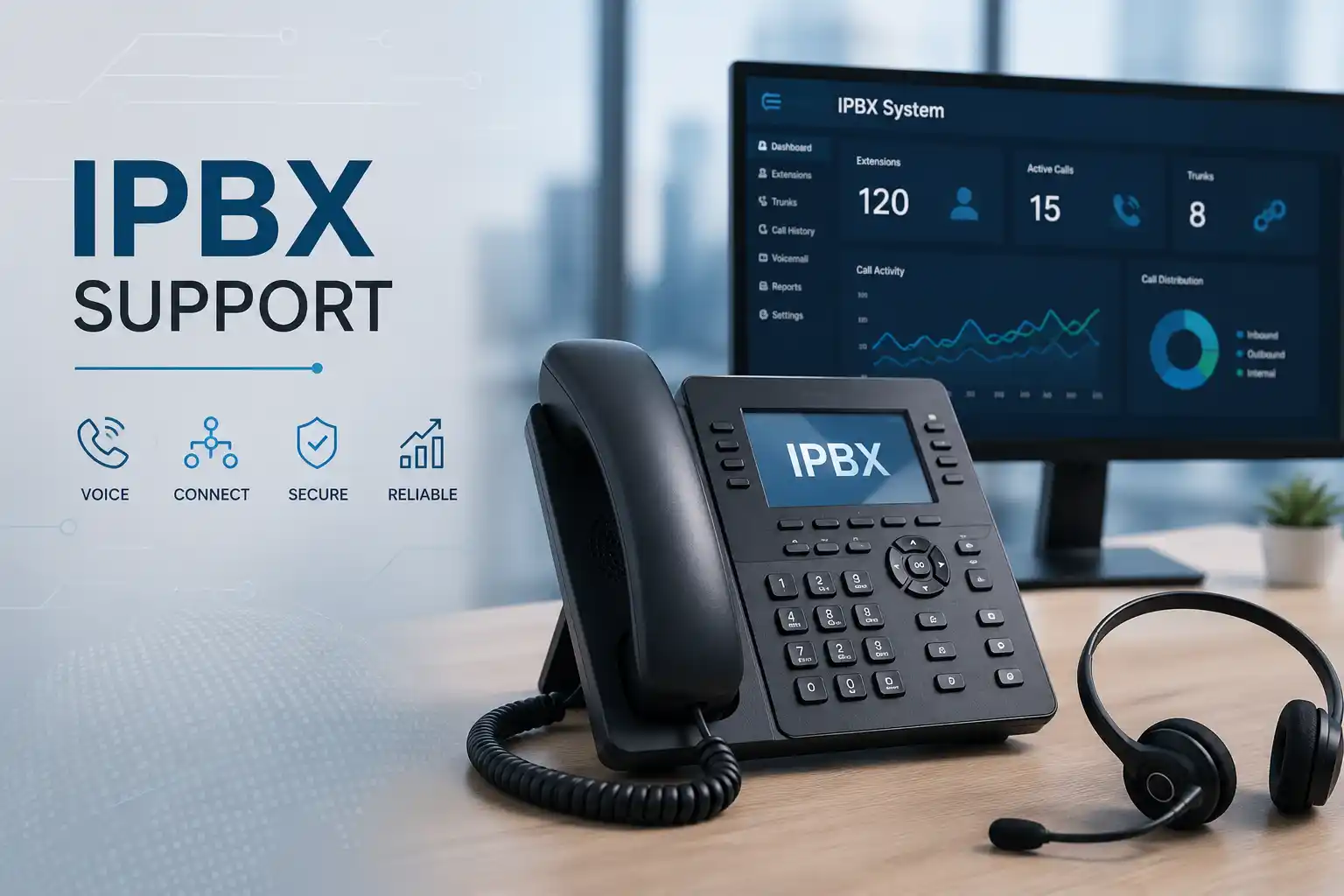
Trace symptoms across phone, PBX, network and provider layers.
Plan routing and user changes around the required business outcome.
Choose the service method according to access and physical dependencies.
Confirm users, locations, platform, carrier and requested work before quotation.
What does IP PBX support actually cover?
IP PBX support is the technical assistance used to diagnose, administer, maintain and improve a business telephone environment where calls are controlled by an IP-based private branch exchange. It is mainly used for extension problems, inbound and outbound call failures, routing changes, voicemail, queues, auto attendants, SIP trunk issues, IP phone registration, call-quality investigation, system documentation and upgrade planning. Businesses with reception teams, departments, remote users, branch offices or customer-facing telephone numbers should consider support when call behaviour no longer matches operational requirements or the system has become difficult to manage. Before work is confirmed, the customer should identify the affected users and numbers, describe the expected call flow, provide the PBX platform and provider details, confirm authorised administrative access, note recent changes and explain whether physical phones, network equipment or cabling may also be involved.
Why an IP PBX problem is rarely only a telephone problem
A business telephone call travels through a chain of systems. A desk phone may obtain power from a network switch, receive an IP address from the local network, register with a PBX, send signalling through a firewall or session path, and reach an external party through a SIP trunk or telecom service. The audio stream may follow a different network path from the signalling. This is why symptoms such as one-way audio, dropped calls, delayed ringing, failed registration or intermittent outbound calling cannot be diagnosed reliably from the phone screen alone.
The first task is to identify the boundaries of the problem. If one extension fails while all other phones work, the likely investigation is different from a situation where an entire department cannot make external calls. If inbound calls fail only on one main number, the call route and provider mapping may deserve attention. If users can call internally but audio fails only on external calls, the PBX, firewall, network path or voice provider may be involved. A useful support process therefore compares working and non-working cases, records when the behaviour started, checks whether any configuration, internet, network or provider change occurred, and reviews evidence before modifying the system.
Business impact also matters. A reception routing problem can send customers to the wrong team. A queue configuration issue can leave calls waiting longer than expected. A failed trunk can interrupt sales, service and supplier communication. Incorrect office-hours rules can affect calls even when the phones themselves are healthy. FourTeck approaches the PBX as part of the connected office so the support scope can include the surrounding dependencies when required, while still distinguishing what belongs to the customer environment from what requires carrier, internet provider, cloud host or platform-vendor action.
What the service may include
Depending on the confirmed scope, assistance may include extension creation or cleanup, IP phone registration review, ring groups, call queues, voicemail, auto-attendant menus, time conditions, office-hours routing, caller identification behaviour, forwarding, outbound permissions, SIP trunk checks, call-recording settings, backup review, firmware or software planning, remote-user access, configuration documentation and testing. Support can also include coordination with the network or voice provider when evidence suggests the issue sits outside the PBX itself.
Not every item belongs in every engagement. A user-change request may only need authorised remote administration and testing. A call-quality problem may require network measurement and on-site switching checks. A migration can require a separate discovery and change plan. The scope is therefore built around the actual business request, the current environment and the risk of the proposed change.
Who may need this service
IP PBX support can be relevant to professional offices, clinics, retail operations, hospitality sites, warehouses, schools, property teams, logistics operations, call-handling departments and multi-branch organisations that depend on extensions and shared business numbers. It is also useful when a company has inherited an undocumented telephone system, moved premises, changed its internet service, added new staff, introduced remote users, changed reception procedures or needs to understand whether an existing platform can be maintained or should be upgraded.
A business does not need to know the technical cause before requesting support. It is more useful to describe what users experience, when it happens, which numbers or extensions are affected and what the expected call behaviour should be. That information gives the assessment a clear operational starting point.
Common IP PBX symptoms and the technical areas they may involve
The same symptom can have several causes, so these examples should be treated as diagnostic directions rather than conclusions. The purpose of support is to test the relevant layers and narrow the fault safely.
Phone will not register
Possible areas include extension credentials, provisioning, IP addressing, DNS, VLAN assignment, firewall path, PBX availability, firmware compatibility or a device-specific fault.
Inbound calls reach the wrong destination
Call-routing rules, destination mapping, time conditions, holidays, IVR selections, queue overflow behaviour or carrier number presentation may need review.
Outbound calls fail
Outbound rules, dial patterns, user permissions, trunk authentication, credit or provider status, firewall behaviour and number formatting can all be relevant.
One-way or no audio
The investigation may involve RTP media flow, NAT behaviour, firewall handling, SIP provider settings, phone network paths, codecs or remote-user connectivity.
Poor voice quality
Packet loss, latency, jitter, congested links, WiFi use, faulty cabling, overloaded switches, insufficient bandwidth or provider-path issues may contribute.
Voicemail or queue behaviour is wrong
User settings, queue membership, timeout logic, prompts, office hours, forwarding rules, permissions or application state may need confirmation.
What can happen when telephone faults remain unresolved?
Unresolved PBX issues do more than inconvenience individual users. Customers may repeatedly call a main number that routes incorrectly. Reception may need to transfer calls manually because department logic no longer reflects the organisation. Sales and service teams may miss calls when queue membership is inaccurate. Remote staff may lose reliable access after a network or firewall change. Managers may also lack confidence in call records or recordings if the system has not been maintained and storage, permissions or licensing dependencies are unclear.
Repeated faults can also increase support effort because every new incident starts from the beginning when extension lists, trunk details, administrator ownership, backup locations and call-flow diagrams are missing. A structured service engagement can therefore have two objectives: restore or improve the current operation, and leave the environment easier to understand next time. That may mean documenting the important routes, confirming who manages the carrier account, recording the network dependencies, identifying unsupported components or creating a controlled improvement plan rather than applying unrelated changes each time a symptom appears.
Service scope at a glance
| Service area | What may be reviewed | Scope guidance |
|---|---|---|
| Main purpose | Troubleshooting, administration, maintenance, controlled change and upgrade preparation for business IP PBX environments. | Environment dependent. |
| Typical systems | PBX platform, IP phones, SIP trunks, switches, voice VLANs, firewall, internet circuit, remote clients and related applications. | Compatibility and access dependent. |
| Remote support | Configuration review, log checks, extension changes, call-flow administration, provider evidence collection and guided testing. | Suitable when secure authorised access and internet connectivity are available. |
| On-site support | Phones, cabling, PoE, switch ports, racks, local network paths, physical gateways and site-specific testing. | Location, access and scheduling dependent. |
| Configuration | Extensions, groups, queues, IVR, forwarding, office hours, outbound rules, permissions and selected trunk settings. | Approved change scope required. |
| Migration or upgrade | Inventory, compatibility, number and trunk mapping, call-flow capture, backups, test plan and cutover coordination. | Separate project scope may be required. |
| Testing and handover | Internal, inbound and outbound calls, reception routes, queues, voicemail, remote users and agreed business scenarios. | Test coverage depends on access and confirmed requirements. |
| Third-party coordination | Voice carrier, ISP, cloud host, platform vendor or other provider where evidence shows a dependency. | Vendor dependent. |
| Quotation | Prepared after the requested outcome, affected environment, access, location and work are understood. | Contact FourTeck to confirm. |
Is this the right type of support for your situation?
| Business situation | Relevant assistance | What must be confirmed |
|---|---|---|
| Several phones suddenly cannot make external calls | PBX route, trunk, network and provider-path diagnosis. | Affected extensions, error behaviour, time of failure and recent changes. |
| Reception routing no longer matches the business process | Call-flow mapping and controlled routing changes. | Written desired flow, office hours, overflow and voicemail requirements. |
| One office has poor call quality while another site is stable | Network, internet and site comparison together with PBX evidence. | Locations, network path, affected call types and repeatability. |
| New staff need extensions and phones | Extension setup, provisioning, permissions and user handover. | Phone models, licences, numbering plan and network readiness. |
| The existing PBX is poorly documented | Inventory, call-flow capture, trunk and extension documentation. | Administrative access, existing records and provider ownership. |
| The business is considering a PBX upgrade or migration | Current-state discovery, compatibility review, testing and cutover planning. | Users, numbers, trunks, recordings, phones, integrations and target outcome. |
When remote PBX support can make sense
Remote assistance can be effective when the system is reachable through an approved secure method and the issue relates mainly to configuration, user administration, call routing, logs, softphone or application behaviour, trunk status, permissions or software settings. A local user or administrator may still need to make test calls, confirm what appears on a phone or check a physical indicator.
Remote support begins with authorisation and evidence. Credentials should not be published or sent through an unapproved channel. Once access is confirmed, the technician can review the current state, compare the requested change with existing routing, check logs or registration status where available and plan a controlled modification. Remote access does not remove the need for backups, change awareness or rollback planning where the platform supports those measures.
When an on-site visit is more appropriate
On-site assistance may be required when phones do not power up, patching is unclear, PoE must be checked, a voice gateway or PBX appliance needs physical inspection, switch ports must be traced, cabling is suspected, rack access is required or the system cannot be reached remotely. Site work can also be useful when several users report intermittent symptoms that need to be observed on the local network.
The visit scope should identify what equipment can be accessed, whether building or rack access is available, who can approve changes, which users can assist with call testing and whether the carrier or ISP may need to participate. On-site timing depends on location, engineer availability, customer access, the confirmed work and any third-party requirements.
How an IP PBX support assessment usually progresses
Confirm whether the problem affects one user, one department, one number, one location or all external calling. Establish what users are trying to do and what should happen instead.
Record error messages, time of failure, extension numbers, affected call directions, recent network or provider changes, screenshots and available logs without making broad resets first.
Identify authorised administrative access, backup availability, maintenance restrictions and the contact person who can approve changes and perform test calls.
Review the phone, registration state, PBX logic, network path, firewall behaviour, internet connectivity and carrier dependency according to the symptom.
Separate likely internal causes from provider dependencies and explain whether corrective configuration, physical work, replacement, upgrade planning or escalation is appropriate.
Make only the agreed change, test the relevant inbound and outbound scenarios, confirm user behaviour and record remaining risks or follow-up actions.
Planning configuration changes without disrupting the wider call flow
A request that sounds simple can affect several destinations. Changing the reception extension, for example, may require updates to the main inbound route, queue membership, overflow behaviour, after-hours logic, voicemail destination and perhaps a recorded prompt. Removing an employee can affect a direct number, ring group, queue, forwarding rule, voicemail box and call-recording access. For this reason, configuration work should begin with a written business outcome instead of a list of menu clicks.
Where the platform supports configuration backup, export or rollback options, those safeguards should be reviewed before significant changes. The technician should understand which routes are business critical, whether a maintenance window is needed, what test calls will prove the new behaviour and who can confirm that the result is correct from the customer side. Changes involving external numbers, trunks or hosted services may also depend on the carrier or platform provider.
A useful validation plan covers more than one successful call. It may include internal extension-to-extension calling, inbound calls to main and direct numbers, outbound calls to expected destinations, transfers, unanswered calls, queue overflow, voicemail, office-hours and after-hours behaviour, remote users and any special reception process included in scope. Testing depth should match the risk and importance of the change rather than relying on one quick check.
Testing, documentation and handover after support work
A PBX change is not complete merely because the administration screen accepts it. The result must work in the user’s real call path. Testing should therefore be agreed before the change and should include the routes most important to the business. If a problem only occurs at certain times, from particular external networks or with remote users, that limitation should be recognised rather than treating a short local test as final proof.
Documentation can be proportionate to the engagement. A small user change may only require a record of the extension and action completed. A wider PBX review may benefit from an extension list, key incoming numbers, trunk references, call-flow notes, queue membership, office-hours logic, administrator ownership, backup location and dependencies on the ISP or voice provider. The objective is not to expose passwords. It is to leave useful operational information so future support does not depend on memory.
Handover may also include concise guidance for reception staff, supervisors or administrators. Users can be shown the functions that changed, such as transfer methods, voicemail access, queue login or new call-routing behaviour. Administrators can be shown where approved records are kept and what should be checked before future changes. Ongoing maintenance needs are then separated from one-time corrective work so the customer can decide whether recurring support is appropriate.
Capability 1: Faster fault isolation across voice dependencies
A strong PBX support process compares the call path instead of replacing components at random. Phone registration, switch connectivity, addressing, PBX service state, firewall rules, internet stability and provider status can be reviewed in an order that matches the symptom. This is especially important for intermittent issues, because unnecessary resets can remove useful evidence without correcting the underlying cause. FourTeck can help organise the evidence, reproduce the problem where practical and identify which technical owner should act next.
The limitation is access. If the provider portal, firewall, PBX administration or logs are unavailable, the assessment may only reach a partial conclusion until the responsible party supplies access or evidence. Clear escalation notes can still reduce confusion by documenting what has already been tested.
Capability 2: Safer call-flow and user administration
Business call flows change as teams grow, working hours shift and staff responsibilities move. Controlled administration helps keep main numbers, direct numbers, groups, queues, forwarding and voicemail aligned with the organisation. The practical benefit is clarity: the requested outcome is mapped first, then the required configuration is changed and tested against that outcome.
Platform features, licences and terminology vary, so the exact configuration method cannot be assumed from the business request alone. Existing rules may also interact in unexpected ways. FourTeck can review the current logic, identify dependencies and plan the approved change around a test and fallback path where available.
Capability 3: Better maintainability before the next incident
A PBX becomes difficult to support when nobody knows which carrier owns the numbers, where backups are stored, which extensions are active or how office-hours routing is built. Maintenance therefore includes more than reactive repair. A service review can identify undocumented settings, ageing phones or gateways, unsupported software, unclear administrator ownership, missing backups and network dependencies that should be recorded.
Documentation does not eliminate faults, and a health check does not guarantee future availability. It does, however, give future support a stronger starting point. The value is highest when records are kept current as users, numbers, trunks and routes change.
Dependencies, access and customer inputs to confirm
IP PBX support is access dependent. Useful information may include the PBX brand or platform, deployment type, software or firmware version, phone models, extension range, main business numbers, SIP trunk provider, internet provider, network layout, firewall model, voice VLAN details, remote-user method, known licence limitations and the location of current configuration backups. Customers should also identify the person authorised to approve changes and the users available for testing.
Passwords should not be posted in public requests or included in website forms unless the approved secure process specifically supports credential transfer. Administrative credentials, provider access and sensitive configuration should be shared only through an authorised secure method after identity and access requirements are confirmed.
Some environments are maintained by multiple parties. A telecom provider may control the trunk, an ISP may manage the edge device, a cloud host may control the PBX server, and an internal administrator may own user policy. A successful support plan depends on knowing who can access each layer and whether their participation is required. If a dependency cannot be accessed during the service window, the work may need to pause or proceed with limited findings until the responsible provider can assist.
Risks, limitations and exclusions to understand before work starts
Diagnosis depends on the evidence and access available. A call failure can originate inside the PBX environment or within an external carrier, ISP, hosting provider or remote user network. FourTeck can help gather evidence and coordinate technical information, but third-party systems remain dependent on the responsible provider. Hardware failure may require replacement parts outside the labour scope. Unsupported PBX versions, gateways or phones may have limited safe options, and compatibility should be reviewed before reuse or upgrade.
Configuration changes can interrupt calling if they affect trunks, routing, network paths or system services. Significant changes should therefore be authorised, backed up where practical and scheduled in a suitable maintenance window. A successful test immediately after a change does not remove the value of later monitoring, especially for intermittent call-quality or provider-path issues.
Migration outcomes depend on accurate number records, current configuration, phone compatibility, licensing, access to carrier services, backups and third-party integrations. Zero downtime should not be assumed. Existing recordings, prompts, reports or integrations may require separate planning depending on the source and target platforms. Final commercial terms, included tasks and scheduling are defined by the approved quotation or service agreement.
Business environments where IP PBX support may be useful
Professional offices often rely on a receptionist, direct extensions and department ring groups. Their support needs may involve staff moves, new extensions, office-hours changes, call forwarding and maintaining a consistent user experience across desk phones and soft clients. Clinics and service businesses may depend on reliable main-number routing and clear handoff between front desk and specialist teams. Retail operations and showrooms may need calls to reach the correct location even when staff rotate between shifts.
Warehouses and logistics sites can introduce physical network complexity because phones may be spread across offices, loading areas and remote buildings. Here, PoE, cabling, switch paths and internet stability can become part of the voice investigation. Hospitality environments may use several departments and after-hours rules, while training centres and schools may need straightforward extension administration and documented reception flows. Multi-branch businesses add another layer because each site may use different internet links, local phones or remote registration methods even when calls are controlled centrally.
The useful point is not the industry label but the call workflow. Support should reflect who answers the main number, what happens when the first destination is busy, how unanswered calls are handled, which users need external calling, whether remote or branch users are involved and what level of documentation management expects. These operational details define a more useful service scope than a generic telephone-system checklist.
Operational, security and maintenance considerations
PBX administration carries operational and security responsibilities. Administrator access should be limited to authorised people, shared credentials should be avoided where the platform supports individual accounts, and remote management should be exposed only through an approved secure method. Trunk permissions and outbound rules should reflect business requirements rather than granting every extension unrestricted capability by default. Software or firmware updates should be assessed for compatibility, support status and rollback considerations before they are applied to a live system.
Network design also influences voice reliability. Voice VLANs may help segment traffic where appropriate, but segmentation must be configured consistently across switching, routing, DHCP and phone provisioning. Quality of Service can help prioritise voice on managed links, but it does not create bandwidth that is not available and cannot control every external internet segment. Call quality should therefore be assessed end to end, especially when remote users, WiFi phones, VPNs or congested internet circuits are involved.
Preventive maintenance can include backup review, extension cleanup, inactive-user review, trunk and number documentation, call-flow checks, storage or recording review, update planning, licence awareness and test calls for critical routes. Actual maintenance frequency and included work depend on the agreed service plan. Maintenance reduces uncertainty and improves support readiness, but it should not be described as a guarantee against carrier outages, hardware failure or future misconfiguration.
Before you contact FourTeck about an IP PBX issue
Providing a concise picture of the environment helps the first assessment focus on the right layer. Prepare what you know; missing details can be identified during discovery.
- The Dubai or UAE service location and whether more than one site is affected.
- The main contact person and the person authorised to approve configuration changes.
- The number of users or extensions affected and whether the issue is isolated or widespread.
- The PBX platform, deployment type and version if known.
- Relevant IP phone, gateway or soft-client details.
- Affected inbound numbers, outbound destinations or internal extensions.
- A clear description of what happens now and what the expected call behaviour should be.
- When the issue started, how often it occurs and whether it can be reproduced.
- Any recent PBX, firewall, network, ISP, office-hours or provider changes.
- The SIP trunk or telecom provider and relevant service references where appropriate.
- Whether authorised PBX, firewall and provider access can be made available securely.
- Current configuration backup status and where backups are controlled.
- Whether on-site physical checks may be needed for phones, PoE, ports, cabling or racks.
- The business impact and any maintenance window or access restrictions.
- The preferred support method and the result the business wants to achieve.
Service evaluation checklist for quotation and engagement scope
- Confirm the exact objective: fault resolution, administration, maintenance, migration, upgrade or documentation.
- Confirm the number of users, extensions, phones and business numbers involved.
- Identify each site that needs remote or physical work.
- Record the current PBX platform, hosting responsibility and known support status.
- Confirm whether network, firewall, SIP trunk or ISP work is expected to form part of the engagement.
- Identify the authorised access that can be provided and any security restrictions.
- Define the remote versus on-site requirement.
- List the call scenarios that must be tested before handover.
- Confirm whether configuration backup, documentation or administrator handover is required.
- Identify any carrier, hosting, application or vendor coordination that may be needed.
- Confirm the required change window and who will be available for user acceptance testing.
- Separate one-time corrective work from any recurring maintenance expectation.
How FourTeck can assist from first report to quotation
FourTeck’s role begins by translating the reported telephone problem into a clear technical scope. That can mean confirming whether the issue sits with one phone, the PBX, a call route, the local network, the firewall, the internet service or the voice provider. For planned work, the first step is to understand the intended business outcome: which users should receive calls, how unanswered calls should be handled, what hours apply, whether remote users are included and what must be preserved during a change.
From there, support can be organised as remote troubleshooting, an on-site assessment or a combined engagement. FourTeck can review available logs and settings, help define configuration changes, coordinate evidence with third-party providers, test approved changes and record the resulting environment. Where a problem reveals ageing equipment, unsupported software, weak documentation or a broader migration need, the findings can be turned into a separate improvement plan rather than expanding the original support request without agreement.
A quotation is based on the confirmed scope, location, access, urgency, systems involved and expected deliverables. Installation, configuration, migration, maintenance, documentation, provider coordination and on-site work should be explicitly included when required. For wider business technology needs, customers can review FourTeck IT support in Dubai and the UAE, explore the business IT services overview, learn more about FourTeck IT Services or contact FourTeck to discuss the required scope.
Dubai and UAE service coordination
For a Dubai business, remote support may be the most efficient starting point when the PBX is reachable securely and the issue concerns call routing, user administration, logs or other software-level behaviour. An on-site visit may be recommended when phones, gateways, PoE, cabling, rack equipment or local network paths require physical testing. Some requests need both: remote analysis can narrow the likely cause first, followed by a targeted site visit with a clearer test plan.
Service timing depends on engineer availability, customer access, site conditions, approved work, required equipment and any third-party provider that needs to participate. A branch-office issue can also involve coordination between local users and a centrally hosted PBX. Contact FourTeck to confirm whether the immediate need is remote troubleshooting, an on-site assessment, planned configuration, maintenance, migration preparation or a broader telephone-system review.
Coordinating PBX support across Dubai, Abu Dhabi, Sharjah and Ajman
Businesses operating across Dubai, Abu Dhabi, Sharjah and Ajman may have a central PBX with remote phones, separate systems at each site or a mixture of local gateways and hosted services. Support coordination should identify which location is affected, whether the issue is common across sites and which local network or internet service each branch uses. Remote troubleshooting can help compare configurations and symptoms between sites, while planned on-site visits may be appropriate for physical inspection, installation, cabling checks, phone deployment or local network testing.
Travel, building access, site permissions, engineer scheduling, equipment availability and third-party provider timing can affect the service plan. A multi-site change may also require a staged approach so one location can be validated before the same configuration is applied elsewhere. FourTeck can help organise the technical information and proposed sequence, subject to assessment and an approved quotation. The purpose is to create one understandable support plan without implying that every location, task or visit is automatically included.
Related FourTeck IT services that may support a PBX environment
Office network support
Useful when voice quality, phone registration or PoE depends on switches, VLANs, cabling, addressing or routing. See the FourTeck services directory.
IP phone support
Relevant for provisioning, local phone behaviour, power, network registration, user settings and device replacement assessment.
Firewall and internet troubleshooting
May be required when SIP signalling, media flow, remote users or carrier connectivity depend on edge-network behaviour.
Managed IT support
Can place telephony within a wider support relationship covering users, networks, servers and connected office systems, subject to the agreed contract scope.
Why businesses contact FourTeck for PBX assistance
Businesses often need help because the visible telephone symptom sits between several technical owners. The PBX administrator may say the trunk is registered, the carrier may say its service is active, and users may still experience failed calls. FourTeck can provide a connected technical view that considers users, phones, switching, internet connectivity, firewall behaviour, PBX configuration and carrier dependencies together. That approach is useful when the aim is to isolate the responsible layer and create a practical next action rather than pass the request between vendors.
Customers may also contact FourTeck when they need a controlled change rather than a fault repair: adding users, revising reception routing, preparing an office move, documenting an inherited system or planning a migration. The emphasis is on defining the requirement, protecting existing service where practical, testing the result, recording the change and explaining dependencies. Support scope and commercial terms remain subject to assessment and quotation.
Questions businesses often ask before requesting IP PBX support
The questions below reflect the practical decisions a business may need to make before choosing remote troubleshooting, an on-site visit, planned configuration work or a larger PBX improvement project. They are intended to help you prepare useful information and understand what can affect the final scope.
Can an IP PBX problem be checked remotely?
Many PBX issues can be assessed remotely when the system is reachable through an authorised secure method and a user is available to perform test calls. Extension configuration, call routes, queue membership, office-hours rules, trunk status, logs and application settings are typical examples. Remote support can also compare working and failing extensions without requiring immediate physical access to every phone. However, remote support is not automatically the correct choice. If phones have no power, switch ports are unstable, cabling is damaged, a gateway must be inspected or the local network cannot be reached, an on-site visit may be necessary. The best first step is to describe the symptom, affected users and current connectivity so FourTeck can determine which method is appropriate.
Why are some calls clear while others have poor audio?
Different call paths can behave differently. Internal calls may remain inside the local network, while external calls depend on the firewall, internet connection and voice carrier. A remote user may use another internet provider entirely. Poor audio can therefore be related to packet loss, latency, jitter, congestion, WiFi conditions, VPN routing, switching, cabling, codec selection or a provider path. The important diagnostic question is which calls fail and under what conditions. Record whether the issue affects inbound, outbound, internal, remote or only certain destinations. If possible, note the time of occurrence and whether the problem is repeatable. That pattern gives the technical assessment a stronger starting point than changing phone settings at random.
What should we prepare before asking for a call-routing change?
Prepare the desired business flow in plain language. State which number the caller dials, which team should answer first, how long it should ring, what should happen if nobody answers, whether overflow should go to another group, what behaviour is required outside office hours and where voicemail should be delivered. If an IVR menu is involved, list the required options and destinations. Also identify any users who should not be changed. This avoids ambiguity and makes testing easier. The current PBX may have existing dependencies or licence limits, so the final configuration method is platform dependent. A backup or rollback option should be reviewed before significant routing changes where the platform provides it.
Is a failed external call always a SIP trunk problem?
No. A failed external call may involve the user’s extension permissions, dial pattern, outbound route, PBX service state, trunk authentication, firewall behaviour, DNS, internet connectivity, number formatting or the carrier itself. An effective diagnostic process checks whether all extensions are affected, whether inbound calls still work, whether the trunk shows registered where that is relevant, what the PBX logs show and whether recent changes occurred. Provider escalation is more useful when it includes evidence such as timestamps, affected numbers and the direction of the call. If the fault is inside the customer environment, that evidence also helps avoid unnecessary carrier tickets.
When should we choose one-time PBX support instead of ongoing maintenance?
One-time support is often suitable for a defined request such as correcting a route, adding a small group of users, investigating a specific fault or documenting a known configuration. Ongoing maintenance may be more appropriate when the business regularly adds or removes staff, changes call flows, depends heavily on customer calls, has multiple sites or needs recurring review of backups, support status and documentation. The decision should be based on the number of changes and the operational importance of the system rather than an assumption that every PBX needs the same service plan. Any recurring arrangement should define covered systems, support channels, exclusions and separately quoted project work.
Do we need an on-site engineer to add extensions or phones?
Not always. If the network is ready, phones are compatible and provisioning can be completed through the existing management platform, much of the configuration may be handled remotely. A local user may simply connect the device and confirm that it registers. On-site work becomes more useful when new network points are needed, PoE capacity must be checked, phones must be physically deployed across many desks, cabling is unclear or rack and switch work is part of the request. For a larger rollout, a site inventory can also reduce errors by matching phone models, user locations, MAC addresses or extension assignments before configuration begins.
How do we know whether to repair the current PBX or plan a migration?
The decision depends on supportability, hardware condition, software version, licensing, phone compatibility, carrier requirements, available backups, administration effort and the business features still required. A stable system with a manageable fault may only need corrective work. An older environment with repeated failures, unclear ownership, unsupported components or difficult expansion may justify migration planning. Before deciding, document the current extensions, direct numbers, trunks, prompts, queues, recordings, reports, remote users and integrations. That inventory helps compare the cost and risk of maintaining the present system with the effort required to move to a new platform.
What can affect the price or final quotation for PBX service?
The quotation depends on the number of users and sites, the platform involved, the amount of available documentation, whether remote access works, the need for on-site testing, the complexity of call routing, third-party provider participation, migration requirements, hardware work, testing depth and documentation expected at handover. A simple extension change is different from tracing intermittent audio across multiple branches. The quickest way to get an accurate scope is to state the desired outcome, affected environment and access available. Where the request includes installation, migration, licensing, replacement equipment or provider changes, those items should be identified separately rather than assumed to be included in general support.
What should we test after a PBX configuration change?
Testing should reproduce the business situations the change was intended to improve. For a reception route, call the main number during the relevant time condition, confirm the first destination, check overflow, test transfer and verify voicemail or after-hours behaviour. For a new extension, test registration, internal calling, inbound reachability if applicable, outbound permissions, caller identification and voicemail. For a trunk or network change, include calls in both directions and, where relevant, remote users or branch locations. Record any limitations that could not be tested during the service window. A single successful call is useful evidence, but it does not always prove every route or intermittent condition.
Can FourTeck coordinate with our telecom or internet provider?
FourTeck can help collect technical evidence and coordinate information with a telecom, SIP trunk, internet or hosting provider when the support scope requires it. The provider may still need the customer’s account authorisation or may follow its own escalation process. Useful evidence can include the affected number, call direction, timestamp, trunk state, public IP information, error response or the result of controlled tests. The goal is to give the responsible provider enough context to investigate its part of the path while keeping the customer informed about what has already been checked internally.
How should a Dubai business prepare for a PBX migration?
Start with an inventory before selecting the change window. Record extensions, users, direct numbers, main numbers, SIP trunks, groups, queues, IVR menus, office-hours rules, prompts, voicemail requirements, remote users, recordings, reports, gateways, analogue devices and integrations. Confirm which existing phones can be reused and whether the target platform supports the required functions. Review backups and rollback options, identify carrier lead times, plan user communication and define the test cases that must pass after cutover. If the business has several UAE branches, decide whether to migrate all locations together or in stages. A migration should be treated as a project with dependencies rather than as a routine settings change.
Frequently asked questions about IP PBX support in Dubai
What does IP PBX support include?
Depending on scope, it may include fault diagnosis, extensions, call routing, queues, voicemail, SIP trunk checks, phone registration, remote-user issues, backup review, documentation, testing and maintenance or upgrade planning.
Can you support a PBX when the brand is not yet known?
An initial assessment can begin from the symptoms and available environment details. The exact technical scope is confirmed once the platform, version, access method and connected provider services are identified.
Can remote support fix one-way audio?
Remote troubleshooting can review PBX, firewall and network evidence when authorised access is available, but on-site checks may be required if local cabling, switching, gateways or physical network conditions are involved.
Do you change office-hours and IVR routing?
Configuration assistance may include office-hours rules, auto attendants, queues, forwarding and voicemail when the current platform supports the required behaviour and the requested flow is clearly approved.
What access is needed for PBX support?
Access depends on the issue. PBX administration, provider portals, firewall management or local network access may be needed. Credentials should only be shared through an approved secure method after authorisation is confirmed.
Can a PBX issue be caused by the office network?
Yes. IP phones depend on network connectivity, addressing, switching and often PoE. Call quality can also be affected by packet loss, congestion, unstable links or internet-path problems.
Can you help before an office relocation?
PBX relocation planning can include current-state documentation, network readiness, extension mapping, phone inventory, carrier coordination, test planning and cutover preparation, subject to the confirmed project scope.
Is call recording always part of PBX support?
No. Recording depends on the platform, licences, storage, customer policy and requested scope. Recording review or migration should be identified explicitly before work begins.
Do you provide ongoing PBX maintenance?
Recurring maintenance can be discussed for environments that need regular user changes, backup review, documentation, update planning or operational checks. Actual inclusions depend on the agreed service plan.
How is a support quotation prepared?
FourTeck reviews the requested outcome, affected systems, user and site count, access, service method, third-party dependencies, testing needs and expected deliverables before confirming the proposed scope.
Discuss your IP PBX issue or planned change
Share the affected users or numbers, the current PBX platform if known, the behaviour you are seeing, recent changes and whether you prefer remote assessment or on-site assistance. FourTeck can review the information, identify the likely support path and confirm what should be included in the quotation before work begins.
Service scope, scheduling, compatibility, provider participation and final commercial terms are subject to assessment and the approved quotation or service agreement.