
BUSINESS TELEPHONY MAINTENANCE
IP PBX Maintenance Dubai in Dubai, UAE
A business telephone platform can keep working while small faults accumulate in routing, extensions, trunks, backups, network settings, permissions and documentation. IP PBX maintenance is a structured way to review those dependencies, investigate recurring problems and keep approved configurations easier to support as users, departments and locations change.
FourTeck can help assess an existing IP PBX environment, identify the areas that need attention, plan controlled corrective work and document practical next steps. The final scope depends on system access, platform condition, network design, service-provider dependencies, maintenance objectives and the approved quotation.
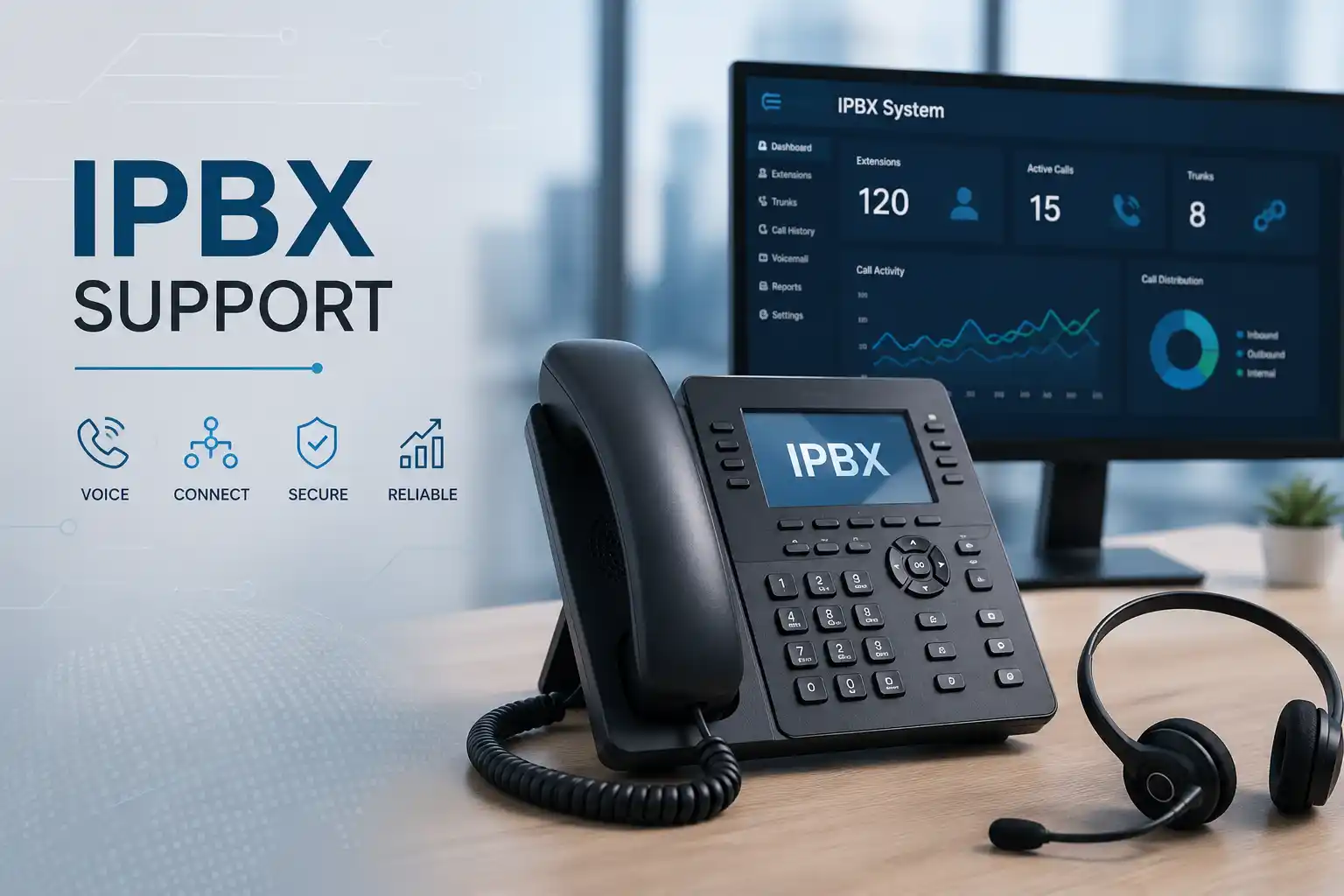
Call flow, extensions, trunks, phones, backups and dependencies
Remote or on-site according to access and fault type
Assessment, authorisation, backup, testing and documentation
Confirmed after environment and work requirements are reviewed
What does IP PBX maintenance involve?
IP PBX maintenance is the planned review, troubleshooting and upkeep of the telephone platform that controls business extensions, incoming and outgoing call routes, voicemail, queues, auto-attendant functions, office-hours behaviour and related voice services. It is mainly used to reduce recurring faults, keep configuration understandable, identify network or provider dependencies and prepare the system for user changes or future upgrades. Businesses should consider maintenance when call behaviour is unreliable, documentation is weak, changes have accumulated over time or the PBX has become difficult to administer. Before work begins, the customer should confirm the platform in use, affected users and sites, known symptoms, recent changes, available configuration backups, service-provider details and authorised access. Physical devices, cabling or network equipment may require an on-site visit even when the PBX itself can be reviewed remotely.
What the maintenance service can cover
An IP PBX is not an isolated box. It sits between users, desk phones or softphones, the local network, internet connectivity, firewall policies, voice gateways where used, SIP or telecom services, number routing and business procedures. Maintenance therefore starts by understanding what the telephone system is expected to do and which parts are currently causing concern.
Depending on the confirmed scope, assistance may include extension and registration checks, call-routing review, ring groups, queues, voicemail behaviour, office-hour schedules, permissions, outbound rules, trunk status, configuration backup review, log inspection, call-quality investigation, phone provisioning, gateway checks, voice VLAN review, switch or PoE checks, provider coordination, documentation and recommendations for corrective maintenance. Not every activity is required for every PBX, and platform-specific actions depend on available access, licensing, support status and existing configuration.
Who may need an IP PBX maintenance review?
The service can suit an organisation that depends on telephone calls for reception, sales, support, reservations, coordination, customer service, dispatch, administration or internal communication. It can also be useful after staff changes, office expansion, a network redesign, a service-provider change, relocation, repeated call complaints or a period in which several people have modified the system without maintaining records.
A maintenance review is not limited to an obviously failed PBX. A system may still place calls while carrying operational risk: an outdated extension list, an unknown administrator account, untested backups, undocumented call forwarding, old queue members, inconsistent office hours or an internet dependency that has never been tested under failure conditions. The purpose is to establish what exists, what matters to the business and which maintenance actions are justified by evidence rather than changing settings simply because they are available.
Common symptoms and maintenance triggers
Telephone problems are often reported as a single symptom, but several technical layers can create similar behaviour. A dropped call may involve the phone, PBX, switch, internet path, firewall, provider or remote destination. An extension that fails to ring may be caused by user status, forwarding, queue membership, time conditions, registration, network connectivity or an intentional rule that is no longer documented. Maintenance should therefore gather a pattern before assuming the cause.
Call reliability concerns
Intermittent inbound or outbound failures, delayed ringing, dropped calls, one-way audio, no audio, unusual call setup delay, inconsistent caller ID or recurring complaints about voice quality can justify a structured review. Evidence should include affected numbers, times, users and whether the issue occurs internally, externally or only across specific routes.
Call-flow confusion
Incoming calls may reach the wrong department, continue ringing former employees, skip a receptionist, fail to enter a queue, follow an incorrect after-hours rule or reach voicemail unexpectedly. Maintenance can map the intended business flow against the configured flow before approved changes are applied.
User and device changes
New starters, departures, desk moves, remote users, replaced phones and department restructuring can leave obsolete extensions, stale forwarding rules or inconsistent permissions. A maintenance cycle can reconcile users, extensions and devices so the system reflects current operations.
Weak documentation
When nobody can explain trunk ownership, extension ranges, emergency contacts, administrator responsibility, backup location or key call routes, even a small incident takes longer to diagnose. Documentation gaps are a legitimate maintenance trigger before a major move, upgrade or provider change.
Network-related voice issues
IP phones depend on switching, addressing, cabling, power, routing and often internet connectivity. Port errors, insufficient PoE, a misconfigured voice VLAN, congestion, packet loss or an unstable uplink can appear to be a PBX fault. Maintenance can separate voice-platform issues from the underlying network path.
Planned lifecycle changes
A maintenance review is also useful before an office move, system upgrade, phone refresh, trunk migration, new branch connection or major call-flow redesign. Establishing the current state first helps identify what can be retained, what requires testing and what needs a separate project scope.
Why recurring PBX issues matter to daily operations
Business telephony problems can affect more than the person who first reports them. Reception may be unable to route callers, sales opportunities can be delayed, service teams can miss queue calls, managers may lose visibility into call handling and remote users may become difficult to reach. If the root cause is a shared network or provider dependency, many extensions can be affected at once.
Repeated small fixes can also create maintenance debt. For example, temporary forwarding rules, ad-hoc extension names, reused devices and undocumented changes can make the next fault harder to diagnose. A structured maintenance approach gives the business a chance to clean up known issues, separate operational requirements from obsolete configuration and establish records that another authorised administrator can understand.
Maintenance does not eliminate every future failure. Internet outages, hardware faults, provider incidents and third-party service changes can still occur. The practical goal is to make the system easier to assess, support and recover by understanding dependencies, maintaining appropriate backups, validating important call paths and keeping responsibilities clear.
Possible IP PBX maintenance scope
The exact work should be agreed after the PBX environment and maintenance objectives are understood. Depending on the confirmed scope, FourTeck assistance may include the following areas. A maintenance engagement does not automatically include replacement hardware, new licences, telecom-provider charges, extensive migration work or unrelated network projects unless those items are specifically included in the quotation.
Configuration health
Review of extensions, call routes, ring groups, queues, office hours, voicemail, forwarding, permissions and other settings relevant to the business workflow.
Trunk and provider path
Status checks and evidence gathering for external calling, assigned numbers and provider-facing settings, with provider coordination when an issue cannot be resolved within the customer environment.
Endpoint and registration review
Checks for desk phones, soft clients, registrations, provisioning, user assignment, power and network connectivity where these are part of the confirmed maintenance scope.
Network dependency checks
Review of switch ports, voice VLANs, addressing, DNS, routing, firewall path, packet loss, latency or other network factors where symptoms indicate they may influence voice service.
Backup and recovery readiness
Confirmation of available configuration backup methods and the practical ability to retain an approved recovery point before significant maintenance changes, subject to platform capabilities and access.
Documentation and recommendations
Recording useful findings, key dependencies, completed changes, outstanding risks and recommended next actions so future support does not depend on memory alone.
Service-fit matrix: what should happen next?
| Observed business situation | Relevant maintenance assistance | What must be confirmed |
|---|---|---|
| Calls fail occasionally but the pattern is unclear. | Evidence collection, call-path testing, log review and dependency checks. | Affected numbers, users, times, direction of calls and provider details. |
| Former staff still appear in routes, queues or extension lists. | User and extension reconciliation, routing cleanup and documentation. | Approved user list, business call-flow requirements and authorisation. |
| Voice quality changes after a network modification. | PBX and network-path review, switch or VLAN checks and controlled testing. | Recent network changes, affected locations and access to relevant devices. |
| The PBX works but nobody knows whether backups are current. | Backup-method review, recovery-point planning and administrator documentation. | Platform capability, storage location, credentials and support status. |
| A branch, office move or new department is planned. | Current-state documentation, capacity review, call-flow planning and project handoff. | Users, numbers, sites, network readiness, provider tasks and target date. |
| A suspected hardware or cabling issue affects phones. | On-site inspection, physical connectivity checks and fault isolation. | Site access, equipment location, affected ports or devices and replacement scope. |
IP PBX maintenance service information
| Service topic | IP PBX maintenance and support for business telephone environments. |
|---|---|
| Main purpose | Review system health, investigate recurring faults, maintain approved call behaviour, improve supportability and identify practical next actions. |
| Suitable for | Businesses using IP-based telephony for reception, departments, internal extensions, external calling, remote users or branch communication. |
| Typical systems involved | PBX platform, IP phones or soft clients, SIP or telecom service, switches, PoE, voice VLAN, firewall, internet connectivity, gateways and local cabling as applicable. |
| Assessment method | Business-impact review, configuration and log checks, call testing, dependency review and physical inspection where needed. Environment dependent. |
| Remote support suitability | Potentially suitable for configuration, logs, extension administration, call-flow review and controlled tests when secure authorised access and connectivity are available. |
| On-site support suitability | May be required for phones, cabling, switch ports, PoE, gateways, racks, physical faults, inaccessible systems or site-specific testing. |
| Customer access required | Authorised administrative and site access as relevant. Credentials should be shared only through an approved secure method after identity and authorisation are confirmed. |
| Information required | Platform details, user and location scope, symptoms, recent changes, provider information, network context, current documentation and maintenance objectives. |
| Testing and validation | Scope-dependent test calls, extension checks, routing confirmation, voicemail or queue validation and verification of affected user workflows. |
| Documentation and handover | May include maintenance findings, change records, extension or route notes, dependencies, unresolved items and recommended follow-up work. |
| Vendor coordination | May be needed where the voice carrier, internet provider, hosted PBX operator, licensing provider or hardware manufacturer controls part of the service path. |
| Security considerations | Administrator access, remote exposure, user permissions, firewall rules, unused accounts and supported update practices may require review according to the platform and approved scope. |
| Service location | Dubai and UAE coordination, with remote or planned on-site assistance subject to location, access, scheduling and confirmed work. |
| Scope dependency | System condition, access, number of users and sites, fault complexity, maintenance objectives, provider involvement, hardware needs and approved quotation. |
| Important note | Maintenance can improve supportability and reduce avoidable configuration problems, but it does not guarantee that external outages, hardware failures or future faults will not occur. |
Remote maintenance or an on-site PBX visit?
When remote assistance may be suitable
Remote work can be efficient when the PBX is reachable through an authorised secure method and the problem mainly concerns configuration, logs, accounts, extension administration, queues, routing, trunk status or software-level behaviour. A local user or administrator may still be needed to place test calls, confirm what appears on a phone or verify whether a change matches the business requirement.
Remote access should not be opened casually for convenience. The method, authorisation and duration should fit the customer’s security process. If the PBX or local network is unreachable, or the fault depends on a physical device, remote diagnosis may only establish that an on-site inspection is required.
When on-site assistance may be more appropriate
An on-site visit may be recommended when physical inspection or local testing is necessary. Examples include phones that do not power up, cabling problems, PoE issues, gateway faults, switch-port errors, rack work, inconsistent behaviour across specific desks or floors, or a PBX appliance that cannot be reached through the network. Local coordination can also help when several departments need their call handling tested together.
Attendance depends on the site, building access, approved scope, scheduling, engineer availability and any equipment or third-party coordination required. The service plan should state which physical checks are included and which replacement or project work would require separate approval.
How an IP PBX maintenance assessment can be organised
1. Establish the business impact
The first step is to understand why the maintenance is being requested. Is there a current fault, a history of repeated call complaints, a coming office move, a need to clean up user accounts, concern about backups, or simply a lack of documentation? The answer changes the priority of the work. Reception and externally published numbers may require different validation from an internal extension used only occasionally.
2. Identify affected users, systems and locations
The PBX may serve one office or several locations. Maintenance should identify the number of extensions, major departments, reception points, remote users, trunks, gateways and connected device types that are relevant to the scope. If only one floor or branch is affected, that pattern can guide network and cabling checks. If every location is affected, a central PBX, carrier or shared internet dependency may deserve earlier attention.
3. Collect evidence before changing settings
Useful evidence can include error messages, timestamps, call examples, screenshots, user reports, call logs, extension numbers, recent changes and provider ticket references. A clear example such as “external callers to this number do not reach the queue after 6 p.m.” is more actionable than a general statement that the PBX is unreliable. Evidence allows maintenance to test a hypothesis instead of making broad changes that may affect working services.
4. Confirm access, backups and change authority
Before significant configuration work, administrative authority should be clear. Existing backups should be reviewed where the platform supports them, and a new recovery point may be appropriate before approved changes. The customer should identify who can authorise changes to call routes, user permissions, provider settings or maintenance windows. Credentials should be exchanged only through an approved secure method, not posted in public messages or page forms.
5. Review the PBX and its dependencies
Maintenance can then move through the relevant layers: extension registration, call routing, groups, queues, schedules, voicemail, trunk status, phone provisioning, local addressing, network path, firewall behaviour and external provider reachability. The purpose is not to inspect every possible setting; it is to focus on the functions the business uses and the risks or symptoms identified during discovery.
6. Separate maintenance findings from project work
A review may discover that the system is operational but approaching a larger change. Examples include an unsupported platform, insufficient capacity, ageing gateways, a network that cannot support planned phone growth, or a need to migrate numbers to a new service. These findings should be documented and scoped separately rather than quietly turning a maintenance visit into an uncontrolled migration or replacement project.
7. Apply approved corrective work
Where the maintenance scope includes corrective changes, they should be tied to an agreed objective. Removing an obsolete extension, changing a queue member, correcting office hours or adjusting a route should have a clear reason and a way to test whether the intended result was achieved. Changes that may interrupt live calling may need a planned maintenance window or coordination with reception and business managers.
8. Validate the user experience
Configuration status alone is not enough. Test calls should cover the functions that matter: inbound calling, outbound permissions, transfer, queue behaviour, voicemail, office-hours routing or remote-user access as applicable. Validation should include both technical observation and confirmation from users who understand the expected business workflow.
9. Record what changed and what remains
A useful maintenance outcome includes a record of the areas reviewed, changes made, checks completed, unresolved dependencies and recommended follow-up. If the carrier must still investigate a trunk issue or a network upgrade is needed before voice quality can improve, that should be stated clearly. Documentation makes the next support request faster and helps management distinguish a completed maintenance action from an open third-party task.
Preventive maintenance should follow the business, not a generic checklist
A PBX used by a small professional office has different priorities from one supporting a busy reception, multiple sales queues or several branches. Check frequency and depth therefore depend on business use, the system’s age and support status, how often users or call flows change, whether remote endpoints are involved, how critical external calling is and what the approved maintenance plan actually includes.
Preventive attention may include reviewing active extensions against current staff, checking key inbound destinations, confirming office-hours behaviour, verifying queue membership, examining repeated registration or call errors, reviewing available configuration backups, checking provider contact records, documenting recent changes and identifying equipment that is difficult to support. Network-related checks may be added when the PBX depends on local switching, PoE, voice VLANs or internet connectivity that has shown instability.
Updates and firmware require caution. A maintenance plan should first confirm platform support, backup availability, compatibility with phones and gateways, licensing implications, change risk and rollback options. An update should not be applied merely because a newer version exists. Likewise, an old system should not be left unchanged indefinitely without understanding whether its support status or dependencies introduce practical risk.
Where a recurring service plan is required, covered systems, locations, tasks, remote and on-site balance, exclusions, reporting, chargeable work and escalation responsibilities should be defined in the agreement. Maintenance should not be described as unlimited support unless the signed contract explicitly states that scope.
Testing, validation and handover after maintenance
A PBX maintenance task is complete only when the relevant business behaviour has been checked. The test plan should reflect the work carried out. If the change involved an incoming number, the team may test that number from an external line and confirm the destination, overflow and after-hours behaviour. If the work involved extensions, registration and internal calling may be checked. If voice quality was investigated, testing may compare affected and unaffected users, wired and remote paths, or different call directions where useful.
User acceptance matters because a technically successful route can still be wrong for the business. Reception may need a call to ring longer, a queue may require different members, a voicemail destination may need approval, or a department may depend on a transfer method that was not obvious from the configuration. The maintenance process should capture these workflow requirements rather than treating every green status indicator as proof that the job is finished.
Handover can include a concise record of what was reviewed, approved changes, key test results, new or unresolved dependencies and follow-up recommendations. Sensitive configuration details should be stored appropriately rather than exposed in general documents. Where responsibilities are split among FourTeck, the customer, an internet provider and a voice carrier, the handover should identify who owns each next action.
A successful test also does not remove the need for future maintenance. User changes, provider updates, network modifications and business growth can alter the environment. Keeping the documentation current is part of making later troubleshooting more predictable.
Capability: faster fault isolation through call-path thinking
Voice problems are easier to diagnose when the maintenance process follows the full call path instead of assuming the PBX is always responsible. An external inbound call may pass through a carrier, public network, firewall or session-handling layer, PBX route, time condition, queue and finally an endpoint. An outbound call takes a different decision path and may also depend on user permissions, dial patterns and provider rules.
FourTeck can organise evidence around where the call succeeds and where it fails. If internal extension calls work but external calls do not, the investigation moves differently than it would for an unregistered desk phone. If only remote users hear poor audio, the local PBX may be healthy while the issue lies in the remote network or internet route.
This approach does not guarantee immediate identification of every carrier or intermittent fault. It does, however, produce more useful evidence for escalation and reduces the risk of making unrelated PBX changes that could introduce new problems.
Capability: safer configuration changes and cleaner administration
Over time, telephone systems can collect temporary rules that become permanent by accident. A former employee may remain in a queue, a forwarded number may still point to an old mobile, an extension may be renamed without updating a directory, or a seasonal office-hours rule may never be restored. These issues are operational rather than dramatic, but they make the PBX harder to understand.
Maintenance can compare current users and business requirements with the live configuration. The process should avoid bulk deletion or broad resets unless they are justified, authorised and recoverable. Where practical, configuration backups or export records should be retained before significant changes. The intended call flow can be written in plain business language first, then mapped to the PBX settings.
The outcome is not simply a “cleaner” screen. It is clearer ownership of extensions, routes and responsibilities, which helps reception, administrators and future support teams make changes with less guesswork.
Capability: better maintenance documentation for future change
A PBX can be technically functional while being operationally fragile because important knowledge exists only in one person’s memory. Maintenance documentation can record the items that matter most for support: extension ranges, major inbound destinations, provider contacts, trunk identifiers, backup location, administrator responsibility, key network dependencies and unusual call-flow requirements.
The amount of detail should match the environment. A small office may need a concise extension and call-route summary, while a multi-site business may require clearer records of branches, remote phones, numbering, gateways and provider responsibilities. Sensitive credentials should not be placed into general documentation; the record should instead state where authorised access is managed.
Good records support future maintenance, onboarding, troubleshooting and upgrade planning. They also help a business request a more accurate quotation because the next service provider can see the current state rather than beginning from assumptions.
Dependencies, access and customer inputs that can affect maintenance
The PBX may be administered locally, hosted by a third party or managed through a vendor portal. Some settings may be under the customer’s control while trunk configuration, public numbers, licensing or hosted infrastructure belongs to another provider. FourTeck needs to know these boundaries before confirming what can be changed directly and what requires coordination.
Authorised access is a practical dependency. The customer may need to identify who owns the administrator account, whether remote access is allowed, whether multi-factor authentication is in use and who can approve changes that affect external calling. Public website content should never ask customers to publish passwords. Credentials should be shared only through an approved secure method after the service request and identity are confirmed.
The network is another dependency. IP phones may rely on PoE switches, specific VLANs, DHCP options, DNS, local routing and firewall policies. Hosted or remote PBX functions may depend on stable internet connectivity and provider reachability. A maintenance scope that ignores these relationships can miss the real cause of call-quality or registration problems.
Backups and rollback also influence what can be changed safely. If no recent configuration backup exists, the maintenance plan may need to establish one before substantial edits, subject to the platform’s capabilities. If the system is old or unsupported, a backup may not guarantee that it can be restored to different hardware or a newer release. Those limitations should be explained before relying on backup as the only recovery measure.
Finally, business timing matters. Reception routes, sales queues or critical lines should not be altered during a busy period without coordination. A maintenance window may be appropriate for changes that could interrupt calling. The schedule depends on the approved work, customer availability, site access, provider participation and other project conditions.
Maintenance limitations, exclusions and risk guidance
Diagnosis depends on the evidence and access available. Intermittent faults may require repeated observation, provider logs or testing during the time the problem occurs. A maintenance visit cannot always reproduce a complaint that happened days earlier, particularly when the carrier or internet path has changed since the event.
Some issues are outside the PBX itself. Voice carriers, internet service providers, hosted-platform operators, building cabling contractors, cloud services or hardware manufacturers may need to act. FourTeck can help gather technical evidence and coordinate the issue when that work is within the approved scope, but third-party resolution times and policies are not controlled by a local maintenance task.
Hardware replacement, new licences, provider fees, extensive rewiring, major upgrades and migrations may require a separate quotation. Unsupported or legacy systems can have limited maintenance options, and an available configuration backup does not guarantee that obsolete hardware can be restored indefinitely. If a maintenance finding points to replacement or migration, the recommended project should be evaluated separately.
Changes to call routing, firewall rules, firmware or platform versions can affect live service. Appropriate authorisation, backup, maintenance-window planning, testing and rollback considerations should be used where relevant. Security hardening can reduce risk but cannot guarantee complete protection against misuse, vulnerabilities or external attacks.
Commercial inclusions are defined by the approved quotation or service agreement. Maintenance should not be assumed to include unlimited support, replacement parts, all future user changes or every related network task unless they are explicitly listed.
Business environments where PBX maintenance can be useful
Professional offices
Law firms, consultancies, finance teams and other offices may rely on reception, direct numbers, transfer and voicemail. Maintenance can help keep staff changes and department routing aligned with the current organisation.
Retail and hospitality
Sites handling reservations, customer enquiries or internal coordination may need dependable front-desk routing and clear overflow behaviour. Maintenance can focus on the routes and endpoints that directly support those workflows.
Warehouses and logistics
Large premises may combine office phones, warehouse extensions, gateways and network links across different areas. On-site checks can be important where faults are tied to cabling, switch ports or physical device locations.
Clinics and service businesses
Appointment lines and reception communication may be operationally important. Maintenance can help verify that intended call flows, queue behaviour and user assignments remain understandable after staffing changes.
Multi-branch organisations
Several sites introduce dependencies on WAN or internet connectivity, centralised PBX services, remote phones, numbering plans and provider coordination. Maintenance can document these relationships and separate branch-specific issues from central faults.
Growing businesses
An organisation adding staff, departments or locations may use maintenance as a current-state review before expansion. The review can identify whether the existing numbering, call routes, network capacity and administration process are ready for the next stage.
Operational, security and lifecycle considerations
Telephone maintenance works best when it is connected to normal business administration. User onboarding and offboarding should trigger extension and permission review. Department changes should trigger a check of ring groups or queues. Office-hours changes should be reflected in call routing. Provider changes should be recorded with account ownership and technical contacts. These operational habits reduce the number of emergency changes made without context.
Administrative access should be controlled. Shared administrator credentials, unknown remote-access methods and former staff accounts can increase security and support risk. The appropriate controls depend on the PBX platform and hosting model, but the maintenance process can identify who currently has access and whether management needs a clearer ownership process. Security review should be proportional to the environment and should not rely on a single setting as proof that the whole telephony system is secure.
Network segmentation may also be relevant. Some organisations use a dedicated voice VLAN to separate phone traffic logically and make addressing or policy easier to manage. Whether this is appropriate depends on the existing network, switches, phones, routing and operational needs. Maintenance can review the current design but major segmentation changes may require a separate network scope.
Lifecycle planning matters because phones, gateways, PBX appliances, operating systems and hosted services do not remain supported forever. Maintenance findings can identify components that require closer monitoring or future replacement. Compatibility should be checked before reusing older phones or gateways with a new platform, and migration planning should include call-flow mapping, provider coordination, testing and rollback considerations.
Business continuity should consider how important external calling is during an internet, PBX or power outage. Backup links, alternate routing, mobile continuity or other options may be relevant, but their suitability depends on the site and provider. A maintenance review can identify continuity questions; implementing them is a separate design decision based on budget, risk and available services.
Before you contact FourTeck for IP PBX maintenance
Preparing a few facts can make the initial assessment more useful and help determine whether remote work, an on-site visit or a wider project scope is appropriate.
- Confirm the business location and whether the PBX serves one site or several sites.
- Identify the main contact who understands the telephone workflow and can approve changes.
- Provide the PBX platform or hosting model if known, without posting credentials.
- Estimate the number of extensions, phones, soft clients and remote users relevant to the request.
- Describe the main symptoms, including which users, numbers or departments are affected.
- Record example dates and times for intermittent call failures or quality issues.
- Mention recent changes such as new phones, staff moves, network work, provider changes or firewall updates.
- Confirm the voice or telecom provider and any open provider ticket if external calling is involved.
- State whether authorised administrative access is available and how secure access is normally handled.
- Indicate whether a recent configuration backup exists and where responsibility for backups currently sits.
- Note whether the issue affects wired office phones, remote users, mobile clients or all users.
- Explain any building-access, rack-access or security restrictions that would affect an on-site visit.
- Identify the business-critical call flows that must be preserved, such as reception or published sales numbers.
- Share the preferred maintenance window if changes could interrupt live calling.
- State the expected result: fault diagnosis, preventive review, configuration cleanup, documentation, user changes or maintenance planning.
Checklist for defining a maintenance quotation
A clear quotation should reflect the actual environment rather than assume every PBX maintenance request is identical. The following items can help define the engagement:
How FourTeck can assist with the maintenance process
FourTeck can begin by clarifying the reported issue or maintenance objective and identifying which parts of the telephone environment are relevant. This can include the PBX, user extensions, IP phones, voice network, gateways, firewall path, internet connectivity and service-provider dependencies. The objective is to build a practical scope before making changes.
Depending on access and the confirmed work, assistance can be organised remotely or on site. FourTeck can review symptoms, inspect available configuration and logs, test call behaviour, coordinate with users, document findings and apply authorised corrective settings that fall within the approved scope. Where a third party controls the trunk, hosted platform or internet service, technical evidence can be organised for coordination rather than assuming the PBX is the only cause.
If maintenance identifies a larger requirement such as a platform upgrade, network improvement, office relocation or migration, FourTeck can help define the next project separately. Visit the FourTeck IT Services home page for the wider support approach, review the company service profile, or contact FourTeck to discuss the PBX environment and request a quotation based on the confirmed scope.
Dubai and UAE service coordination
For a Dubai business, the practical service method depends on the issue. Configuration review, extension administration, logs and certain call tests may be possible remotely when secure access and a local contact are available. Physical phone faults, cabling, switch ports, PoE, gateway equipment, rack access or site-specific network checks may require an on-site visit. The first assessment can help determine which approach is appropriate.
Scheduling depends on engineer availability, customer authorisation, building access, maintenance-window requirements, affected locations, equipment availability and any involvement from a carrier, ISP or hosted service. A planned visit should identify the devices or areas to be inspected so that the work is not reduced to an open-ended search across unrelated systems.
Customers elsewhere in the UAE can also discuss remote troubleshooting, planned maintenance, assessments and project assistance. Contact FourTeck to confirm the service scope, location considerations and quotation before arranging the work.
Coordinating support across Dubai, Abu Dhabi, Sharjah and Ajman
Businesses with offices or branches across Dubai, Abu Dhabi, Sharjah and Ajman may have one shared PBX, separate site systems or a hosted platform serving several locations. Maintenance should first establish which design is in use because a central routing issue can look different from a branch-specific network or phone problem. Remote checks may be useful for configuration and logs, while local physical inspection may be needed at the site where the symptom occurs.
Planned on-site work depends on travel, site access, building procedures, customer contacts, available equipment and confirmed scheduling. Multi-site maintenance may also depend on third-party providers if each location uses different internet or telecom services. A structured scope can identify which sites need physical work and which can be validated remotely.
Where maintenance is part of a wider standardisation or migration project, it can be useful to document the current numbering, device types, call flows and provider ownership at each location before a common design is selected. That project should be quoted according to its own scope rather than assumed to be included in routine maintenance.
Related FourTeck IT services
Assistance with business phone users, extensions, call behaviour and connected telephony devices.Network support
Switching, addressing, VLANs, cabling and connectivity checks that may influence IP voice performance.Firewall and connectivity support
Review of the network path when remote registration, provider access or internet-dependent voice is affected.IT annual maintenance planning
A wider recurring support framework where telephony maintenance is one part of the agreed business IT scope.
Why businesses contact FourTeck for PBX maintenance assistance
A telephone fault does not always sit inside the telephone system. FourTeck’s service approach can consider the relationship among users, IP phones, the PBX, switches, network segmentation, internet connectivity, firewalls, gateways and external providers. That broader view is useful when the same symptom could originate from more than one layer.
Businesses may also need practical coordination rather than a large redesign. An office manager may want old extensions removed, a receptionist may need a call-flow problem investigated, an IT manager may want a configuration health review, or a multi-site organisation may need clearer documentation before a provider change. The work can begin with the actual maintenance objective and expand only when evidence shows a wider project is required.
FourTeck can help organise remote and on-site activities, record the affected environment, perform approved checks, explain dependencies, support controlled configuration work, test the relevant user workflow and document next steps. When another provider owns part of the problem, the service can focus on gathering useful technical evidence and defining the handoff.
The quotation should state what is included, what access is required and what work would be separate. This gives decision-makers a clearer basis for approving maintenance without assuming that every voice, network, hardware or provider task is automatically part of one request.
Questions businesses ask before arranging IP PBX maintenance
Can an IP PBX problem be checked remotely?
Many configuration and administration problems can be assessed remotely when the PBX is reachable through an authorised secure method, the internet or network path is working and somebody at the customer site can help with call testing. Examples may include extension settings, queue membership, office-hours rules, call forwarding, voicemail behaviour, trunk status, logs and certain registration issues. Remote access does not remove the need for change control. The customer should still confirm who can approve changes, whether a configuration backup is available and which live call paths must be protected.
Remote work becomes less suitable when the suspected fault involves cabling, power, phones that do not boot, switch ports, PoE, gateways, local rack equipment or an inaccessible network. In those cases, remote diagnosis may narrow the problem but an on-site visit can be the more efficient next step.
When should we request maintenance instead of one-time troubleshooting?
One-time troubleshooting focuses on a specific symptom and the immediate steps required to diagnose it. Maintenance is broader when the business wants to review the condition of the PBX, reduce repeat issues, reconcile users and extensions, check important call flows, improve documentation or assess backup and lifecycle readiness. A company experiencing the same category of problem repeatedly may benefit from maintenance because the review can look for patterns rather than treating each incident independently.
The two services can overlap. An urgent fault can reveal maintenance gaps, and a maintenance review can uncover a problem that needs focused troubleshooting. The quotation should state whether the engagement is incident-based, preventive, recurring or a combination.
Does poor call quality always mean the PBX needs repair?
No. Poor voice quality can be influenced by the endpoint, local cabling, switch performance, network congestion, packet loss, latency, Wi-Fi where used, firewall behaviour, internet connectivity, the voice carrier or the remote destination. A maintenance assessment should identify whether the problem follows a user, device, location, call direction or time pattern. This evidence helps determine which layer should be tested next.
Replacing the PBX or phone without this evidence may not fix the underlying problem. Conversely, a healthy network does not prove the PBX configuration is correct. Voice maintenance should treat the whole communication path as connected while keeping the scope focused on the reported symptoms.
What information helps diagnose intermittent call failures?
Specific call examples are valuable. Record the date and time, calling number, called number, affected extension or department, whether the call was inbound or outbound, what the user heard, what the other party heard and whether a second attempt succeeded. If the issue affects only one branch or one group of users, note that too. These details can be matched against available PBX, network or provider logs.
For recurring but unpredictable issues, a maintenance plan may include a period of evidence collection before any configuration change. That is often more useful than resetting devices immediately, because a reset can clear the symptom without explaining why it occurred.
Should we update PBX software or firmware during every maintenance visit?
Not automatically. Update decisions should consider the current version, platform support, known dependencies, compatible phones or gateways, licensing, security requirements, backup availability, maintenance window and rollback options. An update that is appropriate for one PBX may be unsuitable for another because the deployment model and connected devices differ.
A maintenance assessment can identify whether the current software state needs attention and what preparation is required. If an update introduces significant compatibility or downtime risk, it may be better treated as a planned change rather than a routine background task.
How do we know whether our PBX backup is useful?
A backup is useful only if the business knows what it contains, where it is stored, how recent it is, which system or version it belongs to and what would be required to restore it. The exact backup capability varies by platform. Maintenance can review whether an appropriate configuration recovery point exists before approved changes, but a backup should not be treated as a guarantee that any failed or obsolete system can be restored without replacement or migration work.
The maintenance record should identify backup responsibility without exposing sensitive credentials. If no reliable recovery process exists, that gap can become a separate recommendation.
Can maintenance help after employee changes or department restructuring?
Yes, subject to the agreed scope. Staff changes are a common reason for configuration drift. Extensions may retain old names, queue membership can become outdated, forwarding rules can remain active, devices may be reassigned and permissions may no longer match roles. Maintenance can compare an approved user list with the system and remove or adjust obsolete settings carefully.
The business should provide a current list of users, departments and expected call handling. It is safer to confirm intended ownership before deleting an extension that may still receive a published number or scheduled call route.
What if the voice carrier or internet provider is causing the problem?
When evidence points outside the customer-controlled environment, the next step may be provider coordination rather than further PBX changes. FourTeck can help document the symptoms, test results and relevant configuration information within the approved scope. The carrier or ISP may then need to investigate its own service, routing or circuit.
Third-party action can affect scheduling and resolution time. A maintenance quotation should not imply that FourTeck controls external provider timelines. The useful outcome is a clearer technical case and an identified owner for the next action.
When does maintenance become an upgrade or migration project?
Maintenance becomes a broader project when the required outcome involves replacing the PBX, moving to a different platform, changing trunk architecture, relocating multiple users, redesigning numbering, introducing new branches, replacing many phones, carrying out major network changes or coordinating a significant service cutover. These tasks involve more discovery, compatibility review, testing, rollback planning and user communication than routine maintenance.
A useful maintenance review can prepare for that project by documenting the current state, identifying key call flows and listing dependencies. The migration itself should then be scoped and quoted separately so downtime, responsibilities and acceptance tests are clear.
What should a business expect after the maintenance visit?
The expected outcome depends on the work ordered. For a fault-focused visit, the result may be a diagnosed cause, an approved corrective change, a provider escalation or a recommendation for additional work. For preventive maintenance, the outcome may be a health summary, configuration cleanup, validated call paths, identified lifecycle risks and updated records. Some issues can remain open if they require parts, external providers or a separate project.
The most useful handover states what was checked, what changed, what was tested, what could not be completed and what should happen next. This is more valuable than a generic statement that the system was “serviced.”
How can we prepare for an on-site PBX maintenance appointment in Dubai?
Confirm the site contact, building-access requirements, PBX or rack location, affected phones, available network information and the business window for testing calls. If certain numbers or departments are critical, identify them in advance. Ensure authorised access can be provided through the company’s normal secure process. If the voice carrier or hosted provider may need to participate, have the account or ticket reference available.
Preparation helps the visit focus on evidence and the agreed system rather than spending time locating equipment or identifying who can approve a change. Contact FourTeck before the visit to confirm the scope and any information that should be available.
Frequently asked questions about IP PBX maintenance
What is normally checked during IP PBX maintenance?
The checks depend on the environment and objectives. They may include extensions, registrations, call routes, queues, office-hours settings, voicemail, trunk status, logs, backups, phone provisioning, network dependencies and documentation. The final checklist should be confirmed before work begins.
Can maintenance be completed without interrupting calls?
Some review and documentation tasks can be performed while the system remains in service, but configuration changes, restarts, provider work or updates may require a maintenance window. Downtime cannot be assumed to be zero; it depends on the approved task and platform.
Do you need administrator access to the PBX?
Administrative access is usually required for configuration review or changes, but the exact level depends on the platform and scope. Customers should not send credentials publicly. Access should be provided through an approved secure method after authorisation is confirmed.
Can you maintain the PBX if the network is managed by another provider?
Potentially, yes, but voice issues may require coordination with the network provider. The service scope should define which checks FourTeck can perform and which changes or evidence requests must be handled by the other party.
Does maintenance include new phones or replacement hardware?
Not automatically. Hardware supply, replacement parts, licences and extensive installation work should be listed separately if required. Maintenance may identify a faulty or unsupported component, after which replacement can be quoted according to compatibility and availability.
Can maintenance include extension and queue changes?
It can, when those changes are part of the confirmed scope and approved by the customer. A current user and department list helps ensure that queue membership, extension names, permissions and forwarding reflect the intended business workflow.
How often should an IP PBX be maintained?
There is no single schedule that suits every business. Frequency depends on system criticality, user changes, platform lifecycle, fault history, provider dependencies, internal administration and the agreed maintenance plan. FourTeck can discuss a scope suited to the environment.
What happens if maintenance finds a major network problem?
The finding should be documented and the next action explained. Minor checks may fall within the PBX scope, while wider switching, cabling, firewall or network redesign may require a separate service quotation so responsibilities and testing are clear.
Can FourTeck help with a PBX that is being prepared for migration?
Yes, maintenance can help document the current state, key call routes, users, trunks, devices and dependencies before a separate migration plan is created. Compatibility, downtime, provider tasks and rollback should be addressed in the migration scope rather than assumed.
How do we request a quotation for IP PBX maintenance in Dubai?
Share the site, PBX platform if known, approximate number of users, main symptoms or maintenance objectives, provider details, access availability and whether you expect remote or on-site work. FourTeck can use that information to clarify the scope before quotation.
Plan the next maintenance step with a clear scope
If your IP PBX has recurring call problems, outdated user settings, unclear call routes, weak documentation or a maintenance backlog, start by describing the environment and the business outcome you need. FourTeck can review the available information and help determine whether the next step should be remote assessment, an on-site visit, provider coordination, preventive maintenance or a separately planned upgrade.
The final service scope, schedule and commercial terms depend on access, system condition, site requirements, third-party involvement and the approved quotation.