
Surveillance maintenance assessment
CCTV Health Check in Dubai, UAE
A CCTV system can appear to be operating while individual cameras, recording channels, storage, network links or remote-viewing paths are already unreliable. A structured health check helps a business understand what is working, what needs attention, what should be tested further and which corrective actions should be planned before the system is relied upon for an important incident.
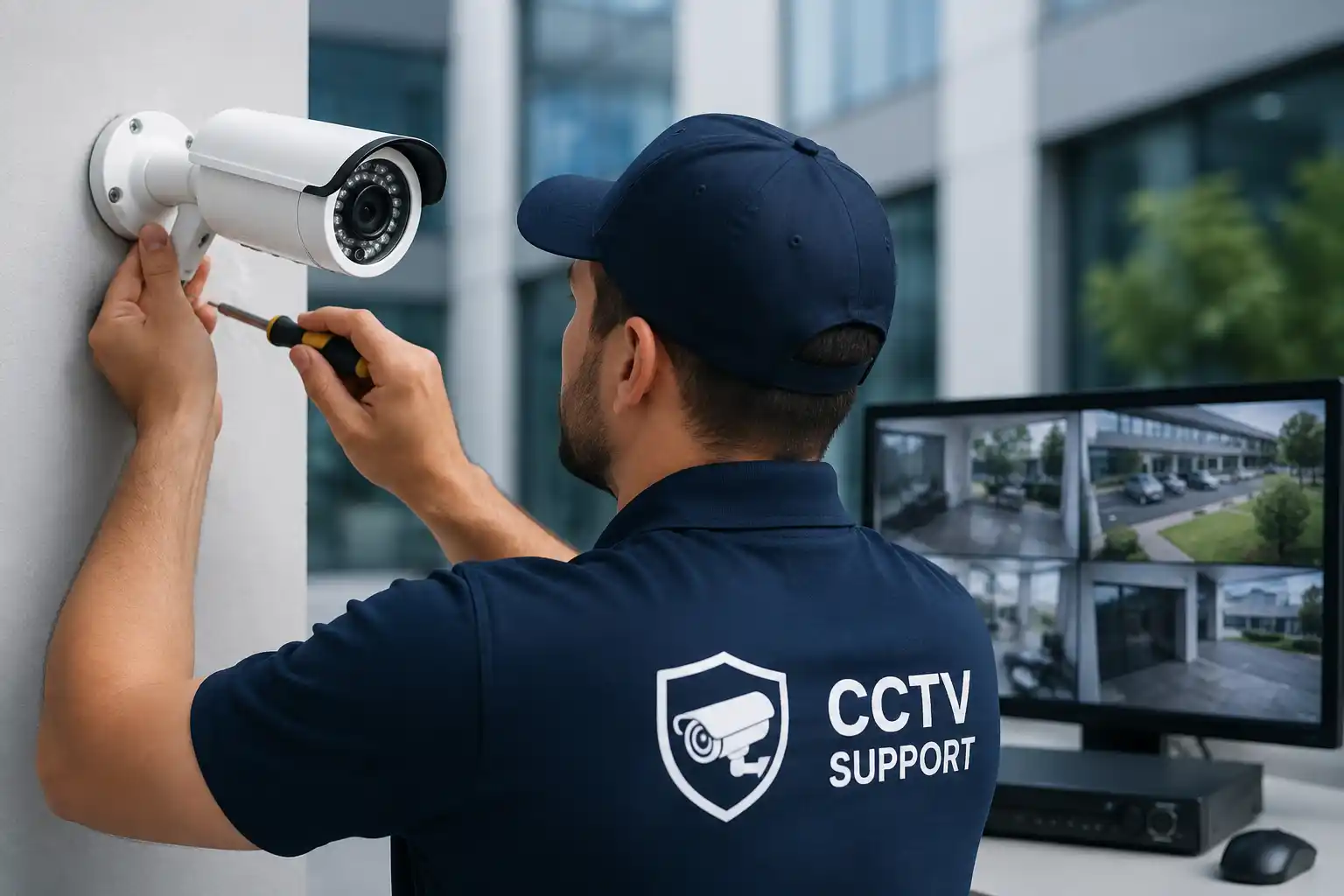
Availability, image quality, focus, position and environmental condition.
Recorder health, channel status, storage behaviour and playback checks.
PoE, switching, addressing, bandwidth and connectivity where applicable.
Authorised users, remote viewing, documentation and follow-up priorities.
What does a CCTV health check do?
A CCTV health check is a practical review of an installed surveillance environment. It is mainly used to find operational weaknesses before they result in missing video, unavailable cameras, poor incident evidence, full or failing storage, inaccessible remote viewing or repeated service calls. It can be useful for businesses with an older system, recurring faults, recent network changes, new site management, unclear maintenance records, camera additions or concerns about whether recordings can actually be retrieved when needed.
Before work is confirmed, the customer should be ready to identify the site, approximate camera count, recorder type, known symptoms, recent changes, business-critical areas and authorised access arrangements. A useful review may involve cameras, recorder channels, storage drives, network switches, PoE power, structured cabling, monitors, mobile or desktop viewing, date and time settings, account permissions and supporting network services. The exact scope remains environment dependent and should be agreed before intrusive testing, configuration change or equipment replacement is carried out.
Why a working live view does not always mean the CCTV system is healthy
A live camera picture proves only that one video path is available at that moment. It does not by itself confirm that the recorder is saving the correct stream, that all channels are recording continuously, that motion schedules are suitable, that storage is retaining footage for the intended operational period, that timestamps are accurate or that remote users can retrieve evidence securely. A health check looks beyond the immediate live image and follows the path from camera to recorder, storage, playback and authorised viewing.
This distinction matters because surveillance problems are often discovered late. A camera may have been pointed away from its useful scene after maintenance work. An IP camera may be reachable but intermittently disconnect because of a cable or switch-port problem. A recorder may show no obvious warning even though one drive is reporting errors or recording retention has reduced because resolution, frame rate or camera count changed. A mobile application may still connect through an old shared account even though user access should be reviewed. None of these situations should be diagnosed from one symptom alone; they need evidence and controlled testing.
For a business, the purpose of the health check is therefore not simply to produce a list of faults. It is to create a clearer operating picture: which cameras are dependable, which areas need corrective work, whether recording can be validated, which dependencies are outside the camera itself and which maintenance actions should be prioritised. That gives management a better basis for deciding whether to repair, reconfigure, replace, document or monitor particular parts of the environment.
What the health check may cover
Depending on the confirmed scope, FourTeck may review camera availability, image quality, focus, field of view, mounting condition, power, PoE delivery, cabling, switch connectivity, IP addressing, recorder registration, recording status, storage utilisation, playback, date and time consistency, display output, user access, remote viewing and system documentation. Configuration changes, repairs, replacement work or additions should be separately identified and approved where required.
Who may need the service
The service may suit an office manager who has inherited an undocumented camera system, a facilities team receiving repeated camera complaints, a retailer that needs dependable incident playback, a warehouse with cameras spread across network switches, a property manager coordinating several contractors, or an IT team that wants a baseline before network, recorder or surveillance upgrades are planned. The review is also useful when no one is sure when the system was last checked.
Common signs that a CCTV environment should be checked
Intermittent or offline cameras
A camera may disappear, reconnect, freeze or show a blank feed. The underlying area could be the camera, power supply, PoE budget, cable, switch port, address conflict, recorder registration or network path. The same symptom can have different causes.
Poor or inconsistent images
Blurry footage, glare, darkness, washed-out scenes, dirty lenses, poor positioning and changing lighting can reduce the usefulness of video. A health check can separate camera-setting issues from physical positioning or environmental limitations.
Recording gaps or failed playback
A live picture may be available even when the recorder is not storing usable footage. Channel schedules, stream settings, drive health, storage capacity, date ranges and recorder status may need review before conclusions are made.
Remote viewing complaints
Users may report slow loading, failed login, missing cameras or access from one device but not another. The issue can involve permissions, the viewing application, network access, firewall policy, internet connectivity or recorder services.
Uncertain retention period
Businesses often assume footage is kept for a particular period without verifying actual storage behaviour. Camera count, resolution, frame rate, codec, recording mode and drive capacity can all influence retention.
No recent maintenance record
When no current camera list, recorder information, access record or maintenance note exists, even a small fault can take longer to isolate. A health check can create a useful technical baseline without assuming every asset needs replacement.
Business impact of unresolved CCTV faults
The operational impact of a surveillance fault depends on the area affected and the purpose of the system. A missing camera may reduce visibility at an entrance, cash counter, loading area, corridor, parking zone or stock location. Incomplete recording can make later incident review difficult. Incorrect timestamps can slow the process of matching video with access logs, transaction records or reported events. Repeated remote-viewing failures can cause managers to rely on informal workarounds rather than a controlled access process.
Unresolved faults can also create support inefficiency. Staff may repeatedly restart a recorder, unplug network equipment or share credentials because they do not know which component is responsible. Different vendors may look only at their own device and miss a dependency between camera, switch, firewall, internet connection or viewing application. A health check helps reduce that uncertainty by establishing what has been tested, what evidence was found and what should happen next. It does not guarantee that every fault can be corrected during the assessment itself; hardware, third-party services, access limitations or replacement requirements may need separate action.
Possible CCTV health-check scope
The following areas show the kinds of assistance that may be included after the environment and objective are understood. The final scope depends on camera quantity, recorder type, network design, site access, documentation, operational risk and whether the customer wants an assessment only or approved corrective work as well.
Camera checks
Camera online status, image clarity, scene relevance, focus, lens condition, physical damage visible during access, mounting concerns, day or night behaviour where practical, and obvious environmental obstructions.
Recorder and channel review
NVR or DVR channel availability, recording mode, playback checks, event or continuous schedules where relevant, time settings, alerts, basic system status and connectivity between cameras and recorder.
Storage observation
Drive visibility, available capacity, recording retention observations, overwrite behaviour, health indicators exposed by the recorder and any evidence that deeper storage testing or replacement planning is required.
Network and PoE review
Where IP cameras are used, checks may include switch connectivity, PoE availability, port status, IP addressing, duplicate-address concerns, gateway reachability and relevant network dependencies.
Access and viewing
Authorised local and remote access, user-role considerations, application reachability and account hygiene can be reviewed without publishing or requesting credentials through the public page.
Findings and priorities
The assessment can be summarised into faults, observations, risks, corrective actions, replacement considerations, documentation gaps and maintenance recommendations so decision-makers can prioritise next steps.
Service-fit matrix: what should happen next?
| Observed situation | Possible technical areas | Recommended next step |
|---|---|---|
| One camera is offline | Power, PoE, cable, port, camera hardware, addressing or recorder registration. | Start with evidence and connectivity checks; plan physical inspection if remote testing cannot isolate the fault. |
| Several cameras fail together | Shared switch, uplink, power source, recorder service, network segment or common cabling path. | Review the shared dependency before treating each camera as a separate fault. |
| Live view works but playback is missing | Recording schedule, storage, channel configuration, time range or recorder status. | Validate recording and storage behaviour; do not assume the camera itself is the cause. |
| Image is too dark or unclear | Lens, focus, lighting, exposure, camera position, dirt, scene distance or hardware limitation. | Compare configuration and physical scene conditions before recommending replacement. |
| Remote app cannot connect | Internet, firewall, account permission, application settings, recorder service or third-party platform. | Check authorised local access and internet path first, then confirm any vendor-dependent service requirement. |
| System has not been maintained for a long period | All major layers: cameras, recorder, storage, network, access, physical condition and documentation. | Use a broader baseline health check and prioritise corrective work by operational impact and evidence. |
CCTV health-check service information
| Service topic | CCTV health assessment for an existing business surveillance environment. |
|---|---|
| Main purpose | Identify faults, recording risks, access issues, maintenance gaps and practical next actions. |
| Typical systems involved | IP or analogue cameras, NVR or DVR, storage drives, displays, PoE switches, network equipment, cabling, power and viewing applications. |
| Remote support suitability | Access dependent. Remote review can help when authorised secure access and working connectivity are available. |
| On-site support suitability | Often appropriate for physical camera, cable, power, recorder, rack, view-angle or environmental checks. |
| Customer access required | Authorised access to relevant equipment, viewing interfaces and technical areas; secure credential exchange only through an approved method after authorisation. |
| Testing and validation | Scope dependent; may include live-view, recording, playback, connectivity, access and selected camera-path checks. |
| Documentation | Findings and recommended next actions can be documented according to the agreed engagement. |
| Service location | Dubai and UAE coordination, subject to location, access, scheduling and approved scope. |
| Quotation requirement | The final commercial scope depends on camera count, site conditions, access, requested depth of assessment and any corrective work. |
When remote assessment may help
Remote assistance can be useful when the recorder or management interface is reachable through an authorised method, the internet connection is working and a responsible customer contact is available. It may allow review of channel status, camera reachability, recording schedules, storage information exposed by the platform, time settings, user permissions, log information and selected network parameters. Remote work can also help narrow down whether an on-site visit should focus on a particular camera, switch, cable run or recorder component.
Remote access should not be treated as automatic. The customer must authorise it, the connection method must be acceptable to both parties and credentials should be exchanged securely after identity and permissions are confirmed. If physical testing is needed, remote access alone is not enough.
When an on-site visit is usually more useful
On-site assessment is often appropriate when the work involves camera position, focus, lens condition, enclosure damage, physical obstructions, cable continuity, PoE power, local switch ports, recorder hardware, rack access, drive replacement consideration, display problems or environmental conditions. It can also be helpful when several cameras are affected and the shared infrastructure needs hands-on inspection.
A site visit still depends on clear access arrangements. Some cameras may be mounted at height, located in restricted areas or require building coordination. Additional equipment, specialist access, replacement parts or cabling work may fall outside the initial health-check scope and should be confirmed before the work proceeds.
How the CCTV assessment and diagnostic process can be structured
Clarify whether the goal is preventive maintenance, fault diagnosis, recording verification, takeover of an undocumented system, upgrade planning or a wider review after repeated complaints.
Record the site, recorder, approximate camera count, key viewing areas, network dependencies and any devices already known to be offline or unstable.
Collect user observations, screenshots, error messages, event times, previous maintenance notes, known configuration changes and details about when the problem began or how frequently it appears.
Agree who may approve access, whether remote connectivity is allowed, which equipment areas are available and how secure credential handling will be managed.
Where practical, record existing settings, status information and observed faults first. If configuration changes are requested, backup or rollback considerations should be addressed before altering critical settings.
Follow the issue from camera and power through cabling, network, recorder, storage and viewing path rather than assuming a fault belongs to the first device that shows a symptom.
A failed playback test is different from a recommendation to improve camera positioning. Findings should make that distinction so corrective work is based on evidence.
Immediate operational faults, recurring reliability concerns, security-access issues, maintenance needs and longer-term upgrade options can be grouped by impact and dependency.
Repairs, configuration changes, replacements, cabling or upgrades should proceed only when they are authorised and included in the agreed scope or an approved follow-on quotation.
Re-test the affected function, record what changed, note any remaining limitation and identify the next maintenance or upgrade action where required.
Capability focus 1: verifying that cameras provide useful operational coverage
A camera can be technically online but operationally weak. The image may be out of focus, partially blocked, badly affected by glare, pointed too high, aimed at an outdated scene or unable to provide the detail the business expects from that location. During a health review, image usefulness should be considered in relation to the business purpose of each important view. An entrance camera, loading-bay camera, cashier-area view and general corridor view may all have different practical expectations.
This does not mean every image problem can be solved by changing settings. Lighting, distance, lens choice, mounting height, weather exposure and the physical camera capability can set limits. A night image that is consistently weak may need a scene or equipment review rather than repeated brightness changes. A camera positioned behind dirty glass may need a physical maintenance action. A wide view may be useful for general activity while still being unsuitable for close detail. The health check should therefore document the limitation before recommending a specific corrective route.
For the business, better visibility begins with knowing which views are dependable. A camera list that marks critical scenes, known blind spots, current faults and any physical access constraint makes later maintenance easier. It also helps prevent an upgrade project from becoming a simple camera-for-camera replacement without checking whether the original coverage design still fits the way the site operates.
Capability focus 2: checking the full recording and storage chain
Recording verification is one of the most important differences between a casual visual inspection and a proper CCTV health check. A business should not rely only on the live screen. The review may need to confirm that selected channels are actually recording, that playback works for relevant time periods, that the displayed date and time are sensible and that the recorder is not showing storage or channel warnings that have been ignored.
Retention is environment dependent. The amount of video stored is influenced by camera count, stream settings, resolution, frame rate, codec, motion behaviour, recording schedule, available drive capacity and the health of the storage subsystem. If the customer has a specific operational retention objective, it should be discussed and validated against the current environment rather than assumed. A change such as adding cameras or increasing resolution can shorten retention even when no drive fails.
Storage hardware also deserves careful treatment. Health indicators visible through the recorder can support assessment, but they may not prove that a drive is free from all future failure risk. Where storage appears unstable, replacement planning, backup of configuration and controlled maintenance may be needed. If the recorder or drive vendor has a specific diagnostic process, that may need to be followed. The health-check outcome should distinguish between current evidence, maintenance recommendations and any component that requires specialist or vendor-dependent follow-up.
Capability focus 3: understanding CCTV as part of the business network
IP surveillance depends on more than cameras and a recorder. Cameras may receive power from PoE switches, use addresses assigned manually or through a network service, send video across switching infrastructure and rely on gateways, DNS, firewall policies or internet connectivity for selected remote functions. A fault in one of these shared layers can affect several cameras at once. Treating every offline camera as a failed camera can therefore waste time and create unnecessary replacement cost.
A health check can look for practical signals such as multiple devices disappearing from one switch, a link that repeatedly negotiates poorly, duplicate addressing, insufficient PoE availability, an unstable uplink, a recorder that has been moved to a different network segment or remote access that stopped after firewall or internet changes. The exact tests depend on the network design and available authorisation. Any change to business network settings should be controlled because surveillance may share infrastructure with other operational systems.
Network review also supports maintainability. If camera addresses, switch locations and recorder connections are undocumented, future troubleshooting is slower. A simple mapping of cameras to network areas, where available, can help IT teams and facilities teams coordinate without guessing which vendor owns the problem. FourTeck’s broader business IT support approach is relevant here because CCTV performance can depend directly on the same network, power and access environment used by other business services.
Dependencies, access and customer inputs
A useful health check depends on access to the right information and equipment. The customer does not need perfect documentation before requesting assistance, but several details can make the assessment more efficient. These include the physical site, main business concern, approximate camera count, recorder location, critical views, known offline channels, recent network or building work, previous contractor involvement, remote-viewing method and whether an authorised site contact is available.
Administrative access may be required to review recorder settings, user roles, storage information or network configuration. Credentials should not be entered into a public enquiry or shared casually. FourTeck can confirm an approved secure method after the customer’s identity and authorisation are established. Where a third-party cloud relay, mobile application, internet provider or vendor portal is involved, the customer may also need to confirm account ownership or subscription status.
Physical access can be equally important. Cameras may be installed above ceilings, outdoors, at height, inside restricted rooms or in tenant-controlled areas. Recorder cabinets may be locked, network switches may be in separate communications rooms and some cable routes may be inaccessible without building permission. These factors can affect what is practical during the first visit. If ladders, lifts, special access, replacement drives, new cabling or other project work is required, it should be identified separately in the quotation or follow-up plan.
Risk, limitation and exclusion guidance
A health check improves visibility into the current condition of the CCTV environment, but it does not remove every future risk. Diagnosis depends on available evidence, equipment access and the behaviour of the system while it is being tested. Intermittent faults may need monitoring or repeated observation. Hardware can fail after a successful test. A camera or recorder that appears operational may still have age-related or environmental risks that require planned replacement.
Some corrective actions may also sit outside the assessment scope. Failed cameras, storage drives, power supplies, PoE switches, network equipment or cable runs may require parts and installation work. High-mounted cameras can require special access. Third-party remote-viewing services or vendor accounts may depend on platform availability and customer ownership. Unsupported or legacy systems may offer limited diagnostics or replacement compatibility. Changes to recorder, network or access settings may require a maintenance window, configuration backup and rollback plan.
The service should not be interpreted as a guarantee of evidence availability, data recovery, complete security or future uptime. Where recording has already been lost, recovery may not be possible. Where security settings are improved, that reduces certain risks but does not make the entire environment immune to compromise. Final commercial terms, exclusions, parts, travel, access arrangements and corrective work depend on the approved quotation or service agreement.
Business environments where a health check can be useful
Retail and customer-facing locations
Retail sites may depend on clear coverage around entrances, point-of-sale areas, stock movement and customer zones. A health review can help identify cameras that no longer show the intended scene, recording channels with gaps or remote access that has become unreliable after internet or network changes.
Warehouses and logistics operations
Large spaces can involve many cameras, long cable routes, multiple PoE switches and different lighting conditions. A systematic assessment helps separate local camera faults from shared network or power dependencies and can support future expansion planning.
Professional offices and clinics
Businesses may need reliable common-area, reception or perimeter visibility without treating CCTV as an isolated security appliance. Recorder access, network impact, user permissions and maintenance responsibility often need to be clearer when several departments are involved.
Hospitality and property-management sites
Distributed cameras and shared building infrastructure can involve facilities staff, IT teams, security operators and external vendors. A health check can create a common list of faults and dependencies before follow-up work is assigned.
Multi-branch businesses
Different branches may use different recorder models, network designs or remote-viewing methods. A consistent assessment framework can help identify where the environment can be standardised and where site-specific limitations must remain.
Sites preparing for change
A business planning a recorder upgrade, camera addition, office renovation, network refresh or takeover by a new facilities team can use the health check as a current-state baseline before the change is designed.
Before you contact FourTeck: information that helps define the assessment
Providing the following information does not commit the customer to a particular solution. It helps determine whether the first stage should be remote review, an on-site visit or a broader maintenance assessment.
- The CCTV site location and the main on-site contact person.
- Approximate number of cameras and whether they are IP, analogue or a mixed environment if known.
- Recorder type, model or platform details if available.
- The specific symptoms: offline camera, poor image, no playback, short retention, remote-viewing issue or general maintenance concern.
- When the issue started and whether it is constant or intermittent.
- Any recent changes to the network, internet service, firewall, switch, recorder, camera layout or building works.
- Which cameras or viewing areas are operationally most important.
- Whether local recorder access is available and who can authorise it.
- Whether secure remote access is permitted by the customer’s policy.
- Any known storage warnings, failed drives, unexpected restarts or recording gaps.
- The current remote-viewing method and which authorised users are affected.
- Existing network or camera documentation, if any.
- Physical access restrictions such as locked rooms, ceiling access, outdoor areas or cameras mounted at height.
- The business impact and whether a particular maintenance window is preferred for disruptive testing.
- Whether the objective is assessment only, corrective work, maintenance planning or preparation for an upgrade.
Checklist for confirming the service and quotation scope
- Confirm the main outcome expected from the health check.
- Confirm the approximate camera and recorder count.
- Confirm whether the assessment covers one site or multiple locations.
- Confirm whether network and PoE troubleshooting are included where relevant.
- Confirm whether remote review, on-site work or both are expected.
- Confirm physical access limitations and any special site-entry requirements.
- Confirm whether configuration changes are permitted during the first engagement.
- Confirm whether replacement parts, cabling or installation work are excluded from the assessment and quoted separately.
- Confirm which testing and playback checks are required.
- Confirm the level of documentation or findings report expected.
- Confirm whether vendor or internet-provider coordination may be needed.
- Confirm whether the customer wants a follow-on maintenance, upgrade or corrective-action quotation after the findings are reviewed.
Questions Dubai businesses commonly ask before arranging a CCTV health check
Can a CCTV health check be done remotely?
Part of the assessment may be possible remotely when the customer has a working internet connection, authorised secure access to the recorder or management platform, and someone available to confirm the physical condition of equipment if needed. Remote work can help review camera status, channel configuration, storage information, recording schedules, playback, user permissions and some network details. It cannot replace hands-on testing when the suspected issue involves power, PoE, cabling, connectors, camera focus, physical damage, mounting, weather exposure or a recorder that cannot be reached online. A practical approach is often to begin with available evidence and use remote access to narrow the fault, then arrange an on-site visit only where the remaining checks genuinely require it.
When is an on-site CCTV inspection usually necessary?
An on-site inspection is usually more useful when the health concern involves the physical path of the system. Examples include one camera that repeatedly loses power, several cameras connected to the same switch becoming unstable, unclear images caused by lens condition or mounting, damaged outdoor enclosures, cable faults, recorder hardware warnings, local display problems or cameras that need their real field of view checked. Site access is part of the scope: cameras at height, locked equipment rooms, ceiling spaces and restricted business areas can require coordination. The visit should therefore be planned around the areas that actually need physical access rather than assuming every camera must be disturbed.
How do we know whether a camera problem is really a camera fault?
You cannot always tell from the symptom alone. An offline IP camera may have a failed camera, but it may also have lost PoE power, developed a cabling fault, been moved to a different address, lost its switch connection or failed to register correctly with the recorder. If several cameras go offline together, a shared network or power dependency becomes more likely. A structured health check follows the path from camera through power, cable, switch and recorder so the recommendation is based on evidence. This matters because replacing a camera will not solve a failed cable or switch-port problem, and changing network settings unnecessarily can create new issues elsewhere.
Should we arrange a health check if live view is working?
Yes, if there are concerns about recording, maintenance, image quality, retention, remote access or the age and condition of the wider system. Live view confirms only that a picture can be displayed at that moment. It does not automatically confirm that footage is being stored for the intended period, that playback is available from every critical channel, that timestamps are correct or that storage is healthy. A preventive review is particularly useful when the system has not been checked for a long time, the site has changed, camera count has increased or responsibility for the CCTV environment has moved to a new manager or service provider.
What information should we prepare before requesting a quotation?
Start with the site location, approximate number of cameras, recorder type if known, main symptoms, how many cameras are affected and whether the system is still accessible locally. Note recent changes such as a new internet line, firewall replacement, switch upgrade, building renovation, power work, recorder change or additional cameras. If the problem is recording related, explain which dates or channels could not be played back. If remote viewing is affected, identify whether all users or only one authorised user has the issue. Also confirm whether the customer can provide authorised equipment and management access. This information helps define whether the engagement is a targeted fault check or a broader site health assessment.
Is a CCTV health check the same as preventive maintenance?
They overlap, but they are not always the same engagement. A health check is typically a current-state assessment: it establishes what is working, what is not, where risk or maintenance gaps exist and what actions should be prioritised. Preventive maintenance is usually recurring and may include scheduled camera cleaning, visual inspection, recorder checks, storage review, connectivity testing and documentation updates according to an agreed plan. A business that has no recent maintenance history may start with a health check, then use the findings to decide whether periodic maintenance is appropriate. Actual recurring tasks and frequency should be defined in the service agreement rather than assumed.
Can the health check tell us whether we should repair or replace equipment?
It can support that decision, but replacement should follow evidence and operational requirements. A camera may be repairable or recoverable through power, cabling or configuration work. Another camera may still work but no longer provide a useful image for the scene. A recorder may be functional yet limited by storage capacity, available channels or compatibility with planned additions. The assessment can identify these trade-offs and separate urgent failures from lifecycle improvements. Final replacement recommendations depend on the condition of the current device, compatibility, availability of suitable parts or replacements, the customer’s intended retention and viewing needs, and the broader network or infrastructure plan.
What can affect the final service scope in Dubai?
Camera quantity, site size, system age, recorder platform, network design, equipment accessibility, working hours, physical height, building permissions and the depth of testing all affect the scope. A small office with one recorder and accessible cameras is different from a warehouse with multiple switches, outdoor cameras, long cable routes and restricted operational zones. Travel, site-entry requirements, maintenance windows, replacement parts and third-party vendor access can also influence the plan. FourTeck can confirm whether remote review, on-site assessment or a staged approach is more appropriate once these details are known. Service timing should be agreed from the confirmed scope rather than assumed from the page description.
What should happen after the health check?
The next step depends on the findings. A healthy system may need only documentation updates and a future maintenance schedule. A system with minor issues may need camera cleaning, focus adjustment, permission review or selected configuration corrections. More serious findings could require cable repair, switch or PoE work, recorder storage replacement, camera replacement, network changes or an upgrade plan. The important point is to separate assessment from unapproved change. Findings should be explained, priorities agreed and any corrective work or project activity clearly included in a quotation before it proceeds.
Can FourTeck check both CCTV and the network that supports it?
Where IP cameras depend on business switching, PoE, addressing, firewall or internet connectivity, a joined-up review can be useful because the camera and the network are not independent. The extent of the network review should still be defined. A targeted CCTV assessment may only need to confirm relevant switch ports and connectivity, while a wider network problem may justify a separate support scope. Customers can review FourTeck’s IT service areas and discuss whether the CCTV issue should be treated as a surveillance fault, a network fault or a combined assessment.
How should we handle passwords and administrator access?
Do not place passwords, recovery codes or private credentials in a public website form or ordinary page content. First confirm who is authorised to request the service and what access is genuinely required. FourTeck can then agree an approved secure method for temporary or controlled credential exchange. Where possible, access should be limited to the task, recorded and reviewed after the work. Shared administrator accounts, unknown ownership or former-contractor credentials should be treated as a maintenance concern rather than ignored. If access cannot be established safely, the assessment may be limited until account ownership or vendor recovery procedures are resolved.
When should a business consider recurring CCTV maintenance after the assessment?
Recurring maintenance becomes useful when the surveillance system is operationally important, cameras are exposed to dust or weather, the site changes frequently, there are many cameras or switches, recording retention must be watched, or repeated faults have shown that informal checks are not enough. The maintenance plan should be shaped around the actual environment rather than a generic frequency. It may include scheduled camera condition checks, recorder and storage review, playback validation, access review, documentation updates and reporting. The agreed contract should clearly state which tasks, visits and exclusions apply, because a health-check recommendation does not by itself create unlimited ongoing support.
How FourTeck can assist after the assessment
FourTeck can help turn health-check findings into a practical action plan. That may mean clarifying the reported fault, identifying whether the affected layer is camera, power, cable, network, recorder, storage or access, and then separating what can be corrected through configuration from what needs physical repair or replacement. Where another provider controls the internet service, building cabling, cloud platform or specialist equipment, FourTeck can help organise the technical information needed for vendor coordination rather than assuming one contractor can control every dependency.
If corrective work is approved, the plan may include camera reconfiguration, addressing changes, recorder settings, user permissions, network checks, replacement coordination, storage work, testing and documentation. Each change should be appropriate to the current environment and authorised scope. For larger changes such as recorder upgrades, new camera additions or network redesign, it may be safer to prepare a separate project plan with prerequisites, compatibility checks, maintenance window, validation steps and rollback considerations.
The aim is to make the CCTV environment easier to support after the visit. Clear findings, known dependencies and recorded next actions help office managers, security users and IT teams understand what remains unresolved and who needs to act. Customers who want to understand FourTeck’s broader support approach can review the FourTeck IT Services overview before defining a follow-on engagement.
Dubai and UAE service coordination
For CCTV health checks in Dubai and wider UAE locations, remote or on-site assistance depends on the issue, site access, system availability, urgency and approved quotation. An on-site visit may be recommended when the assessment requires physical camera inspection, cabling, power, recorder hardware access, coverage review or equipment that cannot be reached remotely. Remote work may be appropriate for selected configuration, playback, storage, access or network checks when authorised connectivity is available.
Service timing depends on engineer availability, customer access, building rules, site conditions, required equipment, third-party providers and the confirmed work scope. Customers should identify any restricted areas, preferred maintenance windows and site-entry requirements before scheduling. Installation, repair, replacement, configuration change or maintenance tasks that sit beyond the health-check assessment should be clearly included in the quotation before work begins.
Combined coordination for Dubai, Abu Dhabi, Sharjah and Ajman
FourTeck can coordinate CCTV assessment, remote troubleshooting, planned site visits and related IT support for businesses in Dubai, Abu Dhabi, Sharjah and Ajman according to the confirmed scope. The practical service plan may vary by location because travel, access, working hours, camera placement, building permissions, equipment availability and third-party dependencies are different from site to site. Multi-site customers should provide one clear list of locations, recorder types, camera counts and priorities so the assessment can be planned efficiently instead of treating every branch as an unrelated request.
Related FourTeck IT services
Discuss corrective work, maintenance planning, camera issues, recorder checks and follow-on support after a health assessment.
IP camera supportUseful where camera performance depends on PoE, switching, addressing, recorder registration and network connectivity.
Network supportRelevant when surveillance faults appear to involve switches, uplinks, IP configuration, internet access or shared infrastructure.
IT support consultationUse the contact page to describe the site, reported symptoms and whether you need assessment, troubleshooting or a wider maintenance review.
Why businesses contact FourTeck for a CCTV health assessment
A surveillance problem often crosses technical boundaries. A camera depends on power, cabling, network reachability, recorder configuration, storage and authorised user access. FourTeck’s service approach is useful when the customer wants those dependencies considered together rather than moving from one contractor to another without a shared diagnosis. The process begins by clarifying the business concern and the affected part of the environment, then choosing remote or on-site checks according to what evidence is available.
Businesses may also contact FourTeck when they need a clearer technical record. An undocumented recorder, unknown camera addresses, inconsistent user access and unclear maintenance history all make future support harder. A structured health check can identify what should be documented now and what needs a separate project. The value is in practical findings, clear scope and safer next actions, not in unsupported claims that every system can be repaired immediately.
For customers comparing service options, the most useful next step is to describe the current environment and the decision you need to make. If the aim is simply to restore one camera, say so. If the aim is to verify recording across an entire site, that is a broader engagement. If management is preparing for an upgrade or maintenance contract, the health check should collect enough evidence to support that planning. Contact FourTeck IT Services to confirm what level of assessment is appropriate.
Frequently asked questions
What does the health check include?
It can include camera status, image quality, recording, playback, storage, network, PoE, access and physical observations. The exact checklist depends on the system design and confirmed quotation.
Can you check an NVR or DVR?
Recorder review may form part of the assessment where access is available. Checks can include channel status, recording behaviour, playback, time settings, storage information and visible warnings.
Will the assessment repair every fault?
Not necessarily. Some faults can be corrected during an approved scope, while hardware replacement, cabling, access equipment, parts or larger configuration changes may require separate approval.
Can recording retention be verified?
The current retention behaviour can be reviewed, but it depends on camera count, recording settings, storage capacity, drive condition and how the recorder manages old footage.
Do you need administrator credentials?
Certain checks may require authorised administrative access. Credentials should be shared only through an approved secure method after identity and permission are confirmed.
What if some cameras are mounted at height?
Physical access requirements should be identified before the visit. Special access equipment or building coordination may need separate planning and may not be included in the initial assessment.
Can the health check cover remote viewing?
Yes, where authorised and relevant. Remote-viewing problems may involve accounts, the viewing application, recorder services, firewall settings, internet connectivity or a third-party platform.
Can you assess an older CCTV system?
An older system can be assessed, but available diagnostics, parts and compatibility may be limited. The findings can help decide whether repair, staged replacement or upgrade planning is more practical.
Do you provide a maintenance plan after the review?
Maintenance recommendations can be discussed from the findings. Any recurring tasks, visit frequency, exclusions and commercial terms should be defined in a separate service plan or quotation.
How do we request a CCTV health check in Dubai?
Share the site location, camera count, recorder details, known symptoms, recent changes, access constraints and whether you prefer remote or on-site assessment. FourTeck can then confirm the service scope and quotation.
Request a CCTV health check based on your actual site
Send FourTeck the location, approximate camera count, recorder details, known faults, access limitations and the business outcome you want from the assessment. The service can then be scoped around the current CCTV environment rather than a generic checklist. Remote and on-site options, corrective work, documentation and any follow-on maintenance or upgrade requirements can be confirmed in the quotation.