
SURVEILLANCE SYSTEM HEALTH, RECORDING AND VIEWING SUPPORT
CCTV Monitoring Dubai in Dubai, UAE
A surveillance system can show live pictures and still fail when footage is needed. CCTV monitoring support focuses on the full path from camera and power to recorder, storage, network, authorised viewing and routine verification. FourTeck helps Dubai businesses assess whether their CCTV environment is operating as intended, investigate faults and define practical maintenance or corrective work without assuming the cause before the system is checked.
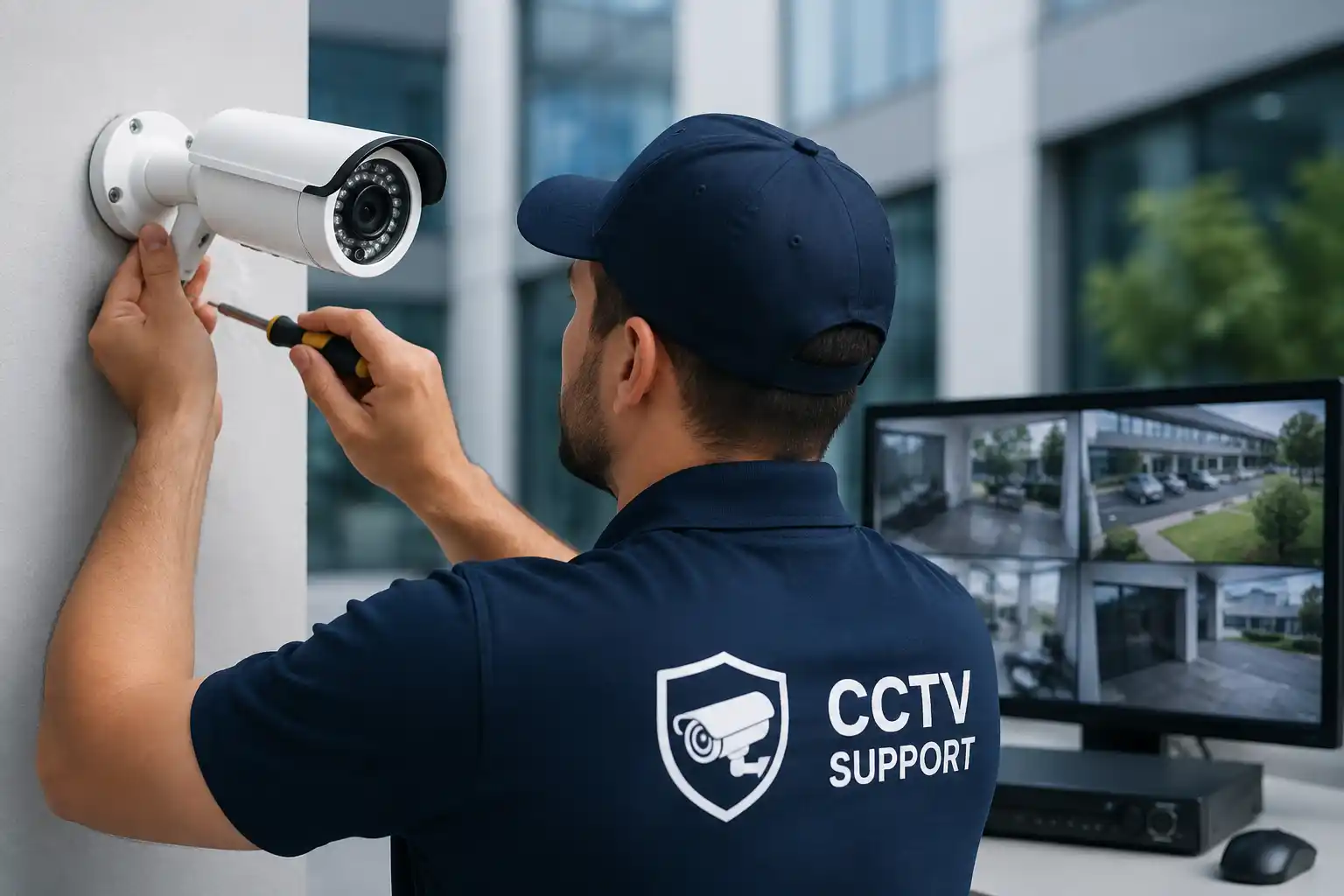
The useful question is not simply whether a camera is powered. It is whether the required scene is visible, recorded at the right time, retrievable, protected by suitable access controls and supported by a maintainable network and storage path.
Confirm footage is actually being stored.
Review authorised local and remote viewing.
Camera, power, cabling, network, recorder and storage.
Remote or on-site work depends on the fault.
What CCTV monitoring support means for a business
CCTV monitoring support is the technical work required to keep surveillance video available for authorised live viewing, recording, playback and remote access according to the customer’s intended use. It may involve cameras, analogue or IP video paths, DVR or NVR recorders, storage drives, PoE switches, power supplies, cabling, time settings, user permissions, network addressing, internet access and viewing applications. A problem at any one of these layers can affect what users see or what the recorder stores.
Businesses should consider this service when cameras appear offline, playback is missing, the recorder reports storage problems, remote viewing is unstable, footage has the wrong time, video quality no longer meets the intended purpose, or nobody is certain whether the system is recording correctly. It is also relevant when a site has inherited an undocumented CCTV installation or has added cameras over time without a structured health review.
Before work can be confirmed, FourTeck needs a clear description of the required monitoring outcome, the site location, the number of affected cameras, the recorder or platform where known, the symptoms, recent changes and the administrative access available. Customers should not publish or email passwords unnecessarily; credentials should be shared only through an approved secure method after authorisation is confirmed. The exact support method, schedule and quotation depend on access, site conditions, equipment condition, third-party systems and the agreed scope.
Monitoring begins with the question: what must be available when an incident occurs?
A CCTV environment is not valuable merely because a monitor shows several camera tiles. The operational test is whether the required view is available when the business needs to confirm an event, review a sequence or understand activity at a location. That requires more than a working camera. The camera must receive suitable power, send video through the expected path, use correct date and time information, remain registered to the recording platform, write to healthy storage, and allow authorised users to locate and play back the footage.
For some organisations, the main need is a reception or security desk that watches selected cameras during working hours. For others, the priority is unattended recording that can be reviewed after an incident. A multi-branch company may care most about authorised remote access to several recorders. A warehouse may focus on loading areas and overnight recording, while a retail operation may need confidence that entrances, counters and stock areas remain covered. These are different monitoring requirements, so the service scope should begin with the business purpose rather than a generic list of camera features.
FourTeck’s role is to help translate that purpose into technical checks and support actions. Where the customer expects continuous human observation, alarm handling or a formal manned monitoring service, that requirement should be stated explicitly and confirmed separately. This page describes technical CCTV monitoring support and system readiness; it does not promise a staffed twenty-four-hour surveillance desk or emergency response service.
Common signs that a CCTV monitoring environment needs attention
Live view works, playback does not
A camera can display live video while recording is stopped, the schedule is incorrect, storage is unavailable or the expected stream is not being written. Playback should be tested independently of live view.
One or more cameras disappear
Offline alerts can relate to power, cabling, PoE, switch ports, addressing, camera failure, recorder registration or network changes. Replacing the camera before checking the path may miss the actual fault.
Remote viewing is unreliable
Local recording may continue even when remote access fails. Internet service, firewall rules, platform status, account permissions, certificates, addressing or application settings may all affect external viewing.
Footage has the wrong time
Incorrect time, time-zone settings or loss of synchronisation can make incident review difficult. The recorder and cameras should be checked so timestamps match the required operational reference.
Images are dark, blurred or washed out
Lighting, reflections, dirty covers, focus, exposure, mounting angle, stream settings or hardware limitations can affect useful detail. Daylight and night conditions should both be considered.
Storage warnings appear
A full or unhealthy storage device can reduce retention or stop recording. Capacity, disk status, recording mode and actual retention should be reviewed rather than assumed from nominal disk size.
The same symptom can come from different technical layers. A frozen picture may be caused by a camera, a weak link, network congestion, recorder load or a viewing application. A blank playback period may relate to storage, schedule, stream availability or the requested search time. Diagnosis should therefore follow evidence rather than a single assumption.
Business impact when surveillance is not being verified
Surveillance failures often remain hidden because the system is not used continuously by every employee. An office may discover a failed camera only after property goes missing. A shop may find that a recorder stopped writing several days earlier. A warehouse may have video from the wrong angle, while a building manager may discover that remote access credentials belong to a former user. The operational problem is not merely a technical alert; it is uncertainty about whether the organisation can use the system for the purpose it expected.
Unverified CCTV can also create avoidable support cost. Staff may repeatedly reboot a recorder without understanding why storage is failing. Cameras may be replaced when the real problem is a damaged cable or insufficient PoE power. Remote access may be made less secure through broad changes because nobody has documented the correct method. When monitoring depends on a network shared with other business services, an unmanaged change can affect phones, Wi-Fi or other devices as well.
A structured review reduces this uncertainty by establishing what is working, what is not, which cameras are business-critical, how footage is retained, who can view it and what must be corrected. The goal is not to claim that a surveillance system can prevent every incident. The goal is to make its technical condition visible enough that management can make informed maintenance, replacement and access decisions.
What the service may cover
Depending on the confirmed scope, CCTV monitoring assistance may include an initial consultation, remote review, on-site inspection, camera status checks, recorder health checks, playback verification, storage review, time and recording-schedule checks, authorised remote-viewing support, network connectivity testing, PoE and power checks, cabling inspection, user-permission review, image-quality assessment, coverage observations, corrective configuration, documentation and preventive recommendations. Installation, replacement, migration or expansion work can be quoted separately or included when clearly defined.
| Business situation | Possible technical areas | Recommended next step |
|---|---|---|
| Footage is missing for a required period | Recording schedule, storage health, stream availability, time settings, recorder events | Preserve available evidence and assess the recorder before making broad changes. |
| Camera repeatedly drops offline | Power, PoE, cable, connector, switch port, IP address, camera hardware, recorder registration | Trace the path from camera to recorder and compare the fault pattern with network and power conditions. |
| Remote viewing stopped after a network change | Firewall, internet addressing, platform account, certificates, application configuration, recorder network settings | Review the approved access method and recent changes without exposing the recorder unnecessarily. |
| Management is unsure which cameras still record | Camera inventory, recording status, playback sampling, naming, storage, time and retention | Carry out a structured health review and document verified camera-to-recorder relationships. |
| The site needs additional views | Coverage purpose, mounting, lighting, cabling, PoE, network bandwidth, recorder compatibility and storage | Assess capacity and prerequisites before adding devices or changing the recording design. |
Service information at a glance
| Main purpose | Assess the technical readiness of CCTV for live viewing, recording, playback, authorised remote access and maintainable operation. |
|---|---|
| Typical systems involved | IP or analogue cameras, DVR/NVR, storage, PoE switches, power supplies, cabling, monitors, network equipment and approved viewing applications. |
| Remote support suitability | Useful when the system is reachable through an authorised method and the issue relates to configuration, playback, logs, users or remote access. Access dependent. |
| On-site support suitability | Often required for camera inspection, cabling, power, PoE, storage hardware, mounting, environmental checks and physical coverage review. |
| Customer information required | Site, affected cameras, symptoms, recorder details where known, recent changes, business impact, access availability and expected monitoring outcome. |
| Testing and validation | Scope dependent; may include live view, recording, playback, time, storage status, remote access and selected camera-path tests. |
| Security considerations | Authorised accounts, appropriate permissions, controlled remote access and protection of administrative credentials. |
| Service location | Dubai and UAE coordination subject to location, access, scheduling, engineer availability and approved scope. |
| Quotation | Required scope depends on current environment, equipment condition, access, number of cameras, corrective work and third-party dependencies. |
Can CCTV monitoring be checked remotely?
Some monitoring problems can be investigated remotely when the customer has working internet access, the CCTV system is reachable through an approved secure method, authorised administrative access is available and a responsible user can confirm what is happening at the site. Remote support may be useful for checking recorder status, reviewing configuration, testing playback, verifying recording schedules, examining user permissions, reviewing remote-viewing settings and gathering logs or screenshots. It can also help determine whether a physical visit is necessary before time is spent travelling to site.
Remote support has limits. It cannot confirm a loose connector by touch, inspect a damaged outdoor camera housing, measure conditions at a mounting point, replace a failed disk, verify a PoE port physically or clean a lens. If the recorder itself is unreachable, the network path is down, the system has lost power or the customer cannot provide authorised access, remote work may be restricted to guidance and information gathering.
When is an on-site visit usually needed?
An on-site visit is often appropriate when the issue involves camera hardware, mounting, cable routes, power supplies, PoE switches, connectors, storage drives, rack equipment, local display output or physical viewing conditions. It may also be needed when several cameras are affected, the system is undocumented, the site has inherited equipment from a previous tenant, or management wants a coverage and condition assessment rather than a single fault fix.
The visit should be planned around access to camera locations, ceilings, racks, secure rooms and any building-management restrictions. Ladders, lifts, permits, escorts or other site arrangements may be required depending on the camera positions and property rules. These requirements should be identified before the appointment because they can change what an engineer can safely inspect during one visit.
How FourTeck approaches a CCTV monitoring assessment
Confirm whether the concern is live viewing, missed footage, remote access, storage, image quality, camera availability, expansion or a maintenance review.
Identify affected cameras, users, sites, time periods and business areas. A single camera fault is different from a recorder-wide issue.
Gather camera names, recorder model where available, screenshots, error messages, recent changes, playback examples and storage warnings.
Check that the customer can approve access to the recorder, network and viewing platform. Protect credentials and existing settings.
Follow the video path from camera and power through cabling or network to recorder, storage, display and authorised remote viewer.
Compare symptoms with power, link status, addressing, recorder events, disk condition, schedule, time, image settings and access controls.
Explain what can be corrected, what needs replacement or third-party action, and what should be scheduled to reduce operational risk.
Retest the agreed functions, note remaining limitations and record useful camera, recorder, access and maintenance information.
A camera-to-storage view helps isolate faults faster
Monitoring problems are easier to understand when the surveillance chain is separated into layers. At the edge is the camera and its local environment: lens condition, mounting, lighting, enclosure, power and physical connection. The next layer is transport, which may include coaxial cabling or Ethernet, PoE, network switches, IP addressing and uplinks. The recorder layer receives streams, applies schedules, manages time and writes data. Storage determines how much history can be retained and whether recordings can be read reliably. The viewing layer includes monitors, workstations, mobile applications and remote access. Finally, user permissions determine who can see live or recorded video.
This relationship explains why a single symptom does not identify a single cause. If a camera is visible locally but unavailable remotely, the camera and recorder may be healthy while the external access path has changed. If live view is available but playback is missing, the transport path may be fine while recording or storage is not. If several cameras connected to one switch fail together, the shared network or power component deserves attention. Mapping the symptom to the layer reduces unnecessary replacement and helps avoid changes that could affect unrelated devices.
For IP surveillance, the CCTV environment also intersects with the wider office network. Camera traffic can share switches, uplinks and infrastructure with business devices unless segmentation is used. Addressing, PoE capacity, switch health and firewall policies can therefore influence monitoring. For this reason, CCTV troubleshooting is often more effective when the technician can assess both surveillance and network dependencies rather than treating cameras as isolated appliances.
Capability focus 1: verify recording instead of assuming it
Recording verification is one of the most important monitoring tasks because a healthy-looking live screen does not prove that useful footage is being stored. A practical check should confirm that expected cameras are recording, that playback can be opened for a recent sample period, that the time is sensible, and that storage is not reporting obvious errors. Where retention matters, the actual oldest available footage should be compared with the customer’s operational requirement rather than relying only on a theoretical calculation.
Retention depends on many variables: camera count, resolution, frame rate, compression, motion or continuous recording, scene activity, storage capacity and recorder behaviour. It can change after cameras are added or stream settings are increased. FourTeck can help review these factors and explain whether the existing platform is likely to support the desired recording objective. Final retention requirements and any legal or policy obligations remain subject to the customer’s site, business use and applicable requirements.
Capability focus 2: make remote viewing controlled and supportable
Remote viewing is convenient for owners, facilities teams and authorised managers, but it should not be created by exposing a recorder without regard to security. The appropriate method depends on the platform, network, firewall, user accounts and customer policy. The service may include reviewing the current connection method, confirming which users require access, removing unnecessary shared access where practical, checking application connectivity and documenting the intended route.
If remote access stopped after a router, firewall, internet or recorder change, the investigation should establish what changed before creating new rules. Some solutions depend on vendor cloud services, subscriptions, certificates or account ownership. Those dependencies are vendor dependent and should be confirmed for the actual system. FourTeck can coordinate the technical side while avoiding unsupported claims about third-party service availability.
Capability focus 3: reduce repeat faults through maintenance visibility
CCTV systems run continuously in environments where heat, dust, vibration, changing network conditions and ageing storage can affect reliability. Preventive review can identify dirty lenses, deteriorated connectors, loose mounting, intermittent links, storage warnings, incorrect time, undocumented accounts or cameras that no longer meet the required field of view. The purpose is not to promise that maintenance prevents every failure. It is to make developing issues more visible and create a record of what should be monitored, repaired or replaced.
A maintenance plan can also reduce dependence on one person’s memory. Camera names, approximate locations, recorder details, critical views, access ownership and previous fault notes give future support a clearer starting point. The frequency and exact tasks should be defined in the agreed service plan; recurring maintenance does not automatically mean unlimited incidents, replacement parts or unrestricted project work.
Planning corrective work without creating a new surveillance problem
Once the likely issue is understood, corrective work should be planned according to business impact and change risk. A small change such as correcting a camera name may be low risk, while replacing a recorder, changing addressing, updating firmware, replacing storage or redesigning remote access can affect multiple cameras and users. Where possible, existing settings should be documented or backed up before changes that could alter system behaviour. A rollback approach should be considered when the change is significant and the platform supports it.
Replacement decisions should be based on compatibility and the required outcome. A new camera must work with the intended recorder or management platform, available power, network design and mounting conditions. A new storage drive must be suitable for the recorder and required workload. A recorder replacement may affect camera support, channel count, remote applications, storage and user workflows. These details should be confirmed before purchase or installation rather than discovered after equipment arrives.
If the customer wants to expand coverage, the design should begin with what must be observed and at what level of detail. A very wide view may show activity but not enough identifying detail for the customer’s purpose. A camera placed too high, behind reflective glass or facing strong backlight may underperform despite good specifications. FourTeck can help turn the operational requirement into a scope that accounts for camera location, environment, network, power, recording and maintenance access.
Dependencies, access and customer responsibilities
CCTV support is access dependent. The customer should identify an authorised contact who can approve work on surveillance equipment and, where required, the supporting network. Administrative access may be needed to a recorder, camera management interface, viewing platform, network switch, firewall or vendor account. Credentials should never be posted publicly. They should be exchanged only through a secure method agreed for the engagement.
Physical access matters as much as digital access. A camera mounted above a warehouse aisle, external wall, high ceiling or restricted area may require access equipment or site permission that is not automatically part of an ordinary support visit. The network cabinet or recorder may be inside a locked room. Building management may control access windows. Sites with multiple tenants may have shared infrastructure. These constraints should be disclosed when requesting service so the visit can be scoped realistically.
Third-party dependencies may include internet providers, firewall administrators, building-management teams, cloud viewing platforms, manufacturers, distributors or security contractors. FourTeck can help collect technical evidence and coordinate where this is included, but a third party may need to make the final change or supply replacement equipment. Unsupported or legacy devices may also have limited configuration, compatibility or recovery options.
Risks, limitations and exclusions to understand before work starts
A CCTV assessment can identify evidence and likely fault areas, but diagnosis depends on the access and information available. If an intermittent camera happens to work during a visit, historical logs, user observations and repeat testing may still be needed. If administrative credentials are unavailable, some recorder or camera settings may be inaccessible. Resetting a device to regain access can remove configuration, so the effect should be understood before it is attempted.
Recorded footage cannot be promised when a recorder was not writing, a disk has failed, data has been overwritten or the required period is outside the available retention. Data recovery, where relevant, is a separate specialist consideration and cannot be guaranteed. A successful playback test today also does not guarantee future recording; surveillance systems require ongoing health checks appropriate to their importance and environment.
Hardware failure may require replacement parts or new equipment outside the labour scope. A manufacturer, vendor or platform provider may control firmware, licensing, password recovery or cloud access. Site work can also depend on safe physical access, permits, lifts, building rules and customer escorts. Final commercial terms, exclusions and scheduling should be written into the approved quotation or service agreement.
CCTV systems may be subject to customer policies, property requirements and applicable authority or privacy obligations. FourTeck can support the technical environment, but the customer should confirm the requirements that apply to its premises, recording purpose, placement, retention and access. Technical configuration should not be presented as a substitute for legal or regulatory advice.
Where CCTV monitoring support can be useful
Professional offices
Reception areas, entrances, shared corridors, server or stock rooms and parking access may need dependable recording and controlled viewing by authorised staff.
Retail and showrooms
Managers may need usable views of entrances, customer areas, cash points and stock zones, together with reliable playback when an incident must be reviewed.
Warehouses and logistics
Large areas, loading zones, distant cameras, outdoor exposure and long cable or network paths create monitoring dependencies that benefit from structured inspection.
Clinics and service centres
Surveillance must be planned around operational needs and appropriate access controls, with clear responsibility for viewing and recording-system maintenance.
Hospitality and food service
Multiple public and back-of-house areas can create a large camera estate where naming, playback, storage and remote access need consistent management.
Multi-site businesses
Different recorder types, internet connections and user accounts can make support difficult. Documentation and a consistent access approach can improve maintainability.
Operational and security considerations for day-to-day monitoring
A reliable monitoring process includes people as well as equipment. Someone should know which cameras are important, who is allowed to view them, how to report an offline camera and how often recording should be checked. Shared administrator accounts can make ownership unclear, while former staff may retain access if user lists are never reviewed. Where the platform permits, individual or role-based access can make administration easier to understand.
Time accuracy deserves routine attention because video without a trustworthy timestamp is harder to correlate with access records, delivery logs, customer reports or other systems. The method used to maintain time depends on the recorder and cameras. Changes should be tested carefully, especially if the system has previously operated with inconsistent time settings.
Storage is another recurring concern. Continuous writing creates a demanding workload, and capacity is finite. The oldest available recording should be sampled periodically against the expected retention target. If retention is shorter than expected, the answer may involve capacity, recording mode, stream settings, added cameras or storage health. Increasing retention can affect budget and compatibility, so it should be planned from actual requirements.
Remote access should remain limited to authorised users and supported methods. Broad port exposure, reused passwords or unmanaged shared accounts increase risk. Where network changes are needed, they should be coordinated so cameras do not interfere with business systems and business changes do not unexpectedly break surveillance.
Before you contact FourTeck
Providing a few practical details makes it easier to decide whether the first step should be remote troubleshooting, an on-site assessment or a defined project quotation. You do not need perfect technical documentation; share what is known and identify what is uncertain.
- The Dubai or UAE service location and the type of premises.
- A main contact who is authorised to discuss the CCTV environment.
- The number of cameras affected, or the approximate total camera count if the issue is system-wide.
- The main symptom: offline camera, missing recording, playback error, storage warning, remote-access problem, poor image or another concern.
- When the problem began and whether it is constant or intermittent.
- Any recent change to internet service, firewall, network, recorder, storage, cameras or user accounts.
- Recorder or platform details where they are available.
- Examples of error messages or screenshots that do not expose sensitive credentials.
- Whether local live viewing is working and whether playback has been tested.
- Whether authorised administrative access is available to the recorder and supporting network if required.
- Any known storage warnings or required retention objective.
- Whether camera positions require special building access, ladders, lifts, escorts or work permits.
- The business impact and any critical time period that needs investigation.
- Whether the desired outcome is repair, health assessment, maintenance, expansion, documentation or a combination.
Service scope checklist for quotation and engagement
A quotation is clearer when both sides agree on the objective and boundaries. The following points can be used to define the engagement; they do not mean every item is automatically included.
- Exact monitoring or troubleshooting objective.
- Number of sites, recorders and cameras in scope.
- Current system condition and known faults.
- Remote-access availability and authorised credentials.
- On-site inspection, access equipment or building coordination.
- Storage and playback verification requirements.
- Network, PoE, cabling or firewall checks needed.
- Any camera replacement or expansion requirement.
- Required documentation, camera naming or location records.
- Testing and user acceptance expectations.
- Third-party vendor or provider coordination.
- Ongoing maintenance expectations after corrective work.
How testing and handover should work after CCTV changes
Corrective work is not complete simply because the camera tile turns green or a live image returns. The agreed business function should be tested. Depending on scope, this can include confirming live view, recording, playback, time, camera naming, remote access, storage status and the specific symptom that triggered support. If a camera was moved or replaced, the field of view should be checked in the real environment. If storage changed, recording should be observed and playback sampled after the change.
User acceptance is especially important for remote viewing. The authorised person who will actually use the mobile application, workstation or monitoring display should confirm that the expected cameras are visible and that access levels are appropriate. Administrator accounts should not be used for ordinary viewing when a more limited user role is available and suitable for the platform.
Handover can include a summary of work performed, key findings, unresolved limitations, devices replaced, settings changed, test results and recommended maintenance. For larger sites, a simple camera naming convention and location list can reduce future fault-finding time. Documentation depth is scope dependent, but even basic records are more useful than relying on memory after several technicians, tenants or network changes.
Dubai CCTV monitoring: questions businesses often ask before requesting support
Customers often begin with a simple search such as “why is my CCTV camera online but not recording?” The direct answer is that live video and recording are separate functions. The camera may be sending a stream successfully while the recorder schedule, storage, stream assignment or event configuration prevents footage from being written. A technician should check the recorder and storage path before treating the camera as the cause.
How do I know whether my CCTV system is really recording?
The most useful test is to open playback for selected cameras and recent time periods, not only look at the live screen. Check whether the timeline contains expected footage, whether date and time are correct and whether the recorder reports storage problems. For a business-critical system, this verification should be part of a repeatable maintenance routine. If the system is unfamiliar or access is limited, FourTeck can help perform a structured health assessment.
Why is one camera offline while the others still work?
A single-camera fault usually narrows the investigation but does not prove that the camera itself has failed. Power, PoE, a cable, connector, switch port, IP address, local configuration or recorder registration may be involved. If safe access is available, the path can be compared with a working camera. Physical inspection may be required when the fault concerns cabling, mounting or power.
Why do several cameras fail at the same time?
Multiple simultaneous failures suggest a shared dependency should be checked. Examples include a PoE switch, power source, network uplink, recorder service, storage system or network change. The affected camera grouping matters: cameras on the same switch or cable route can point to a different cause than cameras spread across the whole site. FourTeck can use that pattern to define which components should be tested first.
Can remote support fix a CCTV monitoring problem?
Remote support can resolve or narrow many configuration, playback, user-access and connectivity issues when the system is reachable securely. It is also useful for deciding whether a site visit is necessary. It cannot replace physical checks when there is a damaged cable, failed disk, camera power problem, mounting issue or environmental condition. The most efficient starting point depends on the symptom and access available.
When should we request an on-site CCTV health check instead of a single repair?
A health check is useful when the site has several recurring faults, undocumented cameras, mixed-age equipment, unknown storage condition, inconsistent naming or uncertainty about who has remote access. It is also valuable after taking over a fitted office, warehouse, shop or building where the surveillance system belonged to a previous tenant or contractor. The outcome can be a condition summary and prioritised actions rather than a narrow repair ticket.
Should we repair the existing recorder or replace it?
That decision depends on the actual failure, equipment age and condition, camera compatibility, storage requirement, secure remote-access options, availability of parts and whether the platform still meets the business objective. A failed storage disk does not always justify replacing the full recorder. Conversely, repeated faults or major compatibility limits can make continued repair poor value. FourTeck can assess the technical factors and quote the agreed path.
How much CCTV storage do we need?
Storage cannot be determined accurately from camera count alone. Resolution, frame rate, compression, bitrate, motion or continuous recording, scene activity and retention target all matter. Existing retention can be checked by looking at the oldest available footage and current recording settings. Any new storage plan should be based on the actual monitoring objective and recorder compatibility.
Why is remote viewing slow even though local cameras look fine?
Remote viewing adds network and internet dependencies that local display does not have. Upload bandwidth, latency, firewall behaviour, remote platform status, stream settings, user device performance and the number of simultaneous streams can affect the experience. The investigation should separate recorder health from the external connection before camera settings are changed unnecessarily.
Do we need separate CCTV network equipment?
Not every environment needs physically separate equipment, but IP cameras should be planned as network devices with power, addressing, bandwidth, security and support requirements. Segmentation may be appropriate depending on the network design and policy. The answer depends on the existing switches, PoE capacity, firewall, recorder location and broader IT environment. A network review can determine whether current infrastructure is suitable.
What should we prepare before requesting a Dubai site visit?
Prepare the site address, contact person, affected camera names or locations, symptom history, recorder location, access restrictions and any known recent changes. Confirm whether administrative access is available and whether camera positions require ladders, lifts, building permission or escorts. If footage from a specific incident period is important, identify that period clearly and avoid unnecessary resets or changes before the system is assessed.
Can CCTV monitoring support include user access review?
Yes, where the platform and agreed scope allow, the support process can review which accounts can view live or recorded video, whether former or unnecessary users should be removed and whether routine users can use more limited permissions than administrators. Account recovery and changes depend on authorised ownership and vendor capabilities. Customers should use secure channels when sharing credentials.
What can affect the final CCTV support quotation?
The number of cameras and recorders matters, but so do site access, fault complexity, network involvement, required parts, equipment compatibility, travel, access equipment, third-party coordination, documentation depth and whether the work is diagnostic, corrective, expansion or maintenance. The fastest way to obtain a useful scope is to describe the business outcome and known symptoms rather than asking for a generic price per camera.
Is one-time troubleshooting enough, or should we plan maintenance?
One-time support can be appropriate for a defined fault, while maintenance makes more sense when recording continuity, storage condition, camera cleanliness, access control and recurring health verification are important. The maintenance interval and included tasks should be agreed from the environment and business needs. A maintenance plan should state exclusions and chargeable work clearly rather than implying unlimited support.
What happens after FourTeck identifies the likely cause?
FourTeck can explain the findings, identify dependencies and propose the next practical action. That may be a configuration correction, cable or power repair, storage replacement, camera replacement, network adjustment, remote-access change, documentation task or broader upgrade plan. Work that changes the live environment should be authorised, scoped and tested. If a vendor or building contractor must act, FourTeck can coordinate technical information where included.
Can a monitoring system be expanded without replacing everything?
Often an existing installation can be expanded in stages, but the answer depends on recorder channel capacity, camera compatibility, PoE and switch capacity, available addresses, cabling, storage and the intended field of view. A staged plan is preferable to adding cameras first and discovering later that the recorder or network cannot support them. Assessment should determine which existing components remain suitable.
How should a multi-branch company manage CCTV monitoring?
Multi-site monitoring benefits from consistent camera naming, site records, authorised user ownership, predictable network design and a documented method for remote access. Different brands or inherited recorders can complicate administration. FourTeck can help inventory the environment, identify common support needs and separate site-specific limitations from standards that can be applied across branches.
Does fixing remote viewing mean the system is secure?
No. Successful connectivity proves only that the authorised viewing path works at the time of testing. Security depends on the wider design, including account management, passwords, firmware support, network exposure, firewall configuration and customer policy. Improvements can reduce risk, but no single setting can guarantee complete protection.
When should we contact FourTeck instead of continuing to reboot the recorder?
Contact support when the same fault returns, recording is uncertain, multiple cameras are affected, storage warnings appear, access is unclear, or the team is considering resets or configuration changes without a reliable backup. Repeated reboots may temporarily hide symptoms and can make evidence harder to interpret. A structured assessment is more useful when the monitoring outcome matters to business operations.
How FourTeck can assist from initial report to quotation
FourTeck can begin by clarifying what the customer is seeing and what the CCTV system is expected to do. This includes separating live-view problems from recording problems, determining whether one camera or a shared component is affected, identifying network involvement and understanding whether the request is an incident, a health review, an expansion or an ongoing maintenance requirement. That first conversation helps avoid quoting a generic activity that does not match the real problem.
Where remote support is appropriate, the initial scope can focus on accessible configuration, playback, recorder status, user permissions and connectivity. Where physical inspection is more useful, the quotation can account for camera locations, cabling, power, recorder access, storage and any site restrictions. If the environment is unknown, an assessment visit may be the sensible first deliverable before larger repair or upgrade work is priced.
After assessment, FourTeck can organise approved corrective work, coordinate with relevant network or equipment providers, test the agreed functions and document useful findings. Recommendations should distinguish an immediate fault from a design limitation or maintenance issue. Contact the team through the FourTeck IT Services website or the support contact page with the site details and monitoring objective so the next step can be scoped.
Dubai and UAE service coordination
For Dubai customers, the support method depends on whether the issue can be accessed remotely and whether physical camera, recorder, storage, cabling or network inspection is required. A planned site visit can be more productive when the customer provides the recorder location, affected camera areas, access restrictions and an authorised contact in advance. Service timing depends on engineer availability, customer access, site conditions, required parts, third-party providers and the confirmed work scope.
Across the UAE, remote troubleshooting, planned on-site assessment, corrective work, installation, maintenance or project support can be coordinated according to the issue and approved quotation. Physical work should account for travel, building access, equipment availability and any dependency on contractors, internet providers or site management. Customers with more than one site should identify which locations are affected and whether the systems share the same platform or network design.
Dubai, Abu Dhabi, Sharjah and Ajman coverage planning
Businesses with locations in Dubai, Abu Dhabi, Sharjah and Ajman may need a mix of remote and planned on-site CCTV support. A central office may manage viewing for several branches while each branch has its own recorder, internet connection and building restrictions. In that situation, FourTeck can help separate common support tasks from site-specific work, prepare an inventory and coordinate visits where physical inspection is needed. Scheduling, travel, building access, site conditions, equipment availability and third-party dependencies can affect the final plan. Contact FourTeck to confirm the scope and scheduling options for the actual locations involved.
Related FourTeck IT services
CCTV monitoring often intersects with network, power, remote access and broader IT support. The following service areas may be relevant when the surveillance issue is part of a larger environment. Availability and scope should be confirmed for the actual requirement.
CCTV service and maintenance
Camera, recorder, storage, playback, image quality and preventive maintenance support for existing surveillance systems.
IP camera support
Support for network-connected cameras, PoE, addressing, switch connectivity, recorder registration and authorised remote access.
Network support
Useful when camera traffic depends on switches, VLANs, uplinks, addressing or firewall connectivity that also supports business IT.
Business IT support
Connected support across users, networks, servers, internet, communications and surveillance where faults cross several technical layers.
See the FourTeck services overview for the current range of business technology support, or read about FourTeck IT Services for broader company context.
Why businesses contact FourTeck for CCTV monitoring support
The practical value of a support partner is the ability to look beyond a single camera. A surveillance fault may involve the camera, cable, PoE switch, recorder, disk, firewall, internet connection or viewing account. FourTeck can assess these connected layers, explain what evidence supports the next action and organise remote or on-site work according to the problem. This is particularly useful when the business has several vendors and no one is sure which party owns the fault.
FourTeck can also help make existing installations easier to support. Clear camera names, recorder details, user ownership, network notes and maintenance recommendations reduce dependence on guesswork. When a system is old or mixed-brand, the objective is to distinguish what is serviceable from what has become a compatibility or reliability limitation. When expansion is planned, the objective is to check capacity and dependencies before new equipment is added.
The quotation process should remain transparent about scope. Assessment, repair, replacement, configuration, access equipment, documentation, third-party coordination and recurring maintenance should be identified where relevant rather than assumed. This gives operations and IT teams a clearer basis for approving work and planning follow-up actions.
Frequently asked questions about CCTV monitoring support in Dubai
Does CCTV monitoring support mean someone watches our cameras continuously?
Not automatically. This service page focuses on the technical readiness of live viewing, recording, playback, remote access and system health. If you require continuous staffed monitoring, event response or a dedicated security-control-room service, state that requirement separately so the appropriate scope and provider responsibilities can be confirmed.
Can FourTeck check whether existing cameras are recording?
Depending on authorised access and system condition, FourTeck can review recorder status, playback, recording schedules, storage condition, time settings and selected camera paths. The exact test depth depends on the platform, number of cameras and approved scope.
What if we do not know the CCTV brand or recorder model?
You can still request an assessment. Provide site details, photos of the recorder or rack where appropriate, the symptoms and available access information. An on-site visit may be more useful when the installation is inherited, mixed-brand or undocumented.
Can remote viewing be restored without exposing the recorder directly to the internet?
The correct method depends on the platform, firewall and customer policy. FourTeck can review supported access options and the current network configuration. Remote access should be implemented through an authorised, supportable method rather than broad exposure created simply to make an application connect.
Can you recover missing CCTV footage?
Missing footage cannot be guaranteed to be recoverable. If recording stopped, data was overwritten or storage failed, the required video may no longer exist. Avoid unnecessary changes and explain the required time period when requesting support so available evidence can be assessed before broader corrective work.
Can you add cameras to an existing monitoring system?
Expansion may be possible, but recorder capacity, camera compatibility, PoE, network bandwidth, cabling, storage and the required field of view should be checked first. The expansion scope should also define whether new naming, permissions, remote viewing and documentation are needed.
How often should a CCTV system be checked?
There is no universal interval that fits every site. Frequency depends on camera count, environment, operational importance, equipment age, exposure and the customer’s maintenance policy. A defined plan can include recording verification, storage review, camera condition, time, access and fault reporting according to the agreed scope.
What access will FourTeck need?
Access depends on the issue and may include the recorder, camera interfaces, network equipment, viewing applications and physical camera locations. The customer should provide an authorised contact. Passwords and credentials should be exchanged only through an approved secure method, not placed in public messages or page content.
Will a CCTV health check require downtime?
Basic observation and playback checks may not require downtime, while storage replacement, recorder replacement, firmware work or network changes can interrupt recording or viewing. Any expected interruption should be identified during planning and scheduled according to the approved scope.
How do we request a quotation for CCTV monitoring support in Dubai?
Send FourTeck the site location, main contact, approximate camera count, recorder information where known, symptoms, business impact, recent changes and desired outcome. Mention whether remote access is available and whether physical camera locations need special site access. FourTeck can then confirm whether remote troubleshooting, an assessment visit or a more detailed project scope is appropriate.
Request a CCTV monitoring assessment
If your Dubai site has missing recordings, offline cameras, storage warnings, unstable remote access, unclear user permissions or an undocumented surveillance environment, provide FourTeck with the symptoms and desired monitoring outcome. The next step can then be matched to the actual requirement, whether that is remote investigation, on-site assessment, corrective work, expansion planning or recurring maintenance.
The final scope depends on equipment condition, administrative access, physical access, site location, scheduling, third-party providers, required parts and the work approved in the quotation. Technical support can improve visibility and maintainability, but it should not be presented as a guarantee that every incident will be prevented or every missing recording can be recovered.