
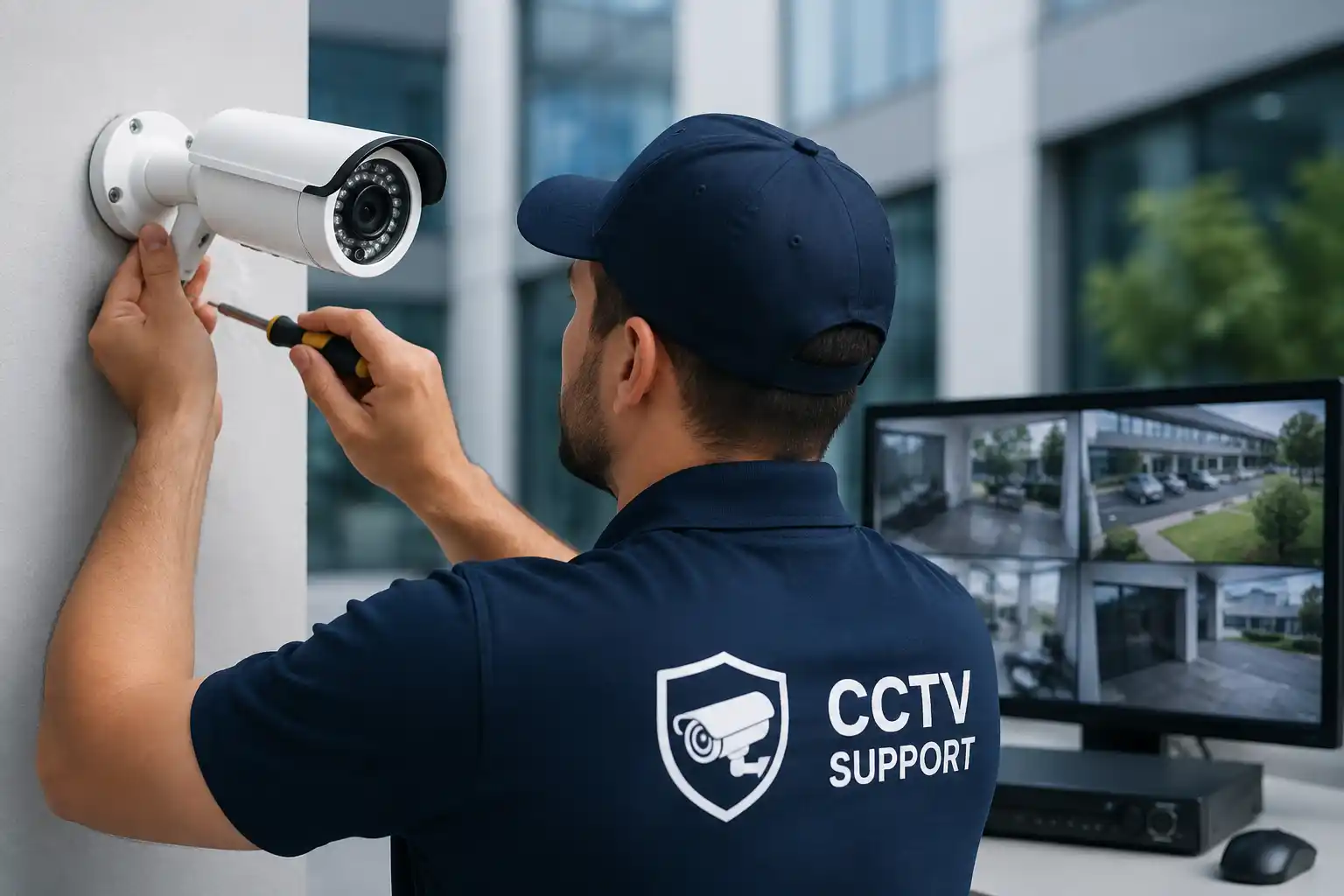
Coverage depends on the installed environment and agreed contract.
Checks are planned around cameras, recording, storage and connectivity.
The right method depends on access and whether physical work is required.
Findings can support repair, replacement and maintenance planning.
What does a CCTV annual maintenance contract cover?
A CCTV annual maintenance contract is an agreed support arrangement for recurring attention to a business surveillance system. It is mainly used to organise preventive checks, identify developing faults, verify recording and viewing functions, maintain useful documentation and define how reported CCTV issues will be handled during the contract period. It may be appropriate for businesses that rely on cameras for operational monitoring, incident review, property oversight or internal security processes and want a clearer maintenance routine than ad-hoc support alone.
The contract should not be assumed to include every repair, part, visit, software licence or third-party service. Before work is confirmed, the customer should prepare an inventory or approximate count of cameras and recorders, identify the site or sites, explain recurring problems, confirm who can authorise access and provide any available system documentation. FourTeck can then assess the environment and help define a practical scope. Remote checks may be suitable for recorder status, software configuration, storage information, network reachability or viewing access when secure authorised connectivity exists. On-site work may be needed for camera condition, cabling, PoE, power, mounting, physical cleaning, coverage checks or equipment that cannot be reached remotely.
Why planned CCTV maintenance matters to business operations
A surveillance system can appear normal while parts of it are gradually becoming unreliable. A live camera view on a monitor does not by itself prove that recording is taking place correctly, that footage can be retrieved for the required period, that time settings are accurate, or that all cameras are still delivering useful images under the lighting conditions where they operate. Likewise, a recorder may remain powered while one storage drive has developed warnings, a network camera may reconnect intermittently, or remote viewing may depend on an undocumented account held by one employee or supplier. Planned maintenance is valuable because it creates opportunities to check these connected areas before the business needs evidence urgently.
For a retail site, a missing camera may reduce visibility over an entrance or transaction area. In a warehouse, an intermittent recorder channel can create gaps in footage around loading activity. In an office or clinic, incorrect time settings can make incident review difficult. At a multi-branch organisation, different recorder configurations and account practices can make support unnecessarily slow because each site behaves differently. A maintenance contract can help turn these scattered technical details into a managed service scope with agreed checks, issue reporting, documentation and recommendations.
Maintenance does not mean that equipment will never fail. Cameras remain exposed to heat, dust, vibration, moisture, physical impact and changing lighting. Power supplies and PoE switches can develop faults. Hard drives wear. Network changes can affect addressing or remote access. Firmware and viewing applications may change over time. The practical benefit of a maintenance programme is that the business has a defined process for reviewing condition, identifying risk, recording faults and deciding what needs correction, replacement, vendor action or a separate project quotation.
What the maintenance service may involve
Depending on the confirmed contract, assistance may include camera status checks, image review, recorder health checks, storage-capacity observations, playback verification, date and time checks, user-access review, remote-viewing troubleshooting, network reachability checks, PoE or power observations, physical camera inspection, lens or housing condition review, cabling observations, configuration review, fault logging, corrective recommendations and coordination with a hardware or software provider where required.
The exact task list should match the installed system. An IP-camera environment may require more emphasis on addressing, switches, network segmentation and NVR communication. A DVR-based environment may depend more directly on analogue cabling, power distribution and recorder inputs. Mixed environments can require both approaches.
Who may benefit from an AMC
An annual arrangement may suit organisations with surveillance systems that support everyday operations and where repeated reactive call-outs create uncertainty. Typical environments include offices, retail shops, warehouses, clinics, training facilities, restaurants, hotels, showrooms, property-management locations, construction offices and businesses with several branches. The service can also be relevant when responsibility for the existing CCTV installation is unclear or documentation is incomplete.
The decision should be based on business dependence, system size, equipment age, fault history, number of locations, access restrictions and internal technical capability. A smaller site with simple requirements may need a different maintenance scope from a multi-site business with many cameras and several authorised viewers.
Common warning signs that maintenance attention is needed
Businesses often start looking for a CCTV maintenance contract after several small problems begin to repeat. A camera may go offline and return without explanation. The image may be blurred at night but acceptable during the day. Playback may show gaps, or recorded footage may cover a shorter period than expected. A remote mobile application may work for one manager but not another. A recorder may report storage warnings. Cameras may show different timestamps. A monitor may display live video while recording is disabled on one channel. These symptoms point to areas that should be assessed, but they do not prove a single cause.
The same visible symptom can originate from different technical layers. An offline IP camera might have a camera fault, damaged cable, PoE problem, switch issue, duplicate IP address, changed subnet, lost recorder registration or credential problem. Poor image quality can be related to lens condition, focus, exposure settings, compression, low bandwidth, environmental lighting, dirty housings or physical movement. Missing footage can involve recording schedules, storage, drive condition, channel settings, time configuration or recorder faults. Maintenance therefore needs a structured diagnostic approach instead of replacing parts based only on the first symptom.
Other planning triggers include office expansion, adding new cameras, replacing an old recorder, moving equipment, changing the network, changing the internet connection, changing the person responsible for CCTV, or discovering that administrator access is held only by a former supplier. These changes can alter how the surveillance system operates even when no camera has visibly failed. Including them in a maintenance review helps the business separate routine care from upgrade work that may need its own scope.
Business impact when CCTV issues remain unresolved
Evidence gaps
If recording is incomplete, incident review may be limited exactly when the business expects footage to be available. Routine playback testing can help identify whether recording and retrieval are working as intended at the time of maintenance.
Support delays
Undocumented recorder addresses, camera names, passwords ownership, cabling routes or device models can slow troubleshooting. Clear records reduce the time needed to understand how the current system is arranged.
Repeated faults
A recurring outage may return if only the immediate symptom is reset. Reviewing power, cabling, network events, recorder logs and environmental conditions can reveal which area needs deeper corrective work.
Unplanned replacement
Health observations can highlight ageing storage, damaged housings, unstable power or obsolete components so replacement decisions can be planned rather than made only after a critical failure.
Possible CCTV AMC service scope
The following table illustrates the types of areas that may be discussed when defining a CCTV annual maintenance contract. It is a scope guide rather than a promise that every item is automatically included. Frequency, labour, visits, replacement parts, licences, third-party services and project work should be confirmed in the approved quotation or service agreement.
| Service Area | What May Be Reviewed | Scope Note |
|---|---|---|
| Camera condition | Online status, image condition, housing, orientation and visible physical issues. | Physical inspection is on-site dependent. |
| Recording system | NVR or DVR status, channel condition, recording schedule, playback and time settings. | Access and equipment condition dependent. |
| Storage | Available capacity, drive warnings, retention observations and recording continuity. | Drive replacement or data recovery may be separate. |
| Network and connectivity | Camera reachability, recorder communication, switch or PoE observations and remote access path. | Network changes require authorisation and may need separate support scope. |
| User access | Authorised viewers, account roles, application access and administrator ownership. | Credentials must be shared only through an approved secure method. |
| Fault handling | Issue recording, diagnostic review, corrective recommendations and escalation. | Response and attendance terms depend on the agreed contract. |
| Documentation | Asset notes, camera labels, recorder details, known faults and maintenance findings. | Depth depends on available records and contracted work. |
Is a CCTV AMC the right fit for your situation?
| Business Situation | Relevant Assistance | What Must Be Confirmed |
|---|---|---|
| Several cameras have intermittent faults. | Structured fault review plus preventive checks across connected layers. | Camera types, power method, cabling, network and recorder access. |
| The system works but has not been checked for a long period. | Baseline health assessment and maintenance planning. | Asset count, condition, site access and maintenance objectives. |
| Recordings are needed for operational reviews. | Playback, recording status, time and storage observations. | Retention expectations, storage capacity and recorder health. |
| Multiple branches use different CCTV setups. | Site inventory, standardisation review and maintenance coordination. | Locations, vendors, access methods and whether systems can be reached remotely. |
| Major replacement or redesign is already planned. | Assessment can support transition planning, but project work may need a separate scope. | Target design, budget priorities, timeline, compatibility and approved project requirements. |
Remote CCTV maintenance support versus an on-site visit
When remote support can be useful
Remote assistance may be appropriate when the recorder or management interface is reachable through an approved secure method, internet connectivity is working, and an authorised customer representative can assist if local confirmation is needed. It may help with reviewing recorder status, checking recording schedules, identifying offline channels, examining storage information, validating date and time settings, reviewing user access, checking network addressing or investigating remote-viewing problems.
Remote work can reduce unnecessary site visits for configuration or evidence-gathering tasks, but it depends on reliable access and does not replace physical inspection. A camera can appear online while its lens is dirty, its housing is damaged or its viewing angle has moved. Those conditions cannot be assessed properly from configuration data alone.
When on-site maintenance is more appropriate
An on-site visit may be required for camera cleaning, focus or physical orientation checks, damaged housings, loose mounting, cabling tests, power troubleshooting, PoE switch inspection, recorder hardware access, rack work, monitor connections or faults that cannot be reproduced remotely. It is also important where a site has no secure remote-access path or where building access and local coordination are necessary to inspect equipment.
The maintenance plan should define which activities are expected to be remote, which need site attendance and which fall outside routine scope. Attendance timing depends on the agreed contract, engineer availability, location, site access and the nature of the reported issue.
How FourTeck can assess an existing CCTV environment
A useful maintenance contract starts with understanding what is actually installed. The first step is normally to identify the business purpose of the surveillance system and the areas where loss of visibility would matter most. The customer can provide the location, approximate camera count, recorder type, known faults, viewing method, relevant vendor details and any available diagrams or previous maintenance records. If the environment has several buildings or branches, the assessment should separate them so equipment and responsibilities are clear.
The next step is to review the technical chain from each relevant camera to the recording and viewing system. For IP CCTV this can include camera power, structured cabling, PoE switch ports, network addressing, VLAN or routing dependencies where applicable, NVR registration, storage and user-access paths. For DVR-connected cameras, power distribution, signal cabling, recorder inputs and local storage become important. Mixed systems may require both types of review. The objective is not to make speculative changes but to establish a reliable baseline.
Access and authorisation should be confirmed before settings are changed. Existing configuration should be recorded where practical, and any change that can affect recording or viewing should have an agreed reason, maintenance window when necessary and a rollback consideration. If a device is unsupported, password access is unavailable, a vendor cloud account is controlled by a third party, or replacement parts are required, those limitations should be documented rather than hidden inside a general maintenance promise.
After the baseline review, FourTeck can help separate routine preventive tasks from corrective work and upgrade needs. A camera that simply requires cleaning is different from a camera with an unstable network link. A recorder with insufficient storage for the customer’s desired retention period may need capacity planning rather than a routine repair. A system using obsolete equipment may need a lifecycle plan. The maintenance contract can then be written around realistic recurring needs.
A practical maintenance journey from baseline to follow-up
1. Business and site review
Identify why the cameras matter, which locations are covered, who uses live or recorded video and which faults have the greatest operational impact.
2. Asset and access baseline
Record available camera, recorder, storage, switch, power and application details. Confirm authorised administrative access without publishing or requesting credentials through insecure channels.
3. Condition and function checks
Review relevant live views, recording status, playback, timestamps, storage information, camera reachability and physical condition according to the agreed scope.
4. Fault classification
Separate routine maintenance observations from issues that require repair, replacement, configuration change, network work, vendor support or a separate project.
5. Approved corrective actions
Apply work that is authorised and included in scope, using controlled changes where configuration, recording or access can be affected.
6. Validation and reporting
Recheck the affected function, record completed work, identify unresolved dependencies and provide practical recommendations for the next maintenance cycle.
Testing recording and playback, not only the live picture
One of the most important maintenance principles is to distinguish live viewing from usable recording. A camera may display correctly on a screen while recording is disabled, scheduled incorrectly, directed to failed storage or affected by time and date problems. For a business that expects to retrieve footage after an incident, periodic validation should include more than confirming that a picture appears.
Depending on the agreed scope and system capabilities, maintenance may include selecting sample cameras, confirming that recent footage can be played back, reviewing recording schedules, comparing timestamps and checking the recorder for storage or channel alerts. If the organisation has a specific retention objective, the installed storage capacity, camera resolution, frame rate, compression, recording mode and number of channels can influence how long footage remains available. The actual retention observed should be treated as an environment result rather than assumed from drive size alone.
Where missing footage is found, the next action depends on evidence. It may involve storage health, recorder configuration, recording schedules, camera communication, time settings or hardware failure. Recovery of already-lost video cannot be guaranteed, and data-recovery work may need specialist assessment outside a normal maintenance scope. The maintenance goal is to identify the condition, protect what can be preserved where appropriate and reduce the chance of the same issue remaining unnoticed.
Keeping IP cameras connected to the network reliably
IP cameras depend on more than the camera itself. Their operation can involve structured cabling, patch panels, switch ports, Power over Ethernet, IP addressing, gateways, network segmentation, recorder communication and sometimes remote-access services. A maintenance approach that checks only the lens may miss the technical layer responsible for repeated dropouts. FourTeck’s broader IT-services context can be useful where CCTV and the office network share infrastructure or where camera connectivity changed after switch, firewall or addressing work.
Preventive review may look for offline or unstable cameras, port errors, insufficient or failing PoE delivery, duplicate addresses, undocumented static addressing, changes in network topology or connectivity between cameras and the NVR. Any network configuration change should be authorised because surveillance traffic may be part of a larger business environment that also carries computers, phones, servers or wireless services. The safest approach is to identify the dependency first, record the current configuration and make only the approved change required for the CCTV objective.
Remote viewing introduces additional dependencies. A mobile or desktop application may depend on an account, a vendor service, firewall settings, internet connectivity, DNS, public addressing or another method chosen for the environment. Maintenance can review whether authorised users can connect and whether access ownership is documented, but the available options can be vendor and configuration dependent. Unnecessary direct exposure of camera or recorder interfaces should not be introduced merely to make remote access easier.
Storage, time accuracy and evidence readiness
Storage is often noticed only after a recording problem appears. A recorder may overwrite older footage as designed, but the resulting retention period may no longer match the organisation’s expectations after cameras are added or quality settings are increased. A drive may also report health concerns or stop recording reliably. Maintenance can help the business understand what the recorder currently reports, how much storage is available and whether sample playback supports the expected operating condition.
Time accuracy is equally important. If cameras or recorders have inconsistent clocks, finding the correct event can become difficult. Time settings can be affected by manual configuration, time zones, daylight-saving behaviour, network time sources or device resets. A maintenance review can compare displayed time with an appropriate reference and record discrepancies for correction. Any adjustment should consider how existing recordings are indexed and how the specific platform handles time changes.
Evidence readiness also includes people and process. Staff who are authorised to retrieve footage should know which system to use and who owns administrative access. The organisation should know where exported files are stored, how they are handled internally and when specialist assistance is needed. FourTeck can support technical documentation and user guidance within the confirmed scope, while the customer remains responsible for its own policies, permissions and legal or regulatory obligations concerning surveillance use and footage handling.
Dependencies, access and customer responsibilities
CCTV maintenance works best when the customer can provide basic ownership and access information. FourTeck may need an authorised contact, site access, a safe route to physical equipment, details of the current installer or vendor, network information relevant to IP cameras, recorder access and a maintenance window for changes that could interrupt viewing or recording. The customer should not place passwords in public enquiry forms or page comments. Credentials should be provided only through an approved secure method after identity and authorisation are confirmed.
The business should also identify any restrictions that affect maintenance. Cameras may be installed at height or in areas requiring special access arrangements. A recorder may be in a locked room controlled by facilities staff. A switch may serve other critical systems and cannot be restarted casually. Remote access may be prohibited by policy. Certain changes may require landlord, building-management, security or internal IT approval. These conditions can shape the practical maintenance plan and should be discussed before scheduling.
Third-party dependencies may include internet providers, cloud-viewing services, camera manufacturers, recorder vendors, software licences, building cabling contractors or equipment suppliers. If a fault depends on a third party, FourTeck can help collect technical information and coordinate the issue where included, but the external provider’s actions, service availability and replacement terms remain outside FourTeck’s direct control. These boundaries should be clear in the contract so the business understands what maintenance labour covers and what may require separate approval or cost.
Important scope, risk and exclusion guidance
A CCTV annual maintenance contract should define recurring service without implying unlimited work. Diagnosis depends on the evidence available and the ability to access the affected system. Hardware failure can require parts or replacement that are outside maintenance labour. Cameras or recorders that are obsolete, unsupported or locked to unavailable credentials may have limited repair options. Configuration changes can require a maintenance window and should be backed up where the platform allows it. Remote-support capability depends on secure connectivity, authorised access and the system being reachable.
Maintenance can reduce the likelihood that obvious faults remain unnoticed, but it cannot guarantee that cameras, storage, networks, power or third-party services will never fail. A successful test confirms the observed condition at the time of testing; it does not remove the need for continued monitoring and future maintenance. Data recovery and recovery of footage cannot be guaranteed. Replacement parts, civil work, specialist access equipment, new cabling, redesign, expansion, licensing, major upgrades or new-site projects may need separate quotations depending on the contract.
Final commercial terms should be based on the approved service agreement. The number of planned visits, support channels, included tasks, exclusions, response expectations, parts handling, site coverage and contract period should be written explicitly rather than assumed.
Business environments where recurring CCTV maintenance can help
Different organisations depend on CCTV in different ways, so the maintenance priorities should reflect how the site operates. A retail shop may care strongly about entrance, checkout and stock-area visibility. Maintenance should therefore confirm that the most important views remain correctly positioned and that footage can be retrieved when required. A warehouse may have cameras covering loading bays, aisles and external yards where dust, heat, changing light and long cable routes can influence reliability. Physical inspection and network or power checks may become more significant.
Professional offices may have fewer cameras but stronger requirements around controlled user access and discreet placement. Clinics and training facilities may need clear internal policies about who is authorised to view footage and how surveillance equipment is maintained without disrupting daily activity. Hospitality businesses, restaurants and showrooms may have extended operating hours that make maintenance-window planning important. Property-management sites can have cameras distributed across entrances, parking areas, common spaces and separate equipment rooms, increasing the value of clear labelling and system diagrams.
Multi-branch businesses often gain value from standardisation. If every location uses different camera names, recorder access methods and documentation, central support becomes difficult. A maintenance programme can gradually establish consistent records and identify where systems are too different to support efficiently. Standardisation does not require replacing everything at once; it can begin with asset naming, access ownership, recorder documentation and a common issue-reporting process, then inform future upgrades.
Operational and security considerations for CCTV maintenance
Surveillance systems hold sensitive access and operational information, so maintenance should consider security as well as availability. Shared administrator accounts, default credentials, unknown remote-viewing users and unnecessary internet exposure can create avoidable risk. Where the platform supports suitable controls, a maintenance review may identify account ownership, check whether former users still require access, note weak access practices and recommend safer administration. The exact capabilities depend on the installed devices and software.
Firmware and software updates also require judgement. Applying an update simply because a newer version exists may not be appropriate if compatibility with the recorder, cameras or viewing application has not been checked. Equally, leaving obsolete software indefinitely can create support and security concerns. The maintenance process should therefore review update status, vendor guidance where available, business risk, compatibility and rollback options before changes are approved.
Operational continuity matters during maintenance. Restarting a recorder, changing network settings or updating a camera can temporarily interrupt viewing or recording. For a system that supports active business operations, such changes should be scheduled and communicated. After the work, validation should confirm that the intended cameras are online, recording functions have returned, authorised viewing works and relevant timestamps remain correct. Documentation should record what changed so the next support engineer does not have to reconstruct the history from scratch.
Before you contact FourTeck about a CCTV maintenance contract
Providing a clear starting picture makes it easier to define the contract and separate recurring maintenance from one-time repair or upgrade work. You do not need perfect documentation before making an enquiry, but the following information is useful where available:
- The Dubai or UAE site location and whether the system covers one building or several locations.
- An approximate count of installed cameras and the number of NVR or DVR recorders.
- Whether the system is mainly IP-based, DVR-based or a mixed environment, if known.
- The main contact person who can authorise technical and physical access.
- Any current symptoms such as offline cameras, unclear images, missing recordings or unstable viewing.
- When the problem started and whether it affects one camera, one area or the wider system.
- Recent network, internet, recorder, camera, power or building changes that may be relevant.
- Available camera, recorder and switch model details where they can be identified safely.
- Who currently owns or manages administrator and remote-viewing accounts.
- Whether secure remote access can be authorised for diagnostic work.
- Any existing maintenance reports, diagrams, camera lists or previous repair notes.
- The current understanding of footage retention and whether playback has been tested recently.
- Building-access restrictions, equipment-room access and any requirements for physical camera work.
- The business priority: preventive care, recurring fault reduction, documentation, upgrade planning or a combination.
- Any preferred maintenance windows or periods when CCTV work would cause less operational disruption.
Checklist for defining the annual maintenance quotation
Before approving a CCTV AMC, the customer and service provider should be clear about what the agreement is intended to achieve. The following points help convert a broad maintenance request into a practical service scope:
- Confirm the number of sites and approximate number of cameras.
- Identify the recorder, storage, network and power components that are relevant to CCTV.
- Decide which preventive checks are required and which will be assessment dependent.
- Define whether remote diagnosis is expected and how secure access will be authorised.
- Define which physical inspections or on-site activities are expected.
- Clarify how faults are reported and what information should accompany a support request.
- Confirm whether replacement parts, cabling, access equipment or new hardware are included or separately quoted.
- Agree how major configuration changes, upgrades or network changes will be approved.
- Specify the documentation or maintenance report expected after planned work.
- Clarify vendor coordination where third-party accounts, licences or hardware support are involved.
- Confirm the sites covered by the agreement and any travel or access dependencies.
- Record exclusions and tasks that require a separate quotation.
How FourTeck can support the maintenance and quotation process
FourTeck can begin by clarifying what the business wants from CCTV maintenance. Some customers are dealing with frequent faults and want a more organised support path. Others have a stable system but want recurring health checks, clearer records and a plan for ageing equipment. Multi-site organisations may want consistent documentation and a single point of coordination across several locations. Understanding that objective helps avoid creating a contract filled with tasks that do not match the real need.
The assessment can review the current system, the known issues, the way cameras connect to recorders, how storage is used, who has authorised viewing access and which areas require physical inspection. FourTeck can help identify whether a reported problem belongs primarily to the camera, power, cabling, network, recorder, storage, user account or third-party service layer. When repair or replacement is needed, the finding can be separated from routine maintenance so the customer can approve the appropriate work.
FourTeck can also coordinate remote and on-site activity, document completed checks, discuss maintenance recommendations and prepare a quotation based on confirmed requirements. The quotation should specify inclusions, exclusions, locations and dependencies. Customers can review broader company information on the FourTeck IT Services about page or use the FourTeck IT Services home page to understand the wider support context around networks, servers, user systems and surveillance.
CCTV maintenance coordination in Dubai and across the UAE
For a Dubai site, the service plan should consider whether the required work can be handled remotely, whether an engineer needs physical access, where the recorder and network equipment are located, and whether cameras are mounted in areas that need special site coordination. A simple configuration review has different scheduling needs from a visit involving outdoor cameras, warehouse ceilings, network cabinets or several branches. Contact FourTeck to confirm the service scope and scheduling options before assuming that a particular task or visit is included.
Businesses with sites in Dubai, Abu Dhabi, Sharjah and Ajman can discuss a combined support arrangement when the CCTV environments are part of one organisation. Coordination may include remote troubleshooting, planned on-site inspection, preventive maintenance, assessment, corrective work or upgrade planning depending on the confirmed scope. Scheduling, travel, building access, site conditions, equipment availability and third-party dependencies can affect the service plan. A multi-site contract should list the covered locations clearly and avoid assuming that every site has the same system or access method.
Remote assistance can be particularly useful when several branches use accessible network-connected recorders and local staff can confirm physical conditions. On-site visits remain important when there are cabling, power, camera-position, mounting, lens, rack or environmental issues. The right balance should be established during assessment rather than fixed without understanding the system.
Questions businesses ask before choosing CCTV annual maintenance
A useful AMC decision usually starts with practical questions rather than a generic request for “CCTV support.” Buyers want to know what will actually be checked, whether the service can reduce repeated failures, how much of the work can be performed remotely, what happens when hardware needs replacement and which information is required before a quotation can be accurate. The answers depend on the installed environment, but the following guidance can help a business prepare.
Can a CCTV system be maintained if we do not know every camera model?
Yes, an initial assessment can begin even when documentation is incomplete. The service provider may need to identify devices during the baseline review, record model and connection information that can be accessed safely, and determine how cameras are linked to the recorder and network. Incomplete documentation can increase assessment time, especially if cameras are difficult to reach or access credentials are unavailable. The useful next action is to share whatever records exist, including old quotations, recorder photos, camera lists or previous maintenance reports, and allow the assessment to fill reasonable gaps.
Is one-time CCTV repair enough, or is an annual contract more suitable?
One-time repair is often appropriate when there is a clearly defined fault and the business does not need recurring maintenance. An annual contract is more relevant when the organisation wants planned checks, a recurring support process, documentation and visibility over several devices or locations. A business with one failed camera may initially need corrective work rather than a contract. A business with repeated outages, ageing recorders, inconsistent records and several branches may benefit more from a structured maintenance arrangement. The decision should be based on the frequency of support needs and the operational value of routine checks, not simply on the number of cameras.
Can the maintenance be done completely remotely?
Some tasks can be completed remotely, but a comprehensive CCTV maintenance programme often includes physical checks that cannot be replaced by remote access. Remote support can review NVR or DVR status, storage information, camera connectivity, user accounts, recording schedules and certain network settings when secure authorised access exists. It cannot confirm the physical security of a camera mount, clean a lens, test a damaged cable end, inspect an outdoor housing or replace failed hardware. A sensible contract can combine remote diagnostics with planned on-site activity according to the system’s needs.
What should be checked when a camera keeps going offline?
The camera itself is only one possibility. For an IP camera, the review may need to include power delivery, PoE switch behaviour, patching, cable condition, IP addressing, link stability, recorder registration and the network path. For another type of camera, the relevant power and signal path may be different. Weather, heat, moisture or physical movement can also contribute. Because the same symptom can come from several layers, the next step should be evidence collection and controlled testing rather than immediate replacement.
What if live viewing works but old recordings are missing?
That situation requires a recording and storage review. The service provider may check recording schedules, channel configuration, storage status, available capacity, drive alerts, overwrite behaviour, timestamps and sample playback. Retention can change when more cameras are added or image settings are increased. If footage is already missing, recovery cannot be promised. The maintenance value is in identifying why the system is not meeting the expected recording behaviour and deciding what correction or replacement is appropriate.
Should a CCTV AMC include hard-drive replacement?
It should be stated explicitly if replacement parts are included. Many maintenance agreements treat labour, preventive checks and fault diagnosis separately from consumable or replacement hardware. Storage drives can fail or become unsuitable as capacity needs change, so the contract should explain whether drive supply, replacement, data handling and disposal are included, excluded or quoted separately. The customer should avoid assuming that “annual maintenance” automatically means all parts are covered.
How can we tell whether a recorder has enough storage?
The answer depends on more than the nominal drive size. Camera count, resolution, frame rate, compression, recording mode, motion activity and retention expectations all influence storage use. A maintenance review can observe the actual system settings and the amount of historical footage available, then compare that condition with the business requirement. If the current retention is insufficient, options may include configuration review or storage changes, subject to compatibility and quotation.
What information should we provide for a CCTV AMC quotation?
Useful details include the location, camera count, recorder count, known brands or models, whether cameras are IP-based, current faults, required business outcome, remote-access availability, equipment-room access, previous maintenance history and whether several branches are involved. Photos or diagrams can help when safe and appropriate. The provider should also know whether the request is for preventive checks only or whether there are existing faults that need corrective work at the start of the contract.
Can existing CCTV faults be included when the contract starts?
They can be assessed, but the treatment of pre-existing faults should be agreed rather than assumed. A baseline visit may identify offline cameras, failed drives, damaged cabling, inaccessible accounts or obsolete equipment. Some corrections may fit within the maintenance scope, while parts, replacement, major cabling or redesign may require a separate quotation. Recording the baseline condition protects both the customer and service provider by making the starting point clear.
When is replacement better than repeated repair?
Replacement may become more practical when equipment is unsupported, repeatedly fails, cannot meet current recording or access requirements, uses unavailable parts, or creates disproportionate support effort. The choice should consider technical condition, compatibility, business needs and lifecycle rather than assuming every old device must be replaced. Maintenance records are useful because they show fault history and can support a more informed upgrade decision.
Does CCTV maintenance include the office network?
Only where the agreed scope says so. IP cameras may depend on switches, PoE, addressing, VLANs, routing, firewall rules and internet services, but those components can also support many other business systems. A CCTV fault may require network diagnostics, yet a major network redesign or switch replacement may be separate work. The provider should define where surveillance maintenance ends and broader network support begins. FourTeck’s wider business IT service coverage can support connected infrastructure when that requirement is confirmed.
What happens after a planned maintenance visit?
The most useful outcome is not only that checks were completed, but that the business receives a clear record of observed condition, work performed and remaining issues. Depending on the agreed contract, this can include a fault list, device notes, maintenance findings, recommendations for replacement or improvement and actions that need customer approval. If a change was made, testing should confirm the affected function. If a third-party issue remains, the report should state what information has been gathered and what the next escalation step is.
How often should CCTV maintenance be performed?
There is no single frequency that suits every site. The appropriate schedule depends on equipment condition, environmental exposure, business dependence, number of cameras, previous fault history, site access and the agreed service plan. Outdoor or dusty environments may need different attention from a small indoor office. A baseline assessment can help determine a suitable planned schedule, but the actual frequency should be stated in the contract rather than assumed from the phrase “annual maintenance contract.”
Can maintenance improve poor night-time image quality?
It can help identify the reason, but the correction depends on the cause. Night image problems may involve dirty lenses, reflections, infrared behaviour, lighting, camera placement, focus, exposure, settings, scene distance or hardware limitations. Maintenance can review the symptom and the environment, then recommend cleaning, adjustment, configuration, lighting changes or hardware replacement where appropriate. It should not promise that every camera can achieve a required night image without understanding the site and equipment.
What if remote viewing stopped after an internet or firewall change?
That usually requires reviewing how remote access was originally designed and which dependency changed. The path may involve the recorder or camera platform, local network, firewall, internet service, public addressing, DNS or a vendor-hosted connectivity method. The exact method varies by system. Troubleshooting should preserve security and avoid exposing devices directly to the internet merely to restore convenience. If firewall or network configuration requires broader work, that should be authorised and documented separately.
Can one maintenance contract cover several UAE branches?
Potentially, yes, if the sites, systems and service expectations are clearly defined. A multi-site contract should list each location, approximate asset count, remote-access method, local contact, visit dependency and known differences in equipment. Remote support can make multi-site coordination more efficient where systems are securely reachable, while physical work still depends on local scheduling and access. The quotation should reflect the actual geography and complexity rather than treating all branches as identical.
Related FourTeck IT support areas
CCTV rarely operates in isolation, particularly in IP-based environments. A camera problem can involve switches, PoE, structured cabling, network addressing, firewall policies, storage or user access. FourTeck’s broader service coverage allows the customer to discuss connected infrastructure when the surveillance issue crosses into another technical layer. Review the FourTeck services overview for related network, server, desktop, WiFi and business technology support, or use the FourTeck contact page to explain the CCTV environment and request a scope review.
Network support
Useful when IP cameras depend on switch connectivity, PoE, addressing or wider network communication.
Firewall and remote access
Relevant where authorised remote viewing depends on secure connectivity and business firewall settings.
Server and storage support
Helpful where CCTV interacts with shared storage, virtual infrastructure or broader data-management requirements.
Business IT maintenance
Suitable when surveillance should be reviewed alongside the wider office technology environment.
Why businesses contact FourTeck for CCTV maintenance planning
Businesses often need more than a camera technician when surveillance depends on networks, storage, user access and remote connectivity. FourTeck approaches CCTV as part of the connected IT environment, which can help when the visible fault is only one part of a wider technical dependency. The aim is to clarify the problem, identify the affected layer, organise suitable remote or on-site activity and explain which work belongs inside maintenance versus a separate repair or project scope.
A clear initial assessment also supports better commercial decisions. Instead of assuming that every camera needs replacement, the business can separate physical faults, configuration problems, network issues, storage limitations and documentation gaps. Instead of promising unlimited support, the contract can define what recurring checks are expected, which sites are covered, how faults are reported and what types of work need additional approval. This gives managers and procurement teams a practical basis for comparing the service with their operational requirements.
Documentation and handover are important because CCTV systems often outlive the people who originally installed or managed them. Camera names, recorder details, network information and access ownership should not depend entirely on one individual’s memory. A maintenance relationship can improve those records over time, helping future support, expansion and replacement planning become more controlled.
Frequently asked questions about CCTV AMC support in Dubai
What is normally included in a CCTV annual maintenance contract?
Inclusions vary by agreement. A contract may cover planned checks, fault reporting, remote diagnosis, selected on-site maintenance, recording and storage observations, camera condition review and documentation. The quotation should state the exact tasks, visit arrangement, exclusions and parts policy.
Can FourTeck maintain an existing CCTV system installed by another provider?
An existing system can be assessed, subject to available access, supported equipment, documentation and the condition of the installation. The initial review may identify limitations such as missing credentials, obsolete devices or third-party account dependencies that affect the final scope.
Will maintenance prevent every camera failure?
No. Preventive maintenance can identify visible or measurable issues and improve maintenance discipline, but hardware, storage, network, power and environmental failures can still occur. The contract should provide a process for handling faults rather than promise that failures will never happen.
Are replacement cameras and hard drives included?
Only if the agreement explicitly includes them. Replacement hardware, parts, licences, cabling and specialist access may be separate. The contract should make this clear before approval.
Can CCTV faults be diagnosed remotely?
Many configuration, recorder, storage, network and viewing issues can be investigated remotely when secure authorised access and working connectivity are available. Physical camera, cabling, power and mounting problems normally require on-site work.
What access is needed before maintenance starts?
The provider may need authorised access to recorders, management interfaces, equipment rooms and relevant network information. Physical access rules and maintenance windows should also be confirmed. Passwords should be shared only through an approved secure method.
Can the AMC include several branches?
It can be discussed for multi-site organisations. The quotation should identify each covered site, system size, remote-access method, local contact, visit requirements and any significant differences between installations.
What happens if a device is obsolete or unsupported?
Maintenance options may be limited. FourTeck can document the condition, discuss practical workarounds where appropriate and recommend replacement or upgrade planning when continued repair is not sensible or supportable.
Can maintenance verify recording retention?
A review can examine current storage information and sample historical footage to understand observed retention. The result depends on camera count, recording settings, storage capacity, drive condition and platform behaviour. Retention should not be guaranteed without confirming the environment.
Does the service cover CCTV network security?
Security-related observations can be part of the assessment where relevant, such as account ownership, unnecessary exposure or network-access concerns. Broader firewall redesign, security projects or compliance work may require a separate scope.
How is maintenance scheduled in Dubai?
Scheduling depends on the agreed contract, engineer availability, customer access, site conditions and whether work is remote or on-site. Planned tasks and preferred maintenance windows should be discussed when defining the service.
How do we request a quotation?
Share the site location, approximate camera and recorder count, known faults, existing documentation, access situation and the type of recurring support you want. FourTeck can use this information to plan an assessment and confirm the quotation scope.
Plan a CCTV maintenance scope around the system you actually have
A useful annual maintenance contract begins with a realistic understanding of the installed cameras, recorder, storage, network, power, access and business priorities. FourTeck can review the current environment, identify preventive and corrective needs, explain remote versus on-site requirements and prepare a quotation that states what is included and what remains scope dependent.
When contacting FourTeck, provide the location, approximate camera count, known faults, available system details and the reason you are considering annual maintenance. This helps the assessment focus on the areas that matter most to your operation.