
SURVEILLANCE TROUBLESHOOTING • RECORDING • CONNECTIVITY
CCTV Repair Dubai in Dubai, UAE
A CCTV fault is rarely just a camera problem. Power, PoE, cabling, recorder settings, storage, network addressing, user access and remote-viewing paths can all affect whether video is available when the business needs it. FourTeck helps organisations assess the actual fault path before repair, configuration or replacement work is agreed.
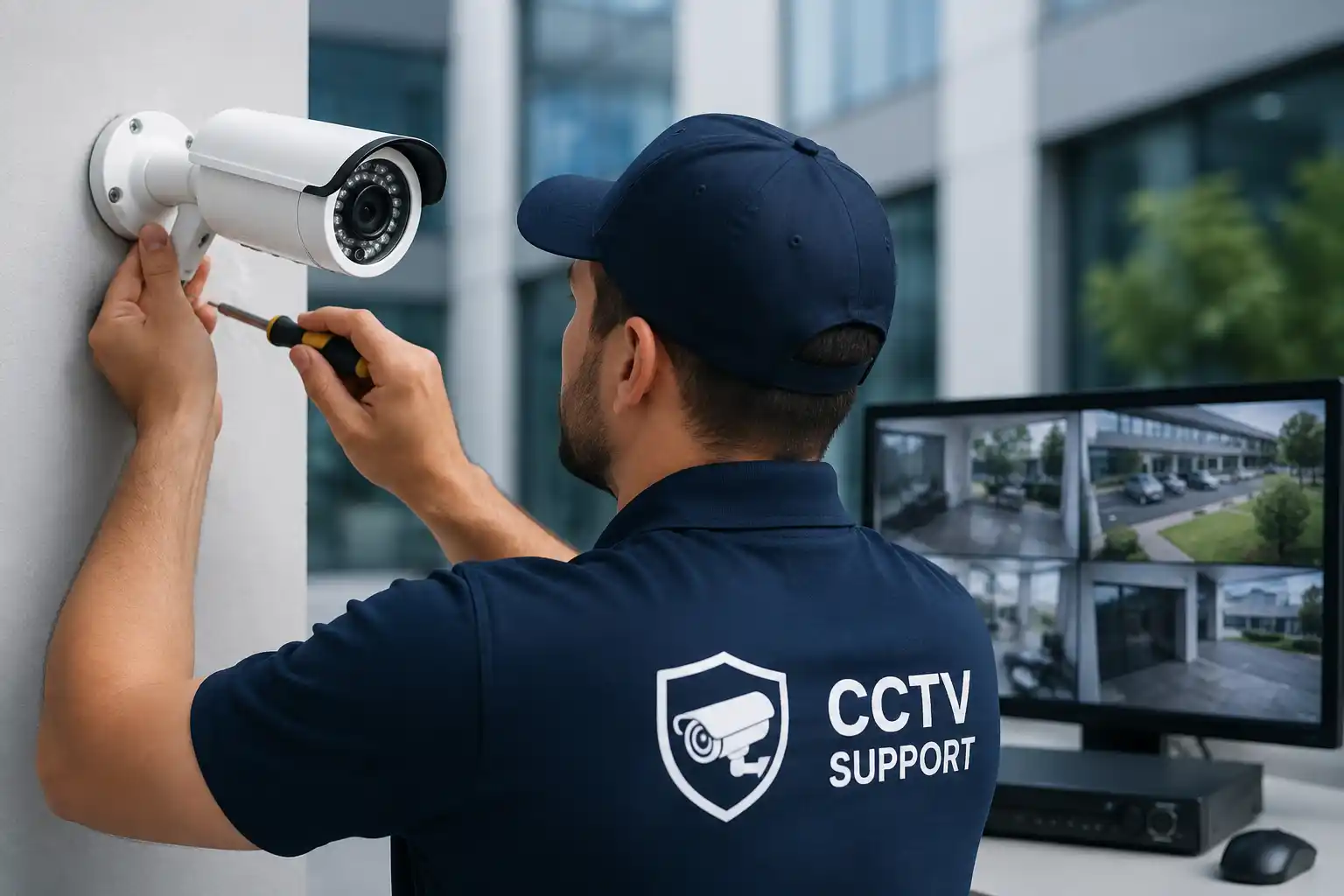
Camera, power, cable, network, recorder and storage are considered together.
Configuration and viewing issues may be assessed remotely when authorised access works.
Cabling, power, camera positioning and hardware checks generally require local access.
Repair, parts, configuration and replacement are confirmed after assessment.
What does CCTV repair in Dubai involve?
CCTV repair is the process of finding why a surveillance system is not delivering the expected live view, recording, playback, image quality or authorised remote access, and then defining the corrective work needed. Businesses should consider repair support when cameras disappear, recordings are missing, video freezes, images are unclear, storage behaves unexpectedly, mobile viewing fails, or faults repeatedly return. The same symptom can have several causes, so a useful assessment checks the complete signal path instead of assuming that the visible camera is defective. Before proceeding, the customer should be ready to confirm the site, affected devices, recorder details if known, when the problem started, recent changes, available authorised access, network status and the operational importance of the affected coverage. The final action may involve remote configuration, on-site testing, repair work, replacement planning, vendor coordination or a combination of these, depending on evidence and the approved quotation.
Why one CCTV symptom can come from several technical layers
A black camera tile on a monitor can look like a failed camera, but it may also result from a lost power feed, an inactive PoE switch port, damaged cabling, a disconnected connector, duplicate or changed IP addressing, a recorder channel problem, an authentication failure or a wider network interruption. Likewise, a camera that appears live may still not be recording correctly if the recorder schedule, storage drive, retention settings, time synchronisation or recording stream is wrong. Troubleshooting therefore starts by separating what the user sees from what the system is actually doing.
For IP surveillance, the camera is part of a networked service chain. It needs power, a working Ethernet path, valid network settings, a route to the recorder where applicable, sufficient switch capacity, suitable recorder registration, working credentials and storage that can accept recordings. For analogue or hybrid systems, the physical video path, power supply, connectors, channels and recorder inputs remain important. Sites may also mix older and newer technologies, which can create compatibility limits that need to be identified before a replacement camera or recorder is recommended.
This layered view helps avoid unnecessary part changes. If three cameras connected to one switch disappear at the same time, the common dependency may deserve attention before three separate cameras are blamed. If playback fails but live view remains available, storage or recording configuration may be more relevant than camera power. If local viewing works but external viewing does not, the fault path may move toward the network, application, account, firewall or remote-access method. None of these observations prove a cause on their own; they guide a controlled diagnostic sequence.
What the service may cover
Depending on the confirmed scope, assistance may include camera availability checks, power and PoE checks, cabling tests, connector inspection, image-quality troubleshooting, recorder channel review, recording schedule review, storage health checks, network connectivity tests, authorised account review, time and date verification, remote-viewing investigation, controlled configuration changes, camera or recorder replacement planning, testing and documentation.
Not every task belongs in every engagement. A single remote-viewing issue and a multi-camera outage at a warehouse require different access, evidence, tools, time and commercial scope.
Who may need CCTV repair support
The service can suit offices, retail outlets, restaurants, warehouses, clinics, schools, showrooms, residential management sites, hospitality environments, construction offices and multi-branch businesses where surveillance availability supports incident review, operational oversight or site security procedures.
It can be relevant for a single failed camera, several offline channels, unstable playback, unclear night images, recorder alarms, incomplete footage, loss of authorised mobile viewing, repeated restarts or a system that has become difficult to maintain after years of undocumented changes.
Common CCTV problems that justify a structured assessment
Camera offline or intermittent
A channel may vanish, reconnect repeatedly or freeze. Power, switch ports, connectors, cable condition, addressing, recorder registration and the camera itself may all need checking.
No recording or incomplete playback
Live video can exist while usable recordings are missing. Recording schedules, storage health, drive capacity, stream selection, channel settings and time configuration are relevant.
Poor or unstable image quality
Blur, glare, darkness, washed-out areas, noise or packet-related freezing may involve lens condition, lighting, physical alignment, camera settings, bandwidth or environmental exposure.
Remote viewing stopped working
If local monitors work but authorised external users cannot connect, application settings, account permissions, network changes, firewall rules, internet service or the approved remote-access method may need review.
Recorder or storage warnings
Repeated beeps, disk errors, abnormal capacity, short retention or failed playback can point toward storage, recorder configuration, disk condition, recording load or system health.
Faults after network or site changes
A new router, switch, ISP service, subnet, rack move, power change or office modification can affect cameras even when the surveillance equipment itself was not intentionally changed.
Business impact when surveillance faults remain unresolved
A CCTV fault can create more than an inconvenient blank screen. A business may be unable to review an incident, verify activity at an entrance, check a loading area, confirm what happened at a cash point, or retrieve a recording requested by management. Repeated faults also consume staff time because users restart equipment, switch applications, call different vendors or manually check areas that were expected to be visible from the surveillance system.
The operational risk depends on which cameras are affected, whether recording is still available, how long the issue has existed, and what the site uses CCTV for. A failed camera in a low-priority internal area has a different impact from a group of unavailable channels covering access points or a warehouse dispatch zone. FourTeck can use that business context to help prioritise assessment, but the fault still needs technical evidence before a cause or resolution can be confirmed.
CCTV repair service-fit matrix
| Observed issue | Possible technical areas | Recommended next step |
|---|---|---|
| One camera offline | Power, PoE, connector, cable, port, address, camera, recorder channel | Check whether the fault is physical or configuration related before replacing equipment. |
| Several cameras failed together | Shared switch, power source, network path, recorder, rack or upstream link | Identify the common dependency first and avoid changing multiple cameras without evidence. |
| Live view works but playback fails | Storage, recording schedule, stream, disk health, recorder service, time settings | Review recorder status and storage evidence before assuming the camera is at fault. |
| Remote viewing fails only outside the site | Internet, firewall, approved remote access, app, account, DNS or network changes | A remote configuration review may be suitable if secure access and a local contact are available. |
| Image is unclear or badly positioned | Lens, focus, dirt, lighting, glare, mounting, scene changes, camera settings | An on-site visual inspection is usually useful because scene conditions must be observed directly. |
Service information for planning a CCTV repair request
| Main purpose | Assess CCTV faults and define approved corrective work for cameras, recording, connectivity, storage or authorised viewing. |
|---|---|
| Typical systems involved | IP or analogue cameras, NVR/DVR, PoE switches, cabling, connectors, storage drives, monitor, network, firewall and viewing applications. |
| Remote support suitability | Suitable for some configuration, recorder, application, account, network and remote-viewing issues when secure authorised access is available. |
| On-site support suitability | Usually required for physical camera, cabling, connectors, PoE, power, rack, alignment, environmental or inaccessible-equipment checks. |
| Customer information required | Site, affected channels, symptoms, timing, recent changes, recorder details, network status, business impact and available authorised access. |
| Testing and validation | Scope dependent; may include live-view checks, recording verification, playback review, connectivity tests and authorised user access confirmation. |
| Parts or replacement | Subject to assessment, compatibility and quotation. A failed component does not mean every connected component needs replacement. |
| Vendor coordination | May be needed when manufacturer tools, cloud services, licenses, ISP services or third-party managed systems are involved. |
| Commercial scope | Final labour, parts, travel, configuration, replacement and follow-up requirements depend on the approved quotation or service agreement. |
Remote CCTV troubleshooting versus on-site repair
When remote support may be practical
Remote work can be useful when the CCTV equipment is powered, the site internet is working, secure remote access is authorised and a local user or administrator can assist if a physical observation is needed. Typical remote tasks can include reviewing recorder settings, checking whether channels are registered, assessing recording schedules, reviewing available storage information, examining application connectivity, checking authorised account permissions and evaluating network settings that can be inspected without physically touching the system.
Remote access does not eliminate the need for site work. If a camera has no power, a connector is damaged, a cable is intermittent, a PoE port is failing or the image must be physically re-aimed, software access alone cannot validate the physical condition.
When an on-site visit is normally more appropriate
On-site support is generally the better route when cameras, cables, connectors, power supplies, PoE switches, racks, monitors or storage hardware need direct inspection. It may also be required when equipment is not reachable remotely, several channels share a physical dependency, the site has changed, image quality must be judged against actual lighting, or safe access to installed equipment is necessary for testing.
Scheduling depends on the location, building access, work area, equipment height, customer authorisation, required tools, possible parts and the confirmed scope. If access equipment, specialist cabling work or third-party building coordination is needed, these should be identified before the visit is treated as a complete repair plan.
How the CCTV fault assessment can progress
- Define the business impact. Confirm which area is affected, whether live view, recording, playback or remote access is unavailable, and whether the problem affects one camera or a wider group.
- Collect evidence. Record channel names, visible error messages, recorder warnings, timestamps, application behaviour and any pattern such as failure only at night or after a restart.
- Identify recent changes. A switch replacement, ISP change, power event, building work, router change, password update, storage replacement or camera relocation can help narrow the investigation.
- Confirm authorised access. Determine whether an administrator, site contact, recorder login method, network access or vendor portal is available. Credentials should be shared only through an approved secure method after authorisation is confirmed.
- Test the relevant layers. Depending on the fault, this may include power, PoE, cable continuity, switch link, addressability, recorder registration, storage, recording status and viewing paths.
- Isolate the likely fault domain. The goal is to separate camera hardware from shared infrastructure, recorder issues, network problems, access problems and environmental causes.
- Agree corrective action. Configuration changes, cable work, replacement, storage action or third-party escalation should be explained before implementation where scope or risk changes.
- Validate and document. Confirm the intended function after approved work and record any unresolved dependencies, ageing components or recommended follow-up.
Corrective work should be planned around evidence, access and rollback
A repair action can be as simple as restoring a failed connection, but configuration changes deserve the same discipline as other business IT changes. Existing settings should be recorded or backed up where the system supports it, the intended change should be clear, and the customer should understand any effect on viewing or recording during the work. If a recorder, network switch, storage device or camera is being replaced, compatibility with the remaining environment should be checked rather than assumed.
For network-connected CCTV, changing addresses, passwords, switch ports, VLANs, firewall rules or remote-access methods can affect more than the single symptom being investigated. The safest path is to make controlled changes, validate the result and retain a way to restore the previous state where practical. Legacy devices may not support newer security methods or may depend on old applications, so an apparent repair may become an upgrade decision if the existing platform has material compatibility or support limitations.
FourTeck can help separate urgent restoration from longer-term improvement. For example, the immediate objective may be to restore a critical camera or recording channel, while the follow-up recommendation may address cable condition, undocumented network design, ageing storage, account management or repeated faults. These are different work items and should be included explicitly in the quotation or service plan.
Testing, validation and handover after repair work
A repair is not complete simply because a camera tile becomes visible. Validation should match the original business problem. If the complaint was missing recording, playback over an appropriate test period matters. If the issue was an offline camera, stable power, network link and recorder registration may need confirmation. If external viewing failed, the authorised user should confirm the approved viewing method from the relevant connection path. If image quality was poor, the scene may need to be checked under the conditions that previously caused the problem.
Handover may include a summary of the diagnosed fault domain, work completed, settings changed, components replaced, tests performed and items that still depend on another provider. Where useful, camera labels, channel names, recorder details, storage observations, network notes and administrator responsibilities can be recorded so the next incident does not begin from zero. This documentation is especially valuable at sites where several vendors have modified the surveillance system over time.
Testing cannot guarantee that hardware will never fail again, and a successful check does not replace ongoing maintenance. It does, however, provide evidence that the agreed function was validated at handover and gives the customer a clearer baseline for future support.
Capability focus: restoring dependable recording, not only live video
Many CCTV problems become visible only when someone needs historical footage. A system can look healthy on a wall monitor while storage is full, a disk is unhealthy, a recording schedule is wrong, a channel records only at certain times, the recorder time is inaccurate or playback is available for a shorter period than the business expected. Repair assessment should therefore distinguish live-view health from recording health.
Depending on the system and access available, FourTeck can review recorder status, channel recording behaviour, storage indications, time settings and playback availability. If a disk or recorder component is suspected, replacement should be treated as a separate compatibility and quotation decision. Existing recordings should not be assumed recoverable, and data recovery cannot be guaranteed. Where footage is important, customers should avoid repeated uncontrolled resets or storage changes that could complicate evidence preservation.
The business outcome is better visibility into whether the surveillance system is creating usable records rather than merely showing pictures. That distinction can reduce the risk of discovering a recording problem only after an incident has already occurred.
Capability focus: diagnosing the network path behind IP camera faults
IP cameras rely on the same types of network building blocks used by other business systems: switch ports, cabling, IP addresses, gateways, DNS in some designs, time services, segmentation, routing and firewall policies. That does not mean every camera fault is a network fault, but it does mean a camera can be healthy while the path to the recorder or viewing user is broken. This becomes especially relevant after a network upgrade, switch replacement, router change, subnet redesign, office move or ISP change.
A structured investigation can compare affected and unaffected cameras, identify whether several failed devices share a switch or link, check whether addresses are reachable, confirm that PoE capacity and port state are appropriate, and review whether the recorder can communicate with the expected devices. If the camera network is intentionally separated from user traffic, the access path should be respected rather than bypassed simply to make a quick test work.
Because FourTeck works across wider business IT infrastructure, CCTV troubleshooting can be coordinated with network, firewall and internet checks when the evidence points outside the recorder. This prevents the surveillance issue from being treated as an isolated appliance problem when the actual dependency sits elsewhere.
Capability focus: controlled remote viewing and user access
Remote viewing is useful only when authorised users can reach the right cameras through a method that fits the current system design. Problems can appear after password changes, phone replacement, application updates, firewall changes, internet service replacement, account changes or recorder reconfiguration. Restoring access should not mean broadly exposing surveillance equipment to the internet or weakening existing security controls.
Assessment may include checking the approved viewing application, account state, recorder connectivity, network path and relevant security settings. The exact method depends on the manufacturer, model, firmware, licensing where applicable, network design and customer security policy. Some legacy systems may offer fewer secure options than modern platforms, which can turn a recurring remote-access fault into a lifecycle discussion.
User access should also be scoped by role. A receptionist may need live access to a limited set of cameras, while an authorised administrator may need playback or configuration privileges. Shared administrator accounts can make support and accountability harder. Where the platform supports it, documented individual permissions and controlled access can improve maintainability without implying that any single setting makes the system completely secure.
Dependencies and customer inputs that can affect the repair scope
CCTV systems often cross several ownership boundaries. The cameras may have been installed by one contractor, the network may be managed by another provider, the internet service may be controlled by the landlord or ISP, the recorder may use a vendor cloud service, and the mobile application may be linked to an account that a former employee created. These dependencies can affect how quickly the fault can be isolated and who has authority to change the system.
Useful customer inputs include the site location, a contact person who can access the equipment, the approximate number of affected cameras, recorder or camera brand and model where known, screenshots or photographs of error messages, the last time the system worked normally, any recent power or network change, available network diagrams, current recording concerns, remote-viewing symptoms and whether administrator access is available. Do not place passwords or private access details in public forms or public page comments. Credentials should be exchanged only through an approved secure method after identity and authorisation are confirmed.
Building access can also change the plan. Cameras mounted at height, locked communication rooms, shared risers, ceiling spaces or restricted areas may require advance permission, access equipment or facilities coordination. These are practical scope dependencies, not incidental details, because they determine whether the planned diagnostic work can actually be completed on site.
Repair limitations, exclusions and situations that may need third-party action
Diagnosis depends on evidence and access. If the recorder is locked, the network is managed by another provider, a cloud account is unavailable or a camera is physically inaccessible, the initial visit may identify the next requirement without completing every corrective task. Manufacturer-specific tools, account recovery, subscription or license issues, warranty decisions and certain cloud-side faults may require vendor participation.
Hardware failure can require parts or replacement outside the labour scope. Existing cabling may need separate testing or replacement if it is damaged, incorrectly terminated or unsuitable for the intended environment. Storage problems may involve lost or incomplete recordings; no repair service should promise that missing footage can always be recovered. Legacy devices can also limit available security, compatibility or integration options.
Configuration work can temporarily affect live view or recording, so a suitable maintenance window may be needed for higher-impact changes. Site attendance depends on engineer availability, customer access, location, work conditions, required parts and the confirmed quotation. A successful repair test confirms the agreed function at that time; it does not guarantee future uptime or eliminate the need for preventive maintenance.
If the investigation reveals that the most sensible option is replacement or upgrade rather than repair, FourTeck can explain the reason and define a separate scope. That recommendation should be based on evidence such as failed hardware, unsupported equipment, recurring faults, incompatible components or an environment that no longer meets the required business outcome.
Business environments where CCTV repair may require different priorities
Retail and showrooms
Entrances, counters, stock areas and customer-facing zones may have different importance. A repair plan may prioritise the channels needed for incident review while also checking whether storage and playback remain reliable.
Warehouses and logistics
Large areas can involve long cable routes, distributed switches, loading zones and outdoor cameras. Multiple offline channels may share infrastructure, so common dependencies should be tested before individual devices are replaced.
Offices and professional sites
Reception, access areas, server rooms and shared spaces may use a smaller camera estate, but remote access, user permissions and network changes can still create faults that cross IT and surveillance responsibilities.
Clinics and education sites
Access restrictions, occupied areas and operational schedules can affect when cameras may be inspected. The repair scope should account for authorised viewing, site coordination and the ability to test without disrupting normal activity.
Restaurants and hospitality
Operating hours, heat, moisture, cleaning activity, network use and public areas can influence access and fault conditions. Service planning may need a suitable window for physical checks or recorder work.
Multi-branch organisations
Different sites may use different generations of camera, recorder or network design. A central symptom report benefits from documenting each location separately before assuming one repair method fits every branch.
Operational, security and maintenance considerations after a repair
A repaired CCTV system is easier to support when basic ownership information is recorded. The business should know where the recorder is located, which cameras belong to which channels, who is authorised to administer the system, how remote access is approved, who manages the network components, and what maintenance or replacement history exists. Without this information, every future fault can become a rediscovery exercise.
Preventive checks can be scoped to the environment rather than treated as a generic promise. They may include reviewing offline channels, checking visible image quality, confirming recording and playback, monitoring available storage information, inspecting obvious cable or connector issues, validating time accuracy, reviewing authorised accounts and recording any repeated alerts. The appropriate frequency depends on the number of devices, site criticality, environmental conditions, age of equipment and agreed maintenance plan.
Security maintenance also matters for network-connected surveillance. Default or shared credentials, unmanaged accounts, outdated firmware, unnecessary exposure and undocumented remote-access arrangements can increase risk. Changes should be planned carefully because firmware updates, account changes or network segmentation can affect compatibility. Security improvement reduces risk but cannot guarantee complete protection.
Where the system has grown through ad-hoc additions, maintenance may reveal a need to standardise camera naming, switch documentation, recorder channel labels, storage expectations and user access. These improvements can make future troubleshooting more efficient even when they are not part of the immediate fault repair.
Before you contact FourTeck about a CCTV fault
Preparing a small amount of accurate information can reduce guesswork and help determine whether remote or on-site assessment is the better starting point.
- Confirm the exact site location and the person who can authorise access to the surveillance equipment.
- State whether one camera, several cameras, the recorder, playback or remote viewing is affected.
- Describe what users actually see, including error messages, black screens, freezing, beeping or missing dates.
- Note when the problem was first noticed and whether it is constant or intermittent.
- List recent changes such as power work, ISP replacement, router changes, network upgrades, building work or password updates.
- Provide camera, recorder or switch model details where these are readily available.
- Explain whether local live view works and whether recorded playback is available.
- Confirm whether authorised remote viewing fails for all users or only specific accounts or devices.
- Indicate whether administrator access is available without placing credentials in the initial public enquiry.
- Mention any known storage alerts, disk warnings or unusual recorder behaviour.
- Describe the business importance of the affected camera area and any preferred maintenance window.
- Confirm building-access restrictions, camera height, locked rooms or facilities coordination that may affect a visit.
- State whether another CCTV, network, ISP or property-management provider currently controls part of the system.
- Explain the expected outcome: restore existing equipment, investigate recurring faults, assess replacement options or prepare a maintenance plan.
Checklist for defining the quotation and engagement scope
How FourTeck can assist with CCTV repair and troubleshooting
FourTeck can begin by clarifying the reported symptom and mapping it to the affected camera, recorder, network, storage, power or user-access layer. The purpose is to establish what can be checked safely, what access is available, whether the issue is suitable for remote diagnosis and what requires an on-site inspection. This assessment-led approach helps the customer understand why a repair request may involve more than one technical component.
Depending on the confirmed scope, assistance may include evidence collection, configuration review, physical checks, recorder and playback testing, camera connectivity investigation, PoE and network checks, storage observations, authorised viewing support, controlled corrective changes, replacement planning, vendor coordination, documentation and maintenance recommendations. If the fault crosses into network or wider business IT infrastructure, the issue can be considered in that broader context rather than passed between unrelated service providers without a clear technical handoff.
The commercial scope should reflect the actual site, device count, access method, urgency, required parts, third-party dependencies and work required. FourTeck can prepare a quotation after enough information is available to define the engagement responsibly. You can learn more about the company’s broader approach through FourTeck’s IT service approach or use the support request page to provide the initial CCTV fault details.
CCTV repair coordination in Dubai and across the UAE
For a Dubai site, the first coordination question is whether the reported problem can be narrowed remotely or whether physical equipment must be inspected. A remote start can be efficient for recorder, application, account or network settings when secure access is authorised, while an on-site visit is more appropriate for camera hardware, cabling, power, PoE, mounting, rack work or equipment that cannot be reached remotely. The chosen method should follow the fault, not a fixed service template.
On-site scheduling depends on engineer availability, building access, security procedures, site contact availability, camera location, work-at-height requirements where relevant, equipment condition, required parts and the approved work scope. If replacement components are likely, compatibility and availability should be confirmed before they are treated as part of the visit. If the fault involves an ISP, property network, manufacturer portal or another contractor, coordination time may also influence the plan.
Customers can contact FourTeck to confirm whether the immediate need is troubleshooting, repair, camera or recorder replacement assessment, remote-viewing support, recording verification or preventive maintenance. The service plan can then be matched to the actual environment rather than relying on a fixed attendance or resolution promise.
Dubai, Abu Dhabi, Sharjah and Ajman service coordination
CCTV support requirements can be coordinated for businesses with sites in Dubai, Abu Dhabi, Sharjah and Ajman, subject to the issue, location, access and approved scope. A multi-site customer may have one central recorder design at one location and separate systems at other branches, or each site may have its own combination of cameras, switches, storage and viewing methods. The first step is to document each affected site separately so an incident at one branch is not automatically treated as identical to another.
Remote troubleshooting can be useful for preliminary evidence collection or authorised configuration review, while planned site visits may be required for physical repair, cabling, camera access, PoE testing, recorder inspection or local coordination. Travel, building-access rules, site operating hours, equipment availability, required parts and third-party providers can affect scheduling. Installation, replacement, maintenance or wider upgrade work should be included explicitly in the quotation rather than assumed to form part of an initial fault visit.
For organisations managing several UAE locations, consistent documentation can become as valuable as the repair itself. Camera naming, recorder details, system ownership, access responsibilities and known dependencies help future support requests reach the right technical path faster.
Related FourTeck IT services that may support a CCTV repair
Useful when the surveillance fault overlaps with wider users, networks, internet, servers or site infrastructure.
Surveillance and infrastructure services
Review CCTV, IP camera, network and related technical support areas that may be relevant to the fault.
Business service and support background
See how FourTeck approaches connected IT services and technical assistance across business systems.
CCTV support enquiry
Provide the site, symptoms, affected channels and preferred next step so the support scope can be discussed.
Why businesses contact FourTeck for CCTV fault assistance
A surveillance problem can sit at the boundary between security equipment and business IT. One contractor may understand cameras, another may control the network, a third may manage the internet connection, and the customer may be left deciding who owns the fault. FourTeck can help by looking at the technical chain as a connected environment and by explaining which layer should be tested next.
This approach is useful when the business wants more than a quick part swap. It supports clearer initial assessment, controlled remote or on-site troubleshooting, safer change planning, documentation, testing, vendor coordination and a quotation tied to the confirmed work. Where an immediate fault reveals a larger lifecycle issue, the business can separate urgent restoration from future improvement instead of treating every recommendation as one undifferentiated repair.
FourTeck does not need to assume a cause before inspection. The practical value is in narrowing the fault, showing the customer what evidence supports the next action, identifying dependencies and recording what should happen after the approved work is completed.
Questions businesses often ask before arranging CCTV repair
Can a CCTV camera that shows a black screen be repaired without replacing it?
Sometimes, because a black screen does not prove that the camera has failed. The camera may have lost power, the PoE switch may not be supplying the port, the cable or connector may be damaged, the camera address may have changed, the recorder may have lost registration, or the channel may be incorrectly configured. The best first step is to establish whether the camera is powered and reachable and whether the fault follows the device or a shared infrastructure component. Replacing the camera before that test can leave the same problem in place. If the assessment confirms hardware failure, replacement can then be scoped with attention to compatibility, mounting, power, network requirements and recorder support.
Why does live view work when there are no recordings to play back?
Live view and recording are related but separate functions. A camera can deliver a stream while the recorder fails to save it because the recording schedule is disabled, the selected recording stream is wrong, storage is unavailable, a disk is unhealthy, the channel is not configured correctly, capacity is exhausted or the recorder has another fault. Time settings can also make recordings appear missing because playback is searched under the wrong date or time. A useful repair request should therefore state whether the issue affects live viewing, recording, playback or all three. If missing footage is important, avoid repeated uncontrolled resets or storage changes and have the recorder assessed before assuming historical video can be recovered.
Can CCTV repair be handled remotely in Dubai?
Some faults can be assessed remotely when the site has working internet, the equipment is reachable through an approved method, secure remote access is authorised and a local contact can assist. Recorder configuration, channel status, application access, account permissions, recording schedules and certain network settings may be reviewed this way. Remote support is less suitable when the problem involves a failed power supply, damaged cable, loose connector, PoE port, physical camera damage, image angle, lens condition, environmental exposure or inaccessible hardware. The correct decision depends on what is already known about the fault. Sharing the symptom, affected camera count and whether local viewing works helps determine whether remote diagnosis is a sensible first step.
When should we request an on-site CCTV technician instead of remote troubleshooting?
An on-site visit is usually appropriate when physical inspection is necessary. That includes camera mounting, cable testing, connector checks, power measurement, PoE troubleshooting, rack inspection, storage hardware, camera alignment, environmental damage or equipment that cannot be reached remotely. It is also useful when several devices are affected and the common infrastructure needs hands-on testing. Before arranging the visit, confirm building access, camera height, equipment-room permissions, a local contact and any operational restrictions that could prevent testing. If spare parts may be needed, compatibility should be assessed so the visit does not assume a replacement that cannot work with the existing recorder or network.
Should we repair an old CCTV system or plan a replacement?
The answer depends on the fault, age, condition, compatibility and business requirement. Repair can make sense when a limited component has failed and the wider system remains maintainable. Replacement planning becomes more relevant when faults recur, storage is unreliable, compatible parts are difficult to source, remote access depends on obsolete methods, the recorder cannot support required cameras, or the platform no longer fits the site’s operational needs. A repair assessment can identify whether the current issue is isolated or a sign of broader lifecycle risk. The quotation should then distinguish urgent restoration from optional or necessary upgrade work so the customer can make a decision based on evidence rather than pressure to replace everything.
What information should we send when asking for a CCTV repair quotation?
Start with the site location, affected camera count, symptoms, when the issue began, whether live view works, whether playback works, whether remote viewing is affected, and any recent power, network or building changes. Recorder and camera model details are useful when easy to obtain, but the request can still begin without a complete inventory. State whether authorised administrator access is available and whether another provider controls the network, ISP or surveillance account. Mention camera height or restricted equipment rooms if an on-site visit may be needed. Do not send passwords in a public enquiry. The more accurately the business impact and affected functions are described, the easier it is to identify what must be assessed before a commercial scope can be confirmed.
Why do several CCTV cameras sometimes fail at the same time?
Several simultaneous failures often suggest that the devices share a dependency, but the specific cause still needs testing. Cameras may share a PoE switch, power supply, network uplink, recorder, cable path, rack, VLAN, internet link or upstream device. A power event or switch change can therefore make multiple cameras disappear together even though each camera is individually healthy. The diagnostic advantage is that grouped symptoms can help narrow the fault domain. Instead of treating each channel as a separate repair, the assessment can check the shared path first. This is particularly useful in warehouses, multi-floor buildings and sites where cameras are distributed across several switches or communication rooms.
What causes CCTV remote viewing to stop after an internet or router change?
An internet or router change can alter addressing, firewall rules, DNS behaviour, network segmentation, remote-access paths or the way the recorder reaches a vendor service. A new router may also use different local subnets or security defaults. If local viewing and recording still work, the camera hardware may be unaffected while the external connection method has changed. The repair approach should confirm the approved remote-viewing design and avoid simply exposing equipment to the internet to restore convenience. Depending on the system, vendor account settings, application configuration or other dependencies may also need review. Providing the date of the router or ISP change can make this relationship easier to assess.
How do we know whether a CCTV problem is caused by the camera, cable, PoE switch or recorder?
The components are separated through comparison and controlled testing. A technician may compare an affected camera with a working one, verify whether power is present, check link status, examine the switch port, test or swap a known-good path where appropriate, confirm addressing, review recorder channel registration and observe whether the symptom moves with a component. The exact test sequence depends on the system design and should avoid uncontrolled changes that could disrupt recording. The goal is not to guess which component is most likely to fail; it is to collect evidence that identifies where communication stops or where the expected function changes.
Can a CCTV repair visit also improve image quality and camera position?
It can be included when confirmed in the scope. Image quality may be affected by dirty or damaged housings, focus, lens choice, glare, low light, infrared reflection, compression settings, resolution, bandwidth or physical angle. A camera that technically works may still provide an unhelpful scene if a door, sign, shelving change or new lighting blocks the intended view. Physical repositioning, cleaning, lens or settings work should be evaluated against the site requirement. If the customer wants a broader coverage review rather than repair of a specific fault, that should be stated so the quotation includes the time and access needed for a deliberate camera-by-camera assessment.
What should happen after a CCTV fault has been fixed?
The repaired function should be tested in a way that reflects the original complaint, and the customer should receive a clear record of completed work where documentation is part of the scope. For a camera outage, that may mean confirming stable live video and recorder registration. For missing playback, recording should be verified. For remote viewing, the authorised user should test the intended access method. Any remaining warning, unsupported device, ageing storage, weak cable, account issue or third-party dependency should be noted rather than silently left as an unknown. If repeated faults or poor documentation caused the incident to take longer to diagnose, the business may also benefit from a maintenance or system-documentation plan.
Frequently asked questions about CCTV repair in Dubai
Does CCTV repair include camera replacement?
Replacement may be recommended when hardware failure is confirmed, but parts and replacement work are scope dependent. Compatibility with the recorder, network, power, mounting and remaining cameras should be checked before a replacement is approved.
Can FourTeck troubleshoot NVR and DVR recording faults?
The service can include assessment of recorder behaviour, channel status, recording configuration, storage indications and playback availability, subject to the system, access and confirmed scope.
Will a visit guarantee recovery of missing footage?
No. Missing or damaged recordings may not be recoverable. The result depends on whether data was recorded, the condition of storage, the recorder and the specific fault. Avoid actions that may overwrite or alter important evidence before assessment.
What access is normally needed?
Access needs vary. The engagement may require the CCTV equipment room, recorder interface, camera location, network switch, authorised administrator access and a local contact. Credentials should be shared only through an approved secure method.
Can a network issue make a CCTV camera appear faulty?
Yes, particularly for IP cameras. Cabling, switch ports, addressing, routing, segmentation or upstream connectivity can interrupt video even when the camera hardware is working. Testing is needed to identify the actual fault domain.
Can support cover CCTV after an office move or network change?
Yes, a repair or reconfiguration scope can be discussed when cameras or remote viewing stop working after a move or infrastructure change. Current addressing, cabling, recorder access and new network design may need review.
Is preventive maintenance separate from repair?
It can be. Repair addresses a reported problem, while maintenance may include scheduled checks, recording verification, image review, storage observations, account review and documentation. Actual inclusions depend on the agreed service plan.
What if another vendor controls part of the system?
FourTeck can help identify the technical boundary and coordinate information where appropriate. Some actions may still require the vendor, ISP, building manager, cloud provider or account owner to participate.
Do you confirm repair time before assessment?
A fixed repair duration should not be assumed before the fault, site access, parts, compatibility and third-party dependencies are known. Contact FourTeck to confirm the support scope and scheduling options.
Can the quotation include documentation and handover?
Yes, where required. Ask for channel notes, completed-work records, configuration observations or maintenance recommendations to be included so expectations are clear before work starts.
Discuss the CCTV fault before deciding on the repair
Send the site, affected cameras, recorder details if known, symptoms, recent changes and whether local or remote viewing still works. FourTeck can use that information to determine what needs assessment, whether remote or on-site support is more appropriate, and what should be included in a quotation. Physical repair, replacement hardware, cabling, configuration, storage work and third-party coordination should be confirmed as part of the approved scope rather than assumed.
For wider context on FourTeck’s technical assistance, you can visit the FourTeck IT services home page. When you are ready to describe the CCTV issue, use the support contact page so the next step can be planned around the actual environment.