
Surveillance planning, installation and handover
CCTV Installation in Dubai, UAE
A useful CCTV system begins with the purpose of each camera view. FourTeck helps businesses translate entrances, counters, corridors, warehouses, parking areas, loading zones and other operational spaces into an installation plan that considers camera position, cabling, power, network capacity, recording, storage, authorised viewing and future maintenance. The final scope depends on the site, existing infrastructure, equipment compatibility, access and the required surveillance outcome.
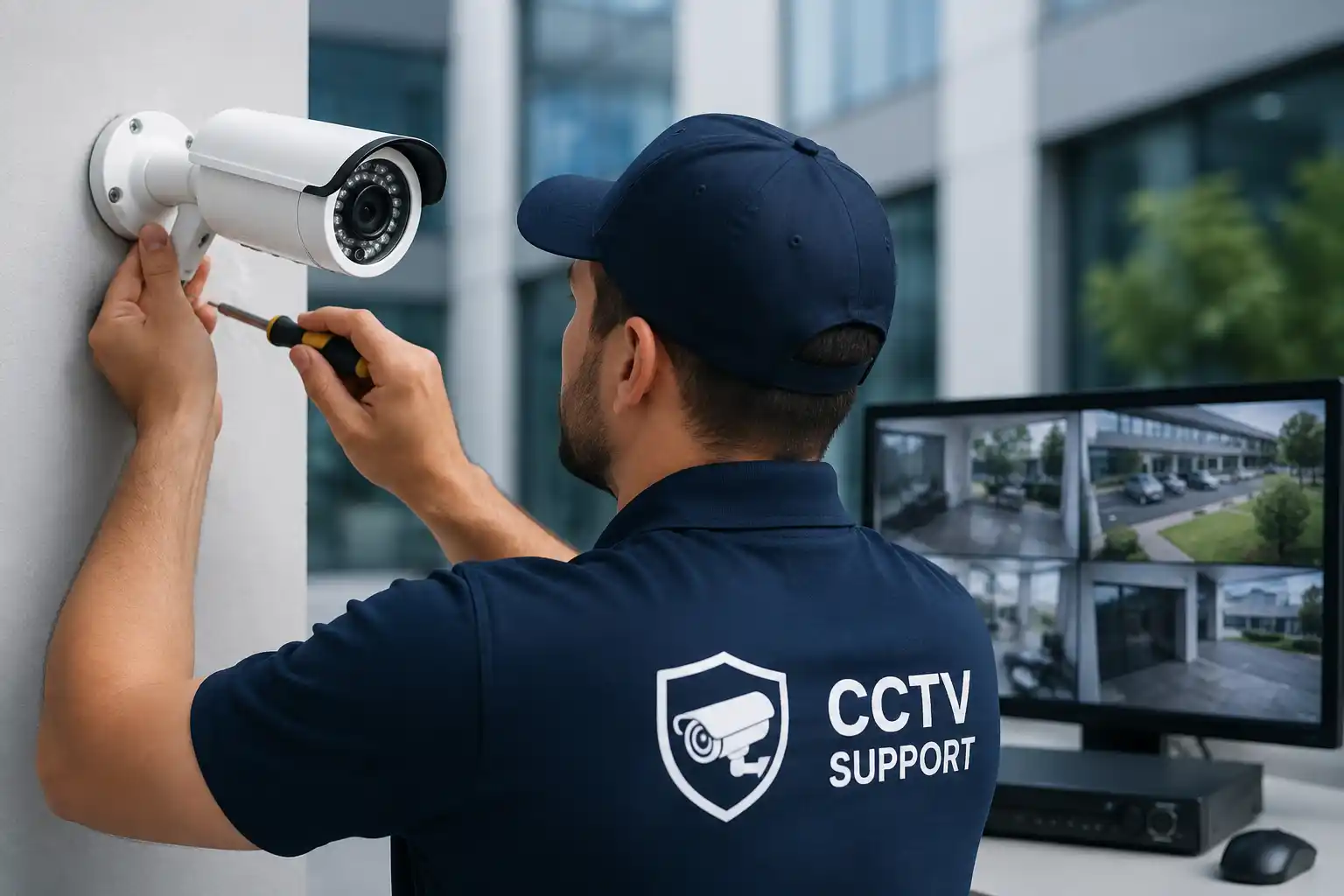
Coverage is planned around real business areas and viewing objectives.
Cameras depend on mounting, power, cabling, switching, recording and access.
Live view, recording, playback, time, storage and approved viewing are checked.
Timing and commercial terms follow assessment, access and the approved quotation.
What does CCTV installation involve?
CCTV installation is the coordinated process of deciding what must be seen, selecting suitable camera locations, preparing power and data paths, mounting and connecting equipment, configuring the recorder and network, defining authorised user access, and proving that footage can be recorded and retrieved as intended. It is mainly used when a business is opening a new site, replacing an unreliable surveillance system, adding coverage, improving recording quality, or bringing an inherited installation under clearer control. Organisations should consider it when camera views need to support incident review, staff or visitor safety, property protection, stock visibility or operational oversight. Before work is confirmed, the customer should prepare the site location, priority viewing areas, approximate number of cameras, any existing equipment details, network or rack information, access restrictions, expected recording period, remote-viewing needs and the person authorised to approve changes. A site assessment is often required before a complete installation quotation can be finalised.
What a well-planned CCTV installation should cover
A surveillance project is more than attaching cameras to walls. Each view must have a reason. An entrance camera may need to show people approaching a controlled doorway, a reception camera may need to cover a waiting area without wasting pixels on a blank wall, and a warehouse camera may need a broader field of view that remains useful under changing light. The intended use affects mounting height, lens choice, image detail, lighting expectations and the number of cameras required. These decisions should be made before cable routes and recorder capacity are treated as final.
The physical infrastructure is equally important. Cameras need a stable mounting surface, protected cable routing and suitable power. IP cameras commonly rely on network cabling and Power over Ethernet, which means the PoE switch must have enough ports and power budget for the planned devices. Analogue systems may depend on separate power arrangements and compatible recorder inputs. Existing cabling can sometimes be reused, but it should not be assumed suitable until its type, condition, route and termination have been checked. A cable that produces intermittent video after installation can create more disruption than replacing an unsuitable run during the project.
The recording layer must be designed for the required camera count, stream settings, storage expectation and retrieval workflow. The recorder location should also be considered from a maintenance and physical-security perspective. It needs appropriate power, ventilation, network access and practical service access. If authorised users need remote viewing, the installation must also consider secure account handling, network configuration and the method supported by the selected platform. The exact configuration depends on the camera and recorder environment, available licences where relevant, the local network and the customer’s access policy.
FourTeck approaches CCTV as part of the connected IT environment. That matters because an IP camera does not operate independently: it can depend on switch ports, VLANs, addressing, gateways, DNS, time synchronisation, firewall policies, recorder services, storage and user applications. An installation that is clear at handover is easier to maintain later. Camera names, positions, network details, recorder information and authorised access should be understandable to the customer rather than living only in one technician’s memory. For wider technology context, businesses can review FourTeck business IT support alongside the CCTV project.
Who may need CCTV installation or expansion support?
New offices and fit-outs
A new workspace can include CCTV while ceiling access, cable routes, network cabinets and power planning are still open. Early coordination can prevent camera positions from conflicting with signage, lighting, partitions, doors, screens or final furniture.
Retail, hospitality and customer areas
Shops, restaurants, showrooms and front-of-house environments may need carefully placed views around entrances, service points, stock movement and operational zones while maintaining sensible access control to footage.
Warehouses and logistics sites
Large spaces may require attention to distance, height, loading areas, lighting variation, cable length, outdoor exposure, switch location and recording bandwidth. Coverage planning should distinguish a broad overview from areas where more detail is required.
Existing and inherited systems
A business taking over a fitted premises may have unknown cameras, undocumented recorder settings, missing camera names or uncertain remote access. An assessment can identify what is reusable and what needs replacement or reconfiguration.
Planning triggers that usually justify a CCTV review
A new installation is often triggered by a change in the business rather than by a camera fault. The company may be moving into a new premises, adding a warehouse area, extending opening hours, reorganising a reception, creating a new storage room, or opening another branch. Each change can alter what needs to be visible and where cable routes can be taken. It is better to define these requirements before cameras are purchased or building finishes make routes difficult to access.
Existing systems also reach a point where repeated small changes become difficult to manage. A recorder may have unused channels while other cameras have been added through a separate platform. Camera names may no longer match the actual locations. Remote viewing may be shared between too many people. Storage retention may have changed as higher-resolution cameras were added. Cabling may pass through unmanaged switches or adapters that were introduced as temporary fixes. None of these conditions automatically means the full system must be replaced, but they are signs that an installation or upgrade project should start with an inventory and design review.
Another common trigger is dissatisfaction with the footage itself. A camera can be technically online and still fail the business objective because the angle is too wide, strong backlight obscures faces, reflections affect night images, or the key activity takes place outside the frame. In these situations, the appropriate action may be repositioning, changing the camera type, adjusting lighting, refining stream settings or adding a targeted view. The right recommendation depends on what the business actually needs to see, not only on whether the current camera is functioning.
Business impact when surveillance is poorly planned
An incomplete CCTV installation can create a false sense of coverage. Cameras may be visible around the site while important doors remain outside the frame, recording may stop unnoticed, timestamps may not match, or footage may be difficult to locate when management needs it. Poor camera naming can slow incident review. Insufficient storage can reduce the available history. Weak cabling or unstable PoE can produce intermittent cameras that appear healthy during a quick inspection but disappear later.
Operational impact can include longer investigation time, uncertainty about what happened, repeated maintenance visits, unplanned equipment replacement and friction between IT, facilities, security and external vendors. A system that depends on one undocumented administrator account can also become difficult to maintain after staff changes. These are practical reasons to treat installation documentation, access ownership and final validation as part of the project rather than as optional finishing tasks.
The aim is not to promise that surveillance prevents every incident or captures every possible detail. A CCTV system should instead be designed around defined objectives, realistic viewing conditions and a maintainable technical environment. That makes expectations clearer and gives the business a better basis for testing whether the installed system meets the agreed scope.
Possible CCTV installation scope
Depending on the confirmed scope, FourTeck assistance may begin with a site discussion, floor-plan review or physical survey. The assessment can identify priority areas, existing cameras, cable routes, rack or recorder positions, network switches, power availability, building restrictions and expected viewing methods. The result is used to separate necessary installation work from optional improvements and from third-party responsibilities.
Discovery and design
Coverage objectives, camera locations, viewing distance, lighting, environmental conditions, cable routes, recorder location, storage expectations, network dependencies and future expansion can be reviewed before the installation plan is confirmed.
Physical installation
Approved work may include camera mounting, cable termination, patching, power or PoE coordination, recorder positioning, monitor connection and device labelling. The exact tasks depend on site conditions and building access.
Configuration
The agreed system may require device activation, address planning, recorder registration, recording schedules, time settings, stream choices, storage allocation, user permissions and approved remote-viewing configuration.
Testing and handover
Checks can include live view, image angle, recording, playback, date and time, storage status, camera naming, authorised remote viewing and a basic record of installed components, locations and administrative dependencies.
Not every project includes every activity. Civil work, specialist access equipment, new electrical work, replacement hardware, permits, authority approvals, building-management requirements or third-party network changes may need to be separately confirmed. The quotation should state what FourTeck is providing, what the customer is providing and what depends on other vendors.
Service-fit matrix: when is installation assistance appropriate?
| Business situation | Relevant assistance | What must be confirmed |
|---|---|---|
| New office, shop or warehouse | Coverage planning, camera positions, cable routes, recorder and network integration, installation and handover. | Final layout, access, ceiling or wall conditions, network readiness, viewing priorities and project schedule. |
| Existing system has blind spots | Coverage review, repositioning or additional cameras, stream and storage impact review. | Exact area that must be visible, current recorder capacity, compatible camera options and cable access. |
| Inherited CCTV with unknown condition | Inventory, recording checks, camera mapping, access review and repair-versus-upgrade guidance. | Authorised access, equipment ownership, available credentials, existing cabling and the business outcome required. |
| More cameras are being added | Capacity review covering PoE, switching, network bandwidth, recorder channels and storage. | Current camera count, recorder model, switch capacity, network design and desired retention. |
| Remote viewing needs improvement | Account, application, recorder and network configuration review after authorisation. | Supported platform method, internet availability, administrator access, security policy and approved users. |
CCTV installation service information
| Service topic | CCTV installation, surveillance-system setup, expansion and related site coordination. |
|---|---|
| Main purpose | To create or improve camera coverage, recording, playback, authorised viewing and maintainability for agreed business areas. |
| Typical systems involved | IP or analogue cameras, NVR or DVR, storage drives, PoE switches, network switches, cabling, power, monitors, local network and approved viewing applications. |
| Assessment method | Remote discussion may establish objectives, but physical site assessment is commonly required for placement, routes, mounting, existing cabling and environmental conditions. |
| Customer information required | Location, target viewing areas, approximate camera count, existing equipment, network details, access restrictions, recording expectations, remote-viewing needs and an authorised contact. |
| Remote support suitability | Useful for discovery, documentation review, some configuration and authorised viewing checks when secure access and a working connection are available. |
| On-site suitability | Normally required for camera positioning, mounting, cabling, power checks, switch or recorder work, coverage validation and physical fault isolation. |
| Testing and validation | Scope dependent; may include image review, recording, playback, date and time, camera naming, storage status and approved viewing devices. |
| Security considerations | Authorised accounts, controlled administrator access, supported remote-viewing methods, reasonable network separation and removal of unnecessary exposure where the environment allows. |
| Service location | Dubai and UAE service coordination, subject to location, scheduling, site access and the approved work scope. |
| Quotation requirement | A confirmed quotation should define assessment, equipment responsibilities, installation tasks, cabling, configuration, testing, documentation, exclusions and third-party dependencies. |
Remote planning versus on-site CCTV installation work
What can often begin remotely
An initial discussion can establish why CCTV is required, what areas matter, whether a system already exists and how users expect to view recordings. Floor plans, photos, equipment lists and recorder details can help prepare questions before a site visit. If an existing system is accessible through an approved secure method, some recorder, account or network information may also be reviewed remotely.
Remote work is most useful when it reduces uncertainty before people arrive on site. It should not be used to guess camera angles, cable condition or mounting constraints that can only be verified physically.
What normally needs on-site coordination
Mounting positions, field of view, cable routes, wall and ceiling conditions, lighting, environmental exposure, power availability, network points and recorder placement require physical confirmation. Installation itself normally involves hands-on work, followed by tests at the actual camera and recorder locations.
A site visit may also be necessary when the existing system is undocumented, several cameras are offline, cable paths are unknown or the network cannot be accessed remotely. Attendance and project timing depend on confirmed scope, site access and scheduling.
How the CCTV assessment and installation journey can work
- Define the business objective. Identify the spaces that matter, what activity needs to be visible, who will review footage and whether the project is new, an expansion or a replacement.
- Review the site and existing environment. Check layouts, walls, ceilings, entrances, cable routes, rack locations, power, network switches, recorder space, current cameras and any building-access conditions that may influence the plan.
- Map camera views to practical requirements. Each proposed position should have an intended purpose. Consider viewing distance, light direction, indoor or outdoor exposure, likely obstructions and whether a wide overview or more detailed view is required.
- Check technical capacity. Confirm the recorder approach, available channels, network and PoE capacity, storage expectations, addressing and any supported licensing or platform requirements that apply to the selected equipment.
- Agree the controlled work scope. The quotation should identify mounting, cabling, equipment responsibilities, configuration, testing, documentation, excluded civil or electrical work and any reliance on building management or third parties.
- Install and label the approved components. Carry out physical work using the agreed routes and positions, connect devices to the correct power or network path and label cameras or ports in a way that supports later maintenance.
- Configure recording and authorised access. Register devices with the recorder, set suitable time and recording behaviour, create understandable camera names and configure approved viewing methods according to the platform and customer policy.
- Validate the real result. Check live image, angle, recording, playback, date and time, storage status and agreed remote or local viewing. Testing should use the installed environment, not only device status lights.
- Hand over what the customer needs to manage. Record key locations, administrative dependencies and next maintenance actions. Credentials should be shared only through an approved secure method after identity and authorisation are confirmed.
Planning camera positions before cables are fixed
Camera placement is one of the most important design decisions because it is difficult to compensate for a poor angle after the physical work is complete. The discussion should start with the event the business expects to review. A doorway view has a different purpose from a general room overview. A cash handling area has different detail requirements from a loading bay. An outdoor perimeter location introduces different lighting and weather considerations from an indoor corridor. The site plan should therefore show why a camera is being installed, not simply mark evenly spaced camera symbols.
Placement also needs to account for the built environment. Columns, signs, shelves, doors, glass, reflective surfaces and future partitions can block or distort a view. High mounting can protect a camera from casual interference but may reduce the detail available at close range. A very wide-angle view may appear impressive on a monitor while providing limited detail for a small target area. These trade-offs should be understood before equipment is fixed.
Lighting should be considered at the times that matter. Entrances can have strong daylight behind a person during part of the day. Indoor lights may be switched off after working hours. Outdoor lights may create glare or deep shadow. Infrared illumination can reflect from nearby walls, glass or protective covers. A project cannot always reproduce every future condition during installation, but the design can reduce obvious problems and leave a clear path for later adjustment if operating conditions change.
Cabling, PoE and network readiness for IP cameras
IP camera projects are also network projects. Each camera requires a reliable path from the mounting point to the switching and recording environment. Where Power over Ethernet is used, the switch must provide both data and sufficient power for the connected load. Planning should consider the total camera count, any future additions, available switch ports, uplink capacity, network segmentation and where the NVR or viewing stations connect. Adding cameras without checking these dependencies can lead to unstable links, overloaded power budgets or difficult troubleshooting later.
Structured cabling should be routed and terminated in a way that can be tested, identified and maintained. Temporary adapters, unmanaged extensions or inaccessible joints can create hidden failure points. Where the project shares cabinets with business data, Wi-Fi or IP telephony, port allocation and labelling become especially important. The CCTV design should not assume it can use any spare port without understanding the wider network.
Addressing and segmentation are configuration decisions rather than physical installation details, but they should be considered early. The chosen design may use a dedicated camera network or another controlled arrangement, depending on existing infrastructure and the capabilities of the switching, firewall and recorder environment. The purpose is to keep communication predictable and authorised, not to create unnecessary complexity. Network changes can affect other business systems, so configuration should be backed up and planned with an appropriate rollback approach where the change carries wider risk.
Recorder, storage and playback planning
Recording is the part of a CCTV installation that turns live video into usable history. Storage planning therefore needs to be based on the actual system rather than a generic number of days. Camera count, resolution, frame rate, compression, scene activity, recording schedule and available storage all affect retention. The final design may also depend on the limits and licensing model of the recorder or video platform. If the customer has a specific retention target, that requirement should be confirmed before the equipment and stream settings are finalised.
Playback should be tested as a user workflow. The customer should be able to identify a camera, choose a time, review footage and export or share material according to the organisation’s authorised process. A system can be recording correctly but still be difficult to use if cameras are poorly named or the administrator accounts are unclear. Time synchronisation is another practical dependency because an incorrect timestamp can complicate incident review across multiple cameras or other business systems.
Storage health also becomes part of ongoing maintenance. The installation handover should make clear how the recorder indicates storage problems and who is expected to review alerts or health information. FourTeck can include recorder and storage checks in the agreed installation or maintenance scope, but continuous monitoring should not be assumed unless it is explicitly defined in a service agreement.
Testing, validation and handover after installation
An installation is not complete simply because every camera appears on a live screen. Validation should confirm that the agreed areas are visible, the image is usable under the tested conditions, cameras are mapped to understandable names, recording is taking place, playback works, time is correct and the recorder recognises the expected storage. For IP systems, network stability and PoE status may also be reviewed. If remote viewing forms part of the approved scope, it should be tested for the authorised users and devices defined by the customer.
Handover should also explain ownership. The customer should know where the recorder is located, which network equipment the cameras depend on, who holds administrative authority and what documentation has been supplied. Passwords should not be published in general documents or public email chains; credentials should be exchanged through an approved secure method once identity and authorisation are confirmed. Camera names and a simple location map can reduce troubleshooting time dramatically if a fault appears months later.
Any remaining limitations should be recorded. A view may still be affected by changing lighting, a legacy camera may remain below the desired quality, or a building restriction may limit a preferred mounting position. Clear handover is not about claiming perfection; it is about giving the customer an accurate understanding of what was installed, what was tested, what remains dependent on the environment and what should be reviewed through routine maintenance.
Capability outcome 1: clearer surveillance coverage
A well-defined coverage plan gives the business a better chance of capturing the areas that matter without installing cameras simply to increase the count. During assessment, each proposed view can be linked to a practical purpose such as an entrance, reception, loading activity, parking area, stock movement or controlled corridor. This helps the project team decide where a broad overview is sufficient and where more detail may be necessary.
The limitation is that camera coverage is always tied to real-world conditions. People or objects can obstruct a view, lighting changes, shelves move, doors open in different directions and outdoor weather changes image quality. The installation can be designed around known conditions, but periodic review may still be needed when the business changes. Clear camera naming and a location plan make those later reviews easier.
For management, the benefit is clarity: instead of asking whether the building has enough cameras, the better question becomes whether the agreed operational areas are covered in a useful and maintainable way. That is a more practical basis for budgeting, testing and future expansion.
Capability outcome 2: a CCTV system that fits the network
Modern surveillance increasingly depends on the same network infrastructure that supports staff, phones, servers and internet access. A CCTV installation should therefore account for switching capacity, PoE power, addressing, uplinks, segmentation and recorder communication before cameras are added. This reduces the risk of creating a technically separate project that later causes problems for the wider office network.
The exact design is environment dependent. A small shop with a single network switch has different requirements from a multi-floor office or warehouse with managed switching and several cabinets. Some sites may already have a suitable dedicated camera segment, while others may need network changes before the new cameras can be integrated. FourTeck can assess these dependencies within the installation scope and coordinate with the customer’s existing IT provider or network administrator where responsibility is shared.
This approach also improves fault isolation after handover. When camera ports, addresses and network dependencies are documented, an offline camera can be investigated through a known path instead of relying on repeated resets or device replacement.
Capability outcome 3: easier maintenance after the project
CCTV systems often operate continuously for long periods, which means maintenance problems can remain hidden until footage is urgently needed. An installation that includes sensible labels, camera names, recorder records and access ownership is easier to check later. When a camera becomes unavailable, support can start from a known location, port and recorder channel rather than first trying to reconstruct the system.
Maintenance needs vary with the site. Outdoor cameras can face dust, heat, weather and physical exposure. Indoor lenses can still collect dust or be moved during cleaning and fit-out work. Storage drives may show health warnings over time. Switches, power supplies and network conditions can also change. The installation itself cannot remove these lifecycle risks, but it can make them easier to identify and manage.
FourTeck can discuss preventive checks or recurring support after installation if the customer wants a defined maintenance arrangement. The agreed plan should state which cameras, recorders, sites and activities are covered, how on-site and remote work are handled, what is excluded and how replacement equipment or third-party work is treated.
Dependencies, access and customer inputs
The final CCTV installation scope depends on information and access that the customer controls. FourTeck may need the site address, an authorised contact, floor plans if available, details of priority viewing areas, approximate camera numbers, existing camera and recorder models, rack or network information, available cable routes, internet or LAN requirements for remote viewing, building access procedures and any maintenance window that affects business operations. If the project reuses existing equipment, current administrative access and ownership evidence may be required before configuration changes can be made.
Customers should not send passwords through a public webpage or include credentials in an open project brief. Credentials should be shared only through an approved secure method after identity and authorisation are confirmed. If access to an inherited recorder cannot be recovered, the options depend on the device and may include vendor-supported reset, replacement or reconfiguration that can affect existing settings.
The project can also depend on people outside FourTeck. Building management may control working hours, ceiling access, cable routes or drilling permissions. A fit-out contractor may own containment or civil work. An electrician may need to provide new power. An internet or network provider may control firewall or switching changes. These dependencies should be identified before the schedule is treated as final.
Risks, limitations and exclusions to confirm
A surveillance project should be planned with realistic limits. Site assessment can reduce uncertainty, but it cannot guarantee that every future incident will occur inside the frame or that every image will contain the same level of detail under all lighting and weather conditions. Camera performance depends on placement, lens, lighting, scene movement, environmental exposure and device capability.
Existing equipment can also limit what is possible. An older recorder may not support newer cameras, higher stream requirements, secure remote access methods or the desired storage size. Reusing legacy cabling may be possible in some cases and unsuitable in others. Hardware that is already failing may require replacement outside the labour scope. Storage retention depends on camera settings, recorder capacity and actual recording behaviour, so a target should be validated against the final configuration rather than treated as an unconditional promise.
Configuration changes can affect wider services when CCTV shares switches, firewalls or network cabinets with business systems. Backups and rollback planning are appropriate before higher-risk changes. On-site work also depends on location, engineer scheduling, customer access, site conditions, parts or equipment availability and third-party participation. Final commercial terms, inclusions and exclusions follow the approved quotation or service agreement.
Business environments and practical use cases
Professional offices may use CCTV around entrances, reception, common areas, controlled rooms and parking access. The main planning challenge is often fitting cameras into a finished workplace without creating poor angles, exposed cabling or unnecessary coverage. Office systems may also share network switches and cabinets with phones, access points and servers, so camera traffic and PoE capacity should be coordinated with the existing infrastructure.
Retail and showroom environments can require views around entrances, sales floors, service counters, storage areas and delivery points. Fixtures and merchandise move, so a useful design should consider how the space changes through the year. Bright storefront glass can affect image quality, while back-of-house areas may have very different lighting. Authorised access should be limited to the people who actually need to review or manage footage.
Warehouses and logistics operations typically present longer distances, higher ceilings, loading activity and large changes in light between doors and internal aisles. Cable routes can be longer and may need coordination with elevated work, racks or other building systems. A broad overview camera may be useful for one purpose while a separate targeted view is needed at a loading entrance or controlled stock area.
Clinics, training centres, hospitality sites and property-management environments each have their own operational requirements. FourTeck can help define the technical scope, but the customer remains responsible for confirming any privacy, landlord, insurer, building-management or authority requirements that apply to the specific premises and intended use. The installation plan can then be aligned with those confirmed requirements.
Operational, security and maintenance considerations
CCTV administration should be treated as a controlled business function. Administrator accounts should belong to authorised individuals or managed roles rather than be casually shared across staff. User permissions should match the viewing or management responsibility required. Where the platform supports separate roles, the customer can consider limiting routine viewers from configuration areas. Default or unnecessary accounts should not remain active simply because the system appears to work.
Remote viewing adds another dependency because it relies on the recorder, network, internet connection and the remote-access method supported by the platform. The design should avoid unnecessary exposure and follow the customer’s security policy. If firewall or network changes are required, these should be reviewed with the authorised administrator and backed up where appropriate before implementation. A camera system should not be described as secure simply because one setting has been changed; security depends on the overall configuration and maintenance practice.
Maintenance should include more than cleaning lenses. Useful checks can include camera availability, image condition, recording status, playback, date and time, storage health, switch or PoE condition, physical mounting and remote access. The frequency depends on the environment, business importance, equipment age and agreed service plan. Any recurring support arrangement should define what is covered, what requires a separate quotation and how hardware replacement is handled.
Before you contact FourTeck about CCTV installation
Preparing a few details can make the first discussion more useful and reduce time spent reconstructing the site requirements.
- Exact service location and building or site type.
- Main contact person authorised to discuss the installation.
- Areas that need surveillance and why each area matters.
- Approximate number of cameras expected, if already known.
- Any existing cameras, recorder, monitor or storage equipment.
- Available floor plans, photos or old camera-location drawings.
- Known network switches, PoE availability and rack location.
- Whether existing cabling is expected to be reused.
- Desired local and remote viewing users.
- Recording or retention expectation that management wants assessed.
- Building-access, ceiling, drilling or working-hour restrictions.
- Any recent renovation or planned fit-out work.
- Existing administrator access if equipment will be retained.
- Target business outcome and any areas of current dissatisfaction.
- Preferred project window, subject to site and engineer availability.
Checklist for defining the quotation and engagement
How FourTeck can assist with the installation project
FourTeck can help translate a general request for cameras into a defined technical project. The first step is to understand the premises, viewing objectives, existing surveillance equipment and related IT infrastructure. From there, assistance can include site assessment, camera-position planning, cabling and PoE coordination, recorder and storage review, network integration, configuration, testing and documentation. The exact combination depends on what the customer already has and what the approved quotation covers.
Where multiple parties are involved, FourTeck can coordinate technical information with the customer’s fit-out contractor, electrician, building management, network administrator, internet provider or equipment supplier. Coordination does not remove the responsibilities of those parties, but it can make dependencies clearer before installation starts. This is particularly useful when cameras share cabinets, switches, internet access or physical routes with other business systems.
The quotation process should identify the work to be completed, customer responsibilities, required access, expected tests, documentation and exclusions. If the site changes after assessment, the scope may need to be updated. Customers can learn more about the company’s wider service approach on the FourTeck IT Services company page.
Dubai and UAE service coordination
CCTV installation in Dubai normally requires a combination of planning and physical site work. The first discussion can be handled remotely, especially when floor plans, photos and existing equipment details are available. An on-site assessment may then be recommended to confirm camera positions, cable routes, mounting surfaces, rack or recorder locations, switch capacity and site-access conditions. Installation timing should not be treated as fixed until the scope, access and equipment responsibilities are confirmed.
Service coordination can also be affected by building rules, fit-out schedules, working-hour restrictions, specialist access requirements, third-party cabling or electrical work and network changes controlled by another administrator. Contact FourTeck to confirm the service scope and scheduling options. Remote or on-site assistance depends on the issue, location, urgency, access and approved quotation. Any installation, configuration, migration or maintenance tasks should be clearly included in the commercial scope before work begins.
CCTV project coordination across Dubai, Abu Dhabi, Sharjah and Ajman
FourTeck can discuss surveillance installation, assessment, maintenance and project support requirements for businesses in Dubai, Abu Dhabi, Sharjah and Ajman. The appropriate service method depends on what has to be done. Documentation review and some configuration questions may be handled remotely, while physical survey, mounting, cabling, camera replacement, coverage testing and recorder work require planned site access.
For multi-site organisations, it can be useful to standardise camera naming, recorder documentation, network conventions and handover records even when the physical layout is different at each premises. A common structure can reduce support confusion without forcing every branch to use an identical design. Site-specific factors still need to be respected, including ceiling heights, entrances, lighting, rack locations, working hours and local access procedures.
Scheduling and travel are scope dependent. Building access, site conditions, equipment availability, fit-out progress and third-party providers can affect the final service plan. Businesses should share the addresses, target work, access contacts and preferred sequence so FourTeck can confirm how the project can be organised.
Related FourTeck IT services that may affect CCTV
CCTV service and maintenance
Useful after installation for recorder checks, camera availability, image condition, storage review and fault diagnosis under an agreed maintenance scope.
Office network support
Relevant when IP cameras depend on managed switches, PoE, addressing, VLANs, uplinks or network changes that must coexist with other business systems.
Structured cabling coordination
Important when new camera points require planned routes, patching, terminations, labels or fit-out coordination before the cameras can be connected.
Business IT support
Helpful where CCTV shares power, racks, switches, internet, firewalls or user devices with the broader workplace technology environment.
These services are described within FourTeck’s connected IT service coverage. Actual work should be defined against the specific site and approved quotation.
Why businesses contact FourTeck for CCTV project support
Businesses often need a technical partner that can look beyond the camera itself. A surveillance system may depend on network switches, PoE power, internet access, recorders, storage, user devices, firewalls and the physical building. FourTeck’s service model is suited to projects where these layers need to be considered together rather than passed between separate vendors without clear ownership.
The value of the engagement is practical: define the requirement, assess the environment, identify dependencies, plan controlled changes, install the agreed scope, test the result and document what the customer needs for future support. Where another provider owns part of the environment, FourTeck can help coordinate the technical information rather than making unsupported assumptions about that system.
Customers should still expect the quotation to be specific. Camera count, cable routes, site conditions, equipment, access, storage, network work and testing can all change the effort required. A clear scope protects both the customer and the service team by separating included work from optional additions and third-party tasks.
Questions businesses ask before choosing CCTV installation in Dubai
Can a CCTV installation be quoted from a camera count alone?
A camera count is useful, but it is rarely enough for a dependable scope. Ten cameras in a finished office can require very different work from ten cameras across a warehouse, outdoor yard or multi-floor property. Mounting height, cable distance, wall or ceiling construction, network availability, PoE capacity, recorder location, lighting and access restrictions all affect the project. If a customer already has a floor plan and proposed camera positions, FourTeck can use that as a starting point, but an on-site assessment may still be required before installation work and responsibilities are confirmed.
Do we need new cabling for every camera?
Not always. Existing cabling may be reusable if it is the correct type, reaches the required locations, is in suitable condition and can be tested successfully. In inherited sites, however, cable routes and terminations are often undocumented. A camera fault can be caused by a damaged run or weak termination even when the camera itself is healthy. Reuse should therefore be a technical decision, not an assumption made only to reduce initial work. If new routes are required, the quotation should explain who is responsible for containment, drilling, ceiling access and any specialist civil work.
Is IP CCTV always the right choice for a new installation?
IP cameras are common in modern business environments because they integrate with network switching and can provide flexible management, but the right design depends on the existing site and project requirements. Some locations already have analogue cabling and recorders that remain serviceable; other locations are better suited to a new IP design. The decision should consider camera objectives, cabling, recorder compatibility, network capacity, PoE, storage, expansion plans and maintenance. FourTeck can assess the environment and explain the trade-offs before the customer approves a specific route.
How do we decide where the cameras should go?
Start with the activity the business needs to review, not with the easiest wall or ceiling position. Mark entrances, service counters, loading points, parking access, stock areas, restricted rooms, corridors or other locations that matter to operations. Then review distance, angle, lighting, obstructions and how people or vehicles move through the space. A wide camera view may cover a large area but provide less detail at a specific point. Placement should therefore balance overview and detail according to the actual purpose of each camera.
Can the system be configured for remote viewing?
Remote viewing may be possible when the selected recorder or camera platform supports it, the site has suitable internet access and the customer authorises the required network and account configuration. The correct method is platform dependent. Remote access should not be treated as simply exposing a recorder to the internet. FourTeck can review the supported viewing method, user permissions and relevant network dependencies as part of the agreed scope. The customer should define who needs access and on which approved devices.
How much recording storage do we need?
Storage depends on the final camera count and how each camera records. Resolution, frame rate, compression, scene activity, continuous or event-based schedules and retention goals all influence usage. The recorder also has platform-specific limits. For that reason, storage should be sized against the intended configuration rather than an assumed number of days. If management has a required retention period, that target should be stated before the recorder and drives are confirmed so the design can be checked against it.
What should we prepare before an on-site CCTV survey?
Prepare the site address, contact person, areas that need to be covered, any floor plan, current camera or recorder details, known network or rack locations and information about access restrictions. It also helps to identify whether ceilings are open or finished, whether work must happen outside normal operating periods and whether a fit-out contractor or building management controls cable routes. If an existing system will be retained, have authorised administrative access available through a secure process rather than sending passwords in advance through an unsecured channel.
Should we repair the existing system or replace it during the installation project?
The answer depends on the condition and capability of the current equipment. A healthy recorder with available capacity may support a controlled expansion, while an obsolete or failing recorder may create repeated limitations. Existing cameras may be serviceable but poorly positioned. Cabling may be reusable even if some devices are not. FourTeck can help separate individual faults from design limitations so the business can decide whether to repair, extend, phase an upgrade or replace specific components. The goal is to avoid both unnecessary replacement and repeated spending on equipment that cannot meet the required outcome.
When is an on-site visit usually necessary?
An on-site visit is usually necessary when the project involves physical camera positioning, wall or ceiling mounting, cable routes, power, PoE, cabinet work, recorder installation, coverage testing or an undocumented existing system. Remote discussion can prepare the project, but it cannot confirm whether a column blocks a view, whether a ceiling route is accessible or whether a cable is physically damaged. For installation work, the site itself is part of the technical environment, so physical verification is often essential.
What can change the final project scope after the first discussion?
Site conditions are the most common reason. The customer may discover that existing cabling cannot be reused, a preferred camera position has no practical route, a switch lacks PoE capacity, the recorder has no available channels, or building management requires a different working method. Additional viewing requirements can also emerge once the site is walked. FourTeck should document these changes and confirm any commercial impact before extra work is treated as included. This is why the first conversation is useful for planning but should not replace proper assessment.
What should happen after the cameras are installed?
The installed system should be validated against the agreed scope. The team should confirm the live image, angle, recording, playback, time, storage status and camera naming. Approved remote or local viewing should be checked if included. The customer should receive enough documentation to understand camera locations, recorder placement and key technical dependencies. Future maintenance should also be discussed, especially for sites where outdoor exposure, dust, changing layouts or business-critical recording make periodic checks useful.
Can FourTeck coordinate CCTV with our existing IT provider or fit-out contractor?
Yes, coordination can be part of the confirmed scope when another party controls network switches, firewalls, electrical work, cable containment or building access. The purpose is to define who changes what and what information each party needs. FourTeck can provide the CCTV network, power, mounting and recorder requirements, while the customer’s other provider carries out the work they own. Responsibility boundaries should be written into the project plan or quotation so that gaps are identified before installation day.
Frequently asked questions
Does FourTeck install CCTV in existing offices?
Yes, existing premises can be assessed for new camera locations, reuse of current cabling or equipment, recorder capacity, network readiness and physical access. The scope depends on what is already installed and the final coverage requirement.
Can old cameras be kept?
Possibly. Reuse depends on camera condition, compatibility, image quality, recorder support and the purpose of the view. An assessment can identify which components remain suitable and which create limitations.
Will installation include all cabling?
Cabling should be explicitly defined in the quotation. Some projects reuse tested infrastructure; others require new routes, containment or third-party civil and electrical work. The site survey helps determine responsibility.
Can CCTV share the office network?
It can in many environments, but switch ports, PoE power, bandwidth, addressing, segmentation and security need to be considered. The correct design depends on the existing network and camera system.
Is remote support enough for a new CCTV project?
Remote work can help with discovery and some configuration, but new installation normally requires on-site assessment and physical work for placement, mounting, cabling and real coverage validation.
Can you configure recording schedules?
Recording configuration can be included when supported by the selected recorder and agreed in scope. Settings should be matched to storage expectations, operational needs and the capabilities of the platform.
Do we need administrator access?
Authorised administrative access is normally required when existing recorders, cameras or network settings must be changed. Credentials should be shared securely after identity and authority are confirmed.
What if our recorder is already full?
A full channel count or limited storage can affect expansion. The recorder’s capabilities, current streams and storage condition should be assessed before more cameras are added.
Can the project include documentation?
Yes, documentation can form part of the approved scope. Useful records may include camera names, locations, recorder details, network dependencies, administrator ownership and key test results.
How is the final quotation prepared?
The quotation is based on the confirmed requirement, site conditions, equipment responsibilities, cabling, network work, installation tasks, testing, documentation, scheduling dependencies and exclusions.
Discuss your CCTV installation requirement with FourTeck
If you are planning cameras for a new site, extending an existing system or trying to make an inherited installation easier to manage, start with the business areas that need to be visible and the result you expect from recording. Share the location, approximate camera requirement, existing equipment, floor plan or photos if available, network information and any building-access constraints. FourTeck can then confirm whether a remote planning discussion, on-site assessment or more detailed technical review is the appropriate next step.
The final service plan remains subject to assessment, access, equipment compatibility, site conditions and the approved quotation. Installation, cabling, configuration, remote viewing, storage, testing, documentation and maintenance should each be confirmed rather than assumed.