
3CX and Panasonic PBX Integration in Dubai, UAE
When a business wants to introduce 3CX without immediately discarding an existing Panasonic telephone environment, the difficult part is rarely the idea of connecting two systems. The real work is deciding how calls, extensions, numbers, gateways, trunks, network paths, security controls and fallback arrangements should behave together. FourTeck can assess that complete path and plan an integration, coexistence or staged migration around the actual office workflow.
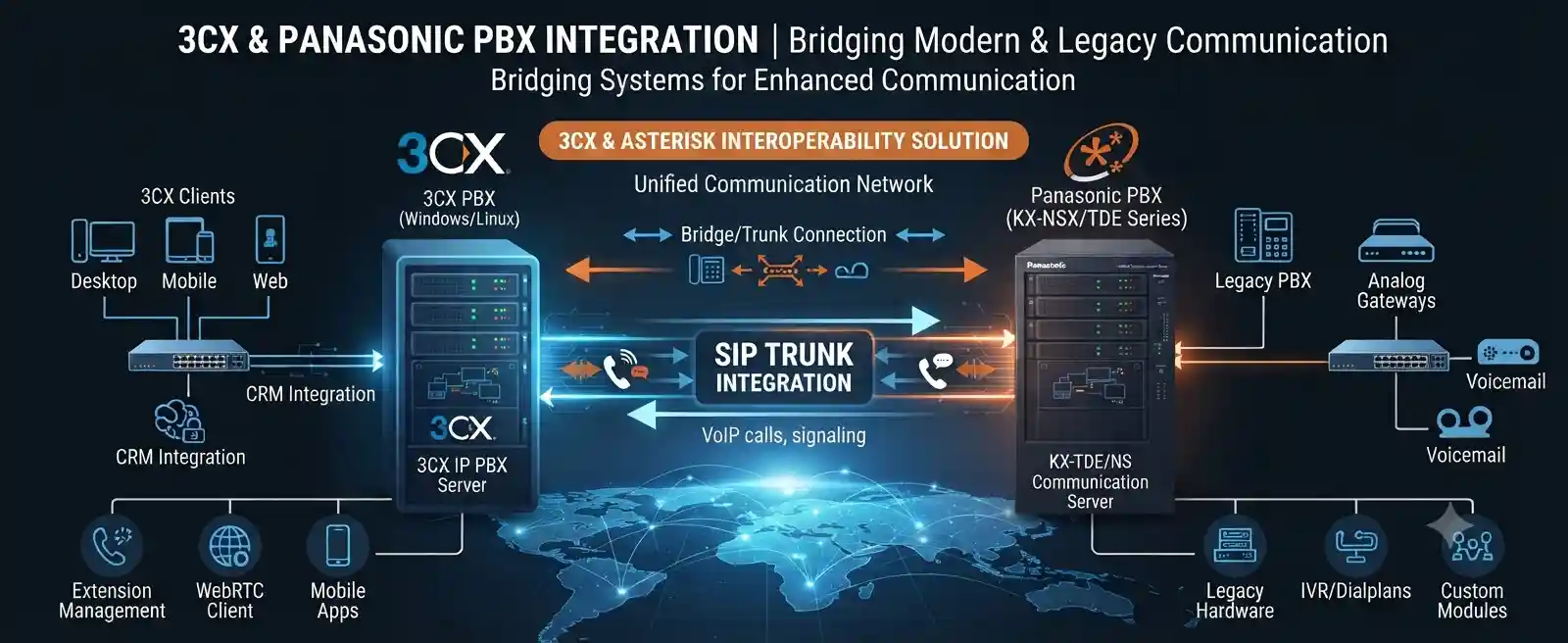
What does 3CX and Panasonic PBX integration involve?
It is the controlled connection or coexistence of a 3CX phone system with an existing Panasonic PBX so approved call traffic can move between them or so users can be migrated in stages. The design may use SIP connectivity where the specific systems support it, or it may require a suitable voice gateway or other telecom arrangement. Businesses should consider this service when they need to retain part of a Panasonic environment while adopting 3CX for selected users, branches, applications or future migration. Before work is confirmed, FourTeck needs the Panasonic model and current configuration, 3CX deployment details, trunk and number information, extension ranges, expected call flows, network and firewall information, licensing status, administrator access availability and a clear business objective. Compatibility and final scope remain environment dependent.
Why businesses consider connecting two PBX environments
An organisation may have a Panasonic PBX that still serves reception, analogue lines, door phones, legacy handsets, branch extensions or specialised interfaces, while newer teams want 3CX web, mobile or modern IP telephony functions. Replacing everything in one cutover may be unnecessary, commercially difficult or operationally risky. Integration can provide a temporary or longer-term way to let the two environments exchange selected calls while the business decides what should remain, what should move and what should be retired.
The objective should be defined in business terms before anyone changes trunk settings. For one customer, success may mean that a 3CX user can dial a Panasonic extension without using a public number. For another, it may mean incoming calls arrive through one system and are routed to a department on the other. A third customer may want a staged migration in which one floor moves to 3CX first while reception and a warehouse continue on Panasonic. These are different projects even though each can be described as PBX integration.
The design also has to respect the reality that support status, SIP implementation, licensing and available interfaces differ between Panasonic product families and generations. Some older Panasonic platforms provide SIP trunk capability but may be discontinued or limited by installed options. Having a SIP menu on both systems does not automatically prove end-to-end interoperability for every feature. A careful assessment therefore treats protocol support as one input, not as a guarantee that caller identity, transfer behaviour, DTMF, diversion, codecs, fax, recording, failover or special call features will behave exactly as expected.
Phased migration
Move selected users or departments to 3CX while keeping approved Panasonic extensions operational. This can reduce the size of a single cutover, but routing and numbering must remain understandable during the transition.
Legacy retention
Keep useful interfaces, handsets or site functions on Panasonic while 3CX provides newer communications for another group. The retained equipment should still be supportable and documented.
Call-path consolidation
Route selected internal or external calls between systems according to a planned numbering scheme. The carrier, DIDs, outbound permissions and emergency-call responsibilities must be clearly assigned.
Branch coexistence
Link a location using Panasonic with another team using 3CX, subject to network and platform compatibility. This can support transition planning without pretending the two systems are identical.
What the integration service may cover
Depending on the confirmed scope, FourTeck assistance may include discovery, configuration review, call-flow mapping, network checks, SIP or gateway planning, controlled configuration, user migration, test calls, documentation and provider coordination. Not every task below is required in every environment. The first purpose of assessment is to separate necessary work from optional work and to identify dependencies that FourTeck cannot control directly.
Current-state discovery
Identify Panasonic PBX family, expansion hardware, installed interfaces, software level, extension plan, trunk arrangement, connected analogue devices, branch links, support status and available backups. Review how 3CX is hosted and which users, phones and applications it serves.
Numbering and dial-plan review
Map extension ranges, direct numbers, reception routes, hunt groups, queues, voicemail paths and special dial codes. Overlapping extension numbers or inconsistent digit lengths can make inter-system routing confusing and should be resolved deliberately.
SIP or gateway feasibility
Check whether an approved direct IP interconnect is realistic for the exact equipment and software in use, or whether a suitable voice gateway, carrier arrangement or different migration path is required. Capacity and licence dependencies are reviewed before changes.
Inbound call routing
Define which system receives each number and where calls should go during office hours, after hours, overflow and failure conditions. Existing receptionist handling, IVR prompts, queues or hunt groups must be considered rather than recreated from memory.
Outbound call routing
Determine which PBX or carrier sends external calls for each user group, how caller identification should appear, which permissions apply and how dialled numbers are normalised. Routing must avoid loops and unintended use of the wrong trunk.
Network and firewall checks
Review addressing, routing, VLANs, DNS, internet path, firewall handling, NAT, QoS policy and site-to-site connectivity as relevant. Voice signalling can appear healthy while audio fails because media follows a different path.
Controlled change and backup
Capture available configurations and agree on a change window before altering production routing. Where rollback is technically possible, define what will be restored and who has authority to approve the reversal.
Testing and handover
Test representative call paths from both systems, including internal calls, inbound numbers, outbound calls, transfer scenarios, voicemail, queues, DTMF and expected caller identity where applicable. Record what was changed and what remains outside the integration scope.
A key technical distinction: SIP support does not equal guaranteed interoperability
3CX is designed to use SIP trunks and provides provider-specific guidance for supported SIP services. Panasonic documentation also shows SIP trunk capabilities on a number of business PBX families. However, connecting one PBX directly to another is not the same as connecting either PBX to a provider that has been tested for that platform. Each system can have different expectations for registration, source identification, number formatting, codec negotiation, DTMF, caller identity, transfer signalling and media handling.
Another useful distinction is the 3CX “Bridge” feature. In 3CX documentation, a Bridge is specifically a method for connecting two 3CX phone systems. A Panasonic PBX should not be assumed to use that same 3CX-to-3CX mechanism. For a Panasonic coexistence project, the technical path must be assessed as a SIP interconnect, trunk, gateway or other supported design according to the exact systems and requirements.
This is why FourTeck begins with compatibility and call-flow discovery rather than assuming one universal configuration template. If a required feature cannot be supported reliably across the interconnect, the better answer may be to alter the call flow, place that function on one system only, introduce a compatible gateway, or accelerate migration of the affected users.
Who may need this service?
This service can suit organisations that have already invested in a Panasonic PBX but are introducing 3CX for a new office, department, remote workforce or future communications strategy. It can also suit businesses that acquired another company, inherited a telephone system during a tenancy or relocation, or have a branch that cannot be migrated at the same time as headquarters.
Reception-heavy businesses may need integration because the existing Panasonic environment still supports operator workflows, analogue devices or building functions that are difficult to replace immediately. Sales or support teams may be the first group moving to 3CX because they require queues, mobile clients, web-based communication or different reporting. Warehouses and operational sites may prefer to keep durable legacy handsets until network and cabling improvements are completed. Multi-site organisations may need a temporary dial plan that lets staff reach one another during a phased rollout.
Integration is not automatically the best answer. If the Panasonic equipment is unsupported, failing, undocumented, at capacity or dependent on unavailable parts, the cost and complexity of coexistence can outweigh the benefit. FourTeck can help compare a temporary interconnect, gateway-assisted coexistence, partial replacement and full migration so management can decide based on operational risk rather than brand familiarity.
Common business triggers and what they may indicate
| Business situation | Relevant assistance | What must be confirmed |
|---|---|---|
| A new team is moving to 3CX while reception remains on Panasonic. | Extension planning, call routing, receptionist transfer testing and staged user migration. | Extension ranges, transfer expectations, licensing, network readiness and supported interconnect method. |
| Users on one PBX need to call extensions on the other. | Dial-plan design, route creation, number normalisation and call-path testing. | No extension conflicts, route capacity, security, reachable network path and compatible signalling. |
| Incoming numbers must reach departments split across both platforms. | DID mapping, IVR or reception flow review, overflow design and fail-path testing. | Which system owns the carrier trunk, which numbers are portable, and what happens after hours or when a destination is unavailable. |
| A branch with Panasonic must coexist with a 3CX-based head office. | WAN or VPN review, numbering plan, route security, bandwidth analysis and branch testing. | Site connectivity, latency, firewall policy, PBX support status, local carrier requirements and failure behaviour. |
| The business wants to retire Panasonic gradually rather than in one cutover. | Inventory, dependency mapping, migration waves, temporary coexistence, user communication and rollback planning. | Which legacy devices are still required, migration order, number ownership, recordings, prompts, queues and compatible phone options. |
| Calls connect but audio is one-way, delayed or unstable. | SIP and RTP path review, packet-loss checks, NAT and firewall analysis, codec and network testing. | Where signalling and media traverse, whether the issue is local, inter-site or carrier related, and whether QoS or bandwidth is a factor. |
| Transferred calls lose caller identity or fail unexpectedly. | Header and transfer-behaviour review, route testing, caller-ID mapping and alternative flow design. | Exact transfer type, expected identity, platform behaviour and whether the feature is interoperable across the chosen trunk. |
| No reliable backup of the old PBX exists before migration. | Configuration documentation, export or backup where supported, manual recording of critical routes and risk planning. | Administrative access, backup capability of the exact model, available media, password ownership and recovery options. |
Business impact when coexistence is poorly planned
A PBX interconnect sits directly in the path of business calls. An incorrect route can send customers to the wrong department, create a loop between systems, expose an outbound trunk to users who should not have access, or make internal calls depend unnecessarily on a public carrier. A numbering conflict can cause one extension range to become unreachable. A caller-ID mismatch can make staff ignore important returned calls. A transfer that works internally but fails across the interconnect may appear only after the change is live.
Poorly documented coexistence also increases support time. If nobody records which PBX owns each DID, where after-hours routing is configured, which gateway links the systems, or which firewall rules are required, later troubleshooting becomes a sequence of guesses. Staff turnover then turns a temporary integration into a fragile dependency that only one technician understands.
The goal of the service is therefore not merely to make one successful test call. FourTeck treats the project as a controlled business change: identify ownership, map call paths, verify security and network requirements, test meaningful user scenarios, record limitations, and leave enough documentation for future moves, adds, changes and eventual migration.
Service information at a glance
| Service topic | 3CX and Panasonic PBX integration, coexistence, troubleshooting and migration planning. |
|---|---|
| Main purpose | Allow selected calls or users to operate across two telephone environments, or support a staged transition from Panasonic to 3CX. |
| Typical systems involved | 3CX deployment, Panasonic PBX, SIP trunks, gateways where required, IP phones, analogue or digital endpoints, switches, router, firewall, WAN or internet service and telecom provider. |
| Assessment method | Remote review and/or on-site inspection based on available access, physical interfaces and system condition. |
| Remote support suitability | Often suitable for configuration review, call-flow mapping, logs, backups, route changes and supervised testing when secure administrative access is available. |
| On-site support suitability | Recommended when cards, ports, gateways, cabling, physical trunks, racks, analogue devices or local packet/network tests must be inspected. |
| Customer access required | Authorised administration access to relevant systems and network equipment, shared through an approved secure method after identity and authorisation are confirmed. |
| Customer information required | PBX model, 3CX deployment details, extension list, DIDs, carrier/trunk details, recent changes, desired call flows, network diagram if available, licensing and maintenance-window constraints. |
| Configuration support | Scope dependent and subject to confirmed compatibility, backup and authorisation. |
| Migration support | Available for staged user movement, number routing, phone transition, call-flow recreation, testing and post-change support, subject to assessment. |
| Testing and validation | Representative inbound, outbound, internal and transfer scenarios should be tested from both sides, including DTMF and caller identity where relevant. |
| Security considerations | Firewall exposure, trunk authentication, trusted network paths, administrator access, unnecessary open ports and provider requirements should be reviewed before deployment. |
| Scheduling dependency | Depends on engineer availability, customer access, change-window approval, telecom provider coordination, hardware availability and site conditions. |
| Quotation requirement | The commercial scope is prepared after the current environment and target outcome are sufficiently understood. |
Remote support or on-site assistance?
When remote work may be suitable
Remote support can be efficient when both systems are reachable through approved secure administration, the customer has working internet access, and the work is mainly concerned with routing, settings, logs, backups, licence review or call-flow changes. A local contact should be available to place test calls and confirm what users experience.
Remote diagnosis can also help determine whether an on-site visit is necessary. For example, if SIP signalling reaches the peer system but no audio returns, logs and packet-path information may narrow the problem before physical inspection. Remote access does not remove the need for authorisation, backups or a planned change window.
When an on-site visit may be better
On-site assistance may be needed when the Panasonic PBX requires physical access to cards or ports, a gateway must be installed, cabling needs tracing, legacy analogue or digital trunks must be identified, network ports must be tested, rack equipment is undocumented, or the system cannot be accessed reliably from outside the office.
Local testing is also useful when the integration affects reception, multiple departments or specialised endpoints that are difficult to reproduce remotely. Attendance timing depends on confirmed scope, location, building access and engineer scheduling; it should not be assumed before the service request is assessed.
How FourTeck assesses a 3CX–Panasonic environment
1. Clarify the business outcome
The process begins with what users need to do, not with a configuration menu. FourTeck confirms whether the aim is internal extension calling, shared inbound routing, outbound trunk access, branch connectivity, phased migration, legacy device retention or fault resolution. A clear outcome prevents unnecessary changes.
2. Identify affected users and locations
We determine which departments, extensions, sites and telephone numbers are involved. An integration for ten users on one floor has different risk from an arrangement that carries every inbound customer call across two PBXs.
3. Inventory the Panasonic environment
The exact PBX model, software or firmware, installed cards or virtual resources, trunk types, extensions, gateways, connected legacy devices and available backup method are recorded. Production-discontinued equipment may still operate, but replacement and support limitations should be understood.
4. Review the 3CX deployment
FourTeck confirms the deployment type, version, licensing, hosting responsibility, FQDN and network path, as well as existing SIP trunks, extension ranges, queues and call routes. This helps avoid designing around assumptions that do not match the installed system.
5. Map numbers and call flows
Incoming DIDs, main numbers, department routes, IVRs, reception handling, voicemail, office hours, overflow and outbound permissions are documented. The target flow is written before configuration so staff can agree on expected behaviour.
6. Check network and security dependencies
We review whether the systems can communicate over the required network path and whether firewall, routing, address translation, QoS, VPN or site-to-site connectivity creates constraints. Only the necessary connectivity should be opened, and production changes should be documented.
7. Confirm compatibility and capacity
SIP capability, channel capacity, licences, codecs, DTMF handling, caller identity and gateway requirements are reviewed at a practical level. Unsupported or uncertain functions are identified for testing rather than described as guaranteed.
8. Prepare a controlled change plan
Where configuration work is approved, available backups are taken, test numbers or routes are chosen, stakeholders are informed and a maintenance window is agreed. A fallback path is considered for customer-facing numbers and reception where feasible.
9. Implement and test in stages
Rather than changing every route at once, a limited path can be tested first where the environment permits. Successful signalling is not the only test; audio, transfer, DTMF, caller identity and failure behaviour are also checked as relevant.
10. Document and hand over
The final record can include interconnect purpose, address or trunk references, extension prefixes, DIDs, routing ownership, provider dependencies, gateway details, key firewall dependencies, test results, outstanding limitations and recommended migration or maintenance actions.
Planning the interconnect without creating a fragile dial plan
The numbering plan is one of the most important design decisions. If Panasonic already uses extensions 100 to 399 and 3CX is built with the same range, a user dialling 205 may not know which system should receive the call. One response is to redesign extension ranges. Another is to use prefixes during a migration. The right choice depends on user habits, the expected life of the coexistence period and how much disruption the business can accept.
Call routing must also avoid loops. If 3CX sends an unmatched call to Panasonic and Panasonic sends the same pattern back to 3CX, the call can bounce between systems until a hop or timeout limit is reached. Clear ownership rules are therefore required: which system owns each internal range, which system owns each DID, which PBX handles outbound PSTN access, and what should happen when a destination is unavailable.
During a phased migration, user communication matters. Staff should know whether they need a prefix, whether old extension numbers remain valid, which voicemail system they should check and how transfers between platforms behave. A technically correct route can still fail operationally if reception staff are not told that a department has moved or if users continue to dial an obsolete code.
FourTeck can help convert the desired business behaviour into a written call-flow plan before configuration. That plan becomes a test checklist and later a support reference, reducing the risk that the environment depends on undocumented assumptions.
Capability 1: Faster fault isolation across two phone systems
Once two PBXs are connected, a failed call can originate from the source extension, local PBX, interconnect, network path, remote PBX, carrier or destination. FourTeck structures troubleshooting around that chain. The first question is whether the fault affects one extension, one route, one direction or all calls. That pattern often determines where evidence should be collected.
This approach reduces random configuration changes. Logs, registration state, route selection, packet path, test numbers and user reports are compared before corrective work. Some issues will still require Panasonic, 3CX, gateway, firewall or carrier support, but a clear technical record makes escalation more useful.
Capability 2: Safer staged migration
A coexistence design can act as a migration bridge in the general business sense: users move in controlled groups while agreed services remain on Panasonic. This reduces the pressure of a single cutover, but only when numbering, routing, carrier ownership, endpoints and rollback are planned.
FourTeck can help define migration waves around departments or locations, test new users before the next group moves, and document what remains on the legacy platform. The process also identifies when coexistence itself becomes more complex than completing the migration.
Capability 3: Clearer ownership of numbers and call flows
Businesses often know which public numbers they advertise but not where those numbers terminate, which provider controls them or how they reach a final extension. Integration is an opportunity to document this chain. Each important DID can be mapped from carrier to PBX to IVR, queue, ring group or user.
This visibility helps future support, office moves and provider changes. It also reduces the risk that a critical reception or after-hours route is left behind when the Panasonic platform is eventually retired.
Voice quality, networking and firewall considerations
Voice is sensitive to packet loss, delay, jitter and interrupted network paths. A PBX interconnect can be logically correct but still deliver poor audio if traffic traverses a congested WAN, unstable internet link, incorrect VLAN, overloaded firewall or poorly configured switch. The network assessment should therefore identify where signalling travels and where RTP media travels rather than treating the PBX configuration as the whole solution.
Where the systems are in the same office, the path may stay on the local network, but addressing, routing and VLAN policy still matter. Where the systems are in different sites, VPN or other secured connectivity may be involved depending on the design. Bandwidth alone is not enough; consistency and latency matter. Quality-of-service policies may help prioritise voice on controlled networks, but they cannot repair every upstream internet or carrier problem.
Firewall changes should be limited to what the approved design actually requires. Broadly exposing SIP services to the internet can create unnecessary security and toll-fraud risk. The appropriate policy depends on where the systems are hosted, how the interconnect authenticates, what 3CX and Panasonic support for the specific setup, and whether a provider or gateway is part of the path. Existing rules should be backed up before material changes.
FourTeck can coordinate telephony and network troubleshooting so the voice problem is not passed endlessly between the PBX technician, internet provider and firewall administrator. If an external provider must act, the escalation can include specific symptoms, affected routes, time of failure and test evidence rather than a general statement that calls are bad.
Dependencies, access and compatibility that must be confirmed
An integration quotation should not be based on the two brand names alone. The exact Panasonic model and available interfaces matter. Some Panasonic business PBX families support SIP trunks, but capacity, licensing and configuration differ by generation. Several older Panasonic systems are production-discontinued, which can affect parts availability, vendor support and long-term strategy. 3CX version, hosting model, licence and supported configuration also matter.
Administrative access is required for the systems that must be reviewed or changed. FourTeck does not recommend publishing passwords in a website form, email thread or public document. Credentials should be provided only through an approved secure method after the customer confirms authorisation. If the previous installer controls the Panasonic password, carrier portal or 3CX ownership, recovering legitimate access may become a separate dependency.
Carrier involvement may be necessary when DIDs, SIP credentials, number presentation, porting or trunk routing must change. Building access may be needed when a physical gateway or PBX card is involved. Maintenance windows may be required for customer-facing call routes. Licences, hardware, third-party professional services and provider changes are not assumed to be included in support labour unless the quotation states them.
Implementation, testing and handover
After discovery, FourTeck can prepare a change sequence suited to the risk of the environment. A small coexistence project may begin with one internal route between test extensions. A larger migration may use a pilot department before customer-facing DIDs are moved. The objective is to validate assumptions while the impact remains controlled.
Testing should reflect real business behaviour. A successful call from one engineer’s phone proves only that one path works. A useful validation plan can include calls from Panasonic to 3CX extensions, calls from 3CX to Panasonic extensions, inbound calls to important public numbers, outbound calls from both user groups, blind and attended transfer where required, voicemail access, queue or reception handling, office-hours behaviour, DTMF to IVRs, caller identity, call recording where legally and operationally applicable, and audio in both directions.
Failure conditions also deserve attention. If one PBX is unavailable, does the other system attempt a route that creates a loop? If a site link fails, are users aware of the limitation? If the carrier trunk remains on Panasonic during migration, what happens when Panasonic loses power? Some businesses may need a temporary fallback number or provider-side diversion. These options depend on the carrier and agreed continuity plan.
Handover can include an updated extension and DID map, route ownership, administrator dependencies, gateway information, network considerations, backup location and a list of known limitations. Documentation should be practical enough that a future engineer can understand why the interconnect exists and what must be removed when migration is completed.
Risk, limitation and exclusion guidance
Interoperability is environment dependent
A shared use of SIP does not guarantee that every supplementary feature behaves identically across the two systems. Feature compatibility should be tested for the exact requirement.
Legacy equipment may limit options
Older Panasonic systems may be discontinued, lack current support or depend on cards and licences that are difficult to obtain. Integration can extend useful life but does not reverse lifecycle risk.
Third parties may control key changes
Telecom carriers, hosting providers, previous installers, building teams and software vendors may control credentials, number routing or equipment required for the project.
Downtime cannot always be eliminated
Changes to production trunks and call routes may require a maintenance window. A staged plan can reduce disruption, but zero downtime should not be assumed before the environment is assessed.
Network quality affects call quality
The interconnect cannot compensate for severe packet loss, unstable site links, inadequate switching or upstream provider problems. Network remediation may become part of the recommended scope.
Commercial scope must be explicit
Hardware, gateways, licences, carrier charges, replacement phones, travel, after-hours work and ongoing maintenance are included only when the approved quotation or agreement says so.
Suitable business environments and practical use cases
Professional offices may use integration during a floor-by-floor migration, allowing finance or administration to remain on Panasonic while sales moves to 3CX. Retail and hospitality groups may have a legacy PBX at one property but want newer communications at a head office. Warehouses may retain existing analogue devices or rugged desk phones until a network upgrade is completed. Clinics and training centres may need careful reception continuity because incoming calls are central to appointments and enquiries.
Multi-branch organisations can also face mixed-platform environments after acquisitions or gradual technology refreshes. The immediate requirement may be simple inter-extension calling, but the long-term objective is often standardisation. FourTeck can help make that transition explicit by documenting what remains on each system and defining a point at which temporary routes should be removed.
Integration should be shaped around the operating context rather than an industry label. A customer service team cares about queue behaviour, call transfer and caller identity. A warehouse may care more about internal extension reachability and analogue endpoints. A management team may prioritise remote users and mobile clients. The correct scope follows those workflows.
Operational, security and maintenance considerations after integration
Once the interconnect is live, configuration ownership should be clear. A later administrator might add a new extension range on 3CX that overlaps with a Panasonic route, or a network engineer might remove a firewall rule that appears unused. Documentation should therefore identify the purpose of the PBX-to-PBX connection, the numbering plan, the systems responsible for external calling and the dependencies required to keep the route working.
Backups should be reviewed periodically, particularly before upgrades. A 3CX backup and a Panasonic configuration backup are separate assets with different restore procedures. A gateway may have its own configuration as well. Keeping one old export from the beginning of a project is not a complete maintenance strategy if routing changes over time.
Security review should cover administrator accounts, provider portals, allowed network paths and unnecessary exposure. Shared credentials make offboarding difficult and reduce accountability. Where possible, customer-controlled administrative ownership and documented recovery methods are preferable. Remote access should be enabled only through approved methods consistent with the environment.
A coexistence design should also have an end-state decision. If the plan is migration, set review points for remaining Panasonic users, analogue dependencies, licences, carrier trunks and retirement tasks. Otherwise the temporary connection can become permanent without anyone evaluating whether its complexity still delivers value.
Before you contact FourTeck
Providing the information below helps FourTeck understand whether the requirement is mainly configuration, network work, gateway installation, migration planning or fault diagnosis. Do not send passwords in the initial enquiry.
- Service location and main on-site contact.
- Exact Panasonic PBX model or family if known.
- 3CX deployment type and version if available.
- Approximate number of users on each system.
- Extension ranges currently used by each PBX.
- Main telephone numbers and important DIDs.
- Current SIP, PRI, analogue or other trunk information.
- Desired call flow between 3CX and Panasonic.
- Any current errors, failed calls or audio symptoms.
- Recent PBX, network, firewall or provider changes.
- Gateway or interface hardware already installed.
- Whether administrator access is available.
- Whether current configuration backups exist.
- Telecom carrier or SIP provider details.
- Preferred remote or on-site assessment method.
- Business urgency and acceptable maintenance window.
Service evaluation checklist for the quotation
The final quotation should reflect the actual engagement rather than assume a standard package. FourTeck may confirm the following points before pricing or scheduling is finalised:
How FourTeck can assist from assessment to handover
FourTeck approaches this work as a connected telephony and network service rather than a product sale. The first task is to understand what the business wants to preserve and what it wants to change. We can review the existing Panasonic environment, the 3CX deployment, extension ranges, trunks, DIDs, call flows, network path, firewall dependencies and available administrative access. Where necessary, the assessment can include both remote review and physical inspection.
Once the environment is understood, FourTeck can explain realistic options. A direct SIP interconnect may be suitable for some configurations. Others may require a gateway, provider-side change or different migration sequence. If a requested feature cannot be confirmed as compatible, it should be tested or redesigned rather than promised. Approved changes can then be scheduled, backed up where possible and implemented under a defined test plan.
After implementation, FourTeck can document completed routes, remaining dependencies and recommended next steps. If the interconnect is part of a migration, the documentation can serve as a checklist for the next wave. If coexistence will remain for longer, periodic review can identify whether legacy hardware, support status or network changes have created new risk.
To discuss the wider technical environment, customers can review FourTeck’s business IT support approach, browse the IT services portfolio, learn more about FourTeck IT Services, or request a telephony assessment.
Dubai and UAE service coordination
FourTeck can coordinate assessment and integration support for businesses in Dubai and other UAE locations. Remote assistance may be suitable for configuration review, planning, logs and supervised changes. An on-site visit may be recommended when the work requires PBX cabinet access, legacy trunk identification, gateway installation, rack checks, cabling or local user testing.
Service timing depends on the confirmed scope, engineer availability, customer and building access, site conditions, required hardware, provider availability and the agreed maintenance window. Contact FourTeck to confirm the most appropriate service method and scheduling options for the environment.
Coverage across Dubai, Abu Dhabi, Sharjah and Ajman
Businesses operating in Dubai, Abu Dhabi, Sharjah and Ajman may require different combinations of remote troubleshooting, planned on-site assessment, integration work, migration support and ongoing maintenance. A multi-site customer may have the Panasonic PBX in one location, 3CX users in another, and a carrier or hosted component outside both offices. The service plan therefore follows the technical topology, not simply the city name.
Scheduling and travel are influenced by site access, building rules, maintenance windows, equipment availability and third-party coordination. FourTeck can first review the requirement remotely where appropriate, then determine which location needs physical work. This can reduce unnecessary visits while still recognising that racks, gateways, cabling and legacy telephone interfaces often need local inspection.
Related FourTeck IT services
3CX support and administration
Extension changes, call-flow troubleshooting, SIP coordination, backups and migration planning for 3CX environments.
IP PBX support
Support for call routing, extensions, queues, voicemail, SIP trunks and office telephone administration.
Network support
Switching, routing, VLAN, firewall-path and connectivity checks that may affect voice signalling and audio.
Telephone system migration planning
Scope discovery, user migration waves, number routing, cutover testing, documentation and handover planning.
Why businesses contact FourTeck for mixed telephony environments
Mixed PBX environments sit at the intersection of telephony, networking, firewalls, carriers, legacy hardware and user workflows. A technician who looks only at one PBX may miss the dependency that actually causes the problem. FourTeck’s service approach considers the complete call path and can coordinate with the relevant provider or vendor when the evidence points outside the local configuration.
Customers also benefit from clear scope definition. If the goal is only to enable internal calls between systems, the project should not quietly expand into a full migration. If the Panasonic platform requires a gateway or licence that is not present, that dependency should be identified before implementation. If a legacy feature cannot be reproduced reliably on 3CX, the business should know before moving the users who rely on it.
FourTeck can help translate technical findings into practical choices: retain a legacy function for now, move it to 3CX, replace an interface, change a call flow, improve the network, involve the carrier, or plan retirement of the old PBX. The aim is an environment that decision-makers and future support staff can understand.
Frequently asked questions
Can 3CX connect directly to every Panasonic PBX?
No universal direct-integration claim should be made. Panasonic has multiple PBX families and generations, with different SIP capabilities, licences, software levels and support status. 3CX also has defined behaviour for SIP trunks and its own supported-provider ecosystem. A direct SIP interconnect may be technically suitable in some environments, while others may need a gateway or a different migration design. FourTeck first confirms the exact systems and the required call behaviour, then tests or validates the proposed method before treating it as production-ready.
Is a 3CX Bridge the same thing as connecting 3CX to Panasonic?
Not in the strict 3CX product terminology. 3CX documentation describes its Bridge feature as a way to connect two 3CX phone systems. A Panasonic PBX interconnect should therefore be assessed separately, usually around SIP trunking, compatible gateway functions or another supported routing method. Using the correct terminology matters because it prevents a 3CX-to-3CX configuration guide from being applied to a different platform without validation.
Can we keep Panasonic phones while moving some users to 3CX?
Possibly, but the answer depends on where those phones register and what features they require. A Panasonic proprietary digital handset may depend on the Panasonic PBX and cannot simply be assumed to register to 3CX. Some SIP-capable endpoints may have different options. A coexistence design can keep selected users on Panasonic while new users move to 3CX, but phone compatibility, licensing, provisioning and the long-term migration plan should be reviewed before deciding which devices to retain.
Can extensions on both systems call each other?
That is a common integration objective. The solution requires a clear numbering plan, a compatible interconnect and routes that send the relevant extension ranges to the other PBX without loops. If both systems already use overlapping extension numbers, the design may need prefixes, renumbering or a more limited routing approach. Calls should be tested in both directions, including transfer behaviour if users need to transfer calls across systems.
Can incoming customer calls be shared across the Panasonic PBX and 3CX?
They can sometimes be routed between systems, but the design depends on which platform or carrier owns the DID and which system should control the first call treatment. FourTeck maps the desired reception, IVR, queue, overflow and after-hours behaviour first. The carrier may need to participate if numbers or trunk termination points change. Any customer-facing route should be tested carefully because a successful internal extension call does not prove that all inbound scenarios are correct.
What causes one-way audio after PBX integration?
One-way audio can come from several layers, including NAT, firewall rules, incorrect routing, asymmetric network paths, codec negotiation, gateway settings or provider behaviour. The symptom does not prove one specific cause. FourTeck can trace signalling and media paths, compare working and failed calls, review network conditions and coordinate with the relevant platform or telecom provider. Broad firewall changes are not recommended as a first response because they can create security risk without fixing the underlying path.
Can the integration be completed remotely?
Some projects can be largely configured and tested remotely when both PBXs, network equipment and required logs are securely accessible and a customer contact is available for call testing. On-site work may still be necessary for Panasonic hardware cards, physical trunks, gateways, cabling, rack access or local endpoints. FourTeck can review the requirement first and recommend the balance between remote and on-site work rather than assuming one method fits every system.
Will the integration interrupt our telephone service?
Not every assessment requires downtime, but production configuration changes can affect calls. The risk depends on which trunks and routes are being changed, whether a gateway is installed, and whether numbers are moving between platforms. A controlled plan can use backups, a maintenance window, staged testing and fallback where technically possible. FourTeck does not assume zero downtime before the existing environment and provider dependencies are understood.
What should we back up before making changes?
Where the platforms support it, current PBX configurations should be backed up before material routing changes. Gateway and firewall configurations may also need backups if they are changed. Important business information such as extension lists, DIDs, call flows, prompts and provider contacts should be documented even when a complete legacy backup is not available. Backup capability varies by Panasonic model and environment, so FourTeck confirms what can realistically be captured and how it could be restored.
Can FourTeck help us migrate completely from Panasonic to 3CX later?
Yes, a coexistence project can be planned with a later migration in mind. FourTeck can document the users and functions that remain on Panasonic, review phone and analogue-device dependencies, map DIDs and call flows, plan migration waves, test the target 3CX configuration and coordinate the cutover. Complete migration still depends on compatibility, licences, provider action, available backups, network readiness and the business functions that must be retained. Some legacy devices may require replacement or gateways rather than direct reuse.
Plan the call path before changing the phone systems
If your business needs 3CX and Panasonic to coexist, exchange calls or support a staged migration, FourTeck can review the current environment and define the work required. The quotation can then separate configuration, network, gateway, provider, migration and on-site tasks so responsibilities are clear before production changes begin.