
3CX and Zycoo Integration in Dubai, UAE
A 3CX and Zycoo integration project usually starts with one practical question: what must pass between the two environments? The answer may be PSTN lines through a Zycoo FXO gateway, analogue devices through FXS ports, PRI connectivity through a digital gateway, or a controlled SIP relationship between existing telephony systems. FourTeck helps businesses assess that requirement, map the call flow, review network and security dependencies, configure the approved integration, test real call scenarios and document the result.
Registration, addressing and routing reviewed together.
FXO, FXS or PRI requirements assessed before change.
Inbound, outbound and exception cases validated.
Models, firmware, licences and access affect the plan.
What 3CX and Zycoo integration means for a business
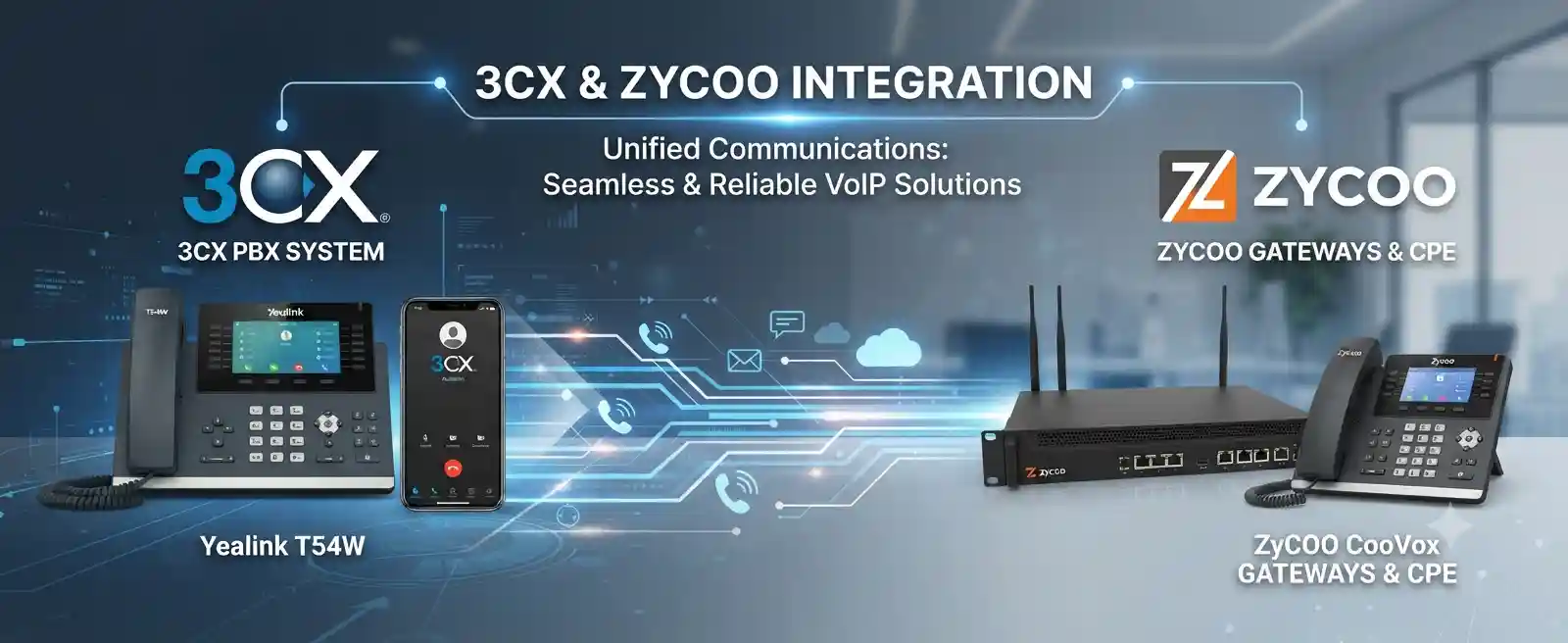
3CX and Zycoo integration is the controlled connection of a 3CX communication system with a Zycoo telephony component so calls or analogue resources can move between them in a predictable way. In many environments, the Zycoo component is a VoIP gateway. An FXO gateway can bring traditional analogue carrier lines into an IP telephony environment, an FXS gateway can connect analogue devices to SIP, and a PRI gateway can bridge digital telephony circuits. Zycoo’s current gateway range uses standard SIP, while 3CX documents a gateway connection as a SIP-based gateway relationship that is configured differently from a normal provider trunk. The exact implementation still depends on the specific models, firmware, deployment method and business call flow.
This service is relevant to organisations that are moving toward 3CX but cannot immediately remove all legacy lines or analogue equipment, businesses that need a staged migration, sites that rely on gateway-connected devices, and teams troubleshooting an existing 3CX-to-Zycoo path. Before proceeding, the customer should prepare the Zycoo model, interface type, 3CX deployment details, line inventory, desired inbound and outbound routes, network information, administrative access availability and a maintenance window suitable for testing. No integration method should be assumed until these points are confirmed.
A bridge between modern 3CX call control and existing telephony resources
Businesses rarely replace every part of a telephone environment at the same time. A company may want 3CX for extensions, web and mobile clients, queues, office hours and central call routing while still relying on analogue PSTN lines, fax equipment, paging interfaces, lift or door devices, analogue handsets, a PRI service, or an existing Zycoo PBX during a transition. The integration task is therefore not just technical connectivity. It is a continuity project that must define which system owns each part of the call flow.
For a Zycoo gateway deployment, SIP is normally the IP-side transport between the gateway and the PBX. The gateway then converts between SIP and its physical telephony interface. That translation creates several areas that must be checked: how the gateway identifies itself to 3CX, which addresses are trusted, how inbound calls are presented, how outbound calls select a physical port or circuit, what number format is passed, which codecs are negotiated, how DTMF is carried, and how the system detects that a call has ended. A configuration that works for one test number may still fail during transfers, busy conditions, after-hours routing or concurrent calls.
The service begins by translating business behaviour into a technical map. Reception may need all analogue line calls to reach a 3CX ring group. A branch may need calls from selected 3CX extensions to use a local analogue line. A legacy fax or paging endpoint may need an FXS path while staff use 3CX applications. An organisation may want to retain a PRI link during migration while new SIP trunks are introduced later. Each scenario has different routing, capacity, fault and support implications.
Which integration situations may need assessment?
Retaining analogue carrier lines
A business wants 3CX for users and call routing but still has analogue PSTN lines that must remain active. A Zycoo FXO gateway may provide the bridge, subject to the carrier line characteristics, gateway model, local signalling behaviour and the required inbound and outbound call logic.
Keeping analogue devices
Some operational devices may still require an analogue interface. An FXS gateway can expose analogue ports to a SIP environment, but each device’s signalling, DTMF, caller-ID and functional requirements should be checked instead of assuming that every legacy endpoint behaves like a standard telephone.
Connecting PRI resources
A site may use a PRI circuit or another digital telephony resource while 3CX handles extensions and call flow. PRI integration requires confirmation of interface settings, channel expectations, numbering, clocking and the gateway’s role. Carrier coordination may be needed before any cutover.
Staged PBX migration
A company may need the old Zycoo environment and the new 3CX system to coexist temporarily. SIP interconnection can be considered where the platforms and versions support the required call path, but extension ranges, route ownership, loop prevention, caller identification and fallback must be designed carefully.
Troubleshooting an existing link
Calls may fail in one direction, disconnect unexpectedly, present the wrong number, have one-way audio, miss DTMF, or route to the wrong destination. These symptoms can come from the PBX, gateway, network, firewall, carrier line or routing logic, so evidence should be collected before settings are changed.
Branch and continuity planning
A branch may need local line breakout, selected legacy resources or a temporary voice path during an office move. The integration can be planned around business continuity, but the design should make clear what happens when the WAN, internet service, gateway, PBX or carrier circuit is unavailable.
Common symptoms and the technical layers behind them
A failed call does not identify its own cause. The same outward symptom can be produced by a routing rule, SIP registration, firewall policy, incorrect number format, analogue line condition, codec negotiation, endpoint behaviour or provider-side issue. The integration should therefore be diagnosed as a complete call path rather than as two isolated devices.
| Observed issue | Possible technical areas | Recommended next step |
|---|---|---|
| Inbound analogue calls do not reach 3CX | FXO line state, gateway port assignment, SIP route, dialled-number presentation, 3CX source identification or destination rule | Trace one controlled inbound call from the physical line to the intended 3CX destination. |
| Outbound calls fail or use the wrong line | 3CX outbound rule, gateway trunk selection, caller-ID matching, prefix handling, port availability or carrier line condition | Confirm the dialled pattern, selected route and actual gateway port used during the attempt. |
| One-way or no audio | RTP path, NAT, firewall, addressing, codec, SIP ALG, media routing or physical line quality | Review signalling and media paths separately and test from both directions. |
| Calls stay connected after a party hangs up | Analogue disconnect supervision, regional line profile, gateway FXO tuning or carrier signalling | Confirm the carrier line behaviour and gateway regional settings before altering PBX logic. |
| IVR digits or DTMF do not work | DTMF method mismatch, codec interaction, gateway setting or upstream provider behaviour | Compare the negotiated DTMF method end to end and perform menu tests. |
| Caller ID is missing or incorrect | Carrier presentation, gateway detection, SIP header mapping, number transformation or 3CX route settings | Capture the number at each handoff and identify where the expected value changes. |
Why unresolved integration problems affect more than the telephone system
Telephony faults quickly become operational faults. A reception team may miss customer calls because an inbound analogue line is not reaching the correct queue. Sales staff may use personal mobile phones because outbound routes fail. A warehouse may lose a paging or analogue endpoint that is tied to a gateway. Finance or customer-service teams may be unable to receive callbacks on familiar numbers during a migration. Even when calls still connect, poor audio, incorrect caller identification or unreliable DTMF can make the service difficult to use and harder to support.
Repeated configuration changes can add a second problem: nobody knows which setting is now authoritative. One person changes the gateway, another changes 3CX, and a provider changes the carrier side. The system may begin working temporarily without a clear explanation, leaving the same fault likely to return during the next reboot, update, office move or line change. A structured integration service records the intended flow, the interfaces involved and the approved configuration so later troubleshooting starts from a known state.
There is also a planning impact. Legacy lines and devices are often retained because they perform a specific business function. Removing them without documenting their purpose can interrupt lift phones, door entry, paging, fax workflows, emergency procedures or branch routing. FourTeck therefore treats integration as a dependency-mapping exercise before it becomes a configuration exercise.
Possible FourTeck assistance for a 3CX and Zycoo project
Depending on the confirmed scope, assistance may include an initial call-flow workshop, review of the 3CX deployment and Zycoo model, gateway or SIP configuration assessment, network checks, firewall and NAT coordination, extension and number mapping, inbound and outbound route planning, test-call design, analogue or PRI interface review, configuration backup, controlled implementation, fault isolation, documentation and post-change verification. Not every activity is required for every project, and hardware replacement, carrier work, licences, internet changes or third-party engineering may be outside the support labour scope unless specifically included.
Confirm 3CX deployment details, Zycoo model, interfaces, lines, extension ranges, numbers, network location, current routes and the business reason for the integration.
Review SIP registration or peer logic, source identification, trunks, gateway ports, codecs, DTMF, number transformation and call permissions as applicable.
Assess addressing, routing, firewall exposure, NAT behaviour, voice VLAN considerations, QoS, secure administration and required communication paths.
Back up settings where available, agree a test window, make approved changes in a defined sequence and maintain a practical rollback or fallback plan.
Test inbound, outbound, internal transfer, IVR, voicemail, queue, busy, no-answer, after-hours and selected failure scenarios that matter to the business.
Record key settings, route ownership, line mapping, dependencies, provider contacts, remaining risks and the process for future changes or support.
Service-fit matrix for common business requirements
| Business situation | Relevant assistance | What must be confirmed |
|---|---|---|
| Move staff to 3CX but keep analogue incoming lines | Zycoo FXO gateway assessment, SIP connection, inbound route and outbound line selection | Line count, carrier signalling, gateway model, required caller ID and call destinations |
| Retain analogue devices while modernising user phones | FXS gateway planning and device testing | Device type, signalling needs, DTMF, number assignment, power and business criticality |
| Connect or migrate a PRI circuit | PRI gateway assessment, routing and carrier coordination | Circuit parameters, numbering, channel use, gateway compatibility and change window |
| Run 3CX and an existing Zycoo PBX during transition | SIP interconnection design, extension routing and staged migration planning | Exact PBX models, versions, numbering plan, route ownership, network reachability and loop prevention |
| Investigate unstable calls after an integration | Logs, packet evidence, gateway status, 3CX route review, network and carrier tests | Reproducible symptoms, timestamps, affected numbers, recent changes and access to both systems |
| Standardise a multi-site voice environment | Architecture review, site-by-site inventory, routing policy and documentation | WAN design, local line requirements, branch resilience, security policy and support ownership |
Service information to define before configuration starts
| Service Topic | 3CX and Zycoo Integration |
|---|---|
| Main Purpose | Connect 3CX with a suitable Zycoo telephony component so required calls, lines or analogue resources can be used within an approved business call flow. |
| Typical Systems Involved | 3CX, Zycoo gateway or PBX, IP network, firewall, switches, carrier lines or SIP services, IP phones, analogue devices and related endpoints. |
| Assessment Method | Configuration review, call-flow mapping, controlled tests, logs and network checks; physical line or gateway inspection when required. |
| Remote Support Suitability | Suitable for many software, SIP, routing, logging and configuration tasks when secure remote access and a working network path are available. |
| On-Site Support Suitability | Recommended when FXO, FXS or PRI cabling, physical ports, rack equipment, switch connections, carrier lines or local device behaviour must be inspected. |
| Customer Access Required | Authorised administrative access to relevant systems and, where necessary, coordination with the telecom provider, firewall administrator or building/site contact. |
| Testing and Validation | Scope dependent. The test plan should include the call directions, numbers, destinations, transfers, DTMF, caller-ID and exception scenarios that matter to the business. |
| Security Considerations | Administrative access, trusted SIP sources, firewall exposure, remote management, passwords, backups and change authorisation should be reviewed as part of the approved scope. |
| Scheduling Dependency | Depends on business call criticality, maintenance window, remote or site access, engineer availability, provider coordination and the need for physical work. |
| Quotation Requirement | Final work should be confirmed after the current environment, desired outcome and integration dependencies are assessed. |
| Important Note | Compatibility and exact configuration are model, firmware, 3CX deployment, carrier and environment dependent. Contact FourTeck to confirm the service scope. |
Remote support versus on-site integration work
When remote assistance may be practical
Remote work can be effective when the 3CX server and Zycoo device are already reachable through authorised management paths and the physical telephony interfaces are known to be functioning. FourTeck may review current trunks, gateway definitions, IP addressing, routes, number transformations, logs, codec choices, DTMF settings, 3CX destinations, firewall rules and recent changes. A local staff member or administrator may be asked to place controlled test calls and confirm the behaviour heard at each endpoint.
Remote access does not remove the need for change control. If the system is carrying live business calls, settings should be backed up where possible and changes should be made during an agreed period. If evidence suggests a cable, PSTN line, PRI circuit, physical port or local network fault, remote troubleshooting may reach a natural limit.
When an on-site visit may be more suitable
On-site work is often appropriate when the integration depends on physical telephony interfaces. Engineers may need to identify analogue lines, label FXO ports, confirm which FXS device is connected, inspect PRI cabling, check the switch port and VLAN used by the gateway, review rack power, test local connectivity or work with a carrier demarcation point. Site presence can also help when several undocumented systems share the same telephone room.
An on-site visit should still begin with a defined objective. The customer should provide building access, a technical contact, available administrator access and permission to interrupt selected lines for testing. Attendance timing and the amount of work depend on the confirmed scope, location, site conditions and third-party dependencies.
How FourTeck can assess the integration before making changes
Identify which lines, numbers, users, departments and devices must communicate, and what a successful call should do from start to finish.
Record the 3CX deployment, relevant version and licence context, Zycoo model and firmware, network addresses, physical ports and carrier services.
Document how inbound and outbound calls currently enter, which platform owns each route and where number transformations occur.
Confirm authorised administration, export or backup options, maintenance windows and the fallback path if a configuration must be reversed.
Check registration or peer status, routing, media, DTMF, physical line condition, switch connectivity and provider behaviour as applicable.
Separate configuration work from hardware, carrier, network, licensing or unsupported-platform dependencies that require different action.
Define the setting changes, test sequence, responsible parties, outage expectations and criteria for rollback or escalation.
Test from the user perspective, capture key configuration details and record remaining risks, provider dependencies and future maintenance notes.
Planning the 3CX side of the connection
3CX controls the business logic that users normally experience: extensions, inbound destinations, queues, ring groups, digital receptionist menus, office hours, forwarding, outbound rules and other call-flow behaviour. A Zycoo integration must fit that logic rather than creating a parallel set of undocumented routes. The 3CX deployment model should be confirmed first because hosting, network boundaries and administrative ownership affect what can be configured and how the gateway reaches the system.
For a VoIP gateway, 3CX distinguishes gateway configuration from a normal SIP provider trunk. This distinction matters because the relationship and registration direction can differ. The implementation should therefore follow the correct gateway or SIP connection pattern for the specific 3CX environment rather than copying a provider template without understanding the purpose. Where a generic or custom SIP relationship is used, source identification, authentication, addressing and security must be designed so 3CX accepts the intended traffic without broadly trusting unnecessary sources.
Routing should then be built around business outcomes. An analogue line may need to arrive at reception during office hours, overflow to a queue, and reach voicemail after hours. Outbound calls may need only selected extensions or departments to use the gateway. Emergency or special numbers may require a different path. Prefixes should not be introduced casually because they affect user behaviour and documentation. Number presentation should be checked at both the gateway and the receiving platform, especially when caller ID or direct inward routing is important.
3CX administration also involves lifecycle considerations. Before an integration, the customer should know who owns the 3CX licence, who manages hosting, where backups are stored, and how updates are handled. A change that works on an undocumented system today may be difficult to maintain after an upgrade. FourTeck can help place the gateway relationship into the wider 3CX support record so future administrators understand why it exists.
Planning the Zycoo gateway or PBX side
The exact Zycoo role must be identified before configuration. Zycoo’s G-Series includes FXO, FXS and PRI gateway options. The physical interface determines what the gateway is translating. FXO ports typically face analogue telephone lines, FXS ports provide analogue station interfaces for devices, and PRI gateway interfaces bridge digital circuits. These are not interchangeable functions, and a call-flow diagram should show which side connects to 3CX and which side connects to the external line or device.
On the SIP side, the relevant trunk or gateway settings must match the 3CX design. Parameters may include peer or registration information, destination server, authentication, port, transport, codecs, DTMF method and routing. On the physical side, additional behaviour can be critical. For FXO, regional line signalling and disconnect supervision can affect whether calls terminate correctly. For FXS, the connected analogue device may have its own tone, ringing or DTMF expectations. For PRI, carrier parameters and channel configuration must be checked with the actual circuit. These details are environment dependent, so a working configuration from another country or carrier should not be copied blindly.
Gateway management should also be treated as part of the support environment. Administrative access should be restricted, configuration backups should be retained where supported, firmware changes should be planned rather than applied during fault isolation without a reason, and network settings should be documented. If the gateway has multiple ports, each physical port should be labelled to match the line or device it serves. This simple discipline can save considerable time during a later outage.
If the Zycoo component is itself an IP PBX rather than a gateway, the project changes. A PBX-to-PBX SIP relationship can introduce overlapping extension ranges, duplicate voicemail or call-forwarding logic, route loops and ambiguity about which system is authoritative. FourTeck can assess such coexistence as a migration or interconnection project, but compatibility and exact behaviour must be confirmed against the actual Zycoo platform and 3CX environment.
Capability focus 1: preserve required legacy telephony without making it permanent by accident
One of the strongest reasons to use a telephony gateway is to retain something the business still needs while the user-facing phone system changes. That may be a group of analogue PSTN lines, a device that only offers an analogue interface, or a digital carrier service that cannot be replaced immediately. Integration allows the organisation to separate the migration of call control from the replacement of every external interface.
This flexibility is useful only when the retained dependency is documented. A company should know which legacy line supports which number, which analogue device performs which operational function, and whether it is temporary, strategic or simply undocumented. Otherwise, the gateway becomes an invisible dependency that nobody reviews. FourTeck can help create that record and identify whether each retained element should stay, be replaced later, or be included in a phased migration plan.
The limitation is that a gateway does not remove the characteristics of the legacy service. Analogue line quality, regional signalling, physical cabling and carrier behaviour still matter. A successful SIP registration does not prove that every analogue call scenario will work correctly. Testing must include real physical lines or devices, and future support should distinguish gateway faults from carrier or endpoint faults.
Capability focus 2: make call routing understandable across two systems
Integration can fail operationally even when it succeeds technically. Two systems may be registered and able to place calls, yet staff still experience wrong destinations, loops, missing caller ID, blocked transfers or confusing dial patterns. The underlying problem is often that the business call flow was never written down before the trunks and rules were created.
FourTeck can map the call path in plain business terms and then translate it into technical routes. For inbound traffic, the map may show the carrier line, Zycoo port, SIP handoff, 3CX inbound rule, office-hours condition and final queue or extension. For outbound traffic, it may show the user, 3CX rule, gateway selection and physical line. If two PBXs coexist, the map should also identify which extension ranges live on each system and which platform owns voicemail, forwarding and external calling.
Clear ownership reduces the risk of routing loops. For example, a call should not be forwarded from 3CX to Zycoo and then returned to 3CX because both systems assume the other owns a number range. Number transformations also need discipline. Prefixes that are removed in one system and re-added in another can make troubleshooting difficult. A simple, documented numbering plan is usually easier to maintain than many exceptions.
The outcome is not a promise that every complex routing scenario is possible. The available behaviour depends on the specific 3CX and Zycoo capabilities, licences, carrier service and connected endpoints. Where a requirement cannot be supported reliably, the customer should be told before the live call flow is changed.
Capability focus 3: protect voice quality, security and supportability
Voice integration depends on the data network, but voice traffic is less tolerant of delay, packet loss, jitter and asymmetric routing than many office applications. A gateway can register successfully while users still hear clipping, echo, delay or one-way audio. The network path between the Zycoo device and 3CX should therefore be reviewed for addressing, routing, VLAN membership, switch errors, bandwidth and firewall behaviour. Quality of Service can be considered where congestion is a genuine factor, but QoS should not be treated as a substitute for fixing unstable links or insufficient capacity.
Security matters because SIP systems can be attractive targets when exposed unnecessarily. The integration should use only the communication paths required for the approved design. Management interfaces should not be left broadly accessible, default credentials should not be retained, and firewall rules should be specific rather than opened widely simply to make a test call work. 3CX publishes firewall requirements for its own services, but the final rule set still needs to reflect the actual deployment and trusted sources. Any remote administration method should be authorised by the customer.
Supportability is the third part of the same capability. Configuration backups, version records, line maps, IP addresses and provider information give the next engineer a reliable starting point. If a fault occurs months later, the business should not have to rediscover which gateway port is connected to which line or why an outbound rule exists. FourTeck can include documentation and handover in the project scope so the integration remains manageable after the initial change.
Dependencies, access and customer inputs
A telephony integration cannot be scoped accurately from the system names alone. FourTeck may need information from the customer’s IT administrator, telecom provider, office manager or existing support vendor. The goal is to collect enough evidence to plan the change without asking customers to expose sensitive credentials in public messages.
Deployment type, current version context, licence ownership, FQDN or network location where relevant, administrator availability, current trunk and route structure, backup status and hosting responsibility.
Exact model, firmware level, FXO/FXS/PRI port count, current IP address, existing trunks, port assignments, configuration backup availability and administrator access.
Telephone numbers, line type, provider contact, PRI or analogue details, current routing, known signalling requirements and whether provider changes are planned.
Gateway subnet, switch port, VLAN, firewall, NAT path, internet connectivity, branch links and any recent changes that coincide with the problem.
Reception behaviour, direct numbers, queues, extension ranges, office hours, voicemail, transfers, emergency or special routes, branch requirements and caller-ID expectations.
Approved maintenance window, onsite contact, building access, test users, outage tolerance, fallback requirement and internal authorisation for configuration changes.
Passwords, private keys and other credentials should be shared only through an approved secure method after identity, access need and authorisation have been confirmed. Public page content or ordinary enquiry text should not contain credentials.
Risk, limitation and exclusion guidance
Integration work should be planned with the understanding that multiple vendors and technical layers may be involved. A successful registration between systems does not guarantee that every call scenario, analogue device or carrier feature will behave as expected. The exact result depends on the models, firmware, 3CX deployment, network, line characteristics, provider behaviour and the requested feature set.
- Diagnosis depends on usable evidence and authorised access. If logs, configuration or the affected line cannot be accessed, the first task may be evidence collection rather than immediate correction.
- Some faults require action by the telecom carrier, internet provider, hosting provider, manufacturer or another system administrator. FourTeck can coordinate technical findings where included in the scope, but third-party actions and timing remain outside FourTeck’s direct control.
- Analogue line behaviour varies by carrier and region. Disconnect supervision, tone cadence, caller-ID presentation and line quality may need field testing.
- Hardware failure may require replacement equipment or parts that are separate from configuration labour. Availability must be confirmed before a replacement plan is promised.
- Unsupported or legacy Zycoo or 3CX environments may have limited configuration, firmware or security options. A migration recommendation may be more practical than repeated repair.
- Configuration changes can interrupt live calls. A maintenance window, backup and rollback plan may be necessary for production systems.
- Security improvement reduces risk but does not guarantee protection from every misuse, outage or attack. Access control and ongoing maintenance remain necessary.
- Final commercial terms, onsite attendance, scheduling and included deliverables depend on the approved quotation or service agreement.
Testing, validation and handover after integration
Testing should mirror the way the business actually uses the telephone system. A single successful call from one extension is not enough evidence for a production handover. The test plan should include the routes that carry operational risk and should record the expected result before testing starts.
Test each relevant line or number, office-hours destination, queue or ring group, voicemail and no-answer behaviour.
Test authorised extension groups, local and international patterns as applicable, gateway port selection and caller-ID presentation.
Verify transfer, hold, conference, DTMF, IVR choices and any special analogue device interaction included in the scope.
Where appropriate, confirm what users should expect if a line is busy, a gateway port is unavailable or a dependent network path fails.
Audio should be checked in both directions. If echo, clipping, delay or one-way audio appears, the team should separate the physical line side from the IP media side. A call may signal correctly but have a media-path problem. For analogue lines, echo or disconnect behaviour can also depend on electrical and regional characteristics that are not visible in the SIP registration state.
Handover should include a concise record of the gateway model, relevant IP information, line or port mapping, trunk or gateway name in 3CX, inbound and outbound route ownership, key number transformations, provider details, backup location and the date of the last validated test. The document does not need to expose passwords. It should make clear where secure credentials are held and who is authorised to use them.
Business environments where this integration can be useful
3CX and Zycoo integration is not limited to one type of organisation. The common factor is usually a business requirement to combine modern IP call control with an existing telephony interface or staged migration path. The operational context determines which parts of the integration matter most.
Professional offices
Reception, direct numbers, call queues and mobile or web clients may move to 3CX while existing carrier lines remain through a gateway during a controlled transition.
Warehouses and logistics
Operational sites may have analogue paging, gate, door or legacy telephone interfaces alongside IP phones. The integration must account for physical device location and network resilience.
Retail and showrooms
Branches may need local incoming lines while centralising extension management or business-hours routing. Local breakout should be documented so branch staff know which service carries each call.
Clinics and service centres
Inbound calls can be business critical for appointments or customer service. Migration should therefore include queue, reception, voicemail and after-hours tests before old call paths are retired.
Hospitality sites
Hotels, restaurants and service properties may have legacy analogue devices or distributed telephone areas. Each retained endpoint should be mapped to its business function before integration.
Multi-branch companies
Sites can have different carrier services and gateway requirements. A standard 3CX call policy can still be considered, but local line behaviour, WAN dependence and support ownership should be reviewed per branch.
Operational, security and maintenance considerations
Once the integration is working, maintenance should focus on preserving a known and supportable configuration. Changes to the 3CX system, Zycoo firmware, firewall, carrier service, IP addressing or switch VLAN can affect the integration even if nobody edits the trunk directly. The support record should therefore identify these dependencies so future change requests include a telephony impact check.
Backups are particularly important before upgrades. A gateway backup can help restore port assignments and SIP settings, while a 3CX backup protects call-flow configuration according to the platform’s supported backup method. Backup availability should not be assumed; it should be verified before a risky change. The team should also know where backups are stored and who is authorised to restore them.
Security review should include administrator accounts, remote access, firewall policies, network segmentation and unnecessary exposure. Voice devices are often installed and then left unchanged for years, which can lead to forgotten credentials or undocumented remote-management paths. Maintenance provides an opportunity to bring those interfaces under the same access-control standards used for other business systems.
Monitoring and logs can also improve fault isolation. If the gateway and 3CX clocks are not aligned, comparing call events can be difficult. Consistent time settings and useful logging make it easier to match a user-reported failed call with the corresponding system event. Logs should be retained in a way that respects the organisation’s operational and privacy policies.
Finally, the business should review whether the integration is still necessary over time. A gateway used during migration may no longer be required once numbers move to a suitable SIP trunk or analogue devices are retired. Removing an obsolete dependency can reduce maintenance complexity, but only after the customer confirms that no business function still relies on it.
Before You Contact FourTeck
Preparing a short integration summary can make the first assessment much more useful. You do not need to know every technical setting, but the following details help determine whether remote review, on-site inspection or a staged project is more appropriate.
- Business location and the site where the Zycoo equipment is installed.
- Exact Zycoo model and whether it uses FXO, FXS, PRI or another interface.
- How 3CX is hosted and who currently administers it.
- Number of telephone lines, gateway ports or analogue devices involved.
- Telephone numbers or extension ranges that must pass between systems.
- A description of the desired inbound and outbound call flow.
- Any current symptoms, error messages, call examples or approximate timestamps.
- Recent changes to 3CX, Zycoo, firewall, internet, switches or telecom service.
- Name of the telecom or SIP provider where relevant.
- Whether administrative access is available for both systems.
- Whether current configuration backups exist.
- Network or VLAN information for the gateway if known.
- Preferred remote or on-site assistance and onsite contact availability.
- Business impact and which call routes are most critical.
- Preferred maintenance or test window for changes that may affect calls.
- Any security, building-access or provider-approval restrictions.
Service evaluation checklist for quotation and engagement
The quotation should reflect the actual environment rather than assume that all 3CX and Zycoo projects are identical. Before approving the work, the following points can be confirmed so responsibilities and deliverables are clear.
How FourTeck can organise the project and quotation
FourTeck’s role is to turn an integration requirement into a defined support or project scope. The first conversation should establish the business objective and identify whether the request is a new integration, a migration, an upgrade or a fault. From there, FourTeck can review the available system information, decide what can be assessed remotely, identify where an on-site visit may add value, and determine whether carrier or vendor coordination is required.
For a new integration, the quotation may include discovery, configuration, testing, documentation and any agreed on-site work. For an existing fault, the first scope may focus on diagnosis and evidence gathering rather than promising a repair before the cause is known. If the diagnosis identifies failed hardware, unsupported software or provider-side problems, FourTeck can explain the next action and prepare a separate change or replacement scope if required.
Customers can review FourTeck’s wider business IT and telephony service coverage, learn more about the company through the FourTeck IT Services profile, or use the IT support contact page to provide the initial project information. The wider FourTeck IT Services UAE website also explains how network, server, firewall, user-device and communication support fit together.
Dubai and UAE service coordination
For businesses in Dubai and across the UAE, 3CX and Zycoo integration can be coordinated as remote configuration work, a planned on-site visit, or a combination of both. Remote review is often useful for call-flow planning, SIP settings, 3CX administration, logs and controlled tests. On-site assistance may be recommended when the project includes physical gateway installation, analogue or PRI cabling, switch ports, rack work, line identification, local carrier testing or devices that cannot be validated remotely.
The service plan depends on the issue, access, location, urgency and approved quotation. Installation, configuration, migration, maintenance and documentation tasks should be clearly included in the agreed scope. Timing can be affected by engineer availability, customer access, building procedures, carrier support, required parts, equipment availability and other third parties. A business-critical telephony change should therefore be scheduled around an agreed window and a clear test plan rather than an assumed completion time.
Coordination across Dubai, Abu Dhabi, Sharjah and Ajman
FourTeck can discuss 3CX and Zycoo integration requirements for businesses operating in Dubai, Abu Dhabi, Sharjah and Ajman, including single offices, branch locations, warehouses, retail sites and multi-site organisations. The practical support method depends on what must be changed or inspected. A configuration-only request may be suitable for secure remote assistance, while a gateway installation or analogue-line problem may require a planned visit to the site where the equipment and carrier handoff are located.
For multi-emirate projects, consistency can be more valuable than treating every branch independently. FourTeck can help create a common numbering and routing approach while still documenting local differences such as analogue lines, PRI services, local gateways or site-specific firewalls. Scheduling, travel, building access, site conditions, equipment availability and third-party provider dependencies can affect the service plan. Contact FourTeck to confirm the scope and scheduling options for the locations involved.
Related FourTeck IT services
Extension administration, call-flow troubleshooting, SIP trunk coordination, backups and migration planning within the wider FourTeck service portfolio.
IP PBX Support
Assistance with extensions, queues, ring groups, office hours, voicemail, inbound and outbound routes, and PBX documentation.
Office Network Support
Switching, routing, VLAN, cabling and connectivity checks when voice quality or gateway reachability depends on the office network.
VoIP Gateway Support
Assessment and troubleshooting for gateway-connected analogue or digital telephony resources, subject to model and environment review.
Why businesses contact FourTeck for integration work
Integration problems often sit between responsibilities. The PBX administrator may say the trunk is configured, the network team may see no packet loss, the carrier may say the line is active, and the gateway may show registered status. Yet the user still cannot complete a call. FourTeck approaches the issue as one business service path, linking the user experience with the PBX, gateway, network, firewall and carrier evidence rather than treating each component in isolation.
Businesses also contact FourTeck when they need a planned change rather than a fault fix. A migration may involve documenting old lines, mapping extension ranges, preparing 3CX, connecting the Zycoo gateway, testing selected users, moving reception routing and retaining a fallback path until the new design is accepted. Clear sequencing reduces the risk of several simultaneous changes making the final result difficult to diagnose.
Another practical reason is documentation. Many telephone systems evolve through years of small changes. Integrating 3CX with Zycoo is an opportunity to record line ownership, extension groups, routing rules, provider contacts, gateway ports and support responsibilities. FourTeck can include this documentation in the handover so future user changes, office moves and provider migrations do not start from guesswork.
Frequently asked questions about 3CX and Zycoo integration
Can a Zycoo FXO gateway connect analogue telephone lines to 3CX?
A suitable Zycoo FXO gateway can provide a SIP bridge between analogue lines and an IP PBX environment. Zycoo documents its current FXO gateways as standard SIP devices and specifically describes use with mainstream IP PBXs including 3CX. The exact configuration still depends on the gateway model, firmware, carrier line behaviour, 3CX deployment, network path and desired call routing. FourTeck can assess these details before implementation.
Is a Zycoo gateway configured like a normal SIP trunk in 3CX?
Not necessarily. 3CX distinguishes VoIP gateway configuration from a standard provider SIP trunk because the relationship and registration behaviour can differ. The correct method should follow the gateway role and the actual 3CX environment. Copying a SIP provider configuration without checking this distinction can lead to source-identification, registration or routing problems.
Can FourTeck connect analogue devices to 3CX using Zycoo FXS ports?
An FXS gateway can provide analogue station ports to a SIP environment, which may be suitable for selected legacy endpoints. The connected device must still be assessed because fax machines, paging adapters, door devices and other analogue equipment can have different signalling and DTMF requirements. The final scope should include device testing rather than assume that every analogue endpoint will behave identically.
Can 3CX and a Zycoo PBX run together during a migration?
A staged coexistence may be possible through a suitable SIP interconnection, but it is more complex than connecting a gateway. Extension ranges, caller ID, inbound and outbound route ownership, voicemail, forwarding, loop prevention and network security must be planned. Compatibility depends on the exact Zycoo PBX model and version, the 3CX environment and the required features. FourTeck can assess the migration design before any live cutover.
Why do calls work in one direction but fail in the other?
The inbound and outbound paths can use different routing rules, source-identification logic, gateway port selection and number formats. A failure in one direction may come from 3CX, the Zycoo device, a firewall or the carrier line. The useful diagnostic method is to trace a specific call from origin to destination and identify the point where signalling or media stops behaving as expected.
Can poor call quality be caused by the gateway even when SIP registration is healthy?
Yes. Registration only confirms one part of the relationship. Audio quality can be affected by the IP network, firewall, codec negotiation, packet loss, jitter, analogue line quality, impedance or other physical characteristics. One-way audio can also come from a media-path or NAT problem. FourTeck can separate signalling, media and physical-line tests to identify the relevant layer.
Can the integration be configured remotely?
Many SIP, routing, log and administration tasks can be handled remotely when secure access is authorised and the network is functioning. On-site assistance may still be required for analogue or PRI line testing, physical gateway installation, switch ports, cabling, rack work or endpoints that cannot be validated from a remote session. The support method should follow the issue rather than force every project into one delivery model.
What information should we provide before requesting a quotation?
Provide the Zycoo model and interface type, 3CX deployment information, number of lines or devices, desired call flow, affected sites, carrier details, known network information, administrative access availability and the preferred change window. For troubleshooting, include examples of failed calls and approximate timestamps. This information helps FourTeck separate assessment work from implementation, hardware or provider dependencies.
Will integration require downtime?
That depends on the current design and the change being made. Some preparation and testing can be performed without affecting live users, while trunk, gateway, line or routing changes may interrupt selected call paths. FourTeck can plan a maintenance window and rollback method where appropriate, but zero downtime should not be assumed until the environment and migration sequence have been assessed.
What happens after the integration is tested?
The handover can record the main routes, gateway port mapping, relevant network information, backup location, provider dependencies and completed test scenarios. Remaining risks or unsupported elements should be documented rather than hidden. The customer can then decide whether ongoing telephony maintenance, future migration work or wider network support should be included in a separate service arrangement.
Need a clear plan for your 3CX and Zycoo environment?
Send FourTeck the Zycoo model, 3CX deployment details, line or device count, required call flow and any current symptoms. We can review the information, identify what should be checked remotely or on site, and prepare a service quotation based on the confirmed integration scope.