
3CX and Yeastar Integration in Dubai, UAE
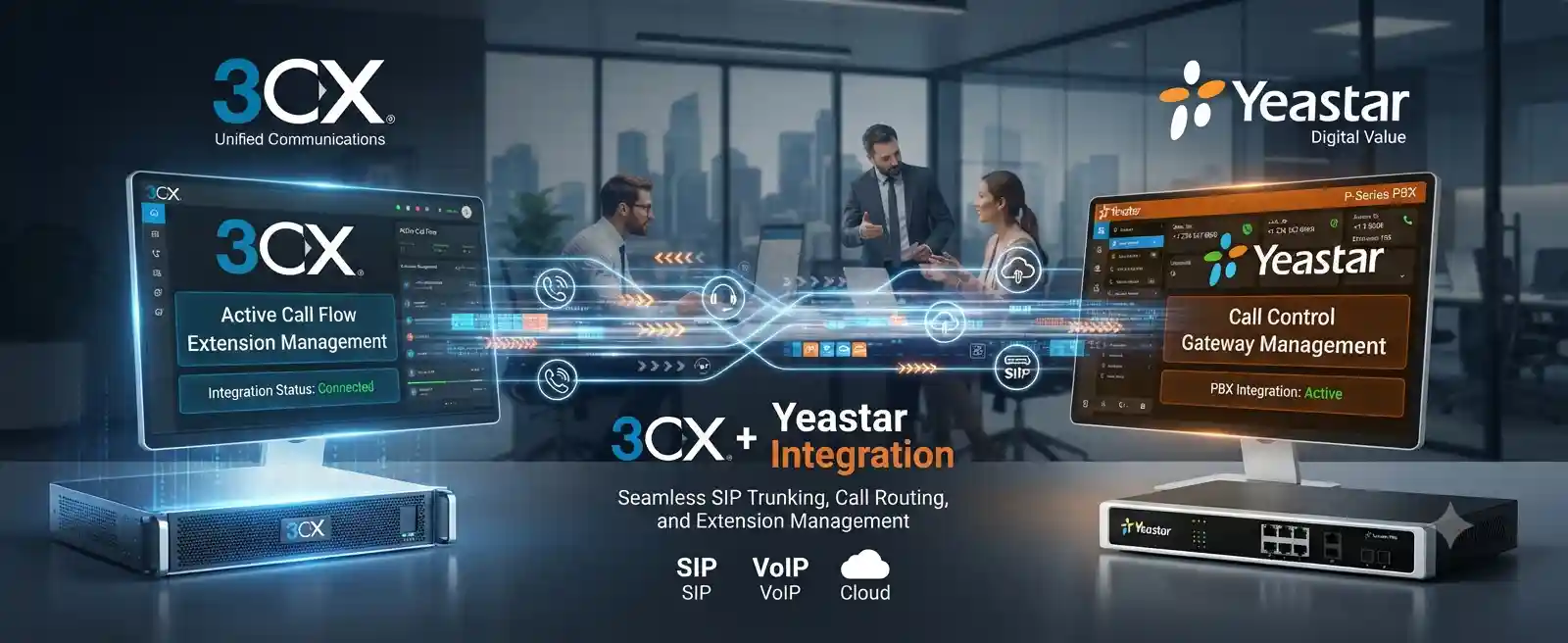
Connecting 3CX with Yeastar equipment can help a business retain useful telephony interfaces, route calls through existing gateways, prepare a phased migration, or bring separate voice components into a more manageable call flow. The practical design depends on the exact Yeastar device, 3CX deployment, carrier service, network path, security controls, and business routing requirements.
What should be confirmed first?
The model and role of the Yeastar device, the 3CX version and hosting model, the current lines or SIP trunks, network addressing, firewall access, routing goals, and the impact of any planned change.
FourTeck can use this information to separate a simple configuration task from a migration, carrier dependency, gateway limitation, or wider network issue.
Gateway, trunk, coexistence, or migration
Backup, approval, testing, and rollback planning
Carrier, SIP, firewall, LAN, and numbering
Remote review with on-site work where required
Direct answer: what does 3CX and Yeastar integration mean?
3CX and Yeastar integration usually means creating a controlled SIP-based relationship between a 3CX phone system and a Yeastar device or environment so calls can reach the required lines, ports, users, or destinations. In many real projects the Yeastar component is a VoIP gateway providing analogue, BRI, E1, or GSM connectivity, while 3CX handles extensions and call routing. In other cases the requirement is temporary coexistence during a migration from one platform to another. Businesses should first confirm the Yeastar model, connected lines, 3CX release and deployment type, IP addressing, firewall policy, carrier details, current call flow, and the exact outcome expected. Integration should be treated as a planned change rather than a generic plug-and-play task because compatibility, routing, signalling, caller identification, codec behaviour, security, and failback options vary by environment.
What this integration service can cover
FourTeck approaches 3CX and Yeastar work as a business telephony service rather than a product installation. The first question is not simply whether two branded systems can communicate. The first question is what the business needs to keep working and which existing voice resources must remain available. A company may want to continue using analogue extensions through a Yeastar FXS gateway, retain legacy digital lines through a BRI or E1 gateway, route mobile-network calls through a GSM gateway, connect a branch during a transition, or move trunks and users from a Yeastar PBX toward a 3CX environment in controlled stages.
Official Yeastar documentation includes examples of connecting several gateway families to 3CX by SIP. Examples include TA FXS gateways for analogue extensions, TG gateways for GSM trunks, TB gateways for BRI, and TE gateways for E1. Those examples are useful evidence that these classes of integration have been implemented, but they reference particular device firmware and 3CX releases. For that reason, a current project should not assume that an older application note exactly matches a present 3CX deployment. FourTeck can review current versions, interface types, SIP behaviour, network requirements, and the customer’s carrier arrangement before a production change is scheduled.
Depending on the confirmed scope, assistance may include reviewing the existing PBX and gateway configuration, identifying current inbound and outbound routes, documenting direct numbers, checking network reachability, examining SIP registration or peer status, reviewing firewall rules, checking voice VLAN or QoS dependencies, confirming codec expectations, planning caller-ID handling, testing route patterns, documenting failback options, and coordinating with the SIP or telecom provider when the carrier side affects results.
Who may need this service?
This service may suit an organisation that already has useful Yeastar hardware or telephony resources but wants 3CX to become the main call-control platform. It can also suit businesses replacing an older PBX in phases, moving a branch, retaining analogue devices, keeping a carrier line that is not immediately being migrated, or troubleshooting an existing 3CX-to-Yeastar connection that no longer behaves as expected.
Typical users include professional offices, warehouses, retail operations, hospitality sites, clinics, education centres, property teams, service businesses, and multi-branch organisations where telephony is tied to reception, sales, support, dispatch, security, or customer service.
When it may not be a simple integration
A request can become a migration or redesign when both platforms are acting as full PBXs, when numbering schemes overlap, when carrier contracts must change, when legacy phones or gateways are unsupported, when a firewall or hosted-network design prevents the required SIP path, or when call recording, queues, emergency routing, failover, or branch logic depends on the existing system.
In these situations, the safer route is to document the current state and design a staged plan rather than make isolated configuration changes that could interrupt incoming or outgoing calls.
Common business triggers and symptoms
A gateway must be retained
The company is moving to 3CX but still depends on analogue phones, fax interfaces, GSM channels, BRI, E1, or another telephony connection provided through an existing Yeastar gateway.
Calls work only in one direction
Outbound calls may complete while inbound calls fail, or the reverse. The cause could involve routing, SIP headers, authentication, numbering format, firewall behaviour, or provider-side rules.
Caller ID is wrong or missing
The receiving side may reject a call or display an unexpected identity. Caller-ID behaviour can depend on 3CX outbound parameters, gateway settings, trunk type, and carrier requirements.
One-way or poor audio appears
Signalling may succeed while media fails or degrades. NAT, firewall rules, RTP handling, network loss, codec negotiation, WAN quality, or voice VLAN design may be involved.
A PBX migration is being planned
The business wants to move users, trunks, direct numbers, IVR, queues, office hours, or call routing from Yeastar to 3CX, but needs a clear inventory and cutover sequence.
The old setup is undocumented
No current record exists for extensions, port mapping, DIDs, carrier credentials, routes, network addresses, or gateway settings. Documentation becomes part of the service before changes can be made safely.
None of these symptoms proves a single cause. A failed call can originate in the endpoint, 3CX route, Yeastar gateway, LAN, firewall, SIP provider, telecom line, numbering format, or destination network. Effective troubleshooting narrows the failure point with evidence rather than guessing.
Business impact when integration problems remain unresolved
Voice-system integration faults are rarely limited to the technician’s console. They can affect how customers reach reception, how sales teams make outbound calls, whether branch staff can call internal extensions, whether an analogue emergency or door device still functions, and whether managers can trust published business numbers during a migration. A routing mistake can send calls to the wrong department, an incomplete number plan can block certain destinations, and poor media handling can create calls that connect but cannot be heard.
Repeated manual workarounds can also increase operational risk. Staff may begin using personal mobiles, bypassing queues, or asking customers to call alternate numbers. This hides the real failure and makes later troubleshooting more difficult. A controlled integration aims to restore a predictable call path and document how traffic moves between systems. Where the environment contains legacy interfaces or carrier dependencies, the objective is not to promise that every component can be retained indefinitely. It is to identify which parts are supportable, which require replacement or migration, and which need provider involvement.
Service-fit matrix
| Business situation | Relevant assistance | What must be confirmed |
|---|---|---|
| Keep analogue phones or interfaces while moving to 3CX | Yeastar FXS gateway assessment, SIP relationship, port mapping, call tests | Gateway model, firmware, port count, network path, extension plan, supported signalling |
| Retain BRI or E1 line access | Gateway-to-3CX trunk planning and carrier-side test coordination | Line type, gateway family, numbering, carrier service, current route behaviour |
| Use a Yeastar GSM gateway with 3CX | SIP trunk review, inbound/outbound routing, caller-ID and test-call validation | SIM/carrier rules, gateway model, number presentation, route restrictions, network security |
| Migrate from a Yeastar PBX to 3CX | Current-state inventory, trunk and route mapping, staged cutover, rollback plan | Users, extensions, DIDs, IVR, queues, recordings, phone compatibility, licences, carrier changes |
| Existing integration fails after a change | Logs, SIP flow, route checks, firewall review, controlled correction | What changed, when failure began, affected call directions, recent updates, backups |
Service information at a glance
| Service topic | 3CX and Yeastar integration, troubleshooting, migration planning, and gateway coordination |
|---|---|
| Main purpose | Create or restore a controlled voice path between 3CX and supported Yeastar equipment or prepare a safe transition between environments |
| Typical systems involved | 3CX PBX, Yeastar gateway or PBX, SIP trunks, telecom lines, IP phones, LAN, firewall, internet connection, voice VLAN, carrier services |
| Assessment method | Configuration review, call-flow mapping, logs, SIP status, network checks, test calls, and dependency verification |
| Remote support suitability | Suitable for many configuration, route, log, registration, and controlled test tasks when secure authorised access is available |
| On-site support suitability | May be required for physical gateway ports, line testing, rack access, cabling, switching, power, or local provider coordination |
| Customer access required | Administrative access and provider information are access dependent. Credentials should be shared only through an approved secure method after authorisation is confirmed. |
| Testing and validation | Inbound, outbound, internal, caller-ID, audio, transfer, queue, after-hours, and failback tests as relevant to the agreed scope |
| Vendor coordination | May involve the SIP provider, telecom operator, hosting provider, firewall administrator, or vendor support depending on the fault or project |
| Quotation requirement | Scope dependent. Contact FourTeck to confirm work, access, scheduling, exclusions, and any project dependencies. |
When remote support may be suitable
Remote support is often practical when the 3CX console, Yeastar management interface, firewall, and relevant network information are reachable through an authorised secure method. A remote session can be used to understand the intended call flow, verify addresses, inspect trunk status, compare routes, review logs, check configuration backups, observe failed test calls, and make controlled adjustments after the customer approves the change.
Remote work is particularly useful when the issue is logical rather than physical. Examples include a misrouted number, an incorrect SIP peer address, authentication mismatch, outbound rule problem, missing caller-ID parameter, route priority issue, or a configuration change after an update. Remote diagnosis may also prepare an on-site visit by identifying which gateway, port, cable, line, or network component requires physical attention.
Remote access does not guarantee that the issue can be resolved without a visit. If the gateway is offline, a carrier line must be measured locally, a port is damaged, network cabling is suspect, or a router cannot be accessed safely, physical work may be necessary.
When on-site support may be the better choice
On-site assistance is appropriate when the integration depends on physical interfaces or infrastructure that cannot be validated remotely. A Yeastar gateway may connect to analogue devices, GSM modules, BRI circuits, E1 lines, local switches, patch panels, or a rack environment. If the problem is related to line presentation, damaged cabling, unstable power, port mapping, switch behaviour, or a device that is unreachable, direct inspection can reduce uncertainty.
A site visit can also be valuable during a migration or cutover when several business-critical routes must be tested in sequence. Reception calls, direct numbers, outbound permissions, analogue endpoints, branch connectivity, queue overflow, after-hours routing, and failback may need local users to confirm results from their normal phones.
Service timing remains subject to scope, location, building access, technician availability, carrier coordination, and any required hardware or replacement parts. FourTeck can help determine whether a remote-first approach, planned on-site work, or a combined method is appropriate.
Assessment and diagnostic process
1. Understand the business impact
Confirm whether the issue affects all calls, one direction, one number, one department, one gateway port, a branch, or only selected users. Establish whether there is a temporary workaround and which calls are operationally critical.
2. Identify the exact equipment and role
Record the Yeastar model, whether it is acting as a gateway or PBX, the 3CX release and hosting model, connected lines, network addresses, SIP relationship, and which side currently owns the main call routing.
3. Collect evidence before changing settings
Review call timestamps, error messages, registration state, route patterns, logs, recent changes, firewall events, and available SIP traces. A single failed-call example is often more useful than a general statement that calls do not work.
4. Confirm access, backups, and rollback
Before production changes, verify that authorised administrative access is available and that current configuration can be backed up or recorded. The rollback path should be understood where a change could interrupt existing calls.
5. Test the technical layers
Check basic network reachability, SIP trunk or peer state, route matching, number format, authentication, caller-ID behaviour, firewall path, media handling, and provider response as relevant. The goal is to isolate the failure point rather than change multiple layers at once.
6. Explain the finding and corrective options
The result may be a configuration correction, a network change, a provider request, an upgrade recommendation, a gateway replacement, or a larger migration project. FourTeck can explain the practical options before implementing approved work.
Planning a new 3CX and Yeastar connection
A new integration should begin with a diagram of the desired call path. This does not need to be complicated. It should show the carrier or physical line, the Yeastar device, the 3CX system, the main user groups, and where incoming and outgoing decisions are expected to occur. For example, a company retaining a Yeastar BRI or E1 gateway may want carrier calls to enter the gateway, pass to 3CX over SIP, and then be distributed by 3CX to reception, queues, or direct extensions. Outbound calls may follow the reverse path. An FXS gateway project has a different objective because analogue endpoints must be represented correctly within the 3CX extension and routing plan.
The design review should confirm IP addressing, network segmentation, routing between subnets, firewall policy, DNS and certificate dependencies where relevant, supported transport, and whether either side is behind NAT. The number plan must also be clear. A trunk may appear online while calls fail because the received number format does not match an inbound route or the outbound dialled digits do not match what the gateway or provider expects.
Caller-ID handling deserves separate attention. The displayed identity can be influenced by the extension configuration, 3CX outbound parameters, SIP headers, Yeastar trunk settings, and carrier policy. Yeastar has published troubleshooting guidance for cases where calls from a 3CX system to a Yeastar gateway were rejected because the expected caller-ID information was not present in the relevant SIP header. The general lesson is that signalling fields should be tested against the actual gateway and carrier rather than assumed from a generic example.
Audio is another layer. SIP signalling can establish the call while RTP media takes a different network path. A successful ring followed by one-way audio may point to NAT, firewall, routing, codec, or network-quality problems rather than a simple trunk-registration issue. For this reason, validation should include two-way audio and not stop when the destination rings.
Migration and coexistence between Yeastar and 3CX
Some customers use the word integration when the real requirement is migration. A business may have a Yeastar PBX that currently owns extensions, SIP trunks, queues, IVR menus, office hours, and direct inward dialling, and wants to move those functions to 3CX. In that situation, connecting the two systems is only one possible stage. The more important work is to identify what must move, what can be recreated, what depends on the carrier, and how users can continue receiving calls while the change is taking place.
A current-state inventory should capture extensions, user names, direct numbers, outbound caller IDs, trunk providers, inbound routes, outbound patterns, ring groups, queues, IVR prompts, office and holiday schedules, voicemail behaviour, call recording requirements, analogue ports, fax or door devices, branch links, mobile users, and phone models. The project should also identify which features are truly needed in the target environment instead of automatically recreating old configuration that no longer serves the business.
Yeastar publishes migration guidance that maps SIP-trunk concepts between Yeastar and 3CX. That information can support planning, but a migration is not simply a field-by-field copy. Authentication types, transport, provider templates, numbering, inbound and outbound matching, and feature behaviour may differ. The migration must be validated against the current versions and the customer’s SIP provider.
Coexistence may be useful when a staged cutover reduces risk. Selected numbers or departments can be moved first, or an existing gateway can remain in place while the main PBX changes. A temporary link may route calls between old and new extension ranges. However, temporary designs should have a documented purpose and end state. An undocumented permanent interconnection can create circular routing, duplicated voicemail, inconsistent caller ID, and difficulty identifying which system controls a call.
Rollback should be considered before the change window. The team should know what must be restored if critical inbound numbers fail, if outbound calling cannot reach required destinations, or if user devices do not register. Backup quality, carrier control, DNS changes, firewall changes, and device provisioning all affect what rollback is realistically possible.
Capability 1: faster fault isolation across PBX, gateway, network, and carrier
One of the main values of an integration service is having a single diagnostic view of the call path. A user may report that a call cannot be made through the Yeastar gateway, but that description does not reveal whether 3CX matched the outbound route, whether the SIP request reached the gateway, whether the gateway selected the expected port or trunk, whether the provider accepted the number, or whether media could return through the network.
FourTeck can structure the investigation around evidence from each layer. This may include verifying the dialled pattern, checking the 3CX call event or log, reviewing SIP status, confirming the gateway route, checking network reachability, comparing a successful and failed call, and coordinating with the carrier when the gateway shows that the remote side rejected the request. This approach reduces random changes and makes it easier to explain which party must act next.
The limitation is access. If carrier logs are unavailable, gateway administration is locked, the firewall is managed by another supplier, or there is no current configuration backup, diagnosis can take longer. FourTeck can still help define what evidence is missing and what should be requested from the relevant provider.
Capability 2: safer change planning for live business numbers
Telephony changes are different from isolated workstation changes because one route can affect an entire business number. A new SIP trunk, gateway address, or inbound rule may immediately change where customers are sent. FourTeck can help define a maintenance window, identify the critical test numbers, record the current route, capture configuration backups, and agree on a rollback step before a production change.
Testing can be organised around the customer’s real call scenarios rather than generic checks. Reception may need to receive the main number during office hours, a sales queue may need an overflow destination, direct numbers may need to reach individual staff, after-hours calls may need a different route, and certain outbound caller IDs may be required for different departments. Analogue devices connected through a gateway may need separate validation because their behaviour is not identical to an IP extension.
The aim is not to promise zero downtime. Carrier updates, DNS changes, device reboot requirements, firmware behaviour, and third-party dependencies can all affect the change. The safer objective is to make the likely impact visible, keep the scope controlled, and confirm the result before the project is closed.
Capability 3: clearer documentation for future support and migration
Many telephony integration problems become expensive because the environment has no current record of where numbers go, which port belongs to which line, who manages the carrier account, or why a special outbound rule was created. A successful project should leave enough documentation that the next change does not require rediscovering the whole design.
Useful handover records can include the role of each platform, management addresses, extension ranges, gateway port mapping, SIP trunk names, direct numbers, inbound destinations, outbound route logic, office-hours behaviour, key provider contacts, firewall dependencies, backup location, and any known limitations. Sensitive credentials should not be placed in general documentation. They should remain in an approved secure credential-management method with access limited to authorised people.
Documentation also helps management decide whether an old gateway should remain in service. If the business understands which legacy line or analogue device still depends on it, replacement can be planned rather than triggered by an unexpected failure.
Testing, validation, and handover
Integration should be validated from the user and business perspective, not only from an administrator screen. A green trunk status is useful, but it does not prove that every important number can reach the correct destination. The agreed test plan should therefore reflect the exact service design.
Call-path tests
Test inbound and outbound calls, internal paths where relevant, selected mobile and landline destinations, direct numbers, reception routes, queue or ring-group behaviour, and after-hours logic included in the scope.
Signalling and media tests
Confirm caller ID, dialled-number presentation, ringing, answer, two-way audio, hold, transfer, and hang-up behaviour. Where voice quality is a concern, check network loss, delay, and route consistency.
Handover tests
Confirm that the customer understands which system controls the route, where backups are stored, who owns provider access, what changed, what remains dependent on legacy equipment, and how to report a future fault.
Where possible, test results should be recorded with the number called, direction, time, outcome, and any exception. This creates a useful baseline if a later provider or configuration change affects service.
Dependencies, access, compatibility, and customer inputs
A 3CX and Yeastar project can involve several independent parties. FourTeck may be able to configure the PBX and gateway, but the final call path can still depend on a SIP provider, fixed-line operator, mobile operator, firewall administrator, internet provider, cloud host, or building network. Those dependencies should be identified early because they affect the change sequence and the evidence available for troubleshooting.
The customer may need to provide the business location, current telephony diagram, the Yeastar model and firmware, the 3CX version and hosting arrangement, the number of users, a list of main and direct numbers, the current carrier, SIP trunk details, gateway port mapping, recent change history, network diagram, firewall ownership, maintenance-window preferences, and a contact person who can approve test calls. For a migration, extension lists, IVR prompts, queues, office hours, call recording requirements, and supported phone models become important as well.
Administrative credentials should not be posted publicly or sent through insecure page forms. FourTeck can confirm an approved secure method for sharing access after identity and authorisation are established. Where the customer does not own the relevant provider account or firewall, the project may require permission from the responsible party before changes can proceed.
Compatibility is environment dependent. A vendor guide that demonstrates an older gateway and 3CX release is evidence of a known integration approach, not a promise that every current combination behaves identically. Firmware, 3CX changes, supported SIP methods, carrier requirements, and network security policies should all be checked against the actual installation.
Risk, limitation, and exclusion guidance
Diagnosis depends on the evidence and access available. A call failure cannot always be isolated from one side if the remote provider does not supply logs or if the physical carrier line cannot be tested. Hardware failure may require a replacement gateway, module, power supply, cable, or other component outside the labour scope. Unsupported or end-of-life devices can limit configuration and security options.
Configuration changes to live trunks can interrupt inbound or outbound calls and may require an agreed maintenance window. Firmware updates or major version changes should not be treated as routine fixes without backup, release review, compatibility checks, and rollback considerations. A successful test after a change confirms the tested scenario at that time; it does not guarantee that future carrier, internet, firewall, or software changes will never affect service.
Migration outcomes depend on the quality of the source configuration, feature differences, phone compatibility, licences, carrier cooperation, and the customer’s acceptance of the target call flow. Zero downtime should not be assumed. Where the project depends on porting numbers, changing a SIP provider, or modifying a telecom line, third-party lead times and approval processes may determine the schedule.
Final commercial terms, visit requirements, included testing, documentation, provider coordination, and any replacement hardware should be stated in the approved quotation or service agreement.
Business environments where this service may be useful
Professional offices
Reception, direct numbers, mobile users, conference rooms, and department queues often need predictable routing. A gateway may remain temporarily for existing analogue or carrier interfaces while 3CX becomes the main communications platform.
Warehouses and logistics
Large sites may retain paging, analogue phones, GSM paths, gate devices, or branch links. Integration planning should consider network segmentation, power, coverage, and the physical location of gateways and switches.
Retail and showrooms
Businesses may need central call handling while keeping branch-level numbers or existing lines during a staged change. Store opening hours, call overflow, and local internet reliability can influence the design.
Clinics and service centres
Reception and appointment calls can be operationally sensitive. Migration testing should focus on published numbers, queue behaviour, voicemail, after-hours routing, and a controlled fallback option.
Hospitality locations
Legacy analogue extensions, reception phones, service departments, or older cabling may need gateway support. The integration should reflect the site’s operational workflow rather than replace components without assessing dependencies.
Multi-branch businesses
A staged standardisation project can involve different providers, firewalls, gateways, and numbering at each branch. Documentation and a repeatable testing method become important before moving additional sites.
Operational, security, and maintenance considerations
Voice integration should be maintained like other business infrastructure. Administrator ownership should be clear, configuration backups should be current, and software or firmware changes should be planned rather than applied without context. The company should know which party manages 3CX, which party manages the Yeastar device, who controls the firewall, and who can open a case with the telecom or SIP provider. When these roles are undefined, a simple call issue can turn into a long coordination problem.
Network security matters because SIP devices and PBX systems exchange signalling and media across local and sometimes public networks. Only required access should be permitted, administrative interfaces should not be exposed unnecessarily, and remote administration should use approved secure methods. A change that makes a trunk reachable should not broadly weaken the firewall. Where 3CX, the Yeastar device, or a provider requires a specific network path, the rule should be documented so future firewall changes do not accidentally remove it.
Voice quality also depends on the LAN and WAN. Congested uplinks, packet loss, unstable Wi-Fi, incorrect VLAN settings, duplex issues, or poor internet service can affect calls even when the PBX and gateway configurations are correct. For larger sites or shared networks, the assessment may need to include switching, voice VLANs, QoS policy, and internet performance.
Maintenance planning should include periodic review of backups, gateway health, trunk status, provider contacts, certificate or subscription dependencies, software support status, and documentation. If a legacy line or gateway is retained only as a temporary measure, the business should record the intended replacement or migration date so temporary architecture does not become permanent by accident.
Before You Contact FourTeck
Providing a concise technical and business picture helps FourTeck decide whether the request is mainly configuration, troubleshooting, migration, or on-site infrastructure work. Useful information includes:
- Business location and the site where the telephony equipment is installed
- Yeastar model and whether it is being used as a gateway or PBX
- 3CX version and whether it is hosted, cloud-based, or on premises
- Main problem, required outcome, and business impact
- Examples of failed or successful calls with approximate times
- Current carrier, SIP provider, BRI, E1, analogue, or GSM dependencies
- Main numbers, direct numbers, and extension ranges involved
- Any recent firmware, PBX, firewall, network, or provider changes
- Whether administrative access is available for both systems
- Who manages the firewall, internet connection, and telecom account
- Current configuration backup status
- Network diagram or IP information if available
- Preferred remote or on-site support method
- Any maintenance-window or business-hours restrictions
Do not place passwords in a public support message. FourTeck can confirm an approved secure method for credentials after the request is reviewed and authorisation is established.
Service evaluation and quotation checklist
The quotation or engagement should describe the work clearly enough that the customer knows what is included and what depends on a third party. Useful confirmation points include:
- Exact integration or migration objective
- Number of sites, users, and relevant lines
- Yeastar equipment and physical interfaces in scope
- 3CX environment and administrative responsibility
- Remote access versus on-site work required
- SIP provider or telecom coordination required
- Firewall or network changes expected
- Configuration backup and rollback requirements
- Call scenarios that must be tested
- Documentation and handover level required
- User or administrator guidance required
- Any migration, coexistence, or decommissioning stage
The final scope should also state exclusions, any hardware or licence dependency, travel or site-access requirements, and whether work outside the confirmed change is subject to separate approval.
How FourTeck can assist
FourTeck can help clarify the reported voice problem, identify whether the Yeastar device is acting as a gateway or full PBX, review the 3CX side, map the expected call path, and determine which technical layer requires attention. Depending on scope, this can include SIP trunk review, route logic, caller-ID behaviour, gateway port mapping, network reachability, firewall coordination, test calls, documentation, migration planning, and provider escalation.
For businesses moving from an older design, FourTeck can help compare a limited integration against a broader migration. If a gateway remains useful and supportable, it may be retained. If the system is undocumented, unsupported, or creating repeated operational risk, a phased replacement plan may be more sensible. The recommendation depends on the actual environment rather than on brand preference alone.
For wider business technology requirements, you can also review FourTeck IT Services in the UAE and the FourTeck service approach.
How a quotation is prepared
A quotation is based on the confirmed objective, environment, access, number of systems or sites, support method, testing requirement, documentation level, and third-party coordination. A troubleshooting visit can be different from a migration project, and a gateway configuration can be different from a full carrier cutover.
Contact FourTeck with the current setup and desired outcome so the required assessment and work can be defined before changes are scheduled.
Dubai and UAE service coordination
FourTeck can review 3CX and Yeastar integration requirements for businesses in Dubai and other UAE locations. Remote assistance may be appropriate when the environment is reachable securely and the task is mainly configuration, log review, routing, or troubleshooting. An on-site visit may be recommended when gateway hardware, physical telecom lines, analogue ports, E1 or BRI connections, rack equipment, cabling, switching, power, or local testing requires direct access.
Service timing depends on engineer availability, customer access, site conditions, required parts, third-party providers, and the confirmed work scope. If a telecom carrier must modify a line or SIP account, the provider’s own process can affect the project schedule. For planned cutovers, the maintenance window should reflect the business importance of the affected numbers and the availability of staff who can validate calls.
For Dubai, Abu Dhabi, Sharjah, and Ajman, service coordination can include remote troubleshooting, planned on-site visits, integration review, gateway checks, migration preparation, test-call support, documentation, or project assistance depending on scope. Travel, building access, parking or loading restrictions, equipment availability, carrier dependencies, and local site conditions can influence the final service plan. FourTeck does not assume permanent local engineer availability in every emirate; scheduling is confirmed for each request.
Related FourTeck IT services
Yeastar PBX supportExtension, trunk, routing, remote-user, and gateway-related support.
IP PBX supportBusiness call routing, phones, SIP providers, queues, and migration planning.
Network and voice supportSwitching, voice VLAN, firewall, internet, and call-quality dependencies.
Why businesses contact FourTeck for telephony integration work
Customers often need more than a change in one PBX menu. They need someone to look across the phone system, gateway, network, firewall, and provider relationship and explain where the real dependency sits. FourTeck’s role can include clarifying the issue, organising remote or on-site investigation, mapping the voice path, reviewing configuration, coordinating with third parties, testing approved changes, and recording the resulting design.
A practical service engagement also helps separate immediate repair from longer-term improvement. The urgent task may be to restore a route through a Yeastar gateway. The wider recommendation may be to standardise trunk configuration, improve voice-network documentation, schedule a firmware or PBX upgrade, replace an unsupported gateway, or complete a phased migration. These decisions are easier when the current environment is documented and the operational impact is understood.
FourTeck can also coordinate related IT support where a telephony issue is linked to switching, internet connectivity, firewalls, branch networking, or wider infrastructure. Customers can review the business IT service portfolio or use the FourTeck contact page to request an assessment.
Frequently asked questions
Can a Yeastar gateway be connected to 3CX?
Yeastar publishes integration guidance for several gateway families used with 3CX, including FXS, GSM, BRI, and E1 scenarios. The exact method and suitability depend on the specific model, firmware, 3CX release, network, and carrier environment. A current assessment is recommended before production configuration.
Is this the same as integrating a Yeastar PBX directly with 3CX?
Not necessarily. A gateway-to-3CX connection is different from linking two full PBX platforms. If both systems are controlling extensions and call routing, the requirement may be coexistence or migration rather than a simple integration. The call ownership and end-state design should be defined first.
Can FourTeck troubleshoot one-way audio?
FourTeck can assess one-way audio as part of the confirmed scope. The cause may involve NAT, firewall rules, routing, RTP media paths, codec behaviour, network quality, or provider settings. The investigation should include both signalling and media rather than assuming the gateway is at fault.
Why would caller ID fail between 3CX and a Yeastar gateway?
Caller ID can depend on extension settings, 3CX outbound parameters, SIP header construction, gateway configuration, and carrier policy. A failed or rejected call should be examined using the relevant logs or SIP evidence before changing parameters.
Can the work be done remotely?
Many configuration and troubleshooting tasks can be handled remotely when secure authorised access is available and the equipment is reachable. On-site work may still be needed for physical telecom lines, analogue interfaces, gateway ports, cabling, rack access, power, or local testing.
Can FourTeck help migrate from Yeastar to 3CX?
FourTeck can review a migration requirement, inventory the current users, trunks, routes, IVR, queues, numbers, phones, and gateway dependencies, then define a staged plan. Feature mapping, phone compatibility, licences, carrier changes, backups, testing, and rollback should be considered before the cutover.
Will there be downtime during integration or migration?
Downtime depends on the work. Some configuration changes can be tested with limited impact, while carrier or PBX cutovers may require a maintenance window. Zero downtime should not be assumed. The quotation and change plan should state the expected sequence and fallback approach.
What information should we provide before support begins?
Useful information includes the Yeastar model, 3CX version and hosting type, main numbers, carrier or SIP provider, extension ranges, symptoms, failed-call examples, recent changes, network ownership, available administrative access, and any existing diagram or backup.
Can an older Yeastar gateway always be reused?
No. Reuse depends on model condition, firmware support, required interface, current 3CX compatibility, network security, carrier requirements, and whether the gateway still supports the business need. An assessment can compare retention, replacement, or migration options.
Do you provide support outside Dubai?
Requests for Dubai, Abu Dhabi, Sharjah, and Ajman can be reviewed for remote or planned on-site support depending on scope. Scheduling, travel, building access, equipment availability, and third-party dependencies can affect the final service plan.
Plan the integration around your real call flow
If your business needs to connect a Yeastar gateway to 3CX, troubleshoot an existing link, or plan a migration between environments, FourTeck can review the technical dependencies and prepare the next steps. Share the device model, current call issue, provider details, and desired outcome so the scope can be assessed.