
Business Telephony Integration & Migration Coexistence
3CX and Avaya IP Office Integration in Dubai, UAE
Connecting two business phone environments is not simply a matter of adding a trunk and assuming every call flow will work. A successful integration needs a clear business objective, compatible SIP behaviour, controlled routing, suitable security, tested number presentation, dependable network paths, and a plan for what happens if a change has to be rolled back.
FourTeck helps organisations assess, plan, configure, test, document, and support 3CX and Avaya IP Office coexistence when a business needs to protect an existing telephony investment, move users in stages, connect departments, or create a temporary inter-PBX calling path during a wider communications project.
What does 3CX and Avaya IP Office integration mean?
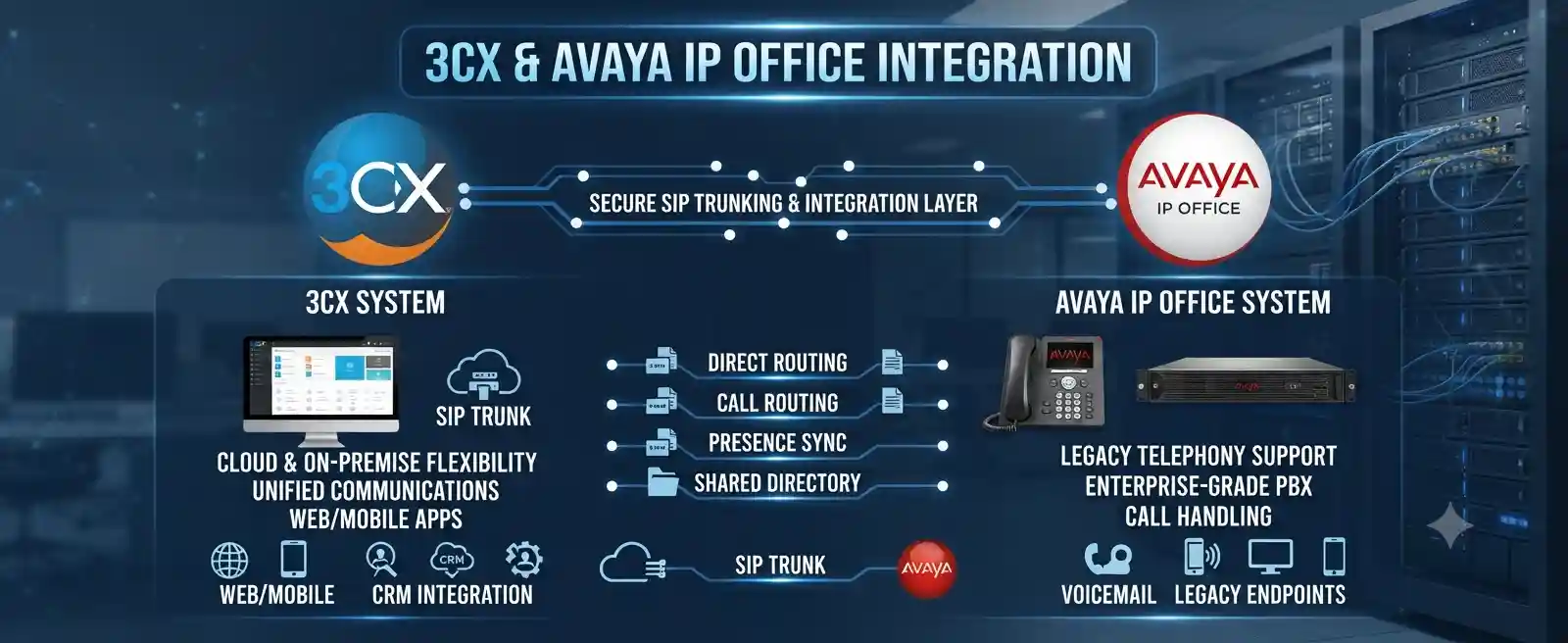
It means designing a controlled way for a 3CX phone system and an Avaya IP Office environment to exchange selected voice traffic or operate side by side for a defined business purpose. That purpose may be a phased migration, temporary coexistence during a project, internal calling between user groups, consolidation of external call routing, or preservation of a specialist legacy workflow while newer users move to another platform.
The connection is normally evaluated around SIP interoperability, but the exact method must be confirmed from the real environment. Avaya IP Office supports SIP trunking and multi-vendor SIP deployment scenarios, while 3CX provides SIP trunk configuration and routing controls. That does not mean every 3CX-to-Avaya design is automatically vendor-certified or plug-and-play. Message handling, authentication, transport, codecs, DTMF, number formatting, caller identity, diversion information, transfer behaviour, media routing, firewall traversal, and licensing can all change the practical result.
Businesses considering this service should prepare the current PBX versions, license position, extension ranges, public telephone numbers, existing SIP or PRI services, network diagrams if available, firewall information, required call flows, and the reason the two systems must connect. FourTeck can then define what should be tested before any production change is approved.
What the integration service may cover
Depending on the confirmed scope, assistance may include current-state discovery, SIP capability review, extension and DID mapping, dial-plan analysis, inter-PBX routing design, firewall and network review, codec planning, caller-ID handling, DTMF checks, transfer and forwarding tests, gateway or SBC assessment, pilot configuration, cutover support, migration sequencing, and documentation.
The work can also include coordination with the SIP carrier, Avaya support provider, 3CX administrator, internet provider, or internal IT team when an external dependency must be changed. Items are included only when they form part of the approved service scope.
Who may need this service
This service may suit a company replacing Avaya IP Office with 3CX in stages, merging offices that use different PBXs, retaining a specialised Avaya group while other teams move, connecting a newly acquired branch, rationalising duplicated telephone services, or planning a transition that cannot be completed in one maintenance window.
It may also be relevant when the business wants to validate whether coexistence is realistic before committing to a broader migration. A feasibility review can be more useful than assuming a direct link will preserve every feature used on either platform.
Common business triggers for connecting the two PBX environments
Integration projects usually start because the organisation needs continuity during change. The requirement is often operational rather than purely technical.
Phased user migration
Not every extension, department, contact centre workflow, analogue device, or branch can always move on the same day. An interim call path can allow approved groups to reach each other while the migration proceeds in controlled stages.
Business merger or site consolidation
Two offices may arrive with different numbering plans, carriers, voicemail habits, hunt groups, and administrator responsibilities. Integration can provide a temporary bridge in operations while the future telephony standard is decided.
Legacy dependency
A department may depend on an Avaya-specific workflow, device, recording path, or third-party application that cannot be replaced immediately. The integration plan should identify what must remain isolated and what can safely exchange calls.
Carrier or number transition
Telephone numbers may move on a different schedule from users and endpoints. Temporary routing between systems can help maintain a deliberate migration order, subject to carrier capability and number presentation requirements.
Branch-to-head-office calling
A branch adopting 3CX may still need to call Avaya IP Office users at another location by extension or defined prefixes. The numbering plan and route selection must prevent ambiguous or looping calls.
Migration proof of concept
Management may want a limited pilot before a wider change. A test group can help expose routing, codec, transfer, caller-ID, firewall, or user-experience issues before the scope expands.
Why an unmanaged inter-PBX connection can create business problems
A connection that appears to pass a basic test call can still fail under real business conditions. Calls may route in one direction but not the other. External caller ID may be lost or rewritten. Transfers can behave differently from direct calls. DTMF may fail when users interact with an IVR. Audio may be one-way if signalling and media follow different network paths. Emergency or restricted routes may use an unintended trunk. Voicemail, busy status, call forwarding, hunt groups, or presence information may not cross the boundary in the way users expect.
The operational impact can include missed customer calls, users redialling externally instead of internally, unexpected telecom charges, longer call handling, confusion over who owns a fault, and change windows that run longer because the previous configuration was not documented. Security can also be affected if a SIP service is exposed more widely than necessary or if firewall rules are opened without a defined source, destination, transport, and maintenance plan.
FourTeck treats integration as a small telephony project rather than a single checkbox. The objective is to understand the call path end to end, define what behaviour is required, change only what is authorised, test representative scenarios, and record what remains dependent on either vendor or a third-party carrier.
Possible integration scope
The final scope depends on the current environment and approved quotation. The following areas illustrate what may be assessed or included when they are relevant to the business objective.
| Integration area | Possible assistance | What must be confirmed |
|---|---|---|
| SIP interoperability | Review signalling expectations, transport, authentication model, media path, and test behaviour. | Platform versions, supported options, licensing, network reachability, and vendor limitations. |
| Numbering plan | Map extension ranges, prefixes, DIDs, short codes, and dial patterns. | Overlapping ranges, user habits, special numbers, branch conventions, and future migration plan. |
| Inbound call routing | Plan which system receives or forwards selected public numbers and internal destinations. | Carrier delivery, DID ownership, hunt groups, IVRs, queues, failover, and after-hours rules. |
| Outbound calling | Define which users or patterns use which trunk and how caller identity is presented. | Carrier policy, emergency calling, restrictions, authorised caller IDs, and route priority. |
| Network and security | Review VLANs, routing, NAT, firewall rules, SBC or gateway role, QoS, and monitoring points. | Site topology, public IP design, approved security policy, bandwidth, latency, and remote access. |
| Feature testing | Test direct calls, transferred calls, forwarded calls, DTMF, busy/no-answer handling, and selected call flows. | Which features must work across platforms and which may remain platform-specific. |
| Migration coexistence | Create user batches, transition routes, cutover checkpoints, and rollback considerations. | Business windows, user groups, device readiness, carrier timing, and application dependencies. |
| Documentation | Record route purpose, numbering assumptions, relevant access dependencies, test results, and next actions. | Customer documentation standard, administrator ownership, and any third-party restrictions. |
Is this integration a good fit for your situation?
| Business situation | Relevant assistance | What must be confirmed |
|---|---|---|
| You are migrating from Avaya IP Office to 3CX in stages. | Coexistence design, extension routing, DID transition, pilot testing, staged cutover, and documentation. | Which users move first, which features must remain, licensing, carrier plan, and rollback point. |
| Two sites use different PBXs but users need internal calling. | Dial-plan review, inter-site SIP path assessment, routing, security review, and call testing. | Addressing, VPN or network path, overlapping extensions, call volume, and quality expectations. |
| A legacy Avaya workflow must remain temporarily. | Dependency mapping, isolation of the legacy function, defined call paths, and phased replacement planning. | Application owner, supported interfaces, vendor support, user group, and retirement timeline. |
| You want one system to carry selected external calls for the other. | Route policy design, caller-ID checks, restriction review, carrier coordination, and failover planning. | Carrier terms, number ownership, emergency calling, capacity, and regulatory requirements. |
| You are unsure whether direct interoperability is practical. | Feasibility assessment, controlled lab or pilot tests, alternative topology review, and scope recommendation. | Access to both systems, representative call scenarios, test numbers, acceptable limitations, and change approval. |
Service information at a glance
Controlled telephony coexistence, inter-PBX calling, or staged migration between 3CX and Avaya IP Office.
3CX, Avaya IP Office, SIP trunks, firewalls, switches, routers, gateways or SBCs, carrier services, and IP phones.
Configuration review, call-flow discovery, numbering analysis, network checks, log or trace review, and controlled testing.
Often suitable for discovery, configuration review, routing analysis, and software-level testing when secure authorised access is available.
May be required for gateways, cabling, physical PBX equipment, switch changes, local voice testing, or inaccessible systems.
Authorised administrative access, telephony ownership information, and relevant network or carrier contacts. Credentials should be shared securely after authorisation.
Scope dependent. Representative inbound, outbound, internal, transfer, DTMF, caller-ID, and failure scenarios can be defined before implementation.
Yes. Final effort depends on versions, sites, number ranges, carrier dependencies, feature requirements, access, and implementation risk.
Remote work versus on-site telephony integration support
When remote assistance may be suitable
A large part of an integration assessment can often be performed remotely if both platforms are reachable through an authorised secure method and a responsible administrator is available. Remote work may include reviewing system versions, collecting configuration information, documenting extension ranges, checking existing SIP lines, reviewing routing rules, analysing logs or traces, preparing a route map, and applying approved software-level changes.
Remote testing is also practical when local users can place and receive test calls and report what they hear or see. It is not appropriate to assume that remote access can resolve every issue. Physical faults, undocumented cabling, analogue interfaces, gateway problems, or local network conditions may require a site visit.
When on-site assistance may be preferable
On-site support may be recommended when the work involves Avaya hardware, voice gateways, patching, rack access, analogue devices, legacy trunks, switch ports, VLAN changes, physical handset testing, or a network path that cannot be validated remotely. A local visit can also help when several departments must participate in user acceptance or when the existing environment has limited documentation.
The visit scope should identify which systems can be touched, who authorises changes, what maintenance window is available, and whether a third-party carrier or vendor must be present. Scheduling depends on location, engineer availability, access, and the confirmed quotation.
How FourTeck assesses a 3CX and Avaya IP Office integration
The most useful discovery process begins with the business outcome and then works backward through the technical layers. This avoids designing a complicated trunk that solves the wrong problem.
- Define the business objective. Confirm whether the requirement is permanent coexistence, a migration bridge, inter-site extension calling, external call sharing, temporary rerouting, or a proof of concept. The expected lifetime of the connection affects how much resilience and documentation it needs.
- Identify affected users, sites, and call flows. Record extension ranges, departments, DIDs, queues, hunt groups, IVRs, voicemail destinations, forwarded numbers, fax or analogue services if present, and any high-priority business lines.
- Collect platform evidence. Confirm 3CX and Avaya IP Office versions, deployment model, available licenses, existing SIP services, network interfaces, administrator access, recent changes, known faults, and vendor support boundaries.
- Map the network path. Review IP addressing, routing, VPNs, VLANs, firewalls, NAT, WAN links, internet services, and the location of any SBC or gateway. Voice quality depends on the media path as well as signalling.
- Review numbering and route conflicts. Overlapping extension ranges, reused prefixes, carrier dial rules, and inconsistent number formats can cause routing ambiguity. A route plan should make each destination predictable.
- Confirm security and change controls. Determine how administrative access will be provided, which firewall changes are authorised, whether configuration backups are available, and what rollback point should be used.
- Build a representative test plan. Define normal and exception calls: 3CX to Avaya, Avaya to 3CX, external to each system, outbound from each user group, transferred calls, DTMF through an IVR, busy/no-answer conditions, and caller-ID presentation.
- Implement a limited pilot where appropriate. A small test group reduces the impact of an unexpected interoperability issue and gives administrators a chance to observe logs, audio, transfers, and user behaviour.
- Validate the approved outcome. The project is not complete when one call connects. Validation should use the agreed scenarios and confirm any known limitations explicitly.
- Document the production state. Record the route purpose, key settings, dependencies, support ownership, test results, rollback information, and next migration or maintenance action.
Planning the actual interconnection without assuming feature parity
SIP is a standard family of protocols, but vendors can implement call features and headers differently. Avaya documentation itself notes that multi-vendor SIP implementations are not guaranteed to interpret every part of the standards in the same way. That is why a project should separate the features that absolutely must cross the boundary from the features that can remain local to each PBX.
Basic voice calling is usually the first target to assess. The route design must decide how one system addresses the other, how incoming SIP messages are matched, which extension or DID patterns are accepted, which system presents caller identity, and whether the media path is direct or anchored through another component. The environment may also need compatible codecs and a consistent DTMF method so callers can interact with menus or remote services.
More advanced behaviour should be treated as a separate test requirement. Consultation transfers, blind transfers, forwarded calls, diversion information, hunt-group states, voicemail callbacks, call recording, presence, busy-lamp information, mobile apps, call queues, emergency routing, and contact-centre integrations may not traverse an inter-PBX SIP link in the same way they operate within one native system. A business that depends on these functions should identify them before the design is approved.
Where direct interoperability is unsuitable, the alternatives may include an SBC, a gateway, a carrier-mediated routing design, a different migration sequence, or retention of separate external trunks with only limited internal connectivity. The correct option depends on the platforms, licenses, business risk, and the intended duration of coexistence.
Capability focus 1: keeping the dial plan understandable during migration
A migration becomes difficult when users do not know whether to dial an extension, a prefix, a full number, or an external DID to reach a colleague on the other PBX. The numbering plan should therefore be treated as part of the integration design, not as a detail to fix after the trunk is created.
FourTeck can document the extension ranges on both systems and identify overlaps before routing is changed. If both platforms use the same extension numbers, a direct pattern can become ambiguous because each PBX may assume the destination is local. The project may need temporary prefixes, renumbering of a pilot group, a translation rule, or a more selective route. The best choice depends on user disruption, the duration of coexistence, and the future-state numbering plan.
Public telephone numbers add another layer. Some DIDs may still terminate on Avaya while new DIDs arrive at 3CX, or a carrier may move all numbers together even though the users migrate in batches. Routing must then decide whether an incoming call stays on the receiving PBX, passes to the other system, or reaches a shared service such as an IVR or operator. Outbound caller ID also needs validation so customers see an approved business number rather than an internal extension or an unintended trunk identity.
Clear dial-plan documentation makes support easier after the change. Administrators can see which prefixes are temporary, which routes are permanent, who owns each number, and what can be removed when the final migration step is complete.
Capability focus 2: protecting call quality and network stability
A call can be signalled correctly and still provide poor audio. Voice packets may cross a LAN, VLAN, firewall, VPN, WAN, internet circuit, SBC, or carrier network before reaching the other endpoint. Delay, packet loss, jitter, asymmetric routing, NAT behaviour, or bandwidth competition can affect the media path even when both PBXs show the call as connected.
The network review should identify where 3CX and Avaya IP Office are located, whether they share a site, whether the connection crosses branches, and which devices inspect or translate the traffic. Voice VLANs and QoS may be relevant in some environments, but they should be designed around the real traffic path rather than added as generic settings. Firewall rules should be limited to what the approved design requires, and the business should avoid exposing a PBX interface directly to the internet without appropriate controls.
Codec choice can also affect call quality and bandwidth. A project may need to align codec availability on both sides or allow a device in the path to transcode, which can add resource and compatibility considerations. DTMF must be tested separately because a voice conversation can sound perfect while keypad input fails to reach an IVR or external service.
FourTeck can coordinate telephony and network checks so the fault is not passed repeatedly between the PBX administrator, firewall team, carrier, and internet provider. Where a third party controls the affected path, evidence can be gathered and shared so escalation is based on observable behaviour rather than assumptions.
Capability focus 3: creating a safer migration path with evidence and rollback
Many integration requests are temporary by design. The business ultimately wants one communications platform but needs a controlled period in which both systems remain active. In that situation, the integration should support migration rather than become a permanent undocumented dependency.
A staged plan can group users by department, site, risk, or dependency. A small pilot may move first, followed by less complex teams, then users who depend on special call flows. Each stage should have entry criteria, a maintenance window, a test checklist, and a clear decision about whether the next group can proceed. If a problem cannot be resolved within the approved window, rollback may mean moving the users back, restoring a configuration, changing the call route, or delaying the carrier change. The exact method depends on what was altered.
Evidence is important because telephony behaviour can be difficult to reproduce after the fact. Configuration exports where supported, screenshots, route maps, timestamps, call examples, trace files, and user reports can help isolate whether the issue belongs to routing, signalling, media, carrier delivery, or an application. This also reduces the risk that a later administrator removes a route without understanding why it exists.
FourTeck can help define the migration checkpoints, organise the technical evidence, test the approved scenarios, and produce handover notes that describe remaining dependencies. The goal is not to promise a zero-downtime migration; it is to make the change understandable, reversible where practical, and aligned with the business tolerance for interruption.
Dependencies, access, licensing, and customer inputs
The integration cannot be scoped accurately from the PBX names alone. Platform versions, current licenses, deployment model, user count, route design, carrier services, network topology, administrator access, and the required features all affect what is technically and commercially practical.
Avaya IP Office SIP trunk operation is license and configuration dependent. 3CX SIP trunk behaviour also depends on the selected trunk method and configured routing. If a direct inter-PBX approach is proposed, it must be validated against the actual systems rather than inferred from generic SIP capability. Where an SBC, gateway, or third-party carrier is involved, its configuration and support boundaries become part of the project.
FourTeck may require authorised administrative access to both telephony systems and relevant network devices. Customers should not publish passwords or credentials in a public form or page. Access details should be shared only through an approved secure method after the requester and authorisation have been confirmed.
The customer should also identify the decision-maker for the change, the local contact for testing, the preferred maintenance window, any blackout periods, and the users whose calls are business-critical. If a carrier or vendor must modify a trunk, license, number route, or security policy, its response and scheduling can affect the project timeline.
Risk, limitation, and exclusion guidance
A standards-based SIP connection does not guarantee identical feature behaviour across vendors. Required call scenarios should be tested in the actual versions and topology.
Available trunk sessions, platform entitlements, gateway capacity, and third-party licenses must be confirmed before final configuration.
Number delivery, caller-ID presentation, SIP registration, emergency calling, or trunk changes may depend on the telecom provider and cannot be completed solely from the PBX side.
Failed gateways, cards, power supplies, cabling, handsets, or other hardware may require replacement, vendor repair, or parts outside the integration labour scope.
Routing, firewall, trunk, or carrier changes can interrupt service. The acceptable window and rollback approach should be agreed before work starts.
Call recording, contact-centre tools, door phones, paging, fax, analogue devices, or specialist integrations may need separate compatibility assessment.
Where this service may be useful
The integration is relevant wherever business operations cannot tolerate a rushed telephony replacement. A professional office may need to move departments in stages because reception, finance, and client-service teams use different call flows. A warehouse may depend on cordless or analogue endpoints that need separate migration planning. A clinic may need to preserve main-number routing and appointment call handling while new users are piloted. A hotel or hospitality operation may have extensions, front-desk workflows, paging, door phones, or guest-room dependencies that require careful mapping.
Multi-branch organisations can use an assessment to decide whether one branch should integrate temporarily with a central Avaya IP Office, whether each site should maintain separate external calling during migration, or whether a carrier-based design is more practical. Companies involved in a merger or acquisition may also need a temporary extension plan so teams can call one another before the long-term communications standard has been selected.
The service is not limited to large enterprises. A smaller UAE business may have only a modest number of users but still face complicated dependencies because its public numbers, door entry, fax, call recording, or telecom contract are tied to the existing Avaya environment. The right scope is determined by operational complexity rather than by extension count alone.
Operational and security considerations
Voice integration changes should preserve the principle of least exposure. A PBX or SIP interface should not be placed directly on an untrusted network simply to make a test call work. Firewalls, ACLs, VPNs, SBCs, NAT rules, and routing should be designed so only the required systems can exchange the required traffic. Avaya security guidance specifically recommends properly configured firewall protection for SIP trunks and considers an SBC for stronger SIP security in appropriate deployments.
Administrative access should be controlled as carefully as call traffic. Shared administrator credentials, unknown remote-access tools, and undocumented vendor accounts make later troubleshooting harder and increase security risk. The project should identify who owns each privileged account, where changes are recorded, and how access will be removed when a temporary migration phase ends.
Monitoring should focus on useful evidence. Registration status, trunk availability, call failures, packet loss, interface errors, firewall drops, and representative call traces can help identify whether a problem is persistent or isolated. It is not necessary to collect every possible metric if nobody is responsible for reviewing it. A simple support plan that identifies the key health indicators and escalation contacts is often more practical.
Maintenance after integration should also include change awareness. A PBX update, firewall replacement, public IP change, carrier migration, new extension range, or revised security policy can break a previously working interconnection. Documentation should therefore describe the dependency and identify which future changes require retesting.
Testing, validation, and handover
A useful acceptance test should represent real business calls rather than a single engineer-to-engineer check. FourTeck can help the customer build a test list around the call flows that matter. Typical scenarios may include extension-to-extension calls in both directions, calls from an Avaya user to a 3CX queue or receptionist, calls from a 3CX user to an Avaya hunt group, incoming public calls that are forwarded between systems, outbound calls from migrated and non-migrated users, and transferred calls between platforms.
DTMF should be tested when users interact with IVRs, banking lines, conference bridges, or remote services. Caller ID should be checked on internal and external destinations. Audio should be assessed in both directions, and the team should note whether problems appear only after transfer, hold, or forwarding. If the project depends on failover, the failure condition should be tested only when it can be done safely within the agreed scope.
Handover can include a route diagram, explanation of temporary prefixes, notes on which DIDs terminate where, a summary of the firewall or network dependency, known feature limitations, support contacts, and the next migration step. Documentation should be practical enough that another administrator can understand why the connection exists without reverse engineering it during an outage.
Successful testing confirms the approved scenarios at that time. It does not remove the need for monitoring, maintenance, or retesting after platform upgrades, carrier changes, network redesign, or major dial-plan changes.
Before you contact FourTeck
Providing a clear starting picture helps FourTeck determine whether the request is mainly a configuration task, a migration project, a network issue, or a multi-vendor coordination exercise. Prepare as many of the following details as you can without sharing passwords publicly:
- The Dubai or UAE site locations involved in the project.
- The main technical and business contact for the telephony change.
- Current 3CX version and deployment model if known.
- Current Avaya IP Office version and server or control-unit details if known.
- Extension ranges on both systems and any overlapping numbers.
- Main telephone numbers and DIDs that must remain reachable.
- Existing SIP, PRI, analogue, or other carrier services.
- The required call flows between the two systems.
- Queues, IVRs, recording, fax, paging, door phones, or specialist applications that may be affected.
- Any recent PBX, firewall, carrier, or network changes.
- Network diagram, VLAN details, WAN or VPN design if available.
- Whether authorised administrative access can be arranged.
- The preferred migration sequence or deadline, if there is one.
- Business-critical periods when call interruption is not acceptable.
- The expected end state: permanent coexistence or retirement of one PBX.
- The known vendor or carrier contacts who may need to approve changes.
Service evaluation and quotation checklist
The quotation should describe the exact outcome and responsibilities. Useful confirmation points include:
How FourTeck can assist
FourTeck can act as the technical coordinator across the phone systems and the network layers that make the integration possible. The engagement can start with a short discovery exercise to clarify the business requirement and identify whether the project is mainly about coexistence, migration, routing, troubleshooting, or carrier transition.
From there, FourTeck can review the current call paths, document extension and DID ranges, examine relevant SIP and network configuration, identify access or licensing dependencies, and propose a controlled test approach. Approved changes can then be scheduled with the customer, validated against the agreed call scenarios, and recorded for future support.
Where the problem belongs to a carrier, internet provider, Avaya specialist, 3CX administrator, firewall vendor, or another third party, FourTeck can help organise the evidence and explain the dependency so the escalation is more focused. This does not replace the third party’s contractual responsibility, but it can reduce the time spent trying to identify which part of the call path needs attention.
For wider infrastructure assistance, customers can review FourTeck business IT support, explore the available IT service areas, learn more about FourTeck, or request a telephony assessment.
A practical quotation starts with the call flows
Instead of quoting from the two PBX names alone, FourTeck can scope the work around the routes that must work, the systems that can be changed, the people who can approve changes, and the test evidence required before the connection is accepted.
This helps separate a simple configuration request from a multi-site migration that involves carriers, security changes, legacy devices, or business-critical cutover planning.
Dubai and UAE service coordination
For organisations in Dubai and across the UAE, the support method can combine remote discovery with planned on-site assistance where the physical environment matters. Remote work may be efficient for configuration review, SIP analysis, call-flow mapping, administrator discussions, and controlled changes. On-site work may be recommended when the project involves a physical Avaya control unit, gateways, cabling, switches, VLAN changes, local carrier equipment, rack access, or hands-on acceptance testing.
A telephony project can involve several schedules at once. The customer may need a maintenance window outside its busiest calling period. A carrier may need notice before changing number routing. Building access may be required for a communications room. A vendor may need to release a license or provide configuration information. Hardware replacement, if required, can depend on availability. FourTeck therefore confirms the service plan after discovery rather than promising a fixed completion time from the topic alone.
Contact FourTeck to confirm the service scope and scheduling options. Installation, configuration, migration, testing, and documentation tasks should be clearly included in the approved quotation. Any excluded carrier charges, licenses, hardware, or third-party professional services should also be understood before implementation begins.
Coordinating Dubai, Abu Dhabi, Sharjah, and Ajman sites
A company with locations in Dubai, Abu Dhabi, Sharjah, and Ajman may have different phone systems, carriers, internet circuits, extension plans, or support arrangements at each site. The integration project should identify whether every office needs to participate in the same call-routing design or whether only selected locations require a temporary path between 3CX and Avaya IP Office.
Remote troubleshooting and configuration may be practical across multiple sites when secure access and local test users are available. Planned on-site visits can be coordinated when equipment must be inspected, cabling or gateways must be checked, or a local cutover needs hands-on support. Travel, building access, site conditions, maintenance windows, engineer scheduling, and third-party availability can affect the final service plan.
For a multi-site migration, it is usually better to standardise the discovery and test process even when the technical design differs by location. A common inventory format, route map, acceptance checklist, and handover record make it easier to compare sites and avoid repeating avoidable mistakes as the rollout continues.
Related FourTeck IT service areas
Network supportRouting, VLAN, switching, connectivity, and infrastructure checks that can affect SIP signalling and audio quality.
Firewall supportReview of controlled connectivity, NAT, access rules, and security dependencies for approved telephony traffic.
Migration planningDependency mapping, phased cutover design, testing, rollback preparation, user communication, and handover.
Why businesses contact FourTeck for telephony integration assistance
A 3CX and Avaya IP Office project sits between telephony, networking, security, carrier services, and user workflow. Businesses often need help because no single symptom identifies the responsible layer. One-way audio may be a media-routing issue, but a failed call may instead be a dial-plan conflict, a SIP mismatch, a firewall rule, a carrier restriction, or a license limitation. FourTeck approaches the service by following the full call path rather than treating each system as an isolated device.
The engagement can be useful when the internal team understands one platform well but needs assistance with the other, when a merger has introduced multiple vendors, when documentation is incomplete, or when the business wants an independent technical plan before scheduling a migration. The emphasis is on clarification, controlled changes, representative testing, and practical documentation.
FourTeck does not need to present every integration as a permanent solution. If the assessment shows that direct coexistence creates more risk or complexity than value, the recommendation can focus on a different migration sequence, a carrier change, a dedicated gateway or SBC, or a shorter transition period. The purpose of the assessment is to identify a supportable path based on the real environment.
Frequently asked questions
Can 3CX and Avaya IP Office be connected directly?
A direct SIP-based connection may be technically possible in some environments, but it should not be assumed from the platform names alone. Versions, licenses, SIP behaviour, authentication, network topology, codecs, routing, and required call features must be reviewed and tested. If direct interoperability is unsuitable, an SBC, gateway, carrier-mediated path, or different migration design may be considered.
Is this the same as a 3CX Bridge?
No. 3CX Bridge functionality is designed to connect 3CX systems to other 3CX systems. A 3CX-to-Avaya IP Office project is a multi-vendor interoperability task and should be assessed around SIP trunking or another suitable interconnection method rather than described as a native 3CX Bridge.
Can users keep their existing extension numbers?
Possibly, but the numbering plan must be checked for overlaps and routing ambiguity. If both PBXs use the same ranges, temporary prefixes, translations, renumbering, or more selective rules may be required. The future migration plan should guide the decision so temporary routing does not become harder to remove later.
Will transfers and caller ID work between both systems?
They may work, but the exact behaviour is configuration and interoperability dependent. Direct calls, blind transfers, consultation transfers, forwarded calls, diversion information, and caller-ID presentation can use different SIP headers or call flows. The features your staff relies on should be listed and tested explicitly.
Can the integration be completed remotely?
Many discovery, configuration, routing, and trace-analysis tasks can be performed remotely when secure authorised access and a working network are available. On-site assistance may still be required for physical Avaya equipment, gateways, cabling, switch changes, analogue interfaces, rack work, or local testing that cannot be reproduced remotely.
Do we need an SBC?
Not every design requires one, and the answer depends on topology, security policy, interoperability, media handling, and vendor requirements. An SBC may provide useful control and security in some SIP designs, while other environments may use a trusted internal route, VPN, gateway, or carrier path. The assessment should decide its role rather than adding one automatically.
Can we migrate users in departments instead of all at once?
Yes, a phased migration is one of the common reasons to consider coexistence. The project should define user batches, extension routing, DID handling, shared services, testing, and rollback for each stage. Departments with specialist applications or complex call flows may be scheduled later after simpler groups have been validated.
What information is needed before a quotation?
Useful information includes PBX versions, site count, extension ranges, public numbers, carrier services, required call flows, critical queues or IVRs, network topology, firewall ownership, administrative access availability, migration objective, maintenance constraints, and any legacy devices or applications that must remain operational.
Will all Avaya features be available to 3CX users?
No blanket feature-parity assumption should be made. Some functions remain local to each PBX or may not traverse a multi-vendor SIP connection in the same way. Identify the essential business functions and test them. Where a feature cannot be preserved, FourTeck can help discuss an alternative workflow or migration sequence.
Can FourTeck coordinate with our telecom carrier or Avaya provider?
Coordination can be included when it is part of the confirmed scope. FourTeck can help describe the required routing change, collect call examples, and share relevant technical evidence. The third party remains responsible for changes and services controlled under its own contract.
Does successful testing guarantee the connection will never fail?
No. Testing confirms the agreed scenarios under the tested conditions. Future PBX upgrades, carrier changes, firewall replacements, public IP changes, network redesign, license changes, or new dial-plan rules can affect a working connection. Documentation and change management help identify when retesting is needed.
Do you support projects outside Dubai?
FourTeck can coordinate service in Dubai and across the UAE, including Abu Dhabi, Sharjah, and Ajman, subject to the confirmed scope, scheduling, site access, and travel requirements. Remote work may cover many configuration tasks, while on-site assistance can be planned when physical inspection or local implementation is required.
Plan the integration around your real call flows
Tell FourTeck why 3CX and Avaya IP Office need to coexist, which users and numbers are affected, and what the final telephony environment should look like. The next step can be an assessment of versions, licenses, routes, network dependencies, security controls, testing requirements, and the work that should be included in a quotation.