
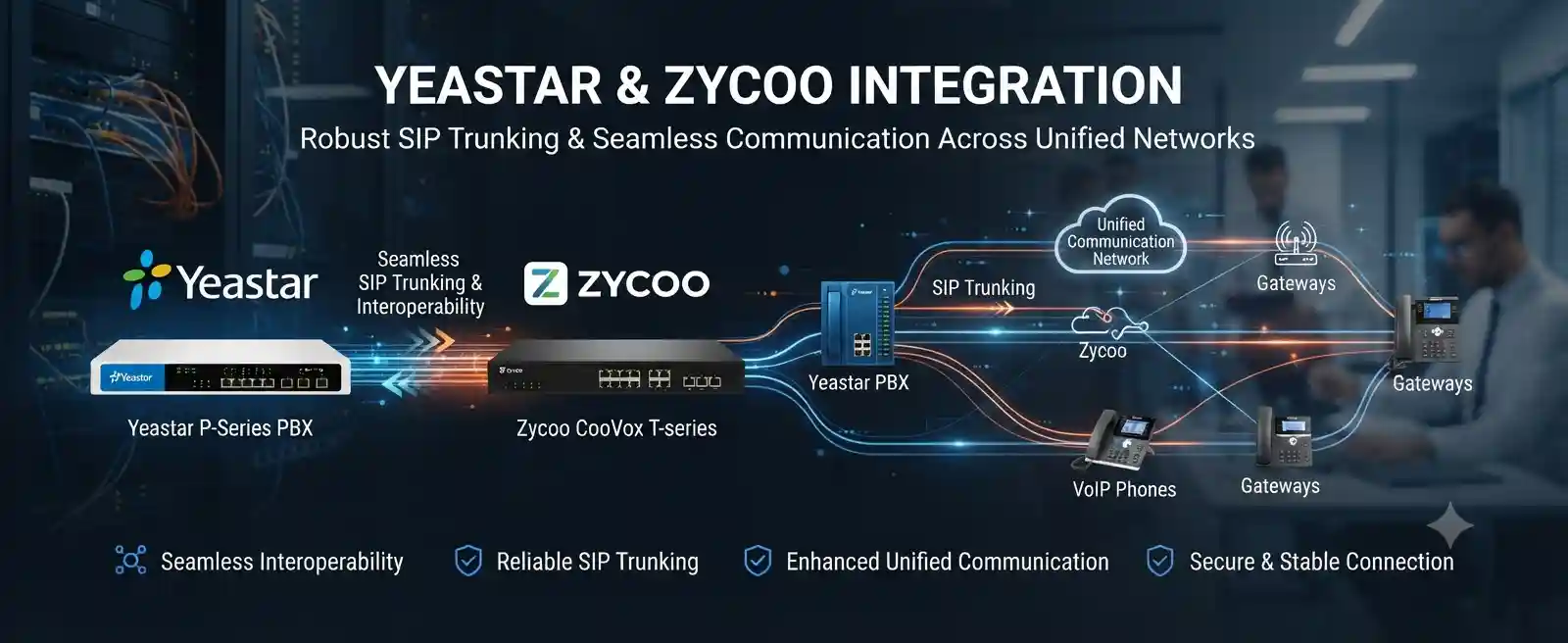
Defined call flow before configuration
SIP connectivity subject to platform support
Backup, test plan and rollback considered
Remote or on-site according to scope
What does Yeastar and Zycoo integration mean?
Yeastar and Zycoo integration is the planned connection of two business telephone environments so that approved call traffic can pass between them in a predictable and supportable way. Depending on the systems in use, this may be achieved through SIP trunking or peer-style connectivity, with routing rules on both sides deciding which numbers are reachable and how calls are presented. Businesses may consider the service when joining branches, keeping an existing PBX during a migration, extending internal calling between environments, or reducing disruption while systems are consolidated. Before work begins, the customer should confirm the exact PBX models or editions, software versions, IP addressing, extension ranges, existing trunks, required call directions, administrative access, available backups, firewall ownership, and any telecom-provider dependencies. Those details determine whether remote work is sufficient or whether on-site access, gateway checks, cabling inspection, or coordinated testing is also required.
What the integration service can cover
At service level, the objective is to make the two PBX environments communicate according to an agreed business call flow. That call flow needs to be written down before settings are changed. A company may want extension-to-extension dialing between two offices, selected outbound calls to use one system, incoming calls to reach departments on the other system, or a temporary coexistence arrangement while users are moved gradually. Each goal creates different requirements for routes, number presentation, failover expectations, and testing.
Yeastar P-Series documentation describes register, peer, and account trunk approaches, while ZYCOO documents SIP capabilities within its CooVox platform. Those platform capabilities provide several possible connection patterns, but they do not mean that every combination is automatically interoperable in every environment. The actual design must consider the specific model, release, transport settings, network placement, NAT behaviour, firewall policy, codecs, DTMF method, dial patterns, caller ID requirements, and whether other trunks or gateways are involved.
Depending on the confirmed scope, FourTeck assistance may include current-state discovery, configuration backup review, addressing and reachability checks, SIP trunk or peer planning, inbound and outbound route mapping, extension-range conflict checks, caller ID review, codec alignment, DTMF testing, firewall coordination, gateway checks, test-call execution, call-direction verification, documentation, and administrator handover. Work that depends on a telecom operator, vendor cloud portal, third-party gateway, unsupported legacy system, or physical line may require separate coordination.
The service is therefore best understood as an interoperability project rather than a single PBX setting. The configuration itself is only one stage. Equally important are defining the requirement, preserving existing service, controlling risk, validating expected call paths, recording what changed, and making sure the customer knows which system owns each part of the final routing design.
Who may need this service?
Integration can be relevant to businesses that have inherited different PBX platforms after a merger, use different systems in separate offices, are replacing one system in stages, or need temporary interworking while a larger telephony project is completed. It may also help organisations with a head office and branch arrangement where internal calling needs to pass between two existing systems without immediately replacing either platform.
Typical environments include professional offices, retail operations, warehouses, hospitality sites, clinics, schools, construction offices, logistics teams, property-management businesses, and multi-branch organisations. The business case matters more than the industry. The service should be driven by who needs to call whom, which numbers must remain reachable, which site or system should handle each call type, and what level of change is acceptable during working hours.
When should integration be assessed carefully?
Extra assessment is useful when extension ranges overlap, both PBXs already use complex routing, a firewall performs SIP-related inspection, sites are connected through VPNs, public addressing changes regularly, a telecom provider restricts trunk registration, call recording is business-critical, or analogue and digital gateways remain in use. These conditions do not automatically prevent integration, but they can affect design and test requirements.
Care is also needed if the systems are on older software, documentation is missing, administrator credentials are unavailable, backups have not been verified, or previous changes were made without a change record. In those cases the initial task may be to establish a reliable picture of the current environment before deciding which configuration approach is appropriate.
Common business triggers and symptoms
A request for Yeastar and ZYCOO integration can begin as a project requirement or as a troubleshooting problem. In a planned project, the trigger may be an office move, business acquisition, branch expansion, PBX replacement, phased migration, telecom-provider change, new numbering plan, or desire to preserve an existing system while another site adopts a different platform. The business may be less concerned with the technical method than with preserving familiar extension numbers and keeping calls moving during the transition.
In troubleshooting situations, users may report that calls between systems fail in one direction, ring but have no audio, connect with one-way audio, show unexpected caller identity, cannot reach certain number ranges, disconnect after a fixed period, fail only from a remote branch, or behave differently for inbound and outbound routes. None of these symptoms proves a single cause. The same visible issue can involve dial patterns, route order, authentication, NAT, firewall policy, SIP headers, media ports, codec negotiation, DTMF handling, transport settings, DNS, gateway configuration, or a third-party carrier.
Repeated routing loops deserve careful attention. If each PBX sends an unmatched number back to the other without clear boundaries, calls can fail in confusing ways. A defined numbering plan reduces this risk by documenting which extension blocks, service numbers, external routes, and fallback destinations belong to each system. Similar planning helps avoid duplicate extensions, which Yeastar specifically highlights as a consideration when using account-trunk style connectivity to another device.
Another common trigger is poor documentation. Businesses sometimes know that two PBXs are already connected but cannot identify the trunk name, destination patterns, firewall changes, or why specific caller-ID rules exist. In such cases integration support may focus first on discovery and documentation before any functional change is attempted.
Why unresolved interoperability problems affect operations
When two telephone systems are expected to work together, small configuration inconsistencies can create large user-facing problems. Staff may be unable to transfer calls to another site, reception teams may need to dial public numbers instead of internal extensions, customers may hear unexpected busy signals, and calls may be routed through an unintended trunk. These workarounds add cost and confusion even when both PBXs appear healthy on their own.
For distributed teams, inconsistent inter-system calling can also undermine the purpose of a shared numbering plan. Users stop trusting short dialing, departments create informal alternatives, and support teams receive repeated reports that are difficult to reproduce. If the configuration is undocumented, each later change becomes riskier because no one can easily see the relationship between route patterns on the first PBX and matching rules on the second.
Voice quality problems create another kind of impact. A call may signal correctly but carry no media or only one-way audio if the media path is blocked, translated incorrectly, or negotiated differently from what the network allows. This is why integration testing should not stop at “the phone rings.” A useful validation plan includes call setup, two-way audio, DTMF, hold, transfer where required, caller identity, ringback behaviour, and the routes that matter to the business.
Possible service scope
Discovery
Identify PBX models, software levels, sites, networks, current trunks, extension ranges, call routes, gateways, carrier connections, and the required business outcome.
Design
Map the SIP relationship, source and destination addressing, number patterns, route priorities, caller ID behaviour, authentication where required, and permitted call directions.
Controlled change
Review backups, authorisation, maintenance window, firewall implications, rollback options, and affected users before changing production telephony settings.
Validation
Run agreed test calls, verify two-way media, number presentation, DTMF, routing behaviour, and expected fallback or escalation paths.
Documentation
Record trunk identities, route logic, address dependencies, approved changes, remaining limitations, and administrator notes for future support.
Ongoing support planning
Define who owns each PBX, who manages firewall and telecom services, what should be monitored, and when an integration review is sensible after future changes.
These are possible activities rather than automatic inclusions. The approved quotation should identify which tasks apply to the specific environment, whether remote or on-site work is required, and which responsibilities remain with the customer or another provider.
Service-fit matrix
| Business situation | Relevant assistance | What must be confirmed |
|---|---|---|
| Two offices use different PBXs and need short dialing | Number-plan review, SIP path, routes and call testing | Extension ranges, network reachability, security policy and call directions |
| A phased migration keeps both systems live temporarily | Coexistence design, staged route changes, rollback planning | User migration sequence, trunk ownership, maintenance windows and acceptance tests |
| Calls work one way but fail in the other | Route, authentication, firewall and signalling review | Logs, test numbers, recent changes and access to both sides |
| Calls connect but audio is missing or one-way | Media-path, NAT, firewall and codec checks | Network topology, public/private addressing and packet-flow evidence where authorised |
| Existing interconnection is undocumented | Configuration discovery and technical documentation | Read access, backups, change history and system ownership |
Service information at a glance
| Main purpose | Enable controlled call exchange and defined routing between Yeastar and ZYCOO PBX environments. |
|---|---|
| Typical systems involved | Yeastar PBX, ZYCOO CooVox IP-PBX, LAN/WAN, firewall, SIP trunks, IP phones, gateways and provider services as applicable. |
| Assessment method | Configuration review, call-flow mapping, connectivity testing, logs, authorised packet analysis where useful, and controlled test calls. |
| Remote support suitability | Often suitable when secure access, reliable internet connectivity and administrator assistance are available. |
| On-site suitability | May be appropriate for physical gateways, cabling, rack access, local network faults, unavailable remote access or coordinated migration work. |
| Customer inputs | System details, authorised access, extension ranges, current call routes, network information, backups, business requirements and a test plan. |
| Scope dependency | Environment, model, software version, network, firewall, provider, gateway, licensing and access dependent. |
| Quotation requirement | Contact FourTeck to confirm the work scope, service method, scheduling and commercial terms. |
When remote support may be enough
Remote assistance can be efficient when both PBXs are reachable through an approved secure method, the network is stable, administrative access is available, and the issue mainly concerns configuration, routing, logs, or call-flow testing. A local user or administrator may still be needed to place test calls, confirm what is heard, check phone displays, or verify physical indicators.
Remote work can also be suitable for pre-project discovery. Configuration exports, screenshots, route tables, addressing information, extension lists, and change history may allow the integration plan to be prepared before a maintenance window. The customer should not send passwords in ordinary email or public forms; credentials should be exchanged only through an approved secure method after authorisation is confirmed.
When an on-site visit may be better
On-site work may be appropriate when the PBXs or gateways cannot be reached remotely, local cabling or switch ports need inspection, analogue or digital interfaces are involved, a firewall or router requires local access, or several physical systems must be coordinated during a cutover. It can also be useful when a branch has limited technical staff and test calls need to be coordinated across multiple desks or departments.
On-site attendance is scope and scheduling dependent. Building access, rack permissions, escort requirements, parking or loading restrictions, maintenance windows, third-party technicians, and equipment availability can all affect the service plan. The purpose of an on-site visit should therefore be clear before travel is arranged.
How the assessment and discovery process works
- Define the business call requirement. The first question is not which SIP field to change; it is what callers need to accomplish. FourTeck may map required extension-to-extension calls, inbound destinations, outbound routing, reception transfers, after-hours behaviour, branch calling, emergency-number handling responsibilities, or temporary coexistence needs. Only the relevant requirements should drive the design.
- Identify the exact platforms. The Yeastar and ZYCOO names cover multiple systems and software generations. Model, edition, firmware or software release, licensing where applicable, gateway use, and current support status should be identified. A configuration pattern that works on one release should not be assumed to match another.
- Map extensions and number ranges. Duplicate or overlapping ranges can create ambiguity. The assessment should record which system owns each extension block, how users currently dial external numbers, whether prefixes are used, and whether any service codes or feature codes overlap with planned routing patterns.
- Review current trunks and routes. Existing provider trunks, peer links, gateways, and route priorities matter because a new inter-PBX path can unintentionally capture calls intended for another destination. Both inbound and outbound route logic should be considered, including fallback behaviour when a route is unavailable.
- Understand the network path. The two systems may be on the same LAN, connected through a site-to-site VPN, separated by routed networks, or exposed through controlled public addressing. The design should account for NAT, firewalls, VLANs, routing, DNS where used, and any security policy that restricts voice traffic.
- Review backup and rollback readiness. Before production settings are changed, the customer should know whether current configuration can be restored if the result is not acceptable. Backups must be appropriate to the actual platform and should not be treated as useful merely because a file exists.
- Collect evidence from failed calls. For troubleshooting, exact source and destination numbers, timestamps, direction, observed messages, audio behaviour, and whether the same call works from another route can reduce guesswork. Logs and authorised packet captures may help isolate signalling or media problems when platform tools support them.
- Agree the change and test window. If active users rely on either PBX, changes should be scheduled to reduce avoidable disruption. The plan should identify who can approve the change, who will place test calls, what constitutes success, and what should trigger rollback or escalation.
- Document assumptions before implementation. Unknown provider restrictions, inaccessible firewall rules, obsolete gateways, missing credentials, or unverified routes should be recorded rather than silently assumed. This keeps the quotation and technical plan aligned with what can actually be confirmed.
Planning and implementing the connection
Once discovery is complete, the next stage is to convert the business requirement into a controlled call-routing design. A straightforward case may use a direct SIP peer-style relationship between the two systems over a trusted network path. Another environment may require registration, specific authentication, a gateway, or a firewall/NAT design that influences how signalling and media are exchanged. The method must match what the installed systems actually support.
Route design should be explicit. If Yeastar extensions use one number range and ZYCOO extensions use another, the integration can usually be designed around those ownership boundaries. If ranges overlap, the solution may require prefixes, number transformation, staged renumbering, or another clear rule. The aim is to remove ambiguity. A route that is too broad can capture external calls accidentally, while a route that is too narrow can leave legitimate internal numbers unreachable.
Caller identity is another planning area. The business may want internal calls to show an extension, a department number, or another approved identity, while calls that eventually leave through a carrier may need to follow provider rules. Both systems can apply number manipulation, so changes should be kept understandable and documented. Hidden transformations on both sides make later troubleshooting much harder.
Codec selection should be treated as a compatibility and network decision rather than a performance promise. A call can fail or behave unexpectedly if the endpoints, PBXs, and any carrier or gateway cannot agree on a usable codec. Likewise, DTMF must be tested when users interact with IVRs, voicemail menus, or other systems that depend on key presses. A call that carries speech correctly can still be operationally unusable if DTMF does not pass as expected.
Security controls belong in the implementation plan. Exposing SIP services broadly to the internet simply to make a trunk work can create unnecessary risk. Where possible, access should be limited to required peers, networks, or approved transport methods, consistent with the customer’s wider firewall policy. The exact controls depend on the PBXs, network design, supported transport, and whether the connection is private, VPN-based, provider-managed, or otherwise constrained.
Configuration should be staged when the change has operational consequences. One route or small number set can be tested first, followed by broader call patterns after the initial behaviour is confirmed. This gives the team a better chance to identify numbering, media, or caller-ID issues before many users are affected. Any production modification should be authorised, backed up where appropriate, and accompanied by a documented rollback path.
Testing, validation and handover
Integration is not complete when a trunk status appears healthy. A useful acceptance process proves the call paths the business actually needs. The test list may include Yeastar-to-ZYCOO extension calls, ZYCOO-to-Yeastar calls, transfers across the boundary, calls to departments or queues, external calling through the intended system, inbound provider calls that cross to the other PBX, caller identification, ringback, two-way audio, hold, resume, DTMF, and any after-hours routes that are part of the approved scope.
Testing should also consider failure behaviour. If one PBX or network path is unavailable, does the call fail clearly, try an approved alternate path, or loop unexpectedly? Not every project requires automatic failover, and failover should not be invented where it is not supported, but the expected behaviour should be understood. This helps operations teams distinguish a designed limitation from a new fault.
Handover should leave the customer with enough information to support future decisions. Useful documentation may include a high-level call-flow diagram, trunk names, peer addresses, routing ownership, number transformations, dependencies on firewall or VPN rules, test results, backup location, responsible contacts, and known limitations. Sensitive credentials should not be placed in ordinary documentation unless the customer’s security policy explicitly provides an approved secure method.
Clearer call-path ownership
One of the most useful outcomes of a well-planned integration is knowing which system owns each number and route. Without that clarity, both PBXs can contain overlapping logic, and a simple change on one side may have unexpected consequences on the other. FourTeck can help map extension ranges, route priorities, and external-call responsibilities so the relationship is understandable.
This is especially valuable during phased migrations. Users may move gradually from one PBX to the other while customer-facing numbers remain unchanged. A documented ownership model makes it easier to decide when a route can be removed, when a number must be translated temporarily, and which system should be checked first when a user reports a failed call.
More controlled network and firewall changes
Voice integration often crosses network boundaries. Treating the network as part of the PBX project reduces the chance of making broad firewall exceptions or troubleshooting only the application layer. The review may consider routing, VLANs, VPNs, NAT, address stability, required signalling paths, media flow, and whether any security function is rewriting SIP traffic.
These checks are not a promise that the network is the cause of every call problem. They provide a method for separating PBX configuration issues from transport issues. When both teams can see the path clearly, changes can be narrower, easier to document, and easier to reverse if they do not produce the expected result.
Safer coexistence during migration
Businesses rarely want a migration to force every user, phone, trunk, and route to change at the same moment. Interworking between existing and new PBX environments can support a staged approach when the platforms and network design allow it. The value is operational: teams can move in planned groups while approved call paths remain available between old and new environments.
Coexistence is still temporary architecture and should be documented as such. The plan should define how long the connection is expected to remain, which routes will be removed at the end, what legacy dependencies remain, and how users will know which system provides each function during the transition. This avoids turning a temporary bridge into an undocumented permanent dependency.
Dependencies, access and customer inputs
The quality of an integration plan depends on the quality of the information available. Customers should be prepared to identify both PBXs, software or firmware versions, network addresses, site locations, extension ranges, current trunks, gateways, external number ranges, expected call flows, and which team manages the firewall, switches, VPNs, telecom services and carrier accounts. If a third party controls part of the environment, their participation may be needed during diagnosis or implementation.
Administrative access must be authorised. FourTeck may require access to configuration areas on both telephone systems and, depending on the issue, to firewall or network management. This does not mean every credential should be shared with every engineer. The customer should use an approved secure process, limit access to what is required, and revoke or rotate temporary access according to its own policy after the work is complete.
Backup status is another important input. A backup should be current enough to support rollback and appropriate to the platform version. If the systems are business-critical, the maintenance window should also identify who can approve service impact, which departments need advance notice, and what communication method remains available if telephone service is interrupted.
Carrier information may be needed when the project changes external routing. The integration between PBXs can be technically correct while an external call still fails because of provider authentication, number-format requirements, registration restrictions, or caller-ID policy. Those issues may require the provider’s involvement rather than repeated changes to the PBXs.
Risks, limitations and exclusions to understand
Interoperability work should be planned with realistic boundaries. A successful SIP connection does not guarantee that every vendor-specific feature will pass across systems. Basic calling may work while proprietary presence, busy-lamp behaviour, advanced transfer functions, recording controls, or application-specific features remain local to one platform. The exact capabilities must be assessed rather than assumed.
Unsupported or older PBX software can limit options. A platform may lack a current security feature, behave differently from newer documentation, or require a change that the customer considers too risky during business hours. Firmware upgrades can also introduce their own dependencies and should not be treated as an automatic prerequisite without reviewing release notes, backups, hardware compatibility, and rollback possibilities.
Network and third-party dependencies can affect the outcome. Firewalls, VPNs, routers, managed internet services, cloud infrastructure, carriers, gateways, and building cabling may all sit between the two systems. FourTeck can coordinate technical evidence and recommended next actions, but another provider may need to make the final change in infrastructure it controls.
Hardware failure is outside normal configuration logic. If a gateway port, network interface, storage device, power supply, or phone is faulty, repair or replacement may require a separate quotation or vendor action. Likewise, the existence of a backup does not guarantee that it is complete or restorable until it has been validated appropriately.
On-site work depends on location, access, scheduling, building conditions and confirmed scope. Remote work depends on secure access and available connectivity. Final commercial terms depend on the approved quotation or service agreement.
Business environments and practical use cases
Multi-branch offices: A head office may use Yeastar while a branch continues operating a ZYCOO CooVox system. Integration can be assessed for internal extension dialing, departmental reachability, and controlled routing between sites. The design should account for WAN stability and whether the branch connection is private, VPN-based or dependent on another provider.
Hospitality and property operations: A hotel, serviced office, or property-management group may inherit a PBX during acquisition or operate different systems in different buildings. The requirement may include reception transfer paths, departmental numbers, guest-service lines, or temporary coexistence. Any property-management or application integration outside basic telephony should be confirmed separately rather than assumed.
Clinics and professional practices: Calls may need to reach reception, appointment teams, billing or administrative departments across different sites. The integration plan should prioritise predictable call routing and caller identity without making claims about clinical or regulatory compliance that are outside the telephony scope.
Warehouses and logistics operations: A warehouse may retain an existing phone system while headquarters moves to another platform. Internal dialing can be useful for dispatch, security, reception and operations teams. Physical conditions such as remote racks, legacy analogue lines or gateways may increase the need for on-site assessment.
Schools and training centres: Separate buildings or campuses can have different telephone infrastructure after phased upgrades. Integration may help preserve staff calling while replacement work is scheduled. The project should define how emergency and public-number routing are handled and who is responsible for those policies.
Office relocation or merger: During a move or business consolidation, one site may be ready before another. A temporary interconnection can support staged change, but the end-state architecture should be agreed so temporary routes are removed when they are no longer needed.
Operational, security and maintenance considerations
A PBX integration becomes part of the production communication environment, so it should be maintained like any other business dependency. Future firewall changes, public IP changes, VPN replacements, PBX upgrades, provider migrations, extension renumbering, and new branch networks can all affect the connection even if the original configuration remains unchanged. A simple maintenance record can save significant troubleshooting time later.
Security review should focus on reducing unnecessary exposure. SIP services should not be opened broadly without a defined reason. Administrative interfaces should be protected according to the customer’s access policy, and temporary accounts should be removed or secured after implementation. Logs can be useful for diagnosis, but retention and access should follow the organisation’s own operational and privacy requirements.
Change management is particularly important when two platforms are interconnected because one team’s adjustment can influence the other side. A route added to Yeastar may appear harmless until it overlaps a pattern on ZYCOO; a firewall change may affect media but not signalling; a provider update may change how external caller identity is accepted. Recording such changes makes cross-system troubleshooting faster and more evidence based.
Maintenance does not have to mean a fixed annual contract. Some organisations may only need documentation and an agreed process for future changes, while others may prefer periodic review of trunks, routes, backups and known dependencies. Actual inclusions depend on the service plan or quotation.
Before you contact FourTeck
Preparing a few details can make the first discussion more useful and reduce the amount of time spent rediscovering the environment.
Service evaluation and quotation checklist
The quotation should describe the objective and boundaries clearly. Before approval, confirm the items that apply to your environment:
- Exact integration objective and success criteria
- Number of PBX systems and locations
- Users or departments affected
- Required extension and external call routes
- Remote versus on-site work
- Network or firewall changes included
- Gateway or carrier coordination required
- Backup and rollback responsibilities
- Testing and user-acceptance requirements
- Documentation and handover deliverables
- Preferred implementation window
- Known exclusions or unsupported legacy elements
This checklist helps separate assumptions from confirmed work. Tasks should not be treated as included until they appear in the approved scope.
How FourTeck can assist
FourTeck’s role is to turn a broad request such as “connect these two PBXs” into an understandable technical scope. That can begin with a remote review of the existing environment and business requirement. If physical equipment, local networking, gateways, or site access are involved, the work can be organised around an on-site assessment or coordinated change window. The service approach should match the actual problem rather than forcing every case into the same template.
For planned integrations, assistance can include call-flow discovery, numbering and route review, SIP connectivity planning, configuration change coordination, firewall or network liaison, test planning, implementation, validation, and documentation. For existing integrations with faults, the emphasis may shift toward evidence collection, route comparison, signalling and media-path review, recent-change analysis, and fault isolation.
FourTeck can also help customers separate responsibilities between the PBX platforms, the internal network, internet or VPN provider, telecom carrier, and any gateway or third-party application. This is useful when different vendors each see only one part of the call path. A shared technical view can make escalation more precise because test evidence and ownership are documented.
For broader technology assistance, organisations can review FourTeck IT support and infrastructure services. The final integration quotation depends on confirmed access, location, complexity, implementation tasks, testing needs and third-party involvement.
Dubai and UAE service coordination
For customers in Dubai and across the UAE, Yeastar and ZYCOO integration work can be organised as remote troubleshooting, remote planning, a scheduled on-site visit, or a combination of these methods. The correct service model depends on whether the systems are reachable securely, whether physical equipment must be checked, the number of locations involved, the urgency of the business requirement, and the approved quotation.
An on-site visit may be recommended when gateways, cabling, rack equipment, switch ports, local firewall connections, analogue interfaces, or inaccessible systems need physical inspection. Remote work can be suitable for configuration review, call-flow mapping, logs and controlled testing when access and internet connectivity are available. Neither method should be promised before the environment is understood.
Scheduling can be affected by engineer availability, building access, customer contacts, maintenance windows, equipment readiness, provider participation, and travel. If the work could interrupt live telephone service, the project should identify a suitable change window and a decision-maker who can approve rollback or continuation.
Coverage for Dubai, Abu Dhabi, Sharjah and Ajman
Businesses in Dubai, Abu Dhabi, Sharjah and Ajman may require different combinations of remote and on-site support depending on how their telephone systems are distributed. A single-site office may only need a secure remote configuration session, while a multi-branch company may require staged work across several locations, local testing, gateway checks and coordination with different site contacts.
Service planning should account for travel, building access, rack or comms-room availability, site operating hours, maintenance windows and equipment readiness. Third-party dependencies such as telecom carriers, internet providers, managed firewalls, hosted network services or building contractors can also influence the schedule. FourTeck can help organise the technical sequence, but timing and attendance remain subject to the confirmed work scope and approved quotation.
For multi-emirate projects, a consistent test script and documentation format can reduce confusion. Each site should record the PBX involved, network path, extension range, test numbers, expected route, observed result and any remaining limitation. This makes it easier to distinguish a site-specific fault from a common configuration issue affecting the wider design.
Related FourTeck services
Explore broader support, configuration and infrastructure assistance relevant to business telephony.Network and business IT support
Review connected workplace support where PBX performance depends on LAN, WAN, firewall or site infrastructure.FourTeck service approach
Understand the wider business technology and support orientation behind project coordination.
Why businesses contact FourTeck for PBX integration work
Many integration problems sit between systems rather than inside one device. A PBX vendor may see its own trunk as configured correctly, a network provider may see connectivity, and a carrier may see registration, yet users still experience failed calls. FourTeck can help bring these layers into one troubleshooting sequence by focusing on the complete call path and the business requirement behind it.
The work is also useful when the customer needs clearer change control. Instead of modifying routes until calls appear to work, the service can establish a starting configuration, document the intended call flow, make controlled changes, test defined scenarios and record the result. This makes later maintenance easier and reduces dependence on individual memory.
Another reason is vendor coordination. When one system, gateway, firewall or provider is outside FourTeck’s direct control, the customer may still need someone to prepare evidence, explain the dependency and identify what the third party needs to check. Coordination does not remove vendor responsibilities, but it can make the technical conversation more precise.
Finally, businesses often need a quotation that separates assessment, configuration, network work, on-site tasks, testing and documentation. Clear scope helps decision-makers compare the proposed work with their operational priorities and maintenance window rather than approving an undefined “integration” task.
Questions businesses ask before integrating Yeastar and ZYCOO
Can Yeastar and ZYCOO PBX systems be connected directly?
They may be connectable through SIP-based trunk or peer methods when the specific systems, software versions, network path and configuration support the required relationship. Yeastar P-Series documentation includes general SIP trunk options such as peer and account-style trunks, and ZYCOO’s CooVox documentation describes standard SIP capability. That establishes a technical basis for assessment, but it does not guarantee every Yeastar and ZYCOO combination will support every feature. The first step is to identify the exact products and define the call flow that must work.
Can we keep both PBXs during a migration?
Yes, coexistence may be possible and is often the reason businesses request integration. A staged migration can reduce the need to move all users and routes at once. The project still needs clear number ownership, route boundaries, testing and an end-state plan. Temporary routing should be documented so it can be removed when the migration is complete rather than becoming an unknown permanent dependency.
Can staff use extension dialing between offices?
Extension dialing may be possible if the numbering plan is designed so that each PBX knows which ranges belong to the other. Overlapping extensions complicate the design because the same number cannot unambiguously represent two destinations. In that situation, prefixes, renumbering or other routing logic may be required. Share the current extension lists before assuming short dialing can be introduced without user changes.
What causes one-way calls between two PBXs?
If signalling works in one direction but not the other, possible areas include inbound versus outbound route configuration, source restrictions, authentication, firewall rules, NAT, address matching or number manipulation. The exact cause should be established from evidence. A useful troubleshooting record includes source number, destination number, direction, time of the call, PBX logs and any relevant network information.
What causes one-way audio or no audio?
Audio follows a media path that can differ from the SIP signalling path. NAT, firewall policy, advertised media addresses, codec negotiation, VPN routing or endpoint behaviour can therefore affect audio even when the call rings and connects. Testing should verify two-way media rather than relying on trunk status alone. The correct fix depends on the network and PBX configuration; broad firewall exposure should not be used as a shortcut.
Can this integration be checked remotely?
Often, yes. Remote assessment is practical when the customer can provide authorised access to both PBXs and relevant network information, and a person is available to place test calls. Physical faults, inaccessible gateways, cabling issues, local switch problems or systems that cannot be reached remotely may require an on-site visit. The service method should be selected after the initial symptoms and environment are understood.
Do we need to change the firewall?
Possibly, but not always. If the PBXs communicate across routed networks, VPNs, public addresses or controlled security zones, the firewall may need rules that permit the required signalling and media paths. Any change should be narrow, documented and consistent with the customer’s security policy. If the firewall is managed by another provider, FourTeck may need to coordinate the requirement rather than apply it directly.
Will caller ID remain correct across both systems?
Caller identification can usually be planned, but the result depends on route configuration, number manipulation on each PBX, trunk settings and any carrier rules when the call leaves the private environment. It is worth testing internal calls and external calls separately. The business should define what identity users expect to see before configuration starts.
Can IVR key presses pass between the systems?
DTMF should be included in testing when calls cross the integration and then reach an IVR, voicemail or application that expects key input. Different DTMF methods can behave differently across equipment and trunks. A normal voice call does not prove that DTMF is working, so test cases should include actual menu interaction where that function matters.
Do we need a VPN between sites?
A VPN can be one possible way to provide a private routed path, but it is not automatically required for every design. The right approach depends on the customer’s network architecture, security policy, addresses, internet services, and what the PBX platforms support. If a VPN already exists, its routing, bandwidth, stability and firewall rules should be considered as part of the voice path.
Should we integrate the systems or replace one of them?
That is a business and lifecycle decision rather than purely a configuration question. Integration can be useful when both systems still have a role, when migration must be staged, or when replacement is not yet approved. Replacement may be more appropriate if one platform is unsupported, difficult to maintain, poorly documented, or no longer meets operational requirements. An assessment can compare short-term integration effort with the longer-term cost of maintaining two environments.
How do we prepare for a quotation?
Prepare the system models and versions, sites, extension ranges, existing routes, desired call flow, network overview, firewall ownership, current backups, examples of failed calls if troubleshooting, and the preferred change window. Also identify whether documentation, user testing, on-site work or third-party coordination should be included. This information helps define an accurate scope instead of pricing an undefined task.
What should happen after the integration is completed?
The customer should receive or maintain a clear record of the final route design, trunk relationship, address dependencies, test results, known limitations and ownership. Future PBX upgrades, network changes, firewall replacements, VPN changes and provider migrations should be reviewed against that documentation. A successful test at handover does not remove the need to manage future change.
Frequently asked questions
What is included in Yeastar and ZYCOO integration support?
Depending on the agreed scope, assistance may include discovery, SIP connectivity planning, route configuration, extension-range review, firewall coordination, test calls, troubleshooting, documentation and handover. Not every task is included automatically; the quotation should confirm the exact work.
Can the two systems share the same extension numbers?
Overlapping numbers can create routing ambiguity. The environment may need prefixes, number translation, staged renumbering or another clear ownership rule. The correct approach depends on how users dial today and the final migration plan.
Is a healthy SIP trunk status enough to confirm success?
No. Trunk state is only one indicator. Testing should cover the actual business call paths, two-way audio, caller ID, DTMF and any transfer or route behaviour included in the scope.
Will every feature work across both PBXs?
Not necessarily. Standard SIP calling may be possible while vendor-specific features remain local to one system. Required features should be listed and tested rather than assumed to interoperate.
What access is normally required?
Authorised administrative access to both PBXs is commonly required. Network or firewall access may also be needed depending on the call path. Credentials should be shared only through an approved secure process.
Can FourTeck coordinate with our carrier or firewall provider?
Coordination can be included where the project depends on a third party. The external provider remains responsible for systems or services under its control, and timing may depend on its availability and process.
Do we need a maintenance window?
A maintenance window may be advisable when route, trunk, network or firewall changes can affect live calls. The appropriate timing depends on the business impact, rollback plan and approved scope.
What documentation should we keep?
Keep a call-flow summary, trunk and route identifiers, number ranges, address dependencies, firewall or VPN notes, test results, backup references, ownership contacts and known limitations. Avoid storing passwords in ordinary documents.
Can an integration support future branch expansion?
It can be designed with growth in mind, but future sites may introduce different networks, number ranges, security policies or capacity needs. Expansion should be reviewed against the documented architecture rather than assumed to fit automatically.
How is the final service scope confirmed?
FourTeck reviews the requirement, environment, access, remote versus on-site needs, testing, documentation and third-party dependencies. The approved quotation or service agreement then defines the actual work and commercial terms.
Plan the integration around your real call flow
Share the Yeastar and ZYCOO system details, extension ranges, required call directions, network information and any current fault symptoms. FourTeck can review the environment and confirm whether the next step should be remote assessment, on-site work, a controlled configuration change, or a broader migration plan.