
Business IP telephony integration and support
FreePBX and Asterisk Integration in Dubai, UAE
Connect the management convenience of FreePBX with the flexibility of Asterisk through a controlled service process that starts with topology, call-flow, security, version, and network assessment rather than assumptions.
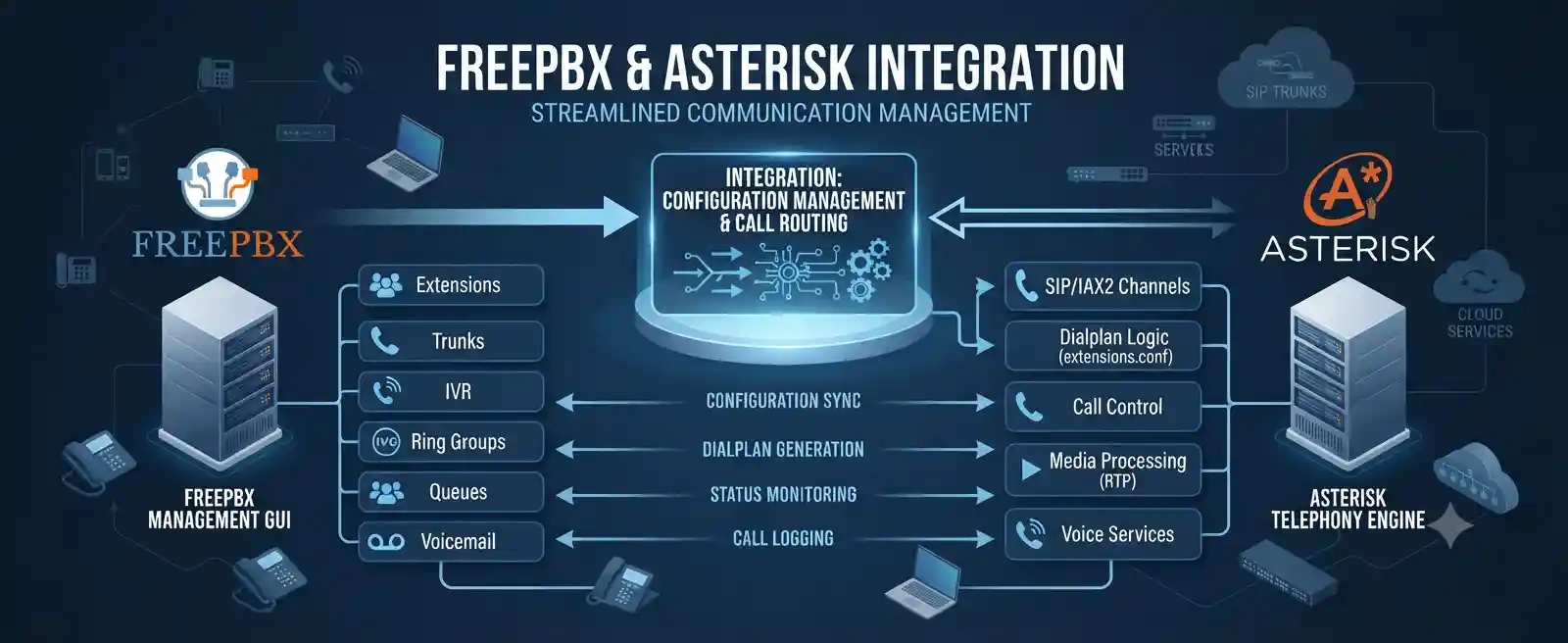
Controlled call routing and platform interoperability.
Versions, trunks, dial plan, network, security, and access.
Remote or on-site according to the confirmed technical scope.
Tested call flows, documented changes, and defined next actions.
What does FreePBX and Asterisk integration mean?
FreePBX is commonly used as a web-based management environment for an Asterisk-based phone system. In many deployments, FreePBX and Asterisk are therefore not two unrelated PBXs: FreePBX manages configuration while Asterisk performs the underlying call-processing work. However, a business may also have a separate Asterisk server that needs to exchange calls or services with a FreePBX-managed system. The phrase “FreePBX and Asterisk integration” can therefore describe either a managed Asterisk deployment or an interconnection between two distinct telephony environments.
FourTeck’s first task is to establish which architecture the customer actually has and what business result is required. That may involve extension-to-extension calling between systems, SIP trunk routing, number-range coordination, migration of selected call flows, queue or IVR continuity, controlled access to custom dial-plan logic, or troubleshooting after an upgrade or network change. Before work is confirmed, the customer should be ready to provide current versions, network details, existing call-flow information, administrative access through an approved secure method, and a maintenance window if changes could interrupt live calling.
Why businesses may need integration assistance
A telephony environment often grows in stages. One office may begin with a FreePBX server, while another site keeps a custom Asterisk deployment because it contains specialised routing, a legacy gateway, an application interface, or a dial-plan design that has not yet been migrated. Mergers, office relocations, provider changes, cloud projects, contact-centre expansion, and the need to preserve existing numbering can also create a requirement for controlled interconnection. In other cases, the “integration problem” is not a new project at all; it is a fault in an existing arrangement that previously worked and now shows failed registrations, one-way audio, rejected calls, inconsistent caller identification, or unexpected routing.
The same symptom can have more than one cause. A call that fails between two systems could relate to trunk authentication, address changes, SIP signalling, dial-plan matching, number formatting, codec agreement, access control, firewall policies, network address translation, DNS, time synchronisation, certificate handling, or routing logic. One-way audio can indicate a media-path problem rather than an extension problem. Calls that work internally but fail externally can point to a different technical layer than calls that never leave the originating PBX. For this reason, the service should begin with evidence, topology, and reproducible tests instead of immediate configuration changes.
The business impact can be wider than a failed extension. Inter-system calling may support reception, sales, service desks, warehouses, remote offices, or emergency contact processes. Incorrect routing can send callers to the wrong destination, create duplicated voicemail paths, break transfer behaviour, or make branch-to-branch communication unreliable. A rushed change can also affect working trunks that were not part of the original complaint. FourTeck therefore treats the integration as a change-managed telephony service with backup, authorisation, test calls, and rollback considerations where appropriate.
What the service may cover
Depending on the confirmed scope, assistance may include current-state discovery, FreePBX module and configuration review, Asterisk service and dial-plan review, SIP or other approved trunk assessment, extension and numbering analysis, inbound and outbound route review, caller-ID handling, codec and media checks, NAT and firewall coordination, voice VLAN review, gateway dependencies, call-log analysis, controlled configuration changes, test-plan preparation, migration planning, documentation, and post-change verification.
The exact work depends on how the systems were built. A FreePBX-managed Asterisk instance should not be treated exactly like a custom standalone Asterisk server because direct edits can interact with generated configuration. Likewise, a custom Asterisk environment may contain hand-written logic, scripts, database dependencies, APIs, or external applications that require separate assessment. FourTeck can help identify where management boundaries exist before deciding how changes should be applied.
Who may need this service
The service may suit organisations running more than one PBX, businesses inheriting an undocumented telephony setup, technical teams that need help connecting a custom Asterisk application to a FreePBX-managed environment, multi-branch companies consolidating call routes, offices changing SIP providers, and organisations preparing to migrate selected functions without replacing every component at once.
It can also help when calls between platforms are intermittent, when an upgrade has changed expected behaviour, when a firewall replacement has affected signalling or media, when numbers need to be normalised between different dial plans, or when management wants clearer documentation before allowing future telephony changes. Suitability is determined by the current architecture and required outcome, not by the platform names alone.
Common symptoms and planning triggers
Calls do not pass between systems
The next step is to identify whether signalling reaches the destination, whether the dialed pattern matches a route, and whether the receiving system accepts the call. Authentication, numbering, transport, firewall policy, or dial-plan logic may each need review.
One-way or missing audio
Successful signalling does not guarantee a healthy media path. RTP addressing, NAT, firewall rules, codec negotiation, VPN routing, or network segmentation can affect audio even when the call appears to connect.
Branch or server consolidation
A business may want to keep existing numbers and call flows while reducing duplicate infrastructure. Discovery is needed to identify dependencies before trunks, queues, IVRs, voicemail, gateways, or custom logic are moved.
Changes after an upgrade
Version changes can alter supported modules, configuration expectations, transports, or surrounding operating-system requirements. Existing customisations should be inventoried and tested rather than assumed to remain unchanged.
Service-fit matrix
| Business situation | Relevant assistance | What must be confirmed |
|---|---|---|
| A FreePBX system must exchange calls with a separate Asterisk server. | Topology review, trunk design, number patterns, routing, media and security checks, controlled testing. | Versions, addressing, transport, route ownership, firewall/NAT, authentication method, expected call flows. |
| An existing interconnection works intermittently. | Evidence capture, logs, call traces where authorised, route checks, media-path review, recent-change correlation. | Failure examples, timestamps, affected numbers, whether the problem is directional, network changes, provider events. |
| A custom Asterisk dial plan needs to coexist with FreePBX management. | Boundary review, safe customisation approach, change control, dependency documentation. | Existing custom files, generated configuration, scripts, databases, application dependencies, support ownership. |
| A business is planning a staged PBX migration. | Inventory, dependency mapping, pilot routes, maintenance-window plan, rollback, validation and handover. | Critical numbers, trunks, queues, integrations, gateways, user groups, downtime tolerance and backup readiness. |
| A firewall, ISP, or voice network change has disrupted calls. | Signalling and media-path review, address and NAT validation, rule coordination, network testing. | Old and new network design, public addressing, VPNs, VLANs, ports, provider details and security approvals. |
Service information
| Service topic | FreePBX and Asterisk integration, configuration, troubleshooting, migration planning, and support. |
|---|---|
| Main purpose | To make approved call flows and telephony services operate predictably across the relevant FreePBX/Asterisk architecture. |
| Typical systems involved | FreePBX, Asterisk, SIP trunks or internal inter-PBX trunks, IP phones, gateways, firewalls, switches, voice VLANs, VPNs, DNS, DHCP and provider services where applicable. |
| Remote support suitability | Often suitable for authorised configuration review, logs, route analysis, controlled testing and documentation when connectivity and secure access are available. |
| On-site support suitability | May be required for physical gateways, switches, cabling, phone testing, rack work, local network faults, site-only access or changes needing local coordination. |
| Customer access required | Environment dependent. Administrative and provider access may be needed through an approved secure process. Public-page submission of passwords is not recommended. |
| Testing and validation | Scope dependent. May include inbound, outbound, inter-system, transfer, caller-ID, DTMF, voicemail or queue test scenarios relevant to the approved change. |
| Documentation and handover | Can include topology notes, route ownership, change summary, test results, outstanding dependencies and recommended maintenance actions. |
| Service location | Dubai and UAE coordination, subject to scope, access, scheduling, site conditions and approved quotation. |
| Quotation requirement | Required to confirm the actual tasks, remote/on-site balance, dependencies, exclusions, schedule and commercial terms. |
Remote support or on-site support?
When remote assistance may be suitable
Remote work can be practical when the PBX servers are reachable through an authorised secure method, the network is functioning, and the main task concerns software configuration, routing, registrations, logs, dial-plan behaviour, call records, or server-side settings. A customer administrator or authorised contact may need to be available to confirm changes and place test calls from relevant extensions or numbers.
Remote access does not remove the need for controlled change. The current configuration may need to be backed up, active call handling may need to be considered, and a maintenance window may be advisable for changes that can affect production calling. If the fault cannot be reproduced remotely or depends on physical equipment, the next stage may move on site.
When an on-site visit may be appropriate
On-site assistance may be more useful when phones, analogue or digital gateways, switches, PoE, cabling, patching, racks, local network segmentation, or site-specific firewalls need physical inspection. It may also be required when the PBX is isolated from secure remote access, when several users report inconsistent behaviour, or when voice quality needs to be correlated with local network conditions.
The visit scope should define which systems can be changed, who will approve changes, whether building or rack access is available, and which test numbers or users can participate. Travel, access, engineer availability, site rules, equipment availability, and third-party coordination can affect scheduling.
How the assessment and integration process is normally structured
- Define the business outcome. Confirm whether the requirement is new inter-system calling, fault restoration, migration, route consolidation, provider change, queue continuity, custom application integration, or another specific result.
- Map the current environment. Identify FreePBX and Asterisk instances, versions, host locations, IP addressing, trunks, number ranges, gateways, firewalls, VPNs, voice VLANs, providers, and any connected applications that influence call handling.
- Collect evidence. Review failed call examples, timestamps, logs, route definitions, recent changes, network events, screenshots, configuration exports, and provider information as relevant. Evidence is used to isolate the failing layer rather than guess at a cause.
- Confirm access and change authority. Determine who can authorise PBX, firewall, provider, or network changes. Credentials should be exchanged only through the approved secure process after identity and permission are confirmed.
- Protect the working configuration. Review backup and rollback options before meaningful production changes. Custom files, generated configuration, certificates, trunks, routes, voicemail, and dependent databases may require different protection methods.
- Test the relevant layers. Depending on the issue, this can include registration, signalling, dial-plan match, number formatting, media, codec behaviour, DTMF, caller identification, NAT, VPN, firewall, DNS, provider routing, or endpoint behaviour.
- Design or approve the corrective change. Explain the proposed route, configuration boundary, security considerations, maintenance impact, dependencies, and expected validation steps before implementation.
- Implement in a controlled window. Apply only the agreed changes. Where possible, avoid modifying unrelated working routes and keep a path to restore the previous state if the approved change does not behave as expected.
- Validate with real call scenarios. Test the directions, number patterns, features and user groups that matter to the business, not only one demonstration call. Record unexpected behaviour and third-party dependencies.
- Document and hand over. Summarise what changed, how the systems interconnect, what remains dependent on providers or legacy components, and what should be monitored or reviewed next.
Capability focus 1: preserving clear configuration boundaries
One of the most important considerations is understanding where configuration should be managed. FreePBX provides a web-based management layer for an Asterisk-based system and can generate configuration from information stored and managed through its interface and modules. A separate Asterisk deployment may instead use hand-maintained configuration files, databases, scripts, or application-generated dial plans. Treating both environments as though they are administered in the same way can create maintainability problems.
During assessment, FourTeck can help document which settings belong in FreePBX, which custom Asterisk logic must remain outside generated sections, and which integrations are external dependencies. This matters when future staff need to understand why a route exists or when an upgrade regenerates managed configuration. A technically working change is not enough if it leaves the environment impossible to support later.
The practical outcome is clearer ownership of trunks, extensions, number transformations, inbound rules, outbound rules, and custom call logic. The exact method depends on the installed versions, modules, architecture and purpose of the integration. Any customisation that could be overwritten, conflict with generated settings, or depend on unsupported legacy behaviour should be identified before production changes are accepted.
Capability focus 2: making call routing predictable across two environments
Interconnecting PBXs introduces another routing boundary. Each side needs to know which numbers belong locally, which numbers should be sent to the other platform, what format should be used, and what should happen when a destination is unavailable. A branch may use four-digit extensions while another system expects a full number. An external caller ID may need to be preserved in one direction but transformed for a provider in another. Emergency, service, international, toll, or restricted destinations may require separate policy decisions.
A reliable design therefore starts with a numbering and call-flow map. It should identify source, destination, expected route, authentication or trust boundary, caller identification requirements, fallback behaviour, and any feature interactions such as transfer, voicemail, queue delivery, IVR selection, conferencing, or recording. Not every feature transfers transparently between systems; compatibility and business expectations must be tested for the actual architecture.
Predictable routing also depends on avoiding loops. When two PBXs can both route similar number patterns, an ambiguous rule can send a call back and forth or choose an unintended path. Route order and pattern specificity should therefore be reviewed carefully. FourTeck can assist with a test matrix that verifies important call directions after changes and records any features that remain platform-specific.
Capability focus 3: separating telephony faults from network faults
FreePBX and Asterisk depend on the network that carries signalling and voice media. A PBX configuration can be correct while calls still fail because a firewall blocks traffic, network address translation rewrites the wrong address, a VPN path is asymmetric, DNS resolves unexpectedly, a voice VLAN is misconfigured, a switch is congested, or an internet connection is unstable. The integration service therefore needs visibility beyond the PBX interface when symptoms suggest a network dependency.
This is particularly important for one-way audio, calls that drop after a consistent interval, intermittent registration, remote extensions, branch-to-branch trunks, hosted servers, or environments that recently changed firewall, ISP, public address, VPN, or router equipment. The diagnostic question becomes: does the call fail at signalling, policy, routing, media negotiation, packet transport, or endpoint behaviour? Logs and controlled network observations can help narrow the layer.
FourTeck’s wider business IT support approach is useful where telephony relies on network services, but the final scope still needs to identify which firewall, switch, VPN, ISP, or provider tasks are included. Changes to security policies should be authorised, minimal and documented rather than broadly weakening controls to make a call work.
Dependencies, access and customer inputs
The speed and accuracy of an integration assessment depend heavily on the information available. A customer does not need to know every technical answer before contacting FourTeck, but it helps to identify the people who do. For example, a telecom provider may control the external SIP trunk, an internal administrator may manage FreePBX, a developer may own custom Asterisk logic, and a network provider may manage the firewall. When no one has a complete picture, discovery must include stakeholder coordination before changes can be safely confirmed.
Administrative access may be required to inspect configurations or logs, but passwords should not be included in a public contact form or visible page content. Credentials and privileged access should be shared only through an agreed secure process after authority is confirmed. If a third party owns part of the environment, the customer may need to arrange permission or join a technical session.
Other dependencies can include provider account access, static public IP addresses, DNS records, certificates, server capacity, operating-system support, database availability, firewall rules, VPN reachability, telephony gateways, phone firmware, licence-dependent modules, recording storage, backup systems, and business applications integrated with Asterisk. The page does not assume that every dependency is present or supported; they are reviewed only when relevant to the actual environment.
Risk, limitations and exclusions to understand before changes
A telephony integration should not be described as risk-free. Configuration changes can interrupt calling if route logic, authentication, network policy, or generated configuration behaves differently from expectation. A maintenance window may be appropriate for production changes, and a rollback path should be considered when the existing state is known to work. Backup quality matters, but a backup is useful only if the relevant files, database content, certificates and configuration can actually be restored.
Some outcomes remain dependent on third parties. A SIP provider may reject a caller ID, restrict registration methods, require particular number formatting, or have its own incident. A cloud host, ISP, firewall provider, or vendor-controlled module may require separate support. Hardware faults in gateways, phones, storage, power supplies or network equipment can also fall outside a configuration-only scope and may require replacement or a separate quotation.
Legacy Asterisk code, unsupported operating systems, abandoned custom modules, undocumented scripts, and old security assumptions can limit the available options. A staged migration may be safer than attempting to preserve every historical customisation. Likewise, a successful test at one point in time does not eliminate the need for monitoring, backup, patch planning, access control and future maintenance.
Final commercial terms, included tasks, exclusions, scheduling, remote or on-site activity and any third-party coordination should be confirmed in the approved quotation or service agreement. Contact FourTeck to confirm the service scope rather than assuming all related PBX, network, firewall, endpoint, provider and cabling work is automatically included.
Business environments where the service can be relevant
Professional offices may need a connection between an established FreePBX deployment and an Asterisk service that supports a specialist application or legacy call flow. Multi-branch businesses may want internal calling between sites without replacing every PBX at once. Warehouses and logistics operations may need robust branch-to-head-office calling while retaining local analogue gateways, paging links or provider circuits. Hospitality, retail and service businesses can have reception, queue or IVR requirements that make call-flow testing especially important during migration.
Contact-centre teams can be sensitive to changes in queue delivery, agent destinations, transfers, recording, DTMF and caller identification. A configuration that allows simple extension calls may still be unsuitable if those workflows are not tested. Clinics, schools and training centres may have multiple departments, reception groups or scheduled operating periods where maintenance windows need coordination. Construction or project offices may use temporary links or mobile internet connections that change the network assumptions behind remote trunks.
The common factor is not industry but dependency. If the business relies on FreePBX, Asterisk, SIP providers, IP phones, gateways, network routes and user workflows that cross system boundaries, the integration should be assessed as one connected service. FourTeck can help map those dependencies and identify which parts require telephony, network, provider or on-site action.
Operational, security and maintenance considerations
A working interconnection should also be maintainable. Administrators need to know which trunk belongs to which purpose, which number ranges are routed across the connection, who can make changes, where backups are stored, and what must be tested after an upgrade. Without this information, future troubleshooting becomes slower because each engineer has to rediscover the architecture before identifying the fault.
Security should be designed around minimum necessary exposure. Telephony servers should not be made broadly reachable simply because signalling is failing. The correct solution may involve controlled firewall policy, VPN use, trusted addresses, strong authentication, transport choices, certificate management, intrusion controls, or provider-specific requirements. The appropriate design depends on whether the systems communicate locally, across branches, through a public provider, or from a hosted environment.
Maintenance should consider platform versions, operating systems, modules, custom code, provider changes, certificates, backups, storage, logs and security updates. Change windows and testing become more important when a business depends on a custom integration that crosses system boundaries. A simple record of current versions, key trunks, number ranges, provider contacts and test scenarios can significantly improve the next support event.
Before you contact FourTeck
Providing a concise picture of the environment helps the first discussion focus on the likely scope. You do not need to send confidential credentials in the initial request. Instead, prepare the following information where available:
- The Dubai or UAE service location and whether the systems are on site, hosted, or split across locations.
- Whether FreePBX and Asterisk are part of one server environment or two separate telephony systems.
- The installed FreePBX and Asterisk versions, plus operating-system information if known.
- The business outcome you need: new interconnection, fault restoration, migration, route change, provider change, or another objective.
- Examples of affected extensions, inbound numbers, outbound numbers or branch routes.
- Recent changes involving PBX updates, firewall replacement, ISP changes, public IP changes, VPNs, trunks, gateways or network equipment.
- Any visible error messages or timestamps for failed calls so logs can be correlated.
- The SIP provider or telecom provider involved, if external trunks are part of the issue.
- Whether a current backup or configuration export exists and when it was last verified.
- Whether administrative access can be made available through an approved secure method.
- The network and firewall contact if those systems are managed by another provider.
- Whether physical gateways, phones, switches or cabling may need inspection.
- A suitable maintenance window if production call routing could be affected by changes.
- The main business impact, such as missed external calls, branch communication failure, transfer problems or intermittent audio.
- The authorised contact who can approve testing, configuration changes and third-party coordination.
Service evaluation and quotation checklist
Before the engagement is finalised, the quotation or agreed scope should make the important boundaries visible. Useful confirmation points include:
How FourTeck can help define the work
FourTeck can begin by clarifying whether the request is an architecture project, a configuration task, a migration, or troubleshooting of an existing connection. That distinction affects the evidence required and the safest order of work. A fault investigation may begin with call examples and logs. A new interconnection may begin with numbering, route ownership and security boundaries. A migration may require a wider inventory of trunks, queues, voicemail, recordings, gateways, integrations and user workflows.
The role can include remote or on-site assessment, network and firewall coordination, SIP trunk review, FreePBX configuration analysis, Asterisk dial-plan review, test planning, vendor communication, documentation and administrator handover, depending on the approved scope. Where the request crosses into broader infrastructure, the FourTeck services overview provides context for connected network and IT support.
A quotation can then separate confirmed tasks from assumptions. For example, it can state whether firewall changes are included, whether an on-site visit is required, whether provider coordination is expected, and whether migration or post-change monitoring forms part of the work. This makes it easier for the customer to arrange access and internal approval before an engineer starts altering a live communication system.
Dubai and UAE service coordination
FreePBX and Asterisk work can often begin remotely when secure access, network connectivity and an authorised local contact are available. Remote assessment can be useful for reviewing configuration, logs, routes, registrations, recent changes and test results. An on-site visit may be recommended when physical gateways, phones, switches, cabling, racks, local firewall access, voice VLANs or network conditions must be inspected directly.
For businesses in Dubai and elsewhere in the UAE, service timing depends on the confirmed work scope, engineer availability, site access, customer approvals, maintenance windows, equipment availability and third-party providers. A project that requires telecom-provider changes, firewall-provider coordination or building access can have different scheduling dependencies from a configuration-only task.
Contact FourTeck to confirm remote and on-site options for the actual environment. Installation, configuration, migration, troubleshooting and maintenance tasks should be clearly identified in the quotation so the customer knows which systems and responsibilities are included.
Coordinating work across Dubai, Abu Dhabi, Sharjah and Ajman
Organisations with sites in Dubai, Abu Dhabi, Sharjah and Ajman may use different local networks, internet providers, firewalls, number ranges or PBX histories. A multi-site integration therefore benefits from one current-state map rather than assuming every branch follows the same design. Remote discovery can collect system versions, routes and call examples from each location, while planned on-site work may be arranged where physical inspection or local implementation is part of the confirmed scope.
Travel, building access, site rules, maintenance windows, equipment delivery and third-party provider availability can influence the service plan. A branch may also have a different business criticality: a reception desk, contact centre or warehouse may require different test coverage from a small administrative office. FourTeck can help organise those requirements into a staged plan, subject to assessment and approved quotation, without assuming permanent on-site coverage in every emirate.
Questions UAE businesses commonly ask before requesting FreePBX and Asterisk integration
The following decision guidance addresses the practical questions that often come before a support request. The answers are intentionally conditional because two installations with the same product names can have very different network, provider, version and customisation histories.
Can FreePBX connect to a separate Asterisk server?
Yes, separate telephony systems can often be interconnected when both environments support a compatible trunking and routing design, but the exact method depends on versions, security requirements, numbering, network reachability and the business call flow. FreePBX itself is already an Asterisk-based management environment, so the first question is whether the customer truly has two systems or simply needs help managing the Asterisk instance underneath FreePBX. If there are two systems, discovery should identify which side owns each extension range, how calls cross the boundary, and what happens when the other side is unavailable.
Why do calls connect but have no audio in one direction?
A connected call confirms that some signalling succeeded, but voice media normally follows its own network path. One-way audio can therefore involve NAT, firewall policy, media addressing, VPN routes, codec negotiation, endpoint behaviour, or network asymmetry. The useful information to collect is the exact direction that has no audio, whether the issue affects all destinations, whether external calls behave differently from branch calls, and whether any firewall, ISP, public-address or VPN changes occurred recently. A PBX-only change should not be assumed to fix a network media problem.
Can this integration be completed entirely remotely?
Many configuration and troubleshooting tasks can be performed remotely when the customer has stable internet connectivity, authorised secure access to both PBX systems, and someone available to place test calls or confirm user behaviour. Remote work can cover logs, routes, trunks, number patterns, registrations, configuration review and much of the validation process. On-site work becomes more likely when physical gateways, cabling, switch ports, phone provisioning, local firewalls, voice VLANs or rack access must be checked. The quotation should state which method applies rather than assuming all work can be done remotely.
What information is needed before a quotation can be prepared?
At minimum, the customer should describe the required outcome, how many PBX systems and sites are involved, whether the work is a new integration or a fault, and which users or numbers are affected. Version details, network diagrams, provider names, trunk information, recent changes, failure examples, custom Asterisk logic, backup status and maintenance-window constraints can make the scope more accurate. If some information is unknown, FourTeck can include discovery as part of the assessment rather than treating unknown assumptions as confirmed facts.
Should we integrate the systems or migrate everything to one PBX?
Integration and migration solve different business problems. Integration can be useful when both systems need to remain active, when a staged transition is preferred, or when a custom Asterisk application must stay in place. Migration may reduce long-term complexity if one platform can support the required workflows and the business is ready to move trunks, numbers, extensions, queues, voicemail, recordings, gateways and integrations. The correct choice depends on compatibility, supportability, downtime tolerance, custom code, provider constraints and the cost of maintaining two environments. An assessment should compare those trade-offs before a design is selected.
Will our existing extensions and phone numbers continue to work?
They may, but this should be confirmed through route and numbering analysis rather than promised in advance. Internal extension ranges can overlap between systems, external numbers may be controlled by a provider, and caller-ID or dialled-number formats may differ. Some call features also depend on how a trunk passes signalling information. A test plan should include the important number ranges, transfer scenarios and external routes that the business relies on. If renumbering or provider changes are required, those tasks should be treated as part of the project scope.
What if FreePBX was upgraded and our custom Asterisk logic stopped working?
The priority is to identify where the custom logic lives, how it is invoked, what changed during the upgrade, and whether the customisation depends on generated configuration, modules, deprecated behaviour, operating-system components or external scripts. Restoring a previous state may be possible in some environments, but it should not be assumed without checking backup quality and version dependencies. The longer-term choice may be to adapt the custom logic to a supported boundary, replace it with an available FreePBX feature, or keep it on a separate Asterisk service. Each option has different maintainability implications.
How do we know whether the problem is FreePBX, Asterisk, the firewall or the SIP provider?
Troubleshooting works best by following one failed call through the layers. The engineer can check whether the originating PBX selected the expected route, whether signalling left the system, whether the destination or provider responded, whether authentication or policy rejected the call, and whether media addresses were reachable after setup. Logs, timestamps and controlled test calls help narrow the layer. If the evidence points to a provider, ISP, firewall or hosting platform, that party may need to participate. The service scope should clarify who coordinates that escalation.
Do we need a maintenance window?
A maintenance window is advisable when proposed changes can affect active trunks, routing, firewall policy, service restarts, module updates, dial-plan generation, network addressing or other production call behaviour. Read-only assessment and evidence collection may not require downtime, but implementation should be scheduled according to the risk. The customer should identify critical calling periods and users who can perform acceptance tests. The final timing depends on the approved change plan and current environment.
Can we keep a custom Asterisk dial plan while using FreePBX?
Custom logic can sometimes coexist with FreePBX-managed configuration, but it needs a clear boundary so generated files and custom files do not overwrite or contradict each other. The appropriate approach depends on the version and how the custom dial plan was originally implemented. The objective should be maintainability: future administrators need to know which parts are safe to change through the GUI, which parts are custom, and what must be retested after upgrades. A design that works today but cannot survive a routine configuration reload is not a good long-term integration.
What should be tested after the integration?
Testing should reflect real business call flows. That can include extension-to-extension calls across the systems, inbound calls to important numbers, outbound calls to permitted destinations, transfers, caller identification, DTMF through IVRs, voicemail delivery, queue routing, ring groups, hold and resume behaviour, and failover paths where they are part of the design. Audio should be checked in both directions. If call recording, applications or gateways are in scope, they need their own validation. The final test list should be agreed from the actual features used by the organisation, not copied from a generic checklist.
What can make the integration scope larger than expected?
Undocumented custom code, overlapping extension ranges, old operating systems, inaccessible administrator accounts, missing backups, multiple SIP providers, legacy gateways, firewall changes, custom CRM or call-centre integrations, recording dependencies, unsupported modules, and different branch network designs can all expand discovery or remediation. The goal of initial assessment is to identify these dependencies before they become surprises during implementation. Where necessary, FourTeck can separate immediate restoration from a longer migration or cleanup project.
When should a Dubai or UAE business request on-site telephony support instead of remote help?
On-site work is more useful when the problem involves physical access or local conditions: a gateway is offline, switch ports need testing, phones lose PoE, cabling is suspect, a rack change is planned, voice VLAN behaviour must be checked at the site, or the PBX cannot be reached securely from outside. It may also be appropriate when a migration needs local user acceptance or several departments must be coordinated. For software-only routing problems with reliable access, remote assessment may be faster to begin. The final service method depends on the actual evidence and approved scope.
Testing, validation and handover
Validation should be designed before the main configuration change so the customer knows how success will be measured. A simple inter-system link may require only a small set of call tests, while a migration could require inbound, outbound, branch, transfer, queue, IVR, voicemail, DTMF, caller-ID, failover and recording checks. Where external providers are involved, tests should include the routes they control.
User acceptance matters because logs alone do not show whether the operational workflow is correct. Reception may need to confirm attended and blind transfer behaviour. A service desk may need to confirm queue delivery. A branch may need to confirm that short dialing reaches the intended extensions. Administrators may need to verify that new routes are understandable and that future changes can be made through the correct management boundary.
Handover can include a concise topology, trunk purpose, number ranges, route ownership, customisation notes, test results, provider dependencies, backup location and recommended maintenance actions. Documentation depth is scope dependent, but even a small integration benefits from a record of what changed and how to verify it later.
Related FourTeck IT services
FreePBX and Asterisk work can intersect with network, firewall, server and broader business IT responsibilities. For connected support requirements, review the FourTeck IT support home page and the business IT services directory. If you need background on the company’s service approach, visit About FourTeck IT Services. To discuss a defined integration, fault or migration requirement, use the technical support contact page.
Network support
Useful when voice traffic is affected by routing, VLANs, VPNs, switching, addressing, DNS, DHCP or site connectivity.
Firewall support
Relevant where SIP signalling or RTP media crosses security boundaries and changes need controlled policy review.
Office telephone support
For wider extension, handset, trunk, queue, voicemail, gateway and user call-flow issues around the PBX environment.
Managed IT support
For organisations that want ongoing coordination across users, devices, networks, servers and communication systems under an agreed service plan.
Why businesses contact FourTeck for integration assistance
A telephony fault can sit between several responsibilities. The PBX administrator may see a failed trunk while the firewall provider sees normal internet traffic. The SIP provider may report no platform incident while users continue to experience one-way audio. A custom Asterisk application may work internally but fail only when calls arrive through a FreePBX route. These cases benefit from a service process that treats users, PBXs, networks, providers and physical infrastructure as connected layers.
FourTeck’s role is to clarify the reported business problem, collect evidence, identify the affected technical layer, define remote or on-site work, coordinate approved changes, and document the result. The company does not need to claim that every issue will be resolved in one visit or that every third-party dependency is under its control. What matters is having a structured assessment and a clear next action when the evidence points outside the original scope.
For planned integration, the same approach reduces avoidable change risk. Topology, numbering, provider requirements, security, maintenance windows, backups and acceptance tests can be addressed before production routing is modified. This gives decision-makers a practical basis for approving the work and understanding what remains dependent on vendors, legacy systems or future maintenance.
Frequently asked questions
Is FreePBX separate from Asterisk?
FreePBX is a web-based management environment commonly used with Asterisk. A customer can also operate a separate standalone Asterisk server, so assessment must confirm whether the request concerns one managed system or two interconnected systems.
Can FourTeck troubleshoot failed inter-PBX calls?
Depending on access and scope, assistance may include route review, logs, registration, signalling, numbering, firewall/NAT, media-path checks, provider coordination and controlled test calls. The root cause should be based on evidence.
Will the service require downtime?
Read-only assessment may not interrupt service, but route changes, restarts, upgrades, firewall changes or migration work can justify a maintenance window. Timing is environment and scope dependent.
Can you work with a custom Asterisk dial plan?
Custom logic can be assessed, but supportability depends on how it was built, which files or databases it uses, its version dependencies and how it interacts with FreePBX-generated configuration.
Do we need to provide passwords before assessment?
Do not send passwords through public page content. FourTeck can first confirm the scope and authorised contacts, then arrange privileged access through an approved secure method when required.
Can a firewall change break a working PBX connection?
Yes. Signalling and media can depend on address translation, routing, VPNs and security rules. If a firewall or public address recently changed, that information is valuable during diagnosis.
Can this be part of a staged migration?
Yes, when technically suitable. A staged plan may interconnect platforms while selected users, trunks or call flows move over time. Dependency mapping, rollback and acceptance testing should be included in the migration plan.
What happens if the issue belongs to the SIP provider?
FourTeck can help collect evidence and coordinate within the confirmed scope, but provider-side changes and incidents remain dependent on that third party’s systems, access and support process.
Is documentation included?
Documentation can be included when defined in the quotation. Useful outputs may include topology, trunk purpose, number ranges, change notes, test results, remaining dependencies and maintenance recommendations.
Do you support Dubai and other UAE locations?
FourTeck coordinates service in Dubai and across the UAE. Remote or on-site assistance depends on the issue, access, location, scheduling, site conditions and approved quotation.
Plan the next step for your FreePBX and Asterisk environment
If you are connecting two telephony systems, restoring a failed route, preparing a migration, or reviewing an undocumented deployment, start by sharing the current architecture, business objective, affected numbers, recent changes and preferred service method. FourTeck can use that information to determine what should be assessed remotely, what may require on-site work, which third parties need to participate, and what should be included in the quotation.
Do not send administrative passwords in a public enquiry. Confirm the authorised contact, service location, maintenance constraints and available backup information first. Access can then be arranged through the appropriate secure process if the assessment requires it.