
Business telephony integration and migration support
Avaya IP Office and Panasonic PBX Integration in Dubai, UAE
When an organisation has Avaya IP Office in one part of the business and a Panasonic PBX in another, the challenge is not simply to make one system call the other. A useful integration must respect numbering, call routing, licensing, media handling, security, user workflows, failure behaviour and the limits of each platform. FourTeck helps businesses assess the existing environment, define the required call paths and plan controlled interconnection work without assuming that every feature will pass transparently between different PBX families.
What should be confirmed first?
- Exact Avaya IP Office platform and software release
- Exact Panasonic PBX family, cards, licenses and software
- Required extension-to-extension and external call flows
- Available SIP, digital or gateway interfaces
- Network path, IP addressing, security and maintenance window
Controlled PBX-to-PBX call routing
Assess before changing live telephony
Remote or on-site, scope dependent
Tested routes, findings and documentation
Direct answer: what does this integration service do?
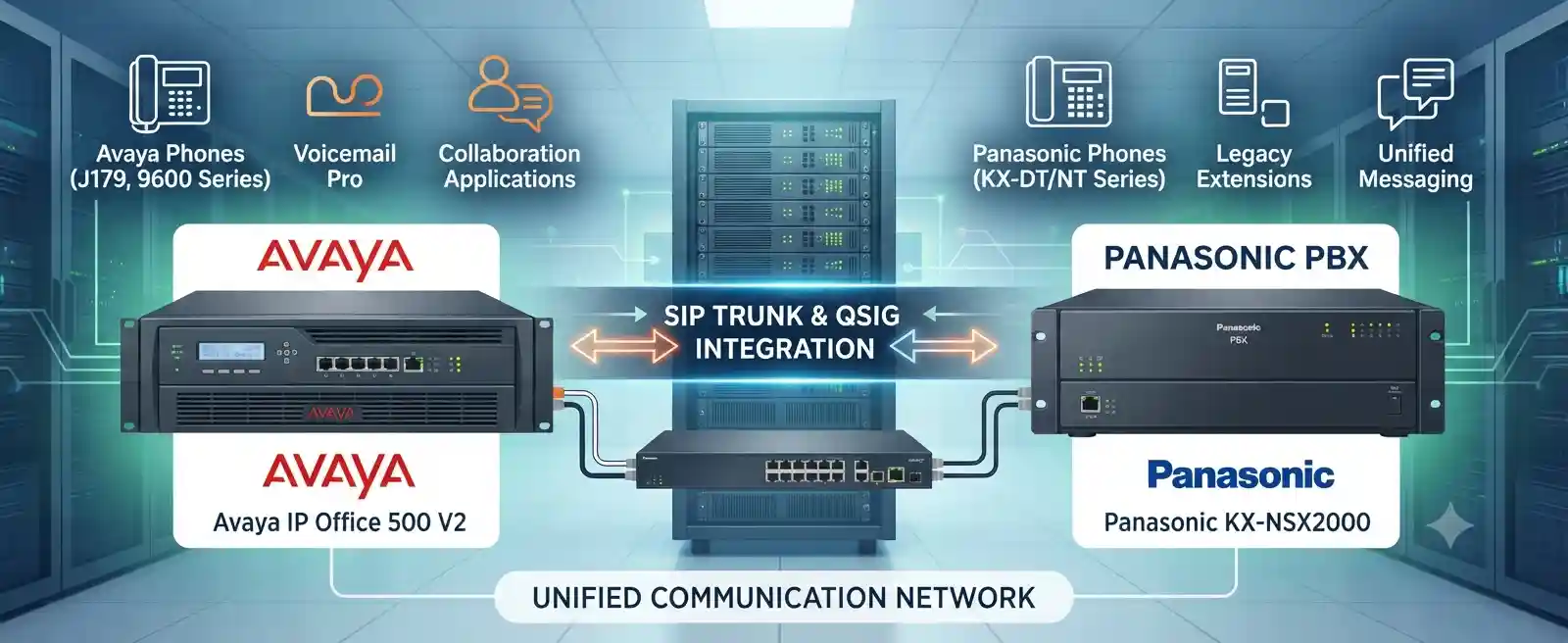
Avaya IP Office and Panasonic PBX integration is the controlled connection of two business phone-system environments so approved calls can pass between them or so users can be migrated in stages. Depending on the systems, available interfaces and confirmed requirements, the design may use SIP trunking or another supported interconnection method. Businesses should consider the service when they are merging sites, keeping a legacy PBX during a transition, standardising extension dialing, consolidating external trunks or reducing manual call forwarding between systems. Before work is confirmed, provide the exact platform models, software levels, licenses, current extension ranges, required call flows, network details, available interfaces, maintenance constraints and access arrangements. Feature behaviour must be tested because interoperability between different vendors can vary by version and configuration.
What the service can cover
The service is centred on understanding the two live telephony environments and defining a safe, supportable interconnection. Depending on the confirmed scope, FourTeck may review PBX configuration, software versions, licenses, trunk resources, extension numbering, short codes, incoming call routes, hunt groups, network settings, codec requirements, gateway interfaces, firewall rules, quality-of-service settings and existing telecom-provider connections.
Assistance may also include change planning, backup of available configurations, creation of the inter-PBX route, dial-plan translation, call testing, transfer and caller-ID checks, fault isolation, migration sequencing, rollback planning, user acceptance support and documentation. Not every activity is required in every environment, and some systems may need vendor-specific licenses, cards, gateway hardware or provider input before a proposed design is practical.
Who may need this service
This type of work may suit a business that has inherited different PBX platforms after a merger, operates separate systems at different branches, wants to move users from Panasonic to Avaya or from Avaya to Panasonic in phases, or needs a temporary bridge while a larger telephony decision is pending. It can also be relevant when departments need internal calling between systems without relying on public numbers for every conversation.
The service may be useful for offices, hotels, clinics, warehouses, schools, professional firms, property-management operations and multi-site businesses where telephony continuity matters during change. The exact design should follow the organisation’s operational requirements rather than a generic PBX template.
Common reasons businesses ask for Avaya and Panasonic PBX integration
Phased system migration
A company may want to move users gradually rather than replace every handset, extension and workflow during one maintenance window. Interconnection can allow controlled coexistence while migration steps are tested.
Branch or department connectivity
Different sites may run different PBX families but still need predictable internal dialing, transferred calls and clear routing rules between teams.
Merger or acquired infrastructure
An acquired business may already have a functioning Panasonic system while the parent organisation uses Avaya IP Office. Integration can provide time to plan consolidation without an immediate rip-and-replace decision.
Legacy service dependency
Certain extensions, analogue devices, door phones, fax services or established call flows may remain tied to one PBX. A bridge may be considered while those dependencies are reviewed.
Dial-plan standardisation
Duplicate or inconsistent extension ranges can make cross-system calling confusing. Integration planning can include prefixes, translation rules and a future numbering structure.
Repeated manual call forwarding
If staff use public numbers or reception teams manually transfer calls between independent systems, a managed interconnection may reduce unnecessary routing steps, subject to feature compatibility.
What can happen if two PBX environments remain disconnected?
Separate systems are not automatically a problem. Some organisations deliberately keep them independent. The difficulty appears when business workflows assume that users, reception teams or branches can communicate as one telephone environment. Staff may then rely on public calls for internal conversations, callers may be transferred manually through reception, extension lists may become confusing, voicemail and hunt-group responsibilities may be unclear, and troubleshooting can involve multiple vendors without a shared view of the route.
An integration project should therefore begin with the business requirement, not with a cable or configuration screen. The objective may be simple inter-extension calling, selected route sharing, a migration bridge, or a more structured multi-site telephony plan. Each objective has different dependencies and risks. A carefully limited integration can be more maintainable than attempting to reproduce every proprietary feature across two unrelated PBX platforms.
Technical layers that should be reviewed before the systems are connected
A PBX-to-PBX link sits inside a wider environment. The same failed call can be caused by routing, numbering, licensing, signaling, media, network reachability, firewall behaviour or an unsupported feature combination. A structured assessment reduces the risk of treating one symptom as proof of one cause.
PBX platform and release
Identify the exact Avaya IP Office platform, Panasonic family, software releases, installed cards and any platform restrictions relevant to trunking or feature support.
Licensing and channel capacity
Confirm whether the required SIP sessions, voice-compression resources, gateway ports or other licensed channels exist for the expected concurrent call volume.
Numbering and routing
Map extension ranges, access codes, incoming routes, outgoing routes, emergency and external-call behaviour, and any overlap that requires translation.
Signaling interoperability
Review how each side expects SIP headers, domains, transport, caller identity, transfers and supplementary services to behave. Standards support does not guarantee identical vendor implementation.
Media and codecs
Confirm compatible codecs, RTP paths, compression resources, packet handling and any transcoding requirement. Voice should be tested in both directions, not assumed from signaling success.
Network and security
Check IP reachability, VLANs, routing, firewall policy, NAT where relevant, quality of service and whether an SBC or gateway is appropriate for the chosen architecture.
Possible service scope
Depending on the confirmed scope, FourTeck assistance may include the following activities. The list describes possible work rather than an automatic inclusion in every engagement.
System models, releases, licenses, trunk resources, extension plans, network details and business requirements.
Existing lines, call routes, short codes, numbering, gateways, interface settings and relevant telephony options.
Selection of an appropriate supported route, addressing, route ownership, channel requirements and change sequence.
Approved trunk, route, translation, network or gateway changes with backup and rollback considerations where available.
Internal calls, selected external paths, CLI, DTMF, transfers, hold, audio direction, fail cases and user acceptance as applicable.
Recorded routes, known limitations, dependencies, support ownership and recommended next actions.
Service-fit matrix
| Business situation | Relevant assistance | What must be confirmed |
|---|---|---|
| Users on both systems need internal extension dialing | Dial-plan mapping and inter-PBX route design | Non-conflicting number ranges, route method, licenses and call permissions |
| A phased migration is planned | Coexistence design, migration sequencing and rollback planning | User groups, dependencies, maintenance windows and target-state plan |
| Calls connect but audio is one-way or absent | Media-path, codec, RTP, firewall and network review | Network topology, packet path, configured codecs and any NAT or SBC involvement |
| Transfers or caller ID behave inconsistently | SIP-header, transfer-method and route testing | Exact software versions and which feature behaviour is business-critical |
| A legacy Panasonic PBX must remain during an Avaya rollout | Temporary or staged interconnection assessment | Available legacy interfaces, gateway need, support status and planned retirement date |
| Two sites use different PBXs | Inter-site routing and network dependency review | WAN/VPN design, latency, security, call capacity and failure behaviour |
Service information at a glance
| Main purpose | Controlled call routing or staged migration between Avaya IP Office and a compatible Panasonic PBX environment. |
|---|---|
| Typical systems involved | Avaya IP Office, Panasonic PBX, IP network, switches, firewall, gateways where required, provider trunks and connected handsets or applications. |
| Assessment method | Configuration review, inventory, network review, route mapping, stakeholder requirements and controlled testing. |
| Remote support suitability | Suitable for many configuration, log and test activities when secure authorised access and a stable network are available. |
| On-site support suitability | May be needed for hardware interfaces, gateways, cabling, rack access, physical tracing, network checks or inaccessible systems. |
| Customer access required | Authorised administrative access, configuration exports where available, network information and relevant site access. Credentials should be shared only through an approved secure method. |
| Testing and validation | Scope dependent; may include internal calls, external paths, caller identity, audio, DTMF, hold, transfer, routing failures and user acceptance. |
| Security considerations | Firewall policy, trusted network paths, SIP exposure, access control, change authorisation and optional SBC/gateway architecture where appropriate. |
| Scheduling dependency | Maintenance window, engineer availability, site access, user testing, provider/vendor dependencies and approved quotation. |
| Important note | Feature parity is environment dependent. A working basic call does not prove that every transfer, identity, voicemail, diversion or proprietary function will operate identically across both platforms. |
Remote assessment or on-site telephony work?
Remote assistance may be suitable when
Both PBX systems are reachable through an authorised support path, the issue is primarily configuration-related, and a customer contact is available to place test calls or confirm user behaviour. Remote work can be useful for inventory collection, configuration review, call-route analysis, license checks, dial-plan planning, controlled changes, log review and post-change testing.
Remote access does not remove the need for change control. The maintenance window, affected users, backup availability and rollback path should still be agreed before altering a live telephony system.
An on-site visit may be appropriate when
The interconnection depends on physical trunk cards, analogue or digital gateways, patching, rack equipment, network ports, cabling or hardware that cannot be identified remotely. On-site work can also help where documentation is incomplete and the actual physical path needs to be traced before changes are made.
Location, building access, maintenance restrictions, equipment availability and the agreed scope affect scheduling. FourTeck can recommend a remote-first, on-site or mixed approach after reviewing the environment.
How the assessment and integration process can be organised
Define the business outcome
Confirm whether the goal is internal extension dialing, branch connectivity, a migration bridge, shared external routing, simplified reception handling or another clearly described call-flow requirement.
Inventory both systems
Record the Avaya platform, Panasonic platform, software releases, hardware interfaces, licenses, connected trunks, extension ranges, critical groups and any dependent analogue devices.
Map the current call flows
Document how inbound, outbound and internal calls work today. Identify prefixes, route selection, hunt groups, reception flows, direct-dial numbers and any services that must not be disrupted.
Review compatibility and prerequisites
Check whether the required interfaces, licenses, channel resources, IP connectivity and supported configuration options are present. If a gateway or additional resource is required, include that dependency in the plan rather than assuming it exists.
Prepare backup, change and rollback steps
Where the platforms allow it, preserve current settings and identify how the previous state can be restored. Agree who authorises the change and when user impact is acceptable.
Configure the approved interconnection
Apply only the agreed trunk, route, dial-plan, network or gateway changes. The exact settings vary by system family and design, so configuration should follow the identified environment rather than a generic recipe.
Test signaling, media and user workflows
Verify calls in both directions and test the features that matter to the business. A successful ring is only one part of validation; audio, DTMF, transfers, caller identity, forwarding and failure handling may also require checks.
Document the working design and known limits
Record route ownership, prefixes, addresses, relevant dependencies, support contacts, test results, remaining risks and any features that require separate treatment or future migration work.
Dial-plan design: make cross-system calling understandable
Numbering is often the first operational challenge. If both systems use the same extension range, a user dialing 201 may be local on one PBX but remote on the other. The design may need a prefix, translated digits or a new numbering plan. The right choice depends on migration goals, user habits, external direct-dial numbers and future architecture.
FourTeck can help map current ranges and identify collisions before a route is introduced. The objective is a plan that users can understand and administrators can troubleshoot. A short-term prefix may be acceptable during migration, while a long-term multi-site design may justify a cleaner standardised range. Any change that affects published numbers, emergency arrangements or provider routing should be handled carefully and confirmed in scope.
Feature interoperability: test what the business actually uses
SIP provides a common framework for call signaling, but different PBX vendors can implement optional features and headers differently. Basic voice calls may work while attended transfers, blind transfers, caller-name display, diversion information, hold behaviour or voicemail interactions require additional testing or have limitations.
The service therefore focuses on agreed user workflows rather than a promise of complete feature parity. Before the change, identify which functions are essential to receptionists, contact teams, managers and branch users. After configuration, test those functions explicitly. If a feature cannot be reproduced reliably between the platforms, the decision may be to accept the limitation temporarily, modify the workflow, use a different integration method or accelerate migration of the affected users.
Voice quality and network path: a connected call still needs good media
A SIP session can establish successfully while the audio path remains poor. Voice media depends on compatible codecs, available processing resources, IP routing, firewall handling, packet loss, latency, jitter and quality-of-service treatment. One-way audio often points to a different layer from a failed call setup.
Where the PBXs are at different sites, the WAN or VPN path becomes part of the telephony design. Capacity should be considered alongside normal data traffic, and the failure behaviour should be understood if the inter-site link is unavailable. FourTeck can review the network context as part of the integration scope rather than treating the PBX configuration as an isolated task.
Security and change-control considerations
Connecting two voice systems creates a new trust relationship. The route should be limited to the required systems and networks, and unnecessary SIP exposure should be avoided. Where traffic crosses security boundaries, firewalls, VPNs, session border controllers or gateways may be relevant depending on the design. Access should be authorised, administrative accounts controlled, and configuration work scheduled so the business knows when calls could be affected.
A maintenance window is especially important when a change restarts a trunk, modifies a live route or affects an interface carrying active calls. The organisation should know which users and numbers are in scope, who approves the change, what constitutes a successful test and when rollback should be considered. Where configuration backups or exports are available, they should be captured before significant changes. Unsupported legacy hardware may have limited backup, encryption or security options, which should be documented rather than hidden.
Security improvement reduces risk but does not make a telephony environment immune to faults or misuse. Ongoing review of access, exposed services, provider connectivity, software support and network controls remains important after integration.
Testing, validation and handover
Testing should follow a written call-flow list that reflects the real business. The exact test set varies, but a useful plan may cover the following areas:
Avaya-to-Panasonic and Panasonic-to-Avaya calls using agreed extension patterns.
Two-way speech, acceptable quality and correct media behaviour across the network path.
Expected number or name presentation where the platforms and route support it.
Digits used with IVR, voicemail or automated services where these workflows cross the link.
Business-critical transfer methods and hold/retrieve behaviour, tested rather than assumed.
What users hear or experience if the route, remote PBX or network path is unavailable.
Handover should explain what changed, which numbers use the link, which features were validated, any limitations discovered, and who owns each dependency. If the integration is temporary for migration, the documentation should also record the target retirement or next migration stage so the bridge does not become an undocumented permanent dependency.
Capability focus 1: faster fault isolation across two vendors
When a call fails between two different PBXs, each side can appear healthy by itself. The useful question is where the call stops. Does the originating PBX select the correct route? Does signaling reach the far system? Does the destination match a valid incoming route? Are both sides using compatible transport and addressing? Does the call establish but media fail? Are transfers failing only after the basic call succeeds?
A structured test sequence helps separate routing, signaling, media, network and feature-level problems. This reduces unproductive changes on the wrong system and gives vendor or provider support teams better evidence when escalation is required. FourTeck’s role can include collecting the relevant information, reproducing the fault in a controlled way, identifying which technical layer needs attention and documenting the outcome. Resolution remains dependent on access, platform support, configuration and any third-party action.
Capability focus 2: safer phased migration instead of uncontrolled coexistence
A temporary interconnection can support a migration when not all users can move at once. The important part is to define which groups remain on the source system, which move to the target system, how calls cross during each phase and how the organisation will eventually remove the bridge. Without that plan, temporary routing rules can accumulate until no one is sure which PBX owns a number.
FourTeck can help create a migration map that identifies user groups, shared numbers, receptionist workflows, analogue dependencies, external DDI/DID ownership, voicemail considerations and the sequence of route changes. Pilot users may be moved first where appropriate, followed by controlled batches. Each stage can have clear acceptance checks and a rollback decision point. Downtime expectations remain scope dependent because the platforms, provider trunks and network design vary.
The value of integration in this context is not that two systems remain connected forever. It is that the business can change in managed stages with a documented path toward the chosen target state.
Capability focus 3: clearer ownership of routes, numbers and dependencies
Cross-platform telephony often becomes difficult to support when the technical route is undocumented. A user reports that “extension 310 cannot call 420,” but the support team may not know which PBX owns each extension, whether a prefix translation exists, whether a gateway is involved, or whether the call crosses a WAN link. Good documentation turns that uncertainty into a traceable path.
A useful handover record can show extension ranges, dial prefixes, trunk or gateway names, network addresses, call direction, critical routing rules, tested features, known limitations and provider dependencies. It should avoid recording passwords in normal public or shared documentation. Administrative credentials should follow the customer’s secure access process.
Clear ownership also helps future change. When a branch closes, a user group migrates or a provider trunk changes, the team can identify which cross-system routes must be adjusted instead of discovering dependencies during an outage.
Dependencies, access and customer inputs
The integration cannot be scoped from the two brand names alone. A Panasonic KX-NS or KX-NSX environment, for example, has different capabilities and installed options from an older Panasonic PBX, while Avaya IP Office deployments also differ by platform, release, license and hardware. The exact configuration determines what can be connected directly and what may need an intermediary gateway or a different migration approach.
Useful customer inputs include platform model names, software versions, license information, available configuration exports, extension ranges, direct-dial number lists, hunt groups, provider details, network diagrams, IP addresses, VLAN information, firewall ownership, WAN/VPN details, maintenance windows and a named business contact who can approve test calls. If recent changes triggered the requirement, include when they occurred and what changed.
Administrative access should be authorised by the customer. Do not send passwords through an unsecured public message or place them in the project page. FourTeck can confirm the approved secure method for credential exchange after identity, scope and authorisation are established.
Risk, limitation and exclusion guidance
- Interoperability depends on the exact Avaya and Panasonic platforms, software releases, licenses, installed interfaces and network design.
- SIP compatibility does not guarantee that every proprietary feature, transfer type, presence state, voicemail function or caller-display behaviour will pass identically between vendors.
- Legacy or unsupported equipment may have limited integration, security, backup or vendor-escalation options.
- Hardware cards, gateways, licenses, provider changes or replacement equipment may fall outside labour scope and require separate quotation.
- Configuration changes can interrupt active calls, so an approved maintenance window and rollback consideration may be required.
- Call quality depends on the network path as well as the PBX configuration. WAN congestion, packet loss, firewall handling and codec mismatch can affect media.
- Some issues may require action from a telecom provider, original vendor, building network team or another third party.
- A successful test confirms the scenarios tested at that time; it does not remove the need for ongoing monitoring, maintenance and documentation.
- Final service scope, timing and commercial terms depend on assessment and the approved quotation.
Business environments where this work may be useful
Multi-branch offices
One branch may use Panasonic while a headquarters or newer branch uses Avaya IP Office. Cross-site calling can be assessed alongside the WAN, VPN and number plan.
Hotels and hospitality operations
Legacy room, back-office or service extensions may remain tied to one system while administrative teams move to another. Integration scope should consider operational dependencies before migration.
Clinics and professional practices
Reception, appointment, administration and management users may rely on stable call routing. Changes can be planned around business hours and critical inbound numbers.
Warehouses and logistics sites
Operations may span offices, gates, security points and dispatch areas. A mixed PBX environment can require careful mapping of extensions and physical device dependencies.
Schools and training centres
Different buildings or acquired campuses can have different telephony systems. Interconnection should be evaluated with site network paths and administrative call flows.
Growing organisations
A company may need time to choose a future telephony standard. A limited bridge can support continuity while licensing, handset, contact-centre or cloud options are evaluated.
Operational and maintenance considerations after integration
Once the link is active, both PBXs still need normal maintenance. Software support status, configuration backups, license availability, network health and provider services remain separate responsibilities unless explicitly included in an agreed maintenance plan. The interconnection should be reviewed whenever a major PBX upgrade, network redesign, firewall replacement, numbering change or provider migration is planned.
Monitoring can also be simpler when administrators know which symptoms belong to which layer. If only cross-PBX calls fail while local calls on both systems continue to work, the interconnection path becomes a priority. If all calls on one PBX fail, the problem may be local to that platform or its provider trunks. If calls connect but audio is poor across sites, network conditions may deserve more attention than dial-plan configuration.
Maintenance should include review of documentation. Temporary prefixes, test routes and migration rules should not remain indefinitely without an owner. Removing obsolete configuration can make future troubleshooting safer and reduce uncertainty.
Before you contact FourTeck
Preparing a few details can make the initial assessment more useful. Exact information is better than assumptions, but it is acceptable to state when a detail is unknown.
- Business location and the sites involved
- Main technical and business contact
- Exact Avaya IP Office platform or server type
- Avaya software release and available license information
- Exact Panasonic PBX family and model
- Panasonic software version, cards and licenses where known
- Current extension ranges on both systems
- Required call flows and any numbers that must remain unchanged
- Whether the systems are on the same LAN or different sites
- Network, VLAN, firewall or VPN ownership
- Recent telephony or network changes
- Available configuration backups or exports
- Preferred maintenance window and business impact
- Whether remote access is authorised or an on-site visit is preferred
- Provider or vendor contacts if third-party trunks are involved
- The expected end state: permanent coexistence, temporary bridge or migration
Service evaluation checklist for quotation and planning
How FourTeck can help define the integration and quotation
FourTeck can begin by clarifying the reported requirement and identifying the technical systems that influence it. This may involve reviewing the current PBX configurations, extension plans, licenses, network path, provider trunks, gateways and business call flows. The objective is to understand what needs to communicate, what must remain unchanged and which technical dependencies could affect the design.
After discovery, FourTeck can outline the proposed assistance, including remote review, on-site inspection, configuration work, gateway or interface requirements, testing, documentation and any vendor coordination. Where a phased migration is involved, the scope can distinguish the temporary coexistence work from the later user or trunk migration stages.
The quotation should make the approved work clear. Timing depends on engineer availability, customer access, maintenance windows, site conditions, equipment and license availability, and third-party providers. Contact FourTeck to confirm the service scope and scheduling options for the actual environment.
Dubai and UAE service coordination
For businesses in Dubai and across the UAE, telephony integration may combine remote configuration work with planned on-site assistance. A remote assessment can be efficient when both PBXs are reachable securely and the required information is available. Physical work may be needed where the project involves trunk cards, gateways, rack equipment, cabling, local switch ports or systems that cannot be accessed remotely.
The service plan should account for building access, the location of the two PBXs, the availability of local contacts, maintenance windows, travel, vendor dependencies and any equipment that must be installed before testing. Installation, configuration, migration and maintenance tasks should be clearly included in the quotation rather than assumed.
Coordinating service in Dubai, Abu Dhabi, Sharjah and Ajman
FourTeck can discuss remote troubleshooting, planned on-site assessment, configuration, migration assistance and project support for organisations operating in Dubai, Abu Dhabi, Sharjah and Ajman. The same project can involve more than one emirate when the PBXs are in different branches or when a central Avaya environment must communicate with a Panasonic system at another site.
Scheduling and the final service plan depend on the confirmed scope, travel, building access, site conditions, maintenance restrictions, network availability, equipment or licensing dependencies and any provider or vendor action. The most efficient approach may be remote-first discovery followed by a targeted site visit, or a coordinated multi-site change when physical work is required.
Related FourTeck IT services
Business IT ServicesExplore broader installation, configuration, migration, network, server and support assistance relevant to a telephony project.
FourTeck Service ApproachUnderstand how FourTeck frames business technology support and infrastructure assistance across the UAE.
Request a Telephony AssessmentShare the PBX models, required call flows, site details and migration or support objective so the scope can be reviewed.
Why businesses contact FourTeck for mixed telephony environments
Mixed PBX projects usually cross more than one technical boundary. A call route may depend on both phone systems, an IP network, a firewall, a WAN, provider trunks, gateways and user workflows. FourTeck can help bring those dependencies into one assessment so the organisation has a clearer technical view before changes are made.
The practical value is in structured discovery, controlled change planning, remote and on-site coordination, business-focused testing, vendor or provider communication where needed, and clear documentation of what was changed. This is particularly useful when the existing environment has evolved over many years and no single administrator has a complete picture of the current routes.
FourTeck does not need to assume that a full integration is always the right answer. Assessment may show that a limited route, a gateway, a different migration sequence or a planned replacement is more maintainable. The final recommendation should reflect the current environment, business priorities and confirmed technical constraints.
Questions businesses often ask before choosing an Avaya–Panasonic integration approach
Can Avaya IP Office and a Panasonic PBX be connected directly?
They may be connectable through SIP or another suitable interface, but a direct connection should not be assumed from the brand names alone. The exact answer depends on the Avaya IP Office release and licenses, the Panasonic PBX family and installed options, the available network or physical interfaces, and the feature set that the business expects to use. Current Avaya IP Office documentation includes SIP trunk capability, and Panasonic publishes SIP-trunk guidance for several KX-NS and KX-NSX platforms. That establishes useful technical building blocks, but it does not prove that every Avaya–Panasonic combination has full feature interoperability.
The practical next step is to provide the exact models and software versions. FourTeck can then assess whether a direct IP route is appropriate or whether a gateway, different interface or migration-focused design should be considered.
Is SIP trunking always the best method for connecting the two systems?
No. SIP is often attractive because it can carry calls over the IP network and both vendor families have SIP-related capabilities in supported configurations. However, an older Panasonic deployment may have different interfaces, licenses or limitations. A legacy environment may already use digital or analogue resources that affect the practical design. The network path may also be unsuitable for a new real-time voice dependency without changes.
A good assessment compares the available interfaces, required call volume, feature expectations, supportability and future migration plan. The cheapest-looking short-term connection can become expensive to maintain if it creates undocumented gateways or fragile routing. Conversely, replacing hardware only to achieve a temporary bridge may not be justified if a simple supported route can meet the business need.
Can users keep their existing extension numbers?
Sometimes, but extension-number retention depends on whether the ranges overlap and which PBX owns each number during coexistence. If Avaya and Panasonic both use extensions in the same range, the systems need a way to distinguish local and remote destinations. This may involve prefixes, digit translation, staged renumbering or a new target plan.
Before migration, identify the numbers that are operationally important: reception, finance, security, management, service desks, meeting rooms and published direct-dial numbers. The plan can then preserve critical workflows while avoiding ambiguous routing. A temporary prefix may be acceptable during a short migration; long-term coexistence may justify a more structured numbering design.
Will call transfer, caller ID and voicemail work across both systems?
These features must be tested in the actual environment. Basic call setup can succeed even when supplementary functions behave differently. Caller identity depends on the signaling information each PBX sends and accepts. Transfer behaviour can depend on SIP methods and the configuration on both sides. Voicemail, message waiting, presence and proprietary phone features may remain local to their original platforms or require separate integration.
The useful approach is to list the workflows the business genuinely needs. Receptionists may need attended transfer and correct caller number. A warehouse may care mainly about extension-to-extension voice calls. A migration project may accept temporary limitations that would be unacceptable in a permanent architecture. Testing should be based on those priorities.
Can the integration be checked remotely before an engineer visits?
Often, yes. A remote assessment may be enough to identify the PBX models, software versions, licenses, extension plans, current routes and network addressing. It can also reveal whether the proposed connection is likely to require physical hardware or cabling. Secure remote access must be authorised, and a customer contact may need to assist with test calls or confirm what users see on their phones.
An on-site visit becomes more useful when the physical interfaces are unclear, rack equipment is undocumented, gateways or cabling need to be traced, or the systems cannot be accessed safely from a distance. Remote-first discovery can make an on-site visit more targeted because the engineer arrives with a clearer list of checks.
What if calls ring but there is no audio or only one-way audio?
That symptom often shifts attention from call routing to the media path. The signaling may have found the correct destination, but RTP voice packets may not be travelling correctly between endpoints. Possible technical areas include firewall policy, NAT, IP routing, codec negotiation, network segmentation, WAN design or media resources. The exact cause cannot be identified from the symptom alone.
Useful evidence includes which call directions are affected, whether the problem occurs only across sites, the IP ranges of both systems, the codecs in use, and whether a firewall or SBC sits between them. Testing should compare signaling success with media reachability instead of repeatedly changing extension routes that are already working.
Do both PBXs need additional licenses for the integration?
They may. Avaya IP Office SIP trunks use licensed SIP sessions in applicable configurations, and channel capacity can also depend on platform resources. Panasonic requirements vary by PBX family, software and installed options. A project should therefore check current license status and available capacity before promising a call volume.
The number of concurrent calls matters as much as the number of extensions. A site with hundreds of users may need only a limited number of simultaneous inter-PBX calls, while a reception-heavy or contact-centre workflow may require more. The sizing decision should be based on actual traffic expectations, migration phase and critical call paths.
Should we integrate the systems or replace one of them?
Integration is useful when coexistence has a clear purpose. It may support a staged migration, keep a specialised legacy dependency running, connect branches during a planning period or reduce disruption while budgets and target architecture are being reviewed. Replacement may be more sensible when a PBX is unsupported, has limited interfaces, creates security or maintenance constraints, or no longer fits the business workflow.
The decision should consider lifecycle, licensing, handset estate, voicemail, contact-centre needs, provider trunks, analogue devices, branch connectivity, administrator skills and the cost of maintaining the bridge. A short assessment can help separate a strategic integration from a temporary workaround that would otherwise become permanent.
What information helps FourTeck prepare an accurate quotation?
The most useful inputs are the exact PBX models and software versions, installed trunk or gateway hardware, available licenses, number of users, concurrent-call expectation, extension ranges, required call flows, site locations, network relationship between the systems, maintenance window and whether the project is permanent integration or phased migration. Screenshots or configuration exports can help when shared securely and authorised.
Also explain what is currently failing or what outcome is missing. “Connect the PBXs” is broad. “Users on Avaya extensions 2xx must call Panasonic extensions 4xx, reception must transfer calls in both directions, and the Panasonic system will be retired after the next migration phase” gives a much clearer starting point for scope.
How much downtime should we expect?
Downtime cannot be stated accurately before the environment and change method are known. Some configuration work can be prepared in advance and activated during a short maintenance window. Other changes may restart a trunk, alter a live route, require gateway installation or involve a provider. A phased migration can also spread change across several windows.
The change plan should identify which active calls or user groups can be affected, what will be tested immediately after activation and when rollback will be considered. If the organisation has call-critical departments, those groups should be included in the maintenance decision rather than discovered during the change.
What does a successful handover look like?
A useful handover is more than confirmation that one test call worked. It should identify the route, the extension patterns, any prefixes or translations, the systems and addresses involved, the features tested, the limitations found, and the support ownership for network, PBX and provider dependencies. For migration bridges, it should state which users remain on each system and what the next change stage is.
This documentation helps future troubleshooting and prevents the integration from becoming an invisible dependency. If another engineer later sees a routing problem, they should be able to understand where the call is expected to go and which system owns each part of the path.
Frequently asked questions
What does FourTeck need to assess first?
The exact Avaya and Panasonic models, software versions, licenses, current extension ranges, required call flows, available interfaces, network relationship and access method provide the most useful starting point.
Can the systems stay operational during assessment?
Discovery and review can often be performed without changing live routes. Any configuration change that could affect calls should be planned separately with authorisation, backup and maintenance-window considerations.
Is a gateway always required?
No. A gateway may be unnecessary where both systems have a suitable supported IP interconnection. It may become relevant when legacy interfaces, protocol conversion or physical trunking requirements are involved.
Can both systems share external carrier trunks?
Possibly, but this is a separate routing and capacity question. Provider terms, licenses, route design, emergency calling, failure behaviour and security must be reviewed before external trunks are shared or redirected.
Will old Panasonic phones work on Avaya after integration?
PBX interconnection does not automatically make proprietary handsets portable between platforms. Endpoint compatibility is a separate issue and should be assessed by phone model, protocol and target system support.
Can we integrate first and migrate users later?
Yes, that can be a valid strategy when the link is designed as a controlled migration bridge. The project should document which users remain on each system, the dialing method and how the temporary route will eventually be removed.
What if the systems are in different buildings?
The network between sites becomes part of the voice design. Bandwidth, latency, firewall policy, VPN/WAN routing, quality of service and failure behaviour should be assessed alongside PBX configuration.
Does the integration guarantee every feature will work?
No. Multi-vendor SIP interoperability can vary. The project should identify critical features and test them explicitly. Any limitation should be documented so users and administrators know what to expect.
Do we need on-site support in Dubai?
Not necessarily. Remote work may cover much of the assessment and configuration if secure access is available. On-site assistance may be recommended for hardware, cabling, gateways, rack access or unclear physical topology.
How is the final scope confirmed?
FourTeck reviews the business objective, technical environment, access, dependencies, required testing and service location, then defines the proposed activities in a quotation. Work should proceed only after the customer confirms the scope.
Discuss your Avaya and Panasonic PBX environment
Share the exact PBX models, required call flows, site locations, current extension ranges and whether the objective is permanent integration or phased migration. FourTeck can review the dependencies and help define a suitable assessment, configuration and testing scope.