
3CX and Grandstream UCM Integration in Dubai, UAE
Connecting two PBX platforms is not simply a matter of entering an IP address and testing one call. A useful integration must account for extension ranges, SIP signalling, media paths, caller identity, inbound and outbound routing, network security, failover expectations, existing telephone numbers and the business reason for keeping both systems connected.
FourTeck can help UAE businesses assess a 3CX and Grandstream UCM environment, define a practical interconnection plan, coordinate authorised configuration changes and validate the call flows that matter to users. The final design remains dependent on the exact UCM model and firmware, 3CX deployment, licences, network topology, carrier services and available administrative access.
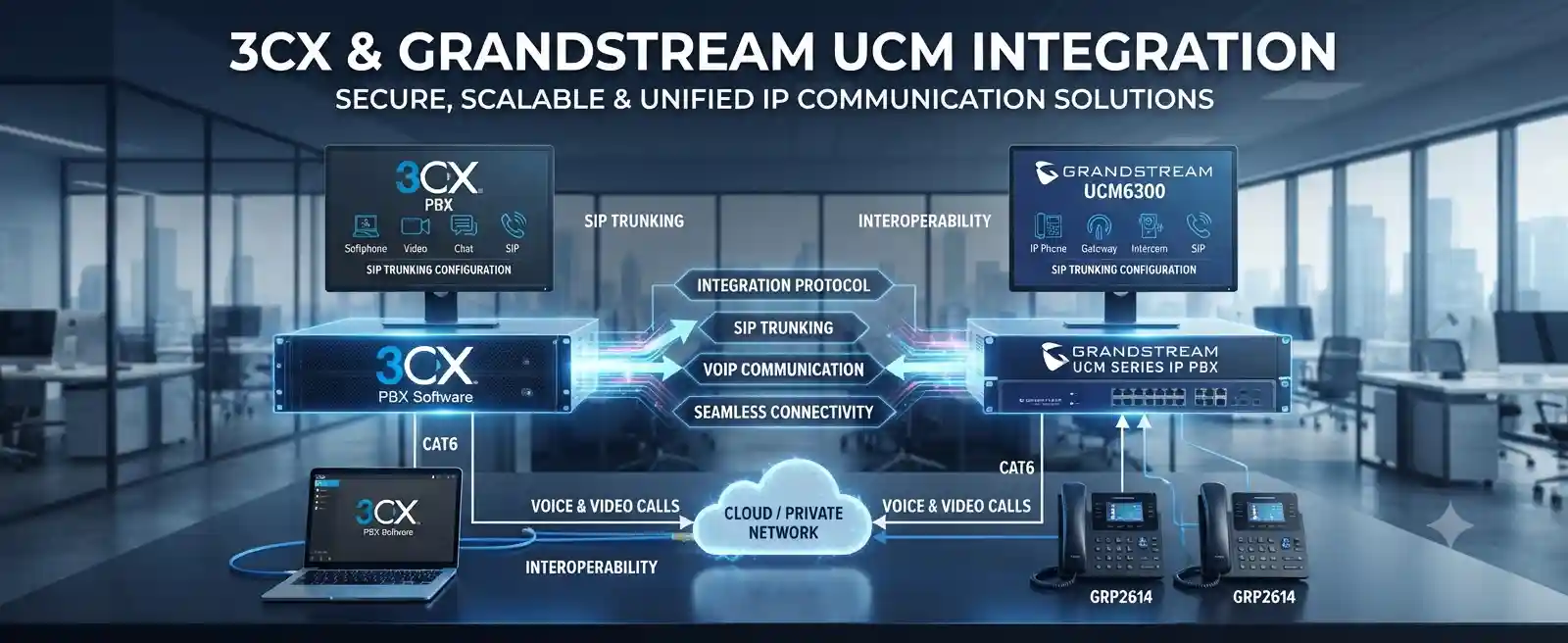
Signalling and media
Routes and numbering
Security and access
PBX coexistence or staged migration
SIP trunk or peer interconnection
Routing, firewall and dial-plan alignment
Remote and on-site as scope requires
What does 3CX and Grandstream UCM integration mean?
In this context, integration normally means creating an authorised SIP-based path between a 3CX phone system and a Grandstream UCM so that selected calls can pass from one PBX to the other according to agreed dialling and routing rules. Businesses may use this during a phased migration, to connect a branch, to retain a specialised legacy call flow, or to allow users on separate systems to dial one another. Before work is confirmed, the customer should provide the 3CX deployment details, UCM model and firmware, current extension ranges, SIP trunk or carrier information, network and firewall ownership, required call flows, and suitable administrator access. The exact implementation is configuration dependent and should be validated with controlled inbound, outbound and internal test calls rather than assumed compatible from SIP support alone.
Why businesses may connect two PBX platforms
A company may already have a working Grandstream UCM at one office while a new location or a new group of users is being placed on 3CX. Replacing everything in a single cutover can create unnecessary operational risk when extension habits, receptionist flows, analogue lines, gateways, existing numbers or branch processes still depend on the original system. A controlled interconnection can create a temporary or longer-term bridge while the business decides what should remain, what should migrate and what should be retired.
Another common situation is a merger, acquisition or office consolidation. Two teams may arrive with different extension plans and different call-management rules. The practical goal is not to make both systems identical on day one. It is to let users communicate reliably while management establishes a clear target architecture, ownership model and migration sequence.
What the service does not assume
FourTeck does not treat every 3CX-to-UCM project as a standard vendor-certified template. Both platforms use SIP concepts, but the success of a PBX-to-PBX link depends on how each side expects authentication, addresses calls, identifies the source, handles caller ID, sends DTMF and negotiates media. Network address translation, security policies, public or private IP design and carrier behaviour can also affect the final result.
The assessment therefore begins with the business outcome and current environment. If the objective can be met more safely through migration, endpoint reprovisioning, a carrier-side change or another supported architecture, that option should be considered instead of forcing an interconnection that becomes difficult to maintain.
What a 3CX and UCM integration may cover
Depending on the confirmed scope, assistance may include discovery, backup review, SIP trunk or peer-trunk planning, extension-range analysis, caller-ID behaviour, route design, codec and DTMF alignment, firewall and NAT review, security controls, test calls, documentation and user handover. The work should be organised around the calls the business actually needs to complete rather than around every possible PBX feature.
PBX discovery
Confirm deployment models, software or firmware versions, licensing dependencies, extension ranges, call routes and administrative ownership.
SIP interconnection
Review whether a registration-based or IP-based arrangement is suitable and how each PBX should recognise the other.
Dial-plan mapping
Define which extensions, prefixes, DIDs or service numbers are reachable across the link and how overlapping ranges are handled.
Media and quality checks
Confirm codec expectations, RTP reachability, one-way-audio risks, DTMF behaviour and network quality across the path.
Security and change control
Limit exposed services, authorise source addresses, protect administrator access, keep backups and plan a rollback where changes can affect live calling.
Testing and handover
Validate real call scenarios, record agreed routes and dependencies, and explain what must be monitored after the change.
Who may need this service?
Businesses migrating in phases
Some organisations cannot move every extension, department, branch or telephone number in one maintenance window. They may need a controlled route between the old UCM environment and the new 3CX environment so teams can continue to call one another while users are moved in planned stages. This requires careful range planning so a number means the same thing throughout the transition.
Multi-branch organisations
A head office may use 3CX while a branch still operates a Grandstream UCM, or the arrangement may be reversed. Interconnection can be considered where the business wants extension-to-extension calling, controlled access to specific routes or a common operational call path without immediately replacing one PBX.
Teams with legacy telephony dependencies
An existing UCM may still support analogue gateways, paging, reception logic, local carrier trunks or other functions that are not ready to move. The integration project can help isolate those dependencies and decide whether they should remain temporary, be redesigned or be included in a later migration.
Businesses repairing an existing link
Some customers already have the two systems connected but experience failed calls, wrong caller ID, one-way audio, DTMF issues, unreachable extensions or inconsistent routes after a network or provider change. In these cases the service becomes a troubleshooting and documentation exercise rather than a new deployment.
Common triggers and symptoms that need investigation
A failed call between PBXs does not automatically prove that the SIP trunk is faulty. The same user experience can be caused by a dial-pattern mismatch, source-identification rule, firewall policy, NAT behaviour, media path, extension permission, route priority, provider interaction or a simple overlapping number range. A structured assessment separates these layers before changes are made.
Users on 3CX can reach UCM extensions, but UCM users cannot return the call, or the opposite. Routing, source recognition, authentication and permissions should be checked on both sides.
SIP signalling may complete while RTP media is blocked or translated incorrectly. Firewall rules, NAT, advertised media addresses and network topology may be involved.
A call may reach the wrong extension, default route or receptionist because number formatting, DID matching or route order differs between the two systems.
The sending PBX, receiving PBX or carrier may rewrite identity fields. The required business presentation should be defined before header changes are attempted.
DTMF methods must be compatible across the call path. The issue can appear only on certain routes or codecs, so test calls should follow the same path as the affected user.
Firmware, PBX updates, firewall changes, public IP changes or carrier modifications can expose an undocumented dependency. Reviewing the previous configuration and recent change history is important.
Business impact when the interconnection is unreliable
An unstable PBX link can create more than missed internal calls. Receptionists may be unable to transfer a caller to another site, a sales team may call out with an unexpected identity, after-hours calls may reach the wrong destination, staff may bypass the normal telephone process with personal mobiles, and troubleshooting can become slower because responsibility is split between two systems and several vendors.
The most useful response is to document which call scenarios are business critical, identify where each route should terminate and assign ownership of the PBX, firewall, network and carrier layers. This creates a supportable design instead of a collection of ad-hoc exceptions that only one administrator understands.
Service-fit matrix for a 3CX and Grandstream UCM project
| Business situation | Relevant assistance | What must be confirmed |
|---|---|---|
| Staged move from UCM to 3CX | Temporary inter-PBX routing, extension-range design, migration call tests | Which users move first, number ownership, rollback path and final retirement plan |
| Branch on a different PBX | SIP interconnection review and controlled branch dial plan | Network reachability, firewall ownership, site addressing and extension overlap |
| Existing trunk has one-way audio | SIP and RTP path review, NAT and firewall investigation, call trace | Public/private topology, ports, recent changes and affected call directions |
| Internal calls reach wrong users | Dial-pattern and route-order review | Complete extension ranges, reserved prefixes and expected destination for each pattern |
| Need to preserve legacy gateway functions | Dependency mapping and coexistence planning | Gateway model, analogue services, emergency or special lines, support status |
| Long-term dual-PBX operation | Maintainable route design, documentation and review process | Business justification, ownership, monitoring expectations and upgrade compatibility |
Service information and scope dependencies
| Service topic | 3CX and Grandstream UCM integration, troubleshooting, coexistence and migration support |
|---|---|
| Main purpose | Connect or assess call flows between two PBX environments using an approved and documented design |
| Typical systems involved | 3CX, Grandstream UCM, SIP trunks, IP phones, gateways, switches, routers, firewalls, internet links and voice-provider services |
| Assessment method | Configuration review, call-flow mapping, logs and traces where available, network checks and controlled test calls |
| Remote support suitability | Often suitable when secure authorised access is available and the issue is mainly routing, software, logs or configuration |
| On-site support suitability | Useful when gateways, cabling, physical phones, switches, firewalls or local network conditions must be inspected |
| Customer access required | Administrative access to the relevant PBX and, where needed, firewall, network or provider portal. Credentials should be shared only through an approved secure method after authorisation is confirmed. |
| Planning support | Scope dependent; may include extension mapping, route ownership, maintenance-window planning and staged migration design |
| Configuration support | Subject to assessment, backup availability, authorisation and compatibility of both environments |
| Testing and validation | Business-relevant call scenarios should be tested in both directions, including transfer, caller identity and DTMF where required |
| Security considerations | Source restrictions, secure administration, minimal exposure, backup and change control should be considered before opening SIP or media paths |
| Vendor coordination | May be required when a carrier, hosting provider, firewall administrator or software vendor controls part of the path |
| Scheduling dependency | Depends on customer access, business call volume, engineer availability, maintenance-window needs and third-party participation |
| Quotation requirement | Final commercial scope depends on the current environment and agreed work |
| Important note | Interoperability should be proven by testing. A SIP-capable platform is not automatically a guarantee that every proprietary feature will pass between two PBXs. |
Remote support versus on-site assistance
When remote work may be practical
Remote assistance can be effective when both PBXs are reachable through an authorised management path, a responsible customer contact is available, internet connectivity is stable and the work focuses on configuration, logs, trunk status, route logic or controlled call testing. A remote session can also help compare settings side by side and gather evidence before a maintenance window is approved.
Remote access does not remove the need for change control. Configuration backups, administrator authorisation and a clear rollback method remain important when a route or firewall change can affect live business calls.
When an on-site visit may be recommended
On-site support may be appropriate when the project includes gateways, analogue lines, rack equipment, cabling, switch ports, physical phone tests, local firewalls or network paths that cannot be verified remotely. A site visit can also help when multiple systems share undocumented cabling or when the customer needs physical inventory and labelling before migration.
Attendance timing depends on location, access, scheduling and the approved quotation. Some issues may still require provider or vendor action after the local environment has been checked.
How the assessment and discovery process usually begins
Confirm whether the objective is branch connectivity, temporary coexistence, a migration bridge, access to a legacy trunk, internal extension calling or repair of an existing interconnection.
List which teams, extensions, DIDs, reception flows, queues or services must communicate across the PBX boundary and which should remain isolated.
Capture the 3CX deployment model, UCM model, software or firmware versions, network locations, public/private addressing, voice provider and supporting gateways.
Confirm authorised administrator access, configuration backup availability and who can approve changes to the PBX, firewall and provider settings.
Compare extension ranges, prefixes, outbound rules, DIDs and special numbers. Overlapping extensions must be resolved before a predictable route can be designed.
Check whether the PBXs can communicate through the intended route and whether SIP signalling and media can pass without unsafe broad exposure.
Describe the settings to be changed, the test sequence, who must be available and how service can be restored if a change behaves differently from expected.
Complete approved call tests, confirm the user-facing result and record the final route, dependencies and remaining limitations.
Architecture and SIP routing considerations
A Grandstream UCM can create SIP trunks, including peer-style arrangements, and 3CX supports configurable SIP trunk authentication and call-routing behaviour. That shared use of SIP provides a technical basis for interconnection, but it does not remove the need to define how each PBX identifies the other and how a dialled number should be interpreted. In a live business environment, a trunk is only one part of the design.
Extension ranges and prefix strategy
If both systems already use extension 2000, a user cannot simply dial 2000 and expect the network to know which PBX should receive the call. The project may need a prefix, an alternate range, a translation rule or a migration plan that gradually removes the overlap. The chosen design should be understandable to users and maintainable by administrators. Very complex translation can solve a short-term problem but create a support burden if it is not documented.
Inbound number recognition
3CX routing can depend on the called number and configured DID matching, while UCM trunks can also derive destination information from different SIP fields. For this reason, the exact number format sent across the link matters. A route may fail even though a SIP message arrives if the receiving PBX does not recognise the destination in the expected format. Testing should include the real length and format of internal extensions, DIDs and any prefixed service numbers.
Outbound rule behaviour
Calls leaving each PBX should be constrained to the agreed patterns. An integration should not accidentally allow one system to use every external trunk on the other unless that is an authorised business requirement. Outbound rules, route priority and permissions should be reviewed so the interconnection provides the intended reach without becoming an uncontrolled alternate path.
Caller identity and presentation
Caller ID may be carried in several SIP headers and may be rewritten by either PBX or by a telecom provider. Internal users may want to see the originating extension while external calls may require an approved company number. The expected presentation should be stated separately for internal PBX-to-PBX calls and carrier-bound calls. Where a carrier imposes caller-ID policy, that policy takes priority over local preferences.
DTMF and application features
DTMF is important for IVRs, voicemail navigation and systems that respond to keypad input. Both sides must use a compatible method along the actual call path. Even when basic voice works, DTMF can fail if one leg handles events differently. Testing should therefore include interactive destinations, not only simple extension ringing.
Network, firewall and media-path planning
Voice quality and call completion depend on more than PBX settings. SIP normally handles call signalling, while RTP carries the audio stream. A system may successfully establish a call yet deliver no audio, one-way audio or unstable speech when the media addresses or firewall path are wrong. This is why the network topology should be documented before ports are opened or NAT rules are changed.
Same-site connection
If both PBXs are on the same trusted internal network, the path may be simpler, but routing, VLANs, local firewall rules and address conflicts still matter. Direct reachability should not be assumed if the systems sit in separate voice or server networks.
Site-to-site connection
When the PBXs are in different offices, the design may use routed private connectivity or a suitable secure inter-site method. The path should be assessed for latency, packet loss, address overlap, bandwidth and firewall policy.
Internet-facing connection
Exposing SIP services to the public internet requires careful source restriction and security review. Broadly opening ports without understanding the source, authentication and media path can create avoidable risk.
Firewall changes should be narrow and reversible
A troubleshooting session should not begin by disabling security controls or opening unrestricted SIP access. The safer approach is to identify the actual source and destination addresses, ports, transport requirements and expected media ranges, confirm a configuration backup, make the minimum approved change and test the result. If a third-party provider manages the firewall or hosted 3CX environment, their participation may be required.
Authentication, transport and security choices
3CX supports different SIP trunk authentication approaches, including registration-based and IP-based configurations, while Grandstream UCM trunks also provide multiple SIP trunk settings. The right choice for PBX-to-PBX communication depends on the topology, software behaviour, security requirements and support boundaries. A setting that is appropriate for a carrier trunk is not automatically the best approach for an internal PBX peer.
Where IP-based trust is considered, source addresses must be stable and tightly restricted. Where account registration is used, credentials must be protected and stored according to the customer’s administrative policy. Administrator passwords, API keys or private credentials should never be published in documentation intended for general users. They should be shared only through an approved secure method and only with authorised personnel.
TLS and SRTP may provide protected signalling and media when both sides and the selected configuration support a compatible implementation. Encryption should not be enabled merely because a checkbox exists. Certificates, FQDNs, transport behaviour and interoperability must be confirmed, then tested. If secure transport cannot be implemented consistently between the two platforms, the network design should reduce exposure and limit the path to approved systems.
Security also includes call permissions. A PBX link can potentially create an unexpected path to external trunks, premium destinations or management interfaces if rules are too broad. The integration plan should define exactly what the peer is allowed to call and which destinations are intentionally blocked.
Testing, validation and handover
A successful configuration save is not the end of an integration project. Validation should follow the business call flows identified during discovery. Test results should be recorded so an administrator knows what was proved and what remains dependent on a carrier, feature or future migration stage.
A practical validation sequence may include
- Call a selected extension from 3CX to the UCM and confirm ringing, answer, two-way audio and correct caller identity.
- Repeat the call from UCM to 3CX to verify the reverse route rather than assuming symmetry.
- Test transfer scenarios that cross the PBX boundary, including attended or blind transfer where the business depends on them.
- Test DTMF against an IVR or voicemail destination when keypad input is part of the required workflow.
- Confirm how external calls are handled if one PBX is intended to route through a carrier trunk attached to the other.
- Check after-hours, receptionist, queue or fallback behaviour if those routes cross the integration.
- Review logs for unexpected rejects, authentication failures or repeated retries during the test window.
- Document the working dial patterns, trunk ownership, dependencies, backup location and any known exclusions.
Handover should distinguish the normal operating design from temporary migration rules. If a prefix exists only for a transition period, the documentation should state when it can be removed. If the link depends on a public IP, VPN or firewall object, that dependency should be visible to future support personnel.
Capability 1: clearer call routing between separate systems
A well-planned interconnection gives administrators an explicit answer to the question, “Where should this number go?” Instead of relying on broad catch-all rules, the design can define which extension ranges belong to each PBX, which prefixes cross the link and which calls should remain local. This reduces the chance that a later route change sends calls to an unintended destination.
The benefit depends on disciplined numbering. If both systems contain overlapping extensions, unmanaged duplicates will continue to create ambiguity until the business adopts a prefix, renumbering plan or another translation strategy.
Capability 2: safer phased migration and coexistence
A temporary PBX link can allow one department or location to move before another. This can reduce the pressure of a single large cutover and give the project team time to validate critical call paths. It also makes it easier to identify legacy dependencies that should be redesigned rather than copied blindly into the new platform.
Coexistence should still have an end-state decision. Temporary routes can become permanent by accident. A migration plan should record what is moving, what will remain, what will be retired and which date or milestone triggers the next review.
Capability 3: better documentation and vendor coordination
PBX problems often involve more than one party: the 3CX host, the UCM administrator, the network team, the firewall provider and the telecom carrier. A documented call path lets each party see the part it controls. This is particularly valuable when a call succeeds internally but fails externally, or when media is lost after signalling completes.
FourTeck can organise the technical evidence and help define the next action, while recognising that a third-party provider may still need to change or approve settings outside FourTeck’s control.
Dependencies, compatibility and customer inputs
The integration scope cannot be confirmed from the names “3CX” and “Grandstream UCM” alone. Both product families have multiple releases, deployment methods and support conditions. The customer should be prepared to identify the exact environment and the business call flows that must work.
Deployment type, current version, hosting responsibility, licence details where relevant, existing trunks, extension ranges and administrator availability.
Exact model, firmware, trunk configuration, extension ranges, gateways or analogue dependencies, backup status and administrator availability.
Site topology, IP ranges, VLANs, public addresses, VPN or routed connectivity, firewall ownership, DNS and any recent network changes.
Carrier or SIP provider, number ownership, DIDs, caller-ID rules, special analogue lines and provider contacts where coordination may be required.
Which departments call across the link, required transfer paths, receptionist behaviour, after-hours destinations, queues, IVRs and any restricted destinations.
Acceptable maintenance window, busy calling periods, internal approver, rollback expectations and users available for testing.
Risks, limitations and exclusions to understand
- Interoperability is environment dependent. SIP support does not guarantee that every feature, proprietary presence state, BLF behaviour, recording function or advanced PBX service will pass between platforms.
- Diagnosis depends on available logs, configuration access and a reproducible call path. If an upstream carrier or hosted platform controls the failure, that provider may need to take the final action.
- Firewall or routing changes can affect live calls. A maintenance window, configuration backup and rollback plan may be required.
- Older UCM models or older 3CX deployments may have support, security or compatibility constraints that limit the preferred design.
- A successful test call does not prove that every peak-load, failover, queue, transfer or external route scenario has been validated. The agreed test plan determines what has been confirmed.
- Carrier caller-ID and numbering policies may prevent a local PBX from presenting arbitrary identities.
- Hardware replacement, new licences, telecom charges, provider work or cabling may fall outside support labour unless included in the approved quotation.
- Final commercial terms and scheduling depend on the confirmed scope, access, site conditions and third-party dependencies.
Suitable business environments and practical use cases
Professional offices
Professional firms may need to move users from an older UCM to 3CX without disrupting reception, direct numbers or internal extension habits. A phased design can keep legacy teams reachable while the new platform is introduced department by department.
Retail and multi-branch operations
A branch may keep a local UCM for operational reasons while a central office uses 3CX. The business may want selected extension calling and controlled access to head-office resources without giving every branch unrestricted trunk access.
Warehouses and logistics sites
Warehouses can contain analogue gateways, paging, cordless devices or local carrier circuits that are difficult to migrate immediately. Interconnection can provide time to map these dependencies while office users move to a different PBX platform.
Clinics and service businesses
Appointment, reception and departmental call flows may depend on stable transfer patterns. Any integration should prioritise these user journeys and avoid untested route changes during busy periods.
Schools and training centres
A campus may contain older extensions, reception phones, gateways or paging functions. A project can separate the modernisation of user calling from the later review of specialised legacy services.
Hospitality and property operations
These environments can have front-desk, back-office and property-system dependencies. Before connecting PBXs, the project should identify any integrations, analogue endpoints or workflows that require vendor participation.
Operational and maintenance considerations after integration
An inter-PBX link should be treated as a maintained business dependency, not as a one-time hidden configuration. Administrators should know which side owns the route, what public or private network path it uses, which firewall policies permit it and what user groups depend on it. If either PBX is upgraded, migrated or moved to a different address, the integration should be included in the change plan.
Configuration backups matter on both platforms. The location and age of those backups should be documented, especially before firmware, PBX or firewall changes. Backup availability does not remove all risk, but it gives the support team a reference point and may provide a rollback option.
Monitoring expectations should also be realistic. A trunk that appears registered or reachable does not prove that every call route is functioning. Periodic test calls, log review and user feedback may be appropriate for important connections, particularly during a migration period. If the link is temporary, it should have a planned review date so the business can decide whether to remove, simplify or formalise it.
Security reviews should consider source restrictions, obsolete administrator accounts, exposed management interfaces and rules that were opened for troubleshooting but no longer serve a purpose. Long-term maintainability improves when temporary exceptions are removed and the final design is recorded in plain language.
Before you contact FourTeck
Preparing a small amount of accurate information can shorten discovery and make the quotation more relevant. You do not need to publish or email passwords in a general support request.
- Business location and main technical contact
- Reason for connecting 3CX and the UCM
- 3CX deployment type and current version if known
- Grandstream UCM model and firmware if known
- Current extension ranges on both systems
- List of call paths that must work
- Examples of failed or incorrect calls
- Recent PBX, network, firewall or provider changes
- SIP provider or carrier details where relevant
- Firewall and network administrator contact
- Availability of current configuration backups
- Whether the PBXs are on one site or multiple sites
- Any analogue gateways or special lines involved
- Preferred remote or on-site support method
- Business impact and suitable change window
- Expected final state: coexistence, repair or migration
Service evaluation checklist for the quotation
These points define the engagement; they do not imply that every task is automatically included. FourTeck can prepare the service scope after the current environment and intended result are clear.
How FourTeck can assist
FourTeck can begin by clarifying the reported business requirement and identifying the technical layers involved. For a new interconnection, that may mean mapping the two PBX systems, comparing extension ranges, reviewing SIP trunk options, checking the network path and preparing a controlled test plan. For a broken existing link, the work may focus on call traces, route logic, firewall changes, caller-ID handling or a recent upgrade that altered behaviour.
When several suppliers are involved, FourTeck can organise the findings so the hosting provider, network administrator, carrier or PBX vendor receives useful technical information. The goal is to reduce the cycle in which each party looks only at its own component while the customer remains responsible for connecting the evidence.
After approved changes, FourTeck can test the agreed scenarios, record the working route and explain remaining dependencies. Where the environment is too complex, unsupported or risky for a permanent dual-PBX design, the assessment can instead support a migration or simplification plan.
For broader information about the company and service approach, visit FourTeck IT Services in the UAE. A quotation can then define the exact remote, on-site, configuration, documentation and third-party coordination work required.
Dubai and UAE service coordination
3CX and Grandstream UCM integration support can involve remote configuration work, planned on-site checks, network assessment and coordination with telecom or hosting providers. The correct mix depends on the issue, access, location, urgency and approved quotation. Remote support may be efficient when the PBXs, logs and firewall settings can be accessed securely. An on-site visit may be recommended when physical gateways, switches, cabling, network segmentation or local phone behaviour must be inspected.
Service timing depends on engineer availability, customer access, site conditions, maintenance-window requirements, provider participation and the confirmed scope. If new hardware, licences, carrier changes or replacement parts are required, those items should be identified separately before implementation is scheduled.
Coordinating projects across Dubai, Abu Dhabi, Sharjah and Ajman
For organisations with offices or operational sites across Dubai, Abu Dhabi, Sharjah and Ajman, PBX integration may combine remote troubleshooting with planned site work. A central 3CX platform may need to communicate with a UCM at one branch, or several locations may be moving in stages. The service plan can identify which work is best completed remotely and which tasks require local equipment access.
Scheduling, travel, building access, site security, maintenance windows, equipment availability and third-party dependencies can affect the sequence. Multi-site work also benefits from consistent extension plans, network documentation and clearly assigned administrator ownership so future changes do not create different rules at every location.
Related FourTeck IT services
Help with extensions, call flows, trunks, queues, upgrades and general 3CX troubleshooting.
Grandstream PBX and phone support
Assistance with UCM configuration, gateways, phones, registration, call routing and support planning.
Office network support
Switching, routing, VLAN, cabling and connectivity checks where voice depends on the wider network.
Firewall and secure access support
Review of rules, NAT, VPN and controlled network access that may affect SIP and RTP traffic.
Why businesses contact FourTeck for telephony integration work
A PBX integration sits at the intersection of telephone administration, networking, firewall policy and carrier behaviour. Businesses often need one technical view that can follow a call from the user’s extension through the originating PBX, across the network, into the receiving PBX and, where relevant, onward to a telecom provider. FourTeck’s role is to organise that path into an understandable assessment rather than treating each device as an isolated fault.
Customers may also need help translating a business requirement into a safe change. “Let branch staff dial head-office extensions” sounds simple, but it raises practical questions about number ranges, permitted destinations, caller identity, after-hours handling, transfer behaviour and what happens if the link is unavailable. Clarifying these questions before configuration reduces rework.
Documentation is another reason to involve a service provider. An integration can work for years until a public IP changes, a firewall is replaced or one PBX is upgraded. A clear record of the trunk, network path, route patterns and ownership makes future troubleshooting more efficient and reduces dependence on one person’s memory.
Frequently asked questions
Can 3CX and a Grandstream UCM be connected directly?
A SIP-based interconnection can be technically possible in many environments, but the exact design should be assessed rather than assumed. Authentication, source identification, routing, number format, transport, media, firewall rules and version compatibility all affect the result. The project should test the required call flows and document any features that do not interoperate as expected.
Is this the same as connecting Grandstream phones to 3CX?
No. Provisioning a Grandstream SIP phone to 3CX is an endpoint task. Connecting a Grandstream UCM to 3CX links two PBX systems, each with its own extensions, routes, permissions and network behaviour. The second scenario requires much more attention to dial plans and call ownership.
Can the integration be used during a migration?
Yes, coexistence can be considered when users are moving in stages and selected calls must cross between the old and new environments. The migration plan should still define an end state, rollback approach, extension strategy and the point at which temporary routes can be removed.
What information is needed before configuration starts?
Useful information includes the UCM model and firmware, 3CX deployment and version, extension ranges, required call routes, SIP or carrier details, network topology, firewall ownership, backup status and authorised administrator access. Error examples and recent changes are important when an existing link has stopped working.
Why do calls connect but have no audio?
Signalling and audio use different parts of the VoIP path. A call can be established while RTP media is blocked, sent to the wrong address or affected by NAT. Firewall rules, advertised media addresses and the network path should be reviewed before assuming the PBX itself is defective.
Can both systems use the same extension numbers?
Overlapping extensions create routing ambiguity. A project may use prefixes, translation or a planned renumbering strategy, depending on the business requirement. The design should be simple enough for users to understand and administrators to maintain.
Can one PBX use the other PBX’s external SIP trunk?
This can be considered only when the business requires it and the carrier, PBX permissions and security design allow it. The route should be deliberately restricted. It should not create an unintended path that lets every extension use every external trunk or bypass carrier caller-ID rules.
Can FourTeck troubleshoot an existing integration remotely?
Remote troubleshooting may be suitable when secure authorised access is available and the affected PBXs, logs and relevant network settings can be reviewed. On-site work may still be required if the issue involves physical gateways, cabling, local switches, phones or firewall hardware that cannot be verified remotely.
Should TLS or SRTP always be enabled?
Encryption is useful when both sides support a compatible implementation and the certificate, FQDN and transport requirements are correct. It should be planned and tested rather than enabled blindly. Where secure transport is not interoperable, network exposure should still be reduced through controlled design and source restrictions.
How are DTMF and IVR problems checked?
The support process tests keypad input across the same route that fails for users, then reviews the DTMF methods and codecs in use. A basic voice call can work while IVR digits fail, so IVR or voicemail testing should be part of validation when those functions are required.
Will the integration survive future upgrades?
No inter-PBX configuration should be assumed permanent across every software, firmware, firewall or network change. Upgrade planning should include the PBX link as a dependency, keep current backups and repeat important call tests after significant changes.
Do you support projects outside Dubai?
FourTeck can coordinate service for businesses in Dubai and other UAE locations, including Abu Dhabi, Sharjah and Ajman, subject to the confirmed scope and scheduling. The work may combine remote assistance with planned on-site visits where physical inspection or local coordination is required.
Plan the integration around the calls your business needs
Share the current 3CX and Grandstream UCM environment, the call flows you want to create or repair, and any network or provider dependencies you already know. FourTeck can review the requirement, recommend the next assessment step and prepare a quotation based on confirmed access and scope.