
3CX and FreePBX Integration in Dubai, UAE
Connect two different PBX environments with a controlled design for SIP signalling, call routing, numbering, media, security and handover. FourTeck helps businesses assess whether a direct interconnection is appropriate, what dependencies must be resolved first, and how the completed call paths should be tested before operational use.
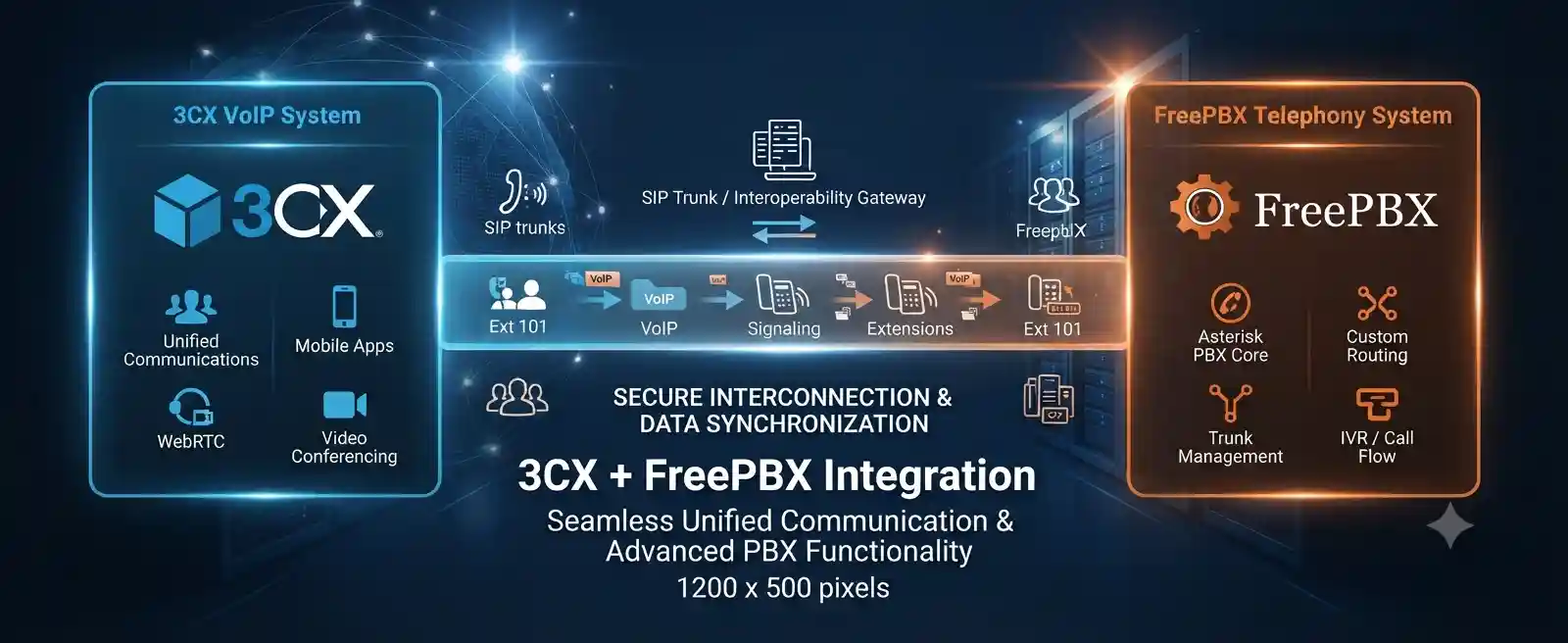
What does 3CX and FreePBX integration mean?
It means creating a controlled voice connection between a 3CX environment and a FreePBX environment so that approved call types can pass between them without forcing every user or number onto one platform immediately. The exact design may use SIP trunking, IP-based or registration-based interconnection, or an intermediary session border controller or gateway where direct peering is unsuitable. This is not the same as the native 3CX Bridge feature, which is designed for connecting 3CX systems to other 3CX systems. Businesses should consider this service when they are consolidating sites, phasing a migration, retaining a specialist FreePBX call flow, connecting a branch, or moving numbers and users in stages. Before work is confirmed, provide the current PBX versions, network locations, extension ranges, trunk details, required call directions, caller-ID expectations, firewall constraints, licensing position and an authorised test window.
What the integration service can cover
Depending on the confirmed scope, FourTeck can review the two PBX environments, map extension ranges, identify SIP signalling requirements, define inbound and outbound routes, inspect codec and DTMF settings, check caller-ID presentation, review firewall and NAT conditions, create or adjust approved trunk settings, test call flows, investigate one-way audio or failed transfers, coordinate with SIP providers or other vendors, and document the completed interconnection.
The work is intentionally broader than entering a few trunk fields. A PBX connection touches dial plans, security policies, voice media paths, numbering logic and operational ownership. The goal is therefore to understand how the business wants calls to move before changing either platform.
Who may need this service
This service may suit companies with a 3CX deployment at one site and FreePBX at another, businesses replacing FreePBX gradually with 3CX, organisations retaining FreePBX for a special IVR or legacy workflow, acquired businesses that have different telephony platforms, or technical teams that need to interconnect systems before a larger consolidation project.
It can also be useful during an office move or phased migration where selected extensions, queues or DIDs must remain available on the existing system while new users are introduced elsewhere. The design should match the business outcome rather than assume that every feature must operate across both systems.
Why two working PBXs can still fail when connected
A 3CX system and a FreePBX system may each work correctly on their own and still experience problems when calls cross between them. Integration introduces a boundary where signalling, media, numbering and security assumptions have to agree.
Call setup fails
A call may be rejected because the receiving PBX does not recognise the source, authentication method, request URI, destination format or allowed route. The same symptom can also result from firewall filtering or a trunk that is not considered available.
Audio is one-way or missing
Signalling can succeed while RTP media fails because of NAT, wrong public-address information, blocked UDP ranges, an SBC policy, direct-media behaviour or a route between network segments.
Digits do not behave as expected
Extension overlaps, prefixes, stripped digits, E.164 formatting, short codes and outbound rules can send the right call to the wrong destination or prevent it from leaving the originating system.
Features work only partly
Transfers, DTMF menus, caller name, caller ID, early media, hold and certain queue behaviours can depend on SIP headers, codec negotiation and platform-specific implementation. Each required feature must be tested explicitly.
Common project triggers and the business impact behind them
Most organisations do not integrate 3CX and FreePBX simply to prove that two systems can call each other. There is usually a business reason such as migration, branch consolidation, an acquisition, a temporary coexistence period, protection of an established call flow, or a need to reduce disruption while users move gradually. Understanding that reason changes the technical design.
Phased migration
A business may want to move departments from FreePBX to 3CX in stages. During coexistence, users on both systems may still need extension-to-extension calling, controlled access to shared numbers, and predictable caller ID. Without a written numbering and routing plan, migration stages can create duplicate routes, unreachable extensions or inconsistent dialling.
Branch or acquired-site connection
A newly added site may already use FreePBX while the wider company uses 3CX. The integration may be intended only for internal calls, or it may need centralised PSTN breakout, shared reception, overflow routing or selective DID delivery. Each additional requirement changes security, call-path and failure-impact considerations.
Retaining a specialist workflow
FreePBX may host an existing IVR, custom route, application integration or departmental workflow that is not being moved immediately. In this case the safest design may be to route only specific calls to that system while 3CX remains responsible for other users. Scope should be limited to the functions that genuinely need cross-platform access.
Temporary coexistence during change
Office relocation, carrier changes and user rollout projects sometimes require both PBXs to operate for a defined period. The operational risk is not only failed calls. Confusing responsibility, undocumented emergency routing, inconsistent business-hours logic and uncertain failback steps can affect customer response and internal communication.
Service-fit matrix for 3CX and FreePBX environments
| Business situation | Relevant assistance | What must be confirmed |
|---|---|---|
| Users on each PBX need to call one another | Numbering review, SIP route design, extension reachability tests | Unique extension ranges, route ownership and supported trunk method |
| Only selected DIDs should cross between systems | Inbound pattern mapping, destination selection, fail-path review | Carrier format, DID presentation, business-hours behaviour |
| FreePBX is being retired gradually | Coexistence plan, migration sequencing, rollback and testing | User groups, legacy dependencies, maintenance window, backups |
| Calls connect but audio is unstable | RTP path review, NAT and firewall checks, codec analysis | Network topology, public/private addressing, media policy |
| IVR digits or transfers fail across the boundary | DTMF, SIP signalling and feature test matrix | Required transfer type, DTMF mode, expected destination behaviour |
| Security policy prevents direct PBX exposure | SBC/gateway option review, ACL and network-segmentation planning | Approved architecture, firewall ownership and vendor support constraints |
Buyer-focused service information
| Service topic | 3CX and FreePBX integration, interconnection and troubleshooting |
|---|---|
| Main purpose | Controlled call exchange or staged migration between separate PBX environments |
| Typical systems involved | 3CX, FreePBX/Asterisk, SIP trunks, SBCs or gateways where required, firewalls, switches, WAN links and IP phones |
| Assessment method | Configuration review, numbering map, call-flow review, log analysis, network checks and controlled test calls |
| Remote support suitability | Often suitable when authorised admin access, logs, stable connectivity and test users are available |
| On-site support suitability | Useful when physical network equipment, phones, gateways, cabling, local firewall access or multi-user testing is required |
| Customer access required | Authorised PBX administration, relevant firewall/network access and vendor portals as scope requires |
| Testing and validation | Inbound, outbound, inter-extension, caller-ID, DTMF, transfer, audio and failure-path checks as applicable |
| Security considerations | Access control, allowed peers, credentials, firewall policy, exposure, transport and media protection are environment dependent |
| Backup considerations | Current configuration backups and rollback information should be confirmed before material changes |
| Vendor coordination | May be required with SIP carriers, hosting providers, firewall suppliers or platform support teams |
| Service location | Dubai and UAE, with remote or planned on-site coordination subject to confirmed scope |
| Scope dependency | Platform versions, network design, support policy, call-flow requirements, access and third-party systems |
| Quotation requirement | Final commercial scope is prepared after the existing environment and target outcome are understood |
Remote support versus on-site integration work
When remote assistance may be practical
Remote work can be efficient when both PBXs are reachable through an approved administrative method and a responsible customer contact can support testing. The engineer may review trunk settings, call routes, SIP logs, extension ranges, codecs, caller-ID rules, registration state, firewall objects, DNS information and recent changes without needing to handle physical equipment.
Remote assistance also suits staged configuration work when a maintenance window has been agreed and backups are available. A remote session can be used to collect evidence before any change, implement an approved route, make controlled test calls and compare the signalling on both systems. This often helps isolate whether a failure sits in 3CX, FreePBX, the network path, an SBC, a SIP carrier or a particular endpoint.
Remote support still depends on working internet, authorised access and sufficient visibility. If the fault affects the same connectivity required for remote administration, or if the engineer cannot verify physical topology, remote troubleshooting may only establish the next step rather than complete the work.
When an on-site visit may be appropriate
On-site assistance can be useful when the integration depends on physical firewalls, voice gateways, separate VLANs, switch ports, local carrier equipment or IP phones that need to be tested from the user side. It can also help when multiple departments report different symptoms, the cabling or network documentation is incomplete, or local access must be coordinated with facilities and telecom providers.
During an on-site session, the engineer may confirm which networks the PBXs and phones actually use, check whether voice traffic crosses a firewall or NAT boundary, trace a gateway connection, review switch segmentation and reproduce user-reported call behaviour. Physical inspection is particularly valuable when diagrams do not match the live environment.
An on-site visit does not automatically mean every configuration or third-party issue can be resolved during the visit. Carrier changes, licence changes, hosted-system permissions, platform restrictions or replacement equipment may require follow-up work. Scheduling depends on location, access, site conditions, engineer availability and the approved scope.
Assessment and discovery: what should be understood before configuration?
Reliable PBX integration begins with a current-state map. A surprising number of telephony problems are caused by undocumented assumptions: an old outbound prefix still active on one system, a number range that overlaps a new department, a firewall rule that points to a retired address, a provider that sends DIDs in a different format, or a call queue that depends on a feature not available across the PBX boundary. FourTeck’s assessment focuses on the business outcome and the technical path needed to achieve it.
- Define the business reason for integration. Confirm whether the project supports internal extension calling, staged migration, central reception, DID handoff, branch communication, shared PSTN access, legacy application retention or another defined requirement. If the purpose is unclear, the integration can grow into unnecessary complexity.
- Identify the platform versions and deployment model. 3CX version and hosting model matter, as do the FreePBX and Asterisk versions, enabled modules and current SIP driver. Modern FreePBX environments favour PJSIP, while older installations may contain legacy chan_sip definitions that need special migration planning rather than simple copying.
- Map extension and DID ranges. Every internal extension range, public number, queue, IVR and service code that may cross the interconnection should be documented. Overlap between extension ranges can require prefixes or a revised numbering plan.
- Trace existing trunks. Determine which PBX currently terminates each carrier trunk, which numbers are delivered there, how authentication works, and whether the carrier expects a particular source IP, caller-ID format, transport or contact information. A PBX-to-PBX interconnection should not inadvertently break carrier routing.
- Review network topology. Record whether systems are on the same LAN, separate VLANs, separate sites, private cloud networks or public networks. Identify NAT devices, firewalls, VPNs, SBCs and any double-NAT condition. Voice media and signalling may follow different paths.
- Confirm security and ownership. Decide who is authorised to change each PBX and firewall. Credentials should not be posted in public requests and should only be shared through an approved secure method after identity and authority are confirmed.
- Collect representative call flows. The assessment should include examples such as 3CX extension to FreePBX extension, FreePBX user to 3CX queue, incoming DID to a remote IVR, transfer back across the trunk, and outbound caller-ID requirements. Testing only one basic call is not enough when production flows are more complex.
- Plan backup and rollback. Current configuration exports or backups should be available where supported. The change plan should identify what can be restored or disabled if the new route creates an unexpected problem.
How the integration design is selected
There is no single safe template for every 3CX and FreePBX environment. The design depends on the current platform capabilities, support boundaries, network exposure, call-flow requirements and whether the connection is temporary or long term. A direct SIP peer may be technically possible in some environments, but the fact that two systems speak SIP does not guarantee that every function will interoperate or that the configuration is supported by each vendor.
Important distinction: 3CX Bridge versus 3CX-to-FreePBX interconnection
The native 3CX Bridge function is documented for connecting one 3CX system to another 3CX system. A FreePBX server is a different platform, so a 3CX-to-FreePBX project should be assessed as SIP interoperability or as a migration architecture rather than being assumed to use the 3CX Bridge feature. Depending on current 3CX capabilities and support policy, the chosen method may use a generic SIP trunk, an IP-based connection, a registration-based relationship, an SBC or another gateway approach. The final method should be confirmed before production changes.
On the FreePBX side, trunks are specifically used to connect the FreePBX/Asterisk system to another VoIP system or device. That makes the trunk module a natural place to examine the FreePBX half of an inter-PBX design, together with inbound and outbound routes. The exact FreePBX configuration must still match the chosen authentication model, source identification, context, codec set, network addressing and routing rules.
Where the systems are separated by the public internet, security and media handling become central. Publicly exposing a PBX simply because a SIP port exists is not a sufficient design. Access-control lists, firewall policy, source identification, transport selection, credential protection and ongoing patching should be considered. Where an SBC or site-to-site network design is already approved, it may provide a cleaner security boundary, but the additional device also becomes part of the support and failure path.
Numbering and routing: the part users notice first
Users experience a PBX integration through dialling. If the numbering plan is confusing, technically successful SIP signalling will not make the project feel successful. A good route design should allow staff to understand how to reach colleagues, queues and external numbers without guessing which PBX owns the destination.
The first question is whether extension ranges overlap. If 3CX has extensions 100 through 199 and FreePBX also has extensions in the same range, neither system can know from the digits alone whether a call to 120 is local or remote. Options may include adding a prefix for cross-system calls, renumbering one group, using longer extension ranges, or defining selective patterns. The choice depends on user impact, existing applications and migration plans.
Outbound routes require equally careful ownership. A business may want all PSTN calls to remain on the existing FreePBX carrier during migration while 3CX users reach that carrier through the interconnection. Another business may want each PBX to use its own carrier. A third may want only specific destinations to cross for cost or resilience reasons. The route order, prefix handling and failover behaviour should be documented so that a broader rule does not unintentionally capture calls intended for another trunk.
Inbound routing needs a DID map that states which number terminates where and which destination should answer. If a DID arrives at FreePBX but the receiving user now works on 3CX, FreePBX may forward the call across the interconnection. If a queue or IVR is involved, the team should also decide where time conditions, holidays, voicemail and overflow logic live. Duplicating the same logic on both PBXs can create inconsistent behaviour during later changes.
Caller ID is another routing dependency. A cross-PBX call may need to preserve the original external number, present the internal extension, or use an approved main business number when it exits to the public network. Each direction should be tested because the originating PBX, interconnection and carrier can interpret identity headers differently. Provider rules and local telecom requirements must also be respected.
Capability 1: more reliable fault isolation across the SIP boundary
One of the most valuable outcomes of a structured integration is not simply that calls work; it is that future faults are easier to isolate. When the call path is documented, an administrator can distinguish a 3CX issue from a FreePBX issue, a firewall problem from a carrier problem, and a signalling failure from a media failure.
For example, if a 3CX user dials a FreePBX extension and the call immediately fails, the investigation can compare the dialled digits, 3CX outbound route decision, SIP destination, receiving FreePBX trunk identification and inbound context. If the call rings but has no audio, attention shifts toward SDP, RTP addressing, firewall/NAT policy and codec negotiation. If audio works but keypad input fails in an IVR, DTMF handling becomes a more likely technical area. This layered method avoids changing unrelated settings simply because the symptom is inconvenient.
FourTeck can help build a test matrix that lists representative calls in both directions and records expected outcomes. That matrix can include extension-to-extension, extension-to-queue, inbound DID handoff, outbound PSTN calls where authorised, attended transfer, blind transfer, hold/resume, DTMF interaction and caller-ID presentation. Not every project requires every test, but the tests should reflect the real business workflows rather than a single engineering call.
Logs should be collected during controlled failures when possible. A SIP response code, rejected source, unmatched route or codec offer can provide evidence that is more useful than repeated configuration changes. Where the issue appears to sit with a carrier, cloud host or platform vendor, FourTeck can help package the relevant technical information for escalation instead of asking the customer to explain the entire environment from memory.
Capability 2: controlled media, codec and DTMF behaviour
SIP creates and controls a call, but the spoken audio normally travels as a separate media stream. This is why a phone can ring normally even when one party cannot hear the other. During 3CX and FreePBX integration, the engineer needs to understand both signalling and media paths, especially when systems are at different sites or behind NAT.
Codec selection should be deliberate. Both sides need at least one compatible codec for the intended call path, and carrier legs may introduce another negotiation point. Using many codecs without understanding the order can make troubleshooting harder. Using only one codec can also be unsuitable if a required external trunk or endpoint does not support it. The practical choice depends on bandwidth, endpoint support, provider requirements and whether transcoding is expected.
DTMF is the way keypad digits are conveyed during a call. It matters when a caller chooses menu options, enters an extension, interacts with a voicemail system or uses an application that listens for digits. A call that sounds perfect can still fail operationally if the two systems do not agree on DTMF handling. Testing should therefore include at least one real menu or digit-sensitive workflow when such functions matter to the business.
Media security may also be relevant. TLS for signalling and SRTP for media are supported in certain 3CX trunk scenarios, but compatibility varies and should not be assumed across an arbitrary inter-PBX connection. FreePBX security capabilities likewise depend on its configuration, certificates, modules and Asterisk version. If encrypted transport is a requirement, it should be treated as a design item with explicit compatibility tests rather than enabled casually during a production window.
Network quality remains important even after the systems are correctly configured. Voice is sensitive to latency variation, packet loss and congestion. Where traffic crosses WAN links or shared office networks, network assessment may include VLAN design, QoS policy, bandwidth utilisation and firewall processing. These controls reduce avoidable problems but do not guarantee call quality if the underlying internet or carrier service is unstable.
Capability 3: a safer path from coexistence to consolidation
Many 3CX and FreePBX integrations are temporary by design. A company may be migrating users, moving offices, replacing an old carrier or consolidating after an acquisition. In those cases, the integration should support the transition without becoming a permanent undocumented dependency.
A staged plan can divide users into migration groups. Before each stage, the team confirms which extensions and DIDs move, what routes must change, which queues or IVRs remain on the old system, and how users should dial across the boundary. The change is then tested, documented and observed before the next group is moved. This approach can reduce the size of each change window and make rollback more manageable if a compatibility issue appears.
FreePBX version and SIP technology deserve particular attention in older environments. Modern FreePBX development has moved toward PJSIP, and legacy chan_sip configurations are deprecated. A migration project should therefore avoid building a new long-term dependency around a legacy SIP driver simply because it exists today. Where old trunks or extensions still use chan_sip, FourTeck can review whether they need conversion, replacement or temporary support as part of the wider transition.
Consolidation also requires ownership decisions. Which PBX will remain the authoritative source for business hours, queues, voicemail, emergency routing, public numbers and user administration? Which system can be retired after the final stage? Which logs and backups must be retained? A technically functional link without these decisions can leave the business managing two systems indefinitely. The better outcome is a documented target state with milestones, rollback points and clear completion criteria.
Implementation journey from approved design to working call paths
1. Protect the current state
Confirm backups, export relevant settings where supported, capture current trunk and route information, and agree a rollback point. No production change should begin with uncertainty about the original configuration.
2. Create the interconnection
Configure the approved SIP relationship, gateway or SBC path using the agreed authentication and source-identification model. Only necessary network access should be allowed.
3. Build selective routes
Add the smallest set of inbound and outbound patterns needed for the first test. This reduces the chance that a new route unexpectedly captures unrelated production calls.
4. Validate signalling
Confirm that each system recognises the other as expected, routes the intended digits, returns meaningful SIP responses and does not accept unauthorised sources.
5. Validate media and features
Check two-way audio, codec choice, DTMF, hold, transfer and caller identity for the business flows included in scope. Test in both directions where required.
6. Expand carefully
Once the basic route is stable, add additional extension groups, DIDs or call scenarios in controlled steps. Do not turn a test rule into a broad production rule without review.
7. Observe failure behaviour
Confirm what happens if one PBX, route, internet path or carrier dependency becomes unavailable. The acceptable response is business dependent and may require additional design.
8. Document and hand over
Record the final call map, dependencies, key configuration ownership, known limitations and next actions so future support does not begin from guesswork.
Testing, validation and handover
Testing should be planned before configuration, not added at the end. The project team should know what a successful call looks like for each critical workflow, who can make test calls, which external numbers may be used, and how the results will be recorded. This prevents a project being declared complete because two test extensions could call each other while business-critical features remained unchecked.
A typical validation sequence starts with a simple internal call in each direction. The engineer confirms ringback, answer, two-way audio and caller identification. Next, the test expands to the routes that matter to the business: a transferred call, an IVR digit, a queue destination, an inbound public number or an outbound route where the approved scope includes it. If the integration is part of migration, testing should include at least one representative user from each migration group.
Failure testing is equally important where the business depends on the connection. The team may need to confirm what happens when the remote PBX does not answer, when a route is unavailable, or when the WAN path is interrupted. The objective is not to manufacture a guarantee of availability; it is to know whether calls fail clearly, retry another route, reach voicemail or require manual intervention. The appropriate behaviour depends on business requirements and available infrastructure.
Handover documentation can include a call-flow summary, extension-range map, trunk purpose, route ownership, firewall dependencies, test results, outstanding limitations and the contact path for third-party issues. Credentials should not be stored in general-purpose documentation unless the customer has an approved secure credential-management process. The document should help an authorised administrator understand the design without exposing sensitive information.
Dependencies, access and customer responsibilities
FourTeck can only assess and configure what can be safely accessed and what the customer is authorised to change. A PBX integration may involve several administrative domains: 3CX, FreePBX, Asterisk, cloud hosting, a firewall, a router, an SBC, a SIP carrier, DNS, public IP addressing and sometimes a managed network provider. Delays often occur when ownership is unclear rather than because the SIP configuration itself is difficult.
- Authorised administrative access to the 3CX environment
- Authorised administrative access to FreePBX and relevant Asterisk information
- Firewall or network administrator availability where rules must change
- Current PBX versions and hosting locations
- Extension numbering and DID list
- Carrier or SIP provider information relevant to the route
- Public IP, FQDN or private network details as applicable
- Current backup status and rollback options
- Approved test users and test numbers
- A maintenance window if production call routing will change
- Security approval for any new inter-system connectivity
- A responsible customer contact who can confirm call behaviour
Do not send PBX passwords, API keys or other credentials through a public enquiry form. Sensitive access details should be exchanged only through an approved secure method after the customer and scope are confirmed.
Security and network considerations for PBX interconnection
Connecting two PBXs changes the security boundary. A route that did not exist before can introduce new sources of SIP traffic, new administrative dependencies and new paths to public trunks. The security design should therefore be reviewed alongside the call-flow design.
At a minimum, the team should understand which IP addresses or FQDNs are expected to communicate, how the systems identify one another, whether authentication is required, which transport is being used, and which firewall rules are necessary. Broadly opening SIP and RTP traffic to the internet is not a substitute for a controlled peer relationship. Where a firewall or SBC can restrict traffic to defined sources and destinations, those controls should match the approved architecture.
NAT deserves special attention. A PBX may advertise an internal address even though the remote side must send media to a public address, or a firewall may rewrite ports in a way that breaks return traffic. On-premise 3CX deployments have explicit firewall requirements, and the platform provides a firewall checker for relevant installations. FreePBX also relies on correct local and external address configuration. The exact rules should be based on the deployed versions and topology, not copied from an unrelated site.
SIP ALG is another network feature that can interfere with VoIP by rewriting SIP messages unexpectedly. If troubleshooting suggests that a router or firewall is altering signalling, the network configuration should be reviewed carefully. Changes to security devices should be authorised and documented because disabling or bypassing controls without understanding the wider environment can create new risk.
Encrypted signalling and media may be appropriate where supported, but certificate, transport and interoperability requirements should be checked first. Security should also include software maintenance, unique credentials, controlled administrator roles, logging, backup and removal of obsolete rules after a migration completes. A temporary coexistence route should not remain exposed indefinitely just because the final migration succeeded.
Risks, limitations and exclusions to understand before proceeding
Vendor support boundaries
Technical SIP interoperability does not automatically mean that each vendor will support every cross-platform design. 3CX support guidance is particularly important when using generic or unsupported SIP configurations. The final approach should be validated against the current platform and commercial support requirements.
Legacy FreePBX components
Older FreePBX installations may use deprecated SIP drivers, custom dialplan or modules that behave differently after upgrades. A new integration should not assume that legacy settings can be copied safely into a modern environment.
Feature parity is not guaranteed
Basic calls may work while presence, transfer methods, caller-name presentation, queue behaviour, recording control or other platform-specific features differ. Required features must be identified and tested rather than inferred from a successful call.
Third-party dependencies
SIP carriers, internet providers, cloud hosts, DNS, firewalls and SBCs can affect the project. Some corrective actions may require another provider to change a route, whitelist an address, update credentials or investigate service quality.
Change-window requirement
Routing and firewall changes can affect live calls. Production implementation may require a planned maintenance window, user communication and rollback option. Zero downtime should not be assumed.
Scope is environment dependent
FourTeck cannot confirm exact effort, attendance, completion time or final design until the systems, access, versions, network and target call flows are reviewed. Replacement hardware, licenses or carrier work may sit outside the labour scope unless specifically quoted.
Business environments where this integration can be useful
Different industries tend to have different reasons for running two telephone platforms. The integration should follow the operational context rather than use a generic rule set for every customer.
Professional offices
A professional-services firm may be moving departments to 3CX while keeping a FreePBX-based reception or legacy extension group temporarily. The integration can support internal reachability during migration while the business standardises user numbers and public DIDs.
Retail and hospitality
A multi-site operation may inherit different PBXs across locations. Cross-system routing can help central reception, reservations or back-office staff communicate during a consolidation project, but branch internet quality and after-hours routing need careful consideration.
Warehouses and logistics
A warehouse may retain existing FreePBX devices or paging-related workflows while corporate users adopt 3CX. The scope should identify which operational numbers must remain reachable and whether local network conditions affect media quality.
Clinics and customer-service teams
Organisations with queues and public numbers need particular attention to caller-ID, transfer, overflow and business-hours behaviour. Migration testing should include the full customer call path rather than only staff-to-staff extension calls.
Multi-branch businesses
One branch may use FreePBX while a new or central office uses 3CX. The integration can provide a transition layer while the organisation decides whether to keep separate local systems or move toward a single managed telephony architecture.
Project and temporary offices
A temporary site may need to communicate with a permanent office without immediately changing all phones or trunks. The design should still include security, ownership and a clear decommissioning plan so temporary routes do not become unmanaged permanent infrastructure.
Operational and maintenance considerations after integration
An interconnection creates an ongoing dependency between two systems. Once it is placed into production, routine platform changes should consider the effect on the peer. A 3CX update, FreePBX upgrade, firewall replacement, public-IP change, certificate renewal, carrier migration or route change can alter behaviour even if the original configuration was stable.
For that reason, the handover should identify which components are safe to change independently and which require cross-platform validation. If the integration uses IP-based source identification, a public-IP change may affect trust. If it uses FQDNs or certificates, DNS and certificate lifecycle become important. If it relies on an SBC, that device needs its own updates, backups and monitoring. If FreePBX contains custom dialplan, the business should know who maintains it and how changes are tested.
Periodic review can also identify obsolete routes. During a staged migration, the number of calls crossing between systems should decrease as users and DIDs move. Once a route is no longer needed, removing it can simplify troubleshooting and reduce security exposure. Old test trunks and broad temporary patterns should not remain active simply because they are not causing visible problems.
Call quality trends should be considered separately from configuration correctness. If users experience intermittent jitter or drops, the team may need network data, WAN utilisation, provider evidence or packet captures rather than repeated PBX changes. FourTeck can help separate persistent configuration faults from variable network or carrier conditions and recommend the next diagnostic step based on available evidence.
Before You Contact FourTeck
Providing a concise technical picture at the start helps FourTeck determine whether the first action should be a remote review, an on-site assessment, a configuration session or a broader telephony migration discussion.
- Your business location and the sites involved
- The current 3CX version and hosting model
- The current FreePBX and Asterisk versions if known
- Whether FreePBX uses PJSIP, legacy chan_sip or a mixed environment
- The extension ranges used on each PBX
- The DIDs or public numbers that need to cross systems
- The business reason for the integration or migration
- Examples of calls that should work in each direction
- Any current error message or call symptom
- Whether there is one-way audio, DTMF or transfer trouble
- The relevant SIP carrier or telecom provider if involved
- Whether firewall and network administration are available
- Backup status for both PBXs before changes
- Any maintenance-window or user-communication restrictions
- Your preferred remote or on-site assistance method
- The expected result and any date-dependent business milestone
Integration scope checklist for quotation
The quotation should describe the actual work rather than use a generic “PBX integration” label. The following points help define what is and is not included.
How FourTeck can assist with 3CX and FreePBX integration
FourTeck approaches the project as a connected IT and telephony task. That means the work can include the PBX configuration itself as well as the network, firewall and operational dependencies that determine whether calls are usable. The first objective is to clarify the reported requirement: which callers need to reach which destinations, what must remain unchanged, what can be migrated, and what failure risk the business can accept during the change.
From there, FourTeck can review the two PBX environments, identify overlapping extension ranges, examine existing trunks and routes, confirm the network path, and determine what information is missing. Where a direct SIP design appears suitable, the configuration can be planned around current platform capabilities and support limits. Where a direct design is unsuitable, FourTeck can discuss alternatives such as an SBC, gateway, provider-supported routing change or a different migration sequence.
During implementation, changes can be introduced in controlled stages with defined tests. If a call fails, FourTeck can review both sides of the path rather than assuming the originating system is at fault. The same approach applies to one-way audio, DTMF failure, caller-ID problems and route conflicts. When a third party owns part of the path, FourTeck can help identify the evidence needed for escalation and coordinate the technical conversation.
After testing, the handover can document what was changed, what still depends on third parties, what the business should monitor and what follow-up work is recommended. For customers planning a longer migration, the same documentation can become the foundation for the next stage instead of treating every new group of users as a separate troubleshooting event.
To understand FourTeck’s wider approach to connected business technology, visit FourTeck IT Services UAE, review the IT services overview, learn more about FourTeck, or use the technical support contact page to discuss the required scope.
Dubai and UAE service coordination
FourTeck can coordinate 3CX and FreePBX integration work for businesses in Dubai and across the UAE. The service method depends on how the PBXs are hosted, where the affected users are located, whether the network can be accessed remotely, and whether physical equipment needs inspection. A hosted 3CX instance and remotely accessible FreePBX server may be assessed largely online, while a site with local gateways, complex firewalling or undocumented voice networks may benefit from an on-site visit.
For Dubai projects, the initial discussion should identify whether the requirement is urgent troubleshooting or planned integration. Urgent faults may need evidence collection first so changes are not made blindly under pressure. Planned work may be easier to schedule around a maintenance window with test users and rollback preparation. The same principle applies across other UAE locations: the correct delivery model is based on the environment and business risk, not simply on distance.
Installation, configuration, migration and maintenance tasks should be clearly included in the approved quotation. If replacement hardware, third-party licences, carrier changes or new connectivity are needed, those items should be identified separately. Timing can depend on engineer availability, customer access, building restrictions, vendor responses, required parts, maintenance windows and the final work scope.
Combined coverage for Dubai, Abu Dhabi, Sharjah and Ajman
Businesses with users or offices in Dubai, Abu Dhabi, Sharjah and Ajman may need a mixture of remote troubleshooting and planned on-site support. A 3CX and FreePBX integration can span those locations in different ways: one PBX may be hosted centrally, another may sit in a branch, users may connect from multiple offices, and SIP carriers or internet services may differ by site. The service plan should therefore identify each location’s role in the call path rather than assume one identical network design.
Remote work may include configuration review, log analysis, route mapping and controlled call testing with local users. On-site visits may be appropriate where physical firewalls, switches, gateways, phones or cabling need inspection, or when network documentation is incomplete. Travel, building access, site conditions, local contact availability, equipment availability and third-party scheduling can affect the plan. Contact FourTeck to confirm which activities are required at each site and which can be handled remotely.
Related FourTeck IT services
Network supportAssessment of switching, VLANs, routing and connectivity that can influence SIP and RTP traffic.
Firewall and VPN assistanceReview of controlled network access, NAT behaviour and site-to-site connectivity where relevant.
Managed IT supportOngoing assistance for connected business systems after a telephony integration or migration project.
Why businesses contact FourTeck for PBX integration work
Cross-platform telephony problems rarely belong to one device. A failed call can involve a PBX rule, a SIP header, a codec, a firewall, NAT, a WAN connection, a carrier policy or a user endpoint. Businesses contact FourTeck when they need those dependencies considered together rather than receiving isolated advice from separate vendors.
The service begins by translating the business requirement into testable call flows. That creates a more useful scope than a broad request to “connect the systems.” FourTeck can then help determine which technical layer is responsible for each part of the path, what access is required, what changes are safe to make, and what evidence should be preserved if another provider needs to become involved.
Documentation is part of that practical approach. When the integration is complete, an authorised administrator should be able to understand why the route exists, which numbers use it, what network access it depends on and what should happen during the next migration stage. Clear handover reduces the chance that an old temporary route becomes a mystery dependency later.
FourTeck also helps customers define a quotation based on the real environment. A simple single-site interconnection with documented routing is different from a multi-site migration involving legacy FreePBX configuration, public trunks, custom call flows and firewall changes. The scope should reflect those differences instead of promising a fixed outcome before assessment.
Frequently asked questions about 3CX and FreePBX integration
Can 3CX and FreePBX be connected directly?
A SIP interconnection may be technically possible in some environments, but it should not be assumed to be universally supported or feature-complete. The current 3CX version, FreePBX/Asterisk version, authentication model, network topology and support policy must be reviewed. Some projects may be better served by an SBC, gateway, provider-supported route or a different migration approach.
Is the 3CX Bridge feature used for FreePBX?
The documented 3CX Bridge function is intended for connecting 3CX systems to other 3CX systems. A 3CX-to-FreePBX project is therefore assessed as cross-platform SIP interoperability rather than treated as a normal 3CX Bridge configuration.
Can users keep their existing extension numbers?
Possibly, provided the numbering plan does not create conflicts. If both PBXs use overlapping extension ranges, routing may require prefixes, selective rules or renumbering. The best choice depends on how users dial today and whether the integration is temporary or long term.
Why do calls ring but have no audio?
SIP signalling and RTP media are separate. The call may be established even when media is blocked or sent to the wrong address because of NAT, firewall rules, an SBC policy, media settings or routing between networks. Diagnosis requires evidence from the actual call path.
Can DTMF and IVR menus work across the integration?
They can work when both sides and the intervening path handle DTMF compatibly, but this should be tested. A normal voice call does not prove that keypad digits will pass correctly to an IVR or application.
Can FourTeck help during a phased migration from FreePBX to 3CX?
Yes, subject to assessment. The work can include current-state review, numbering and route mapping, coexistence planning, selected call-path configuration, migration-stage testing, rollback preparation and documentation. Legacy FreePBX dependencies should be identified before users or DIDs are moved.
Does FreePBX PJSIP matter for the project?
Yes. Current FreePBX development favours PJSIP and legacy chan_sip is deprecated. If the existing system still depends on chan_sip, that should be identified early because the integration or wider upgrade plan may need to account for conversion, compatibility and rollback.
Can the work be done remotely?
Often, when both systems and relevant network controls can be accessed securely and a customer contact can assist with test calls. On-site work may still be recommended for physical network inspection, local gateways, phone testing, cabling, firewall access or issues that cannot be reproduced remotely.
What should we back up before changing routes?
The available backup or configuration-export options depend on each platform and deployment. Before material changes, confirm that current PBX configuration and relevant network settings can be restored or reversed. Custom FreePBX dialplan and external carrier settings may require separate documentation.
How is the service quotation prepared?
The quotation is based on the number of systems and sites, platform versions, existing documentation, required call flows, network and firewall involvement, remote or on-site work, testing depth, vendor coordination, documentation and any migration stages. Exact effort cannot be confirmed until the environment and target outcome are understood.
Plan the integration around your real call flow
Send FourTeck the two PBX versions, site information, extension ranges, current trunk details, required call directions and any known symptoms. We can review the environment, identify dependencies and prepare the appropriate assessment or quotation scope for Dubai or other UAE locations.