
3CX and Asterisk Integration in Dubai, UAE
When a business needs 3CX and Asterisk to coexist, the important question is not simply whether both platforms understand SIP. The real task is to define which calls should cross between the systems, how numbers are translated, which side controls each service, how media is carried, and how the change can be tested without disrupting daily communication.
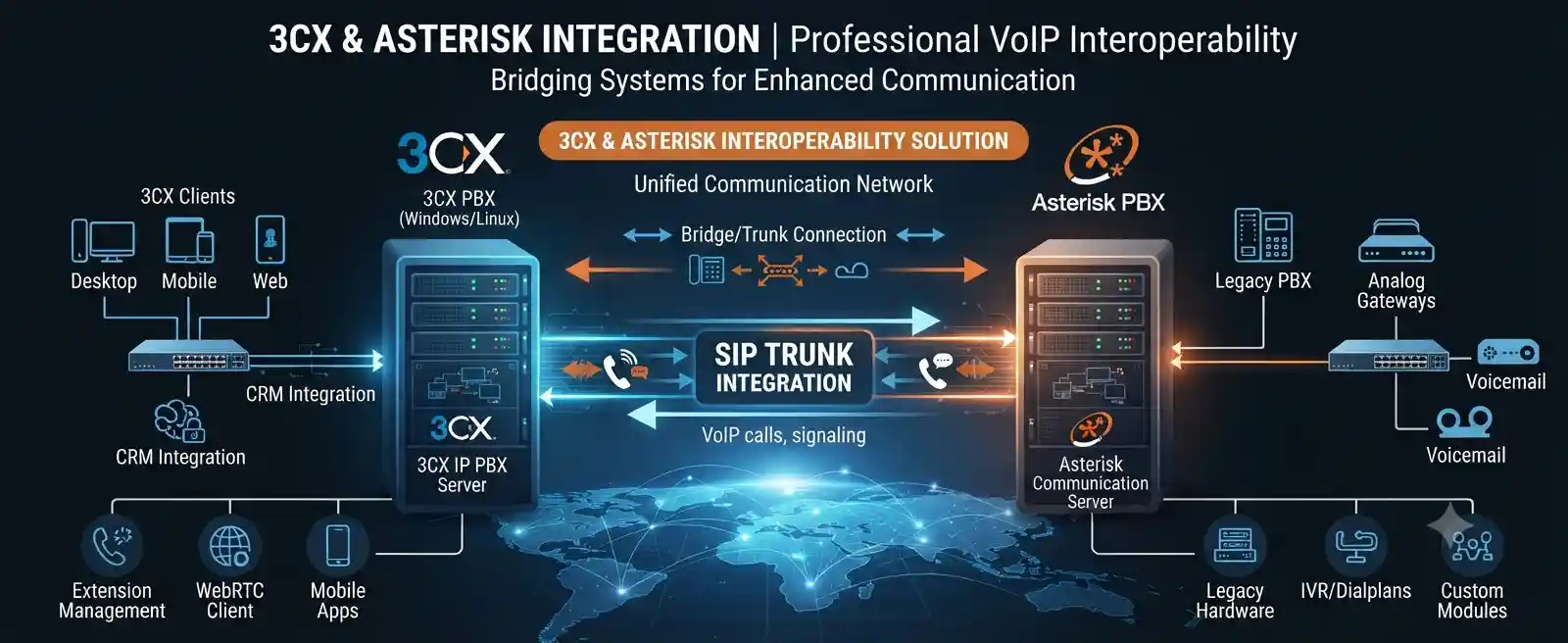
What does 3CX and Asterisk integration mean?
It means designing a controlled telephony relationship between a 3CX environment and an Asterisk-based PBX so selected calls can be routed between them for an agreed business purpose. That purpose may be a staged migration, branch interconnection, continued use of an Asterisk application, extension-to-extension calling, controlled access to a legacy dialplan, or consolidation of external calling. The exact method is environment dependent. Before work is confirmed, the customer should identify the current 3CX deployment, Asterisk version, extension and DID ranges, call routes that must be preserved, network path, firewall policy, available administrator access, backup status, and any third-party carrier or gateway dependencies. The integration should be assessed as a change project because signalling, media, authentication, number formatting and feature behaviour can differ between systems.
What the integration can cover
Depending on the confirmed scope, assistance may include a SIP connection between the systems, inter-PBX extension routing, DID or trunk handoff, number translation, outbound-routing logic, codec alignment, DTMF behaviour, firewall and NAT review, caller-ID handling, call-path testing, migration sequencing and technical documentation.
The design should be based on the business call flow rather than on an assumption that every 3CX or Asterisk feature must be mirrored across both platforms. Some functions are local to the PBX that owns them, and custom feature transparency may not be possible across an interoperability link.
Who may need this service
This service can suit organisations moving users from Asterisk to 3CX in stages, businesses keeping an Asterisk application or custom dialplan while introducing 3CX, multi-site environments with different PBXs, or teams that must preserve existing numbering during a transition.
It may also help when a business inherits a mixed telephony estate and needs a structured path to simplify it. Suitability depends on current versions, access, network design, licensing, carrier arrangements, call volumes and the features that must work across the boundary.
Why businesses consider linking 3CX with Asterisk
A mixed PBX environment usually exists for a reason. An older Asterisk server may still host a custom IVR, a specialised dialplan, a connection to legacy telephony hardware, or an application that the business is not ready to replace. At the same time, 3CX may be introduced for a new office, a new group of users, a planned migration, remote-working requirements, or a wider communications refresh. Integration creates a bridge between the old and new environments while the business decides what should remain, what should move, and what can be retired.
Other projects begin with an operational symptom rather than a migration plan. Users may be unable to call extensions on the other PBX, calls may connect with one-way audio, DTMF selections may not be recognised, caller identity may arrive in the wrong format, transferred calls may fail, or inbound calls may reach one platform but not the destination on the second. These symptoms do not prove one cause. The fault may sit in SIP signalling, the dialplan, firewall policy, NAT, codec negotiation, RTP routing, number manipulation, authentication, a carrier rule, or a routing decision on either PBX.
A useful assessment therefore starts with the required call journey. For example: a 3CX extension needs to dial an Asterisk extension, a selected Asterisk DID must terminate on 3CX, or Asterisk should pass only a defined set of destinations to 3CX. Once that objective is clear, the technical path can be evaluated without creating unnecessary routes or exposing services that do not need to communicate.
Common integration triggers and symptoms
Staged PBX migration
Only some departments are moving to 3CX, while other users, call queues or applications remain on Asterisk during the transition.
Extension reachability
Users on one platform need predictable short-code or full-number calling to users hosted on the other platform.
Legacy application retention
A custom Asterisk service, announcement, IVR, recorder, gateway or application must remain available while the rest of telephony changes.
Call-routing separation
Different sites or teams use different PBXs but need agreed routes between them without changing every endpoint immediately.
Intermittent audio
Calls establish but audio works in only one direction, fails after transfer, or behaves differently for internal and external destinations.
Number-format mismatch
One PBX sends extensions, DIDs or caller IDs in a format that the other system’s routing rules do not expect.
DTMF or IVR failure
Calls connect, but keypad selections are not reliably understood by menus or applications reached across the SIP path.
Unclear PBX ownership
Nobody is certain which platform should own the trunk, DID, queue, voicemail, routing rule or outbound policy after earlier changes.
Business impact of an unmanaged PBX link
A telephony integration can appear to work during a basic test yet still fail under real operating conditions. A route may accept one extension range but reject another. Media may pass for local calls but fail after a transfer. Caller ID may be altered twice. A firewall may permit signalling while blocking the negotiated RTP range. Duplicate rules can send calls in loops. A broad route may also expose destinations that were never meant to be reachable from the second PBX.
The business consequences can include missed customer calls, staff unable to reach colleagues, inconsistent caller identity, failed IVR choices, confusion during support incidents, difficult fault isolation and greater dependency on undocumented settings. Controlled integration reduces this uncertainty by defining the call path, limiting the route to what is required, testing realistic scenarios and recording who owns each part of the service.
Possible FourTeck service scope
The final service scope depends on the existing configuration, authorised access, business objective and quotation. Depending on what is confirmed, FourTeck assistance may include the following areas.
Current-state discovery
Review the role of each PBX, extension ranges, DIDs, trunks, gateways, call queues, IVRs, custom Asterisk applications, network position and existing cross-system routes.
SIP interoperability planning
Identify the signalling method, addressing, authentication approach, transport, call direction, codec expectations, DTMF handling and media path required for the agreed use case.
Dial-plan and number mapping
Map extension ranges and public numbers, avoid overlaps, define prefixes where needed, and determine how caller and called numbers should be presented between systems.
Firewall and network review
Check permitted source and destination paths, NAT considerations, routing, DNS where applicable, VLANs, QoS considerations and the media path without broadly opening unnecessary services.
Controlled configuration
Back up relevant settings where practical, prepare a change plan, apply approved PBX and network changes, and retain a rollback path for changes that affect live calling.
Testing and handover
Validate inbound and outbound scenarios, extension calling, caller identity, audio, DTMF, transfers and agreed failure cases, then document the final routing and remaining dependencies.
Service-fit matrix
| Business situation | Relevant assistance | What must be confirmed |
|---|---|---|
| Moving departments from Asterisk to 3CX in stages | Temporary inter-PBX routing, number plan, migration sequencing and test plan | User groups, extension ownership, DIDs, downtime tolerance and target migration order |
| Keeping a custom Asterisk application | Restricted routing to the required application or destination | Exact call flow, SIP behaviour, application dependencies and security boundaries |
| Two sites use different PBXs | Extension reachability and selected inter-site call routing | WAN or internet path, addressing, overlapping extensions, firewall rules and call volumes |
| Calls connect but audio or DTMF fails | Signalling capture, media-path checks, codec and DTMF review | Reproducible test calls, timestamps, affected destinations and network access |
| Consolidating external trunks | Call-route planning and phased handoff between systems | Carrier requirements, supported trunk design, number ownership and fallback path |
Service information for planning
| Service topic | 3CX and Asterisk interoperability, routing, migration and troubleshooting assistance |
|---|---|
| Typical systems involved | 3CX PBX, Asterisk PBX, SIP trunks or peer connections, IP network, firewall, gateways, DIDs, extensions and business call applications |
| Assessment method | Configuration review, call-flow mapping, access validation, log or signalling review, controlled test calls and network checks |
| Remote support suitability | Often suitable for configuration, logs and call testing when secure access and a working network path are available |
| On-site support suitability | May be required for gateways, cabling, physical appliances, local network faults, firewall access, cutover coordination or multi-party testing |
| Customer access required | Authorised administrative access to relevant systems and network components; credentials should be shared only through an approved secure method |
| Backup considerations | Relevant configuration backups and a workable rollback approach should be confirmed before live changes where practical |
| Security considerations | Limit SIP exposure, validate trusted peers, use appropriate authentication and transport options, and avoid unnecessary public reachability |
| Scheduling dependency | Environment dependent; production changes may require a maintenance window and user coordination |
| Quotation requirement | Scope dependent. Contact FourTeck to confirm assessment, configuration, testing, travel and third-party coordination requirements. |
Remote support versus on-site integration work
When remote work may be practical
Remote assistance can be efficient when both PBXs are reachable through an authorised secure method, the internet connection is working, administrators can provide the required access, and the task is mainly configuration, routing, log review or call testing. It can also be useful during discovery because screenshots, exports, version information, trunk definitions and dial-plan summaries can be reviewed before a maintenance window is arranged.
Remote access does not remove the need for control. The responsible customer contact should approve the change scope, backups should be available where appropriate, and test calls should be coordinated with users who can confirm the real business result.
When an on-site visit may be better
On-site support may be recommended when the integration depends on a local voice gateway, physical PBX appliance, cabling, rack equipment, switch ports, firewall access, analogue interfaces or a network path that cannot be verified remotely. It can also help during a coordinated cutover where several departments, reception staff or branch contacts must test calls at the same time.
Attendance and timing depend on location, access, site conditions, engineer scheduling, the approved quotation and any third-party provider involvement. An on-site visit should be planned around the work that actually requires physical presence rather than used as a substitute for preparation.
How the assessment and discovery process can work
A reliable integration starts with a clear picture of the current environment. That is especially important with Asterisk because the platform may contain custom dialplans, modules or application logic that are unique to the business. 3CX also has version, deployment and trunk-support considerations that should be checked before treating another PBX as though it were a standard carrier service.
- Define the business outcome. Confirm exactly what users need to achieve. Examples include dialling extensions across systems, sending selected DIDs to the other PBX, retaining an Asterisk IVR during migration, or allowing a branch to reach a central 3CX environment.
- Identify affected users, numbers and locations. Record the extension ranges, public numbers, departments, queues, reception workflows and sites that participate in the call path. This prevents broad rules from being created when only a limited set is required.
- Inventory both PBX environments. Capture the relevant 3CX deployment information, Asterisk version, SIP channel driver, key dial-plan contexts, trunks, gateways, external addresses, internal subnets and any high-availability or virtualisation dependencies.
- Review recent changes and known symptoms. If the integration already exists, gather the time problems began, examples of failed numbers, SIP error messages, call timestamps, packet-path information and whether the issue affects all calls or only certain routes.
- Check access, backup and authorisation. Confirm who approves changes, whether the current configuration is backed up, whether rollback is practical, and how secure administrative access will be provided. Public pages should never request passwords; access details should be exchanged through an approved secure method after identity and authorisation are established.
- Map signalling and media. Identify the IP or FQDN destinations, SIP transport, port policy, NAT boundaries, firewall rules and expected RTP media path. Signalling can succeed while audio fails, so both paths need to be understood.
- Compare SIP behaviour. Review authentication expectations, endpoint identification, codec lists, DTMF method, caller-ID presentation, number formats, diversion information, transfer behaviour and other headers that matter to the required call flows.
- Check route ownership. Decide which PBX is authoritative for each extension range, DID, outbound route, queue, IVR and external trunk. Ambiguous ownership can create loops or make troubleshooting unnecessarily difficult.
- Test a small, controlled scenario. Where appropriate, validate one restricted route before enabling wider traffic. A pilot reduces the number of variables and provides evidence for any required adjustments.
- Document findings and scope. Separate confirmed issues from assumptions, note third-party dependencies, list the changes needed, identify testing responsibilities and prepare the work for approval or quotation.
Planning and implementing the SIP connection
Asterisk currently uses PJSIP as its standard SIP channel driver for modern deployments, while older systems may still contain legacy configuration. That matters because the authentication, endpoint identification and transport configuration available to the engineer depend on the Asterisk release and how the existing PBX was built. On the 3CX side, current documentation places strong emphasis on supported SIP trunk providers; a PBX-to-PBX link therefore needs to be evaluated carefully as a custom interoperability requirement rather than assumed to have the same vendor support position as a listed carrier trunk.
Implementation normally begins by choosing the narrowest practical route between the systems. A business that only needs 3CX users to reach 2xxx extensions on Asterisk should not automatically expose every Asterisk context or public route. Likewise, if Asterisk only needs to pass a defined group of DIDs to 3CX, the receiving route can be constrained to those numbers. Smaller, explicit routes are easier to test, document and secure.
Numbering must be considered before configuration. An overlap such as 2000-2099 existing on both PBXs can make short-code routing ambiguous. The project may require a prefix, a temporary translation rule, a renumbering plan, or a decision that one side will use full-number dialling during migration. The same principle applies to public DIDs and caller ID: each system should know the format it receives and the format it must send onward. Rewriting the same number on both systems can produce unexpected results, so transformations should have clear ownership.
Media and signalling also need separate attention. SIP messages establish and manage the call, while RTP or SRTP normally carries the audio. A firewall can permit SIP but still block media, causing one-way or no audio. NAT can also cause private addresses to be advertised incorrectly if the systems or network edge are not configured consistently. Where TLS or SRTP is required, both sides and the chosen design must support compatible operation; encryption should not be enabled on one side by assumption because negotiation failure can prevent calls from completing.
Codec selection should reflect interoperability and network needs. Asterisk can be configured with explicit codec preferences on an endpoint, and 3CX also applies codec policy through its trunk and PBX configuration. The integration should use only codecs that both sides can negotiate for the target calls. Transcoding can increase processing requirements and may affect quality, so it should be understood rather than introduced accidentally. DTMF handling also deserves a specific test because an IVR can appear healthy until users press keypad digits.
Firewall rules should be specific to the approved path. Broadly exposing SIP services to the internet increases unnecessary attack surface and can attract registration attempts or scanning. Where public connectivity is unavoidable, source restrictions, secure authentication, appropriate transport options and monitoring should be considered according to the environment. If the PBXs communicate through a private routed network or VPN, the design still needs to account for latency, path changes, QoS and failure behaviour.
Once the technical design is approved, changes should be applied in a controlled sequence. Where the live environment permits it, a configuration backup should be taken, a maintenance window agreed, pilot routes enabled first, and a rollback point retained. The customer should know which calls may be affected during testing and who will validate the user experience. A change is not complete merely because both PBXs show a configured trunk; it is complete when the agreed call flows operate as intended and the result has been recorded.
Testing, validation and handover
Testing should reflect the business workflow, not only a single call in each direction. A staged migration may need internal extension calls, external inbound calls, external outbound calls, transfers between PBXs, calls to a queue, calls to an IVR, DTMF input, caller-ID display, voicemail routing and selected failure cases. If only some of these features are in scope, the test plan should say so clearly.
Signalling validation
Confirm the expected SIP response, route match, authentication or peer recognition, calling number, called number and correct destination on the receiving PBX.
Media validation
Confirm two-way audio for representative calls and check that transfers, hold or re-invite behaviour do not unexpectedly break the media path.
Feature validation
Test only the cross-platform features the business actually requires, such as DTMF to an IVR, caller ID, transfer destinations or specific hunt-group access.
Handover record
Document route ownership, addressing, number transformations, dependencies, test results, remaining limitations and the contact path for any carrier or third-party system.
Handover should also clarify what happens next. If the link is temporary, the migration plan should state the condition for retiring it. If the link will remain, the business should know which PBX logs to check first, who maintains each side, and which changes require coordinated testing. A successful commissioning test does not remove the need for ongoing monitoring, backups and maintenance.
Capability 1: clearer routing between two different PBX environments
The first operational benefit of a well-planned integration is clarity. Users should not need to understand which PBX hosts a colleague or service before making a normal business call. The route can be designed so that an agreed extension range, prefix or public number is directed to the correct platform. This becomes particularly useful during a phased migration, when departments move at different times and the numbering plan must continue to work while both systems remain active.
Clear routing also helps support teams. If Asterisk is responsible for one range and 3CX for another, a fault can be traced against a defined boundary. Logs can show whether the originating PBX sent the call, whether the receiving PBX accepted it, and where the destination logic continued. Without that boundary, engineers may spend time searching two systems for a route that was never formally owned by either.
The limitation is that routing simplicity depends on a clean number plan. Overlapping extensions, duplicated outbound prefixes, historical rewrites and multiple gateways can complicate the design. FourTeck can help map these dependencies and propose a practical route, but renumbering or workflow change may sometimes be preferable to layers of translation that are difficult to maintain.
Capability 2: safer staged migration instead of a single cutover
Some organisations cannot move every phone, queue, application and telephone number in one change window. A controlled interconnection can create a transition period in which the new 3CX environment serves selected users while Asterisk continues to run workloads that have not yet moved. This can reduce project pressure because the migration can be separated into manageable groups, with each group tested before the next one is changed.
A staged approach is most useful when the exit criteria are defined. The project should identify which users move first, which DIDs follow them, what remains on Asterisk, what dependency blocks the next stage, and how calls are routed during each phase. Otherwise the temporary bridge can become permanent by accident, leaving the business with two PBXs, duplicate administration and unclear responsibility long after the migration was supposed to finish.
Migration safety still depends on backups, compatibility, carrier coordination, user communication and a rollback plan. No integration can guarantee zero downtime or preserve every legacy behaviour unchanged. Custom Asterisk applications, old phones, gateways or unusual SIP features may require separate testing or redesign before they can be moved or retired.
Capability 3: better fault isolation across signalling, media and network layers
A PBX integration introduces several technical layers, and the same user symptom can originate in different places. A failed call might be a missing outbound rule on 3CX, an unmatched context on Asterisk, a rejected SIP request, a number-format mismatch, a firewall block or a route pointing to the wrong address. One-way audio may have nothing to do with the dialplan and instead reflect NAT or RTP routing. DTMF failure may appear only when a call reaches an IVR.
A structured diagnostic method separates these layers. First confirm whether the call leaves the source PBX. Then check whether the destination PBX receives and accepts it. Next verify the chosen destination and the media negotiation. Finally, compare what the user experienced with what the systems recorded. This reduces guesswork and helps determine whether FourTeck, the customer, a carrier, an internet provider or another vendor owns the next action.
Evidence matters. Useful information includes timestamps, source and destination numbers, whether the call was inbound or outbound, the point at which it failed, relevant SIP response codes, and whether the same route works for another user. Diagnosis depends on access and available logs; an isolated screenshot may be helpful, but it does not always show the complete call path.
Dependencies, access and customer inputs
A 3CX and Asterisk project depends on information that may be held by different people. The telecom provider may own the SIP trunk details, the internal IT team may manage the firewall, a previous vendor may know the Asterisk dialplan, and the office manager may understand the real reception workflow better than anyone else. Bringing these inputs together early can prevent repeated changes.
Customers may need to provide the service location, responsible contact, affected user groups, 3CX deployment details, Asterisk version, network addressing, extension ranges, DIDs, call-flow diagrams if available, recent configuration changes, firewall ownership, carrier information, gateway details, backup status and an approved maintenance window. If a custom Asterisk application is involved, the engineer may also need a description of what triggers it and what it returns to the call flow.
Administrative access should be authorised and shared securely after identity and permissions are confirmed. Passwords, API keys, private keys or other secrets should not be placed in public tickets, visible page comments or unsecured email chains. If the customer cannot provide access to a required system, FourTeck may still assist with assessment, but the exact diagnosis or implementation may be limited until the responsible vendor or administrator participates.
Risks, limitations and exclusions to understand
- Vendor support position: a direct PBX-to-PBX design may not have the same vendor support status as a listed SIP trunk provider. The exact 3CX version and deployment model should be checked before the design is approved.
- Feature transparency: connecting two SIP systems does not guarantee that every local PBX feature, presence state, voicemail function, transfer method, recording feature or proprietary application will work across the boundary.
- Legacy Asterisk configuration: older systems may use deprecated SIP components or custom modules. Modern Asterisk releases use PJSIP as the standard SIP driver, so upgrade or migration considerations may affect the scope.
- Network dependency: internet, WAN, VPN, routing, firewall, NAT and DNS conditions can affect call establishment and audio independently of the PBX configuration.
- Third-party dependency: a carrier, ISP, hosting provider, firewall vendor, legacy PBX supplier or application developer may need to make or approve changes outside FourTeck’s direct control.
- Change risk: live routing modifications can affect inbound and outbound calling. Maintenance windows, backups and rollback planning should be used where the environment requires them.
- Security: tighter ACLs, authentication and encrypted transport can reduce risk but do not guarantee complete protection. Unnecessary public exposure should be avoided.
- Commercial scope: licensing, carrier charges, replacement hardware, third-party subscriptions, travel and work outside the approved quotation are not automatically included.
Business environments where this integration may be useful
Professional offices often encounter this requirement during a PBX refresh because departments move at different speeds. Reception and customer-service teams may need uninterrupted public numbers while back-office users are migrated. A temporary route between 3CX and Asterisk can preserve reachability while the change is staged and tested.
Warehouses and logistics operations may retain Asterisk connections to paging, gates, analogue gateways or operational applications while introducing 3CX for administrative staff. In this case the integration should be narrow and clearly documented because a specialist operational endpoint may behave differently from a normal user extension.
Retail, hospitality and multi-branch businesses may have acquired different PBX platforms over time. A routing project can help selected locations reach a common extension plan or transition gradually toward one platform. The WAN path, site bandwidth, local firewall policy and failure handling become particularly important when calls cross locations.
Clinics, schools, training centres and other organisations with front-desk workflows can also benefit from staged telephony change, but the project should respect operational hours, call handling priorities, privacy requirements and local responsibilities. FourTeck can help translate the business workflow into a technical scope without assuming that the same design suits every site.
Operational, security and maintenance considerations
The integration should remain understandable after the original project is finished. That means naming trunks and routes clearly, recording address and number-plan decisions, noting any transformations, identifying the maintenance owner for each PBX and preserving enough information for another administrator to diagnose a future problem. A configuration that works but cannot be explained is difficult to support safely.
Security should focus on least necessary exposure. If the PBXs communicate across a public path, the design should restrict which sources can reach the service where possible, use suitable authentication, consider supported encrypted transport options, and avoid publishing administrative interfaces unnecessarily. If the path uses a private WAN or VPN, the business should still control who can route to each PBX and monitor for unexpected traffic.
Maintenance also includes version planning. Asterisk evolves over time, and modern releases use PJSIP rather than the removed legacy chan_sip driver. 3CX releases can also change supported deployment or trunk requirements. Before upgrading either platform, the interconnection should be included in the change assessment so that authentication, transport, codec and routing assumptions are revalidated.
Finally, backup and restore procedures should include the configuration that makes the systems interoperate. A PBX restore to an older state, a firewall replacement, a public IP change or a cloud migration can break a previously working path. Documentation should therefore cover not only the PBX settings but also the network and provider dependencies needed to recreate the service.
Before you contact FourTeck
Preparing the following information can make the first assessment more useful. You do not need to publish credentials or secret keys; those should be provided only through an approved secure method if they are required after authorisation.
- Main office or service location and a local contact person
- Business objective for linking 3CX and Asterisk
- Which PBX currently receives the public telephone numbers
- 3CX deployment type and current version information
- Asterisk version and whether PJSIP is already in use
- Extension ranges on both systems and any overlap
- DIDs, prefixes or routes that must cross between PBXs
- Examples of failed calls with source, destination and approximate time
- Known SIP error messages, screenshots or relevant logs
- Firewall, public IP, VPN or private routing information
- Carrier, SIP provider or gateway involved in the call path
- Custom Asterisk IVR, application or dialplan dependencies
- Availability of current configuration backups
- Who can authorise PBX and firewall changes
- Preferred remote or on-site support method
- Business impact and acceptable maintenance window for testing
Service evaluation and quotation checklist
A quotation should reflect the confirmed environment rather than a generic integration label. FourTeck may use the following points to define the engagement:
How FourTeck can assist with the integration
FourTeck can help turn a mixed telephony requirement into a defined support or project scope. The first task is to clarify the business call flow and identify which system owns each destination. From there, the assessment can cover SIP settings, dial-plan logic, network paths, firewall requirements, codecs, DTMF, caller identity, migration dependencies and the testing needed before the change is accepted.
Where the issue is already live, FourTeck can assist with troubleshooting by correlating user symptoms with PBX logs, call timestamps and network behaviour. Where the project is new, assistance can include discovery, design review, controlled configuration, cutover planning, validation and documentation. If a telecom provider, hosting company or another specialist must make a change, FourTeck can help organise the technical information needed for that coordination.
For wider environment support, customers can review FourTeck IT support in the UAE, read about the company’s service approach on the FourTeck IT Services overview, or use the contact page to request an assessment. The final scope is confirmed after the current environment, access and required outcome are understood.
Dubai and UAE service coordination
For businesses in Dubai and across the UAE, 3CX and Asterisk integration may be assessed remotely, on site, or through a combination of both methods. Remote work is often useful for configuration review, logs, call-flow mapping and planned changes when authorised access is available. An on-site visit may be recommended when the project involves local gateways, cabling, firewall appliances, rack equipment, branch network troubleshooting or coordinated user testing.
Service timing depends on engineer availability, customer access, site conditions, maintenance windows, required equipment and any third-party provider action. Installation, configuration, migration and troubleshooting tasks should be listed in the approved quotation so both sides know what is included before live changes begin.
Coverage for Dubai, Abu Dhabi, Sharjah and Ajman
FourTeck can coordinate telephony assessment and project support for businesses in Dubai, Abu Dhabi, Sharjah and Ajman, subject to the confirmed scope and scheduling. A multi-site company may begin with remote discovery across all PBXs and then schedule on-site work only at locations where physical inspection or local cutover support is necessary. This can be useful when different branches have different firewalls, gateways, numbering plans or local service providers.
Travel, building access, site conditions, equipment availability, branch operating hours and third-party dependencies can affect the service plan. The objective is to match the support method to the actual technical requirement rather than assume the same visit pattern for every location.
Related FourTeck IT services
PBX integration often touches more than the telephone servers themselves. The following service areas may be relevant depending on what the assessment finds.
PBX and IP telephony support
Routing, extension, trunk, gateway and call-quality issues within the wider business voice environment.
Network support
LAN, VLAN, routing, WAN and connectivity checks where voice traffic depends on the data network.
Firewall and VPN support
Controlled network access, private inter-site paths and troubleshooting where SIP or RTP is affected by security policy.
Migration support
Staged user moves, dependency mapping, test plans, rollback preparation and post-change validation.
Why businesses contact FourTeck for mixed telephony environments
A 3CX and Asterisk integration sits at the boundary between applications, network infrastructure and business workflow. A change on one PBX may appear correct while the receiving system, firewall or carrier interprets it differently. FourTeck approaches the issue as an end-to-end call path: who starts the call, which route is selected, what signalling crosses the network, where audio should flow, which system owns the destination, and how the result is confirmed by the user.
This approach is useful for organisations that want a clear initial assessment, controlled configuration changes, remote and on-site coordination, vendor communication and practical documentation. It also helps managers understand which parts are known, which are still assumptions, which dependencies belong to third parties and what must be approved before implementation.
The goal is not to force two platforms together at any cost. In some environments, integration is the right transition tool. In others, simplifying the numbering plan, replacing a legacy gateway or completing a migration may be more maintainable. FourTeck can help evaluate those trade-offs and prepare a scope that fits the actual business requirement.
Frequently asked questions
Can 3CX and Asterisk be connected directly?
They may be able to exchange calls through SIP-based interoperability, but the exact design depends on the 3CX deployment and support position, the Asterisk version, authentication method, network path and required features. The connection should be assessed before configuration is approved.
Is this the same as adding a normal SIP provider to 3CX?
Not necessarily. 3CX publishes guidance for supported and generic SIP trunk providers, while another PBX can behave differently from a carrier service. A PBX-to-PBX link should therefore be treated as a custom interoperability requirement and tested against the current environment.
Can users keep their existing extension numbers during migration?
Often this can be planned, but it depends on whether extension ranges overlap and which PBX owns each number during each migration stage. Temporary prefixes or translations may be needed if both systems currently use the same numbers.
Can the integration be configured remotely?
Remote work can be suitable when secure administrative access is authorised and the required systems and network path are reachable. Physical gateways, cabling, firewall appliances or local network faults may require on-site assistance.
Why do calls connect with one-way audio?
One-way audio can result from several layers, including NAT, firewall rules, RTP routing, advertised addresses, codec negotiation or path asymmetry. The symptom alone does not identify the cause, so signalling and media should be checked separately.
Can DTMF and IVR menus work across the integration?
They can work when both sides use compatible DTMF handling and the call path preserves it correctly. DTMF should be tested explicitly because a call may have good audio while keypad selections still fail at an IVR.
Do we need a maintenance window?
A maintenance window may be appropriate when changes affect live routes, trunks, firewall rules or external numbers. The requirement depends on the current environment, rollback options and business impact. FourTeck can help define the change sequence before implementation.
What information is most useful for troubleshooting an existing link?
Provide representative source and destination numbers, approximate call times, whether the issue is inbound or outbound, screenshots or SIP errors if available, recent changes, affected sites and confirmation of which system currently owns the route.
Can FourTeck coordinate with our SIP carrier or existing PBX vendor?
Coordination can be included when it is part of the confirmed scope. Third-party providers may need to change authentication, routing, number presentation, public IP records or other settings that FourTeck cannot control directly.
Will every 3CX and Asterisk feature work across the connection?
No assumption should be made that every feature will pass between systems. Basic call routing may be practical while presence, proprietary features, complex transfers, voicemail integration or custom applications require separate validation or may remain local to one PBX.
Can this be used as a permanent inter-site design?
Possibly, if the business need, network path, security model, supportability and maintenance ownership justify it. A long-term design should be documented and reviewed during upgrades so it does not become an unmanaged dependency.
How is the quotation prepared?
The quotation depends on discovery results, number of systems and sites, remote or on-site requirements, network and vendor dependencies, configuration work, testing, documentation and any migration or cutover activity. Contact FourTeck to confirm the service scope.
Plan the integration around your real call flow
If 3CX and Asterisk must coexist, migrate in stages or exchange selected calls, FourTeck can review the current environment, identify dependencies and prepare a controlled configuration and testing scope. The exact method depends on access, versions, network design, required features and third-party services.